I picked the book up, put it on the table without really looking at it, and left, assuming that maybe one of Sophie's friends left it for her. When I got back from work though, Sophie confronted me, mystified, saying the book was perfect, just the thing since we'd been talking about reading bedtime stories to each other. I had to swear several times (and she still doesn't quite believe me) that I had nothing to do with the book's appearance. Talking it over, we realized that only a handful of people know where we live, and of those only one or two might have left the book, but with no note? And it's highly unlikely our crazy neighbors would have had anything to do with it. Very mysterious indeed, as if the Universe had wanted us to have a good befuddlement before bed.
7.30.2008
Bedtime Stories from the Universe
Today on my way out to work, I found a book in our doorway, no package, no note. "The Miraculous Journey of Edward Tulane," by Kate DiCamillo, which looks to be a dark, modern "Velveteen Rabbit," with gorgeous illustrations by Bagram Ibatoulline.
I picked the book up, put it on the table without really looking at it, and left, assuming that maybe one of Sophie's friends left it for her. When I got back from work though, Sophie confronted me, mystified, saying the book was perfect, just the thing since we'd been talking about reading bedtime stories to each other. I had to swear several times (and she still doesn't quite believe me) that I had nothing to do with the book's appearance. Talking it over, we realized that only a handful of people know where we live, and of those only one or two might have left the book, but with no note? And it's highly unlikely our crazy neighbors would have had anything to do with it. Very mysterious indeed, as if the Universe had wanted us to have a good befuddlement before bed.
7.29.2008
Quick Update
Some goodies to tide you over until an upcoming, larger post...
A new issue of Arthur Magazine, featuring an excerpt from Alejandro Jodorowski's new book! (downloadable PDF)
And the Uysal-Walker Archive of Turkish Oral Narrative, which should be an interesting read (when I ever get the free time), as I am currently reading the Richard Burton translation of the "Tales of the Arabian Nights," and though there are certain trends that can be traced through folklore at an international level, many of the stories Westerners are familiar with are descended from a smaller group of Germanic/ Jewish stories.
Coming soon... the anarcho-mystical "Anamnesis" (when I can figure out how to make a PDF from a bunch of images of different sizes).
And the Uysal-Walker Archive of Turkish Oral Narrative, which should be an interesting read (when I ever get the free time), as I am currently reading the Richard Burton translation of the "Tales of the Arabian Nights," and though there are certain trends that can be traced through folklore at an international level, many of the stories Westerners are familiar with are descended from a smaller group of Germanic/ Jewish stories.
Coming soon... the anarcho-mystical "Anamnesis" (when I can figure out how to make a PDF from a bunch of images of different sizes).
Labels:
Crimethinc,
culture,
inspiration,
Jodorowsky,
literature
7.23.2008
Bah Humbug
"Steampunking, with its commerce driven, faddish re-skinning of their own history, is closer to Disney than punk or sci-fi. A laptop styled like a Eastlake sideboard is merely a threat of bad taste, not a threatening reaction to massive social and economic disenfranchisement. In its essence Steampunk seems suburban in its attitude: nostalgic for an imagined, non-existent past, politically quietist, and culturally insular hidden behind cul-de-sacs of carefully styled anachronisms that let in no chaos or ferment. The larger, more impossible questions are missing. How would the Victorian imagination conceive and execute a functioning computer? The answer must be more interesting than adding wood veneers to your laptop or turning a mouse into a contraption of gears that looks more like a medieval torture device.

"I haven’t figured out whether cracking open your computer, attaching it to an Underwood typewriter, then inserting it into a combination Victorian mantel clock/desk and calling it “The Nagy Magical-Movable-Type Pixello-Dynamotronic Computational Engine” is some sort of daft wit or evidence of a pedantry bordering on the pathological. "
from design writer Randy Nakamura's "Steampunk'd, Or Humbug by Design"
"I haven’t figured out whether cracking open your computer, attaching it to an Underwood typewriter, then inserting it into a combination Victorian mantel clock/desk and calling it “The Nagy Magical-Movable-Type Pixello-Dynamotronic Computational Engine” is some sort of daft wit or evidence of a pedantry bordering on the pathological. "
from design writer Randy Nakamura's "Steampunk'd, Or Humbug by Design"
The Logic of Dreams
"What is the logic behind dreams? Is dreaming only a pale imitation of our waking abilities, as some say, or does it represent an entirely different ability? This question has forever shadowed the scientific exploration of dreams.

The question can be summed up as: is dreaming a failure of cognition, a breakdown of logic, and otherwise deficient OR is dreaming an accomplishment of cognition, a creative fire that burns bright inside us, the original inspiration behind art, genius, and even religion?
It’s always been Either/or. Madness versus Creativity. Proto-mammalian gibberish versus Spiritual Ascent.
Thankfully, researcher Don Kuiken from the University of Alberta is questioning this false dualism. His paper at the Montreal Dreams conference was one of my favorites because of its far-reaching implications. Kuiken simply asked, “What if dreaming is both?” Focusing on the anomalies of dreams - those discontinuities of scene, memory, and thought - Kuiken illustrated how dreaming cognition can be seen as a “failure” and an “accomplishment” at the same time."
[via the Dream Studies Portal]
The question can be summed up as: is dreaming a failure of cognition, a breakdown of logic, and otherwise deficient OR is dreaming an accomplishment of cognition, a creative fire that burns bright inside us, the original inspiration behind art, genius, and even religion?
It’s always been Either/or. Madness versus Creativity. Proto-mammalian gibberish versus Spiritual Ascent.
Thankfully, researcher Don Kuiken from the University of Alberta is questioning this false dualism. His paper at the Montreal Dreams conference was one of my favorites because of its far-reaching implications. Kuiken simply asked, “What if dreaming is both?” Focusing on the anomalies of dreams - those discontinuities of scene, memory, and thought - Kuiken illustrated how dreaming cognition can be seen as a “failure” and an “accomplishment” at the same time."
[via the Dream Studies Portal]
The Comic Book of the Dead
The Tibetan Book of the Dead,or Bardo Thodol, a funerary text intended to guide one through the experiences that the consciousness has after death, during the interval between death and the next rebirth, is now presented in easy to read comic book form!

There are two things I find highly interesting about this text. One is that the traditional western depictions of the afterlife, heaven hell, or the layered cake of Dante's "Inferno," are merely distractions from the state of either rebirth or liberation from the entire process, and they are fairly early distractions at that. Of course religions like Catholicism have been known to be fairly self-punishing.

Second, is that this journey through the afterlife, and all its wild "retinal circus" of visions, is highly reminiscent of the dreaming state, particularly when one is asked to realize in the afterlife that all the gods and demons are not only aspects of each other but aspects of one's own projections. In fact this recognition that after-world experiences are similar to the visions of sleep is but an aspect of tibetan dream yoga, where through practices of lucid dreaming and recognizing that all reality is a dream one can learn to wake up and achieve liberation in the "clear light."
There are two things I find highly interesting about this text. One is that the traditional western depictions of the afterlife, heaven hell, or the layered cake of Dante's "Inferno," are merely distractions from the state of either rebirth or liberation from the entire process, and they are fairly early distractions at that. Of course religions like Catholicism have been known to be fairly self-punishing.
Second, is that this journey through the afterlife, and all its wild "retinal circus" of visions, is highly reminiscent of the dreaming state, particularly when one is asked to realize in the afterlife that all the gods and demons are not only aspects of each other but aspects of one's own projections. In fact this recognition that after-world experiences are similar to the visions of sleep is but an aspect of tibetan dream yoga, where through practices of lucid dreaming and recognizing that all reality is a dream one can learn to wake up and achieve liberation in the "clear light."
7.21.2008
Rabbi unveils the reversible name and gender of God
"Rabbi Mark Sameth contends in a soon-to-be-published article that the four-letter Hebrew name for God - held by Jewish tradition to be unpronounceable since the year 70 - should actually be read in reverse. When the four letters are flipped, he says, the new name makes the sounds of the Hebrew words for "he" and "she." God thus becomes a dual-gendered deity, bringing together all the male and female energy in the universe, the yin and the yang that have divided the sexes from Adam and Eve to Homer and Marge.
"The Hebrew name of God that is known as the Tetragrammaton - the four letters Yud-Hay-Vov-Hay - appears 6,823 times in the Hebrew Bible. Since early Hebrew script included no vowels, the pronunciation of the name was known by those who heard it. According to Sameth's footnotes, the name was said only by priests after the destruction of the First Temple in 586 BCE. After the destruction of the Second Temple in 70 CE, the name was no longer said and the pronunciation lost.
"Sameth doesn't believe that he has stumbled on a previously unknown understanding of God's name, but that he has been able to connect the dots in a fresh way. Those who find meaning in his work, he said, may encounter a different understanding of God that is comforting to feminists and those on many spiritual journeys. They may also read the Torah differently. "If this interpretation is correct, it says that the Torah is a mystical or esoteric text," he said. "The mystics have been saying all these years that the text conceals more than it reveals. It is structured with different levels of meaning and reveals itself over time. We're talking about one tradition that goes all the way back."
"Sameth has shared his image of a dual-gendered God with the seventh- and eighth-graders he teaches at his synagogue. He said they've been very receptive, which isn't surprising because they are growing up in a post-modern age. "As post-moderns, we've been conditioned to a different relationship with language," he said. "That's why there is all this interest now in Jewish mysticism." He wonders how, 2,000 years from now, people will understand the final chapter of "Ulysses," which includes no punctuation. Will they try to add punctuation, believing that it's been lost? Or will they grasp that James Joyce knew what he was doing? "Joyce was playing with language, using language to play with the medium," Sameth said. "And the Torah isn't just about Noah taking the animals, twosies by twosies. If that's what the Torah was all about, how could it have captivated Western civilization for 3,000 years? There had to be more."
"Sameth doesn't believe that he has stumbled on a previously unknown understanding of God's name, but that he has been able to connect the dots in a fresh way. Those who find meaning in his work, he said, may encounter a different understanding of God that is comforting to feminists and those on many spiritual journeys. They may also read the Torah differently. "If this interpretation is correct, it says that the Torah is a mystical or esoteric text," he said. "The mystics have been saying all these years that the text conceals more than it reveals. It is structured with different levels of meaning and reveals itself over time. We're talking about one tradition that goes all the way back."
7.18.2008
Urban Adventures
Yesterday I took Sophie to see one of the still hidden wonders that haunt the ruins of Pittsburgh's old steel and glass industry- what I like to call the glass burial grounds, but I have also seen called the broken glass path, a hillside overlooking the old Carrie Furnace featuring heaps covered in shards of colorful glass.
While Carrie Furnace has become somewhat of an underground hotspot for urban adventurers in Pittsburgh, mainly due to the artistic construction there of a forty-five foot tall deer head, the nearby trail of glass is almost unheard of, covered by weeds and missing even an iconic name or carefully preserved history:
"In 1885 the W. R. McCloy Glass Works were erected at Rankin Station, on a 5-acre tract of land fronting on the Union Siding of the P. McK. & Y. and B. & O. Railroads, and extending back to the Monongahela river, the property adjoining the ground of the Duquesne Forge on the south. Here one of the first tank furnaces ever built in the Pittsburgh district for making crystal blown glass was constructed. The product chiefly consisted of lantern globes, fruit and candy jars. In the year 1887 The Braddock Glass Company, Ltd. was organized and incorporated, and the capacity of the plant enlarged by the installation of one 10-pot furnace. This company employed about 150 men, and in addition to the former product, also turned out a complete line of lamp chimneys. In March, 1892, the plant was totally destroyed by fire, which is said to have originated from sparks emitted by a passing switching locomotive. The whole country was at that time entering a period of depression, and the works were consequently not rebuilt."
(flickr photos taken by Sophie Klahr)
It's rather fascinating, and otherworldly, to be walking among such kaleidoscopic rubble that has presumably been laying there for over a century! When I was first taken to this magical spot it was much less overgrown, and it seems that over the four years since then much of the glass has been scavenged, though I can only imagine (or hope) that the remaining huge heaps conceal enough colorful treasures to last another century. At the time I had gotten in an argument with the friend who had taken me there over whether or not to not just tell people where this place is, but if it even existed (though of course enough gifts of rainbowed glass were given that it's obvious it had to have come from somewhere). Surely we were not the first to discover it in over a hundred years, and, like the old adventuring spot of the Dixmont mental asylum, demolished several years back to become a Walmart instead of historical ruins, it is unlikely that the glass burial grounds will survive forever. I suppose the issue is that, while it is a beautiful and important landmark that people should know about, it is also one that should be respected (hopefully by someone not up and taking all the glass that's left in one foul scoop).
Labels:
art,
history,
personal narrative,
pittsburgh,
psychogeography
Amusica
Gil Alterovitz, a research fellow at Harvard Medical School, is developing a computer program that translates protein and gene expression into music. In his acoustic translation, harmony represents good health, and discord indicates disease. [via] Using data collected from a study of protein expression in colon cancer, Alterovitz analyzed more than three thousand related proteins involved in the disease. He found four key networks, using various genetic databases that catalog relationships between genes and proteins. He then assigned a note to each network, and together, these notes formed a harmonic chord. He compared the "music" of normal, healthy human data sets to that of the colon-cancer samples and found that, according to his model, colon cancer sounded "inharmonious."

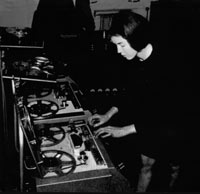
Also, a recently uncovered musical experiment by pioneering electronic musician Delia Derbyshire predicted the sound of modern dance music three decades before it became fashionable. [via]
Subscribe to:
Posts (Atom)