8.29.2009

Review of Tsutsui's Paprika

It's always interesting reading a book after watching (and being a big fan of) its movie version, especially in this case where the book's translation was only finished after the movie came out. Perhaps the main difference in this story about dreams taking over reality through stolen psychotherapy devices is that, unlike in Satoshi Kon's anime, where the more surreal imagery leaps from the screen within the first ten minutes, Tsutsui takes more than half the book for the content of dreams to become manifest. In fact, a quarter of the book passes before the dream detective Paprika enters someone's dream at all. Despite the potential for this to seem really slow, and less interesting than the more frantically paced movie, Paprika the novel actually works best by holding off the potential for surreality to manifest itself, because that allows the author to create a familiar and logical real world first, which is necessary in order to make the weirder elements read as believable. Another interesting twist is that many of the inter-character plot elements held till the end of the movie are given at the novel's beginning, making the story less about finding out how the characters interact but seeing how these interactions change in the face of embodied subconscious impulses.

As someone who has spent a lot of time working with my own dreams in a narrative context, it was interesting seeing some of the ideas that Tsutsui uses for his dream detective's dream interpretation methods, such as having dream characters really represent other people from our memories, which I find a little too simplifying with how dreams actually seem to work, but was necessary for the novel's cohesion. One unique concept is that of "dreason," which opposed to the reason in dreams that allows us to control our subconscious imagery (the translator should have called this lucidity, but for some reason didn't), dreason is the awareness of where logic falls apart in dreams, which keeps us from accomplishing even the most simple task and eventually wakes us up through being startled by frustration, guilt, etc, an idea that I've come up against in my own dreamwork and have called thwartedness, though I think the term dreason captures the scope of it better, and Tsutsui does a good job of displaying this in action, letting dream scenes and characters morph into each other, startling the dreamers who aren't always quite aware when they are dreaming.

One of the deeper themes of the novel, and a necessary one in talking about dreams vs. reality, is unfortunately not introduced (either directly or indirectly) until near the end of the novel, and I would have liked to see be played out from the beginning, more as it is in the Kon's movie: that goodness and evil (or god and the devil in religious terms), are imaginal constructs that are not opposed to each other but are opposed to the banality of everyday life/ human waking existence, the idea being that such extreme aspects of psyche necessitate each other, and the wilder, surreal parts of life, whether desired or feared, are at odds with life as it is lived on a daily basis. Unfortunately this idea just seems tossed off or unfinished, as the setting of a cutting-edge psychiatric institute is not exactly everyday enough to see the range/ struggle between reality and the dreams. Similarly, there is no resolve: good triumphs over evil as if it was reality triumphing over the dreams, which is certainly a common ending, but it perhaps would have been more interesting, and more in line with some of the Jungian psychology that the book draws on, to have the characters find a balance, a place where both good and evil, dreams and the everyday, could coexist as equally real and important, since humans after all are the ones who created these ideas of psychic extremes in the first place and still must learn what to do with them through our imaginations.

Those critiques aside, this book is fantastic, mesmerizing, and full of so many novel ideas and writing techniques that it is a must read for anyone interested in dreams, science fiction, psychology, and plain human behavior.

8.10.2009

The Alchemical Visions of Alberto Almarza

I've been following the work of my good friend, the CMU graduate and Chilean visionary artist Alberto Almarza, for many years now. This weekend I had the opportunity to attend the first Pittsburgh Visionary Arts Festival, which Alberto organized and showed his work at, including his series of small intricate image boxes. It seems that in preparation for the event, Alberto has finally started putting his work online:


And for those interested in the creation of sacred geometries and hand-made mud flutes Alberto is also blogging lessons from his current Pittsburgh Center for the Arts classes.

8.07.2009

The Rational Fallacy (or, in the future noone can hear you dream)

Several rather unsettling potential futures have been trickling across the aether the past several days: the Semantic Apocalypse (or the evolutionary dead end of human consciousness), the death of free will (as the last grasp of the unenlightened), and what really makes me sad and/or laugh, the need(?) to get out of the narrative fallacy, that our evolutionary ability to make meaning out of sense-events by stringing them into recognizable narratives is perhaps no longer necessary, and from the sound of the article all rational beings ought to immediately stop telling themselves stories. The irony being that these are all stories that speak of both a need for control and meaning, and more so indicate to me some peculiar postmodern desire to no longer be human, to escape from the weird impulses of our bodies and all our non-linear reasons for doing what we do. As if in a fully rational world we can all finally be sterile passionless robots or programs, rows of ones and zeroes doing nothing unexpected, nothing out of bounds, a dystopia predicted long before 1984 in Zamyatin's "We." As if just because the Universe is a mysterious ungraspable place, on the largest and smallest scales, the only way we rational beings can bear its unfathomableness is by killing off our own mysterious uncertain selves. This is a future in which art, magic, even love would no longer be possible, because the rational fallacy seeks to do away with the fact that just as much as we are analytical beings we are also batshit crazy, I mean, that we crave meaning and find value in our lives from novelty and personal experience and not from predictable routines or the scientific rigor mortis of western materialism. What is the point of learning how the Universe works if not to better understand how we exist in it, or could better exist. What is the point of knowing if our knowings don't add up to a larger picture, and who would be looking at the picture? As PK Dick asked, do androids dream of electric sheep? We are still, and hopefully will remain, more than just our neurochemical programs, our biological probabilities.

Besides allowing us to learn how to evade saber tooth tigers, or even get up in the morning, stories always have and continue to serve a vital human function, that of allowing us to express how we are or should be in the world. What this means to us, individually or collectively, and where we are going next. Even prior to ethics or mythological taboos, without a sense of narrative there is literally no future, no reason to believe in the consequences of our current actions. Logic divorced from muthos will not allow us to better exist on earth tomorrow, let alone two minutes from now. Science for science's sake, without a grander story to guide its research and invention, produced the atomic bomb and conditions for global warming (though to be very clear, it was the rather fucked up stories of those in power that allowed such atrocities to happen), and without finding a balance, the solely rational mindset could produce further horrors. If our dreams can't become reality there will cease to be one. This is rather similar to how I see the contemporary atheist movement, cultishly trying to kill the religious impulse when it is impossible to prove or disprove whether or not gods exist, without even trying to understand what purpose they, their worship, and belief in general might still serve in helping people determine how to be in the world and with each other. The greatest irony is that any argument for atheism ultimately relies solely on faith, that there is stubbornly not more on heaven and earth than can ever be dreamed of in our philosophies. Personally I believe that everything is real or has the potential to be real, tangible or intangible, anything ever conceived of, no matter how surreal or unfathomable, exists. As Pablo Picasso put it, "everything we can imagine is real." To believe otherwise is to close your mind, or dare I say soul, to all that is beautiful, marvelous, or deep in what it is to be human, in what it still could mean to be human. This is my fear of arguments for such rational post/trans-humanism: that if we don't learn to accept, or even revel in, all the psychotic, creative, baffling irrationales with which humankind has always struggled, than any transcended intelligent being may find these repressed instincts come back to haunt them more so... assuming we have stories, consciousness, and the will to get us that far first.

8.04.2009

On Aliens as Symbol and Experience

My family has many strange stories, of the kind that Gabriel Garcia Marquez might have written if he was into sci-fi, such as that when they were children both my brother and cousin claimed they were abducted by aliens. While visiting my family this past week we spent some time with this cousin, who I've only met a handful of times before and haven't seen in maybe five years, and Sophie wanted to ask her about being an abductee. I persuaded her not to, because as curious as we both are these stories in my family are all somewhat secret or taboo, often covering for situations that were traumatic or uncomfortable. Even the mere mention of Montana where my cousin grew up was enough to give her the howling fantods, mainly as that's where her family lived in a bunker as part of the Church Universal and Triumphant doomsday cult before the world didn't end and they became normal people again.

Asking my folks about it later gave us a little more information, though they too seemed anxious to change the subject: my cousin woke up one night in the woods far from the bunker (perhaps an alien abduction being more sane than their cult). My brother on the other hand had a much more normal upbringing, but this included a lot of educational struggles and being outcasted at school, which left him with some strange compulsive behaviors that he could only, and adamantly explained as having been abducted. While these situations could be explained as dissociation or social anxieties mixed with hyperactive imaginations, that doesn't account for the small triangular scar that they both have from whatever experience did happen to them. The strange thing was my mother's comments vis-à me.

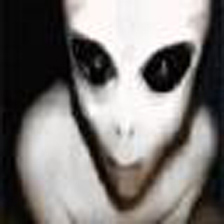
Personally I can recall (and have written of here before) being a kid and being paralyzed with fear of taking out the garbage at night, because I knew that a mothership would descend from the orange sky to get me, perhaps if they hadn't already. Or in the '90s when that pointy-chinned bug-eyed alien face was becoming a pop cultural icon I found it horrifying even to think about (though admittedly I felt that way about spiders and the California Raisins). Before that though when I was really young my mother helped edit the Time-Life Mysteries of the Unknown series on paranormal experiences, having to check sources for the articles. Apparently, though I have no memory of it, we were one day in a bookstore where she picked up Whitley Strieber's book of UFO research, on the cover of which was that iconic grayfaced alien. When I saw it I flipped out, telling her that I had seen those creatures before - that they had come for me in my dreams - which could have all sorts of interpretations but was clearly so terrifying that I completely repressed it, and have only recently begun to allow myself to see and sort through the symbol of the alien in my dreamwork practices. Though thinking back I always wondered or suspected if I'd been abducted, or was myself an alien, because my whole life I have clearly felt different or separated from my fellow human beings.

While I don't know, and refuse to make any claims without further direct experiences, if alien abductions really happen (and suspect these could be the imagination's way of covering up or describing otherwise even more inexplicable experiences), it seems clear that people have many reasons to feel and believe that they have or might be abducted, whether in fear or even desire for such extra-terrestrial intrusion, that has led to aliens becoming a potent symbol in our post-modern age. While often addressed through stereotypes of new-age fanaticism or pop-skepticism, alien beings may still say something vital about what it means or feels like to be human. Mac Tonnies of Posthuman Blues seems to suggest that the image of the gray aliens may be either a projection of our desire to transcend being merely human in this post/trans-human age, or a metaphoric anxiety nightmare left over from the horrors of war and technology from the middle of last century.

I am not quite convinced however that aliens don't also cover an impulse or feeling that is an ancient one for which these are only the most recent and applicable symbol: that of feeling alienated or disconnected from the other. Consider for example Greek legends of people being kidnapped by fauns or waylaid by sirens, Victorian romances in which men become monsters and vampires, or even the Biblical angels, who contain that same longing to transcend our everyday experiences through external salvation (angels being technically depicted as eye-studded revolving spheres that sound more like UFOs than anything else). Looking at my relatives' experiences, they clearly were in extreme situations of alienation, which they only found words for in terms of alien abduction: I don't belong, therefor I must have been removed/transformed. I suffered from the same kind of alienation as a child, feeling that either I didn't belong or that no one else did, a feeling particularly strong as a tenager dealing with understanding one's place in the social spheres, much less the celestial spheres. After trying and failing to fit in I tried not to fit in, and didn't fit in there either, and only found some relief from this anxiety in music and art, listening to Bowie's Ziggy Stardust, his myth of the good alien come to save all the alienated youth certainly allowing me (and I imagine many others) to feel that they did belong, somewhere, even if that was in the distant stars, much like a modern day Ezekial, whose visions of angels the Jews turned to during the alienating reign of Nebuchadnezzar. "Look out your window I can see his light/ If we can sparkle he may land tonight/ Don't tell your poppa or he'll get us locked up in fright."

While children are certainly more inclined to describe or occlude their experiences in imaginistic terms or characters, I suspect this feeling of being alienated may belong to everyone. As rational creatures whose perceptions work through distinction rather than homogenization of experiences, it is no wonder that some of the hardest struggles of history have risen from our perceived human differences. Race, sex, class, customs, gender, age, intelligence, ability, etc, whether arbitrary or not, when taken as the primary signifier and worth of individuals, reduces up to a type or group often at odds with or misunderstood by others outside that group, leading to such bromides as "men are from Mars/ women from Venus," or more real conflicts like the recent racial profiling and arrest of the black professor Gates in his own home (not to mention centuries of national or racial warfare). Orson Scott Card, in his brilliant Ender's Quartet novels sets up the Hierarchy of Exclusion, which seems to operate on a function between familiarity and communicability:

"The Nordic language recognizes four orders of foreignness. The first is the otherlander, or utlanning, the stranger that we recognize as being a human of our world, but of another city or country. The second is the framling... This is the stranger that we recognize as human, but of another world. The third is the raman, the stranger that we recognize as human, but of another species. The fourth is the true alien, the varelse, which includes all the animals, for with them no conversation is possible. They live, but we cannot guess what purposes or causes make them act. They might be intelligent, they might be self-aware, but we cannot know it." -from Speaker for the Dead

Of course, when the other is so foreign to us that we can't communicate, it often ends in direct conflict, or goes further, beyond anything remotely conceivable and thus truly alien. While this final level of total alienness could be interpreted as encounters with the numinous or ineffable - I am partial to the idea that God is the ultimate alien - it also points to our boundaries of knowledge and description, and more directly to the human experience of being bound in an individual consciousness. To some degree we are all alien to each other, and even sometimes to ourselves: this is a limit to our ability to express who we are and what our experiences of the world mean, and the alien may be the mask, the image we refer others to in order to describe what might otherwise be inexplicable, what feels out of this world, much like Freud's idea of the uncanny or un-homelike, except with Earth as Home, we react with fear and wonder to that which is extraordinarily unfamiliar. In an age when we can finally begin to say that we know most of what is on Earth, there is still more, roughly 98% more, in the Heavens than we can fit into our scientific philosophies, dark matter and gravity if not little gray beings (though the truth may still be out there... so might God for all we can prove or disprove).

I occasionally tell people that I'm in support of space exploration, which often (and more often than I'd have hoped in the 21st Century) draws blank or incredulous stares, as if I really am from outer space. As the author of the exceptional Red Mars,Kim Stanley Robinson recently pointed out, in conjunction with the 40th anniversary of the first moon landing, there is still a reason for going to space. Forget interstellar exploration, forget contact with other potentially intelligent life in the universe, forget finding a habitable new home for when this one inevitably wears out, the current resurgence of space programs could be local; by living on other planets in our solar system we might better figure out how to live on and take care of this planet, which is in sore need of better stewardship. Though this may first mean resolving those lingering problems of otherness that still plague and alienate mankind.

Which isn't to say that we can't refamiliarlize ourselves with those who are other from us, a process of dealienazation, which can only begin at home. This was one of the lessons I learned from seeing my family this week, that our secrets are symptomatic of larger miscommunications that lead to conflicts and division the way they do in the larger world, that even though we are all involved in fields of communication (as more and more people are these days), we are still shockingly out of touch from each other, as if E.T. had never extended his finger for contact. But all it sometimes takes is a phone call or a letter, or even just a smile, to make our families familiar to us again, which can equally apply to strangers, enemies, the world. Though we are all aliens lost in space, we are all human on Earth together, one vast estranged family still learning to accept each other and explain what this all might mean. Perhaps one day we'll be able to look up at the stars together, and when we see the occasional peculiar lights zipping around like nothing but unidentifiable objects, we can finally discuss them openly, or just say hello.


8.02.2009

Dreaming without a Dictionary

Ryan Hurd over at Dream Studies is in the middle of a ten-article series on dream interpretation techniques without a dream dictionary, which seems highly useful for more than casual dreamers, as dream dictionaries at best can give you general cultural meanings for symbols, at worst trite new-agey misleadings, and can never give the way symbols are lived for the individual people who experience them (whether in dreams or waking).

This quote from Joseph Campbell sums it up: "I don’t believe people are looking for the meaning of life as much as they are looking for the experience of being alive."

The articles posted so far (on dream sharing and keeping a dream journal) are posted in the first article's comments section.

7.28.2009

The Recovery Room now Online

My flash story The Recovery Room (formerly The Pandemic) is now online at Brain Harvest.

Enjoy!

7.21.2009

The Pursuit of

"Most of the mistakes [in the War on Drugs] have roots in an elementary error, the inability to accept that "altering one's consciousness is a fundamental human desire." The craving to be more relaxed or more alert, more outgoing or more reflective, happier or deeper or even just sillier and less bored -- in one form other another, this drive has always been and always will be with us, though many of us refuse to admit it. As a result, our political response to drug problems tends to be blinkered."

from Why we say yes to drugs, a Salon review of a new book on the futility of anti-drug laws.

I would agree that "altering one's consciousness is a fundamental human desire," as humans have been seeking out in their rituals new ways of perceiving themselves and the world since we've had a consciousness to alter. This is also a pertinent theme in Infinite Jest, whether people given the choice to pursue some form of happiness regardless if they know it's bad for them will still choose to do so. Of course I don't think the issue is as simple as the pursuit of novelty and entertainment vs. conservative policies. On one hand is the issue of addiction, that some people are perhaps more prone to continually harmfully altering themselves, and on the other is the double standard with which America has presented drug policy: Not only that programs like DARE actually encourage drug experimentation, as the article claims, but even more so that media and entertainment options are generally passive and consumptive by nature (ie TV), and other active forms of enjoyment such as creating art require some skill and drive, neither of which are encouraged or actively taught in contemporary culture. Which, for our country's bored youth left drugs as one of the few choices of how to spend one's time. Of course nowadays there's the internet, which seems to give that kind of choice, though is perhaps as equally addictive.

7.20.2009

Infinite Jest vs. the Importance of the Tome

Having hurtled through "Gravity's Rainbow" earlier in the summer, I decided to continue my roll of large-scale fiction and tackle another tome that's been on my list for half a decade, Infinite Jest, a task made easier by knowing that countless others are also slogging through David Foster Wallace's masterpiece. I am currently at the halfway point, some 550 pages in, and since that's beyond the Infinite Summer reading schedule I won't say anything specific about the novel's plot and instead focus on its extreme length. One might wonder, in an age of increasingly brief and fast communications, when narratives over 140 characters are considered too long for our casual attentions, why anyone would read, let alone write, a novel as thick and dense as a dictionary, despite the quote that "the enormous novel of technical, scientific, or historical knowledge [has] become the highest credential for male writers." Besides smarmy erudition, what purpose could such massive stories serve?

Personally I have always been partial to these sprawling and epic books, perhaps due to reading Tolkien's "Lord of the Rings" trilogy as a child, followed by an unabridged copy of "Les Misérables" in middle school, and have recently come to feel that what Tomes (as I distinguish them as a literary form) do is allow an author to create and represent a fully realized world or reality, far beyond the ability of lesser fictions. Certainly the novel as a form was originally invented (at the end of the 19th Century) in order to represent reality as it is, ie: Realism, though it never quite did this. Even contemporary realist novels fall into the same problems of being able to present only selected facets of reality (and hence are more artificial than realist), relying on current cultural assumptions to convey what there isn't room to say about how worlds work, and preferring to deploy the quotidian and inconsequential as the most available sign of "real life," while completely neglecting to address other, larger, and just as necessary (if not more so) aspects of human existence, as if reality only happened in small towns, bars, or foreign countries. Some examples: historical/global change (Pynchon and Neal Stephenson's more tome-like works), a person's lifetime (Eliade's "The Forbidden Forest," Ellison's "The Invisible Man," Rushdie's "Midnight's Children"), Familial generations (Marquez's "One Hundred Years of Solitude"), the fantastic/mythic ("Lord of the Rings" and other fantasy series, serving as an escape (in Tolkien's sense) from being too close to events so that we can see them on a larger perspective), or the worlds hidden and horrendous that lurk just behind the ones in which we live (Delaney's "Dhalgren," Bolaño's "2666). As Roberto Bolaño suggested, though I can't find the source, the quest and the apocalypse are the two most prominent themes in American literature, and I would argue in stories in general since long before stories were written down. And it seems preposterous that one could even think to tackle these themes, much less represent a real world, in anything less than 800 or so pages. The novel on the other hand can only capture a subset, most predominately the individual (person or location). Short stories best communicate a series of events or Poe's unified effect, and flash fictions the immediacy of an event. The tome meanwhile can convey all these at once, while at the same time placing the character in a local, national, and global milieu to which they have to respond, in a world that is not just fully articulated but is itself changing alongside (and at best reflective of) the character/s. What the shorter forms dangerously lack is the ability to remind us that we live in such a total world, with all a worlds' problems, peoples, beliefs, circumstances, etc, beyond the immediacy of our easily distractable and entertainment-starved attentions. One could argue that the briefer our narratives become the less they are able to represent to us humanity and its deepest struggles on that necessary ultimate level, leaving us to forget the past beyond our last twitter or status update. If the written word has a future it is in striving to keep representing reality as it really and vastly is: all-encompassing.

So how does Infinite Jest work as a tome? It clearly encompasses a lot, but this far in I don't think it encompasses enough. The world represented is on one hand a futuristic satire of the West, where the Americas are one country, years are subsidized by corporations, and everyone is still as hung up on pleasure as they were last century. But at the same time the actual action (if there is any) is set in a tennis academy and halfway house in Boston that already feel outdated, presumably late 1990's era, leaving the represented world feeling somewhat contradictory and slapdash, as if these disparate ideas were thrown together to satisfy DFW's theme of Entertainment rather than because they formed a cohesive, realistic whole, like most other tomes I've read manage. Secondly, though the novel takes place over a period of ten years, most of the action takes place in a period of several months, the last of which is told first, so that the reader is not given that epic sense of broad-scale changes taking place over large swathes of time (we only get these events in flashbacks), but instead a flattening of event-ness, where the action focuses solely on the minutiae of everyday life, so that it reads that nothing of narrative importance is happening at all (except for in what up to this point seems a series of subplots). Third, due to this focus on the quotidian unjuxtaposed with the epic or kairotic, told from the POV of multiple quotidian characters, I am hard pressed to believe that any of these narratives add up to something. Though supposedly they do. Though I have a sinking suspicion I already figured out what in the first hundred pages. Lastly, and most relevant to Infinite Jest's infinite length is the banal, unmusical, longwindednes of its language. DFW broke the primary rule of engaging storytelling and chose to tell descriptions instead of show events occurring, which is frightfully slow to plow through in search of the moving bits. Whole pages are spent describing the structural integrity of a roof for instance, or sentences will repeat information just given a sentence before, as if DFW thought the reader too stupid or distracted to remember what he just said, most of this description seeming to serve no other purpose than to showcase the erudition of the author and/or the hyper-intelligent main protagonist (though all the other characters speak this way too). Not even to mention the colloquial use of the word "like," which is not nearly as funny or enduring as Pynchon's use of "that," for instance. And then there are the endnotes, almost a hundred pages worth, which I respect for their contribution to Ergodic literature, though in this case these notes are often even more irrelevant details, could have just been included in the text, sound faux-academic like some of the more ghastly footnotes in Danielewski's "House of Leaves," or can't even be left unread/add another perspective like the extra chapters in Cortazar's "Hopscotch," because IJ's endnotes contain actual information about what's going on in the story, often more useful information than is ever presented in the main body of the text, which just comes off as unadoringly postmodern. In fact, it seems that the first half of the book is DFW's attempt at creating this world (with how this world was created being the payoff?), while he never seems capable of just letting the created world do its thing, as if he was afraid that if he stopped tinkering the whole thing would fall apart.

One thing Infinite Jest does well is that all its diverse characters/ruminations do in fact relate to the main theme of Entertainment (though admittedly a Western upper/middle class view of entertainment). This is particularly poignant in the Marathe/ Steeply dialogues, which are my favorite sections so far and could have been a much more streamlined philosophical document or cultural critique. I could care less about privileged tennis prodigies, and only find the AA digressions interesting due to knowing people in the program (though these bits are deeply informed, they are told in an ironic/hopeless manner almost counter to the kind of spiritual prescience and egolessness necessary it seems to really tackle the issue of addiction without mocking it, which leaves me thinking its no wonder DFW erased his own map last year if this was his worldview, or a worldview he was motivated enough to write over a thousand pages on). Nevertheless, I am still curious to see what happens, to see how and if it all ties together, and hope that my perspectives on the tome's style and discontinuities are proven wrong. If not then at least I will have the satisfaction, as an ardent reader, of having gotten through it, a satisfaction like that of mountain climbers who have reached the summit of a particularly challenging peak. As a tome, at least Infinite Jest is a challenging peak, and not just another narrative molehill.