12.25.2008

Murakami's "The Wind-up Bird Chronicle"


In this beautifully strange book Murakami tries to present a reality that is eventually broken open into an increasing irreality, and the narrator's struggle to get back to the "real" life he once led. Along the way we are presented with a colorful cast of characters, intense and vivid sensory/ consciousness details, a stunning use of dream sequences and imagery, a series of intriguing stories within the main story, and synchronistic interconnections between all the events, details, and characters that left me quite curious to keep turning each page to see just where it was all leading.

While being rather brilliantly written in these terms, enough that I highly enjoyed it, I was left slightly unsatisfied at the end for several technical reasons. The reality which the narrator originally inhabits is never clearly fleshed out so it is difficult to tell how far from it he moves (most likely due to cultural assumptions). The intense use of details and consciousness sometimes seem overwritten and don't add to the flow of the story's already tenuous plot. And for a story that relies on the interconnectedness of events and small details, many of the characters and events seem to randomly vanish as if they were threads that the author either never figured out what to do with or just forgot about when another more exciting detail suggested itself. This last point really irked me because it seemed as if the story could never quite figure out whether randomness or interconnectedness was more important to the total effect, and consequently the total effect seemed much more haphazard then I imagine it was meant to be. Add on top of that passages that accidentally change tense and case, which I would like to blame on the translation rather than the writing style. On the whole I felt that I was only getting half of what was supposed to be on the page.

Nonetheless this was a really wonderful read and points to all sorts of interesting directions for the use of fractured narratives, alternative histories, and perceptual irrealities that harken to the best of magical realist and post-modern literatures. I highly recommend this book and look forward to reading more of Murakami's work in the future.

12.23.2008

Quotes from Bolaño on Literature and the Abyss

"All literature, in a certain sense, is political. I mean, first, it’s a reflection on politics, and second, it’s also a political program. The former alludes to reality—to the nightmare or benevolent dream that we call reality—which ends, in both cases, with death and the obliteration not only of literature, but of time. The latter refers to the small bits and pieces that survive, that persist; and to reason. Although we know, of course, that in the human scale of things, persistence is an illusion and reason is only a fragile railing that keeps us from plunging into the abyss. But don’t pay any attention to what I just said."

"For me, the word writing is the exact opposite of the word waiting. Instead of waiting, there is writing. Well, I’m probably wrong—it’s possible that writing is another form of waiting, of delaying things. I’d like to think otherwise."

"Yes, plots are a strange matter. I believe, even though there may be many exceptions, that at a certain moment a story chooses you and won’t leave you in peace. Fortunately, that’s not so important—the form, the structure, always belong to you, and without form or structure there’s no book, or at least in most cases that’s what happens. Let’s say the story and the plot arise by chance, that they belong to the realm of chance, that is, chaos, disorder, or to a realm that’s in constant turmoil (some call it apocalyptic). Form, on the other hand, is a choice made through intelligence, cunning and silence, all the weapons used by Ulysses in his battle against death. Form seeks an artifice; the story seeks a precipice. Or to use a metaphor from the Chilean countryside (a bad one, as you’ll see): It’s not that I don’t like precipices, but I prefer to see them from a bridge."

[from an interview with RB]

The adventure tradition and the apocalyptic are "the only two traditions that remain alive on our continent, perhaps because they're the only two to get close to the abyss that surrounds us."

[from New York Review of Books]

God vs. the Scientific Method

A person's unconscious attitudes toward science and God may be fundamentally opposed, researchers report, depending on how religion and science are used to answer "ultimate" questions such as how the universe began or the origin of life.

"It seemed to me that both science and religion as systems were very good at explaining a lot, accounting for a lot of the information that we have in our environment. But if they are both ultimate explanations, at some point they have to conflict with each another because they can't possibly both explain everything."


As such, more Americans believe in the Devil, Hell and Angels than in Darwin’s Theory of Evolution, church attendance is projected to fall by 90% by the year 2050, and researchers are still trying to find a neurophysiological model of spiritual experience.

This fall I took a physics course in which we discussed quantum mechanics, relativity, cosmology, and other weird aspects of modern science. Far from finding these ideas in conflict with my perspectives on spirituality I found that science paints a picture of reality that is mysterious, open-ended, and ultimately not very different than many early spiritual beliefs. If the fact that the universe is made almost entirely of dark matter and energy that we know nothing about doesn't move one to contemplate the meaning of life then I am completely confused as to what makes for a spiritual or religious experience. According to Rudolf Otto in The Idea of the Holy anything that brings up this feeling of utter mystery and incomprehensibility in the face of reality is spiritual, and the closer science looks at the Universe there is only more and more that we don't understand.

On the other hand, science and religion could find another sort of common ground as the Vatican embraces iTunes prayer books.

12.14.2008

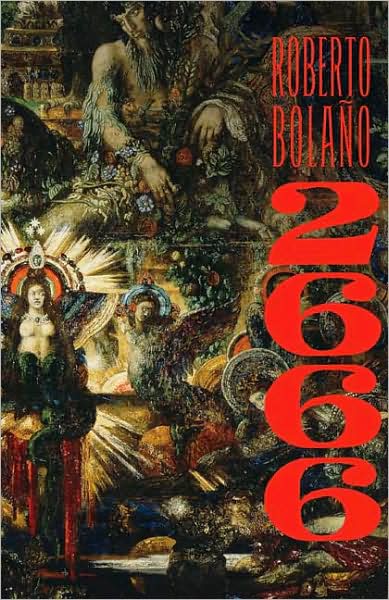
2666: Bolaño's Oasis of Horror


In the beginning of Roberto Bolaño's posthuomous masterpiece is a quote from Baudelaire, "An oasis of horror in a desert of boredom." That about sums up the aesthetic approach of the tome, the first section of which begins with the seemingly irrelevant story of an international group of academics chasing as elusive German author to the small Mexican border town of Santa Teresa. Sure, the academics give conferences, fall in love, and learn just briefly of a series of crimes in which hundreds of women have been killed in Santa Teresa over the past decade, but ultimately nothing happens, the academics do not find their author, and the story continues without them.

But this desert of boredom is the genius of the work, for in each section we get closer and closer to what is happening in Santa Teresa, reaching through the boredom to an unmistakable and spine-chilling horror that seems to lurk just below the surface of the page. Even the section about the crimes, essentially 200 pages worth of crime reports on every single raped and murdered woman in Santa Teresa (the crimes based off the still unsolved murders of women in the real Ciudad Juárez) told with the "false neutrality of a police report." These page are brutal, graphic, and yet, still part of the desert of boredom surrounding the horror that has not yet been revealed. As such it is interesting to note that Bolaño has turned Baudelaire's quote into a kind of architectonic structure for the plot of his novel. Instead of moving forward in time, or with building events, we have a microscope that starts off on the boring international level and gradually circles closer and closer to the terrifying circumstances of one small town.

12.12.2008

The Imaging of Dreams

Many years back I had a dream in which there had been invented the technology for people to record their dreams while asleep so that others could later view/ dream them for themselves. I called it the Subjunctive Dream Network, and many years worth of hilarity ensued in which I would be having a particularly terrible dream only to wake up (in another dream), take off the sleep mask and wires, and be thankful it was only someone else's dream I had been viewing.

It now seems that a group of Japanese scientists are in the process of developing software that can actually process and display the images of thoughts and dreams on a computer screen, which is a step closer to making the Subjunctive Dream Network and actual reality (though one imagines there's still lots of kinks, if this is actually true). Of course, it also means that instead of writing out all my dreams to use as material, I could just be making a movie while sleeping!

11.24.2008

Dali Lama Unleashes Revolutionary New Reincarnation Techniques


[via]

"Deciding that they should be the ones to appoint all future Lamas, in an attempt to gain the upper hand in the mindspace of the people of Tibet in their struggle against them for independence, the Chinese government recently enacted a law giving themselves full authority over all reincarnations.

Well played China. Well played.

But the Dalai Lama knows how to play the game as well.

In response, at the end of 2007, the Dalai Lama proposed to hold a referendum among his millions of followers on whether he should be reincarnated at all, and, if the vote was in favor, to determine his reincarnation while he was still alive. He cited the example of one of his teachers as a precedent for a lama being reincarnated while still alive. But he also indicated that he would not be reborn in China or any other country which is “not free.”

In turn, the Dalai Lama has raised the possibility to forgo his rebirth, or to be reborn while still alive so that he, not China, can choose his successor.

The Dalai Lama has even suggested reincarnating as a woman.

I find it incredibly interesting that the Dalai Lama, a being who’s existence spans at least fourteen lifetimes, is now reincarnating only in free countries in order to stay free of the grasp of the ancient empire which seeks to trap and control him within it’s borders. That is, of course, unless he chooses not to reincarnate at all and instead transcends to a higher dimension.

I certainly hope they aren’t using Dielbolds to count the votes in that referendum, it would be an easy way for the Chinese to finally remove the Dalai Lama from this level of reality (at least for a while).

What’s especially interesting about this strange game of espionage and rebirth is how important it actually is to the future of Tibet, China, and the rest of the world, as well as to the lives of the individuals involved."

11.18.2008

Place Names as Reality Effect in Joyce's “Portrait of the Artist as a Young Man”

Place Names as Reality Effect in Joyce's “Portrait of the Artist as a Young Man”

While it is tempting to read James Joyce’s “Portrait of the Artist as a Young Man" purely in terms of the spiritual and artistic growth of its main character, it is also profitable to look at the way in which Joyce uses details to construct the reality of the world of his novel. In his essay, “The Reality Effect,” Roland Barthes argues that authors include incidental details – details that don’t add to plot, character development, or atmosphere – which indicate the reality of the story in which they are deployed. While Barthes’ argument is primarily applied to Realist authors, the inclusion of seemingly insignificant details in a modern text, such as the use of specific place names in “Portrait of the Artist as a Young Man,” can also produce this ‘reality effect,’ while raising questions as to whether these kinds of detail in Joyce’s novel are actually incidental.

One of the most obvious uses of specific detail in Joyce’s novel is the inclusion of place names in the text. Throughout the book the protagonist Stephen Dedalus goes on numerous walks through Dublin and its environs, where the story is set: “Along the Goatstown road and thence into Dundrum,” or, “from the door of Byron’s publichouse to the gate of Clontarf Chapel” (Joyce, 64 and 128). It is arguable that if the novel focused solely on the apotheosis of Stephen’s character, these specific place names would be incidental to both plot and character. Their inclusion primarily sets the story in a reality – that of the recognizable and historically accurate Ireland – and as such produces Barthes’ ‘reality effect.’

To say that this use of place names is incidental however seems to evade the fact that the novel is essentially a working out of the protagonist’s perspective in relation to the reality in which he exists. That the place names set the novel in a ‘real’ Ireland is not insignificant to the plot, as Stephen is trying to grapple with the nets of Irish “nationality, language, religion” (Joyce, 220). The place names make the references to Parnellian politics, the revival of the Gaelic tongue, and the intricacies of Irish Catholicism more specific and valid for the character. For example, “the name of [Maple’s Hotel]… stung him like a glance of polite disdain. He stared angrily back at the softly lit drawingroom of the hotel in which he imagined the sleek lives of the patricians of Ireland housed in calm” (Joyce, 258). Without these specific locations, it might be easier to read this story as taking place anywhere, but in doing so we would miss the way in which Stephen’s character is driven by his specific culture.

We furthermore see that Stephen has a fascination with language throughout the novel: “We are in Cork, in Ireland. Cork is a city. Our room is in the Victoria Hotel. Victoria and Stephen and Simon. Simon and Stephen and Victoria. Names” (Joyce, 98). It is essential to the protagonist’s development into a writer that he pays attention to names in this way. As he later suggests in his aesthetic theory, “that is beautiful the apprehension of which pleases” (Joyce, 225), and as such, the apprehension of specific place names adds to this artistic aspect of Stephen’s character. He is the kind of character who finds names and language beautiful, or at least worth attending to.

There is another, brief passage that illuminates a third way in which the use of place names in “Portrait of the Artist as a Young Man” is intimately related to the character and structure of the story. In an aside, Stephen remarks that his friend Cranly has a “way of remembering thoughts in connection with places” (Joyce, 267). Place names do not just serve as cultural or aesthetic signs, but are also markers for memory and association. As the novel is directly concerned with Stephen’s associations, it is possible to take the inclusion of specific places in the story as a structure on which the events of Stephen’s life are hung.

This connection between location and personal association furthermore suggests an identification between the character and specific places, as when Stephen remarks in his journal: “Crossing Stephen’s, that is, my green” (Joyce, 271), identifying himself with the actual Stephen’s Green. From a young boy living in Ireland but feeling culturally separate from it, Stephen is able to identify with his country through specific place names to the extent that he feels “the thoughts and desires of the race to which he belonged flitting like bats, across the dark country lanes” (Joyce, 259). This identification with Ireland, as a real place full of memories and associations, ultimately allows Stephen to both leave the country and begin creating the conscience of his race, a conscience that that is born nowhere but in the specific setting of Ireland. So though Joyce’s use of place names does at some basic level create Barthes’ ‘reality effect,’ this specific kind of detail is crucial to the development of plot and character through the story, and as such is hardly what Barthes might call incidental.

Writing and the Duende (or, the pen is mightier than the keyboard)

Another point of contention I have with many authors of the technological age is their reliance on computers as a tool for writing. Personally I prefer writing by hand, as one can not stop to edit, even with all the scratch marks one is forced to forge ahead, to find a flow that doesn't cease, doesn't break, a voice that seems to well up unstoppable from the depths of the soul or the soil under your feet. As opposed to this I hear many computer writers fret over revising and revising one line for hours as they write, and I suppose one could do the same thing on paper (that is the classic and comic example of the writer's process after all), but the non-linear nature of the word-processing medium is not what I'd call conducive to a constant flow of words.

There is a difference in writing that is created in either of these ways. One can tell words that welled up, strung themselves together, the fast, unstoppable train of consciousness unbound by grammatical rules, the desire to be precise when sometimes the emotional torrent has the greater effect. This is comparable to Garcia Lorca's Theory and Play of the Duende:

"So, then, the duende is a force not a labour, a struggle not a thought. I heard an old maestro of the guitar say: ‘The duende is not in the throat: the duende surges up, inside, from the soles of the feet.’ Meaning, it’s not a question of skill, but of a style that’s truly alive: meaning, it’s in the veins: meaning, it’s of the most ancient culture of immediate creation."

While Lorca's excellent (and much recommended) essay focuses primarily on folk music, its premise is applicable to any art: that there is a force behind creation that has to be fought with, channeled, and ultimately allowed to burst forth from the throat, pen, or paintbrush regardless of one's artistic intentions and formal techniques. One struggles to find the right word, the correct phrase to get across a certain meaning, but at times, often, those meanings are not something that can be rationalized into precise thoughts. Instead there is the emotional and almost daemonic chaos of our souls demanding expression in whatever way it can get out, and the use of a medium that does not stand in the way of this process, as computer keyboards do in being discrete and removed from the direct creative process, is imperative in stepping out of one's own way to actually create.

11.17.2008

The Unsayable

As a writer, or more generally an artist, something that has become increasingly more important to me is the ability, desire, or perhaps necessity to express the inexpressible, to represent in some form those situations, characters, feelings, or ideas that either defy representation, or are shades of experience that others have not found ways of representing before. Heidegger, I believe, discussed experience or perception as being similar to driving over the surface of the world, that is, one can only or most readily articulate the outermost (or perhaps innermost) layer of reality. I take it for certain that many deep and true things have been said in the past, that language has been used in innumerable ways, that any subject has been discussed, any combination has been to some degree tried out (one only has to turn to Joyce’s “Finnegan’s Wake” for illustration of that). But I also resent how much schlock and ironic, surface content is thrown around these days, how easy it is to not have the courage to face the unfathomable in one’s self and in the world. A fellow student in my fiction class told me that he once wrote a story putting in a lot of himself and his real feelings and decided that it was so intense that he’d rather not do it again. I fear it’s indicative of our age.

And yet, as far as one can or chooses to push words, music, and visions, it seems that there will always be something more that is left unexpressed; that any art is ultimately a medium, a mediation of a reality that is still immediate and sensorially complete, and more, carrying in every moment associations to memory and imagination, references to culture and history, and gods know what else besides. Emotions, thoughts, sensations, intentions. And even then, if one where able to accurately convey all these modes of perspective, there still remains some ineffable and overwhelming quality, the spirit or life-ness of reality that has not yet come across through any artifice. Though one can come closer, through pushing ones’ perspectives and means of expression. Freud and other psychologists have called this inexpressibleness the ‘uncanny,’ or, by the religious theorist Rudolf Otto, the ‘numinous’. It reveals itself in what is weird, non-rational, fascinating, and terrifying, in the unexpected, unprecedented, and juxtaposed. It is processed in dreams, prayed to in religious rituals, and approached tentatively through an artist’s imagination and vision. Some have called it God but I think that’s just a symbol and it’s something else entirely, something wholly other than the surfaces we say it is.

For a visceral example take the body. For many the body as material is the surface, what it looks like, what’s on it, or the mass, the weight. For those trained to see it otherwise, like doctors, the body is series of elaborate processes, organs, meat, hidden beneath the outward skin. But how often do we have a total lived sense of this (excepting of course moments of illness and malfunction), on an aesthetic or even spiritual level? Or apply it outwards to the rest of the world? One of the most intense and inexpressible moments for me of this sort was not religious or drug-induced, but was the result of seeing the Bodyworlds exhibit several years back: the plasticization of human bodies and organ systems and parts of bodies, all splayed open in exact form, some refracted or expanded to bizarre, inhuman proportions. And yet all still recognizably human, still recognizably my form. One was split down the middle and folded open so that he was standing in two place at once, and I felt my own body trying to physically know what that felt like. I left acutely aware of my every organ, of every living layer within me, and when I walked out into the city and looked around I was just as aware of the insides of every other thing: the trees, machines, animals, building, the air itself even. It was awe-inspiring in such a way that I still don’t know if I’ve gotten it across.

Or on the other hand there are the psychological approaches toward memory and emotion, therapy or artistic transmutation. You could spend a lifetime tracing out the symbols and associations of your individual psyche, and still there might be some part of what makes you tick that you can’t quite lay your finger on. Or perhaps you begin to recognize feelings that you’ve never felt before and can’t yet explain. I am currently working on a story which the character goes through a transformation of a wide spectrum of emotions, and in doing so I am forced to similarly process my own emotions towards an emotional perspective that I know I’ve never felt before and certainly don’t yet know how to express. Several of my friends and classmates have asked why I am writing this piece if it is such an intense and inexplicable process, to which my response has invariably been that this is why I am writing: to experience something that hasn’t been experienced or expressed before in order to offer it up to others and the world.

11.16.2008

Snowy Day Update


I realize I haven't been posting here in a while, not once all October! School's been rather consuming this semester, as has my writing (not just the storytelling but notes on aesthetic and spiritual systems and the use of fiction as a tool for processing the emotions, but more on that later perhaps), and as always my personal life seems to take more precedence. It also doesn't help that I no longer have home internet access, though I find I'm now getting more done with myself, which is a blessing. Except for when I pick up a stray wireless signal.

Anyway here are some links for your perusal:

The life and work of James Joyce explained
The life and work of Joseph Campbell
Big Dreams and Archetypal Visions
The Future of Science Fiction
Obama on Faith

"I believe that there are many paths to the same place, and that is a belief that there is a higher power, a belief that we are connected as a people. That there are values that transcend race or culture, that move us forward, and there's an obligation for all of us individually as well as collectively to take responsibility to make those values lived." - Barack Obama

11.14.2008

Stealing Your Library

OCLC, owners of WorldCat, are getting greedy. It's now demanding that every library that uses WorldCat give control over all its catalog records to OCLC. It literally is asking libraries to put an OCLC policy notice on every book record in their catalog. It wants to own every library. It's not just Open Library that's at risk here -- LibraryThing, Zotero, even some new Wikipedia features being developed are threatened. Basically anything that uses information about books is going to be a victim of this unprecedented power[ ]grab. It's a scary thought.

Open Library provides a free alternative to WorldCat, provided it doesn't get sued into oblivion.

[via metafilter]

11.02.2008

Dystopian Symbols and Counter-Symbols in V for Vendetta and Alphaville

Dystopian Symbols and Counter-Symbols in V for Vendetta and Alphaville

In “Our Future – Our Past: Fascism, Postmodernism, and Starship Troopers,” Florentine Strzelczyk argues that Hollywood is fascinated with the aesthetic of fascism, especially that of Nazi Germany. Filmmakers use fascist-styled uniforms, symbols, and other elements of mise-en-scène in order to create recognizable dystopian societies – science fiction fascisms. It is interesting to note however that the Nazi Party’s primary symbol, the swastika, was already a recontextualization of an ancient Indo-European sun symbol, through which they were able to express their own dystopic aspirations for the future. The films “V for Vendetta” and “Alphaville” both present dystopian societies that recontextualize familiar symbols through their mise-en-scènes in order to represent the content and style of their particular fascistic worlds, as well as the counter-revolutions to those worlds.

James McTeigue’s 2006 film, “V for Vendetta,” depicts the Norsefire party, a religiously conservative dictatorship that has taken over England in the year 2038. Beyond their Nazi-esque uniforms and Orwellian surveillance and slogans, the Norsefire Party’s primary symbol is a doubled cross, shown in red on a black background. This symbol was originally the Cross of Lorraine, used by the French to counter the Nazi swastika during World War II. In the film this symbol also perverts St. George’s Cross, a single-armed red cross on a white background that historically served as the flag of England and the Church of England, as well as distorts the more familiar Christian cross. The Norsefire party has practiced Nazi (and Christian)-style religious discrimination against Muslims, Jews, and racial and sexual minorities in order to achieve power, and in the movie’s opening newscast the Voice of the Party argues that England prevails because of its faith in a judgmental God watching over the country.

The Norsefire Party’s doubled cross appears many places in “V for Vendetta,” on the Party posters, on the fingermen’s badges, and in news clips, suggesting the ubiquity of the regime. The symbol most predominately appears though along side the massive view screen on which is projected Chancellor Sutler’s face. As the leader of the fascist party, Sutler’s video appearance next to these monstrous doubled crosses suggests that he himself is the removed and ever-watchful God of England, or at least an omnipresent figure reminiscent of Big Brother in George Orwell’s dystopian “1984.” While it is implied that the crosses are always next to the Chancellor’s view screen, we only see them in specific shots, such as when Sutler demands the falsification of news or a desire to speak “directly” to the people. What is made clear about the symbol’s appearance is that it seems to occur only whenever the government is telling blatant lies. The Norsefire Party’s favorite political technique is double crossing the English people, and the symbol of the doubled cross directly illustrates this each time it is depicted on camera. Even during the art-terrorist V’s newscast early in the film, the doubled cross is shown next to him when he suggests that the people let themselves be tricked by the war, terror, and disease orchestrated by their government.

As opposed to the Norsefire Party’s doubled cross, V employs his own counter symbol, a circled letter V. V’s V does not directly reference or distort the government’s symbol, it is instead a depiction of his historical reasons for vengeance; V was held in room five (the Latin numeral V) of the Larkhill detention center where he was horribly burned and many minorities were killed by the government. This symbol however is displayed in the film in the same red on black as the doubled cross: in V’s newscast, slashed or painted over the Party posters, and even in fireworks over the exploding Bailey and Parliament buildings. Aesthetically, the image of red spray-painted lines over the posters most directly references the pop-culture image of the anarchist symbol, a red, circled letter A. V’s revolution depends exactly on the kind of people-driven chaos discussed in anarchist theories and misrepresented by current popular media. In “V for Vendetta” it is a young girl shot for spray painting V’s symbol that pushes the English people over the edge towards anarchistic rebellion.

While V’s symbol appears all throughout the film, he also employs the V on a linguistic level, taking it out of the level of mise-en-scène. In his opening speech to Evey, V sums up his own political theory using fifty words beginning with the letter V. We also later see that V’s motto is the Latin phrase from Faust, “Vi Veri Verdiversum Vivus Vici,” by the power of truth, I, while living, have conquered the Universe. In his newscast, V tells the people of England that words will always maintain their power as an annunciation of truth, and his speeches clearly illustrate this power of language. Unlike the Norsefire Party, V understands that a symbol (like the act of blowing up a building) is by itself meaningless, and must be given an actual voice by actual people in order to have a real affect on the world.

The dystopian symbols and counter-symbols in “V for Vendetta” are clearly depicted, but such is not the case in Jean-Luc Godard’s 1965 film, “Alphaville.” The dystopic government in this movie is a technocracy run by the scientific-logical computer Alpha 60. While Alpha 60 does not employ a direct or ubiquitous symbol like the Norsefire Party’s doubled cross, a set of scientific symbols occurs that can represent the regime: Einstein’s famous formula for mass-energy equivalence, E = mc2, and Planck’s equation for the quantization of light energy, E = hf. Historically, Einstein’s equation stood as a revolution in physics, unifying specific conservation laws of mass and energy into a larger theory under the specific speed of light, though the formula is also linked popularly with ideas of scientific destruction through its use in the creation of the atomic bomb. “Alphaville” plays on this idea that light energy is a logical, destructive power, as, according to Professor Von Braun, the creator of Alphaville, they are entering a Light Civilization attempting to take over the universe.

Planck’s equation states that the energy of light is carried in discrete amounts in relation to its frequency; light is quantized, or, in popular terms, it is digital rather than containing a continuous spectrum of possibilities. In “Alphaville,” the computer Alpha 60 is described by the agent Henry as being 150 light years more powerful than any previous computer, a discrete number he returns to later in his tale about ant societies. This dystopic society similarly operates under the idea that certain words have certain, discrete meanings: any uncertain words are removed from the Bible-dictionary and replaced by more specific ones. Language, like light, has become quantized, and is used as an element of control, much as it is in “V for Vendetta.” This use of scientific equations as fascist symbols in “Alphaville” echoes the head programmer’s statement to agent Lemmy Caution that an order is a logical conclusion; the logic of science cannot be disobeyed.

The biggest challenge in interpreting these scientific formulas as dystopian symbols in “Alphaville,” and in determining the appropriate counter-symbols, is that they only appear in two specific scenes, in brief flashes during moments when Lemmy Caution is figuring out how to counter Alpha 60’s control. In the first of these scenes, Lemmy has just learned from Henry about the computer, and directly following the symbols he says that people have become slaves of probability, statistics and equations being science’s way of controlling people’s perception of what is possible in reality. Henry goes on to tell a story however about a similarly technocratic ant society that 150 light years ago had artists like those in Alphaville, and then the equations flash again, remixed into the statement hf=mc2. Several things are happening here: the equivalence of E in the two formulas could imply that the particle scale of hf, or of the ants in Henry’s story, is the same as the galactic scale of mc2, that Alpha 60 is not only killing artists in Alphaville but would do the same throughout the universe.

Secondly, there is the suggestion that artists offer an alternative to scientific-logical control of how people perceive the world. Throughout the scene and film both of the agents reference popular and artistic culture in their dialogues: comic book detectives of the time; women from French literature; and after being given the poetry book of Éluard, Lemmy says that he is going on a “journey to the end of the night,” a reference to another French novel of the same name that apparently satirizes scientific research. We see the same thing in “V for Vendetta,” where V (and other outlaws like Gordon) attempts to keep human culture alive through collecting censored cultural artifacts and referencing them in dialogue that contrasts with the fascist regime.

During the Institute of General Semantics scene of “Alphaville,” Alpha 60 says that life and death are discreet events on the circle of time. This is echoed later when the scientific equations are flashed again, while Lemmy is being shown a tour of the computer. At this point the symbols flash slower, from left to right, while the computer says that Lemmy thinks more of the past than the future, and then again while Lemmy remarks that he is too old, and that shooting first is his only weapon against fatality. This differentiation between kinds or perspectives of time echoes the earlier symbol scene, most importantly the instant when Lemmy questions the specific 150 light year time frame of Henry’s story and then sets the bare light bulb swinging. This moment suggests that instead of the discrete, logical quantities of energy or power utilized by Alpha 60 through the E=hf equation, light, and life itself, exist in a continuous spectrum that can be accessed through the illogic and uncertainty of art. The past, with its implied reference to artifacts of human culture, can become a weapon against the cultureless dystopian future envisioned by the machine. Most precisely, or creatively, Lemmy uses the culturally subjective meanings of poetic words – symbols without the fixed meanings of scientific equations – to destroy the computer and its fascist society.

There is thus no clear counter-symbol that Lemmy uses in “Alphaville;” poetry is not an emblem to be flashed quickly on a screen or be represented as a direct element of mise-en-scène. Even when we are shown the supposed copy of Éluard’s “The Capital of Pain,” the camera has to slowly pan over the text in order to give the viewer time to interpret the meaning of the words, much the way that Alpha 60 destroys itself slowly by searching for the answer to Lemmy’s poetic riddle. But, as we saw in “V for Vendetta,” it is not V’s fast, iconic V symbol that changes his world either. It is instead the meanings given to symbols and words by people themselves over culturally continuous times (or despite culturally-destroying times) that make symbols powerful, and ultimately keep us free.

10.02.2008

Simultaneity of Tradition in Eliot’s “The Wasteland”

Simultaneity of Tradition in Eliot’s “The Wasteland”

In “Tradition and Individual Talent,” T. S. Eliot suggests that it is important for poets to recognize themselves as part of a long literary tradition and to develop a consciousness of the past. This “historical sense” is for Eliot a “feeling that the whole of the literature of Europe… has a simultaneous existence” (Eliot, 115). While Eliot stresses that a work of art changes all the art that precedes it, this simultaneity of tradition also suggests that all these works of art can be present in one work. In “The Wasteland,” and in particular Book III, “The Fire Sermon,” we see a simultaneity of traditions that allows Eliot to comment on modern life through reference to the past.

Eliot suggests that for the poet it is not enough just to study the past. Tradition is another element that, along with emotions, feelings, impressions, and experiences, can “combine in peculiar and unexpected ways” (Eliot, 118). In “The Wasteland,” Eliot combines tradition with experience through a large number of references to various literary traditions. He is Just as likely to quote from the Bible or Shakespeare as paraphrase his fellow poet Baudelaire or the Buddha’s Fire Sermon. Eliot himself might argue that his radically new poem remains entrenched in the established tradition precisely in drawing so freely from it.

But what is the effect of this literary mash-up, where lines from different times and places are combined in even the same stanza? For some perhaps it is a labyrinthine mess of time, though as Eliot points out, “History has cunning passages, contrived corridors/ And issues” (Rainey, 89). It is precisely this maze of traditions that allows works of art to influence each other. By juxtaposing Augustine and the Buddha in the lines, “To Catharge then I came/ Burning burning burning burning” (Eliot, 15), Eliot is able to illuminate similarities between Eastern and Western traditions that the individual quotes could not have done on their own.

This technique of combining divergent references does not just apply to the past. The situating of ancient mythologies in and against modern settings and actions is the particular genius of “The Wasteland.” Sweeny approaches Mrs. Porter on the dirty Thames and bustling London streets, but they are enacting the classical roles of Actaeon and Diana. Ancient Teresias watches and comments on a pair of modern lovers as he once did for Jove and Juno. And lest we forget that the relationships in Eliot’s unreal cities are doomed to failure, there is the almost nonsensical insertion of, “Jug jug jug jug jug jug/ So rudely forc’d./ Tereu” (Eliot, 12), which keeps Tereus’s rape of Philomela clear in the educated reader’s mind.

So what ultimately does “The Wasteland” say about the age in which it was composed? The answer probably depends on the interpretation of all the other experiences and feelings combined in the poem with the more academically accessible literary references. Eliot’s use of the simultaneity of traditions might at the least suggest that all of these historical and mythological occurrences still exist within the modern age. The inhabitants of London or any Twentieth Century city have the potential of reenacting the tragedy of Tereus and Philomela or the passions of Augustine and the Buddha. The message of “The Wasteland” is perhaps that it is not just poets who need to develop Eliot’s “historical sense.” Unless we learn to recognize the influence of the past and present on each other, we may too be condemned to repeating all the cruel and cunning passages of history.

9.28.2008

Poetry Bailout Will Restore Confidence of Readers

[from Harper's]

As you know, the glut of illiquid, insolvent, and troubled poems is clogging the literary arteries of the West. These debt-ridden poems threaten to infect other areas of the literary sector and ultimately to topple our culture industry.

Cultural leaders have come together to announce a massive poetry buyout: leveraged and unsecured poems, poetry derivatives, delinquent poems, and subprime poems will be removed from circulation in the biggest poetry bailout since the Victorian era. We believe the plan is a comprehensive approach to relieving the stresses on our literary institutions and markets.

Let there be no mistake: the fundamentals of our poetry are sound. The problem is not poetry but poems. The crisis has been precipitated by the escalation of poetry debt—poems that circulate in the market at an economic loss due to their difficulty, incompetence, or irrelevance.

Illiquid poetry assets are choking off the flow of imagination that is so vital to our literature. When the literary system works as it should, poetry and poetry assets flow to and from readers and writers to create a productive part of the cultural field. As toxic poetry assets block the system, the poisoning of literary markets has the potential to damage our cultural institutions irreparably.

As we know, lax composition practices since the advent of modernism led to irresponsible poets and irresponsible readers. Simply put, too many poets composed works they could not justify. We are seeing the impact on poetry, with a massive loss of confidence on the part of readers. What began as a subprime poetry problem on essentially unregulated poetry websites has spread to other, more stable, literary magazines and presses and contributed to excess poetry inventories that have pushed down the value of responsible poems.

9.25.2008

The Eyeless Prison

I just uploaded a revised version of The Last 20 Moments to my Goodreads account. It is now called The Eyeless Prison (sign in required) and it is a historical romance about international art thieves at the outbreak of World War II.

This was another assignment for my fiction class, and the exercise for the revision process we had to do was rather interesting. We were required to take our 300 word stories and revise them as seven drafts in seven days, each day focusing on a different mechanic of storytelling: character, conflict, setting, point of view, plot, language, symbol. It was actually shockingly useful, editing has never been one of my strong points, mainly because I have a hard time missing the trees for the whole damn forest, but if this is the kind of stuff I can get out of honing in on specifics then I'm all for it.

* * *

Sobs resounded in the cramped black cell. The man took his ear from against the immobile concrete and whispered through the hole in the wall. “Randolph? Is that you?”

There was a groan. “Thank God you’re still there Murphy, I don’t know if I could have born this any longer, not without you to talk to. The things they did…”

“It’s okay, friend, I’m still here, as much as I wish otherwise. I don’t think they’ll ever let us out.”

“Murphy? This time it was my eyes…”

Murphy sank to the straw and piss covered floor in despair. It was inhuman. When would it be his turn? He could barely remember how long it had been; years lost rotting in this shit-smelling hole. He used to try and count the days, the constant light dancing just out of reach in the thin, barred window by the ceiling. But then it grew dark, for what seemed like months at a time, they must have been covering it, trying to break his will, make him confess to the impossible, the same way they gave him cigarettes without a math, lavish dinners wafting on the other side of the locked iron door. Until Randolph had appeared in the adjoining cell Murphy thought he’d go mad, days pacing back and forth between the tight walls, avoiding the growing pile of offal in the corner. He wondered at what point things had gone wrong.

The last he knew for certain was a confusion of small rooms, train cars tumbling through the ancient, gloomy forests of Europe towards this place, bound and occasionally beaten within an inch of his life. The brown-uniformed officers snarled at him like wolves. They’d stripped him of his good suit and brass pocket watch, waved the notepad in front of his face asking where he’d hidden the secrets. American spy, they barked, and paraded in front of him a panoply of identities that offered some hope of freedom if he’d but given in. Yet he swore these names were not his own, if only he could convince them who he was, why didn’t they see it in his face, the fear contrasted by the electric torches in their rough hands?

“Randolph,” he asked when the man had stopped moaning though the hole, only large enough to transmit their words and cries, “did they get you to talk?” Murphy scratched at his beard, how he wanted to shave it. He wished there was a mirror to se how haggard he looked, but there wouldn’t have been enough light in the cell for a reflection.

“Only so much, doubt they believed any of it, though I swore it was the truth. Ha, as far as I can see it. I told them about us, everything, except what they wanted to know. I’m sorry, but it’s been on my mind.” Randolph’s big mouth had made him the first target of interrogations, but Murphy feared he too would be reduced to this same fate before he saw the light of day again. He tried to remember Eleanor’s face, as she’d stood on their porch in the brilliant Massachusetts spring, a quickly fading talisman in the dim of the prison.

Through the desperate numb of the days that felt like one endless night, Murpy’s only safety, his sanity now was with this friend on the far side of the wall, who once was a braggart and now a shriveled husk of a man. Randolph would tell stories through the ragged hole to keep their spirits up, starting with what he’d do when they escaped and moving on to a progressively incoherent fantasy that Murphy feared was rubbing off on him. He hated the man, but they’d been through so much together, he was all he had. Eventually the two recounted their delirious history, trying to sort out how they’d ended up here, afraid that the answer still wouldn’t set them free.

(read the rest through the link above!)

Punk Rock and Irish Literature

The Sick Bag Of Cuchulainn

[from The Blog of Revelations]

The folks from the Edge08 festival invited a few of us up to Ballina recently to talk about how punk rock influenced Irish literature. That’s a big question. The short answer is ‘not enough’, but of course it’s a little more complicated than that. The corollary is that Irish literature influenced punk rock – or at least the Irish strain of the virus – a lot more than punk subsequently re-influenced modern Irish writing.

Irish punk bands and their new wave cousins swallowed Joyce, Beckett, Wilde and Flann O’Brien, chewed them up in a blender and spewed them back out in a great technicolour yawn. By contrast, modern Irish fiction writers, even the ones who treasured their copies of Never Mind The Bollocks and London Calling, seemed to be looking the other way when the punk stinkbomb let off. The influence is there, but in the most staggered and splintered way, a series of sporadically tossed pipe bombs rather than one big atomic bang.

Punk rock was a musical – some say cultural – revolution that happened in New York circa 1975, instigated by the Bowery bands who played Max’s Kansas City and CBGBs: The Ramones, Television, the Patti Smith Group, the Heartbreakers. Latter-day New York Dolls manager Malcolm McClaren caught the bug from Johnny Thunders and Richard Hell and passed it onto his charges the Sex Pistols a year later. But if the New York strain was an art movement conspired by misfits who’d never been to university, its English counterpart was more seditious. The Sex Pistols were the ultimate Oedipal act: ‘Anarchy In the UK’ attempted to kill the King; ‘God Save The Queen’ stuck it to her Majesty.

These were leery, sneering rebel songs played at high volume, sung by a London-Irish misfit with a wicked mouth and eyes like headlights. The Pistols were a horror show, and like the best horror shows they were conceived on a shoestring, with the production values of a snuff movie, and so their music felt scarily real. Never Mind The Bollocks ripped a fissure in reality through which could be glimpsed a whole new wave of horrors: The Clash, The Damned, The Buzzcocks, Siouxsie & the Banshees, the Dead Kennedys, Black Flag.

But despite the Year Zero propaganda, punk wasn’t conceived in a void. It was a mutant Eraserhead baby with many fathers: the 60s garage acts collected by Patti Smith Group guitarist Lenny Kaye on the Nuggets box set, Detroit’s Stooges and the MC5, the Velvet Underground and the New York Dolls, Alice Cooper, David Bowie and Roxy Music.

Punk lifted bits of its aesthetic from the Decadents, the Symbolists, the Modernists, the Lettrists, the Dada-ists and Surrealists and Situationists, from the Paris Communes and the 1968 riots. It was Un Chien Andalou and Howl and A Clockwork Orange and Catcher In the Rye. Its icons included Rimbaud, Genet, Beckett and Burroughs. It produced poets and writers like Patti Smith, Richard Hell, Jim Carroll and John Cooper Clark, artists like Raymond Pettibon and Ray Lowry, filmmakers like Don Letts, Julien Temple, Alex Cox and Mary Harron, was documented by journalists like Lester Bangs, Nick Kent, Tony Parsons and Julie Burchill, and inspired a hundred fanzines and indie labels.

But if punk began as an homogenous skinny whiteboy noise, it evolved with the speed of mutagen into something that transgressed genre. It refused to know its place, wouldn’t stay within the prescribed lines. It had the gall to speak in bad taste, to venerate energy and innovation over technique, to thieve from previously prohibited sources. By comparison with the old boys’ club of stadium rock acts, punk was multicultural, homo-friendly and equal opportunities.

It acknowledged Captain Beefheart and Neu and Can, ska and dub and street poets like Lynton Kwesi Johnson, and through The Clash’s appropriation of ghetto blaster chic, Grandmaster Flash & the Furious Five. When John Lydon teamed up with Afrika Bambaataa for the one-off single ‘World Destruction’ in 1984, it sounded like a replay of ‘Anarchy in The UK’ set in a New York dance club, and prophesised Public Enemy’s armagedddon effects, the smash and grab sample larceny of hip-hop.

Punk was, on the face of it, aggressively Modernist bordering on dystopian Futurist, even if many of its avatars were of the old guard. Pete Shelley was a Beckett fan. Joy Division channelled JG Ballard’s Atrocity Exhibition. The Clash co-opted Allen Ginsberg for Combat Rock. Martin Scorsese considered casting the Clash as a street gang in his earliest imaginings of Gangs of New York. Eraserhead’s Jack Nance looked like a member of Pere Ubu.

Burroughs was celebrated by the punk set at the Nova Convention in New York in 1978. Debbie Harry collaborated with HR Giger, appeared in Cronenberg’s Videodrome, and but for her management’s intervention might have secured Darryl Hannah’s part in Blade Runner. She and Chris Stein forged a friendship with William Gibson, chief visionary of the literary movement that would become termed ‘cyberpunk’, a new wave of streetwise noirish sci fi that proliferated in the early 80s, and whose Neuromancer mantra – “the street finds its own use for things” – could have been a neo-Situationist slogan.

“1977 seemed kind of like a roots moment,” Gibson said. “My take on it wasn’t that it was brand new nihilism, it was like a return to something that had been the real beginning of the ’60s but had been collectively forgotten. I had forgotten it to some extent myself.

“And it actually wasn’t so much the punk from England that did that for me, it was the stuff from New York that slightly predated what happened in London: Television and the first Patti Smith album. They were very consciously subversively retro in a really irony-free way, they seemed very, very sincere about it, and what I was seeing and hearing out of London was much more self-conscious material.

“Now, decades later, I know that Malcolm McClaren had been reading the Situationists, and the stuff from New York was somehow way less considered and in fact didn’t really go anywhere. Most of those people vanished or took too much heroin or wound up pumping gas, which is actually a more traditional fate for young artists at that time.”

Here in Ireland, punk did something unprecedented: it occurred in real time. Pre 1977, the future was on a five year sattelite delay. Ireland received its inklings of a brave new world via Radio Luxembourg. The country didn’t have a pop music station until 1979. But London and New York punk generated a direct current that jumpstarted The Radiators, The Boomtown Rats, U2, The Virgin Prunes, The Atrix, Stiff Little Fingers, the Outcasts, DC Nien, The Blades, The Undertones.

Except Irish punk acts were different. They resisted the Oedipal pose, acknowledged rather than erased history. On The Radiators’ second album Ghostown, Philip Chevron wrote about ‘Kitty Ricketts’, one of the prosititutes from the Nightown section of Ulysses. U2’s debut album Boy namechecked Dorian Gray and stole from William Goldman’s Lord Of The Flies, a sacred text shared by The Virgin Prunes. Gavin Friday took Wilde as his oracle on Each Man Kills The Thing He Loves. The Pogues’ brilliant, bawdy carnivalesque songs referenced Brendan Behan and James Clarence Mangan and James Stephens.

Nor did Irish punk bands necessarily disassociate from their musical predecessors. They were more likely to consult members of Horslips or Thin Lizzy for advice than badmouth them in the press, and if they didn’t exactly pay homage to Rory Gallagher and Van Morrison, they didn’t deny them either.

Van, always a contrary figure, started out with Them, a snotnosed Belfast R&B band who wrote the all time great garage staple ‘Gloria’, but he made his reputation with Astral Weeks, an emigrant’s recurring dream of an East Belfast demimonde populated by hustlers, heroin casualties and persecuted drag queens.

The songs had strong literary associations – the dirty old man obsessed with a thirteen year old schoolgirl in ‘Cypress Avenue’ could’ve been Nabokov’s Humbert Humbert; the tragic drag queen Madame George was straight out of Last Exit To Brooklyn by way of Tennessee Williams.

Like its weirder twin, the Velvet Underground & Nico, Astral Weeks was a seminal album dealing with adult themes of vice, mortality and deviance. And like the Velvets, its influence vastly overshadowed its sales. In time it came to occupy the same place in pop music as Joyce’s Ulysses does in literature.

But if Irish musicians were galvanised and inspired by the country’s literary history, its post-war writers were always in danger of being paralysed by the towering figures of Oscar Wilde, Brendan Behan, Sean O’ Casey, George Bernard Shaw, Samuel Beckett, Eugene O’ Neill – the litany invoked by by Kevin Rowland in Dexy’s Midnight Runners’ ‘Dance Stance’. To any young scribbler, such figures could seem as ancient and ominous as the Tuatha De Danaan, mythic beings, ten feet tall, casting shadows of influence in which few new forms could grow.

The revolutionary example of punk rock – and the free for all polyglot of styles and sounds that it permitted – did not find expression in an identifiable Irish literary movement akin to the Beats of ’50s New York, or Scotland’s Children of Albion Rovers in the 90s. Throughout the 1970s it seemed more furtive, more covert. There were secret meetings and small presses, cellar rendezvous and writers’ groups that numbered among their suspects Dermot Bolger, Neil Jordan, John Banville, Colm Toibin.

Punk’s impact on writers like Clash fan Roddy Doyle was manifest in form rather than content. His first novel The Commitments chose proletarian soul rather than white noise as its motif, although the book’s self-published DIY ethic, plus its use of sawn off rapid fire dialogue and Northside Dublin vernacular, was pure punk. Elsewhere, the cover of Boomtown Rats disciple Joe O’ Connor’s Cowboys and Indians featured a London postcard mohawk. Novelist and playwright Billy Roche started out as singer with The Roach Band, who combined Springsteen-ish smalltown visions with a the taut energy of Elvis Costello and Graham Parker; his first play A Handful of Stars climaxed with a James Cagney stand-off soundtracked by PiL’s ‘Rise’.

Despite these strobe flashes, Irish fiction seemed still preoccupied with trying to make sense of the grim and grey preceding decades – a landscape of domineering fathers, martyred mothers, ogre-like Christian Brothers, despotic priests, skeletons in family closets, valleys of squinting windows, incessant rainfall. Throughout the 1980s it operated under the influence of the late John McGahern, the big daddy of rainy realism, a writer many modern Irish novelists still feel compelled to define themselves in alliance with or opposition to.

Maybe the satellite delay was still in effect, because 1977 finally arrived in 1993, in the unholy form of Pat McCabe’s The Butcher Boy. Notwithstanding the fact that it was written in the late early 90s and set 30 years before, this was the first true Irish punk novel, the Never Mind The Bollocks of letters, and its impact on modern Irish fiction was analogous to that of Irvine Welsh’s Trainspotting on Scottish writing: an adrenaline jab to the heart. Pitched halfway between slapstick and horror, the tale of Francie Brady was a shocking but moving hybrid of Huckleberry Finn, A Clockwork Orange and Lord Of The Flies, and Pat McCabe became the dragon young upstarts had to slay – or at least sneak past – before they gained entry to the crypt.

“I remember reading The Butcher Boy and recognising something about small town Ireland, and the dialogue struck me as amazingly vivid,” says Mayo writer Mike McCormick. “I was really sickened, because I was about halfway through the writing of the Getting It In The Head when I read it. McCabe’s work was important, as was Roddy Doyle’s, in that it also allowed people to use popular culture, songs and comic books.”

McCormack is, as the old saw goes, a man out standing in his own field: in this case a wind-blasted pasture in a mythologised Co. Mayo where the natives veer between decent skinnery and intemperent religiosity, where speaking statues of the Sacred Virgin drive local women to apocalyptic ministry, where earthbound angels coast across bay waves the colour of hammered lead, where you can’t move but for masonry saints and shrines and visitations and plastic Jesuses luminescing day-glo green.

Both McCormack’s full-length novels Crowe’s Requiem (1998) and Notes From A Coma (2006) meld the fantastical and future-shocked with the local and parochial. If Pat McCabe’s feverish inner monologues trace the southern gothic bloodlines of Faulkner and O’Connor back to their Irish origins, McCormack’s yarns are rendered with a rigorous, almost Anglo-Irish formalism on a par with Patrick McGrath.

“I was asked to describe Notes From A Coma towards the ending of my writing of it,” McCormack recalls, “and I say this respectfully now the man is dead, and I respected his work hugely, but the book was like if you imagined John McGahern and Philip K Dick were contracted to write an episode of the X Files, this would be the result.”

This, I believe, is under-explored territory in Irish fiction. We’ve had books like Eoin McNamee’s Belfast noir classic Resurrection Man, Joe Ambrose’s squat culture dispatch Serious Time, Conor McPherson’s rewiring of ghost stories and strange tales for the modern depopulated rural Ireland, Julian Gough’s metafictional Jude trology, John Connolly’s Nocturnes, Claire Keegan’s tales from the county hell. But the literary chattering classes are still more likely to cite John Banville over Blade Runner.

Maybe writers like Roddy Doyle and Joe O’Connor and Colm Toibin confuse the argument when they produce their richest writing in the guise of stately historical novels like A Star Called Henry, Star Of the Sea and The Master. But imagine a climate where Irish writers, and, crucially, non-Irish writers resident here, co-opted punk’s refusal to observe protocol, where there’s no confining delineation between so called serious and popular literature, where language, theme, storytelling craft and imagination all co-exist.

The equivalent, maybe, of the generation of writers who’ve thrived in the realm of the slipstream, an umbrella term wide enough to encompass Michael Chabon, Jonathan Lethem, Kelly Link, Joe Hill, AM Homes, David Foster Wallace, Steven Hall, Jeffrey Eugenides, Dave Eggars, George Saunders, Katherine Dunne and Tom Spanbauer.

The compost theory of culture holds that what was once held as ‘low’ entertainment – gothic, southern gothic, pulp fiction, westerns, post-war noir, horror, magic realism, new journalism, the new wave of 60s sci-fi, EC and Marvel comics, tales from the crypt, performance poetry, graffitti art, graphic novels – gets turned to precious metal by the pressure of successive decades heaped on top of each other, until, at this end of the process, what was once derided as common has become retroactively transmuted into art.

Anybody feeling queasy here should note that Cormac McCarthy, maybe the most respected living American writer, has worked exclusively in genre for decades, be it the post-apocalyptic (The Road), modern noir, (No Country For Old Men), western (The Border Trilogy) horror masquerading as western (Blood Meridian) or southern gothic (Child of God, Outer Dark).

The Serious Fiction Factory, the Man Booker mill, seems a long way from the surreal, funny, hyperbolic, fantastical tales that reside in the national body of mythology, legend, folk tale, gothic yarns, murder ballads and outrageously tall tales. Celtic storytelling has always been by turns bawdy, mystical, absurdist, and prone to gross exagerration. The Midnight Court contained lusty couplets that’d make a sailor blush. The Song of Amergin was a visionary shape-shifter hymn. And there’s an account of Cuchulainn’s bersker fit in Thomas Kinsella’s translation of The Táin that reads like a live review of Iggy & the Stooges:

“The first warp-spasm seized Cuchulainn, and made him into a monstrous thing, hideous and shapeless, unheard of… His face and features became a red bowl: he sucked one eye so deep into his head that a wild crane couldn’t poke it onto his cheek out of the depths of his skull; the other eye fell out along his cheek.

“His mouth weirdly distorted: his cheek peeled back from his jaws until the gullet appeared, his lungs and liver flapped in his mouth and throat, his lower jaw struck the upper a lion-killing blow, and fiery flakes large as a ram’s fleece reached his mouth from his throat.

“His heart boomed loud in his breast like the baying of a watch-dog at its feed or the sound of a lion among bears. Malignant mists and spurts of fire – the torches of the Badb – flickered red in the vaporous clouds that rose boiling above his head, so fierce was his fury.”

Now that’s what I call punk rock.

9.11.2008

The Legend of the Forbidden Treasure in Conrad’s “Nostromo”

The Legend of the Forbidden Treasure in Conrad’s “Nostromo”

“The poor, associating by an obscure instinct of consolation the ideas of evil and wealth, will tell you that [the peninsula of Azuera] is deadly because of its forbidden treasures. The common folk of the neighbourhood, peons of the estancias, vaqueros of the seaboard plains, tame Indians coming miles to market with a bundle of sugar-cane or a basket of maize worth about threepence, are well aware that heaps of shining gold lie in the gloom of the deep precipices cleaving the stony levels of Azuera. Tradition has it that many adventurers of olden time had perished in the search. The story goes also that within men's memory two wandering sailors -- Americanos, perhaps, but gringos of some sort for certain -- talked over a gambling, good-for-nothing mozo, and the three stole a donkey to carry for them a bundle of dry sticks, a water-skin, and provisions enough to last a few days. Thus accompanied, and with revolvers at their belts, they had started to chop their way with machetes through the thorny scrub on the neck of the peninsula.

“On the second evening an upright spiral of smoke (it could only have been from their camp-fire) was seen for the first time within memory of man standing up faintly upon the sky above a razor-backed ridge on the stony head… The impious adventurers gave no other sign. The sailors, the Indian, and the stolen burro were never seen again… the two gringos, spectral and alive, are believed to be dwelling to this day amongst the rocks, under the fatal spell of their success. Their souls cannot tear themselves away from their bodies mounting guard over the discovered treasure. They are now rich and hungry and thirsty.”

Conrad, Joseph. “Nostromo.” Penguin Classics edition. 1990. Pgs. 39-40


This passage, which stands at the beginning of Conrad’s Nostromo, tells of two sailors who go in search of a buried treasure, in the process becoming ghosts. This story is told stylistically as a folk legend or local fairytale of the people of Sulaco, that is, an event that may not have actually happened, or occurred only in some mythical, non-historic time. The use of fairytale sets up a tone that this story may not be important to the following events, as it is something that did not happen, perhaps only suggesting some background about the people or place of the book. Linguistically however, Conrad uses the same kinds of descriptive language that abound through the rest of the novel. The depictions of the folk of the neighborhood or the gringos’ provisions clearly place this legend within a setting and cultural context similar to that in which Nostromo as a whole takes place. It is important to notice that despite this clarity of detail, the two gringos are not given names; in fact it is not even certain that they are actually Americans. They only thing definite is that they are sailors, and as gringos they may most likely be foreigners to Sulaco.

Several images appear in the legend of the forbidden treasure that hold thematic importance for Nostromo, and can be tied up in the opening sentence’s equating of evil and wealth. Beyond the almost insignificant details mentioned above, the story focuses on a treasure hidden in a ravine on the peninsula of Azuera, off the coast of Sulaco, suggesting the lure and inaccessibility of money. Secondly, there is the pair of foreigners who go searching for the treasure with the help of a mozo, a native youth. This image points to the way that foreign interests have exploited the local populaces of Latin America in order to grow wealthy. Then there is the fate of the gringos, who become hungry ghosts, unable to either use or abandon the treasure once they find it. This idea of money as a curse or “fatal spell” most clearly illustrates the evil inherent in wealth, and leads the way into the actual story of Nostromo.

Legends and fairytales hold an important place for the people of Sulaco, even though the rest of the novel unfolds in actions clearly bound to a historical chain of events (though often a labyrinthine one). There is for instance a popular legend that the former dictator Guzman Bento became a specter whose body is carried off by the devil after his death, a fitting apotheosis for a man who had many put to death under his regime. This local folktale can be contrasted with the names of classical Roman mythology, the old deities of the Spanish upper class, which are household words in Sulaco only because the O.S.N. Company ships are named after them. Costaguana had “never been ruled by the gods of Olympus” (Conrad, 43). Another more basic local story concerns a treasure supposedly buried under the house of Giorgio Viola, echoing the legend of the gringos’ treasure and foreshadowing both the treasure that is his daughters as well as the lost silver that ends up under his lighthouse. As the engineer-in-chief puts it, the events of the novel are “like a comic fairy tale… true to the very spirit of the country” (Conrad, 273).

Many of the characters in Nostromo not only tell, but live their lives based on such fantasies, which they identify with or make up about themselves. One case of this is the mine owner Charles Gould, who Decoud claims idealizes everything and does not believe his own motives if they are not part of a fairytale. When first introduced to Charles Gould’s fascination with the San Tomé mine, we are even told that he personifies mines as living beings. The journalist Decoud claims that his own life is not “a moral romance derived from… a pretty fairy tale” (Conrad, 202), yet while trying to save the silver he later admits to living an imaginative existence: the desire to form an independent state out of his love of Antonia. It is not just the book’s “heroes” who contain this flaw of self-mythologizing. General Montero’s brother Pedrito helps bring about the Monterist Revolution because he wants to live out the political splendor depicted in stories of the Duc de Morny. Colonel Sotillo is similarly possessed by the delusion that the silver has been sunk in the harbor, and eventually gets killed by his own man for refusing to give in to reality. As Mrs. Gould says of her husband, though it could apply to almost any character in the book, “A man haunted by a fixed idea is insane. He is dangerous even if that idea is an idea of justice; for may he not bring the heaven down pitilessly upon a loved head” (Conrad, 322)?

There is no clearer place where we see this tragic self-mythologizing than in the character of Nostromo, especially since he directly identifies himself with the gringos of Azuera in the legend of the forbidden treasure. While trying to save the silver, Nostromo says that the treasure of the mine is greater than the one guarded by ghosts on Azuera, and that their task is more dangerous than trying to get the forbidden treasure. Nostromo also tells Dr. Monygham that if he fails he won’t linger like the dead sailors, while at the same time suggesting that having the silver is like a curse. After the treasure is hidden it does indeed become a curse on the sailor, and we really begin to see the association of evil and wealth. Where Nostromo had been an integral, though proud, man, after becoming a slave to the silver “the genuineness of all his qualities was destroyed” (Conrad, 432). He compares himself to the gringos again, as unable to forget the treasure until he is dead, and “belonging body and soul to the unlawfulness of his audacity” (Conrad, 438) in stealing the silver.

“There are spirits of good and evil that hover near every concealed treasure” (Conrad, 416), spirits that seem to make Decoud fascinated with the power of the silver until he kills himself, spirits that turn Mrs. Gould’s heart into a wall of silver-bricks. It is perhaps these same evil spirits, trapped in the ghosts of Azuera, that keep Nostromo coming back for more treasure until he is accidentally killed for it (by his old friend Viola, who thought he was another man trying to run off with the treasure of his daughter). On his deathbed Nostromo says that the silver has killed him, when his killer was perhaps his own fascination with its mythology. Yet even still he offers to pass that curse on. Thankfully Mrs. Gould decides to let the legend of the forbidden treasure die with him.

9.10.2008

End Times, by Lydia Lunch

End Times
By Lydia Lunch. [via, posted in full]

“In times of universal deceit telling the truth is a revolutionary act.”
– George Orwell

It took balls for Elton John to suggest banning all organized religion because it turned people into hateful lemmings devoid of compassion. And I may be putting my cock on the line here, but I think we need to go directly to the source and simply get rid of God. After all God was the first cop. The original tyrant. An egotistical dictator whose sadism was so immense that he insisted on the murder of his only begotten son just to prove what he was capable of after he condemned us all to rot in eternal damnation like flesh puppets in his own private dungeon. An amusement arcade full of fire and brimstone.

Religion used to be the opium of the masses. Now it’s the crack cocaine of assassins. Millions of addicts tripping on a celestial high. Throwing psychotic temper tantrums like little brats who forgot to take their Ritalin. Backyard bullies screaming MY GOD IS BIGGER THAN YOUR GOD. God junkies — dangerous and delirious. Drunk on blood and bombs and the smell of burning flesh. Painting the desert red in an attempt to appease BIG POPPA, that vengeful War Lord whose favorite blood sport has always been one of violence, torture and retribution.

And excuse me if I feel that John McCain is suffering from Stockholm Syndrome. If after five years of being held in captivity and forced to endure relentless tortures, he is simply too twisted to realize what the real price of war is, then we’re all doomed. After all if he could survive such mind numbing cruelty and still want to play war whore, what the hell are the rest of us all whining about?

War is as old as God himself. And the War is never over. The War is never ending. The War is just an orgy of blood and guts masterminded by testosterone-fueled dirty old men that get off on fucking the entire fucking planet. This is the REAL PORNOGRAPHY. An outrageous cockfight fought by gung-ho cowboys who have drawn a line in the sand and will challenge anyone to a duel foolish enough to threaten resistance against the advent of the rodeo mind.

And hold on to your hats because now entering the bullring is a petite pit-bull in lipstick with a hotline to God’s pipeline whose idiotic credo of “Intelligent Design” insults not only science and evolution but the individual’s ability to reason when presented with hundreds of thousands of pages of evidence to the contrary.

Man was not created in the image of God. God was created in the image of man so that man had someone to blame his infantile rage on. The need to believe in God is a pathological viral infection that has spread like an incurable disease infecting man’s ability to reason clearly. Belief acts as a psychic buffer against anxiety over the unavoidable reality of impending mortality. Scared shitless and still greedy for more than merely earthly delights, man, that all consuming piranha has wreaked havoc by gobbling up and devouring every other creature forcing predictions that unless a miracle happens even the fish will be wiped out before the midterm of this century. And with rifle-toting zealots like Sarah Palin and her Assembly of God clan smiling smugly and smirking about killing caribou, hunting moose, exterminating wolves and hounding polar bears into near extinction the death count will surely mount.

Only end times apocalypticians are demented enough to dream of a magnificent bounty to be served up in heaven by angels and virgins alike assuming it’s the just deserve of a hard fought battle for the glory of God and Cuntry. In the meantime, the rest of us better prepare to go hungry because soon enough we won’t even be able to afford food anyway.

Am I imagining it or were we a lot safer when the so-called leader of the free world was getting blowjobs in the White House? Isn’t it better to blow off a little steam in the face of a willing victim than to take out your sexual frustrations and pent-up aggression on endangered species or countries half way around the world, blatantly lying about democracy and freedom in a thinly-veiled disguise to suck the juice out of a hole in the ground, while the rest of us are stuck at the Exxon stations holding gas pumps in our fists like big limp dicks that we pay out the ass to get perpetually screwed by?

No one wins in War except the Military Industrial Complex. A Corporate Cabal run from inside the Pentagon’s walls set up to both build weapons of mass destructions and then repair the damage done by them. The astronomical expense of war, at last count $100,000 dollars a minute in maintenance fees seems paltry when you consider the estimated 37,000 corporations who have their hands in the till and are growing fat on the blood and bones of widows, orphans and soldiers piling up in mass graves strewn throughout the desert. An oasis of death and destruction.

A war which has utterly demolished the separation of church and state, is operating secret prisons across the globe, grants immunity to mercenaries and has turned America into a Police State whose own citizens are now under siege. A war in continuum, orchestrated by an arrogant pig-headed son of a military father whose status as head cop at the CIA lead him to believe that America has a divine duty to police the planet as his Soldiers of Christ commit whole sale slaughter in effort to push forth judgment day. Oh closer my God to thee! Holy War! Holy War!

I pity the fool who prays for life everlasting. I want my taste of Heaven and I want it now. I realize that at any moment I could become the next victim of this war without end. And Heaven to me would mean dying with a smile on my face, screwing a half a dozen returning amputee Iraqi war veterans. Hell, somebody’s gotta take care of the vets. Their own government sure as shit won’t. America has over 200,000 homeless veterans of war. Men tossed to the streets and forced to fend for themselves when they were no longer useful as mercenary cogs on the wheel of the world’s greatest killing machine; suffering from Post Traumatic Stress Disorder, tricked into a war and conned by doublespeak into believing that fighting will bring peace, domination will bring freedom, and that your Uncle Sam will take care of you after you’ve risked life and limb to safe guard his superiority complex.

We inhabit this vast potential Utopia, which is being destroyed by its abusers. Man has created a hell on earth, turning the world into a ghetto, a slaughterhouse, a refugee camp, an orphanage, a sweatshop, a bomb factory, a land mine, a shooting gallery, an insane asylum, a toxic dump. And the way I see it Mother Nature is getting pretty pissed off. Earthquakes, tornadoes, floods, mudslides, hurricanes, droughts, monsoons, famine. She is becoming more violent against the men who cause her violence.

And maybe after all, violence is only natural. All Creation bears the molecular memory of a terrible explosion of electricity, energy, matter and motion. A violent eruption of white light and white heat. Violence was the first act of creation. THE BIG BANG. Chaos is the law of Nature; it is the score upon which reality is written. Or to quote Mussolini “Blood alone moves the wheels of history.” Same as it ever was.

War is an incurable virus, forever mutating, that travels the globe feeding on man’s fears, spreading panic and terror, violence and death, which until we find a vaccine that finally inoculates the entire population against stupidity, arrogance, aggression and blind faith, we will be forced to forever repeat like stunted victims of Orwell’s Memory Hole.


ABOUT THE AUTHOR
Lydia Lunch is an art terrorist who has been confronting apathy and kicking its fucking teeth in for the past three decades.

9.08.2008

Banned Books and the Election

Maybe the only thing I'll say about politics... [via technoccult]


There’s a bogus list of books that Palin wanted banned making the rounds on the internet these past few days. In reality the books listed were taken from a site listing books that were once banned in the United States. And while the list is clearly disinformation at its finest, it at least brings attention to the fact that Palin attempted to fire a librarian after inquiring into banning some books from the library. According to Anne Kilkenny who has known Palin since ’92:

“While Sarah was Mayor of Wasilla she tried to fire our highly respected City Librarian because the Librarian refused to consider removing from the library some books that Sarah wanted removed. City residents rallied to the defense of the City Librarian and against Palin’s attempt at out-and-out censorship, so Palin backed down and withdrew her termination letter. People who fought her attempt to oust the Librarian are on her enemies list to this day.”

This poses a threat to the liberty of writers, book lovers, publishers, and libraries everywhere in the country. This means that it’s extremely important to put additional emphasis on this year’s “Banned Books Week-Celebrating the Freedom to Read” (Sept. 27-Oct. 4). Spread the word…

Water Bears in Space


While I don't usually post stuff like this here, I've been somewhat fascinated by tardigrades, more commonly known as water bears, for years now. What's not to love about a cute little microscopic critter that can repair its DNA and survive radiation and exposure to extreme elements by essentially dehydrating itself? In fact, water bears are so hardy that they can survive direct exposure to outer space.

9.07.2008

Review: "Nostromo" by Joseph Conrad

The most important of Joseph Conrad's novels, Nostromo (full online text) is probably one of the densest stories I've ever read (Joyce's writing aside). Detailing the history, landscape, political struggles, and desperate citizens of an entire imaginary South American country takes a lot of attention on the part of the reader, but is was well worth it for intricate plot and brilliantly written characters (although it offers a rather bleak picture of human nature in which every major protagonist fails due to their internal flaws). Written in 1904, Nostromo was ahead of its time, addressing issues of colonialism and psychological depth, but also made more complex by several almost post modern literary techniques. The story is told in a bizarre folding of time that circle around one main event, a failed revolution on the town of Saluco and the fate of its infamous silver mine that hangs like a weight around the characters' necks. Similarly the whole novel begins with a folk tale about buried treasure and the foreigners who were cursed trying to find it, a legend that not only finds symbolic repercussion in the significance and danger of material wealth, but also gets reenacted by characters within the plot. Conrad also claimed his major source for the country was a book called "Fifty Years of Misrule," fictitiously written by one of the characters in the novel. These projections of myth, alternative and lavish timelines, and the breaking of the facade of reality are techniques that predate, but are later much used by the Latin American magical realist writers such as Marquez or Borges, lending one to wonder if there is something in that land itself that breeds such labyrinthine histories.

9.02.2008

Last 20 Moments

Time does strange things when you’re locked in a room, when even that window near the ceiling ceases to illuminate. It has been dark for years, or it’s just the same interminable night. They used to bring a pack of Marlboro’s daily, and seafood on the weekends, but that tapered off some point ago. Thankfully there’s this crust of bread I can nibble till kingdom come.

I like to think I did something wrong, trespassing maybe, or murder, that would be a reason. I like to think that Eleanor is waiting; when I get out we’ll go to the Dollar Theatre, camp at Treasure Lake, even take the kids like we used to. But maybe I’m just making that up, a story to keep my mind off this darkness. I don’t remember if I have kids, what Eleanor’s face looks like.

As long as I’m writing I know I’m at least alive, though I wish my neighbor were still here. He was a man like myself, that is, trapped, who up till Time stopped used to chat through the hole in the wall, my ear against the immobile stone, whispering his inconsistent fables. I’m afraid he’s rubbed off on me.

Now he’s back. He tried to break out. I asked why he returned. Well, there’s nothing left out there. What do you mean, has there been a war? No, unless a rather big one, I mean, there’s nothing left, no ground, no sun, just an immense whiteness, I was so scared to turn around that this room would be gone, at least these walls are safe. I found a pack of smokes though. Are you sure, I lit one of our last twenty moments, this is it then? That’s my story, he said, and this time I’m sticking to it.


(Some flash for an assignment for my advanced fiction class.)

9.01.2008

Sufi Wisdom

"Fate continues. But on no account abandon your own intentions. For if your plans accord with the Supreme Will you will attain a plenitude of fulfillment for your heart."

-Anwar-iSuhaili, from Idries Shah's The Dermis Probe

8.28.2008

Stumbling in the Search

The heart never suffers
when it goes in search of its dream,
because every moment of the search
is a step towards encountering
God and Eternity.

(Paulo Coelho, from "The Alchemist")

8.26.2008

Zenarchy

[via technoccult]

“Zen anarchy? What could that be ? Some new variations on the koans, those classic proto-Dadaist Zen “riddles”? What is the Sound of One Hand making a Clenched Fist? If you see a Black Flag waving on the Flagpole, what moves? Does the flag move? Does the wind move? Does the revolutionary movement move? What is your original nature—before May ‘68, before the Spanish Revolution, before the Paris Commune?

Somehow this doesn’t seem quite right. And in fact, it’s unnecessary. From the beginning, Zen was more anarchic than anarchism. We can take it on its own terms. Just so you don’t think I’m making it all up, I’ll cite some of the greatest and most highly-respected (and respectfully ridiculed) figures in the history of Zen, including Hui-Neng (638-713), the Sixth Patriarch, Lin-Chi (d. 867), the founder of the Rinzai school, Mumon (1183-1260), the Rinzai master who assembled one of the most famous collections of koans, Dogen (1200-1253), the founder of Soto, the second major school, and Hakuin (1685-1768), the great Zen master, poet and artist who revitalized Zen practice.

I. Smashing States of Consciousness

This is what all the great teachers show: Zen is the practice of anarchy (an-archy) in the strictest and most super-orthodox sense. It rejects all “archys” or principles—supposedly transcendent sources of truth and reality, which are really no more than fixed ideas, mental habits and prejudices that help create the illusion of dominating reality. These “principles” are not mere innocuous ideas. They are Imperialistic Principalities that intrude their sovereign power into our very minds and spirits. As anti-statist as we may try to be, our efforts will come to little if our state of mind is a mind of state. Zen helps us dispose of the clutter of authoritarian ideological garbage that automatically collects in our normal, well-adjusted mind, so that we become free to experience and appreciate the world, nature, and the “Ten Thousand Things,” the myriad beings around us, rather than just using them as fuel for our ill-fated egoistic cravings.”

Part 2 and Part 3

8.25.2008

On koans and rotting dogs

Erik Davis of Techgnosis on Jodorowsky's Spiritual Memoir:

"A friend recently asked me if I though Alejandro Jodorowsky’s Holy Mountain was a “good” movie, and I had to answer that, in the case of this surreal mythopoetic masterwork, the usual good/bad categorization does not apply. The film is truly beyond category; or rather, it is “terribly good.” While the first half of the movie—which was definitively released on DVD within the last year—is perhaps the greatest sustained expression of visionary psychedelic filmmaking ever, I can understand why people also find the exploding frogs repulsive and the mystagoguery redolent with all the erratic indulgence and hierophantic pretension that mark the more wayward domains of Seventies spiritual counterculture. But even that’s as much a plus as a minus, especially if, like me, you believe that the peculiar genius of this era provided mystical and hedonic conundrums that are still worthy of study and exploration.


"So it was with great excitement that I read the recent translation of Jodorowsky’s spiritual autobiography, entitled—hold onto your hats—The Spiritual Journey of Alejandro Jodorowsky. Like his films, it is a puzzling, wonderous, grotesque, and sometimes tedious book, but it does confirm the sense I get from his films that he is not fucking around with the mysteries. In the Sixties and Seventies, Jodorowsky was a serious practitioner of Zen, studying and meditating with a Japanese priest in Mexico City named Ejo Takata. Their koan combat is the most steady thread of this book, a male-buddy-cognitive conversation that forms a counterpoint with the other figures in the book, all of whom are women who offer Jodo various modes of initiation—artistic, sexual, magical, energetic. These women include the surrealist painter Leonora Carrington, who sounds as wacky brilliant as Dali, and a goat-killing silicone-implanted Mexican actress known as La Tigress."

8.24.2008

On Being a Young Poet

Every few years I find myself set adrift, for one reason or another placed in an emotional or moral position somewhat off center and in need of guidance. It is in times like these when invariably someone reminds me about Rainer Maria Rilke's "Letters to a Young Poet."

I first came across this text, and Rilke at all, in my first year of my first attempt at college, ten years ago. It was a required text for incoming freshmen! Of course, I was too young, too headstrong at the time, probably like any other kid fresh out in the world, to admit that there were deep issues, dark questions, that one might need advice, not in answering, but in living. As Rilke puts it, "be patient to all that is unsolved in your heart and try to love the questions themselves like locked rooms and like books written in a very foreign tongue. Do not now seek the answers, which cannot be given you because you would not be able to live them. And the point it, to live everything. Live the questions now. Perhaps you will then gradually, without noticing it, live along some distant day into the answer."

This quote has been a favorite for many years, though I still don't fully understand it. Another thing that it's taken me a long time to wrap my head around is the necessity of solitude, something that Rilke stresses on almost every page of his letters. Solitude in order to go into yourself, to find your reason to write and to seek out the dreams, memories, impressions that make one's internal world. Solitude in order to find the patience to allow everything to gestate, the acceptance of doing what is difficult and therefor necessary, the clarity of the senses beneath the surface and multiplicity of the world where one can actually create. Solitude in order to grow into one that can love and be loved, a "love that consists in this, that two solitudes protect and border and salute each other."

These days I exist mostly in a happy solitude, with my stories and new kitten Ruby and lots of music, a happiness that is mainly broken only when other people are involved. It is strange to think that for years I sought out the company of others, not because I actually wanted to be around them, but because I was under the impression that I should, because it was easier to become involved in order to hide from myself and my possibilities behind the social masks of sex, drugs, rock and roll. One of the few kinds of occasions I would actually enjoy myself in public in was being on stage, playing a show. Talk about the performance of everyday life. Which isn't to say that I don't enjoy being around other people, but that I have learned that I require a much more immense amount of time to myself, which when I have it allows me to interact with others in a much more reciprocal and centered way, as well as get a lot of writing done.

"Love your solitude and bear with sweet-sounding lamentation the suffering it causes you. For those who are near you are far, you say, and that shows it is beginning to grow wide about you. And when what is near you is far, then your distance is already among the stars."

It is also interesting, and immensely inspiring, to think that Rilke was twenty-eight, my age, when he wrote these letters, and yet so wise (or so precocious with the weight of the world, though one feels that he really felt and bore that weight in its fullest understanding). I can only bow my head.

[quotes from M.D. Herter Norton's translation of Rainer Maria Rilke's "Letters to a Young Poet," though the Stephen Mitchell translation I linked to above is far superior, as Mitchell gets the emotional necessity of Rilke's writing.]