Showing posts with label personal narrative. Show all posts

1.08.2010

The Method of Loci: Place and the Imagination

The other day I finished moving into a new apartment in the Friendship neighborhood, and in the morning after my first night there I looked out my third story window and was shocked to realize that the view corresponds almost exactly to the view from the window of the house I lived in years ago in my dreams: the playground, the prison-like school, the distant gothic cathedral, the park, each of which carry for me certain symbolic resonances, associating to emotional states, ideas, layers of memory and history. I actually can not see the park - it is only a small triangle compared to the overgrown woodlands in my dreams - but I've had so many powerful and life-changing experiences in that physical location that it is clearly vast and visible in the mind's eye, where such settings take on an imaginistic life of their own. The whole experience would have been uncanny, except that word means "un-homelike," and I felt very much at home. As Gaston Bachelard says in his study of the psychological effects of architecture, The Poetics of Space, "through dreams, the various dwelling-places in our lives co-penetrate and retain the treasures of former days."

I have been intrigued by this concept of psychogeography for years now. Not being a driver, I have the fortune of going on long meandering walks through the city in the dérive style of the early Situationists. However, over and above Debord's aim of psychogeography as the study of the effects of the environment on the emotions and behaviors of individuals, that is, the psychological effect of physical environments, I have grown curious about the representations of locations within the psyche itself, the way people dream, imagine, or narrate settings in which the images of their psychological processes take place, in short, a cartography of the soul.

Granted, there is a correlation between the physical environments we move through and the way we use familiar places to represent psychic states. The view from my dream window does not look out on anywhere that I've not actually walked countless times, but simultaneously, my inner world contains vast deserts, towers spiring into the cosmos, the labyrinthine depths of Hell. The real physical environments are sometimes not big or wild enough to articulate certain feelings and experiences. I was struck with this while readings Jung's Red Book (before I got caught up in moving out of the literal pit of my old neighborhood), particularly that he described his soul as a desert in need of regrowth. I admittedly have not read enough Jung to verify this, but in the popular or casual understanding of Jung's work, while character archetypes play a central role, there is much less thought given to the settings in which those archetypes exist and act. None of us exist in a void (or for that matter in the strange hinterlands our psyches generate, just as very few have actually met living versions of their animas or shadows outside their dreams and projections onto other people). At the most there is discussions of mandalas as the Center, in terms of sacred centers and axis mundis as Eliade discusses in The Sacred and the Profane, but this seems but crude generalization of the array of unique settings in the cultural imagination.

So where do these psychogeographies come from? I am not convinced, as Jung seems to have been, that our archetypal symbols are biologically rooted, or easily divisible into collective vs. individual, conscious vs. subconscious. Instead I currently believe our symbols are mimetic, passed down in the cultural imagination through stories and other media and our personal experiences of and relationship to these cultural expressions. I only started dreaming of the desert after briefly visiting New Mexico, but its psychic power is proportional to the sway that the image of the Wild West still holds on the American imagination, even projected out into space as Tatooine, the desert planet of the Star Wars movie of my childhood. Similarly, the towers and hells could have been evoked by various fantasy stories and video games, and became over my life subconscious settings for the feelings of the epic and apocalyptic that reside in us (these are our oldest modes of storytelling), but seem to have no physical place in the modern world.

On the other hand, people in various times and cultures have imagined precisely such a location where all contents of the human psyche reside. Most popularly articulated in the Theosophist's Akashic Records, this "storehouse of all knowledge" finds earlier analogue in the Islamic Al-Lawh Al-Mahfudh or Hebraic Book of Life. I can vouch for this location from my own psychic experiments, or point to the documented use of it for healing by the medium Edgar Cayce, while also suggesting that it, or there, is a potent metaphor for the possibility of a place for all knowledge, like one of Borges's infinite libraries or Alephs. This is similar to the metaphor of God as the possibility of all knowing, but where we seem today to no longer believe that one consciousness can know all, we are actively working to manifest that place that contains all knowledge. As the Internet expands, the metaphor of the Akashic Records becomes either real or unnecessary (though there are certainly still unknowns, dragons and edges of the world in the tubes of our epistemological maps). The Internet itself has become the imaginal place par excellence, existing nowhere and everywhere and as large as we can populate it, this terrain of our virtual representations which is literally the Sanskrit akasa: the all-pervasive space. Interestingly, it was through various science fiction authors imagining what a virtual reality would feel like - Stephenson's Metaverse, Vinge's Other World, Gibson's matrix - that the Internet as we know it, along with its spatial metaphors, came into being.

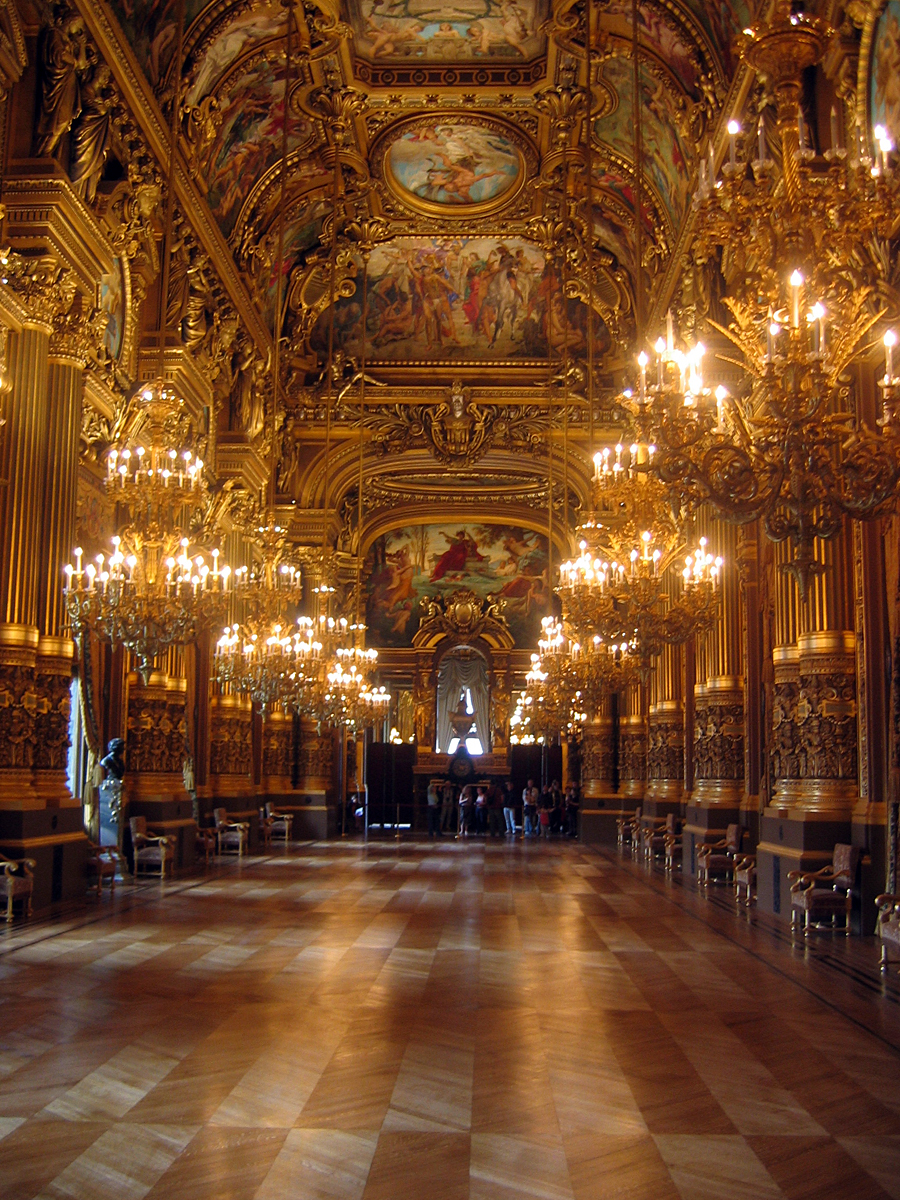
While unparalleled as the location for our conscious representations, glimmerings in the cultural imagination suggest that, as a psychogeography, the Internet is too real, or not real enough to fully articulate the more subconscious aspects of human experience, and other settings may have to be found. Last year I watched the TV show Battlestar Galactica, which (beyond its interesting treatment of the role of belief in the contemporary world) made use of a particular psychic location as a symbolic layer over the real world, directly experienced in visions by a number of the characters: the location of the Opera House. While in the show's plot this location ultimately served as only a cheap visual metaphor, its implications for the cultural imagination are far more suggestive. As an academic colleague pointed out, the Opera House replaces the sci-fi trope of virtual reality with a deeper psychic or subconscious reality, the theater as the place where the contents of our imaginations are made real for all of us. I have dreamt of the Opera House many times (though I was once an actor); it is, as Kerouac says in his own Book of Dreams, the Theater... that old spooky opera house and high school auditorium and classmeet hall of all my days, with hints from all the stages of Time's earth and actors too." While the symbol of the Opera House is still uncharted territory on the Internets, one only has to consider the mythological and ritual bombast of Wagner's operas, or just go see a movie. The drawing of the curtains, or now the darkening of the lights, acts as a veil torn between worlds, so that we sensually enter into the realities of our imaginations; the 3D wonderland of Pandora, the barely repressed longings to rescue Gotham, the Theater as the latest incarnation of the temple sanctum, where the gods become real in us. As Shakespeare said, all the world's a stage. We dream of the day (as Vinge does in Rainbows End) when our technologies allow us to visually project the settings of our imaginations onto the physical landscapes around us, so that we really will inhabit the lands of our dreams.

But where is this place (if not in us), and how are we to get there? The ancient Roman orators had a technique for memorizing long speeches and poems called the Method of Loci: one is asked to create a Memory Palace, taking a highly familiar location and placing in it associated images for the information to be recalled, so that all one has to do is stroll through the loci in the correct order. Personally I am interested in reverse-engineering this process, not further associating psychic terrains but unpacking all the cultural references that have been associated over time to various settings (a hermeneutics of the Opera House, of the Badlands, even of my dreams, whose consistent world this house is a cipher). The cities we inhabit may have a psychological effect on us, but we built the cities in our own image, and buried in them strata of meaning and longing. Perhaps we may uncover the ancient fear of Wilderness that has led so gradually to the current environmental destruction, or just learn to feel at home again, wherever we find ourselves.

1.01.2010

More USD reviews

Post-Gazette review of the Unlimited Story Deck

Reviews and articles continue to come in, along with emails from teachers who want to purchase copies once the deck is eventually published!

This is a very exciting way to begin the new year, and I hope everyone has as blessed a 2010 as I plan on having.


12.24.2009

LA Times Book Review of the Unlimited Story Deck

Carolyn Kellogg of the Los Angeles Times Book Review, has just posted a positive (and humorous) review of my Unlimited Story Deck!

I am deeply flattered, as the cards are still only in a beta version (though available under a Creative Commons license for download) and not yet actually published. Hopefully someone who can resolve that problem will see it and contact me, but this is a pretty good way to end the year.

Happy Holy Days and stay warm inside!

12.14.2009

The Somnolent Territories

Inspired by recent poetry readings, I've started working on some new verses for the first time in years, and in the process went back through some older unpublished works to find and edit this piece, which is essentially a catalog of places I visit in my sleep. Enjoy!


The Somnolent Territories

roving insomniac landscapes
cities hung off the cliffs of mind’s eye
no windows and a blurry clock
peeling the hours between dim alleys
crooked wooden dovecote homes
and the diagonal drift of vague
symbol-choked bars and opera halls
rocknroll dripping from the walls of

haunted hallucinating forests
footsteps cobwebbed off a too-close moon
searching for that one winged book
and a lock to lost love’s keystone
crumpled across the dunes and obelisks
of memory’s striated bedrock
vast with sand in the hourglass eye
and only one light on in the ruins
where they mine for replicating relics
to prove the world was ever here
but only in the lone of night when

the desert of soul ripples with worms
worm holes and the witch’s grotto
she’ll sell you charms and insurance
against early morning amnesia
and the mountains of shivering ice
carved to statues of flayed godsflesh
down the porcelain-leaved road of trials
all highways pass the convex lake
to the city of crystal and conveyors
floating on the edge of that abyss
where they fight off tooth decay
and visions of apocalypse by fire
and you don’t want to know
what lurks in the subbasement

but down to the beach
which we still can never reach
straddling tall mossy barrier reefs
beyond pirated jungle villas
to watch the spume of whalebacks
and the underwater sun slope
out of this rose colored sea of dreams
while the lighthouse keeps blinking
on the shelf of my father’s study
calling out to some greater tower
lying leagues offshore maybe north or

in an Oakland you can’t reach either
and or the walls are all façades and or
labyrinthine with jeebering horrors
you shouldn’t have asked about
and just like every childhood nightmare
it’s hiding around the corners
and or those walls are actually
a hostile alien life form maybe
a dark chaotic maelstrom that will
transport you to another dimension
like endless stairwells or the gates of hell
you can’t seem to stay away from
those worm holes rippling
and somewhere in the middle where
spiders spin the worlds together
is maybe a good night’s sleep.

12.05.2009

Truth and the Transcendent Function

Still preparing to dive into "The Red Book," I reread Jung's essay, "The Transcendent Function," in which he describes the technique that he used for his process of self-experimentation, a method for consciously delving into the subconscious and uniting them, which was also the practice he recommended to patients in order to continue working on their subconscious materials after or outside of therapy.

The method is one of active imagining, and involves taking whatever emotional state one is in and allowing that mood to become more conscious, at the same time writing down associations of that state (in a controlled manner, in order to not go off into other areas of the subconscious), until the unconscious emotion is enriched and clarified. Or, if there is no particular emotion to focus on, one should remove critical attention and let inner images, voices, or movements emerge, taking similar associative or symbolic notes. Once this material has been collected, Jung suggests (here from his own experience, viz. the Red Book), to either subject it to creative formulation or analytical understanding, that is, to give the unconscious an aesthetic form or concrete meaning, depending on one's tendencies towards either art or logic. The important thing though, is not to get caught up in either the form or meaning alone, but to be able to go back and forth between the two, essentially creating an internal dialogue by which the antipathy between the unconscious and conscious minds is transcended.

I have personally had much success with such methods of active imagination, particularly through dreaming (which Jung claims was too difficult to generally recommend as a method) and elaboration as internal fiction, which over the years has put me into direct contact with many of the subconscious forces and symbols that hold play over my psychology. My intention in reading "The Red Book" slowly and through Jung's techniques is in order to return to another stage in my own psychic self-experimentations.

One of the more interesting things I've discovered through becoming more in tune with my subconscious is a decreasing need for such conscious graspings as truth, non-contradiction, and blunt logic (while at the same time being able, ideally, to apply these to a wider scope). As Jung so deftly puts it in this essay:
"One of the greatest obstacles to psychological understanding is the inquisitive desire to know whether the psychological factor is "true" or "correct." If the description of it is not erroneous or false, then the factor is valid in itself and proves its validity by its very existence. One might just as well ask if the duck-billed platypus is a "true" or "correct" invention of the Creator's will. Equally childish is the prejudice against the role which mythological assumptions play in the life of the psyche. Since they are not "true," it is argued, they have no place in a scientific explanation. But mythologems exist, even though their statements do not coincide with our incommensurable idea of "truth."
Of course, one runs into such grasping for truth and consistency almost everywhere you turn, spying every day yet another atheistic rebuttal of belief, such as this article from Alternet on demanding evidence from religious believers (which asks: “Why do you think God or the supernatural exists? What makes you think this is true? What evidence do you have for this belief?”), when the important thing about belief is that one believes without proof, to demand evidence or a truth behind beliefs is to entirely miss the point of believing (at least for me; I will never apologize or condone dogmatism of any flavor). And furthermore, as Jung seems to agree, the important thing is not whether the contents of our belief are true or false, but what those beliefs allow us to feel or do in the real world. The belief exists, and extends beyond truthiness.

I encountered this kind of grasping in my Wisdom class the other day, discussing Berger's concept of the social construction of reality, which my teacher wanted to refute logically, at all costs. Granted, this teacher has applied logical arguments and the principle of truth = non-contradiction to everything we've read this semester, from Aristotle to Lao-tzu, and seems to find all of them lacking as logically consistent systems of wisdom, while I sit there baffled, wondering how logic will ever get you to wisdom, which for me seems at least equal parts belief. Now if this wasn't frustrating enough, the teacher's specific beef with Berger's theory (which I haven't read, so won't comment on myself), was that: to construct reality implies that reality has been made up or fabricated, and as a fiction it is thus false and a pack of lies of no value, etc. And that's the rub, the assumption that fiction necessarily equals falsehood, that things imagined can not convey truth or really effect the world, regardless of if the contents represent any historical, existent reality. Even the too-smart-for-his-britches philosophy major I usually disagree with was aghast, and despite our best arguments the teacher refused to listen to that his "truth" might be wrong.

It seems to me that this perspective is like someone only using the conscious part of their mind, ignoring or fending off the "demons of the irrational" subconscious instead of accepting them as equally a part of who we are, which they are, and if that boundary is transcended then we can begin to enjoy ourselves more fully in the world and more fully accept this world in all its irrational and boundless glory.

11.30.2009

The Unlimited Story Deck – Artist’s Statement

“I think we should put some mountains here. Otherwise, what are all the characters going to fall off of?” -Laurie Anderson
As a storyteller and theorist on the role that narratives play in our lives, I am concerned with how we produce stories, particularly in our contemporary, hyper-mediated age. We are exposed to narratives everywhere we turn, from the news and movies, to the expression of our memories and daily experiences. Despite this overwhelming abundance of narrative forms, it seems that people often take in stories passively, and do not think about how each of us are continually narrating the world around us. The uncertainty over the future of print media and the Internet’s allowance of the production of rapid and potentially low-quality narratives point to a pressing need to encourage people to continue to learn and enjoy the art of good storytelling. To this end I have created a game and technology, called the Unlimited Story Deck, which can be used to highlight the ways in which we construct narratives, both individually and as communities, and encourage people to tell and enjoy telling new and quality narratives.

There is a myth that that the authorial process is a challenging, mystical, and solitary craft. On the contrary though, everyone is telling stories all the time; the ability to form narrative connections between diverse concepts in our lives may be one of our most rudimentary abilities. Scott McCloud, in his Understanding Comics, suggests that we make such intuitive narrative connections when making sense between the panels of comics . We recognize patterns and desire causal or associational relationships between the contents of our experience, regardless of what those contents are or the contexts and mediums in which they are encountered, just as in comics we don’t need to be told how to interpret the variously arranged and disjointed panels. The Unlimited Story Deck works by presenting its users with a variety of such juxtaposed concepts, from which we can recognize and express our narrative connections.

But what are these contents or concepts we recognize and construct narratives from? The Pre-Socratic philosopher Anaximander believed that all reality was constructed from one underlying substance that he called the Unlimited, essentially a storehouse or database of all potential qualities that could be intermixed and expressed in the world . While this was subsequently disproved as a valid physical theory of the Universe, it may serve as a metaphor for the field of storytelling, in that all narrative realities are constructed from the intermixing and expressing of the unlimited storehouse of conceptualized language. Specifically, we find in stories concepts for characters, settings, events, objects, and dynamics, which are intermixed and expressed in a variety of ways. Each card of the Unlimited Story Deck presents one of these types of storytelling concepts, which can be played in a variety of ways to construct narratives.

While one of my aims is to see how we tell stories outside of expected forms or mediums, (otherwise how might they be novel), it seems we can tell stories from concepts because they are familiar or recognizable from our experience; we know the associations and trappings and how they might be used. There are through the wealth of human narratives certain types of stories that are told again and again, and which anyone who has ever read a book or watched a movie might immediately recognize. Like Anaximander’s Unlimited, one imagines a database of all available narrative types, a technology that Heidegger would call a “standing-reserve” of concepts , which reveal these concepts for us to use in story creation. For the Unlimited Story Deck I have collected such recognizable types of content, which should allow its users to more readily and enjoyably create narratives. Though the form of a deck is limited, physically by the need to shuffle the cards, the permutations of narrative connections between any of these concepts is as unlimited as the human imagination.

While I believe our ability to form narrative connections is intuitive, telling stories still takes work. As media theorist Espen Aarseth suggests, texts are machines for the production of narrative meaning that require the input of a human user to make them operate . Even traditional narrative forms like the novel require some amount of feedback and interpretation from the reader to make sense of a story. On the other hand, this ergodic feedback can be fun, when viewed as games that encourage us to enjoy the act of problem solving or narrative resolution . While it does not present the kinds of goals typical of games, the Unlimited Story Deck is intended to induce the same kind of fun when played by randomly generating concepts that we have to express as narratives, and as such stands in a tradition of storytelling and card games that require interaction to form narrative connections.

Aarseth notes that one of the oldest books, the Chinese I Ching, makes use of discrete nonlinear/random methods for being read, producing 4096 possible distinct readings from the permutations of its symbols . A similar and more direct antecedent is the divinatory system of the Tarot, which presents its users with randomly drawn cards that each contain a concept or archetype from which a reading is constructed. Some important aspects of the Tarot to note are that 1). The archetypes are drawn from familiar or basic situations in human life, 2). Provide open guidelines for the spatio-temporal arrangement and reading of the cards, and 3). Ask the reader to consider the cards and their constructed narrative as a representation of the reader and their personal associations to the cards’ contents.

This last point becomes important when considering another antecedent: that of role-playing games such as Dungeons and Dragons. Though many actions in RPGs are decided through the chance of dice rolls, this kind of game’s fun comes primarily through the story that the players and game master construct and express from the randomness of events and charts of possible outcomes. The players are encouraged towards this act of narrative construction because they identify themselves with the characters in the story. While the Unlimited Story Deck could be used in a similar, self-representational way, it seems that this identification between reader and character may be an integral part of how we interpret stories: by imagining ourselves into the situations and relationships presented these become real for us. Many of the cards in this deck have thus been addressed to the user to encourage their involvement in the stories that can be constructed.

A last few antecedent forms to consider include collectible card games, such as Magic: The Gathering, where players place cards on the table that each represent different characters or forces operating on each other. While this may look the most like the Ultimate Story Deck, collectible card games don’t generally encourage narrative creation and have very particular constraints of game play and goal-situations. Another card game worth mentioning though is Fluxx, where the cards played change the rules and end-situations of the game. This is closer to the player relationship to the cards played in the Ultimate Story Deck, but once again without the use of narratives. Lastly is the card game 1000 Blank White Cards (which I have yet to play, and so can’t speak freely about how it operates), essentially blank cards drawn on by the players to make up the game as it goes along. The Ultimate Story Deck seems very similar to this, but with a preset range of cards and a focus on narration somewhat more similar to the Surrealist storytelling game Exquisite Corpse, where a narrative is made up by people passing around sentences to be finished or continued.


This project is still unfinished, the cards are being designed and should hopefully be done next week in time to start play-testing how the Deck works. More details forthcoming.


1. Scott McCloud. Understanding Comics: The Invisible Art (New York: HarperPerrenial, 1994) 62-4
2. Philip Wheelwright [Ed.] The Presocratics (New York: Macmillan, 1985) 53
3. Martin Heidegger. The Question Concerning Technology. Basic Writings. David Farrell Krell [Ed.] 322
4. Espen Aarseth. Cybertext: Perspectives on Ergodic Literature (Baltimore: John Hopkins University) 20-1
5. Raph Koster. A Theory of Fun for Game Design (http://www.gamasutra.com/features/20041203/koster_01.shtml, 11.30.09)
6. Aarseth 9

11.26.2009

Process and the Past

Despite the need to be working on various school and personal creative projects right now I find myself in the middle of a process of going back through past writings and making them more interconnected and available, in short a bit of personal house cleaning, which seems necessary for several reasons. Primarily I have just gotten out of a long term relationship and am realizing that, as happens when ones' life gets intimately wrapped up in that of another, there are many perspectives and interests that I've neglected over the last several years, that need to be dug out and tied back in to my current projects and perspectives before I can begin fully working on those things from a fuller and more integrated place.

Some things I've noticed while doing this: obviously the recognition of neglected perspectives, including poetic, occult, revolutionary, metaphysical, oneiric, and process-oriented views of the world, which have shaped much of my current stance despite getting brief or invisible coverage in my thoughts of late.

Secondly I noticed that I was apt in the past to spill out great amounts of personal drama and woe on the Internet, which more recently I've learned not to do. We all go through emotional turmoil at times, but don't necessarily need to present that publicly. This is not though just a choosing not to present these facets of my life, but a recognition that I and my writing have actually matured, so that these emotional contents do not press on me with the same amount of ferocious necessity that they once did; I can separate what I want to say from all the chaos that surrounds the thoughts and words. On the other hand, what is missing from more academic framings of thought is that ideas are always intimately bound up in our experience. To not discuss personal narratives and the experiential engagement with our ideas, that is, how we live out our thoughts in our real lives, is to present a too small and flattened view of what reality is. Our lives, despite our ideals and intentions, are messy, upsetting, and influence everything that goes on in our heads, and recognizing our fears and doubts and questions along side the theories and fictions is ultimately a more true representation of reality, but one that needs to find balance between discretion and disclosure.

It seems necessary to recognize these things in light of the words inscribed above the Delphic Oracle: know thyself. From time to time, life takes hold and we forget who we fully are, and must return to the process and the past in order to find out again, and again, and move forward from the present in full knowledge and being.

11.24.2009

On Ultimate Realism

I haven't written much yet publicly on the new perspective or belief system I have been attempting to formulate over this past year, a perspective that I call Ultimate Realism, which is perhaps best summed up by the quote from Patchen's Memoirs of a Shy Pornogrpaher: "Everything which man can imagine, dream, or conceivably want to exist... does exist."

This view first occurred to me one day last year during a week of spiritual-existential difficulty. I had gone to a local bar and ran into an acquaintance, who said, having not seen me in ages due to my focus on school and writing, "welcome back to the real world," to which I could only reply, but isn't everywhere also just as real? and then wandered down the street struck by the total implications of everything around me being that real. There is some sense in which we tend to believe that only those habits and experiences that we usually have are really real, or at least of the most real importance to us, forgetting that other experiences we don't have are just as real. And beyond existing situations, every content of our imaginations and the stories we tell is real, in that these have real effects in the real world. And ultimately, any perspective that will allow us to articulate our lives in the whole of such a multifaceted reality, and perhaps allow us to formulate a perspective of global significance and understanding, will have to put us in relation to that whole, not just as it is scientifically and historically understood, but in relation to all that humans have said, imagined, believed, and dreamed.

This view has come out of years of questioning spiritual beliefs and the nature of the stories we tell. How do we, as human beings in a world with other human beings, deal with the fact that people have divergent and often contradictory views on what the world is and our place in it? Historically, belief systems have clashed, and continue to clash because each side takes their perspective as most true and right, whereas if one view was somehow objectively true and right there should be no cause for conflict; and yet there is. In my own life I have struggled with such limited perspectives, not knowing in what to believe, as the beliefs always seemed too small, and yet needing to believe in something, to tell some kind of story, and finally recognizing that any belief I would want to hold would have to be large enough to contain all possibilities of believing.

Similarly I fear global destruction due to the clash of these limited perspectives, and that we as a species do not have the stories to set us in relation to where we are now that might allow us to continue into the future in a meaningful, healthy, and positive way. The stories we are prone to tell today are often too small, quotidian, dealing with failure, comeuppance, and the meaningless joy ride of post-modernity, whereas we need a perspective that can address the Universe as a whole, for future generations of humanity in this Universe. These stories must be ultimate in order to place us and our actions in the widest set of meaning or significance necessary for survival.

My old professor, Dr. Fred Clothey (a student of famed mythographer Mircea Eliade), suggested that the stories we tell can tell us about ourselves, in effect modeling our understanding of reality in order to authenticate current actions and allow future actions. Our stories/ myths/ beliefs/ perspectives, etc. can do this precisely when they are cast in an "aura of ultimate significance," that is, by referring us to the widest possible scope of experience and understanding, to our cosmic and social beginnings, to our longed for and feared endings, to our ideals taking on human form. We find our place and being in between the limits of the real as we know it.

One such ultimate signifier, that has had a direct effect on real occurrences, is the concept of God(s). While belief in supernatural beings has allowed articulation of our relation to society and mortality, is has, perhaps most clearly and distressingly, served as a justification for centuries worth of horror and cruelty: crusades, inquisitions, terrorism, or just plain ignorance. But we are prone to forget in our polarized times that this personification of ultimate ideals was also a necessary and integral perspective for the development of scientific reasoning, framing an objective and total perspective that we humans could then hope to achieve ourselves, a belief that has existed coterminous to science up through the 20th century. Contemporary atheists might be glad that God is no longer a reference for rational understanding, but "His" death has negative impacts as well: God has traditionally not only been a signifier for ultimate perspective and knowing, but also for perfection and goodness, in short, ethical understanding of behavior, without which we do things like build the atomic bomb. Technology runs rampant when not placed in the widest relation to how it might rightly be used, or the lack of an ethical signifier allows the cultural insecurities that haunt us to become manifest, and such horrors not only be imagined but made real. One imagines a similar lack of ultimate significance in the perspectives that have allowed western culture's unparalleled material consumption, environmental destruction, and continued ideological warfare on the rest of humanity.

I am not arguing here for a return to a belief in the traditional monotheistic God or earlier gods. These stories, as we have seen, are just too small and conflict-provoking compared to those perspectives that now need to be adopted. I am arguing though for a greater belief in the reality and efficacy of the contents of our stories and imaginations, and an awareness of how these otherwise subconscious narratives influence the real world.

One of the problems to this approach is the primacy we give to literal truth, vs. the obvious falsity of our "true" representations of reality. I am a huge fan of stories of the fantastic, of the magical, supernatural, weird, heroic, or sci-fi, which, looking at the predominance of these themes in the current cultural media and imagination, I believe I am not alone in. But why do we love supermen, zombies, and the end of the world? There has been a trend in storytelling, dating from the late 18th century, of attempting to represent reality as it "really is," social or quotidian realism, and not as an allegorical reference for otherwise real things. Fiction, when it first was read as not literally true, was cast as "petite histories," in order to accept stories they had to mimic reality while being divorced from talking about reality. My immediate response to all this is, there's already too much of the world we experience on a daily basis, why create more of it, when stories beyond the everyday may raise possibilities of experience and understanding more than that which we are already familiar with. That familiarity constrains us, by being real, to the obviously inadequate belief systems we now live under. We hold up what we believe is a mirror and say, this is real, and because we say it, that marks the bounds up what we will allow to be really real.

My second issue with realism is that it is not reality despite how it primps and masquerades itself as such. It may represent aspects of reality, but does so by relying on and reaffirming our assumptions about how the world is and should be, which constrains us to accepting those views and realities as more true or valid, to the exclusion of wider views. And today it seems our view of the real is that it frankly sucks and nothing matters anymore. And any attempt to actually discuss real human issues in an emotionally valid way is negated by the irony and scorn with which we articulate the real world. The fantastic however, by being non-real and symbolic of the real (mythopoetic in Tolkien's terms), precisely allows us to highlight those human themes and conditions we want to examine in truthful ways. But in order to even accept the contents of fantastic stories we must (as Coleridge first suggested) suspend our disbelief of those things that couldn't be literally true in our everyday experience. We no longer have a problem leaping into wizard fights or across star systems, we can suspend disbelief but we are never asked to truly believe, and thus are not as prone to take such fantasies as being symbolic or ultimately significant for how we really are or could be in the world. We are content to let them be mere entertainments and diversions rather than suggestions of possibility.

Yet, are ghosts and gods really real, or is this even the right way of framing the question? There is a sense that certain things are existentially real, they commit us to accepting their physical reality, being right in front of us. The invisible and imaginative do not so commit us; one can not empirically and scientifically prove a god's actual existence. To argue one way or the other for this is to miss the entire point about gods. But one can clearly see the effects that belief in such unprovables has on our world, both on our perspectives and psychologies and in actual historical occurrences. Ignoring and belittling the immaterial causes of such beliefs and effects does little to add to our understanding of ourselves in the world, allows the results of inappropriate or too-small beliefs to continue unchecked, and limits the human imagination to articulate new possibilities of being and understanding being, which are necessary for our current and continued survival, let alone enjoyment and well being. On the other hand, if we do not remember that the stories we tell are only stories, that have been made up despite their real effects, we run the risk of mistaking the stories as literally true, thus causing us to act in dangerous and inappropriate ways, when imagining better stories to live by and through is always an option (and it is this lack of awareness of the power of our symbols that I mean by the absent narrative).

I do not know where we will go from here, but I am wary and sick of the post-modern skepticism that rejects any ultimate significance in favor of what we can directly lay our hands on (and in so doing, strangle it to death). I would prefer to see interconnections of the layers of reality rather than the whole's deconstruction and rebuttal. Acting as if we know everything and nothing really matters is perhaps the smallest and most dangerous perspective one could hold. Ultimately, we exist in a Universe which we barely understand, and in which we are a bare speck, and perhaps in that widest view humanity is indeed meaningless and fated to extinction for lack of any better options. And yet it is also possible to believe, and live by the belief, that life and our consciousness of life may be more than a random fluke or evolutionary mistake; not that we serve some clear teleological purpose or extant will of God, but that for all these unknowns we are still real, and still here, and confronted with the implications of that for all reality.

Though reality may be inherently meaningless we have the choice to take on meanings and act on those meanings, to continue to be and gather greater understanding and significance, both on this planet and in the Universe as a whole, should we choose to accept this mission. Anything less than such an Ultimately Realist perspective sells ourselves short, and will only propel us down the road of meaninglessness and destruction. But if we can perhaps articulate a perspective wide enough, not just for all humans, but all life in general and beyond life, then perhaps we can continue on until that perspective, and all else we can imagine, becomes real.

11.22.2009

The Artist's Mind/ the Public Eye

Last night I went out to reading held by the local Six Gallery Press, as I haven't been getting out of the house much lately and needed that creative inspiration. There I ran into my friend, the gentle giant Jessica Fenlon, who as always was gushing with her creative process. We stood on the corner talking about that moment when one is writing or making art, and everything starts to come together, not just in the work, but literally as if the contents of the art suddenly spilled over into reality with a great a-ha (such epiphanic moments being for me one of the strongest reasons to and for which to create, somewhat like the faulty pattern recognition of apophenia, except as artists, who else decides what patterns are real?)

Birdeyes

What was actually more inspiring than the reading was afterward finding Jessica's website, drawclose, which, besides having some of her rather fantastic and surreal videos, made me realize that I have far too many creative outlets that a). I've been terribly neglecting of late, and b). aren't as represented on the interwebs as they could be. At least not in one cohesive place. I realize I should probably bite it and get a domain name at some point, but for now I've taken the trouble to make the links to my various writings more visible in the sidebar here, as well as update a ton of artwork from the past 8 years to my flickr account, in particular making new sets for Collages, Inklings, and photographs of Modern Ruins. The next step will be figuring out the best way to host music so that I can put up recordings somewhere.

On the other hand, I am also reaching a point of frustration with the easy and public mediation of the Internet, which happens every couple of years, when I get too caught up in the public representations and analyzes and begin neglecting the creative process all together. It seems to me that we live in an age where everyone is creating (or at least "producing content") all the time, and is equally making that content available, all the time, except what is lost is the ability to step back, to edit, to build larger projects. Or, is lost the necessary silence, the magical space created when no one knows where or who you are or what you are doing, when out of the public eye the artist's mind is the total sphere of attention, and anything becomes possible. It is only when you disappear into the work that the epiphany truly starts to happen. And it won't if you're too busy telling people about it to let the threads weave and build up to something more than the just this.

9.30.2009

Questioning Socrates through the Socratic Method

In my religious studies class on Wisdom we have been reading Plato's dialogues, and were asked to write a dialogue in that style on whether or not we thought Socrates was actually wise (meaning of course that we had to actually state what we though wisdom is, something Socrates was loathe to do). I'm posting the results as part of my ongoing inquiry into human value(s). Interestingly, my take that wisdom should be some sort of heuristic or useful way of determining how to live in the world seems to be answered in our next class reading, Aristotle's "Nichomachean Ethics."


The Sophia

SOPHIA: My dear, thank you for being able to meet with me, I know that you have a lot of work to do this weekend.

TAIT: It is my pleasure. If I can I will always be available to you, and besides, it is a wonderful day out along the river, and I desperately needed a break from my writing. Now what was it you wanted to discuss?

SOPHIA: Wisdom, of which I always have so many questions, and as you know am in sore need of these days.

TAIT: I agree with that for my own sake. Did you not read Plato’s Five Dialogues that I lent to you? Did you not find Socrates to be wise?

SOPHIA: Well, they say Socrates is the wisest man there was, at least in the Western tradition, but I had a hard time understanding just what he thought wisdom is.

TAIT: How so?

SOPHIA: Well he talks in circles, always confounding any clear point he might make by loosing me in a labyrinth of language, and then when each dialogue is over he rushes off without giving any clear answer to what he’s getting at, like when discussing piety or virtue. It seems disingenuous; the wise should at least be able to make a clear statement of what that means, so that others might understand, if not follow them.

TAIT: I agree with you, wisdom should be articulable if anything is, but perhaps Socrates doesn’t know what wisdom is enough to state it clearly? As he admits in his Apology, he alone knows that he does not know anything, and perhaps this makes him wiser than others who do think they know.

SOPHIA: Perhaps, but if this is wisdom, he is not using it to help others become more wise. As he states, his project is to prove if others are wiser than him or not, and finds them all lacking. It seems that if we were to listen to him we would all become confused fools unable to even say that we know our own names!

TAIT: That would be tragic if it was true! He also says in Phaedo that his purpose is that others may agree with him, which I’m not sure whether to take seriously either. One clear point I do agree with is that the unexamined life is not worth living, and clearly he wants us to examine our lives on this subject, and by throwing out what we think we know perhaps we can come to a better understanding of what we don’t. I think he says some things about wisdom that it would be hard not to agree with as well.

SOPHIA: Such as?

TAIT: Let us spell them out directly, as you and I are both inimical to Socrates’ circular arguments, and perhaps we can make some sense of this subject. Reading through the dialogues, Socrates variously states that wisdom relates to the following: deciding what is right or doing and believing in what is right, piety or duty to obligations and agreements, justice, a preference for the truth, not prejudging knowledge, striving for such positive abstractions as Beauty or Goodness, courage or not fearing death, obeying the state or one’s superiors, caring for one’s virtue or excellence of the soul over the body or material concerns, examining our lives, finding what is right in oneself rather than in popular opinion, not doing wrong when others wrong you, moderation, directing our actions towards goodness, a true opinion from the gods (or from dreams and omens), a rejection of the body to prepare us for death, a cleansing or purification of the soul, following reason and truth rather than the senses, and a harmony of the soul.

SOPHIA: Well, that is indeed a motley list, what are we to do with it? Surely these are not all different kinds of wisdom?

TAIT: Hardly. Socrates likes to point out that we should not seek the particulars but the generalized Forms behind them (though that might only be Plato putting words in the wise man’s mouth; I’m not convinced these Forms aren’t some abstraction we have made up). But as such these would all be aspects of wisdom.

SOPHIA: And wisdom would be something that contains or expresses them all?

TAIT: Assuming they are all necessary for wisdom. There are perhaps a few I am not sure are so wise, namely where he equates wisdom with servitude, being death-driven, and god-granted. But first let’s get at the Form before throwing out the particulars, otherwise how would we have a definition or standard by which to judge the parts?

SOPHIA: That seems like a sound approach. What do they suggest?

TAIT: Let’s see… it seems that Socrates is suggesting that wisdom is a kind of thing that allows humans to direct their actions towards good or true ways of being in the world in order to prepare their souls for death. Does that sound correct?

SOPHIA: For now let us say wisdom is that. But what kind of thing is wisdom that it allows us to do this? Surely it is not a virtue itself like courage or justice, for as we said those are parts of wisdom, which wisdom helps us direct ourselves toward or with.

TAIT: Socrates does not say. Personally I am inclined to say that in our definition wisdom is a heuristic, a method or strategy for thinking or deciding our actions in an optimal manner.

SOPHIA: Ah! So that those who have wisdom have a method of living more virtuously than those who do not. That would be nice to have. How could I find such a way of directing myself?

TAIT: Socrates does not say that either. In fact, he is inclined to believe that we cannot learn wisdom at all, only recollect it from an earlier life, like virtue in Meno, or find it in ourselves as a true opinion granted by the gods.

SOPHIA: But if that is the case, how is it possible for some people to be wise and others not?

TAIT: Perhaps we are to think that some people do not recollect as well as others, or do not listen to the opinions of the gods as clearly. Others may not even believe in the gods, but that doesn’t seem to mean that they cannot also be wise, or that wisdom should not also be for the forgetful. These are the ones who might need wisdom the most!

SOPHIA: And surely Socrates would want them to have it, even if, as an Athenian, he was privileged with a certain kind of education and lifestyle that allowed him to go around questioning everyone else’s assumptions. He does seem concerned with people in general.

TAIT: He does, but doesn’t say much about them when discussing wisdom. Perhaps then our definition of wisdom is not wide enough, and other attributes are necessary for wisdom to be clearly stated. – Such as?

TAIT: Well, from what we just discussed, it seems that wisdom must necessarily be teachable, to anyone. Perhaps more specifically, this means to me that wisdom must be both practical and practicable, for without clear and direct methods or guides for directing our actions toward rightness or goodness, how are we to know if we are doing the correct thing? This is particularly the case in today’s world, which as we know is often very confusing. It is difficult to tell what is right, and often times we have to make choices between doing what we need to in order to survive and doing things in a virtuous manner. I know that sometimes going to work feels like it is not a right action, especially when it adds to the total amount of material consumption in the world, which I for one do not find virtuous. Yet I have to work in order to live. Whatever wisdom is, it should be practical enough to allow us to know what is the right way to act in morally ambiguous or paradoxical circumstances, not only directing us towards virtues in the abstract but also establishing them as a practice in our everyday lives.

SOPHIA: Yes, I hadn’t thought of that, but it is true. Do I drive my car to see my mother, or not see my mother because driving is bad for the environment? Socrates seems sure that the right action is generally a pretty clear thing, given by the gods, and now it is not the case at all!

TAIT: And it gets more complicated than that, I’m afraid. As we said before, wisdom should also be for those for whom it is hard to come by. I would go further to say that wisdom should be for everybody, in any place or time, regardless of upbringing or cultural values. For though Socrates’ wisdom is most clearly applicable to the society of ancient Greece, it would only be a part of the Form of wisdom if it were not also applicable to any situation in which it is beneficial to act with rightness, goodness, or truth.

SOPHIA: That does follow, and it would indeed be a great wisdom if all people could follow or practice it. But you said this was complicated?

TAIT: Yes, unfortunately. The thing Socrates neglects, perhaps in thinking of his particular culture as the apex of civilization, is that not everyone in all places and times has the same perspective on what is right, good, beautiful, or true. Even we in one place and time don’t know what is always right, and people raised under vastly different circumstances may come at what is right from entirely different directions. Consider beauty as an example. Though there is a Form of the Beautiful, particular things we encounter may be beautiful to one person but not to another, or, depending on our moods or experiences may appear variably beautiful to us or not. The other virtues are no different in being thus subjective. Certainly Socrates in Phaedo warns against finding arguments true at one time and not true at another, but what I consider true, and even feel to the depths of my soul to be true, may not seem at all that way to you, otherwise everyone would always be in agreement, and that is clearly not the case. Perhaps then there are greater truths that everyone could agree on, or greater rightnesses and beauties, and maybe wisdom could lead all people toward these specific, perfect forms.

SOPHIA: But that would be boring.

TAIT: It would indeed. Perhaps wisdom then necessarily has to embrace and respect a multiplicity and diversity of perspectives as to what the aims and means of wisdom are. Instead of believing that your truth is the best truth, it would be wiser to compare it with someone else’s truth and perhaps find a larger perspective in which they are both true. If there is any way of really knowing these Forms, it is through that aspect of wisdom. At the very least it would ease many of the tensions and arguments between people, who fight for not seeing eye to eye and from holding their own truths as absolutely true. As we said, wisdom must direct us to living right in the world, and peaceful resolution of conflicts along with human understanding seem to be right, if we can say anything is. Socrates suggests wisdom is a harmony of the soul, and I would say that when we say rightness or right action, it means being in such harmony or balance, with ourselves, with other people, and with the environment of our world.

SOPHIA: So then, wisdom must be a practical, teachable, and multiple-perspective embracing method of directing our actions towards good or true, that is, harmonious, ways of being in the world? That seems a fairly clear and useful definition.

TAIT: Yes, though you forgot that we also posited from Socrates’ statements that wisdom is not for the living, but to prepare us for death. In fact, Socrates makes clear he does not think it possible to really gain knowledge of wisdom until after we are dead.

SOPHIA: But that is preposterous. Why would we need wisdom after we are dead? How can that help us now, when we most need it?

TAIT: Well, Socrates believed that we are reborn, and can recall that wisdom in our lifetimes, but it seems an assumption to state these as if they are known, true things, when clearly, and even reasonably, we can not know anything while alive about what it is like to not be alive, regardless of what you, or Socrates, wants it to be like. And yet there is still this thing called wisdom, and there is still the need for us to live in harmonious ways while actually living. If it were only for death, why shouldn’t we just kill ourselves, or, like the Christians, do terrible things while alive knowing that what really counts is the afterlife? Certainly it seems wise not to fear death, and to prepare ourselves to meet it gracefully, but it seems even wiser not to fear life, with all its contradictions and material impulses. Any wisdom that I would truly call wisdom must necessarily be directed at directing our actions in this world, for it is only in this world, while alive, regardless of if there is an afterlife or rebirth, that our actions have effects and can achieve a greater harmony, not only in ourselves or in our time, but for all peoples and times to come.

SOPHIA: Amen. Wisdom then must not be some abstract philosophical pursuit, but a real lived concern with real results in this world.

TAIT: If it were not, would people still be discussing Socrates?

SOPHIA: Academics do love abstractions though… but wait; you had another disagreement with Socrates’ specific descriptions of wisdom, something about obedience or servitude not being wise.

TAIT: Yes, thank you for reminding me. I do disagree, not that obedience is necessarily bad, sometimes other people who hold authority over us do have better or more wise ways of doing things than we do, and contrariness for its own sake often achieves little (though I, like Socrates, seem to find some pleasure in questioning everything). My problem is that Socrates seems to suggest that one must always obey, in particular the State, and must continue to obey even if those in authority do something wrong to us or others. Socrates reasons that we have made an agreement and must follow it, but I say, those in authority have also made agreements that they must follow without doing us wrong, and if they did not make such agreements, why are we obeying them? Socrates suggests that if the state does wrong then we can try to convince them to do otherwise, but as we see with individuals who do wrong, they are not prone to listening to wise advice. And where does that leave us, except with that paradoxical choice to do the more right thing, either continuing to serve or rejecting servitude. Neither is wiser and both may be necessary. But the deeper issue is, can any situation where one person or group holds power or authority over another, especially through the threat of violence, ever result in the kind of harmony of the world that we have stated wisdom is directed towards?

SOPHIA: I… don’t know.

TAIT: I don’t either, but it’s not like history has given us that many opportunities to find out. The world is still a violent and disrespectful place, even if pierced by moments of levity. But it seems that if our definition of wisdom includes a respect for a multiplicity of perspectives, this must hold also true across divisions of power. Perhaps a wiser world would not have such divisions, or, when they are necessary, would not place the greater value on those with the greater power and might.

SOPHIA: But what if those with power know best what to do? And if they don’t, who else will teach us? Can we decide for ourselves how to act harmoniously or learn some other way? I feel we’ve created circles around this without even meaning to!

TAIT: Yes, wisdom is not so clear, nor is life. But that is why we must strive for it. I will try to answer by refuting another of Socrates’ points, and hopefully end it at that. In Phaedo, Socrates suggests that wise men cannot look after themselves when free, that their wisdom is god-given in this prison called life, which is to say that they have placed the higher authority, and the burden of making responsible choices, on some force that no one can see and may or may not actually exist. The only agreements made by the gods were in the stories we made up about them, and you would have to look very far to find a deity who was truly wise and harmonious in the world. – But…

TAIT: Yes, I know you believe there may be some higher force than the gods that is truly wise and in such harmony, but such a thing is beyond our immediate kin and rationalities, and any entreaties we make toward it are perhaps only a reflection of our own inner sense of the harmony of the world, which when projected outwards becomes more clear to us. I do not know, but don’t think we even need to posit such a thing, as reassuring as it may feel, in order to live wisely. If we can not turn to the gods, or other wiser men for knowledge of wisdom, then what do we have to turn to but ourselves, that is, our experiences, which when we allow ourselves to perceive, understand, and believe in, seeking always to balance them against our senses of harmony, do seem to grant us better ways of living in the world. That being the case, those most free to experience the world would by necessity be the wisest. That is what I strive for, though admittedly, I have experienced relatively little of what the world has to offer.

SOPHIA: I like the sound of it though. It feels true, or harmonious if you want to put it that way. And what we need then may not just be more of our own experiences, but other people’s experiences, a community of experiencers, sharing our different understandings and harmonies, which can add up, like our conversation here, into some greater sense of wisdom for the whole world! – I like that very much, and hope we may find such a community one day soon.

SOPHIA: But where? Who else here will listen to these wise words?

9.21.2009

On Retrograde Motions

I discovered yesterday that Mercury's been in retrograde since the 7th until the 29th, which can help explain some of my current frustrations with not being able to write or otherwise express myself clearly. Riding my bike around after finding this out, I was somewhat relieved to know it was "only the planets" moving backwards again, but considered that actually, retrograde motion isn't real, it is only a centuries old misperception that we still express because of how it looks to us, which was itself a kind of crisis to the scientific methods, in that in our anthropocentric cosmologies the planets had to be moving backwards, and no simple and elegant system could fully articulate that, when really it was only a disparity of orbits and velocity, where the planets on wider orbits would get behind our perception of where they should be in the sky, thus appearing to move backwards.

On the other hand, I believe that as big gravitationally active objects, the planets must have some physical effect on us, the way the moon influences tides and periods. At the beginning of the war on Iraq, Mars was the closest its been to Earth in thousands of years, and I don't think that's a coincidence, so that even though the planets don't move backwards they do seem to fall behind, thus causing a seeming opposition in our actual lives, particularly Mercury, which is fairly close to us, going retrograde three times a year, often with disastrous effects to communication and travel, those fields the Egyptians relegated to Hermes' influence.

Of course it seems it would be impossible to scientifically prove if the effects of retrograde motion are real or imagined (not that that might make much difference to those who claim to feel the effects), as any experiment would require a control solar system similar enough to ours but without retrograde motion, which clearly we don't just have a spare solar system lying around, or otherwise for a survey historical records of all communication happening during periods of Mercury retrograde, which data computers might be able to crunch one day, except that "not working" or "going wrong" seem to be more in our perceptions of the intended effects of our communications then int the communications themselves, once again a matter of misperception. And so like God, retrograde motion may currently have to be relegated to the realm of the unprovable, and thus a matter of individual taste and faith to believe in. If anything though, real or not, knowing Mercury's in retrograde right now at least took some of the burden off of blaming myself solely for things not working right, which makes it possible to frame the attitudes necessary to do them different, because retrogrades reminds me to remember that we often, like Earth, get ahead of the reality of our perceptions.

9.16.2009

Faith and the Pattern

Over the past year I have been going through an extreme crisis of faith. Due to a number of physical, emotional, and psychic challenges I found myself last winter in a state of disillusionment, that everything I had previously held to be good, desirable, possible, and expected in the world may not have been the case at all, a state close to feeling jaded, except that the crisis is precisely in trying to find some reason to carry on, to still believe: in love, the power of the human spirit, self-growth, god, some point to life as we know it, or at least a deeper understanding. But the closer I looked at any of these things the further they seemed to recede, from view, from understanding, so I was left wondering if they really existed. In centuries of the human quest for the truth and goodness we are still no closer to truth it seems, and people can be as ignorant, violent, and uncaring as they always have been, if not more so, which is rather disheartening to someone who feels they have spent their life searching for and hoping to bring these positive qualities into being. More recently I have summed up my quandary in asking, what is the point of self-growth, of struggling to improve how one is in the world, when the work is hard and there seems to be no real “reward” no incentive from society to do so (though that I take this as a valid question shows at least some will towards growing). How can I spend roughly the same amount of time writing on my novel as watching a TV show, and find the same amount of satisfaction in both? And sometimes more in the casual, indulgent activities, because they are easier? This is baffling to me. I believe that everything is real, even those things we can only imagine, but nevertheless there seems to be a primacy to the everyday, to those things, which when we pick ourselves off the floor or put down our books we still have to deal with, of which we can sigh and say, well maybe this is it. But is it? Ultimately everything is real, but some things are more real than others. Worrying about money or physical pain unfortunately feel to be some of the most real there is.

The problem, I know, is one of perspective. To say, this is it, is to presuppose that we know everything there is to know about life, enough to cast some judgment on it, when really we can know nothing with any such certainty. I am aware that the mystery of the Universe is far deeper than we can fathom. Not even the scientific method can say what is really true, either point at a position or velocity of a particle but not both, or how and why they are entangled and add up to all this. Any other human effort to value one mode of the world over another is based on subjective claims, of perception, of intuition, of faith. On some level even an atheist claims, I believe God doesn’t exist, because it is a statement that can’t be proven one way or another. For centuries scientists laughed at the notion of atoms, of forces and fields, because they couldn’t be seen, only to find that maybe they really are there, and though still unseen may be more real than this, but just as inexplicable and mystic as when the ancient Greeks first made up the story. How can I know this is just it, when my intuitions, the evidence my senses have gathered over a lifetime of searching, have suggested otherwise, if but to say, maybe it’s too hard to keep looking, no one else is really looking, not everywhere at once, and the whole edifice of Western knowledge is constructed on the basis of looking only at the visible and provable, and when confronted with a reality greater than that which can be known, it crumbles, is shown to be a charade based on the misapplication of ancient dialectical devices and assumptions: that dialectics can really tell us anything about anything, for when you point at or name something it always creates the thing it is not, and the thing neither of those are, ad nauseum, the way a proton pulled from an atomic nucleus mysteriously creates another proton in its place. This is beautiful and mysterious, but then you still have to go to work, or patch up an argument with your beloved. And there is no place to escape from that reality to, no one to turn to in our need outside this predicament. No matter what your perspective is on the world/Universe, or what you believe is our place and purpose in it, we are still within that system, like an existential Goedel’s Theorem, constrained by our physical senses and abilities and ways of knowing, and still have to find some reason to get out of bed in the morning, some small joy, and maybe the courage to choose to act as decent human beings, for ourselves and others, if we have any strength and calmness left over.

But how, and why? Because most days I feel full of rage, time slipping through the eye of it and feeling there is something more I could be doing that is the thing I really am meant to be doing, except I only have a vague, limited notion of what that is and no one has stepped down from on high to let me in on the secret plan for the Universe and my role in it. I feel a lot like the character John Locke from the show Lost, who, unlike the more reason-based characters trying to escape from the Island,, has an intuitive faith that he can and is meant to solve the labyrinthine puzzle and mystery that surrounds the place, following his gut, connecting scraps of information, seeking ever deeper in the mystery, and yet still plagued by doubts, hoping someone will tell him where to look next, constrained like the original philosopher Locke to the empiricism of believing what he can see, yet unable to explain that he has seen things beyond what most people would ever believe could be real. I relate to this and wonder how many others can. I think of my neighbor, watching sports on his big-screened TV, driving his motorcycle noisily up and down our street. He seems totally fulfilled in this, as far as I can see. There is not a question or even a need for a question of is this it.

The Presocratics (who I am studying in a class on the historical roots of science in mythology), were the first to systematically ask the questions, what is really real, can and do things change, can and what do we know? These ontological and epistemological questions are the foundation of any philosophy or metaphysics, and without before realizing that, they have also been my pivotal questions (along with that bugaboo, are we free/active agents). In answer to what is really real, they posit everything from water, to air, to numbers as the foundational substance of reality, or there is Anaximander, who believed it was the Apeiron, the unlimited storehouse of potential qualities of all things as the one underlying substance. My teacher, a younger grad student, laughed, this all seems absurd or primitive in light of our current scientific conceptions of reality, and the class all nodded. Except for me it doesn’t. For me the idea of some fount, of imagination or possibility, seems more intuitively true than the random motion of subatomic particles. In fact, it is an idea recorded in a number of different spiritual traditions: the Theosophic Akashic Records, the Sufi Scriptorum, the Hebraic Book of Life, even the Platonic Forms as an underlying reality. Is this really so absurd then, or are they all wrong? And more confounding, it is something that I have experienced, with my own senses (admittedly under a mystical trance state), but without knowing of it beforehand or expecting anything of the sort. But how could I explain this in class, in the face of the entire academic apparatus that is not about my experiences but recorded “facts?” These are two entirely different views of reality, like the conflict between Evolution and Creationism, both of which are mistaken for Truth, when they can never be anything more than descriptions, stories, metaphors for processes we can never really know anything about. Pirsig’s “Zen and the Art of Motorcycle Maintenance,” (reading in my class on Narrative and Technlogy), does a good job of framing this problem, n the context of a metaphysical detective story: we can either romantically-intuitively appreciate the surface aesthetic of things, or logically seek out the structures beneath them. But not both, though that is exactly what it seems we must do. That ability and desire however were lost centuries ago, when Aristotle argued down the Sophists in the forum, paving the way for Dialectical Materialism. And the world has been a cold calculating place since, lit by moments of decadence and revelry, but with no real new understanding or wisdom, meaning or faith to guide us out of this spiritual morass.

To what can we turn then, if not to our own experiences and the way we choose to pick them up in our daily lives (this division between events and our intentions or them being my definitions of fate and destiny). Are we just trapped on this island in space or do we choose to explore what being here could mean? When the stars that guided the ancients (both in sea travel and in mythic timekeeping) now begin to fade, there are still the stars in our hearts, which is the meaning of that word desire. As Crowley said, each and every one of us is a star. For most of my life I have been a proponent of a magical worldview, most clearly as spelled out in Bill Whitcomb’s Axioms, the first three of which are that reality is created from our worldviews that can be changed, that we reaffirm or change our worldviews through attention, and that seemingly disconnected events can strike us as being intricately connected, what Jung called synchronicity, or meaningful coincidence, but I call constellations of meaning, because meaning does not exist in events but in our interpretation of the relationships between them in relation to the patterns of our worldviews. Though I have actively sought out such constellations of meaning, in the last several years they have grown few and far between, a feeling I keep expressing as that always before the pattern of meanings suggested where to look next, except recently they haven’t, and everywhere has felt like a dead end, not at all that personal Eureka moment I recall first feeling reading James Joyce’s description of that Eureka moment in “Portrait of the Artist as a Young Man” and I’ve chased after ever since. Perhaps I have stopped looking in as active or connected a manner. Or perhaps, as I fear, that though I’ve looked and connected, the net of my looking wasn’t wide enough, and the pattern or destiny I found meaningful for myself in following certain dreams and ideas is too small, is not interrelated to Reality as a whole, as was the case with the Apeiron in class. Am I crazy for having experienced something no one else has, or are they for not even considering that such things could be? So that I lost faith with any of it being meaningful. And lastly, I have been afraid, for to connect our own meanings to any larger collective meaning takes work, and forces us to confront ourselves in wholly new ways, and precisely where our old maps no longer fit the territory of actual existence.

I have come to recognize recently that my novel, and indeed my task as a creative being, is an attempt to create such interconnected maps of our experience of Reality, a daunting and seemingly impossible task (though less impossible due to our current information technologies), yet one I am driven to through whatever genetic or spiritual reasons. To this end I have to start experiencing again the world, the larger world, as synchronistically connected, however those mechanisms work, but from scratch. Because if my patterns before are what I expected to find, but clearly didn’t, then I have to forgo faith in my expectations and recreate a new pattern from nothing, from everything, but not with the certainty in thinking that Descates had in his doubting of all. And in this letting go was confronted yesterday with a number of synchronicities if not answering than at least pointing to ways out of my current crisis. I wrote a letter to my beloved discussing love in terms of encouraging another’s and our own self-growth, an idea from Peck’s “The Road Less Traveled,” and immediately after in my Wisdom class in which we are reading that book, I had to write a letter as if to a distant friend on that very subject, allowing me to better clarify my questions. Then, finishing “Zen and the Art of…” came upon a summation passage equating Pirsig’s concept of Quality (as that missing from the Western dialectical tradition) to the Presocratic Ariste, excellence or heroic virtue, virtue already being a term personally loaded with positive meaning of acting right in the world, here defined not as virtue for others but of the self, improvement and growth into what one can most be, a joy in the process that I had forgotten, also connected to the Buddhist Dharma (further constellated in relation to the mystery in Lost as well as the self-mythologizing of Kerouac). All of which left me with a big Yes! And further constellated into this essay, which before I started writing I found a blog on synchronicities, cementing the point.

But the question remains, as much as I live this and find it necessary to my life, it seems mainly like a metaphysical thought experiment, and still does not connect back to the mundane, having to work sleep, relate to other people, go the bathroom, let alone all the wars and environmental degradation and illness at large in the world. Years ago I had a chance to sit in on a Zen retreat and told the Monk that it felt like I was in a dream from which I couldn’t wake up. He said, all our ideas, knowledge, stories, expectations, these are the dream, when Reality is just this. But now I realize that what I really meant was that that just this is what feels dreamlike, or actually worse, nightmarish, when the stories and ideas would be much more wonderful if they were that primarily real. I may find joy in contemplating quantum entanglement or synchronicity, but I see my friends struggling daily to find jobs or housing, getting robbed, sick, or mentally ill, and I wonder, why is that more real? Why am I not satisfied with it, except for perhaps being raised with some religious notion of an afterlife that has crushed me on idealism and hope for more? I understand that I am in a way very privileged to be able to even ask these questions. I have a steady job, a home, friends and family and fairly good health, I was raised with an education of intelligence, creativity, and faith, and questioning. Many do not have this, or if they did they got bogged down in the tribulations of the everyday, or just don’t care. I doubt for instance that my neighbor, if he were to take time away from his TV and motortoys, would he feel inclined to ask any of this? The meaning of his everyday life and material possessions seems to be enough for him (if they really are). Does he not want to spiritually grow, or is that process different for each person? Who can answer any of this? I on the other hand do not feel like I have a choice; even at my poorest and most downtrodden I have always felt the urge and made the time to ask these questions. I suspect that, being raised to have a capacity and willingness towards belief, but always questioning the presumed things one might believe in, it is like this large, too large hole that no material thing and few non-material things have ever come close to filling, or even fitting into, that leaves me with this internal tension, a spiritual angst like a spring about to burst, that might only find ease with ordering the whole reality in myself, and then what of everything out of reality? And then what of still having to live, and share this with others? It is as if, what are these questions for if they cannot be interconnected and applied in our daily lives, for everyone’s lives? What god is a map or pattern if other people can’t follow it somewhere they want to go? That I do not know, and only raises further questions. As Rilke put it, the pattern grows more intricate and subtle & being swept along is no longer enough.

9.14.2009

Literacy Narrative

For my class on Narrative and Technology I was asked to create what's called a literacy narrative, the story of my development as as "content producer/consumer" (to use the parlance of the age, focusing also on how our experiences with media have helped us develop standards of quality. The results were interesting and integrating, somewhat like a statement of intention or a road map, if a bit lengthy and abstract (I am trying to write a novel dealing with some of these similar themes). Thought it was worth posting here:


Long before the written word meant anything to me I loved a good story. Weekend nights growing up my father would tell my brothers and I bedtime stories; made up on the spot, featuring our stuffed animals as characters, a continuing series of tales that always intertwined with the previous nights’ adventures and with the content of our lives. Years later, when my father lost his job as a graphic designer and turned to his passion for genealogy, his stories became an ongoing collection of family legends that he hasn’t finished discovering or telling us. Encouraged more than anything to use our imaginations, my twin brother and I would go on long walks on the beach each summer and make up our own stories, often placing ourselves as characters in our favorite books and video games, but also creating between us an entire internal world through our words, which we would explore and return to year after year.

When our father was at work late, our mother would read us books, from “Alice in Wonderland” to “The Wizard of Oz,” and when I learned to read, sometime before kindergarten (roughly 1985), I became a voracious reader, consuming the entire sci-fi and fantasy sections of our local libraries before turning to more realistic literatures. I was such an avid reader that I would often stay up all night reading with a flashlight under the covers, or read books beyond the reading level of my peers, which I realized in 6th grade when I read the entire unabridged “Les Misérables” back to back with the Bible. Though I read everything I could get my hands on I became most intrigued by ancient mythologies, which I discovered in dusty large-prints in the school library, containing that epic and symbolic sense that reality contains much larger stories than those we experience on a daily basis, which we are also participating in, a sense furthered through role-playing video games and the choose your own adventure novels of the ‘80s.

Most of my love of reading was due to certain challenges I experienced as a child. The first was a sensory integration dysfunction, which eventually resulted in encouragement towards more physical and multi-modal forms of expression: music, art, acting, and gymnastics. Secondly, though, or perhaps due to being, intelligent and imaginative, I was entirely outcasted from my peers, and turned instead to a richer inner life, full of imagined stories and made up games. When I became aware of popular cultures, I explored alternate ways that teenagers express who they are in the world, researching the aesthetic and arts of various subcultures, settling eventually into the narrative of punk rock, with its Do It Yourself and world-changing ideals, the idea that anyone can say anything in any way they want, giving up my viola and books for a guitar, which was my main tool for creative expression for many years, though not the one that would become ultimately important to me.

I never wrote much when I was young, a few fantasy stories in grade school, one journal filled mostly with imaginary maps and drawings. It wasn’t until the first time I tried going to college that I learned that was what I wanted to learn to do. In a philosophy class on the meaning of death I had to keep a daily journal, assumedly so the teacher could keep track of our emotional responses, but this combined with a really droll fiction class and the encouragement of my poetess girlfriend convinced me I had to apprentice myself to recording my thoughts and experiences before I could ever tell a good story. Though my family members are mainly computer programmers/designers and I was raised with several old machines in the house, I always rejected using them for my writing, in somewhat of a luddite or romantic stance (in Pirsig’s sense) combined with being too poor to afford a decent machine. Though most importantly I write by hand, and in cursive, because this method replicates the flow of my thoughts better than my mediocre typing skills, and while typing the urge to go back and edit is too strong/easy, and the sense of flow this creates is generally apparent in the finished work.

An equally important lesson from the class of death was the idea that it is possible and necessary to more fully experience life, which I took to with a vengeance, immediately dropping out of school and moving from the DC area to Pittsburgh. Due to this idea, my imagination, literariness, and love of mythology, as well as several conversations on the subject with my new likeminded band-mates, I realized that instead of experiencing life fully in a random way, a person’s life could become a story, a narrative, a work of art or self-made mythology (an idea that many associate with Kerouac, though his wasn’t at all the story I wanted to live, because it wouldn’t be a good story if it had already been told). To this end I pursued a variety of novel and extreme experiences: protest/activism/street performance, rock and roll, romance, making fairie wings, web design, blogging (and before it was called blogging), circus performances, collective living, children’s storytelling, entheogenic drugs, various spiritual and occult rituals/experiences, psychological and philosophical studies, going crazy a couple times, writing poetry, cooking, traveling, etc. Through all of which I journaled what happened and what it could mean in terms of a larger personal narrative, making several attempts to write it into a novel that was some combination of a Proustian autobiography (as in not necessarily factual) with Grant Morrison’s idea of the hypersigil, that extended works of art are akin to magic spells created in order to realize and chart the course of one’s intentions in and for the world. This magical use of writing is important, as language as a technology may also originally have been a form of magic (spelling as a spell): words have power to cause changes in how we think/look/act in the world, as well as conjure real sensory experience in our imaginations.

In order that my particular personal narrative be interesting or applicable to other people, I have attempted to tie it into common human themes and symbols culled from psychology and mythology. At the same time I have explored the deeper symbolic content of my own life through a study of my dreams, which are admittedly rather wild and epic, which have added to my personal story and sense of meaning as well as help develop my memory and sense making apparatuses. Dreams eventually took on a greater significance as a source or form of narrative, as they are contained, symbolic even when dealing with everyday concerns, and contain a weird or thwarting element in which the thing itself escapes (a concern with the possibility of description I find in Magical Realist literatures, that the imaginative and the non-real can sometimes express more about reality by sidestepping the inefficacy of language to actually capture what really is, best summed up in the Emily Dickinson line, “Tell all the truth but tell it slant...”). At the very least, dreams are like personalized narratives or an internal TV show, offering some of the most interesting inspirations to one’s artistic process.

As for my definition of Quality, it is expressed in four parts relating back to the above narrative. First I find Quality in that which is rare, unique, or novel, that is, not what can be found in the everyday or in mass consumer culture. I recall throwing my TV out the window in 7th grade and wearing a shard of the screen around my neck for many years after, though more recently I’ve been appreciating some of the higher quality TV programming (Battlestar Galactica, Lost, Deadwood), art that pushes its medium to new places or beyond the mean and expected. Quality as not yet been done.

Second, that which has Quality contains an element of intention or ability to evoke a response. Quality art always moves people in some way. Prior to an academic response it is felt viscerally, if you love it or even if you hate it the work is doing something worthwhile, allowing the viewer to experience a fullness or depth of experience. This is somewhat like Garcia Lorca’s concept of the Duende, the clear emotional depth to a performance that sets it above more rote ways of creating. Quality as authentic.

Next, Quality implies to me a harmony or reflexivity across scales, which comes from two pivotal ideas: Marshall McLuhan’s concept that the medium is the message, that form and content reflect each other, and the alchemical idea of as above so below, that the smallest scale of a work has to be reflexive of the whole, that when the parts reinforce each other they add up to something complete and larger than the sum of the parts. In terms of Quality storytelling, this means personal or local stories are reflexive of global concerns and the human condition. Quality as interconnected.

Last, I find Quality in those things that strike me as being connected to my own creative or learning processes, the eureka! or synchronistic moment where that thing is exactly what I was looking for next. Of course, this is entirely subjective and implies that Quality is conditional to the time and place of a person’s encounter with the thing, but things that don’t have that Quality don’t force themselves on our attentions in the same way (if at all). Quality as immediate and personal.

Since returning to school for creative fiction writing, in the last two years I have been trying to hone my writing process, getting a number of stories published in print and online [1] [2], making the rest of my creative output available, blogging (though I rarely have the time for this), reading more than ever, and attempting to finally finish my first novel, as there are two more pushing at the back of my brain to be written. My current literary concerns focus around the interplay of very short and very long forms, that is, flash fiction’s ability to capture the immediacy of a moment vs. the tome (800+ pages), which allows an author to create a full and changing world; second, ergodic or non-linear narratives, and last the use of storytelling and memory as a way of literally saving the world (as in backing it up so it won’t be lost), writing as a collage of personal experiences, global events and narratives, ideas, imaginations, &c. which I wish that I'd thought of two decades ago before my father's bedtime stories were mostly forgotten.

9.02.2009

Magic Shoes

Contemporary Americans generally do not wear magical amulets, or other specially-endowed articles of clothing, as in other times or cultures, such as the ghost shirts of the Lakota Indians. Certainly there are superstitions, lucky sports caps or underwear for the winning game or date, but clothing as a statement and symbolically intentional affect has declined somewhat in the last several decades. We may still wear suits to work or funerals, jerseys to games, jewelry to dinner, the usual ritual uniforms, but it is just as likely to see someone on the street in merely jeans and a t-shirt (what up till recently was considered underwear), or worse, kids in classrooms wearing sweatpants, what are essentially pajamas, or hats on their heads which at any other time would have signified either a lack of respect or a desire to not be indoors. This isn't to say that clothes no longer signify anything, one only has to look at the inordinate amount of money and attention that is put into the tennis-shoe industry, people buying brand new expensive designer brand sneakers instead of food to live on, people robbing other people for said same sneakers. Also the resurgence of boots, as a casual footwear encountered on a daily basis, but also an aesthetic and symbolic one, laden with connotations of toughness, travel, endurance (often sexualized), etc. The desire once filled by the role of the high heel in the cultural imagination, idealized in the Ruby Slippers Dorothy wore to escape from the childhood fantasy of Oz into sexual adulthood, has been replaced it seems with a new desire for distance-durability or strength, groundedness, or a thick solid place to stand and move from.
I have worn boots for the last 15 years, my first pair being black army boots (of the kind favored in the punk/outcast subculture of the late '90s, though I never owned a pair of Docs), that carried that significance of toughness, integrity (of a military persuasion), etc. For the last four years however I have owned a pair of hand-made, custom-fitted moccasin-style boots from Catskill Mountain Moccasins, of a dark blue-green leather with laced up sides that as long as I take care of will last probably the most of my life. While an expensive purchase, these boots were actually a gift from some friends who had come into some money, and were gifted as something to "help me on my journey/ adventure," which is the spirit I have always tried to wear them in, somewhat like the legendary Seven League Boots, or perhaps more exactly as if they were magic boots from some role-playing game, not quite boots of speed as much as boots of doubled experience, as I have worn them through many situations of extreme, unique, self-changing experience. The significance being that because the boots were a gift and are already unique looking (people call them my elf boots), wearing them is a reminder that when I am in the world it is not just the casual going about the day, but that every day is an adventure, a quest in the sense of a search after deeper questions and significance.

After a couple years and wearing them on a cross-country road trip, my boots were pretty worn down at the heel and needed to be resoled, which I was thankfully able to find someone to do, and then a year later they needed to be resoled again. This was last fall, a time of great personal inner turmoil and questioning, and I took that the soles of the boots were worn through to be indicative of a deeper spiritual uncertainty, as in that my soul was worn through (a not inappropriate homophone, as the ancient Egyptian symbol for the person's steps through life, the ankh, was represented by a sandal-strap). In preparation for this fall semester, in which I am taking a number of philosophy courses and will need, not answers, but a renewed sense of my quest/ions, I thought it made sense to get the boots fixed, with thicker heels, which I did this week and finally picked up today, biking out to Edgewood to get them. Since I was already out and coming through East Liberty, I decided to stop by the Cathedral of Hope, which on Wednesdays sets up their labyrinth for people to walk, which in other years has been an extraordinarily centering and spiritual practice for me and I already felt the need of recently. Labyrinth's the symbol of life's journey, the winding of questions in the neural pathways, long ruminative walks mapped onto the backstreets of the city, and I thought this labyrinth walk was a good time to reconsecrate my boots for the future, putting them on afterward and remembering that, as they are custom-fit, they are more comfortable than anything else I've worn on my feet, and almost begging to walk out into the world again.