
We laid ‘em low. Pa said to grab the scythe an the lantern, an head out to the am’ranth, e’en of itn so dark it scares me. He grabbed the bundle an when he done buryin it Pa come out ta help me cut. I ask him why’rd it gottena be circles if they was commin out anyways, an he jus’ slap me an say ta keep on cutting ‘em. Aftern hour or so we’d gotten three circles down an half the lines, an he finally say cause thatn what Snopes did when they’da come out for them horses he stolen. Snopes jus’ cut the circles an when the goverm’t come out they jus’ paid him off ta hushn it up. Never asked about no horses. Why’d they do that, I say, an Pa jus’ give me that look, liken what he gave me when he found me still holden the shotgun in ma hands, an he say keepn cuttin. Ifn only yarn brother was here to help, we’da get these crops laid low afore morn.
Well, when we’sa finally done, an the sun start to dis’pate the witchin’ lights of the fog offna highway, Pa, he took a deep sigh, leanin thar on the handle the scythe like he’n a skinny grey shadow, when finally he ses it: alyens. Whatn ya mean alyens, I ses, like the ‘drigez family thatn come up narth an you ses a stealin all the jobs atn the plant? Nome, he cuffed me agan, an stared up trembling atn the silent orange dawn. I don’t mean no man asa come across a natchel border. I mean alyens, from upn stars. Goverm’t don’ like ‘em none. An I nodded, an I knew then whatn he meant, cause Jed’d read them stories to me at night and say theys a comin and it scaren me so bad that I… So I’sa started runnin, lookin up at ‘em fadin night an them hostile stars as ifn some fant’sy ship is gonna come sail’n outna ma nightmares.
So when they foun me, hidin in the hedges, I hollered good, them flashin lights an beams I thoughtn was some space monster, an I started holler’n real good then. We did it, I ses, cause’n me ‘at shot Jed, an so we made ‘em crop circles, but we’s did it, not yarn, I swear. Please don’ taken me up in yar mothernship or noth’n. Son, they ses, watchu holler’n ‘bout, an then I don’ know whetherna laugh orn cry, cause’n it was only the goverm’t an’ I scared it was some bug-eyed alyen!


3.12.2009
The Small Storm
How disappointing, she thought as she strode down the hall of the National Museum, where Lincoln’s gold pocket watch had just been opened up to reveal a message engraved inside by an erstwhile jeweler on the first day of the Civil War. The miniscule words were not nearly as exciting as the apocryphal version, but then again, she tweeted, kicking her long legs into the shoebox-sized taxi, most of what people say nowadays is drivel too. It was like some anachronistic twitter, a linguistic Kilroy that had taken 150 years to upload. And besides, what gadget was still large enough to engrave something on its surface?
Everything was getting smaller. She blinked in the article on her thumbnail-sized cell phone while checking her bags. Cars, microchips, certain species of mammals, even the lines at the airport were microsized, she smiled, whisking through security, now that the economy’s shrinking. Of course, so are the airplanes. She scrunched up her legs, trying to get comfortable in the clownishly small seat, graciously accepting a complementary peanut and thimbleful of ginger ale. It’s a good thing I’m on a diet, though these bones won’t start shrinking for another few decades yet!
But then, just before they reached Boston, where the technological conference was to be held and she hoped to find something smarmy to tweet about, a tremendous thwomping noise resounded through the cabin. Why, she thought, just before everything went black, maybe it’s one of those mysterious sonic booms that have been occurring up and down the Eastern Seaboard all week I was just reading about on my RSS feed.
Miraculously, she found when she woke up, everyone had survived the crash landing. They were in a deserted grassy field with no civilization in sight, perhaps one of the last places in the country, she speculated, without at least power lines. At least she could stretch her legs now, but just as she stood up and threw back her hair another loud boom sounded, and then another, knocking her over, flattening small patches of grass about the field. It’s like the Tunguska Event, she wanted to report, that whole Russian forest flattened in one fell whoomp, except much smaller, as if the electrons in the air were suddenly all speeding up, popping into and out of existence. It was almost magical, except that she had no wi-fi to share it with the rest of the world.
But then, what should appear, but a team of the new emergency response microcopters, little dust mote sized hotspots battling against the small storm of booming electromagnetic chaos to establish for one moment a local network of internet connectivity. She danced up and down, she could tweet at last, but then she stopped, uncertain and trembling, for how was she going to describe this to anyone, this patently absurd series of events, in 140 words or less?
Everything was getting smaller. She blinked in the article on her thumbnail-sized cell phone while checking her bags. Cars, microchips, certain species of mammals, even the lines at the airport were microsized, she smiled, whisking through security, now that the economy’s shrinking. Of course, so are the airplanes. She scrunched up her legs, trying to get comfortable in the clownishly small seat, graciously accepting a complementary peanut and thimbleful of ginger ale. It’s a good thing I’m on a diet, though these bones won’t start shrinking for another few decades yet!
But then, just before they reached Boston, where the technological conference was to be held and she hoped to find something smarmy to tweet about, a tremendous thwomping noise resounded through the cabin. Why, she thought, just before everything went black, maybe it’s one of those mysterious sonic booms that have been occurring up and down the Eastern Seaboard all week I was just reading about on my RSS feed.
Miraculously, she found when she woke up, everyone had survived the crash landing. They were in a deserted grassy field with no civilization in sight, perhaps one of the last places in the country, she speculated, without at least power lines. At least she could stretch her legs now, but just as she stood up and threw back her hair another loud boom sounded, and then another, knocking her over, flattening small patches of grass about the field. It’s like the Tunguska Event, she wanted to report, that whole Russian forest flattened in one fell whoomp, except much smaller, as if the electrons in the air were suddenly all speeding up, popping into and out of existence. It was almost magical, except that she had no wi-fi to share it with the rest of the world.
But then, what should appear, but a team of the new emergency response microcopters, little dust mote sized hotspots battling against the small storm of booming electromagnetic chaos to establish for one moment a local network of internet connectivity. She danced up and down, she could tweet at last, but then she stopped, uncertain and trembling, for how was she going to describe this to anyone, this patently absurd series of events, in 140 words or less?
3.09.2009
The Big Hunt
They say there’s no rest for the wicked, but perhaps it’s more apt to say there’s no explanation for the rational minded. At least there’s funding, even if it comes from eccentric billionaires.
“We’re cryptoxenologists,” I told him as I slid into the booth, shaking the last of the rain off my trench coat, “trained professionals in the scientific methods. Not ghost hunters.” Despite the expensive felt hat pulled low over his face, which was shadowed in the flashing light show of the Vegas club, I could still see a mad gleam in his eyes, like a kid setting his targets on the Holy Grail. So this was Robert Bigelow, I thought, of Bigelow Aerospace Advanced Space Studies, and my new patron.
“Don’t worry,” he smiled, the quivering of his fat jowls sending a shiver down my replaced spine, “I’m still talking aliens, UFOs, what have you. I need someone I can trust independent from the Mutual UFO Network to head a special division of my Star Impact Project: we’re after the big one, the biggest alien of them all.”
“Bigger than Roswell? Than the Vogans, than Xenu?”
“Very.”
“Hmm. You’ve got me intrigued, but I don’t come cheap. Is this supposed to be a Category Two or Three, physical traces, physiological effects in the witnesses?”
“Yes.” He smiled again; gesturing at the drink which a peculiarly androgynous waiter had set on the dark table. “Traces and effects of every imaginable kind. I didn’t believe it myself first either. This one’s beyond old Vallee’s categorizations. You want the run down?”
“Don’t you have a spec sheet? I’d like to get started before another bug hunter gets the goods.”
“No, I want you to understand the scope of what we’re dealing with here. Humor me.”
I shrugged back in the booth and took the drink, the first of many he’d be paying for I imagined. Its taste was impossible to pin down. While Bigelow talked I wondered what kind of alien we were hunting here, where it fit in Card’s Hierarchy of Foreignness, as varelse or raman: the other-as-enemy or other-as-self. I hoped the later; friendly aliens are always easier to negotiate with, and cover up after they leave town. But as the fat billionaire talked I began to think he was referring to the last function of foreignness, that ghost in the machine: the other as wholly and in-fucking-effably other.
“Wait, wait,” I stammered, sloshing the last of the weird blue drink on the tabletop, “did you just list as traces certain international monuments, text, rituals, and as physiological effects specific systems of belief and social codification, including the whole of our cultural value system?”
He smiled again, and this time the fear it caused me was almost enough to make me jump up and run screaming from the club, from the whole cursed city of Las Vegas, lit up like a giant welcoming beacon in the deserted night. “I told you I’m after that most alien of aliens…”
I gripped the table; the spilled drink sticky and surreal under my fingers. “You… you’re talking about God aren’t you?”
“We’re cryptoxenologists,” I told him as I slid into the booth, shaking the last of the rain off my trench coat, “trained professionals in the scientific methods. Not ghost hunters.” Despite the expensive felt hat pulled low over his face, which was shadowed in the flashing light show of the Vegas club, I could still see a mad gleam in his eyes, like a kid setting his targets on the Holy Grail. So this was Robert Bigelow, I thought, of Bigelow Aerospace Advanced Space Studies, and my new patron.
“Don’t worry,” he smiled, the quivering of his fat jowls sending a shiver down my replaced spine, “I’m still talking aliens, UFOs, what have you. I need someone I can trust independent from the Mutual UFO Network to head a special division of my Star Impact Project: we’re after the big one, the biggest alien of them all.”
“Bigger than Roswell? Than the Vogans, than Xenu?”
“Very.”
“Hmm. You’ve got me intrigued, but I don’t come cheap. Is this supposed to be a Category Two or Three, physical traces, physiological effects in the witnesses?”
“Yes.” He smiled again; gesturing at the drink which a peculiarly androgynous waiter had set on the dark table. “Traces and effects of every imaginable kind. I didn’t believe it myself first either. This one’s beyond old Vallee’s categorizations. You want the run down?”
“Don’t you have a spec sheet? I’d like to get started before another bug hunter gets the goods.”
“No, I want you to understand the scope of what we’re dealing with here. Humor me.”
I shrugged back in the booth and took the drink, the first of many he’d be paying for I imagined. Its taste was impossible to pin down. While Bigelow talked I wondered what kind of alien we were hunting here, where it fit in Card’s Hierarchy of Foreignness, as varelse or raman: the other-as-enemy or other-as-self. I hoped the later; friendly aliens are always easier to negotiate with, and cover up after they leave town. But as the fat billionaire talked I began to think he was referring to the last function of foreignness, that ghost in the machine: the other as wholly and in-fucking-effably other.
“Wait, wait,” I stammered, sloshing the last of the weird blue drink on the tabletop, “did you just list as traces certain international monuments, text, rituals, and as physiological effects specific systems of belief and social codification, including the whole of our cultural value system?”
He smiled again, and this time the fear it caused me was almost enough to make me jump up and run screaming from the club, from the whole cursed city of Las Vegas, lit up like a giant welcoming beacon in the deserted night. “I told you I’m after that most alien of aliens…”
I gripped the table; the spilled drink sticky and surreal under my fingers. “You… you’re talking about God aren’t you?”
3.08.2009
The Automata
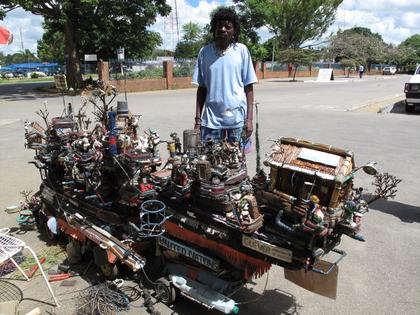
Dexter Nyamainashe was having trouble starting his automata. For years he had been collecting scrap metal from the wasteland deserts and the ruined streets, which he welded together into little worlds of people, animals, buildings. When he stepped behind the contraption and turned the crank, these tiny, mechanical beings would spring to life: eating, loving, killing (for verisimilitude); a whole microcosmic reproduction of the world he saw around him. He called them the Global Villages of Peace. And yet, despite the infinite and infinitesimal care with which he crafted and operated his machines, Dexter’s Zimbabwean countrymen wanted nothing to do with them. The government called them charlatanry; the poor called them witchcraft, and fled with dark backwards glances as soon as he touched the crank. Those who might have understood, who could afford an education, could also unfortunately afford televisions, and preferred to spend their time watching reproductions of such a distant, sensational life that Dexter’s Global Villages seemed little more than the scraps they were made out of.
Eventually one of his friends, who owned a junk shop in town, suggested that Dexter set up his automata in the store window, where he could crank to his heart’s content without fear of persecution or misunderstanding, even if the purpose of his art had been reduced to selling the occasional shoddy good. When his arm got tired he would stop cranking and turn bitterly to the television that also blared behind the storefront’s glass, tuned often to the peculiar cartoons of the Fox Network. Stupid box that needed no human turning to bring it to life, that was witchcraft, he thought, an automaton of the finest and yet pernicious make. For who turned the crank? He couldn’t figure it out.
One day however, when he was taking such a break, Dexter was startled by an interruption of the moving, speaking drawings in the box. There for once was a real man, named Rupert Murdoch, the head fox himself, the Zimbabwean thought. After several minutes of hemming and hawing, Rupert sighed, and then admitted that he had been slyly using the content of his shows to brainwash the North American people (and, by extension of the technology, the rest of the world): his cartoons would cleverly contradict the immediacy of global warming, or spout the political rhetoric with which the last North American President had been trying to take over the world. Ah, Dexter smiled sadly when the old fox had finished, so they were just automata, but what a shame that they were used to such evil ends, especially as anyone and everyone can see them. Witchcraft indeed. With that, he turned off the television, and began cranking his Global Village of Peace to life, even though no one was on the street to watch.
Eventually one of his friends, who owned a junk shop in town, suggested that Dexter set up his automata in the store window, where he could crank to his heart’s content without fear of persecution or misunderstanding, even if the purpose of his art had been reduced to selling the occasional shoddy good. When his arm got tired he would stop cranking and turn bitterly to the television that also blared behind the storefront’s glass, tuned often to the peculiar cartoons of the Fox Network. Stupid box that needed no human turning to bring it to life, that was witchcraft, he thought, an automaton of the finest and yet pernicious make. For who turned the crank? He couldn’t figure it out.
One day however, when he was taking such a break, Dexter was startled by an interruption of the moving, speaking drawings in the box. There for once was a real man, named Rupert Murdoch, the head fox himself, the Zimbabwean thought. After several minutes of hemming and hawing, Rupert sighed, and then admitted that he had been slyly using the content of his shows to brainwash the North American people (and, by extension of the technology, the rest of the world): his cartoons would cleverly contradict the immediacy of global warming, or spout the political rhetoric with which the last North American President had been trying to take over the world. Ah, Dexter smiled sadly when the old fox had finished, so they were just automata, but what a shame that they were used to such evil ends, especially as anyone and everyone can see them. Witchcraft indeed. With that, he turned off the television, and began cranking his Global Village of Peace to life, even though no one was on the street to watch.
3.05.2009
The Instant Engine
Struggling to reconstruct the speculative technologies lost when the Great Singularity had collapsed all centuries into one interpenetrating pan-spacetime, they had first succeeded in reimagining the now whimsical Faster-Than-Light and Faster-Than-Dark drives. But it was patently clear in this hyper-connected agelessness that though one couldn’t go faster than discrete energy fields, one, or many, could easily outrace light by already being in the temporality in which the pre-probability waves would shortly quantize. And so the Faster-Than-Now drive was born, called in popular parlance the Instant Engine, or by the retro-fantasists a time travel machine: a small plastic torus set spinning in the belly of a large plastic torus, which was the vessel, and looked like nothing except a large plastic donut, without wings, or any other evident aerodynamic or propulsionary devices.
The team had been assembled with great care and the exaggeratedly patient expediency with which everything was done now that time had been abolished. Scientists of the highest caliber, archeologists, linguists and interpreters, and technicians in case of the inevitable breakdown all stood trembling in the hanger bay, for this was to be (and immediately should already have been) the first attempt to connect the everlasting present with one of the disparate moments in history with which humanity had always been plagued before, an event that would itself be historical if it didn’t already exist outside of such temporally-absurd, arbitrary perspectives. But to be on the safe side, they had decided not to risk all the bugaboos and paradoxes of the extant prophecies – the few remaining pre-collapse science-fictions – and instantize in a somewhere, a somewhen, that would not unduly traumatize the pre-atemporal mentalities of those they might encounter. To this end, a young and already ancient ahistorian suggested they leap to a less unwieldy and potentially awkward moment then say, Hitler’s bunker at the end of the second great war, or Roswell in the late ‘40s, and appear instead somewhere out of the way, but no less rich in historical data. So they picked the Archives of Cologne, just prior to their collapse in what had been considered in the old frameworks early 2009. As all of the Archive’s records and artifacts had been demolished when the bunker, which had been designed to outlast the apocalypse, clearly didn’t outlast much of anything, it would be an easy thing to jump in, pick up some noteworthy pieces of time, and jump back out without causing much of a rift or reversal.
After the brief but interminable speeches by each member of the planetary congress, the crew boarded and began spooling up the FTN drive. There was a pause, a blink of the eye, an almost miniscule yet monstrous gap, on the other side of which the crew might have wondered if they’d gone anywhen at all, except for the epic tearing noises and cascading rustles caused as the Archive’s massive concrete walls and towering stacks of old newspapers and estate files all fell around and on top of them at once, in that one momentous instant when they did indeed intersect history by causing the Archives of Cologne to collapse, through their arrival, half an hour earlier than it had collapsed in all previous spacetimes. From the limited, one-way perspective of most in-timers however, there was nothing odd about this at all: it was simply when this event happened. As for the crew of the timeship, in order to forestall the embarrassment of discovery, they made one last sudden and uncalculated jump, to some distant and farflung spacetime from which they have not yet been heard from again.
The team had been assembled with great care and the exaggeratedly patient expediency with which everything was done now that time had been abolished. Scientists of the highest caliber, archeologists, linguists and interpreters, and technicians in case of the inevitable breakdown all stood trembling in the hanger bay, for this was to be (and immediately should already have been) the first attempt to connect the everlasting present with one of the disparate moments in history with which humanity had always been plagued before, an event that would itself be historical if it didn’t already exist outside of such temporally-absurd, arbitrary perspectives. But to be on the safe side, they had decided not to risk all the bugaboos and paradoxes of the extant prophecies – the few remaining pre-collapse science-fictions – and instantize in a somewhere, a somewhen, that would not unduly traumatize the pre-atemporal mentalities of those they might encounter. To this end, a young and already ancient ahistorian suggested they leap to a less unwieldy and potentially awkward moment then say, Hitler’s bunker at the end of the second great war, or Roswell in the late ‘40s, and appear instead somewhere out of the way, but no less rich in historical data. So they picked the Archives of Cologne, just prior to their collapse in what had been considered in the old frameworks early 2009. As all of the Archive’s records and artifacts had been demolished when the bunker, which had been designed to outlast the apocalypse, clearly didn’t outlast much of anything, it would be an easy thing to jump in, pick up some noteworthy pieces of time, and jump back out without causing much of a rift or reversal.
After the brief but interminable speeches by each member of the planetary congress, the crew boarded and began spooling up the FTN drive. There was a pause, a blink of the eye, an almost miniscule yet monstrous gap, on the other side of which the crew might have wondered if they’d gone anywhen at all, except for the epic tearing noises and cascading rustles caused as the Archive’s massive concrete walls and towering stacks of old newspapers and estate files all fell around and on top of them at once, in that one momentous instant when they did indeed intersect history by causing the Archives of Cologne to collapse, through their arrival, half an hour earlier than it had collapsed in all previous spacetimes. From the limited, one-way perspective of most in-timers however, there was nothing odd about this at all: it was simply when this event happened. As for the crew of the timeship, in order to forestall the embarrassment of discovery, they made one last sudden and uncalculated jump, to some distant and farflung spacetime from which they have not yet been heard from again.
3.04.2009
The Greatest Discovery
If only he'd found them first: the twin black holes, spinning around each other like crushing dynamos, abysmal toy tops of the Universe. But no, that honor belonged to the astronomical team at _____ University, undoubtedly now basking in the fame of every major scientific journal, along with the guaranteed grants to continue their research. He had not even discovered the massive black hole twirling at the core of our own galaxy, and that had been his pet project for years, bound by the no longer seemingly foolish conviction that there was some connection between such imposing gravity and the energy fields of star systems. It had not been his name on the article. No, instead he'd gone out and gotten drunk with the molecular biologists, one of their experiential experiments on cell decay, and on his way home he had been jumped by a pair of hoodlums, they could have been twins in their identical skull masks, their cloth teeth chattering at his absolute inability to defend himself. It had taken the better part of the week to cancel and renew his credit card, replace his license and security badge. In fact, all that he had really lost, beyond the time in which he should have been the one to discover the black holes, was his wallet, a worn leather thing it'd been about time to replace anyway.
And so there he was, at Wal-Mart, or Target, with a new wallet in one hand and his new MasterCard in the other. After the cashier rang him out he opened the wallet to put the card inside, and found there, in one of the black pockets, ten teeth, ten human teeth. One of them had a filling. He was horrified, and despite the profuse apologies of the clerk, he hurried out, not taking the wallet or even the teeth he had paid for, and without giving his name to the reporter who had suddenly materialized, as if through matter transference, and tried to assure him that finding these teeth might prove to be the greatest discovery since Galileo found the moons of Jupiter.
And so there he was, at Wal-Mart, or Target, with a new wallet in one hand and his new MasterCard in the other. After the cashier rang him out he opened the wallet to put the card inside, and found there, in one of the black pockets, ten teeth, ten human teeth. One of them had a filling. He was horrified, and despite the profuse apologies of the clerk, he hurried out, not taking the wallet or even the teeth he had paid for, and without giving his name to the reporter who had suddenly materialized, as if through matter transference, and tried to assure him that finding these teeth might prove to be the greatest discovery since Galileo found the moons of Jupiter.
Galeano's Political Fables
Eduardo Galeano’s The Book of Embraces reads like a collection of politically charged fairy tales. He does this by drawing on the form, style, and tone of Aesop’s Fables (which was essentially the first collection of short short prose fiction) and inserting in moments of magic or myth at pivotal moments in his short narratives, such as the line, “he scoured heaven and earth in vain” (16) in the section The Origin of the World, the title of which also partakes and sets up this mythic scope. But what really makes these fables is the use of historical peoples, times, places, and events as the backdrop for whatever magical event or effect Galeano is trying to get at. Often these historical events detail the terrible political realities of South America, but the horror is tempered through the magical moment, such as José Carrasco becoming a miracle worker after he is shot fourteen times in the head in Celebration of the Human Voice/ 3. These magic moments serve as indications of each vignette’s moral (as every fable has to have a moral), and for Galeano, the points that he is trying to make are about the intersection of language, art, reality, and politics. In short, Galeano’s lessons are about the power of language to create the world and keep it free. The story in The Function of the Reader/ 2, in which an army captain resigns after reading the oppressed poet César Vallejo, perhaps best highlights this theme of the power of language.
The use of historical events to ground the magical and moralizing elements allows these metaphors to become more real for us the reader (as is the function of magical realism), but there is also perhaps a reverse effect too which works against Galeano. By blending into an imaginative, magical sense of reality, these historical events also become less real, more figurative. Part of this might have to do with the 21st Century’s apathy towards images of violence, we are so attenuated to them in movies that the subtlety with which they are portrayed here looses a good deal of their intended horror. What we are left with, the most striking parts of the text, are the miraculous and whimsical non-real moments, though this might also be Galeano’s point, that the horrors of political reality are only real because they have been given power through language previously, power that can be likewise used to create beauty in the world.
Another reason however that I felt the vignettes were less powerful than they could be was that they were vignettes. Only in a few places, like the dream sequences, do we have larger narratives building from the separate and disparate historical events. But otherwise these events are isolated, and as such, can’t seem to add up to more than facets on Galeano’s ideas. They are too readily digested, where a longer narrative, or one with a more continuous structure might build up to a larger and more significant effect. If, as Galenao suggests, we can create reality through language, a fully crafted literary world, as one might find in a novel, might convey that idea on a much deeper level. Of course, if I had already written a poetic trilogy of books on the history of the Americas, as Galeano did in Memory of Fire, I would probably want to move towards shorter disconnected forms as well!
The use of historical events to ground the magical and moralizing elements allows these metaphors to become more real for us the reader (as is the function of magical realism), but there is also perhaps a reverse effect too which works against Galeano. By blending into an imaginative, magical sense of reality, these historical events also become less real, more figurative. Part of this might have to do with the 21st Century’s apathy towards images of violence, we are so attenuated to them in movies that the subtlety with which they are portrayed here looses a good deal of their intended horror. What we are left with, the most striking parts of the text, are the miraculous and whimsical non-real moments, though this might also be Galeano’s point, that the horrors of political reality are only real because they have been given power through language previously, power that can be likewise used to create beauty in the world.
Another reason however that I felt the vignettes were less powerful than they could be was that they were vignettes. Only in a few places, like the dream sequences, do we have larger narratives building from the separate and disparate historical events. But otherwise these events are isolated, and as such, can’t seem to add up to more than facets on Galeano’s ideas. They are too readily digested, where a longer narrative, or one with a more continuous structure might build up to a larger and more significant effect. If, as Galenao suggests, we can create reality through language, a fully crafted literary world, as one might find in a novel, might convey that idea on a much deeper level. Of course, if I had already written a poetic trilogy of books on the history of the Americas, as Galeano did in Memory of Fire, I would probably want to move towards shorter disconnected forms as well!
3.03.2009
Steps to Futurity
After reading Fuller's "Operating Manual for Sapceship Earth," I began thinking of what we need to do now as a species in order to survive in the long run, starting from the premise that we are fucked now but that we can survive, if we allow that the narratives and perspectives we have on what is possible actually do determine reality.
In the long run, the sun, which is our primary fuel source, will die out, so by that point we will have needed to develop the technology to find and inhabit other Earth-like, life-sustaining planets. Previously the challenge to this has been inventing faster than light travel, but, as the rate of expansion of the Universe is increasing due to the heretofore unknown dark energy, we should instead focus on FTD (faster than dark) technology, or methods of alternate universe travel.
In order to create technologies on this level, and even to develop the scientific perspectives on which this technology might be based, we must first resolve local problems of time, resources, and education. The sun is our main energy source. We must develop technologies to harness this continually radiant and free energy source in order to stop using our non-renewable resources at all costs. This in turn requires a new model of wealth, not as debt, scarcity, or "not enough to go around" which rules the current economic markets, but as Fuller suggests as a measure of futurity: the number of forward-projected days per person that we as a species can live. Secondly we need to curb global consumption, in particularly North American culture's rampant production and consumption of readily-disposable, non-biodegradable, resource-wasting doohickeys. Perhaps new plastic-like materials can be invented from renewable resources.
But for either wealth or consumption to change we need a global, cultural paradigm shift towards sustainability, equality, conservation, etc, in short a shift towards looking at humanity as something with a future. This requires mass education and conscientious media engagement to raise awareness of the issues at hand, offer alternatives, and stop promoting the reckless, passive lifestyles and worldviews that currently infest our world. After this, resources need to be redistributed evenly to all peoples, as well as free access to health care, education, and technologies, in order that the largest number of people are freed of time and mind to be able to address the large social and technological problems of energy transformations, space travel, universal acceptance, etc.
The primary challenge to all of this utopian idealism is the mythologies of nationality and spiritual scarcity that promote global warfare. Wars may be fought over ideologies, money, resources, land, etc, but they result from the misguided notion of us vs. them, that there are only limited resources and that superficial differences between people determine who should acquire what goods and who should be obliterated. The new paradigm must be that we are all in this together. The more subtle and dangerous myth currently creating global hostilities, especially in the Middle East, is the religious myths of the Armageddon - that is, over who will control the end of their world by wiping out their cultural enemies and thus insuring the victors a place in Heaven, because clearly there is an age old belief that there is also not enough heaven or salvation to go around. This is the greatest fallacy being fought over between East and West. Any attempt to win, with any one side over the others, will inevitably result in the greatest expenditure of non-renewable resources and wealth as futurity, the loss of multicultural perspectives, and eventually or immediately the destruction of the human race. This was the threat of the Cold War and is has not gone away. Any total war will mean total destruction.
The only way to win will be by getting along and getting out of this mess, which is in creating Heaven on Earth, prior to exploring out into the very real heavens which are all around us. To this end education/ media narratives must encourage global, multicultural perspectives converging on the essential humanity of all of us in the face of the totality of Universal experience we as a species have so far attained or imagined, as well as a focus on grassroots community organizing via the internets, and the encouragement and sharing of ideas, instructions, perspectives, etc for people to once again take control of their own lives and futures.
In the long run, the sun, which is our primary fuel source, will die out, so by that point we will have needed to develop the technology to find and inhabit other Earth-like, life-sustaining planets. Previously the challenge to this has been inventing faster than light travel, but, as the rate of expansion of the Universe is increasing due to the heretofore unknown dark energy, we should instead focus on FTD (faster than dark) technology, or methods of alternate universe travel.
In order to create technologies on this level, and even to develop the scientific perspectives on which this technology might be based, we must first resolve local problems of time, resources, and education. The sun is our main energy source. We must develop technologies to harness this continually radiant and free energy source in order to stop using our non-renewable resources at all costs. This in turn requires a new model of wealth, not as debt, scarcity, or "not enough to go around" which rules the current economic markets, but as Fuller suggests as a measure of futurity: the number of forward-projected days per person that we as a species can live. Secondly we need to curb global consumption, in particularly North American culture's rampant production and consumption of readily-disposable, non-biodegradable, resource-wasting doohickeys. Perhaps new plastic-like materials can be invented from renewable resources.
But for either wealth or consumption to change we need a global, cultural paradigm shift towards sustainability, equality, conservation, etc, in short a shift towards looking at humanity as something with a future. This requires mass education and conscientious media engagement to raise awareness of the issues at hand, offer alternatives, and stop promoting the reckless, passive lifestyles and worldviews that currently infest our world. After this, resources need to be redistributed evenly to all peoples, as well as free access to health care, education, and technologies, in order that the largest number of people are freed of time and mind to be able to address the large social and technological problems of energy transformations, space travel, universal acceptance, etc.
The primary challenge to all of this utopian idealism is the mythologies of nationality and spiritual scarcity that promote global warfare. Wars may be fought over ideologies, money, resources, land, etc, but they result from the misguided notion of us vs. them, that there are only limited resources and that superficial differences between people determine who should acquire what goods and who should be obliterated. The new paradigm must be that we are all in this together. The more subtle and dangerous myth currently creating global hostilities, especially in the Middle East, is the religious myths of the Armageddon - that is, over who will control the end of their world by wiping out their cultural enemies and thus insuring the victors a place in Heaven, because clearly there is an age old belief that there is also not enough heaven or salvation to go around. This is the greatest fallacy being fought over between East and West. Any attempt to win, with any one side over the others, will inevitably result in the greatest expenditure of non-renewable resources and wealth as futurity, the loss of multicultural perspectives, and eventually or immediately the destruction of the human race. This was the threat of the Cold War and is has not gone away. Any total war will mean total destruction.
The only way to win will be by getting along and getting out of this mess, which is in creating Heaven on Earth, prior to exploring out into the very real heavens which are all around us. To this end education/ media narratives must encourage global, multicultural perspectives converging on the essential humanity of all of us in the face of the totality of Universal experience we as a species have so far attained or imagined, as well as a focus on grassroots community organizing via the internets, and the encouragement and sharing of ideas, instructions, perspectives, etc for people to once again take control of their own lives and futures.
3.02.2009
The Operating Manual
Worried over the global economic crises and wondering where he was going to get the budget to balance the lot, Obama was invited on a personal space tour (which was also looking for funding). Pondering if the ship had an operating manual as they alit up the gravity well, or at least an abort button, he turned to the window and soon money lost its weight. There was Earth, a little cloudier and muddied than he imagined. But, Obama smiled, that’s what made it real. The planet was breathtaking, all sun soaked amidst the embering stars, if not a little on the small side.

I apologize for the lack of posting in the last several months. I have been inordinately busy with school and going through what is most likely my Saturn Returns, attempting to find new perspectives on reality and how I can best approach it in the coming decades without giving up, getting jaded, or going crazy. On the other hand I have become obsessed with the concise narratives of flash or short short fiction, and so hopefully I will post more like the above here in the future as I work out some aesthetic and global theories. I have been particularly distraught over the news that the increased rate of expansion of the Universe will one day mean the vanishing of all the stars from the sky. Of most use in formulating more hopeful positions on life today has been R. Buckminster Fuller's Operating Manual for Spaceship Earth (full text online).
In the mean time, I posted a new story called In the Moment on my Goodreads account, a sort of absurdist tour diary of my rock and roll days in which a stolen book of censored songs precipitates the end of the world as we know it. Enjoy!
I apologize for the lack of posting in the last several months. I have been inordinately busy with school and going through what is most likely my Saturn Returns, attempting to find new perspectives on reality and how I can best approach it in the coming decades without giving up, getting jaded, or going crazy. On the other hand I have become obsessed with the concise narratives of flash or short short fiction, and so hopefully I will post more like the above here in the future as I work out some aesthetic and global theories. I have been particularly distraught over the news that the increased rate of expansion of the Universe will one day mean the vanishing of all the stars from the sky. Of most use in formulating more hopeful positions on life today has been R. Buckminster Fuller's Operating Manual for Spaceship Earth (full text online).
In the mean time, I posted a new story called In the Moment on my Goodreads account, a sort of absurdist tour diary of my rock and roll days in which a stolen book of censored songs precipitates the end of the world as we know it. Enjoy!
Subscribe to:
Comments (Atom)

