
I haven't written much yet publicly on the new perspective or belief system I have been attempting to formulate over this past year, a perspective that I call Ultimate Realism, which is perhaps best summed up by the quote from Patchen's Memoirs of a Shy Pornogrpaher: "Everything which man can imagine, dream, or conceivably want to exist... does exist."
This view first occurred to me one day last year during a week of spiritual-existential difficulty. I had gone to a local bar and ran into an acquaintance, who said, having not seen me in ages due to my focus on school and writing, "welcome back to the real world," to which I could only reply, but isn't everywhere also just as real? and then wandered down the street struck by the total implications of everything around me being that real. There is some sense in which we tend to believe that only those habits and experiences that we usually have are really real, or at least of the most real importance to us, forgetting that other experiences we don't have are just as real. And beyond existing situations, every content of our imaginations and the stories we tell is real, in that these have real effects in the real world. And ultimately, any perspective that will allow us to articulate our lives in the whole of such a multifaceted reality, and perhaps allow us to formulate a perspective of global significance and understanding, will have to put us in relation to that whole, not just as it is scientifically and historically understood, but in relation to all that humans have said, imagined, believed, and dreamed.
This view has come out of years of questioning spiritual beliefs and the nature of the stories we tell. How do we, as human beings in a world with other human beings, deal with the fact that people have divergent and often contradictory views on what the world is and our place in it? Historically, belief systems have clashed, and continue to clash because each side takes their perspective as most true and right, whereas if one view was somehow objectively true and right there should be no cause for conflict; and yet there is. In my own life I have struggled with such limited perspectives, not knowing in what to believe, as the beliefs always seemed too small, and yet needing to believe in something, to tell some kind of story, and finally recognizing that any belief I would want to hold would have to be large enough to contain all possibilities of believing.
Similarly I fear global destruction due to the clash of these limited perspectives, and that we as a species do not have the stories to set us in relation to where we are now that might allow us to continue into the future in a meaningful, healthy, and positive way. The stories we are prone to tell today are often too small, quotidian, dealing with failure, comeuppance, and the meaningless joy ride of post-modernity, whereas we need a perspective that can address the Universe as a whole, for future generations of humanity in this Universe. These stories must be ultimate in order to place us and our actions in the widest set of meaning or significance necessary for survival.
My old professor, Dr. Fred Clothey (a student of famed mythographer Mircea Eliade), suggested that the stories we tell can tell us about ourselves, in effect modeling our understanding of reality in order to authenticate current actions and allow future actions. Our stories/ myths/ beliefs/ perspectives, etc. can do this precisely when they are cast in an "aura of ultimate significance," that is, by referring us to the widest possible scope of experience and understanding, to our cosmic and social beginnings, to our longed for and feared endings, to our ideals taking on human form. We find our place and being in between the limits of the real as we know it.
One such ultimate signifier, that has had a direct effect on real occurrences, is the concept of God(s). While belief in supernatural beings has allowed articulation of our relation to society and mortality, is has, perhaps most clearly and distressingly, served as a justification for centuries worth of horror and cruelty: crusades, inquisitions, terrorism, or just plain ignorance. But we are prone to forget in our polarized times that this personification of ultimate ideals was also a necessary and integral perspective for the development of scientific reasoning, framing an objective and total perspective that we humans could then hope to achieve ourselves, a belief that has existed coterminous to science up through the 20th century. Contemporary atheists might be glad that God is no longer a reference for rational understanding, but "His" death has negative impacts as well: God has traditionally not only been a signifier for ultimate perspective and knowing, but also for perfection and goodness, in short, ethical understanding of behavior, without which we do things like build the atomic bomb. Technology runs rampant when not placed in the widest relation to how it might rightly be used, or the lack of an ethical signifier allows the cultural insecurities that haunt us to become manifest, and such horrors not only be imagined but made real. One imagines a similar lack of ultimate significance in the perspectives that have allowed western culture's unparalleled material consumption, environmental destruction, and continued ideological warfare on the rest of humanity.
I am not arguing here for a return to a belief in the traditional monotheistic God or earlier gods. These stories, as we have seen, are just too small and conflict-provoking compared to those perspectives that now need to be adopted. I am arguing though for a greater belief in the reality and efficacy of the contents of our stories and imaginations, and an awareness of how these otherwise subconscious narratives influence the real world.
One of the problems to this approach is the primacy we give to literal truth, vs. the obvious falsity of our "true" representations of reality. I am a huge fan of stories of the fantastic, of the magical, supernatural, weird, heroic, or sci-fi, which, looking at the predominance of these themes in the current cultural media and imagination, I believe I am not alone in. But why do we love supermen, zombies, and the end of the world? There has been a trend in storytelling, dating from the late 18th century, of attempting to represent reality as it "really is," social or quotidian realism, and not as an allegorical reference for otherwise real things. Fiction, when it first was read as not literally true, was cast as "petite histories," in order to accept stories they had to mimic reality while being divorced from talking about reality. My immediate response to all this is, there's already too much of the world we experience on a daily basis, why create more of it, when stories beyond the everyday may raise possibilities of experience and understanding more than that which we are already familiar with. That familiarity constrains us, by being real, to the obviously inadequate belief systems we now live under. We hold up what we believe is a mirror and say, this is real, and because we say it, that marks the bounds up what we will allow to be really real.
My second issue with realism is that it is not reality despite how it primps and masquerades itself as such. It may represent aspects of reality, but does so by relying on and reaffirming our assumptions about how the world is and should be, which constrains us to accepting those views and realities as more true or valid, to the exclusion of wider views. And today it seems our view of the real is that it frankly sucks and nothing matters anymore. And any attempt to actually discuss real human issues in an emotionally valid way is negated by the irony and scorn with which we articulate the real world. The fantastic however, by being non-real and symbolic of the real (mythopoetic in Tolkien's terms), precisely allows us to highlight those human themes and conditions we want to examine in truthful ways. But in order to even accept the contents of fantastic stories we must (as Coleridge first suggested) suspend our disbelief of those things that couldn't be literally true in our everyday experience. We no longer have a problem leaping into wizard fights or across star systems, we can suspend disbelief but we are never asked to truly believe, and thus are not as prone to take such fantasies as being symbolic or ultimately significant for how we really are or could be in the world. We are content to let them be mere entertainments and diversions rather than suggestions of possibility.
Yet, are ghosts and gods really real, or is this even the right way of framing the question? There is a sense that certain things are existentially real, they commit us to accepting their physical reality, being right in front of us. The invisible and imaginative do not so commit us; one can not empirically and scientifically prove a god's actual existence. To argue one way or the other for this is to miss the entire point about gods. But one can clearly see the effects that belief in such unprovables has on our world, both on our perspectives and psychologies and in actual historical occurrences. Ignoring and belittling the immaterial causes of such beliefs and effects does little to add to our understanding of ourselves in the world, allows the results of inappropriate or too-small beliefs to continue unchecked, and limits the human imagination to articulate new possibilities of being and understanding being, which are necessary for our current and continued survival, let alone enjoyment and well being. On the other hand, if we do not remember that the stories we tell are only stories, that have been made up despite their real effects, we run the risk of mistaking the stories as literally true, thus causing us to act in dangerous and inappropriate ways, when imagining better stories to live by and through is always an option (and it is this lack of awareness of the power of our symbols that I mean by the absent narrative).
I do not know where we will go from here, but I am wary and sick of the post-modern skepticism that rejects any ultimate significance in favor of what we can directly lay our hands on (and in so doing, strangle it to death). I would prefer to see interconnections of the layers of reality rather than the whole's deconstruction and rebuttal. Acting as if we know everything and nothing really matters is perhaps the smallest and most dangerous perspective one could hold. Ultimately, we exist in a Universe which we barely understand, and in which we are a bare speck, and perhaps in that widest view humanity is indeed meaningless and fated to extinction for lack of any better options. And yet it is also possible to believe, and live by the belief, that life and our consciousness of life may be more than a random fluke or evolutionary mistake; not that we serve some clear teleological purpose or extant will of God, but that for all these unknowns we are still real, and still here, and confronted with the implications of that for all reality.
Though reality may be inherently meaningless we have the choice to take on meanings and act on those meanings, to continue to be and gather greater understanding and significance, both on this planet and in the Universe as a whole, should we choose to accept this mission. Anything less than such an Ultimately Realist perspective sells ourselves short, and will only propel us down the road of meaninglessness and destruction. But if we can perhaps articulate a perspective wide enough, not just for all humans, but all life in general and beyond life, then perhaps we can continue on until that perspective, and all else we can imagine, becomes real.
Showing posts with label apocalyptica. Show all posts
Showing posts with label apocalyptica. Show all posts
11.24.2009


11.10.2009
Disasters are Waiting for All of Us
Despite the fact that the Mayans have strongly emphasized that the western world has entirely misinterpreted and appropriated the year of 2012, that their myths say nothing about the end of the world, our telling of that story has become so hyped up by the media that the "2012 Prophecy" is actually sparking real fear and suicides. As the new movie convinces people that we are all going to die, others try to combat the myth by hopefully providing more accurate information. Or if that fails, suggestions on plans to ensure the continuity of our species. While asteroid defense, planet hacking, terrestrial seed vaults, lunar doomsday arcs, and off-world colonization all seem like noble, albeit sci-fi options (along with more actual attempts at space elevators and solar sails), it seems that culturally there is still the tendency to either believe that we are all going to die in 2012 (and perhaps that's a good thing) or that none of this is true (not even environmental degradation) and we should continue to live the technologically destructive lives we've been living throughout the last century.
Personally I hold the middle ground, that the whole 2012 phenomena is a myth, a story we have taken to heart because it is very suggestive to us of the possibilities of what might happen and what we ought to do about it. This means that 1). it is unlikely that anything untoward will actually happen on this date (besides perhaps some spectacular astronomical movements), and 2). despite this myth not being literally true, it is still figuratively significant in telling us that we really do fear the end of the world in some form, and that we are either responsible for bringing it about or for stopping it if at all possible. I feel that if we really are concerned with the continuity of our species, along with that of the planet that makes life possible for our species, instead of coming up with far fetched worse case scenarios or ignoring the mess altogether, we instead have to begin telling truthful stories about what is actually going on in the world, what might actually happen, and those immediate steps that will have to be taken to deal with it. No more fear-mongering or denial, but futurestance. We need stories that tell us how we are in the world, and why, and what we need to do.
Part of the problem here is a lack of any current mythology to address the rampant technological changes of the last century, which combined with the continually growing disbelief in the value of belief seems to spell disaster at every turn. One of the earliest functions of myth, as maps for human action, was casting reality in terms of ultimate significance. We are here and act as we do because the gods do it/ our ancestors do it, etc. The most we can say now is that we do because our celebrities and politicians do it, but we are as avid in taking them down to our level and know they are just as fallible, just as human. Not to advocate a return to belief in gods as really real, but our lack of contemporary myths of such large significance pushes us out to the meaningless edges of the cosmos where we no longer have any reason to believe or act with even the present in mind, let alone the future. I feel that what is lacking and most needed are new myths that replace us as central characters of our own story, not Earth as the physical center of the Universe, but us as the storytellers as the key for the meaning of our experiences, that is, myths that stress the responsibility we have as stewards of ourselves and the world which we've decided we control, stories that suggest that cooperation, multiple points of view, responsibility, awareness of actions, etc. are all heroic qualities that may have the most real effects in staving off whatever apocalypses we come up with to amuse and frighten ourselves.
Personally I hold the middle ground, that the whole 2012 phenomena is a myth, a story we have taken to heart because it is very suggestive to us of the possibilities of what might happen and what we ought to do about it. This means that 1). it is unlikely that anything untoward will actually happen on this date (besides perhaps some spectacular astronomical movements), and 2). despite this myth not being literally true, it is still figuratively significant in telling us that we really do fear the end of the world in some form, and that we are either responsible for bringing it about or for stopping it if at all possible. I feel that if we really are concerned with the continuity of our species, along with that of the planet that makes life possible for our species, instead of coming up with far fetched worse case scenarios or ignoring the mess altogether, we instead have to begin telling truthful stories about what is actually going on in the world, what might actually happen, and those immediate steps that will have to be taken to deal with it. No more fear-mongering or denial, but futurestance. We need stories that tell us how we are in the world, and why, and what we need to do.
Part of the problem here is a lack of any current mythology to address the rampant technological changes of the last century, which combined with the continually growing disbelief in the value of belief seems to spell disaster at every turn. One of the earliest functions of myth, as maps for human action, was casting reality in terms of ultimate significance. We are here and act as we do because the gods do it/ our ancestors do it, etc. The most we can say now is that we do because our celebrities and politicians do it, but we are as avid in taking them down to our level and know they are just as fallible, just as human. Not to advocate a return to belief in gods as really real, but our lack of contemporary myths of such large significance pushes us out to the meaningless edges of the cosmos where we no longer have any reason to believe or act with even the present in mind, let alone the future. I feel that what is lacking and most needed are new myths that replace us as central characters of our own story, not Earth as the physical center of the Universe, but us as the storytellers as the key for the meaning of our experiences, that is, myths that stress the responsibility we have as stewards of ourselves and the world which we've decided we control, stories that suggest that cooperation, multiple points of view, responsibility, awareness of actions, etc. are all heroic qualities that may have the most real effects in staving off whatever apocalypses we come up with to amuse and frighten ourselves.
10.18.2009

10.13.2009
It's not the End of the World
I've been insisting on this point for years now, so it's finally good to see the Mayans argue that 2012 is not the end of the world.
The only thing the Mayan long count calendar suggests is that one period of time is finished and the next begins, somewhat like a new year or an odometer clicking over. As it is based on the position of astral bodies, in particular the alignments of Venus, the metaphor of an odometer clicking over on a galactic scale is really about the closest meaning to what the calendar says.
The Mayans contend that any notion of apocalypses and singularities is a Western construction, perhaps a projection of our values onto another culture's belief and measurement systems. Bear in mind it is only in Western traditions such as Christianity that a teleological endpoint to time and reality are posited, often in terms of the spectacular fiery cataclysms we seem to enjoy or desire. The notion of an apocalypse is only valid in a culture based on belief systems that suggest that there is only linear time, and that only in later times can we find true reality or happiness (ie, in an afterlife). Take the notion of heaven after death and apply it collectively and you get a desire for a collective death. This notion applies to the ancient Norse Ragnarok as a collective means of reaching Valhalla, but does not apply to cycle notions of time, such as in Buddhism or Mayan cosmologies. Why would the world end if the myths played themselves out year after year, eon after eon, in the heavens as well as on Earth?
What strikes me as strange is that, though many people in Western culture no longer treat our foundational myths as real or valid, we still have that understanding of time as linear and endable, and enjoy if not demand such endings. Why do we want the world to end? Why do we want to project our desire for that onto someone else's beliefs, as if we can justify the desire by saying it is prophesied, and therefor not our fault? Whether the Mayans like it or not, 2012 has become a contemporary Western myth of the end of time, and as such says something about how we experience the world we live in. Perhaps we are too scared, too ashamed, of the extent of of the damage Western cultural values have inflicted on the planet, which along with the looming resource crises and potential threat of technological transcendence/annihilation, we can point to the Mayans and say, look it's not our fault, they said it was going to happen first, and how can we change that? What our myth of 2012 does is allow us to evade responsibility for our actions in the world we live in for the world that our children may still inherit. Who needs to worry about the future if no one will be around to experience it?
The only thing the Mayan long count calendar suggests is that one period of time is finished and the next begins, somewhat like a new year or an odometer clicking over. As it is based on the position of astral bodies, in particular the alignments of Venus, the metaphor of an odometer clicking over on a galactic scale is really about the closest meaning to what the calendar says.
The Mayans contend that any notion of apocalypses and singularities is a Western construction, perhaps a projection of our values onto another culture's belief and measurement systems. Bear in mind it is only in Western traditions such as Christianity that a teleological endpoint to time and reality are posited, often in terms of the spectacular fiery cataclysms we seem to enjoy or desire. The notion of an apocalypse is only valid in a culture based on belief systems that suggest that there is only linear time, and that only in later times can we find true reality or happiness (ie, in an afterlife). Take the notion of heaven after death and apply it collectively and you get a desire for a collective death. This notion applies to the ancient Norse Ragnarok as a collective means of reaching Valhalla, but does not apply to cycle notions of time, such as in Buddhism or Mayan cosmologies. Why would the world end if the myths played themselves out year after year, eon after eon, in the heavens as well as on Earth?
What strikes me as strange is that, though many people in Western culture no longer treat our foundational myths as real or valid, we still have that understanding of time as linear and endable, and enjoy if not demand such endings. Why do we want the world to end? Why do we want to project our desire for that onto someone else's beliefs, as if we can justify the desire by saying it is prophesied, and therefor not our fault? Whether the Mayans like it or not, 2012 has become a contemporary Western myth of the end of time, and as such says something about how we experience the world we live in. Perhaps we are too scared, too ashamed, of the extent of of the damage Western cultural values have inflicted on the planet, which along with the looming resource crises and potential threat of technological transcendence/annihilation, we can point to the Mayans and say, look it's not our fault, they said it was going to happen first, and how can we change that? What our myth of 2012 does is allow us to evade responsibility for our actions in the world we live in for the world that our children may still inherit. Who needs to worry about the future if no one will be around to experience it?
8.07.2009
The Rational Fallacy (or, in the future noone can hear you dream)
Several rather unsettling potential futures have been trickling across the aether the past several days: the Semantic Apocalypse (or the evolutionary dead end of human consciousness), the death of free will (as the last grasp of the unenlightened), and what really makes me sad and/or laugh, the need(?) to get out of the narrative fallacy, that our evolutionary ability to make meaning out of sense-events by stringing them into recognizable narratives is perhaps no longer necessary, and from the sound of the article all rational beings ought to immediately stop telling themselves stories. The irony being that these are all stories that speak of both a need for control and meaning, and more so indicate to me some peculiar postmodern desire to no longer be human, to escape from the weird impulses of our bodies and all our non-linear reasons for doing what we do. As if in a fully rational world we can all finally be sterile passionless robots or programs, rows of ones and zeroes doing nothing unexpected, nothing out of bounds, a dystopia predicted long before 1984 in Zamyatin's "We." As if just because the Universe is a mysterious ungraspable place, on the largest and smallest scales, the only way we rational beings can bear its unfathomableness is by killing off our own mysterious uncertain selves. This is a future in which art, magic, even love would no longer be possible, because the rational fallacy seeks to do away with the fact that just as much as we are analytical beings we are also batshit crazy, I mean, that we crave meaning and find value in our lives from novelty and personal experience and not from predictable routines or the scientific rigor mortis of western materialism. What is the point of learning how the Universe works if not to better understand how we exist in it, or could better exist. What is the point of knowing if our knowings don't add up to a larger picture, and who would be looking at the picture? As PK Dick asked, do androids dream of electric sheep? We are still, and hopefully will remain, more than just our neurochemical programs, our biological probabilities.
Besides allowing us to learn how to evade saber tooth tigers, or even get up in the morning, stories always have and continue to serve a vital human function, that of allowing us to express how we are or should be in the world. What this means to us, individually or collectively, and where we are going next. Even prior to ethics or mythological taboos, without a sense of narrative there is literally no future, no reason to believe in the consequences of our current actions. Logic divorced from muthos will not allow us to better exist on earth tomorrow, let alone two minutes from now. Science for science's sake, without a grander story to guide its research and invention, produced the atomic bomb and conditions for global warming (though to be very clear, it was the rather fucked up stories of those in power that allowed such atrocities to happen), and without finding a balance, the solely rational mindset could produce further horrors. If our dreams can't become reality there will cease to be one. This is rather similar to how I see the contemporary atheist movement, cultishly trying to kill the religious impulse when it is impossible to prove or disprove whether or not gods exist, without even trying to understand what purpose they, their worship, and belief in general might still serve in helping people determine how to be in the world and with each other. The greatest irony is that any argument for atheism ultimately relies solely on faith, that there is stubbornly not more on heaven and earth than can ever be dreamed of in our philosophies. Personally I believe that everything is real or has the potential to be real, tangible or intangible, anything ever conceived of, no matter how surreal or unfathomable, exists. As Pablo Picasso put it, "everything we can imagine is real." To believe otherwise is to close your mind, or dare I say soul, to all that is beautiful, marvelous, or deep in what it is to be human, in what it still could mean to be human. This is my fear of arguments for such rational post/trans-humanism: that if we don't learn to accept, or even revel in, all the psychotic, creative, baffling irrationales with which humankind has always struggled, than any transcended intelligent being may find these repressed instincts come back to haunt them more so... assuming we have stories, consciousness, and the will to get us that far first.
Besides allowing us to learn how to evade saber tooth tigers, or even get up in the morning, stories always have and continue to serve a vital human function, that of allowing us to express how we are or should be in the world. What this means to us, individually or collectively, and where we are going next. Even prior to ethics or mythological taboos, without a sense of narrative there is literally no future, no reason to believe in the consequences of our current actions. Logic divorced from muthos will not allow us to better exist on earth tomorrow, let alone two minutes from now. Science for science's sake, without a grander story to guide its research and invention, produced the atomic bomb and conditions for global warming (though to be very clear, it was the rather fucked up stories of those in power that allowed such atrocities to happen), and without finding a balance, the solely rational mindset could produce further horrors. If our dreams can't become reality there will cease to be one. This is rather similar to how I see the contemporary atheist movement, cultishly trying to kill the religious impulse when it is impossible to prove or disprove whether or not gods exist, without even trying to understand what purpose they, their worship, and belief in general might still serve in helping people determine how to be in the world and with each other. The greatest irony is that any argument for atheism ultimately relies solely on faith, that there is stubbornly not more on heaven and earth than can ever be dreamed of in our philosophies. Personally I believe that everything is real or has the potential to be real, tangible or intangible, anything ever conceived of, no matter how surreal or unfathomable, exists. As Pablo Picasso put it, "everything we can imagine is real." To believe otherwise is to close your mind, or dare I say soul, to all that is beautiful, marvelous, or deep in what it is to be human, in what it still could mean to be human. This is my fear of arguments for such rational post/trans-humanism: that if we don't learn to accept, or even revel in, all the psychotic, creative, baffling irrationales with which humankind has always struggled, than any transcended intelligent being may find these repressed instincts come back to haunt them more so... assuming we have stories, consciousness, and the will to get us that far first.
6.18.2009
Writing and the Future
Story That Takes 1,000 Years to Read [may be] Antidote to Media Whirlwind: "San Francisco conceptual artist and journalist Jonathon Keats is trying to rejuvenate literature in the age of hyperspeed media by writing a story that will take a millennium to tell. The printing process in question is a simple but, as usual with Keats, pretty clever idea. The cover is printed in a double layer of standard black ink, with an incrementally screened overlay masking the nine words. Exposed over time to ultraviolet light, the words will be appear at different rates, supposedly one per century."
I'm not sure if I consider a thousand years to be rejuvenation, more like a clever gimmick that no one will remember tomorrow.
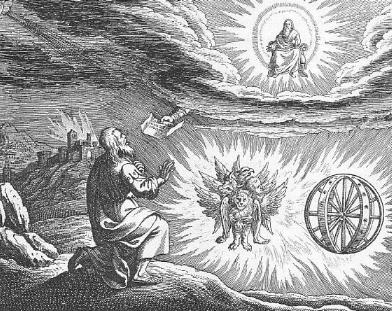
In other news though, physicist Richard Obousy has proposed a "scientifically accurate" design for a "warpship" that closely resembles Ezekiel's vision of "wheels within wheels." Right now the warship is only theoretical, awaiting our ability to harness dark energy. The Discovery Channel website reports that "the shape of the warpship was chosen to optimize the manipulation of surrounding dark energy, creating a spacetime bubble. How exactly the bubble would be created is still a mystery."
The one thing this article doesn't mention is that the wheels within wheels were not supernatural crafts but were the angels themselves. Nor does it mention that every square inch of them is covered in eyeballs. Though that would make for a pretty wild spaceship...
I'm not sure if I consider a thousand years to be rejuvenation, more like a clever gimmick that no one will remember tomorrow.
In other news though, physicist Richard Obousy has proposed a "scientifically accurate" design for a "warpship" that closely resembles Ezekiel's vision of "wheels within wheels." Right now the warship is only theoretical, awaiting our ability to harness dark energy. The Discovery Channel website reports that "the shape of the warpship was chosen to optimize the manipulation of surrounding dark energy, creating a spacetime bubble. How exactly the bubble would be created is still a mystery."
The one thing this article doesn't mention is that the wheels within wheels were not supernatural crafts but were the angels themselves. Nor does it mention that every square inch of them is covered in eyeballs. Though that would make for a pretty wild spaceship...
3.05.2009
The Instant Engine
Struggling to reconstruct the speculative technologies lost when the Great Singularity had collapsed all centuries into one interpenetrating pan-spacetime, they had first succeeded in reimagining the now whimsical Faster-Than-Light and Faster-Than-Dark drives. But it was patently clear in this hyper-connected agelessness that though one couldn’t go faster than discrete energy fields, one, or many, could easily outrace light by already being in the temporality in which the pre-probability waves would shortly quantize. And so the Faster-Than-Now drive was born, called in popular parlance the Instant Engine, or by the retro-fantasists a time travel machine: a small plastic torus set spinning in the belly of a large plastic torus, which was the vessel, and looked like nothing except a large plastic donut, without wings, or any other evident aerodynamic or propulsionary devices.
The team had been assembled with great care and the exaggeratedly patient expediency with which everything was done now that time had been abolished. Scientists of the highest caliber, archeologists, linguists and interpreters, and technicians in case of the inevitable breakdown all stood trembling in the hanger bay, for this was to be (and immediately should already have been) the first attempt to connect the everlasting present with one of the disparate moments in history with which humanity had always been plagued before, an event that would itself be historical if it didn’t already exist outside of such temporally-absurd, arbitrary perspectives. But to be on the safe side, they had decided not to risk all the bugaboos and paradoxes of the extant prophecies – the few remaining pre-collapse science-fictions – and instantize in a somewhere, a somewhen, that would not unduly traumatize the pre-atemporal mentalities of those they might encounter. To this end, a young and already ancient ahistorian suggested they leap to a less unwieldy and potentially awkward moment then say, Hitler’s bunker at the end of the second great war, or Roswell in the late ‘40s, and appear instead somewhere out of the way, but no less rich in historical data. So they picked the Archives of Cologne, just prior to their collapse in what had been considered in the old frameworks early 2009. As all of the Archive’s records and artifacts had been demolished when the bunker, which had been designed to outlast the apocalypse, clearly didn’t outlast much of anything, it would be an easy thing to jump in, pick up some noteworthy pieces of time, and jump back out without causing much of a rift or reversal.
After the brief but interminable speeches by each member of the planetary congress, the crew boarded and began spooling up the FTN drive. There was a pause, a blink of the eye, an almost miniscule yet monstrous gap, on the other side of which the crew might have wondered if they’d gone anywhen at all, except for the epic tearing noises and cascading rustles caused as the Archive’s massive concrete walls and towering stacks of old newspapers and estate files all fell around and on top of them at once, in that one momentous instant when they did indeed intersect history by causing the Archives of Cologne to collapse, through their arrival, half an hour earlier than it had collapsed in all previous spacetimes. From the limited, one-way perspective of most in-timers however, there was nothing odd about this at all: it was simply when this event happened. As for the crew of the timeship, in order to forestall the embarrassment of discovery, they made one last sudden and uncalculated jump, to some distant and farflung spacetime from which they have not yet been heard from again.
The team had been assembled with great care and the exaggeratedly patient expediency with which everything was done now that time had been abolished. Scientists of the highest caliber, archeologists, linguists and interpreters, and technicians in case of the inevitable breakdown all stood trembling in the hanger bay, for this was to be (and immediately should already have been) the first attempt to connect the everlasting present with one of the disparate moments in history with which humanity had always been plagued before, an event that would itself be historical if it didn’t already exist outside of such temporally-absurd, arbitrary perspectives. But to be on the safe side, they had decided not to risk all the bugaboos and paradoxes of the extant prophecies – the few remaining pre-collapse science-fictions – and instantize in a somewhere, a somewhen, that would not unduly traumatize the pre-atemporal mentalities of those they might encounter. To this end, a young and already ancient ahistorian suggested they leap to a less unwieldy and potentially awkward moment then say, Hitler’s bunker at the end of the second great war, or Roswell in the late ‘40s, and appear instead somewhere out of the way, but no less rich in historical data. So they picked the Archives of Cologne, just prior to their collapse in what had been considered in the old frameworks early 2009. As all of the Archive’s records and artifacts had been demolished when the bunker, which had been designed to outlast the apocalypse, clearly didn’t outlast much of anything, it would be an easy thing to jump in, pick up some noteworthy pieces of time, and jump back out without causing much of a rift or reversal.
After the brief but interminable speeches by each member of the planetary congress, the crew boarded and began spooling up the FTN drive. There was a pause, a blink of the eye, an almost miniscule yet monstrous gap, on the other side of which the crew might have wondered if they’d gone anywhen at all, except for the epic tearing noises and cascading rustles caused as the Archive’s massive concrete walls and towering stacks of old newspapers and estate files all fell around and on top of them at once, in that one momentous instant when they did indeed intersect history by causing the Archives of Cologne to collapse, through their arrival, half an hour earlier than it had collapsed in all previous spacetimes. From the limited, one-way perspective of most in-timers however, there was nothing odd about this at all: it was simply when this event happened. As for the crew of the timeship, in order to forestall the embarrassment of discovery, they made one last sudden and uncalculated jump, to some distant and farflung spacetime from which they have not yet been heard from again.
3.03.2009
Steps to Futurity
After reading Fuller's "Operating Manual for Sapceship Earth," I began thinking of what we need to do now as a species in order to survive in the long run, starting from the premise that we are fucked now but that we can survive, if we allow that the narratives and perspectives we have on what is possible actually do determine reality.
In the long run, the sun, which is our primary fuel source, will die out, so by that point we will have needed to develop the technology to find and inhabit other Earth-like, life-sustaining planets. Previously the challenge to this has been inventing faster than light travel, but, as the rate of expansion of the Universe is increasing due to the heretofore unknown dark energy, we should instead focus on FTD (faster than dark) technology, or methods of alternate universe travel.
In order to create technologies on this level, and even to develop the scientific perspectives on which this technology might be based, we must first resolve local problems of time, resources, and education. The sun is our main energy source. We must develop technologies to harness this continually radiant and free energy source in order to stop using our non-renewable resources at all costs. This in turn requires a new model of wealth, not as debt, scarcity, or "not enough to go around" which rules the current economic markets, but as Fuller suggests as a measure of futurity: the number of forward-projected days per person that we as a species can live. Secondly we need to curb global consumption, in particularly North American culture's rampant production and consumption of readily-disposable, non-biodegradable, resource-wasting doohickeys. Perhaps new plastic-like materials can be invented from renewable resources.
But for either wealth or consumption to change we need a global, cultural paradigm shift towards sustainability, equality, conservation, etc, in short a shift towards looking at humanity as something with a future. This requires mass education and conscientious media engagement to raise awareness of the issues at hand, offer alternatives, and stop promoting the reckless, passive lifestyles and worldviews that currently infest our world. After this, resources need to be redistributed evenly to all peoples, as well as free access to health care, education, and technologies, in order that the largest number of people are freed of time and mind to be able to address the large social and technological problems of energy transformations, space travel, universal acceptance, etc.
The primary challenge to all of this utopian idealism is the mythologies of nationality and spiritual scarcity that promote global warfare. Wars may be fought over ideologies, money, resources, land, etc, but they result from the misguided notion of us vs. them, that there are only limited resources and that superficial differences between people determine who should acquire what goods and who should be obliterated. The new paradigm must be that we are all in this together. The more subtle and dangerous myth currently creating global hostilities, especially in the Middle East, is the religious myths of the Armageddon - that is, over who will control the end of their world by wiping out their cultural enemies and thus insuring the victors a place in Heaven, because clearly there is an age old belief that there is also not enough heaven or salvation to go around. This is the greatest fallacy being fought over between East and West. Any attempt to win, with any one side over the others, will inevitably result in the greatest expenditure of non-renewable resources and wealth as futurity, the loss of multicultural perspectives, and eventually or immediately the destruction of the human race. This was the threat of the Cold War and is has not gone away. Any total war will mean total destruction.
The only way to win will be by getting along and getting out of this mess, which is in creating Heaven on Earth, prior to exploring out into the very real heavens which are all around us. To this end education/ media narratives must encourage global, multicultural perspectives converging on the essential humanity of all of us in the face of the totality of Universal experience we as a species have so far attained or imagined, as well as a focus on grassroots community organizing via the internets, and the encouragement and sharing of ideas, instructions, perspectives, etc for people to once again take control of their own lives and futures.
In the long run, the sun, which is our primary fuel source, will die out, so by that point we will have needed to develop the technology to find and inhabit other Earth-like, life-sustaining planets. Previously the challenge to this has been inventing faster than light travel, but, as the rate of expansion of the Universe is increasing due to the heretofore unknown dark energy, we should instead focus on FTD (faster than dark) technology, or methods of alternate universe travel.
In order to create technologies on this level, and even to develop the scientific perspectives on which this technology might be based, we must first resolve local problems of time, resources, and education. The sun is our main energy source. We must develop technologies to harness this continually radiant and free energy source in order to stop using our non-renewable resources at all costs. This in turn requires a new model of wealth, not as debt, scarcity, or "not enough to go around" which rules the current economic markets, but as Fuller suggests as a measure of futurity: the number of forward-projected days per person that we as a species can live. Secondly we need to curb global consumption, in particularly North American culture's rampant production and consumption of readily-disposable, non-biodegradable, resource-wasting doohickeys. Perhaps new plastic-like materials can be invented from renewable resources.
But for either wealth or consumption to change we need a global, cultural paradigm shift towards sustainability, equality, conservation, etc, in short a shift towards looking at humanity as something with a future. This requires mass education and conscientious media engagement to raise awareness of the issues at hand, offer alternatives, and stop promoting the reckless, passive lifestyles and worldviews that currently infest our world. After this, resources need to be redistributed evenly to all peoples, as well as free access to health care, education, and technologies, in order that the largest number of people are freed of time and mind to be able to address the large social and technological problems of energy transformations, space travel, universal acceptance, etc.
The primary challenge to all of this utopian idealism is the mythologies of nationality and spiritual scarcity that promote global warfare. Wars may be fought over ideologies, money, resources, land, etc, but they result from the misguided notion of us vs. them, that there are only limited resources and that superficial differences between people determine who should acquire what goods and who should be obliterated. The new paradigm must be that we are all in this together. The more subtle and dangerous myth currently creating global hostilities, especially in the Middle East, is the religious myths of the Armageddon - that is, over who will control the end of their world by wiping out their cultural enemies and thus insuring the victors a place in Heaven, because clearly there is an age old belief that there is also not enough heaven or salvation to go around. This is the greatest fallacy being fought over between East and West. Any attempt to win, with any one side over the others, will inevitably result in the greatest expenditure of non-renewable resources and wealth as futurity, the loss of multicultural perspectives, and eventually or immediately the destruction of the human race. This was the threat of the Cold War and is has not gone away. Any total war will mean total destruction.
The only way to win will be by getting along and getting out of this mess, which is in creating Heaven on Earth, prior to exploring out into the very real heavens which are all around us. To this end education/ media narratives must encourage global, multicultural perspectives converging on the essential humanity of all of us in the face of the totality of Universal experience we as a species have so far attained or imagined, as well as a focus on grassroots community organizing via the internets, and the encouragement and sharing of ideas, instructions, perspectives, etc for people to once again take control of their own lives and futures.
12.23.2008
Quotes from Bolaño on Literature and the Abyss
"All literature, in a certain sense, is political. I mean, first, it’s a reflection on politics, and second, it’s also a political program. The former alludes to reality—to the nightmare or benevolent dream that we call reality—which ends, in both cases, with death and the obliteration not only of literature, but of time. The latter refers to the small bits and pieces that survive, that persist; and to reason. Although we know, of course, that in the human scale of things, persistence is an illusion and reason is only a fragile railing that keeps us from plunging into the abyss. But don’t pay any attention to what I just said."
"For me, the word writing is the exact opposite of the word waiting. Instead of waiting, there is writing. Well, I’m probably wrong—it’s possible that writing is another form of waiting, of delaying things. I’d like to think otherwise."
"Yes, plots are a strange matter. I believe, even though there may be many exceptions, that at a certain moment a story chooses you and won’t leave you in peace. Fortunately, that’s not so important—the form, the structure, always belong to you, and without form or structure there’s no book, or at least in most cases that’s what happens. Let’s say the story and the plot arise by chance, that they belong to the realm of chance, that is, chaos, disorder, or to a realm that’s in constant turmoil (some call it apocalyptic). Form, on the other hand, is a choice made through intelligence, cunning and silence, all the weapons used by Ulysses in his battle against death. Form seeks an artifice; the story seeks a precipice. Or to use a metaphor from the Chilean countryside (a bad one, as you’ll see): It’s not that I don’t like precipices, but I prefer to see them from a bridge."
[from an interview with RB]
The adventure tradition and the apocalyptic are "the only two traditions that remain alive on our continent, perhaps because they're the only two to get close to the abyss that surrounds us."
[from New York Review of Books]
"For me, the word writing is the exact opposite of the word waiting. Instead of waiting, there is writing. Well, I’m probably wrong—it’s possible that writing is another form of waiting, of delaying things. I’d like to think otherwise."
"Yes, plots are a strange matter. I believe, even though there may be many exceptions, that at a certain moment a story chooses you and won’t leave you in peace. Fortunately, that’s not so important—the form, the structure, always belong to you, and without form or structure there’s no book, or at least in most cases that’s what happens. Let’s say the story and the plot arise by chance, that they belong to the realm of chance, that is, chaos, disorder, or to a realm that’s in constant turmoil (some call it apocalyptic). Form, on the other hand, is a choice made through intelligence, cunning and silence, all the weapons used by Ulysses in his battle against death. Form seeks an artifice; the story seeks a precipice. Or to use a metaphor from the Chilean countryside (a bad one, as you’ll see): It’s not that I don’t like precipices, but I prefer to see them from a bridge."
[from an interview with RB]
The adventure tradition and the apocalyptic are "the only two traditions that remain alive on our continent, perhaps because they're the only two to get close to the abyss that surrounds us."
[from New York Review of Books]
11.02.2008
Dystopian Symbols and Counter-Symbols in V for Vendetta and Alphaville
Dystopian Symbols and Counter-Symbols in V for Vendetta and Alphaville
In “Our Future – Our Past: Fascism, Postmodernism, and Starship Troopers,” Florentine Strzelczyk argues that Hollywood is fascinated with the aesthetic of fascism, especially that of Nazi Germany. Filmmakers use fascist-styled uniforms, symbols, and other elements of mise-en-scène in order to create recognizable dystopian societies – science fiction fascisms. It is interesting to note however that the Nazi Party’s primary symbol, the swastika, was already a recontextualization of an ancient Indo-European sun symbol, through which they were able to express their own dystopic aspirations for the future. The films “V for Vendetta” and “Alphaville” both present dystopian societies that recontextualize familiar symbols through their mise-en-scènes in order to represent the content and style of their particular fascistic worlds, as well as the counter-revolutions to those worlds.
James McTeigue’s 2006 film, “V for Vendetta,” depicts the Norsefire party, a religiously conservative dictatorship that has taken over England in the year 2038. Beyond their Nazi-esque uniforms and Orwellian surveillance and slogans, the Norsefire Party’s primary symbol is a doubled cross, shown in red on a black background. This symbol was originally the Cross of Lorraine, used by the French to counter the Nazi swastika during World War II. In the film this symbol also perverts St. George’s Cross, a single-armed red cross on a white background that historically served as the flag of England and the Church of England, as well as distorts the more familiar Christian cross. The Norsefire party has practiced Nazi (and Christian)-style religious discrimination against Muslims, Jews, and racial and sexual minorities in order to achieve power, and in the movie’s opening newscast the Voice of the Party argues that England prevails because of its faith in a judgmental God watching over the country.
The Norsefire Party’s doubled cross appears many places in “V for Vendetta,” on the Party posters, on the fingermen’s badges, and in news clips, suggesting the ubiquity of the regime. The symbol most predominately appears though along side the massive view screen on which is projected Chancellor Sutler’s face. As the leader of the fascist party, Sutler’s video appearance next to these monstrous doubled crosses suggests that he himself is the removed and ever-watchful God of England, or at least an omnipresent figure reminiscent of Big Brother in George Orwell’s dystopian “1984.” While it is implied that the crosses are always next to the Chancellor’s view screen, we only see them in specific shots, such as when Sutler demands the falsification of news or a desire to speak “directly” to the people. What is made clear about the symbol’s appearance is that it seems to occur only whenever the government is telling blatant lies. The Norsefire Party’s favorite political technique is double crossing the English people, and the symbol of the doubled cross directly illustrates this each time it is depicted on camera. Even during the art-terrorist V’s newscast early in the film, the doubled cross is shown next to him when he suggests that the people let themselves be tricked by the war, terror, and disease orchestrated by their government.
As opposed to the Norsefire Party’s doubled cross, V employs his own counter symbol, a circled letter V. V’s V does not directly reference or distort the government’s symbol, it is instead a depiction of his historical reasons for vengeance; V was held in room five (the Latin numeral V) of the Larkhill detention center where he was horribly burned and many minorities were killed by the government. This symbol however is displayed in the film in the same red on black as the doubled cross: in V’s newscast, slashed or painted over the Party posters, and even in fireworks over the exploding Bailey and Parliament buildings. Aesthetically, the image of red spray-painted lines over the posters most directly references the pop-culture image of the anarchist symbol, a red, circled letter A. V’s revolution depends exactly on the kind of people-driven chaos discussed in anarchist theories and misrepresented by current popular media. In “V for Vendetta” it is a young girl shot for spray painting V’s symbol that pushes the English people over the edge towards anarchistic rebellion.
While V’s symbol appears all throughout the film, he also employs the V on a linguistic level, taking it out of the level of mise-en-scène. In his opening speech to Evey, V sums up his own political theory using fifty words beginning with the letter V. We also later see that V’s motto is the Latin phrase from Faust, “Vi Veri Verdiversum Vivus Vici,” by the power of truth, I, while living, have conquered the Universe. In his newscast, V tells the people of England that words will always maintain their power as an annunciation of truth, and his speeches clearly illustrate this power of language. Unlike the Norsefire Party, V understands that a symbol (like the act of blowing up a building) is by itself meaningless, and must be given an actual voice by actual people in order to have a real affect on the world.
The dystopian symbols and counter-symbols in “V for Vendetta” are clearly depicted, but such is not the case in Jean-Luc Godard’s 1965 film, “Alphaville.” The dystopic government in this movie is a technocracy run by the scientific-logical computer Alpha 60. While Alpha 60 does not employ a direct or ubiquitous symbol like the Norsefire Party’s doubled cross, a set of scientific symbols occurs that can represent the regime: Einstein’s famous formula for mass-energy equivalence, E = mc2, and Planck’s equation for the quantization of light energy, E = hf. Historically, Einstein’s equation stood as a revolution in physics, unifying specific conservation laws of mass and energy into a larger theory under the specific speed of light, though the formula is also linked popularly with ideas of scientific destruction through its use in the creation of the atomic bomb. “Alphaville” plays on this idea that light energy is a logical, destructive power, as, according to Professor Von Braun, the creator of Alphaville, they are entering a Light Civilization attempting to take over the universe.
Planck’s equation states that the energy of light is carried in discrete amounts in relation to its frequency; light is quantized, or, in popular terms, it is digital rather than containing a continuous spectrum of possibilities. In “Alphaville,” the computer Alpha 60 is described by the agent Henry as being 150 light years more powerful than any previous computer, a discrete number he returns to later in his tale about ant societies. This dystopic society similarly operates under the idea that certain words have certain, discrete meanings: any uncertain words are removed from the Bible-dictionary and replaced by more specific ones. Language, like light, has become quantized, and is used as an element of control, much as it is in “V for Vendetta.” This use of scientific equations as fascist symbols in “Alphaville” echoes the head programmer’s statement to agent Lemmy Caution that an order is a logical conclusion; the logic of science cannot be disobeyed.
The biggest challenge in interpreting these scientific formulas as dystopian symbols in “Alphaville,” and in determining the appropriate counter-symbols, is that they only appear in two specific scenes, in brief flashes during moments when Lemmy Caution is figuring out how to counter Alpha 60’s control. In the first of these scenes, Lemmy has just learned from Henry about the computer, and directly following the symbols he says that people have become slaves of probability, statistics and equations being science’s way of controlling people’s perception of what is possible in reality. Henry goes on to tell a story however about a similarly technocratic ant society that 150 light years ago had artists like those in Alphaville, and then the equations flash again, remixed into the statement hf=mc2. Several things are happening here: the equivalence of E in the two formulas could imply that the particle scale of hf, or of the ants in Henry’s story, is the same as the galactic scale of mc2, that Alpha 60 is not only killing artists in Alphaville but would do the same throughout the universe.
Secondly, there is the suggestion that artists offer an alternative to scientific-logical control of how people perceive the world. Throughout the scene and film both of the agents reference popular and artistic culture in their dialogues: comic book detectives of the time; women from French literature; and after being given the poetry book of Éluard, Lemmy says that he is going on a “journey to the end of the night,” a reference to another French novel of the same name that apparently satirizes scientific research. We see the same thing in “V for Vendetta,” where V (and other outlaws like Gordon) attempts to keep human culture alive through collecting censored cultural artifacts and referencing them in dialogue that contrasts with the fascist regime.
During the Institute of General Semantics scene of “Alphaville,” Alpha 60 says that life and death are discreet events on the circle of time. This is echoed later when the scientific equations are flashed again, while Lemmy is being shown a tour of the computer. At this point the symbols flash slower, from left to right, while the computer says that Lemmy thinks more of the past than the future, and then again while Lemmy remarks that he is too old, and that shooting first is his only weapon against fatality. This differentiation between kinds or perspectives of time echoes the earlier symbol scene, most importantly the instant when Lemmy questions the specific 150 light year time frame of Henry’s story and then sets the bare light bulb swinging. This moment suggests that instead of the discrete, logical quantities of energy or power utilized by Alpha 60 through the E=hf equation, light, and life itself, exist in a continuous spectrum that can be accessed through the illogic and uncertainty of art. The past, with its implied reference to artifacts of human culture, can become a weapon against the cultureless dystopian future envisioned by the machine. Most precisely, or creatively, Lemmy uses the culturally subjective meanings of poetic words – symbols without the fixed meanings of scientific equations – to destroy the computer and its fascist society.
There is thus no clear counter-symbol that Lemmy uses in “Alphaville;” poetry is not an emblem to be flashed quickly on a screen or be represented as a direct element of mise-en-scène. Even when we are shown the supposed copy of Éluard’s “The Capital of Pain,” the camera has to slowly pan over the text in order to give the viewer time to interpret the meaning of the words, much the way that Alpha 60 destroys itself slowly by searching for the answer to Lemmy’s poetic riddle. But, as we saw in “V for Vendetta,” it is not V’s fast, iconic V symbol that changes his world either. It is instead the meanings given to symbols and words by people themselves over culturally continuous times (or despite culturally-destroying times) that make symbols powerful, and ultimately keep us free.
In “Our Future – Our Past: Fascism, Postmodernism, and Starship Troopers,” Florentine Strzelczyk argues that Hollywood is fascinated with the aesthetic of fascism, especially that of Nazi Germany. Filmmakers use fascist-styled uniforms, symbols, and other elements of mise-en-scène in order to create recognizable dystopian societies – science fiction fascisms. It is interesting to note however that the Nazi Party’s primary symbol, the swastika, was already a recontextualization of an ancient Indo-European sun symbol, through which they were able to express their own dystopic aspirations for the future. The films “V for Vendetta” and “Alphaville” both present dystopian societies that recontextualize familiar symbols through their mise-en-scènes in order to represent the content and style of their particular fascistic worlds, as well as the counter-revolutions to those worlds.
James McTeigue’s 2006 film, “V for Vendetta,” depicts the Norsefire party, a religiously conservative dictatorship that has taken over England in the year 2038. Beyond their Nazi-esque uniforms and Orwellian surveillance and slogans, the Norsefire Party’s primary symbol is a doubled cross, shown in red on a black background. This symbol was originally the Cross of Lorraine, used by the French to counter the Nazi swastika during World War II. In the film this symbol also perverts St. George’s Cross, a single-armed red cross on a white background that historically served as the flag of England and the Church of England, as well as distorts the more familiar Christian cross. The Norsefire party has practiced Nazi (and Christian)-style religious discrimination against Muslims, Jews, and racial and sexual minorities in order to achieve power, and in the movie’s opening newscast the Voice of the Party argues that England prevails because of its faith in a judgmental God watching over the country.
The Norsefire Party’s doubled cross appears many places in “V for Vendetta,” on the Party posters, on the fingermen’s badges, and in news clips, suggesting the ubiquity of the regime. The symbol most predominately appears though along side the massive view screen on which is projected Chancellor Sutler’s face. As the leader of the fascist party, Sutler’s video appearance next to these monstrous doubled crosses suggests that he himself is the removed and ever-watchful God of England, or at least an omnipresent figure reminiscent of Big Brother in George Orwell’s dystopian “1984.” While it is implied that the crosses are always next to the Chancellor’s view screen, we only see them in specific shots, such as when Sutler demands the falsification of news or a desire to speak “directly” to the people. What is made clear about the symbol’s appearance is that it seems to occur only whenever the government is telling blatant lies. The Norsefire Party’s favorite political technique is double crossing the English people, and the symbol of the doubled cross directly illustrates this each time it is depicted on camera. Even during the art-terrorist V’s newscast early in the film, the doubled cross is shown next to him when he suggests that the people let themselves be tricked by the war, terror, and disease orchestrated by their government.
As opposed to the Norsefire Party’s doubled cross, V employs his own counter symbol, a circled letter V. V’s V does not directly reference or distort the government’s symbol, it is instead a depiction of his historical reasons for vengeance; V was held in room five (the Latin numeral V) of the Larkhill detention center where he was horribly burned and many minorities were killed by the government. This symbol however is displayed in the film in the same red on black as the doubled cross: in V’s newscast, slashed or painted over the Party posters, and even in fireworks over the exploding Bailey and Parliament buildings. Aesthetically, the image of red spray-painted lines over the posters most directly references the pop-culture image of the anarchist symbol, a red, circled letter A. V’s revolution depends exactly on the kind of people-driven chaos discussed in anarchist theories and misrepresented by current popular media. In “V for Vendetta” it is a young girl shot for spray painting V’s symbol that pushes the English people over the edge towards anarchistic rebellion.
While V’s symbol appears all throughout the film, he also employs the V on a linguistic level, taking it out of the level of mise-en-scène. In his opening speech to Evey, V sums up his own political theory using fifty words beginning with the letter V. We also later see that V’s motto is the Latin phrase from Faust, “Vi Veri Verdiversum Vivus Vici,” by the power of truth, I, while living, have conquered the Universe. In his newscast, V tells the people of England that words will always maintain their power as an annunciation of truth, and his speeches clearly illustrate this power of language. Unlike the Norsefire Party, V understands that a symbol (like the act of blowing up a building) is by itself meaningless, and must be given an actual voice by actual people in order to have a real affect on the world.
The dystopian symbols and counter-symbols in “V for Vendetta” are clearly depicted, but such is not the case in Jean-Luc Godard’s 1965 film, “Alphaville.” The dystopic government in this movie is a technocracy run by the scientific-logical computer Alpha 60. While Alpha 60 does not employ a direct or ubiquitous symbol like the Norsefire Party’s doubled cross, a set of scientific symbols occurs that can represent the regime: Einstein’s famous formula for mass-energy equivalence, E = mc2, and Planck’s equation for the quantization of light energy, E = hf. Historically, Einstein’s equation stood as a revolution in physics, unifying specific conservation laws of mass and energy into a larger theory under the specific speed of light, though the formula is also linked popularly with ideas of scientific destruction through its use in the creation of the atomic bomb. “Alphaville” plays on this idea that light energy is a logical, destructive power, as, according to Professor Von Braun, the creator of Alphaville, they are entering a Light Civilization attempting to take over the universe.
Planck’s equation states that the energy of light is carried in discrete amounts in relation to its frequency; light is quantized, or, in popular terms, it is digital rather than containing a continuous spectrum of possibilities. In “Alphaville,” the computer Alpha 60 is described by the agent Henry as being 150 light years more powerful than any previous computer, a discrete number he returns to later in his tale about ant societies. This dystopic society similarly operates under the idea that certain words have certain, discrete meanings: any uncertain words are removed from the Bible-dictionary and replaced by more specific ones. Language, like light, has become quantized, and is used as an element of control, much as it is in “V for Vendetta.” This use of scientific equations as fascist symbols in “Alphaville” echoes the head programmer’s statement to agent Lemmy Caution that an order is a logical conclusion; the logic of science cannot be disobeyed.
The biggest challenge in interpreting these scientific formulas as dystopian symbols in “Alphaville,” and in determining the appropriate counter-symbols, is that they only appear in two specific scenes, in brief flashes during moments when Lemmy Caution is figuring out how to counter Alpha 60’s control. In the first of these scenes, Lemmy has just learned from Henry about the computer, and directly following the symbols he says that people have become slaves of probability, statistics and equations being science’s way of controlling people’s perception of what is possible in reality. Henry goes on to tell a story however about a similarly technocratic ant society that 150 light years ago had artists like those in Alphaville, and then the equations flash again, remixed into the statement hf=mc2. Several things are happening here: the equivalence of E in the two formulas could imply that the particle scale of hf, or of the ants in Henry’s story, is the same as the galactic scale of mc2, that Alpha 60 is not only killing artists in Alphaville but would do the same throughout the universe.
Secondly, there is the suggestion that artists offer an alternative to scientific-logical control of how people perceive the world. Throughout the scene and film both of the agents reference popular and artistic culture in their dialogues: comic book detectives of the time; women from French literature; and after being given the poetry book of Éluard, Lemmy says that he is going on a “journey to the end of the night,” a reference to another French novel of the same name that apparently satirizes scientific research. We see the same thing in “V for Vendetta,” where V (and other outlaws like Gordon) attempts to keep human culture alive through collecting censored cultural artifacts and referencing them in dialogue that contrasts with the fascist regime.
During the Institute of General Semantics scene of “Alphaville,” Alpha 60 says that life and death are discreet events on the circle of time. This is echoed later when the scientific equations are flashed again, while Lemmy is being shown a tour of the computer. At this point the symbols flash slower, from left to right, while the computer says that Lemmy thinks more of the past than the future, and then again while Lemmy remarks that he is too old, and that shooting first is his only weapon against fatality. This differentiation between kinds or perspectives of time echoes the earlier symbol scene, most importantly the instant when Lemmy questions the specific 150 light year time frame of Henry’s story and then sets the bare light bulb swinging. This moment suggests that instead of the discrete, logical quantities of energy or power utilized by Alpha 60 through the E=hf equation, light, and life itself, exist in a continuous spectrum that can be accessed through the illogic and uncertainty of art. The past, with its implied reference to artifacts of human culture, can become a weapon against the cultureless dystopian future envisioned by the machine. Most precisely, or creatively, Lemmy uses the culturally subjective meanings of poetic words – symbols without the fixed meanings of scientific equations – to destroy the computer and its fascist society.
There is thus no clear counter-symbol that Lemmy uses in “Alphaville;” poetry is not an emblem to be flashed quickly on a screen or be represented as a direct element of mise-en-scène. Even when we are shown the supposed copy of Éluard’s “The Capital of Pain,” the camera has to slowly pan over the text in order to give the viewer time to interpret the meaning of the words, much the way that Alpha 60 destroys itself slowly by searching for the answer to Lemmy’s poetic riddle. But, as we saw in “V for Vendetta,” it is not V’s fast, iconic V symbol that changes his world either. It is instead the meanings given to symbols and words by people themselves over culturally continuous times (or despite culturally-destroying times) that make symbols powerful, and ultimately keep us free.
9.10.2008
End Times, by Lydia Lunch
End Times
By Lydia Lunch. [via, posted in full]
“In times of universal deceit telling the truth is a revolutionary act.”
– George Orwell
It took balls for Elton John to suggest banning all organized religion because it turned people into hateful lemmings devoid of compassion. And I may be putting my cock on the line here, but I think we need to go directly to the source and simply get rid of God. After all God was the first cop. The original tyrant. An egotistical dictator whose sadism was so immense that he insisted on the murder of his only begotten son just to prove what he was capable of after he condemned us all to rot in eternal damnation like flesh puppets in his own private dungeon. An amusement arcade full of fire and brimstone.
Religion used to be the opium of the masses. Now it’s the crack cocaine of assassins. Millions of addicts tripping on a celestial high. Throwing psychotic temper tantrums like little brats who forgot to take their Ritalin. Backyard bullies screaming MY GOD IS BIGGER THAN YOUR GOD. God junkies — dangerous and delirious. Drunk on blood and bombs and the smell of burning flesh. Painting the desert red in an attempt to appease BIG POPPA, that vengeful War Lord whose favorite blood sport has always been one of violence, torture and retribution.
And excuse me if I feel that John McCain is suffering from Stockholm Syndrome. If after five years of being held in captivity and forced to endure relentless tortures, he is simply too twisted to realize what the real price of war is, then we’re all doomed. After all if he could survive such mind numbing cruelty and still want to play war whore, what the hell are the rest of us all whining about?
War is as old as God himself. And the War is never over. The War is never ending. The War is just an orgy of blood and guts masterminded by testosterone-fueled dirty old men that get off on fucking the entire fucking planet. This is the REAL PORNOGRAPHY. An outrageous cockfight fought by gung-ho cowboys who have drawn a line in the sand and will challenge anyone to a duel foolish enough to threaten resistance against the advent of the rodeo mind.
And hold on to your hats because now entering the bullring is a petite pit-bull in lipstick with a hotline to God’s pipeline whose idiotic credo of “Intelligent Design” insults not only science and evolution but the individual’s ability to reason when presented with hundreds of thousands of pages of evidence to the contrary.
Man was not created in the image of God. God was created in the image of man so that man had someone to blame his infantile rage on. The need to believe in God is a pathological viral infection that has spread like an incurable disease infecting man’s ability to reason clearly. Belief acts as a psychic buffer against anxiety over the unavoidable reality of impending mortality. Scared shitless and still greedy for more than merely earthly delights, man, that all consuming piranha has wreaked havoc by gobbling up and devouring every other creature forcing predictions that unless a miracle happens even the fish will be wiped out before the midterm of this century. And with rifle-toting zealots like Sarah Palin and her Assembly of God clan smiling smugly and smirking about killing caribou, hunting moose, exterminating wolves and hounding polar bears into near extinction the death count will surely mount.
Only end times apocalypticians are demented enough to dream of a magnificent bounty to be served up in heaven by angels and virgins alike assuming it’s the just deserve of a hard fought battle for the glory of God and Cuntry. In the meantime, the rest of us better prepare to go hungry because soon enough we won’t even be able to afford food anyway.
Am I imagining it or were we a lot safer when the so-called leader of the free world was getting blowjobs in the White House? Isn’t it better to blow off a little steam in the face of a willing victim than to take out your sexual frustrations and pent-up aggression on endangered species or countries half way around the world, blatantly lying about democracy and freedom in a thinly-veiled disguise to suck the juice out of a hole in the ground, while the rest of us are stuck at the Exxon stations holding gas pumps in our fists like big limp dicks that we pay out the ass to get perpetually screwed by?
No one wins in War except the Military Industrial Complex. A Corporate Cabal run from inside the Pentagon’s walls set up to both build weapons of mass destructions and then repair the damage done by them. The astronomical expense of war, at last count $100,000 dollars a minute in maintenance fees seems paltry when you consider the estimated 37,000 corporations who have their hands in the till and are growing fat on the blood and bones of widows, orphans and soldiers piling up in mass graves strewn throughout the desert. An oasis of death and destruction.
A war which has utterly demolished the separation of church and state, is operating secret prisons across the globe, grants immunity to mercenaries and has turned America into a Police State whose own citizens are now under siege. A war in continuum, orchestrated by an arrogant pig-headed son of a military father whose status as head cop at the CIA lead him to believe that America has a divine duty to police the planet as his Soldiers of Christ commit whole sale slaughter in effort to push forth judgment day. Oh closer my God to thee! Holy War! Holy War!
I pity the fool who prays for life everlasting. I want my taste of Heaven and I want it now. I realize that at any moment I could become the next victim of this war without end. And Heaven to me would mean dying with a smile on my face, screwing a half a dozen returning amputee Iraqi war veterans. Hell, somebody’s gotta take care of the vets. Their own government sure as shit won’t. America has over 200,000 homeless veterans of war. Men tossed to the streets and forced to fend for themselves when they were no longer useful as mercenary cogs on the wheel of the world’s greatest killing machine; suffering from Post Traumatic Stress Disorder, tricked into a war and conned by doublespeak into believing that fighting will bring peace, domination will bring freedom, and that your Uncle Sam will take care of you after you’ve risked life and limb to safe guard his superiority complex.
We inhabit this vast potential Utopia, which is being destroyed by its abusers. Man has created a hell on earth, turning the world into a ghetto, a slaughterhouse, a refugee camp, an orphanage, a sweatshop, a bomb factory, a land mine, a shooting gallery, an insane asylum, a toxic dump. And the way I see it Mother Nature is getting pretty pissed off. Earthquakes, tornadoes, floods, mudslides, hurricanes, droughts, monsoons, famine. She is becoming more violent against the men who cause her violence.
And maybe after all, violence is only natural. All Creation bears the molecular memory of a terrible explosion of electricity, energy, matter and motion. A violent eruption of white light and white heat. Violence was the first act of creation. THE BIG BANG. Chaos is the law of Nature; it is the score upon which reality is written. Or to quote Mussolini “Blood alone moves the wheels of history.” Same as it ever was.
War is an incurable virus, forever mutating, that travels the globe feeding on man’s fears, spreading panic and terror, violence and death, which until we find a vaccine that finally inoculates the entire population against stupidity, arrogance, aggression and blind faith, we will be forced to forever repeat like stunted victims of Orwell’s Memory Hole.

ABOUT THE AUTHOR
Lydia Lunch is an art terrorist who has been confronting apathy and kicking its fucking teeth in for the past three decades.
By Lydia Lunch. [via, posted in full]
“In times of universal deceit telling the truth is a revolutionary act.”
– George Orwell
It took balls for Elton John to suggest banning all organized religion because it turned people into hateful lemmings devoid of compassion. And I may be putting my cock on the line here, but I think we need to go directly to the source and simply get rid of God. After all God was the first cop. The original tyrant. An egotistical dictator whose sadism was so immense that he insisted on the murder of his only begotten son just to prove what he was capable of after he condemned us all to rot in eternal damnation like flesh puppets in his own private dungeon. An amusement arcade full of fire and brimstone.
Religion used to be the opium of the masses. Now it’s the crack cocaine of assassins. Millions of addicts tripping on a celestial high. Throwing psychotic temper tantrums like little brats who forgot to take their Ritalin. Backyard bullies screaming MY GOD IS BIGGER THAN YOUR GOD. God junkies — dangerous and delirious. Drunk on blood and bombs and the smell of burning flesh. Painting the desert red in an attempt to appease BIG POPPA, that vengeful War Lord whose favorite blood sport has always been one of violence, torture and retribution.
And excuse me if I feel that John McCain is suffering from Stockholm Syndrome. If after five years of being held in captivity and forced to endure relentless tortures, he is simply too twisted to realize what the real price of war is, then we’re all doomed. After all if he could survive such mind numbing cruelty and still want to play war whore, what the hell are the rest of us all whining about?
War is as old as God himself. And the War is never over. The War is never ending. The War is just an orgy of blood and guts masterminded by testosterone-fueled dirty old men that get off on fucking the entire fucking planet. This is the REAL PORNOGRAPHY. An outrageous cockfight fought by gung-ho cowboys who have drawn a line in the sand and will challenge anyone to a duel foolish enough to threaten resistance against the advent of the rodeo mind.
And hold on to your hats because now entering the bullring is a petite pit-bull in lipstick with a hotline to God’s pipeline whose idiotic credo of “Intelligent Design” insults not only science and evolution but the individual’s ability to reason when presented with hundreds of thousands of pages of evidence to the contrary.
Man was not created in the image of God. God was created in the image of man so that man had someone to blame his infantile rage on. The need to believe in God is a pathological viral infection that has spread like an incurable disease infecting man’s ability to reason clearly. Belief acts as a psychic buffer against anxiety over the unavoidable reality of impending mortality. Scared shitless and still greedy for more than merely earthly delights, man, that all consuming piranha has wreaked havoc by gobbling up and devouring every other creature forcing predictions that unless a miracle happens even the fish will be wiped out before the midterm of this century. And with rifle-toting zealots like Sarah Palin and her Assembly of God clan smiling smugly and smirking about killing caribou, hunting moose, exterminating wolves and hounding polar bears into near extinction the death count will surely mount.
Only end times apocalypticians are demented enough to dream of a magnificent bounty to be served up in heaven by angels and virgins alike assuming it’s the just deserve of a hard fought battle for the glory of God and Cuntry. In the meantime, the rest of us better prepare to go hungry because soon enough we won’t even be able to afford food anyway.
Am I imagining it or were we a lot safer when the so-called leader of the free world was getting blowjobs in the White House? Isn’t it better to blow off a little steam in the face of a willing victim than to take out your sexual frustrations and pent-up aggression on endangered species or countries half way around the world, blatantly lying about democracy and freedom in a thinly-veiled disguise to suck the juice out of a hole in the ground, while the rest of us are stuck at the Exxon stations holding gas pumps in our fists like big limp dicks that we pay out the ass to get perpetually screwed by?
No one wins in War except the Military Industrial Complex. A Corporate Cabal run from inside the Pentagon’s walls set up to both build weapons of mass destructions and then repair the damage done by them. The astronomical expense of war, at last count $100,000 dollars a minute in maintenance fees seems paltry when you consider the estimated 37,000 corporations who have their hands in the till and are growing fat on the blood and bones of widows, orphans and soldiers piling up in mass graves strewn throughout the desert. An oasis of death and destruction.
A war which has utterly demolished the separation of church and state, is operating secret prisons across the globe, grants immunity to mercenaries and has turned America into a Police State whose own citizens are now under siege. A war in continuum, orchestrated by an arrogant pig-headed son of a military father whose status as head cop at the CIA lead him to believe that America has a divine duty to police the planet as his Soldiers of Christ commit whole sale slaughter in effort to push forth judgment day. Oh closer my God to thee! Holy War! Holy War!
I pity the fool who prays for life everlasting. I want my taste of Heaven and I want it now. I realize that at any moment I could become the next victim of this war without end. And Heaven to me would mean dying with a smile on my face, screwing a half a dozen returning amputee Iraqi war veterans. Hell, somebody’s gotta take care of the vets. Their own government sure as shit won’t. America has over 200,000 homeless veterans of war. Men tossed to the streets and forced to fend for themselves when they were no longer useful as mercenary cogs on the wheel of the world’s greatest killing machine; suffering from Post Traumatic Stress Disorder, tricked into a war and conned by doublespeak into believing that fighting will bring peace, domination will bring freedom, and that your Uncle Sam will take care of you after you’ve risked life and limb to safe guard his superiority complex.
We inhabit this vast potential Utopia, which is being destroyed by its abusers. Man has created a hell on earth, turning the world into a ghetto, a slaughterhouse, a refugee camp, an orphanage, a sweatshop, a bomb factory, a land mine, a shooting gallery, an insane asylum, a toxic dump. And the way I see it Mother Nature is getting pretty pissed off. Earthquakes, tornadoes, floods, mudslides, hurricanes, droughts, monsoons, famine. She is becoming more violent against the men who cause her violence.
And maybe after all, violence is only natural. All Creation bears the molecular memory of a terrible explosion of electricity, energy, matter and motion. A violent eruption of white light and white heat. Violence was the first act of creation. THE BIG BANG. Chaos is the law of Nature; it is the score upon which reality is written. Or to quote Mussolini “Blood alone moves the wheels of history.” Same as it ever was.
War is an incurable virus, forever mutating, that travels the globe feeding on man’s fears, spreading panic and terror, violence and death, which until we find a vaccine that finally inoculates the entire population against stupidity, arrogance, aggression and blind faith, we will be forced to forever repeat like stunted victims of Orwell’s Memory Hole.
ABOUT THE AUTHOR
Lydia Lunch is an art terrorist who has been confronting apathy and kicking its fucking teeth in for the past three decades.
9.02.2008
Last 20 Moments
Time does strange things when you’re locked in a room, when even that window near the ceiling ceases to illuminate. It has been dark for years, or it’s just the same interminable night. They used to bring a pack of Marlboro’s daily, and seafood on the weekends, but that tapered off some point ago. Thankfully there’s this crust of bread I can nibble till kingdom come.
I like to think I did something wrong, trespassing maybe, or murder, that would be a reason. I like to think that Eleanor is waiting; when I get out we’ll go to the Dollar Theatre, camp at Treasure Lake, even take the kids like we used to. But maybe I’m just making that up, a story to keep my mind off this darkness. I don’t remember if I have kids, what Eleanor’s face looks like.
As long as I’m writing I know I’m at least alive, though I wish my neighbor were still here. He was a man like myself, that is, trapped, who up till Time stopped used to chat through the hole in the wall, my ear against the immobile stone, whispering his inconsistent fables. I’m afraid he’s rubbed off on me.
Now he’s back. He tried to break out. I asked why he returned. Well, there’s nothing left out there. What do you mean, has there been a war? No, unless a rather big one, I mean, there’s nothing left, no ground, no sun, just an immense whiteness, I was so scared to turn around that this room would be gone, at least these walls are safe. I found a pack of smokes though. Are you sure, I lit one of our last twenty moments, this is it then? That’s my story, he said, and this time I’m sticking to it.
(Some flash for an assignment for my advanced fiction class.)
I like to think I did something wrong, trespassing maybe, or murder, that would be a reason. I like to think that Eleanor is waiting; when I get out we’ll go to the Dollar Theatre, camp at Treasure Lake, even take the kids like we used to. But maybe I’m just making that up, a story to keep my mind off this darkness. I don’t remember if I have kids, what Eleanor’s face looks like.
As long as I’m writing I know I’m at least alive, though I wish my neighbor were still here. He was a man like myself, that is, trapped, who up till Time stopped used to chat through the hole in the wall, my ear against the immobile stone, whispering his inconsistent fables. I’m afraid he’s rubbed off on me.
Now he’s back. He tried to break out. I asked why he returned. Well, there’s nothing left out there. What do you mean, has there been a war? No, unless a rather big one, I mean, there’s nothing left, no ground, no sun, just an immense whiteness, I was so scared to turn around that this room would be gone, at least these walls are safe. I found a pack of smokes though. Are you sure, I lit one of our last twenty moments, this is it then? That’s my story, he said, and this time I’m sticking to it.
(Some flash for an assignment for my advanced fiction class.)
7.31.2008
The End Time Might Be Running A Little Late
If the hipsters don't kill us, here's a laugh out loud article about the possibility that 2012 might not be the end of the world from Reality Sandwich:
"Christmas morning 2012 should be a barrel of laughs. "Merry Christmas sweetie! I was going to get you that new hydrogen-powered Barbie Transporter you've been bugging me about, but I was pretty certain we'd all be dead by now. Sorry, my bad. Here, have a spoonful of rice."
"Christmas morning 2012 should be a barrel of laughs. "Merry Christmas sweetie! I was going to get you that new hydrogen-powered Barbie Transporter you've been bugging me about, but I was pretty certain we'd all be dead by now. Sorry, my bad. Here, have a spoonful of rice."
6.23.2008
More news of the word
I'm always glad to see news about literature and narratives out in the world, even if they are often cast in other mediums then good old paper.
Cormac McCarthy's "The Road," a father and son bonding story set in an ambiguous and bleak apocalypse, was arguably the best book published this past year. It has just finished filming [via reality sandwich], mainly around the Pittsburgh area (which of course to me is really the perfect post-apocalyptic landscape). The movie adaptation of McCarthy's "No Country For Old Men" was also pretty stellar, so I'm quite excited to go see this when it comes out.

In other news, Cory Doctorow at Boing Boing reports that the Stormworm computer virus is now inventing fictional events to entrap people, playing on such natural disaster and celebrity fears as 'Eiffel Tower damaged by massive earthquake' and 'Donald Trump missing, feared kidnapped.' It would be a rather interesting twist if some of these events started to become true...
For Sophie, here is a great collection of links on the writing of and critical controversy surrounding the poet Anne Carson for her birthday, whose novel-in-verse "Autobiography of Red" recasts the mythic monster Geryon as a a modern photographer and lover of Herakles, and really shows some of the ways that old stories can be recycled to reexamine their hidden themes.
And finally, laser-cut typographic scarves!

Cormac McCarthy's "The Road," a father and son bonding story set in an ambiguous and bleak apocalypse, was arguably the best book published this past year. It has just finished filming [via reality sandwich], mainly around the Pittsburgh area (which of course to me is really the perfect post-apocalyptic landscape). The movie adaptation of McCarthy's "No Country For Old Men" was also pretty stellar, so I'm quite excited to go see this when it comes out.
In other news, Cory Doctorow at Boing Boing reports that the Stormworm computer virus is now inventing fictional events to entrap people, playing on such natural disaster and celebrity fears as 'Eiffel Tower damaged by massive earthquake' and 'Donald Trump missing, feared kidnapped.' It would be a rather interesting twist if some of these events started to become true...
For Sophie, here is a great collection of links on the writing of and critical controversy surrounding the poet Anne Carson for her birthday, whose novel-in-verse "Autobiography of Red" recasts the mythic monster Geryon as a a modern photographer and lover of Herakles, and really shows some of the ways that old stories can be recycled to reexamine their hidden themes.
And finally, laser-cut typographic scarves!
5.20.2008
When the Cosmic Clock Strikes
Having friends who have been fascinated by the modern resurgence of Mayan cosmology for the past decade, it has been rather interesting watching the hype growing around the year 2012 as a potential doomsday,, a cosmic awakening, or just another catastrophic letdown. While people are quick to jump to apocalypses whenever any ending is in sight, such as the end of centuries (and we all know how the world ended with Y2K), it seems important to keep in mind that what is essentially at stake is the end of a calendar cycle, much like midnight or new years, but on the scale of planetary revolutions. 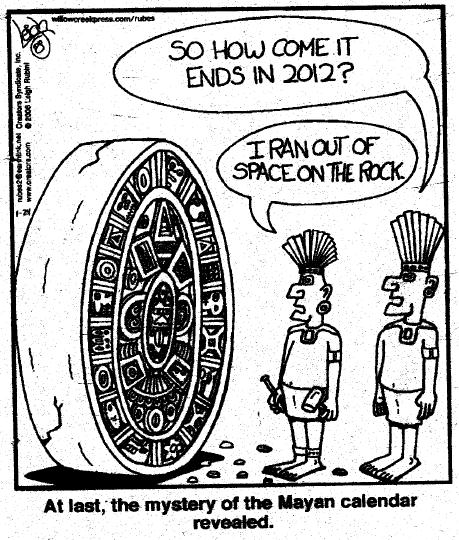 While it seems that the Mayans may not have predicted anything specific happening on December 21st of that swiftly approaching year, it is important to remember that people have a tendency to fulfill their own prophecies in any way possible. Though the ending of the solar year does not currently signal the end of the world, for centuries it did- cultures such as that of ancient Mesopotamia reenacted the destruction and recreation of reality on the new years, in elaborate, orgiastic festivals in which law was held at bay and chaos ruled, at least until tomorrow. Likewise it is possible that though no apocalyptic or revelatory event was predicted by the ancient Mayans, there is nothing to stop modern man from acting like it was, and putting on the kind of elaborate, psychotic dramas we're known for. Of course, the event of 2012 I'm most looking forward to is James Joyce's work going into the public domain.
While it seems that the Mayans may not have predicted anything specific happening on December 21st of that swiftly approaching year, it is important to remember that people have a tendency to fulfill their own prophecies in any way possible. Though the ending of the solar year does not currently signal the end of the world, for centuries it did- cultures such as that of ancient Mesopotamia reenacted the destruction and recreation of reality on the new years, in elaborate, orgiastic festivals in which law was held at bay and chaos ruled, at least until tomorrow. Likewise it is possible that though no apocalyptic or revelatory event was predicted by the ancient Mayans, there is nothing to stop modern man from acting like it was, and putting on the kind of elaborate, psychotic dramas we're known for. Of course, the event of 2012 I'm most looking forward to is James Joyce's work going into the public domain.
5.06.2008
The Myth of the Green Fairy
"An analysis of century-old bottles of absinthe — the kind once quaffed by the likes of van Gogh and Picasso to enhance their creativity — may end the controversy over what ingredient caused the green liqueur's supposed mind-altering effects.
The culprit seems plain and simple: The century-old absinthe contained about 70 percent alcohol, giving it a 140-proof kick. In comparison, most gins, vodkas and whiskeys are just 80- to 100-proof." [via Disinfo]

For some reason this doesn't strike me as being that surprising at all, considering that plain old alcohol has been one of the most common and harshest muses to artists of all times. Wormwood on the other hand has been used medicinally since the time of the Greeks, and it seems that the desire to believe in the mind altering effects of the plant may have been due to the temperance movement, which, in a move similar to the modern American War on Drugs' demonization of marijuana, attempted to paint what was an otherwise cheap and ubiquitous drink as a dangerous and maddening substance. Which all signs point to alcohol being anyway, regardless of if it's green or not. I wonder on the other hand what absinthe's connection might be to the mention of wormwood in the Book of Revelations as a poisonous falling star.
[Edit: Since getting clean I've become quite fascinated by the mystique of drugs, not necessarily their psycho-physical effects but the bizarre subcultures and paraphernalia that accrue to perpetuate the use of certain chemicals. For instance on one of my sojourns on the West Coast I stumbled across a small enclave of "absinthe fiends," who were not emulating Baudelaire et al., but were emulating the media copies of Baudelaire- that is, they all dressed like the Disney version of the Mad Hatter, wore skull rings, smoked clove cigarettes, and drank lots of absinthe. It was really quite humorous, in a sad confused kind of way.]

1.01.2008
Happy Zeitgeist
"Things fall apart; the centre cannot hold;
Mere anarchy is loosed upon the world,
The blood-dimmed tide is loosed, and everywhere
The ceremony of innocence is drowned;
The best lack all conviction, while the worst
Are full of passionate intensity..."
-Yates, from The Second Coming
It's kind of incredible to see how far world civilization has progressed, and yet how mundane modern celebrations have become. In ancient Mesopotamia, the new year was not just celebrated, but had to be ritually brought about by returning the city-state to a point of chaos; mass orgies, feasting, the dethroning of the king, and then the world is re-created by two teams acting out the mythological slaying of Tiamat by Marduk. While I am still not quite convinced that modern America isn't Babylon (our worship of towers and law, and our war-like and demonizing social rhetoric), our new years celebrations only seem to return to chaos on a surface level: screaming in the streets, drinking and fireworks and singing. While these actions certainly don't re-create the cosmos in any paradigmatic image, they do suggest that the spirit of the times is one of a general and undirected anarchy.
I, on the other hand, had a quiet evening with Sophie. We finished setting up and cleaning our new house, had a lovely dinner, watched a silly movie and played scrabble, watched the fireworks from our window view of downtown, reminisced about how positive last year was and how we planned on reaffirming our practices for 2008, called our families and friends, and curled up in bed, where I dreamt of attending a conference held in all the languages of the world.
Mere anarchy is loosed upon the world,
The blood-dimmed tide is loosed, and everywhere
The ceremony of innocence is drowned;
The best lack all conviction, while the worst
Are full of passionate intensity..."
-Yates, from The Second Coming
It's kind of incredible to see how far world civilization has progressed, and yet how mundane modern celebrations have become. In ancient Mesopotamia, the new year was not just celebrated, but had to be ritually brought about by returning the city-state to a point of chaos; mass orgies, feasting, the dethroning of the king, and then the world is re-created by two teams acting out the mythological slaying of Tiamat by Marduk. While I am still not quite convinced that modern America isn't Babylon (our worship of towers and law, and our war-like and demonizing social rhetoric), our new years celebrations only seem to return to chaos on a surface level: screaming in the streets, drinking and fireworks and singing. While these actions certainly don't re-create the cosmos in any paradigmatic image, they do suggest that the spirit of the times is one of a general and undirected anarchy.
I, on the other hand, had a quiet evening with Sophie. We finished setting up and cleaning our new house, had a lovely dinner, watched a silly movie and played scrabble, watched the fireworks from our window view of downtown, reminisced about how positive last year was and how we planned on reaffirming our practices for 2008, called our families and friends, and curled up in bed, where I dreamt of attending a conference held in all the languages of the world.
12.20.2007
The End of the States as We Know them
Writing my research paper on the failure of the 1890 Ghost Dance of the Lakota Sioux, it seemed that though the Lakota had been unable to bring about a millenarian destruction of the invading European-Americans, their fierce sense of independence and traditional religious practices still held strong, and has carried their culture through Western dominance till today. In this light it is fairly amazing, but not at all surprising to see that the Lakota People have declared independence from the U.S. government, finally able to overcome 150 years worth of broken treaties, and are inviting anyone who lives in the five surrounding states to join them in their new Nation. Furthermore, the Navajo are also seeking support for their own tribal Constitution, and it seems that there is a broad push across the country for American Indian tribes to take up the mantel of self-governance. I think this is splendid, and it's about time that peoples who have been oppressed for the last century and a half are finally able to take a stand for their autonomy. We can only wonder if states like Vermont will now make their own pushes to secede.
Over the summer I had a chance to check out the new National Museum of the American Indian, part of the Smithsonian Institute in D.C., and was informed of the some of the difficult problems faced with trying to establish representation for a people who are not one central body-politic, but countless tribes, each with their own distinct culture and mytho-historical milieu. While the museum is run by a tribal council, it turns out that only the richest tribes responded to the open call for artifacts, leading to claims of unfairness by the unrepresented tribes. Consequently, the museum exhibits suffered from trying to give the broadest view to the most distinct of tribes across the Americas, often loosing any sense of context that didn't seem to do any justice to the wealth of cultures, or the influence of Western European ideas and practices on traditional patterns of behavior, such as this ritual prayer circle marked with quotes from the Book of Revelations:

Such apocalyptic fantasizing may not always have a place in American Indian mythologies (the Mayans aside, but when you believe time is cyclical, would you predict that the world will end in 2012?), but the icy climes of Norway certainly lend themselves to their Ragnaroks, which might be why the Norwegians have built a 'doomsday vault' to house a collection of all the world's seeds. When Lif and Lifthrasir inherit the earth after the doom of the Aesir at the jaws of the Fenrir wolf and the Jormungand serpent, the surviving humans will surely want something to eat, and the means necessary to continue culture.
Personally I am in support of such "7th Generation" contingency plans, and while I'd like to believe I have a more enlightened (and less terrified) view these days of what the future holds, there's never any telling if crazy idiots with itching fingers wouldn't just release a nuclear apocalypse. Perhaps more likely, in my opinion, would be an immanent break down of technology. It frightens me that the world is moving all of its media onto digital, and that if one day the parts for computers are no longer available, or the tools to repair them, or any combination of technological failures, then what will become of culture? While storing seeds is a valiant idea, I would also like to see a "time-proof" vault created to store paper copies of the world's greatest literature, philosophies, scientific manuscripts, dictionaries, a true hermetic(ally sealed) library, so that in some distant age people can still maintain an idea of the history of culture, without having to figure out what to play these shiny little discs on.
Over the summer I had a chance to check out the new National Museum of the American Indian, part of the Smithsonian Institute in D.C., and was informed of the some of the difficult problems faced with trying to establish representation for a people who are not one central body-politic, but countless tribes, each with their own distinct culture and mytho-historical milieu. While the museum is run by a tribal council, it turns out that only the richest tribes responded to the open call for artifacts, leading to claims of unfairness by the unrepresented tribes. Consequently, the museum exhibits suffered from trying to give the broadest view to the most distinct of tribes across the Americas, often loosing any sense of context that didn't seem to do any justice to the wealth of cultures, or the influence of Western European ideas and practices on traditional patterns of behavior, such as this ritual prayer circle marked with quotes from the Book of Revelations:

Such apocalyptic fantasizing may not always have a place in American Indian mythologies (the Mayans aside, but when you believe time is cyclical, would you predict that the world will end in 2012?), but the icy climes of Norway certainly lend themselves to their Ragnaroks, which might be why the Norwegians have built a 'doomsday vault' to house a collection of all the world's seeds. When Lif and Lifthrasir inherit the earth after the doom of the Aesir at the jaws of the Fenrir wolf and the Jormungand serpent, the surviving humans will surely want something to eat, and the means necessary to continue culture.
Personally I am in support of such "7th Generation" contingency plans, and while I'd like to believe I have a more enlightened (and less terrified) view these days of what the future holds, there's never any telling if crazy idiots with itching fingers wouldn't just release a nuclear apocalypse. Perhaps more likely, in my opinion, would be an immanent break down of technology. It frightens me that the world is moving all of its media onto digital, and that if one day the parts for computers are no longer available, or the tools to repair them, or any combination of technological failures, then what will become of culture? While storing seeds is a valiant idea, I would also like to see a "time-proof" vault created to store paper copies of the world's greatest literature, philosophies, scientific manuscripts, dictionaries, a true hermetic(ally sealed) library, so that in some distant age people can still maintain an idea of the history of culture, without having to figure out what to play these shiny little discs on.
10.09.2007
"Oh brave new world that has such people in it!"
It seems that all the scientific excitement right now is percolating around Craig Venter's impending creation of the first form of artificial life (via monkeyfilter.com).
Perhaps the most fitting quote I've heard in connection with this event comes from Aldous Huxley's "Brave New World" (though originally from Shakespeare's "The Tempest"), which ironically predicts such biological engineering in contrast to the myth of a 'noble savage' who sees through the Soma haze of this utopian future at the sexual, familial, and moral degradation such genetic manipulation might produce. These are perhaps the kinds of controversial questions Venter hopes to raise with his brash step forward into a somewhat foolish new world. Incidentally, Huxley's society's delight in the intoxications of Soma is drawn from the pre-Hindu Vedic culture of India, where it took pride place in their sacrificial rituals and stirred the warriors into battle frenzy. A far cry from the tripped-out mellow of Huxley's anti-utopia.
Bioengineering is a rather modern plot twist however, even Mary Shelley's "Frankenstein" was a 'modern Prometheus' born from fears of the Industrial Revolution. Humans have been trying to usurp the creative abilities of the gods since at least the Renaissance, when the ancient Hermetic texts of the mythic Hermes Trismegistus were translated, and drawing wild comparisons between science and magic was all the rage. Trismegistus's "To Asclepius" from the "Corpus Hermeticum" in particular claimed to record the rituals ancient Egyptian priests used to bring spirits into statues and animate them to life, which compares to the Kabbalistic technique of creating golems by inserting a scroll into a statue's mouth. Pico Della Mirandola, as exemplary of the Renaissance Man archetype, praised human individuality and ability above the rest of creation, claiming that we could learn the words with which God spoke the world into existence. And though we have up till now not been able to speak life itself into existence, and it still may be too soon to say, the magical power of language to create is perhaps responsible for the enormity of the world's cultures, from myths, to laws, to the varied interactions of our every day.
Perhaps the most fitting quote I've heard in connection with this event comes from Aldous Huxley's "Brave New World" (though originally from Shakespeare's "The Tempest"), which ironically predicts such biological engineering in contrast to the myth of a 'noble savage' who sees through the Soma haze of this utopian future at the sexual, familial, and moral degradation such genetic manipulation might produce. These are perhaps the kinds of controversial questions Venter hopes to raise with his brash step forward into a somewhat foolish new world. Incidentally, Huxley's society's delight in the intoxications of Soma is drawn from the pre-Hindu Vedic culture of India, where it took pride place in their sacrificial rituals and stirred the warriors into battle frenzy. A far cry from the tripped-out mellow of Huxley's anti-utopia.
Bioengineering is a rather modern plot twist however, even Mary Shelley's "Frankenstein" was a 'modern Prometheus' born from fears of the Industrial Revolution. Humans have been trying to usurp the creative abilities of the gods since at least the Renaissance, when the ancient Hermetic texts of the mythic Hermes Trismegistus were translated, and drawing wild comparisons between science and magic was all the rage. Trismegistus's "To Asclepius" from the "Corpus Hermeticum" in particular claimed to record the rituals ancient Egyptian priests used to bring spirits into statues and animate them to life, which compares to the Kabbalistic technique of creating golems by inserting a scroll into a statue's mouth. Pico Della Mirandola, as exemplary of the Renaissance Man archetype, praised human individuality and ability above the rest of creation, claiming that we could learn the words with which God spoke the world into existence. And though we have up till now not been able to speak life itself into existence, and it still may be too soon to say, the magical power of language to create is perhaps responsible for the enormity of the world's cultures, from myths, to laws, to the varied interactions of our every day.
8.31.2007
exploding mythologies
It looks like my Myth, Symbol, and Ritual class will be the most exciting, and most challenging, of my courses this year. The professor, Fred Clothey, was a student of the renowned mythologist Mircea Eliade, a gruff imposing man who founded Pitt's Comparative Religion department and immediately threatened to scare all the freshmen out. Apparently he retired last year, but the University was unable to find another teacher for this course, and I feel highly honored to learn from an authority in this field and not some gawky grad student. Asking us what a myth is, he shot down all our uncertain ideas, and though I recognize that having not been in school for seven years I really need to relearn how to frame my vocal arguments, I feel certain I will have all my assumptions about myth questioned and learn a great deal in this field which I perhaps have the most personal investment in.
As opposed to the six page final paper for my Critical Reading class, here I am expected to write three 7-10 page essays (the first due next month), each dealing with one of the topics, myth, symbol, and ritual. On top of that I must also write my own personal myth and an observation of a ritual outside of my everyday experience, all things that I currently push myself to do in my personal writing, but perhaps not with nearly the critical intent that the professor might hope us to bring. Thankfully, I am fascinated by these themes, and already have thousands of ideas for subject matter.
For the myth I will take one of the apocalypses with which I am familiar, possibly Revelations but more likely the Norse Ragnarok, which has exerted it's influence on my psyche since I first read it in fourth grade, interpreting its symbols as well as through a mythological theory (I'm not sure just whose yet), in order to show that though it describes an end of the world (in illo tempore), it is also a creation myth which paves the way for this present reality.
For the symbol I immediately decided on that of the Tower, perhaps the most pervasive symbol in my own mythology, and fitting because that's exactly the phase of life I'm in. The Tarot's blasted tower, the tower of Babel, the World Trade Centers, Tolkien's White Tower, Stephen King's Dark Tower, the current race for the world's largest skyscraper, and even Oakland's infamous gothic edifice, the Cathedral of Learning (or Tower of Ignorance), in which I have all my classes. Building not just as recreation of world, but as the human folly of trying to become the gods. I could probably tie in the internet as modern parallel of Babel.
For the ritual, I had already been planning on attending a Jewish Temple service with Sophie at some point soon, which could be interesting in comparison to my Catholic upbringing. But I also had the opportunity to participate in a Peyote ceremony in the spring on which I took extensive notes, and could potentially participate in another one specifically to examine for the class. What's interesting about that is the ceremony is removed from its traditional context (in the Yaqui shamanism Castaneda studied), and literally smuggled into the modern American world, an angle which might interest Clothey, who extensively studied religious diasporas in Southern India.
Regardless of what I actually end up writing about it is certainly already getting me thinking much more critically in these terms again, and making me reconsider the idea of doing a double major, in creative writing and comparative religion.
As opposed to the six page final paper for my Critical Reading class, here I am expected to write three 7-10 page essays (the first due next month), each dealing with one of the topics, myth, symbol, and ritual. On top of that I must also write my own personal myth and an observation of a ritual outside of my everyday experience, all things that I currently push myself to do in my personal writing, but perhaps not with nearly the critical intent that the professor might hope us to bring. Thankfully, I am fascinated by these themes, and already have thousands of ideas for subject matter.
For the myth I will take one of the apocalypses with which I am familiar, possibly Revelations but more likely the Norse Ragnarok, which has exerted it's influence on my psyche since I first read it in fourth grade, interpreting its symbols as well as through a mythological theory (I'm not sure just whose yet), in order to show that though it describes an end of the world (in illo tempore), it is also a creation myth which paves the way for this present reality.
For the symbol I immediately decided on that of the Tower, perhaps the most pervasive symbol in my own mythology, and fitting because that's exactly the phase of life I'm in. The Tarot's blasted tower, the tower of Babel, the World Trade Centers, Tolkien's White Tower, Stephen King's Dark Tower, the current race for the world's largest skyscraper, and even Oakland's infamous gothic edifice, the Cathedral of Learning (or Tower of Ignorance), in which I have all my classes. Building not just as recreation of world, but as the human folly of trying to become the gods. I could probably tie in the internet as modern parallel of Babel.
For the ritual, I had already been planning on attending a Jewish Temple service with Sophie at some point soon, which could be interesting in comparison to my Catholic upbringing. But I also had the opportunity to participate in a Peyote ceremony in the spring on which I took extensive notes, and could potentially participate in another one specifically to examine for the class. What's interesting about that is the ceremony is removed from its traditional context (in the Yaqui shamanism Castaneda studied), and literally smuggled into the modern American world, an angle which might interest Clothey, who extensively studied religious diasporas in Southern India.
Regardless of what I actually end up writing about it is certainly already getting me thinking much more critically in these terms again, and making me reconsider the idea of doing a double major, in creative writing and comparative religion.
Subscribe to:
Comments (Atom)

