
[This one's inspired by a bunch of puns from work today, and the ridiculousness of the anxiety that manifests itself in Pittsburgh this time of year. Enjoy!]
Bananarchy in the Bowl of Winds
It was third down in the final minutes of the third quarter, and Jerry was on the edge of his seat. C’mon, he screamed, just catch the ball! I can’t believe that call, he was clearly across the line… I couldn’t tell how Jerry knew; it was almost impossible to see the field from as high up as we were in the stands. But the seats were cheap, even if in this terrible weather the wind just whipped down into the bowl of the arena and froze our faces off, even though the group of fans in bright yellow suits right below us seemed jovially unconcerned.
Touchdown! No it’s not, Jerry howled, wringing his towel and jumping up and down. One of the fans cast an odd glance up our way, but his friends were occupied, huddled around something I couldn’t see, probably watching a replay on the Net as the JumboTron screen was having a hard time staying focused. The fan’s face was inexplicably painted like a clown’s, in a yellow as garish as his suit. Jerry had warned me the fans often dressed quite strange to show their team spirit. I’ve never understood football myself, being more of a story man. What’s the entertainment value of watching large men you can’t even see tumbling all over each other? But Jerry’s enthusiasm was contagious, so when he begged me to come along with him to the game I agreed, not realizing how miserably wretched the weather would be, even in the chintzy team windbreaker Jerry leant me that did nothing to keep out the wind. Those thick yellow suits were starting to look appealing right now.
The game wore on, Pittsburgh falling behind as Dallas caught a second wind, and then a third. Unable to make out the ant-like players below, my attention kept wandering, returning to the yellow-suited fans who seemed to be having a lot more fun. It looked like they were busy constructing some apparatus, what after a moment my brain told me was a catapult. A catapult? I wanted to ask Jerry if this was for some post-game ritual, but he was too busy chewing his mittens to shreds over the last foul to listen, so I sat back again to watch, finally a little curious.
Third down in the final minutes of the last quarter, and the Steelers had just used their last timeout, hopefully planning how to turn their game around before poor Jerry threw himself from the bleachers in despair. The whole crowd was on the edge of their seats, except for me, unable to see why this was so important, and the yellow suits, who’d finished building their contraption and all leaned back, opening their jackets despite the chill. Suddenly, just as one of the Cowboys was about to claim another first down (I think that’s what it’s called), a small flapping object went whirling out of the stands, landing right in front of the runner, whose feet flew out from under him in an inglorious pratfall.
The crowd went wild as the cameras zoomed in to reveal a banana peel on the jittery JumboTron screen. The announcers all mumbled, uncertain where it had come from. The crowd was actually aghast, but they couldn’t keep from laughing at the absurdity of it, the yellow-suited fans most of all. Finally the field calmed down again so the Cowboy could redo his play without interruptions. But no! This time with an audible thwang another yellow whirl went sailing, and another. Suddenly the arena’s cold air was filled with banana peels, all landing whichever way the winds blew them! Looking around I realized that the top rows of the stands were dotted with yellow-suited individuals, each group of them busy at their own little catapult. They must have planned this whole caper in case the Steelers began to loose, unless it was a political statement, hiding the bananas in their jackets to keep them from freezing.
No one else seemed to notice the characters depart, all eyes intent on the field, where the game carried on now despite the rain of peels, the players slipping and tumbling all over the place, the ball slick with juice and a fruity reek wafting up to the stands. It was chaos, sheer bananarchy! Jerry could only shake his head as his cherished pastime was reduced to the buffoonery I’d always told him it looked like, while I laughed and laughed, entirely forgetting about the cold. Eventually the game was called on account of the mushy sabotage, and as we were walking to the lot I turned to Jerry and said, you know what, that was a lot more fun then I expected, you wanna go get a smoothie? For some reason he only grumbled and kept walking.
Showing posts with label farce. Show all posts
Showing posts with label farce. Show all posts


10.28.2009
Fictionology
In light of the Church of Scientology being convicted of Fraud in France, the Onion offers this brilliant mock competing religion, Fictionology [via mutate!]:
Interestingly, I personally suspect that if there is any kind of contemporary folk mythology, this is essentially it, the belief in any literary or culture character as an object of worship, wisdom, or personal identification. Just because in the past the culture characters we did this with were gods does not mean contemporary characters are any less available for their symbolic significance. One just has to look at the hype surrounding the release of new superhero movies, the lines around theaters like ancient temples. Perhaps without intending to the Onion seems to have hit exactly on what makes pop culture tick in the human heart.
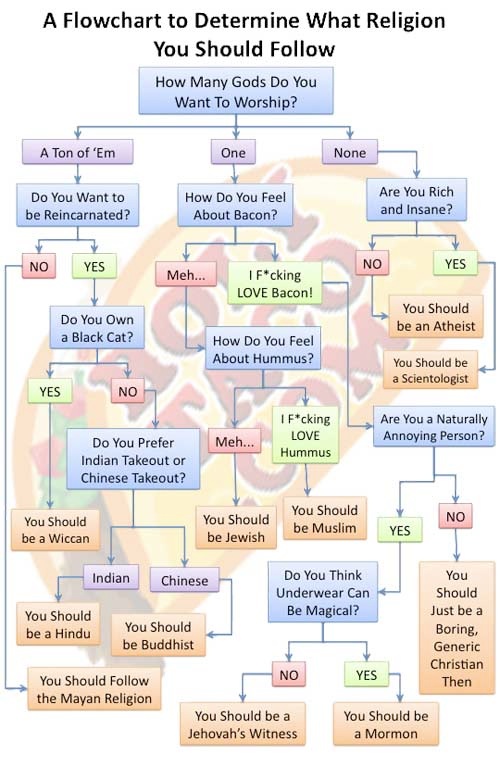
For further perusal, here's an interesting tor.com article on the role memory and recognition play in making quality stories, as well as a handy chart to help you determine (based off food preferences) what religion you should belong to.
Fictionology’s central belief, that any imaginary construct can be incorporated into the church’s ever-growing set of official doctrines, continues to gain popularity. Believers in Santa Claus, his elves, or the Tooth Fairy are permitted—even encouraged—to view them as deities. Even corporate mascots like the Kool-Aid Man are valid objects of Fictionological worship.
“My personal savior is Batman,” said Beverly Hills plastic surgeon Greg Jurgenson. “My wife chooses to follow the teachings of the Gilmore Girls. Of course, we are still beginners. Some advanced-level Fictionologists have total knowledge of every lifetime they have ever lived for the last 80 trillion years.”
“Sure, it’s total bullshit,” Jurgenson added. “But that’s Fictionology. Praise Batman!” [...]
“Scientology can only offer data, such as how an Operating Thetan can control matter, energy, space, and time with pure thought alone,” McSavage said. “But truly spiritual people don’t care about data, especially those seeking an escape from very real physical, mental, or emotional problems.”
McSavage added, “As a Fictionologist, I live in a world of pretend. It’s liberating.”
Interestingly, I personally suspect that if there is any kind of contemporary folk mythology, this is essentially it, the belief in any literary or culture character as an object of worship, wisdom, or personal identification. Just because in the past the culture characters we did this with were gods does not mean contemporary characters are any less available for their symbolic significance. One just has to look at the hype surrounding the release of new superhero movies, the lines around theaters like ancient temples. Perhaps without intending to the Onion seems to have hit exactly on what makes pop culture tick in the human heart.
For further perusal, here's an interesting tor.com article on the role memory and recognition play in making quality stories, as well as a handy chart to help you determine (based off food preferences) what religion you should belong to.
9.28.2008
Poetry Bailout Will Restore Confidence of Readers
[from Harper's]
As you know, the glut of illiquid, insolvent, and troubled poems is clogging the literary arteries of the West. These debt-ridden poems threaten to infect other areas of the literary sector and ultimately to topple our culture industry.
Cultural leaders have come together to announce a massive poetry buyout: leveraged and unsecured poems, poetry derivatives, delinquent poems, and subprime poems will be removed from circulation in the biggest poetry bailout since the Victorian era. We believe the plan is a comprehensive approach to relieving the stresses on our literary institutions and markets.
Let there be no mistake: the fundamentals of our poetry are sound. The problem is not poetry but poems. The crisis has been precipitated by the escalation of poetry debt—poems that circulate in the market at an economic loss due to their difficulty, incompetence, or irrelevance.
Illiquid poetry assets are choking off the flow of imagination that is so vital to our literature. When the literary system works as it should, poetry and poetry assets flow to and from readers and writers to create a productive part of the cultural field. As toxic poetry assets block the system, the poisoning of literary markets has the potential to damage our cultural institutions irreparably.
As we know, lax composition practices since the advent of modernism led to irresponsible poets and irresponsible readers. Simply put, too many poets composed works they could not justify. We are seeing the impact on poetry, with a massive loss of confidence on the part of readers. What began as a subprime poetry problem on essentially unregulated poetry websites has spread to other, more stable, literary magazines and presses and contributed to excess poetry inventories that have pushed down the value of responsible poems.
As you know, the glut of illiquid, insolvent, and troubled poems is clogging the literary arteries of the West. These debt-ridden poems threaten to infect other areas of the literary sector and ultimately to topple our culture industry.
Cultural leaders have come together to announce a massive poetry buyout: leveraged and unsecured poems, poetry derivatives, delinquent poems, and subprime poems will be removed from circulation in the biggest poetry bailout since the Victorian era. We believe the plan is a comprehensive approach to relieving the stresses on our literary institutions and markets.
Let there be no mistake: the fundamentals of our poetry are sound. The problem is not poetry but poems. The crisis has been precipitated by the escalation of poetry debt—poems that circulate in the market at an economic loss due to their difficulty, incompetence, or irrelevance.
Illiquid poetry assets are choking off the flow of imagination that is so vital to our literature. When the literary system works as it should, poetry and poetry assets flow to and from readers and writers to create a productive part of the cultural field. As toxic poetry assets block the system, the poisoning of literary markets has the potential to damage our cultural institutions irreparably.
As we know, lax composition practices since the advent of modernism led to irresponsible poets and irresponsible readers. Simply put, too many poets composed works they could not justify. We are seeing the impact on poetry, with a massive loss of confidence on the part of readers. What began as a subprime poetry problem on essentially unregulated poetry websites has spread to other, more stable, literary magazines and presses and contributed to excess poetry inventories that have pushed down the value of responsible poems.
5.06.2008
On the Improper Propagation of Ideas
While I generally am interested in mythology, shamanism, personal and cultural enlightenment, etc. I am also, and perhaps more, interested in rational and well-written discourse. I am often flabbergasted by the mummery that passes for philosophy (the postmodern deconstructionism of Derrida and ilk) and religion (the new-agey second-rate Castaneda-ism) these days. The problem being that one can't really turn to science to talk about all the intangible, emotio-cultural, and even otherworldly concepts that also need to be grappled with. The problem also being that language is a frail, frail invention, and that in a world entirely consumed by the reproduction of the word it is almost entirely possible to say something that isn't slanted immediately into a thousand quite subjective perspectives. In other words, there is no objective dialogue. To paraphrase José Donoso, the author of a fabulous novel I'm currently reading, the limitation of would-be writers is that they believe there in the existence of a reality to portray. This is why I love stories. Unlike modern attempts at journalism, which fail because they can never be objective enough, literature by its very nature takes on the perspective of a narrator, and any information or ideas couched in the story are almost more palatable for being couched in what we already read as a biased perspective. Narrators lie, they can be obsessive or misinformed, and we love them all the more for it, qualities that would make us cringe in a journalist.
12.11.2007
While two gods skip court, another faces imminent execution
In a move somewhat reminiscent of the goats ritually sacrificed to fix a Nepalese jet, but with far greater implications for the modern validity and legality of myth, an Indian judge has summoned two Hindu gods to court to help resolve a 20-year-old property dispute [via Technoccult]. While they are still waiting for Ram and Hanuman to show up so they can decide who owns the land adjacent to temples dedicated to the two gods, this raises a host of serious question for the modern world.
Can mythic beings own property? What is the legal status of godhood? Where do the gods actually live so they can be contacted? Will the mothers of all the heroic demigods finally file paternity lawsuits? How intricately is human life still wrapped up in the stories of religion?
Earlier I came across an the first two essays on Shadow Democracy of a planned ten part series titled: "Does God Have a Future?" The second article had some interesting points about the rise of spirituality versus the decline of religious participation, a suggestion that modern man (I can only assume the article refers to Americans in particular) is moving towards a view of spirituality that does not necessarily include the worship of distinct deities. While organized religious participation may be down, it is also worth noting that ritual behavior is up, and hundreds of new religious movements have been created in the last few decades. However, I was a bit disappointed with a few perspectives from the first article, not the least of which was that it only focuses on the Christian God, as if He were the only deity active in the world right now. Furthermore, the article suggested that God has mainly been a means for explaining natural phenomena, a point that I recently tried to address my problems with, and suggests that God and religion are inseparable, which also makes me wince. While I generally appreciate any current discussion on the subjects I fear that perspectives like this only add fervor to the "new atheist" movement. Not that it's necessary, or possible, to prove whether or not gods actually exist, but it is certainly disheartening to know that a lot of bright minds, and a lot of everyday yahoos, are belittling religious feelings and practices as nothing more than a quirk of human consciousness that should play no part in the modern, rational world. It makes me feel that, among all the otherwise interesting projects I have planned for my life, I will have to spend an inordinate time defending the validity and efficacy of myth, ritual, and spiritual experiences, both in their historical contexts and as a real, lived existential condition that still pertains to the modern world.
Can mythic beings own property? What is the legal status of godhood? Where do the gods actually live so they can be contacted? Will the mothers of all the heroic demigods finally file paternity lawsuits? How intricately is human life still wrapped up in the stories of religion?
Earlier I came across an the first two essays on Shadow Democracy of a planned ten part series titled: "Does God Have a Future?" The second article had some interesting points about the rise of spirituality versus the decline of religious participation, a suggestion that modern man (I can only assume the article refers to Americans in particular) is moving towards a view of spirituality that does not necessarily include the worship of distinct deities. While organized religious participation may be down, it is also worth noting that ritual behavior is up, and hundreds of new religious movements have been created in the last few decades. However, I was a bit disappointed with a few perspectives from the first article, not the least of which was that it only focuses on the Christian God, as if He were the only deity active in the world right now. Furthermore, the article suggested that God has mainly been a means for explaining natural phenomena, a point that I recently tried to address my problems with, and suggests that God and religion are inseparable, which also makes me wince. While I generally appreciate any current discussion on the subjects I fear that perspectives like this only add fervor to the "new atheist" movement. Not that it's necessary, or possible, to prove whether or not gods actually exist, but it is certainly disheartening to know that a lot of bright minds, and a lot of everyday yahoos, are belittling religious feelings and practices as nothing more than a quirk of human consciousness that should play no part in the modern, rational world. It makes me feel that, among all the otherwise interesting projects I have planned for my life, I will have to spend an inordinate time defending the validity and efficacy of myth, ritual, and spiritual experiences, both in their historical contexts and as a real, lived existential condition that still pertains to the modern world.
12.10.2007
Haunting Tradition: Ritual Failure in the Lakota Ghost Dance
Haunting Tradition: Ritual Failure in the Lakota Ghost Dance
On December 29, 1890, U.S. soldiers massacred over three hundred and fifty Lakota Sioux at Wounded Knee Creek in South Dakota, in response to a supposed “Indian Outbreak” (Mooney 119). Both the agents in charge of the Lakota reservations and the Bureau of American Ethnology believed that a ritual form, known as the Ghost Dance, might have been responsible for the hostility of the Lakota tribe that led to the Wounded Knee massacre (Wallace vii). The Ghost Dance doctrine, as it was preached by the prophet Wovoka of the Paiute tribe in Nevada, may have originally contained a message of interracial peace, but the Lakota, who adopted the ritual in early 1890, believed that this dance would bring about an “Indian millennium,” both destroying their white oppressors and restoring all aspects of their traditional way of life (Mooney 14, 19). Extreme socio-economic deprivations may have led the Lakota to practice this version of the Ghost Dance (Mooney 73), and though some scholars, such as Alice Kehoe, argue that the Ghost Dance revitalized Lakota life prior to, and after, the Wounded Knee massacre (Kehoe 143), this ritual may also have failed to achieve its hoped for millenarian purpose. By looking at specific ways in which the ritual form of the Lakota Ghost Dance was derived, and deviated, from both Wovoka’s original doctrine and traditional Lakota ritualizing, and by applying Ronald Grimes’ classifications of ritual sensibilities and infelicitous performances, it may be possible to offer an interpretation of if and how the Lakota Ghost Dance failed.
Prior to European-American settlement in North America, the Sioux held an immense territory across the Great Plains, on which an unlimited food supply of buffalo and the acquisition of horses in the 1600s made them the largest and strongest Native American tribe until the middle of the 19th Century (Mooney 69). Though Sioux is the common name for these tribes, it is derived from a derogatory term given to them by the Ojibwa tribe, the Sioux’s traditional enemies; the Sioux called themselves Lakota, Dakota, or Nakota, which in their own dialect mean “allies” or “friends” (Mooney 293). Historically, the Sioux organized their tribe from a large number of smaller hunting bands (DeMallie and Parks 6), and were divided into three distinct linguistic divisions, depending on geographic location across the plains: the eastern Santee, middle Yankton, and western Teton (Mooney 293). Lakota is the self-designation from the Teton dialect, the tribal division living in what are now the states of North and South Dakota, who constituted more than two-thirds of all the Sioux (DeMallie and Parks 6-7, and Mooney 294). The Lakota were the wildest of the Sioux branches, pursuing extreme warlike behavior against neighboring tribes, and displaying an “air of proud superiority” that the ethnohistorian James Mooney found unusual among the Native Americans he had visited (Mooney 295-6). Of the 20,000 Sioux who took up the Ghost Dance, 16,000 were from this Lakota or Teton division (Mooney 61).
Written records of Christian missionaries show that the Lakota had contact with European-Americans as early as 1665 (DeMallie and Parks 7). However, in the decades following the Civil War in 1865, the United States government waged an increasing war on Native American tribes, who were seen as a hindrance to the doctrine of Manifest Destiny (Mooney 28), the expansion of European-American settlement across the entire continent. In 1868, the government negotiated a treaty with the Lakota to cut back their land into reservations; the coming of railroads, the discovery of gold in the Black Hills, the Custer War in 1876, a host of epidemics, and the surrendering of more territory over the next thirteen years further reduced their hunting grounds, until the Lakota subsisted solely on government rations and the farming of arid land (Mooney 69-72). By the time the first rumors of Wovoka and his new Ghost Dance religion reached the Lakota in the winter of 1888-9, they were suffering from starvation (Mooney 29), and had become increasingly enculturated by European-American churches, farming, schools, businesses, the railroad, and the postal service (Wallace vii). In the last two decades of the 19th Century, the Lakota had been transformed from a traditionally prosperous hunting and warring lifestyle into poor farmers wearing the clothes of European-American civilization (DeMallie and Parks 12). Though scholars have generally focused on the socio-economic factors leading to the Lakota adoption of the Ghost Dance, the Sioux may still have been in a better economic position than other tribes that did not take up the Ghost Dance (Wallace ix). It is also worth noting that in the 1880s, the U.S. government had prohibited the primary Lakota ritual of the Sun Dance, due to a perception of the ritual cutting and hanging from hooks as a form of self-torture (Amiotte 75, 88), and the Lakota may have embraced and modified the new ritual in order to fill this void. These social, economic, and religious crises my have led the Lakota to perceive the rumors of a new messiah as a hope that would lead them out of their cultural deprivation (Kehoe 39).
After the Wounded Knee massacre, James Mooney was dispatched from the Smithsonian Institute in Washington D. C. to investigate the Ghost Dance religion, and its messiah Wovoka, of the Paiute tribe in Nevada, who was blamed for riling up the Sioux (Kehoe 3). Mooney talked with Wovoka in person about the Ghost Dance doctrine, and was shown the ‘Messiah Letter,’ a document copied by an earlier Arapaho delegate that Mooney describes as the “genuine official statement” of the Ghost Dance religion (Mooney 22). Wovoka told Mooney that he had experienced a vision during a solar eclipse in which he had seen God living with all the Native Americans who had died, and was instructed to tell his people to be honest and to live in peace with the European-Americans (Mooney 13-4). If these instructions were followed, and the Ghost Dance performed at intervals for four consecutive nights, along with ritual bathing and feasting, the Native Americans would soon be reunited with their dead friends and families and the whole earth would be renewed (Mooney 19-20, 23). This doctrine may have drawn from Christian and Mormon theology that framed Wovoka’s upbringing in Mason Valley, Nevada, as well as from the traditional Paiute Round Dance and an earlier, failed version of the Ghost Dance in 1870 (Mooney 6, Hittman 84, 93, and 96), but it was surely a powerful promise for a people suffering from epidemics, the loss of resources, malnourishment, and cultural genocide (Kehoe 8). Despite the Ghost Dance’s origins, the Native Americans revered Wovoka as a direct messenger from the “Other World” (Mooney 7), and delegations were sent on pilgrimage to Mason Valley from around the country to seek guidance and healing for their tribes (Kehoe 6).
Wovoka’s message spread through a process of Native Americans visiting neighboring tribes, observing the ritual, becoming inspired, and returning to their own tribes with the new faith (Kehoe 8). The ritual had been communicated to the Lakota by the northern Arapaho and Shoshoni tribes of Wyoming, and a delegation was sent West by the Lakota in order to confirm the rumors (Mooney 61-3). When they returned in the spring of 1890, the Ghost Dance ritual was immediately accepted and inaugurated by the majority of the tribe (Mooney 29). According to James McLaughlin, the agent at the Pine Ridge reservation in South Dakota, the Lakota were excited about the prospect of an “Indian millennium:” if they believed in and practiced the Ghost Dance their dead families and buffalo herds would return, they would be impervious to bullets, and the European-Americans would be annihilated that coming spring (Mooney 29). However, this idea of an “Indian millennium” does not seem to have been part of the original Ghost Dance doctrine; it was only among the warlike Lakota Sioux that the Ghost Dance assumed this hostile expression (Mooney 19).
Part of the reason for the broad acceptance and distortion of Wovoka’s Ghost Dance message was that the doctrine was abstract enough to allow for a variety of local interpretations (Wallace viii). Each tribe reconstructed the central Ghost Dance beliefs in a return of the dead and the regeneration of the earth from their own mythology, and each believer filled in the details from their own life and trance experiences (Mooney 19). The idea that the earth must be renewed was common to a number of Native American tribes (Mooney 27). The Lakota believed that this renewal of life would occur in the early spring, when the earth’s natural regeneration takes place, and was the time of year when their annual Sun Dance ceremony was formerly held (Mooney 19-20), in which a sacrifice is performed in order to recreate the world and reactivate the wakan, or sacred power of the Universe (Amiotte 76). Similarly, the Lakota strongly believed that the spirits of the dead still exist in the world and can be reached for support (DeMallie and Parks 21). Wovoka’s message, “when your friends die, do not cry,” was interpreted by the plains tribes as forbidding their customary funerary practice of killing horses, burning property, and gashing the mourner’s body, and instead trances were performed during the dance in which they could communicate directly with their dead (Mooney 24, 186). More importantly, Wovoka’s suggestion of living in peace was interpreted as a call to put down the war dances, scalp dances, and the self-inflicted violence of the Sun Dance, that had been an integral part of life for warring plains tribes like the Lakota (Mooney 25).
However, there may have been some discrepancy in Wovoka’s original message that allowed the Lakota Sioux to interpret it in such a millenarian way. It is possible that Wovoka had different revelations that he offered to his different visitors, reflecting doctrinal shifts before and after the perceived involvement of his Ghost Dance in the Wounded Knee massacre (Hittman 98). Black Elk, a Lakota wicaša wakan, or holy man, recounts that Wovoka told the Sioux delegation that a “cloud was coming like a whirlwind” that would crush the old world and restore the buffalo (Neihardt 233). This prediction may have spoken to the central Lakota myth of the White Buffalo Woman, wherein two men hunting buffalo come across a mysterious woman and one of them is filled with evil thoughts towards her. The woman destroys this man with a cloud, reveals herself as Wakan Tanka, a manifestation of the “Great Mystery,” and gives the other man a sacred pipe, the tribal rituals, and the sanction of the buffalo as an everlasting food source (Looking Horse, 68 and DeMallie 28, 31). The offering of the pipe was the primary means of prayer for the Lakota Sioux, and was ritually accompanied by the physical and spiritual cleansing of the sweat lodge, and the communal sacrifice of the Sun Dance, which had been practiced without interruption throughout the previous century (DeMallie and Parks 14). When the Lakota adopted the Ghost Dance in 1890, they included in their adopted version several aspects from these rituals, as well as their mythic desire to see the “evil man,” now embodied by the European-Americans, destroyed in a similar supernatural cloud, altering both the original Ghost Dance doctrine and their own traditional religious practices.
Lakota religion was not separate from everyday life, and due to man’s ability to share in the wakan power, no distinction was seen between man and nature, or between nature and the supernatural; the world was characterized by a sense of unity or oneness (DeMallie 27-8). This relationship to the sacred, established in the myth of the White Buffalo Woman, was symbolized as a fixed and unending circle, and characterized Lakota ritualizing until the advent of European-American settlement and the decline of the buffalo (DeMallie 31). The traditional rituals, whether public or private, taught through myths or personal revelation, were all patterned in accordance to this circular relationship with the Wakan Tanka (DeMallie 33). The Lakota had no standardized theological beliefs; though the tribe shared basic spiritual concepts, individuals formulated specific knowledge of the wakan, whereas the rituals eventually reached an accepted public structure through continual repetition (DeMallie 34). Lakota rituals were often spoken of in terms of “pleasing” the all-powerful wakan beings, and it was believed that if they were left unsatisfied, the Wakan Tanka would do great harm to mankind (DeMallie 33, 29). Consequently, the power of the rituals made their performance dangerous, and if executed incorrectly the rituals would fail to produce their desired results, bringing on the wrath of the wakan beings, which led to an importance of proper instructions for novices and a greater uniformity of rituals (DeMallie 34). Despite pre-established ceremonial forms, Lakota ritualizing was not static, and could be changed through the influence of each individual’s visionary experience (DeMallie 42-3, and Kehoe 71). Mooney felt that such innovative visionary states were the primary feature of the Ghost Dance, and that Native Americans have an implicit faith in the content of such dreams and visions (Mooney 186, 16). Lakota participants would strive to imitate whatever they had seen while entranced, creating new songs, objects, games, and articles of clothing to be used in the next dance (Mooney 186). This mutability of Lakota ritualizing possibly accounts for what may have been a rapid, and spiritually dangerous, accruement of ritual innovations in their Ghost Dance over against Wovoka’s original doctrine.
The Lakota Ghost Dance had many features in common with Wovoka’s Ghost Dance, and with the traditional Paiute Round Dance: the ritual leaders sat in the middle of the dance circle, fires were kept on the outside, no instruments accompanied the ritual songs, and both men and women danced with joined hands, moving from right to left in the direction of the sun (Hittman 93-4, Mooney 179, 185-6, and Neihardt 237). The Lakota also participated in the communal feast that was part of every large Native American ceremony, and in the continuation of the Ghost Dance over four nights, as four was considered a sacred number in most Native American belief systems (Mooney 24), presumably indicating the four cardinal directions. Like in Wovoka’s original Ghost Dance, the Lakota ritual began with the wicaša wakan painting the dancers faces with a red-ochre paint given to the Lakota delegates by Wovoka, which the Paiute collected from their sacred mountain, Mount Grant, and was supposed to ward off illness and assist in the mental vision of the trance (Mooney 20-1). The Lakota however used other colors of paint determined by individual trance visions, and a variety of specific tribal designs that were painted on the dancer’s cheek or forehead (Mooney 68, 184).
Other differences arise between the two versions of the Ghost Dance, drawn from traditional Lakota ritual forms. While the Lakota followed Wovoka’s instruction to bathe in a stream, in order to wash away evil and dirt after the ritual, they also began the Ghost Dance with a large version of their traditional sweat lodge, in which a circular framework of willow branches is covered with blankets, and then filled with the steam from heated stones splashed with water in order to ritually purify those within (Mooney 186, 66-8). The Sweat Lodge was used to begin all Lakota ritualizing, representing the mother’s womb from which the ritual participants would be reborn (Mooney 29, and Looking Horse 72), in the same way they believed that they had been born from the womb of the earth in unity with the buffalo (DeMallie 27). A tree was also raised in the center of the Lakota Ghost Dance circle from which a sacred bow and arrows were hung, along with other ritual objects (Mooney 182, 30). The inclusion of the sweat lodge and a central tree were not found in the Paiute Ghost Dance, though a non-sacred pole was used in the traditional Piute Round Dance in order to orient the dancers in the circle (Mooney 46-7, Hittman 94). Due to Wovoka’s explicit message of peace, weapons like the bow and arrows were specifically disallowed in the Paiute Ghost Dance (Mooney 30). Finally, though trance visions became a dominant feature of the Ghost Dance for many tribes, including the Lakota, Wovoka claimed that there were no innovative trances in the Paiute Ghost Dance, a statement Mooney confirmed through eyewitness reports from neighboring ranchmen (Mooney 14). However, it does seem that Wovoka demonstrated visionary trance performances to the Lakota delegation as part of his preaching campaign, which may have helped lead the Lakota to adopt both the Ghost Dance and the use of trances in their ritual (Neihardt 231-2).
The Lakota use of a tree in the center of the Ghost Dance circle, and the opening ritual sequence associated with the tree are of particular significance as an example of individual innovation from the established ritual form of the Sun Dance. Mooney notes that at many Lakota camps, after the preparatory face painting, the Ghost Dance participants gathered in a circle around the tree, and a woman signaled the beginning of the dance by shooting four sacred arrows, made in the traditional fashion with bone heads dipped in the blood of a steer, towards each of the four cardinal directions. These arrows were then tied to the tree along with the bow, a gaming wheel and sticks, and a horned staff, while the woman remained standing throughout the performance holding a sacred redstone pipe stretched towards the west, from where the messiah was supposed to appear (Mooney 68). A wicaša wakan may also have taken the horned “ghost stick,” which was roughly six feet long and trimmed with red cloth and feathers, and waved it over the participants heads while they faced the sun in the east (Mooney 178-9). Short Bull, a Lakota from the Pine Ridge Reservation who had been part of the delegation to visit Wovoka, was said to have been responsible for the innovations of the woman holding the pipe and shooting arrows (Mooney 299, 31). Upon their return, the delegates proselytized for the Ghost Dance and acted as its ritual leaders, often changing it to fit their own cultural precepts (Mooney 65). In Short Bull’s version of Wovoka’s message, a tree should be raised in the middle of the dance circle, and objects representing the Lakota and surrounding tribes were to be placed in the four directions (Mooney 31).
However, Short Bull may have derived some of these innovations in the Lakota Ghost Dance from aspects of the Sun Dance. The focus in this traditional ritual was a tree placed in the center of the sacred circle to act as an axis mundi, connecting above and below into a place where the wakan powers could descend to communicate with mankind (Amiotte 79). Like in the Ghost Dance, the Sun Dance tree was painted with the sacred red paint, and hung with offerings, cloth, and sacred bundles, which represented all the things that mankind needed in order to construct and preserve life (Amiotte 83). Likewise, in the Sun Dance, a woman touched the tree with the sacred pipe as an offering to the wakan powers; she was supposed to represent the White Buffalo Woman, while the pipe symbolized the center of the world and the tobacco expressed all things in the universe being gathered in this one place (Amiotte 85). However, as this traditional earth renewal ritual had been recently prohibited, Short Bull seems to have taken the inward-looking Sun Dance symbolism and directed it beyond the boundaries of their established religious forms. Perhaps there was a hope that the Ghost Dance ritual would be able to renew their culture both from within the ritual tradition of the sacred tree and pipe, and from without, through the messiah in the west, the wakan power of the sun in the east, and the support of all the surrounding Native American tribes who were also participating in the Ghost Dance. It is possible that such innovations and adaptations are an integral part of the ritual process, serving to legitimate new religious forms in relation to traditional patterns of behavior (Clothey 5), and while the Lakota seem to have adapted their version of the Ghost Dance to their traditional rituals, there are still innovations that may not have been founded in their desire to ritually “please” the wakan powers.
The horned staffs that were hung on the tree and waved over the dancer’s heads may have originated in a trance vision Black Elk had during his first participation in the Ghost Dance. In the account of this trance that he gave to the poet John Neihardt, Black Elk claims that he saw these red-painted sticks being used by the dead in the spirit world, along with “ghost shirts” that he afterwards made for other members of the tribe (Neihardt 241-4). While the staffs seem to have been one of many other innocuous innovations envisioned into the Ghost Dance, the Ghost Shirts became an integral part of the Lakota ritual and constituted the most significant break from both their own traditions and Wovoka’s original doctrine.
The Ghost Shirts were made in a traditional fashion from white cloth and sinew, fringed and adorned with feathers, and painted with a variety of designs drawn from mythology and trances (Mooney 31-4). All adherents to the Ghost Dance religion, men, women, and children, wore the Ghost Shirts as an outside garment during the ritual and under their ordinary clothes at all other times (Mooney 31). Along with the rejection of European-American clothing in favor of the Ghost Shirts, the Lakota did not allow any metal in the Ghost Dance, especially the jewelry and belts of German silver that had become an important part of their tribal costume (Mooney 30, 186). What is most striking about this ritual garment is that the Ghost Shirts were believed to be impenetrable to weapons and bullets (Mooney 34), an idea that may have readily lent itself to the Lakota doctrine of an “Indian millennium,” or helped ferment their resistance to the European-Americans, but at the very least seemed to betray Wovoka’s message of peace (Kehoe 13). When reservation police tried to disband a Ghost Dance ceremony in June of 1890, possibly the first at which the Ghost Shirts were worn, the Lakota reportedly lowered their guns and said that they would defend their religion with their lives, though by this time they may already have been defiant due to starvation (Mooney 92). The neighboring Arapaho and Cheyenne tribes rejected the innovation of Ghost Shirts as being an example of “Sioux belligerency” that distorted Wovoka’s doctrine (Kehoe 14, and Mooney 35), and when Mooney asked the messiah about the Ghost Shirts in person, Wovoka disclaimed any responsibility for this war-like novelty, and said it was better for the Native Americans to peacefully “adopt the habits of civilization” (Mooney 14).
While Black Elk claims some credit for devising the Ghost Shirts in his trances, and introducing them to other Lakota reservations (Neihardt 249), Mooney suggests that Kicking Bear, another of the delegates sent to Wovoka, was actually the idea’s originator (Hittman 85), or at least its disseminator (Kehoe 13-4). It is worth noting that on first seeing the Ghost Dance performed, Black Elk told Neihardt that he was surprised at how much the ritual coincided with a vision he had experienced earlier in his life, but had not told anyone (Neihardt 249, 237). While this may say something about the efficacy of visionary experiences, or the interconnectedness of Native American symbolism as a whole, the belief in the invulnerability of the Ghost Shirts may have been equally inspired from outside of Lakota cultural practices. Lakota warriors were customarily protected by feathers, tiny bags of sacred powder, war paint, or animal claws twisted into their hair, and went into battle naked above the waist, as any covering would have hindered their movements (Mooney 34). It is instead possible that the Ghost Shirts were motivated by observations of Mormon “endowment robes,” a white and symbol-clad badge of office (Mooney 34), that the Mormons believed would protect them from disease, death, and even bullets (Kehoe 13, and Hittman 85). The Mormons living in the Nevada area had a long contact with and interest in the local Native Americans, and the concept of invulnerable articles of clothing may have spread to the Lakota through other tribes (Mooney 35). Furthermore, while Wovoka disclaimed credit for the Ghost Shirts in his talks with Mooney, independent reports suggest that Wovoka claimed to be invulnerable to bullets himself; among the various magical tricks and visions he used to demonstrate his powers as a prophet to the Native American delegates, Wovoka would apparently let himself be shot at and yet remain unharmed (Hittman 83-4). Perhaps the Lakota delegates saw the messiah’s act of invincibility, which along with reports of the Mormon “endowment robes,” and their own war-like nature, lent credibility to Black Elk’s vision of the Ghost Shirts as a central vestment of the Lakota Ghost Dance ritual.
While a belief in the invulnerability of the Ghost Shirts and the immanent destruction of the European-Americans may have added to the Lakota feelings of discontent and defiance, the official U.S. government statement on the causes of the Wounded Knee massacre suggests that these were only symptoms of and a defensive reaction to the already staggering cultural and economic deprivations suffered by the Sioux tribes (Mooney 74-6). The Lakota did not actively revolt until troops were called onto their lands in November 1890, in response to the fears of the reservation agents that they were losing control of the Native Americans (Mooney 73, 95). Even after the prohibition of the Ghost Dance on the reservations; the death of Sitting Bull, a conservative chief whose camp had become a center for plotting resistance to the government; and the panicked flight of Short Bull, Kicking Bull, and many Lakota from the Rosebud and Pine Ridge reservations into the Badlands of South Dakota after the arrival of troops, Mooney believes that there was still no premeditated “Indian Outbreak” leading to the massacre at Wounded Knee Creek (Mooney 99, 108, 119). However, on the morning of December 29, 1890, when the Lakota were being rounded up from the Badlands to be disarmed and returned to the reservations, a wicaša wakan named Yellow Bird continued to urge the Lakota warriors to resist by claiming that their Ghost Shirts would keep them safe (Mooney 115-8). This final incitement, along with what was most likely a rather tense situation, may have proved a tipping point; when Yellow Bird threw a handful of dust into the air, the Lakota took this as a signal to attack, precipitating the return fire of the government troops (Mooney 118), and the interment of the Lakota Ghost Dance as a historical anomaly. One wounded woman said after the massacre that she no longer wanted her Ghost Shirt, as it had failed to protect her from the bullets (Mooney 34), and though a few Lakota leaders continued to proselytize for the Ghost Dance afterwards (DeMallie and Parks 8), the majority of the tribe gave up the new religion, as they may have become convinced that their expectations of invulnerability, and of a coming supernatural assistance for their plights, were groundless (Mooney 200).
While ritual studies have generally ignored rites that do not work, participants may experience ritual failure as often as success, and to engage in ritual criticism may presuppose that rituals can “exploit, denigrate, or simply not do what people claim they do” (Grimes, Ritual 284, 282). It is, however, necessary to determine on what grounds the Lakota Ghost Dance ritual did not work. As the ritual theorist Ronald Grimes suggests, one difficulty in critiquing rituals is that there is often no separation between “failure in” and “failure of” the ritual; is the problem in the performance of the ritualists, in the ritual itself, or in the relation between the ritual and its surrounding “religiocultural processes” (Grimes, Ritual 290)? In the Lakota Ghost Dance we have the hostility and trance innovations of the Lakota, the inclusion of Ghost Shirts and weapons within the originally peaceful ritual, and a discrepancy between the stated desires of the Lakota Ghost Dance and both traditional Lakota ritualizing and their current socio-economic crises. Another difficulty Grimes raises in critiquing ritual is the point of view: do the ritual participants or observers determine if the ritual has actually failed (Grimes, Ritual 290)? It may be too simplistic to take a modern, rational perspective and argue that the Lakota Ghost Dance failed because Ghost Shirts cannot really protect someone from bullets, or because a supernatural cloud that will destroy the European-Americans could not really happen. Instead it is important to take the failure of the Lakota Ghost Dance on its own terms, as a ritual that could have brought about these changes if something had not gone wrong with its performance. As mentioned previously, the Lakota themselves believed that their ritualizing could fail and bring about the disastrous retribution of the wakan powers. That the Lakota stopped performing the Ghost Dance after the Wounded Knee massacre suggests that they may have believed that their ritual had failed.
In order to discuss just how this ritual may not have worked, it is first necessary to articulate what it intended to accomplish, by applying Grimes’ six modes of ritual sensibility, the “embodied attitudes, that may arise in the course of a ritual” (Grimes, Beginnings 35). The first mode, “ritualization,” establishes the relationship of the participants to their ecological and psychosomatic environments through stylized gestures (Grimes, Beginnings 36-7). In the Lakota Ghost Dance the participants would move in a circle following the direction of the sun, and all the songs were adapted to the measure of this dance step (Mooney 185), thus identifying themselves with their physical environment and spiritual powers in accordance with their traditional belief in the unity of man, nature, and the supernatural. The Lakota expressed the second mode of “decorum,” or their conventional interpersonal intentions (Grimes, Beginnings 40-1), by having the men and women dance together, and by intentionally not disturbing those who fell in trance (Mooney 181). While the Lakota placed a high value on such trance states, the spiritual powers of men and women were considered qualitatively different, reflecting a rigid distinction between their roles in everyday life (DeMallie 34). However, as women were much more likely to succumb to trances (Mooney 199), it may have been necessary to break this convention and encourage a new social unity in order to assure the success of the ritual. The third mode of ritual sensibility, “ceremony,” expresses the political or ideological power to conserve or create change (Grimes, Beginnings 41-2). Here we see the Lakota rejecting European-American clothing and tools in favor of the Ghost Shirts, and attempting to articulate their prohibited cultural heritage by offering the pipe and sacred arrows to the messiah and wakan powers. These actions, and the Lakota Ghost Dance songs that refer to the coming of the messiah and the establishment of their cultural practices in the myth of the White Buffalo Woman (Mooney 297-8), express a “liturgical” sentiment, a sense of cosmic necessity that waits on the coming of sacred powers and serves as a preparation for a coming transformation (Grimes, Beginnings 43, 49). The last mode, a “celebratory” expression of play and spontaneity (Grimes, Beginnings 48), may have only arisen in the Lakota trance innovations, and employment of new songs and sacred objects. It seems however that the Lakota were most concerned with rendering themselves invulnerable to and capable of destroying the European-Americans, as well as with restoring the buffalo and their traditional way of life. Anxiously seeking these transcendent and empirical results, the Lakota Ghost Dance ritual may be best expressed in Grimes’ terms as the sixth, “magical” mode of ritual sensibility (Grimes, Beginnings 45).
Desire is an essential factor in the efficacy of magic rituals (Grimes, Beginnings 46), but it seems unlikely that the Lakota “abused” the Ghost Dance ritual through a lack of sincerity, performing their dance without the feelings, thoughts, or intentions necessary in order to make it succeed (Grimes, Ritual 286). If anything they may have been too overzealous to revitalize their decaying religiocultural processes. Instead we must turn to other types of infelicitous performances, which Grimes adapted from J. L. Austin’s Speech-act theory. Austin makes a distinction between descriptive language, and “performative utterances:” words that do something, or fail to do what they intend, and Grimes suggests that while speech-acts only constitute one dimension of ritual action, rituals can be seen as a convergence of several performative genres that likewise have the possibility of doing something, or infelicitously failing to do something (Grimes, Ritual 283).
Beyond the “professed but hollow” abuse type of ritual infelicity, that does not seem present in the Lakota Ghost Dance, Grimes posits a typology of ritual “misfires,” based off of Austin’s own categorizations, where the ritual formula is not effective (Grimes, Ritual 284). Perhaps most directly relevant would be a “nonplay,” where the ritual procedures are either illegitimate or do not exist, among which Grimes includes rites that have been recently invented or borrowed, without being grounded in structures that might legitimate them (Grimes, Ritual 285). While some aspects of the Lakota Ghost Dance seem to be grounded in their traditional Sun Dance and sweat lodge rituals, the Lakota borrowed the main ritual form from Wovoka’s Ghost Dance teachings, itself adapted from the Paiute Round Dance, and invented several elements of their own, including the Ghost Shirts that do not seem to be supported by either religious tradition. While Wovoka’s Ghost Dance may have been a legitimate ritual for the Paiute Native Americans, for the Lakota it was possibly a “misapplication,” their desperate circumstances and warlike nature were inappropriate for the performance of a ritual originally designed to bring interracial peace (Grimes, Ritual 285). Grimes proposes that ritual participants will often blame themselves for a ritual’s failure rather than the rite itself, or blame part of the rite rather than the whole (Grimes, Ritul 291), but it seems that after the discontinuation of the Ghost Dance, the Lakota may have admitted that their ritual contained a “flaw” (Grimes, Ritual 285); their pronouncement that the Ghost Shirts would make them invulnerable proved to be incorrect, and this may have cast doubt on the efficacy of the Ghost Dance as a whole to bring about the desired millennium and earth-renewal. In this case the Ghost Dance may have produced one of Grimes’ own infelicitous types, the more serious “ineffectuality,” where a magical ritual fails to cause its intended changes (Grimes, Ritual 286). Finally, it might be worth noting that the Ghost Dance succeeded to some degree, in stirring up the Lakota to resist the European-Americans in favor of their own cultural traditions, but in doing so served as an example of ritual “contagion” (Grimes, Ritual 287); the Ghost Dance was unable to contain the Lakota’s desire for resistance and an apocalyptic destruction, and this will to violence contaminated their social relationship with the government to the point of precipitating the Wounded Knee massacre.
Grimes admits that this typology of infelicitous rituals needs more testing through application to specific rituals, but he also suggests that the right to criticize a ritual is bought with participation in it or through a richness of observations and interpretations (Grimes, Ritual 290-1). It is unfortunately too late to participate in the Lakota Ghost Dance of 1890, and even Mooney himself, who was in a better position to do so, was told by the Lakota he interviewed that, “The dance was our religion, but the government sent soldiers to kill us on account of it. We will not talk any more about it” (Mooney, 296). However, even relying on the interpretation of relevant texts alone presents challenges to fully examining the Lakota Ghost Dance. The complex multivalence of symbolism and action makes ritual one of the most difficult human behaviors to evaluate; it is complicated to show that a rite has completely failed; while it may not have achieved a particular stated goal, a ritual can still have other social repercussions (Grimes, Ritual 283).
While the Lakota Ghost Dance may have failed to bring about a magical “Indian millennium,” it possibly fulfilled another aspect of ritualizing: to affirm and transform the participants’ identities and social contexts (Clothey 1-2). Alice Kehoe suggests that prior to the Wounded Knee massacre, the Ghost Dance revitalized the Lakota Sioux by reformulating their cultural patterns to better suit their needs and preferences (Kehoe 142-3). The ritual may have offered them hope of communal identity and transformation during their cultural and economic deprivations at the end of the 1800s. Though the Lakota discontinued the Ghost Dance in early 1891, the ritual spread to the Yanktonai Sioux at the Standing Rock reservation and into Canada (DeMallie and Parks 8), where the Saskatchewan Sioux gave up the practice of trances and the invulnerability of the Ghost Shirts, and incorporated the Ghost Dance into their traditional Dakota Medicine Feast (Kehoe 46-8). For the Lakota, the discontinuation of the Ghost Dance allowed them to sign a new treaty in February 1891, for increased rations and an end of hostilities with the U.S. government (Mooney 145). Black Elk was also inspired by this new need for an effective ritual, and he reorganized the traditional Lakota religious practices, albeit within a Christian framework (Kehoe 40, 71), but including a revival of the Sun Dance in 1924 (Amiotte 75). In 1973, Leonard Crow Dog, a Lakota activist in the American Indian Movement, tried to revive the 1890 Ghost Dance, along with hostilities towards the European-American government, but the only result was a second Wounded Knee massacre (Kehoe 51, 86-7, and DeMallie and Parks 8), suggesting that a hostile version of the Ghost Dance truly was not an effective ritual for cultural transformation.
Little belief in the Ghost Dance ritual survives among the Lakota, besides the recollection of the more poignant Ghost Dance songs (DeMallie and Parks 8), but many of the basic spiritual concepts of the Lakota continue to develop in the context of modern life (DeMallie 27), and the Lakota reservations in South Dakota continue to serve as a locus for contemporary religious revitalization (DeMallie and Parks 7). In adopting Wovoka’s Ghost Dance over against their own cultural traditions, and altering the ritual by the inclusion of the violence-provoking Ghost Shirts, the Lakota were unable to bring about a destruction of the European-Americans through their participation in the Ghost Dance. Though this primary, magical intention failed, the performance of the Lakota Ghost Dance, during their critical period of cultural deprivation at the close of the 19th Century, may have succeeded in expressing something vital to the United States government. The Lakota desired to practice their traditional religious forms, and after the disgrace of the Wounded Knee massacre they were again allowed to do so, leading to an eventual rebirth of their cultural and spiritual beliefs that continues through the present day.
Bibliography
Amiotte, Arthur. “The Lakota Sun Dance: Historical and Contemporary Perspectives.” Sioux Indian Religion: Tradition and Innovation. Ed. Raymond J. DeMallie and Douglas R. Parks. Norman: University of Oklahoma Press, 1987. Pp. 75-89
Clothey, Fred. “Rhythm and Intent.” Madras: Blackie and Son, 1982
DeMallie, Raymond J. “Lakota Belief and Ritual in the Nineteenth Century.” Sioux Indian Religion: Tradition and Innovation. Ed. Raymond J. DeMallie and Douglas R. Parks. Norman: University of Oklahoma Press, 1987. Pp. 25-43
DeMallie, Raymond J., Parks, Douglas R. “Introduction.” Sioux Indian Religion: Tradition and Innovation. Ed. Raymond J. DeMallie and Douglas R. Parks. Norman: University of Oklahoma Press, 1987. Pp. 3-22
Grimes, Ronald. “Beginnings in Ritual Studies.” Lanham: University Press of America, 1982
- - - “Ritual Criticism and Infelicitous Performances.” Readings in Ritual Studies. Ed. Ronald Grimes. New Jersey: Prentice-Hall, Inc., 1996. Pp. 279-293
Hittman, Michael. “Wovoka and the Ghost Dance.” Expanded edition. Ed. Don Lynch. Lincoln: University of Nebraska Press, 1997
Kehoe, Alice Beck. “The Ghost Dance: Ethnohistory and Revitalization.” 2nd edition. Long Grove: Waveland Press, Inc., 2006
Looking Horse, Arval. “The Sacred Pipe in Modern Life.” Sioux Indian Religion: Tradition and Innovation. Ed. Raymond J. DeMallie and Douglas R. Parks. Norman: University of Oklahoma Press, 1987. Pp. 67-73
Mooney, James. “The Ghost-Dance Religion and the Sioux Outbreak of 1890.” Chicago: University of Chicago Press, 1965
Neihardt, John G. “Black Elk Speaks: Being the Life Story of a Holy Man of the Oglala Sioux.” Lincoln: University of Nebraska Press, 1988
Wallace, Anthony F. C. “Introduction.” The Ghost-Dance Religion and the Sioux Outbreak of 1890. Chicago: University of Chicago Press, 1965
On December 29, 1890, U.S. soldiers massacred over three hundred and fifty Lakota Sioux at Wounded Knee Creek in South Dakota, in response to a supposed “Indian Outbreak” (Mooney 119). Both the agents in charge of the Lakota reservations and the Bureau of American Ethnology believed that a ritual form, known as the Ghost Dance, might have been responsible for the hostility of the Lakota tribe that led to the Wounded Knee massacre (Wallace vii). The Ghost Dance doctrine, as it was preached by the prophet Wovoka of the Paiute tribe in Nevada, may have originally contained a message of interracial peace, but the Lakota, who adopted the ritual in early 1890, believed that this dance would bring about an “Indian millennium,” both destroying their white oppressors and restoring all aspects of their traditional way of life (Mooney 14, 19). Extreme socio-economic deprivations may have led the Lakota to practice this version of the Ghost Dance (Mooney 73), and though some scholars, such as Alice Kehoe, argue that the Ghost Dance revitalized Lakota life prior to, and after, the Wounded Knee massacre (Kehoe 143), this ritual may also have failed to achieve its hoped for millenarian purpose. By looking at specific ways in which the ritual form of the Lakota Ghost Dance was derived, and deviated, from both Wovoka’s original doctrine and traditional Lakota ritualizing, and by applying Ronald Grimes’ classifications of ritual sensibilities and infelicitous performances, it may be possible to offer an interpretation of if and how the Lakota Ghost Dance failed.
Prior to European-American settlement in North America, the Sioux held an immense territory across the Great Plains, on which an unlimited food supply of buffalo and the acquisition of horses in the 1600s made them the largest and strongest Native American tribe until the middle of the 19th Century (Mooney 69). Though Sioux is the common name for these tribes, it is derived from a derogatory term given to them by the Ojibwa tribe, the Sioux’s traditional enemies; the Sioux called themselves Lakota, Dakota, or Nakota, which in their own dialect mean “allies” or “friends” (Mooney 293). Historically, the Sioux organized their tribe from a large number of smaller hunting bands (DeMallie and Parks 6), and were divided into three distinct linguistic divisions, depending on geographic location across the plains: the eastern Santee, middle Yankton, and western Teton (Mooney 293). Lakota is the self-designation from the Teton dialect, the tribal division living in what are now the states of North and South Dakota, who constituted more than two-thirds of all the Sioux (DeMallie and Parks 6-7, and Mooney 294). The Lakota were the wildest of the Sioux branches, pursuing extreme warlike behavior against neighboring tribes, and displaying an “air of proud superiority” that the ethnohistorian James Mooney found unusual among the Native Americans he had visited (Mooney 295-6). Of the 20,000 Sioux who took up the Ghost Dance, 16,000 were from this Lakota or Teton division (Mooney 61).
Written records of Christian missionaries show that the Lakota had contact with European-Americans as early as 1665 (DeMallie and Parks 7). However, in the decades following the Civil War in 1865, the United States government waged an increasing war on Native American tribes, who were seen as a hindrance to the doctrine of Manifest Destiny (Mooney 28), the expansion of European-American settlement across the entire continent. In 1868, the government negotiated a treaty with the Lakota to cut back their land into reservations; the coming of railroads, the discovery of gold in the Black Hills, the Custer War in 1876, a host of epidemics, and the surrendering of more territory over the next thirteen years further reduced their hunting grounds, until the Lakota subsisted solely on government rations and the farming of arid land (Mooney 69-72). By the time the first rumors of Wovoka and his new Ghost Dance religion reached the Lakota in the winter of 1888-9, they were suffering from starvation (Mooney 29), and had become increasingly enculturated by European-American churches, farming, schools, businesses, the railroad, and the postal service (Wallace vii). In the last two decades of the 19th Century, the Lakota had been transformed from a traditionally prosperous hunting and warring lifestyle into poor farmers wearing the clothes of European-American civilization (DeMallie and Parks 12). Though scholars have generally focused on the socio-economic factors leading to the Lakota adoption of the Ghost Dance, the Sioux may still have been in a better economic position than other tribes that did not take up the Ghost Dance (Wallace ix). It is also worth noting that in the 1880s, the U.S. government had prohibited the primary Lakota ritual of the Sun Dance, due to a perception of the ritual cutting and hanging from hooks as a form of self-torture (Amiotte 75, 88), and the Lakota may have embraced and modified the new ritual in order to fill this void. These social, economic, and religious crises my have led the Lakota to perceive the rumors of a new messiah as a hope that would lead them out of their cultural deprivation (Kehoe 39).
After the Wounded Knee massacre, James Mooney was dispatched from the Smithsonian Institute in Washington D. C. to investigate the Ghost Dance religion, and its messiah Wovoka, of the Paiute tribe in Nevada, who was blamed for riling up the Sioux (Kehoe 3). Mooney talked with Wovoka in person about the Ghost Dance doctrine, and was shown the ‘Messiah Letter,’ a document copied by an earlier Arapaho delegate that Mooney describes as the “genuine official statement” of the Ghost Dance religion (Mooney 22). Wovoka told Mooney that he had experienced a vision during a solar eclipse in which he had seen God living with all the Native Americans who had died, and was instructed to tell his people to be honest and to live in peace with the European-Americans (Mooney 13-4). If these instructions were followed, and the Ghost Dance performed at intervals for four consecutive nights, along with ritual bathing and feasting, the Native Americans would soon be reunited with their dead friends and families and the whole earth would be renewed (Mooney 19-20, 23). This doctrine may have drawn from Christian and Mormon theology that framed Wovoka’s upbringing in Mason Valley, Nevada, as well as from the traditional Paiute Round Dance and an earlier, failed version of the Ghost Dance in 1870 (Mooney 6, Hittman 84, 93, and 96), but it was surely a powerful promise for a people suffering from epidemics, the loss of resources, malnourishment, and cultural genocide (Kehoe 8). Despite the Ghost Dance’s origins, the Native Americans revered Wovoka as a direct messenger from the “Other World” (Mooney 7), and delegations were sent on pilgrimage to Mason Valley from around the country to seek guidance and healing for their tribes (Kehoe 6).
Wovoka’s message spread through a process of Native Americans visiting neighboring tribes, observing the ritual, becoming inspired, and returning to their own tribes with the new faith (Kehoe 8). The ritual had been communicated to the Lakota by the northern Arapaho and Shoshoni tribes of Wyoming, and a delegation was sent West by the Lakota in order to confirm the rumors (Mooney 61-3). When they returned in the spring of 1890, the Ghost Dance ritual was immediately accepted and inaugurated by the majority of the tribe (Mooney 29). According to James McLaughlin, the agent at the Pine Ridge reservation in South Dakota, the Lakota were excited about the prospect of an “Indian millennium:” if they believed in and practiced the Ghost Dance their dead families and buffalo herds would return, they would be impervious to bullets, and the European-Americans would be annihilated that coming spring (Mooney 29). However, this idea of an “Indian millennium” does not seem to have been part of the original Ghost Dance doctrine; it was only among the warlike Lakota Sioux that the Ghost Dance assumed this hostile expression (Mooney 19).
Part of the reason for the broad acceptance and distortion of Wovoka’s Ghost Dance message was that the doctrine was abstract enough to allow for a variety of local interpretations (Wallace viii). Each tribe reconstructed the central Ghost Dance beliefs in a return of the dead and the regeneration of the earth from their own mythology, and each believer filled in the details from their own life and trance experiences (Mooney 19). The idea that the earth must be renewed was common to a number of Native American tribes (Mooney 27). The Lakota believed that this renewal of life would occur in the early spring, when the earth’s natural regeneration takes place, and was the time of year when their annual Sun Dance ceremony was formerly held (Mooney 19-20), in which a sacrifice is performed in order to recreate the world and reactivate the wakan, or sacred power of the Universe (Amiotte 76). Similarly, the Lakota strongly believed that the spirits of the dead still exist in the world and can be reached for support (DeMallie and Parks 21). Wovoka’s message, “when your friends die, do not cry,” was interpreted by the plains tribes as forbidding their customary funerary practice of killing horses, burning property, and gashing the mourner’s body, and instead trances were performed during the dance in which they could communicate directly with their dead (Mooney 24, 186). More importantly, Wovoka’s suggestion of living in peace was interpreted as a call to put down the war dances, scalp dances, and the self-inflicted violence of the Sun Dance, that had been an integral part of life for warring plains tribes like the Lakota (Mooney 25).
However, there may have been some discrepancy in Wovoka’s original message that allowed the Lakota Sioux to interpret it in such a millenarian way. It is possible that Wovoka had different revelations that he offered to his different visitors, reflecting doctrinal shifts before and after the perceived involvement of his Ghost Dance in the Wounded Knee massacre (Hittman 98). Black Elk, a Lakota wicaša wakan, or holy man, recounts that Wovoka told the Sioux delegation that a “cloud was coming like a whirlwind” that would crush the old world and restore the buffalo (Neihardt 233). This prediction may have spoken to the central Lakota myth of the White Buffalo Woman, wherein two men hunting buffalo come across a mysterious woman and one of them is filled with evil thoughts towards her. The woman destroys this man with a cloud, reveals herself as Wakan Tanka, a manifestation of the “Great Mystery,” and gives the other man a sacred pipe, the tribal rituals, and the sanction of the buffalo as an everlasting food source (Looking Horse, 68 and DeMallie 28, 31). The offering of the pipe was the primary means of prayer for the Lakota Sioux, and was ritually accompanied by the physical and spiritual cleansing of the sweat lodge, and the communal sacrifice of the Sun Dance, which had been practiced without interruption throughout the previous century (DeMallie and Parks 14). When the Lakota adopted the Ghost Dance in 1890, they included in their adopted version several aspects from these rituals, as well as their mythic desire to see the “evil man,” now embodied by the European-Americans, destroyed in a similar supernatural cloud, altering both the original Ghost Dance doctrine and their own traditional religious practices.
Lakota religion was not separate from everyday life, and due to man’s ability to share in the wakan power, no distinction was seen between man and nature, or between nature and the supernatural; the world was characterized by a sense of unity or oneness (DeMallie 27-8). This relationship to the sacred, established in the myth of the White Buffalo Woman, was symbolized as a fixed and unending circle, and characterized Lakota ritualizing until the advent of European-American settlement and the decline of the buffalo (DeMallie 31). The traditional rituals, whether public or private, taught through myths or personal revelation, were all patterned in accordance to this circular relationship with the Wakan Tanka (DeMallie 33). The Lakota had no standardized theological beliefs; though the tribe shared basic spiritual concepts, individuals formulated specific knowledge of the wakan, whereas the rituals eventually reached an accepted public structure through continual repetition (DeMallie 34). Lakota rituals were often spoken of in terms of “pleasing” the all-powerful wakan beings, and it was believed that if they were left unsatisfied, the Wakan Tanka would do great harm to mankind (DeMallie 33, 29). Consequently, the power of the rituals made their performance dangerous, and if executed incorrectly the rituals would fail to produce their desired results, bringing on the wrath of the wakan beings, which led to an importance of proper instructions for novices and a greater uniformity of rituals (DeMallie 34). Despite pre-established ceremonial forms, Lakota ritualizing was not static, and could be changed through the influence of each individual’s visionary experience (DeMallie 42-3, and Kehoe 71). Mooney felt that such innovative visionary states were the primary feature of the Ghost Dance, and that Native Americans have an implicit faith in the content of such dreams and visions (Mooney 186, 16). Lakota participants would strive to imitate whatever they had seen while entranced, creating new songs, objects, games, and articles of clothing to be used in the next dance (Mooney 186). This mutability of Lakota ritualizing possibly accounts for what may have been a rapid, and spiritually dangerous, accruement of ritual innovations in their Ghost Dance over against Wovoka’s original doctrine.
The Lakota Ghost Dance had many features in common with Wovoka’s Ghost Dance, and with the traditional Paiute Round Dance: the ritual leaders sat in the middle of the dance circle, fires were kept on the outside, no instruments accompanied the ritual songs, and both men and women danced with joined hands, moving from right to left in the direction of the sun (Hittman 93-4, Mooney 179, 185-6, and Neihardt 237). The Lakota also participated in the communal feast that was part of every large Native American ceremony, and in the continuation of the Ghost Dance over four nights, as four was considered a sacred number in most Native American belief systems (Mooney 24), presumably indicating the four cardinal directions. Like in Wovoka’s original Ghost Dance, the Lakota ritual began with the wicaša wakan painting the dancers faces with a red-ochre paint given to the Lakota delegates by Wovoka, which the Paiute collected from their sacred mountain, Mount Grant, and was supposed to ward off illness and assist in the mental vision of the trance (Mooney 20-1). The Lakota however used other colors of paint determined by individual trance visions, and a variety of specific tribal designs that were painted on the dancer’s cheek or forehead (Mooney 68, 184).
Other differences arise between the two versions of the Ghost Dance, drawn from traditional Lakota ritual forms. While the Lakota followed Wovoka’s instruction to bathe in a stream, in order to wash away evil and dirt after the ritual, they also began the Ghost Dance with a large version of their traditional sweat lodge, in which a circular framework of willow branches is covered with blankets, and then filled with the steam from heated stones splashed with water in order to ritually purify those within (Mooney 186, 66-8). The Sweat Lodge was used to begin all Lakota ritualizing, representing the mother’s womb from which the ritual participants would be reborn (Mooney 29, and Looking Horse 72), in the same way they believed that they had been born from the womb of the earth in unity with the buffalo (DeMallie 27). A tree was also raised in the center of the Lakota Ghost Dance circle from which a sacred bow and arrows were hung, along with other ritual objects (Mooney 182, 30). The inclusion of the sweat lodge and a central tree were not found in the Paiute Ghost Dance, though a non-sacred pole was used in the traditional Piute Round Dance in order to orient the dancers in the circle (Mooney 46-7, Hittman 94). Due to Wovoka’s explicit message of peace, weapons like the bow and arrows were specifically disallowed in the Paiute Ghost Dance (Mooney 30). Finally, though trance visions became a dominant feature of the Ghost Dance for many tribes, including the Lakota, Wovoka claimed that there were no innovative trances in the Paiute Ghost Dance, a statement Mooney confirmed through eyewitness reports from neighboring ranchmen (Mooney 14). However, it does seem that Wovoka demonstrated visionary trance performances to the Lakota delegation as part of his preaching campaign, which may have helped lead the Lakota to adopt both the Ghost Dance and the use of trances in their ritual (Neihardt 231-2).
The Lakota use of a tree in the center of the Ghost Dance circle, and the opening ritual sequence associated with the tree are of particular significance as an example of individual innovation from the established ritual form of the Sun Dance. Mooney notes that at many Lakota camps, after the preparatory face painting, the Ghost Dance participants gathered in a circle around the tree, and a woman signaled the beginning of the dance by shooting four sacred arrows, made in the traditional fashion with bone heads dipped in the blood of a steer, towards each of the four cardinal directions. These arrows were then tied to the tree along with the bow, a gaming wheel and sticks, and a horned staff, while the woman remained standing throughout the performance holding a sacred redstone pipe stretched towards the west, from where the messiah was supposed to appear (Mooney 68). A wicaša wakan may also have taken the horned “ghost stick,” which was roughly six feet long and trimmed with red cloth and feathers, and waved it over the participants heads while they faced the sun in the east (Mooney 178-9). Short Bull, a Lakota from the Pine Ridge Reservation who had been part of the delegation to visit Wovoka, was said to have been responsible for the innovations of the woman holding the pipe and shooting arrows (Mooney 299, 31). Upon their return, the delegates proselytized for the Ghost Dance and acted as its ritual leaders, often changing it to fit their own cultural precepts (Mooney 65). In Short Bull’s version of Wovoka’s message, a tree should be raised in the middle of the dance circle, and objects representing the Lakota and surrounding tribes were to be placed in the four directions (Mooney 31).
However, Short Bull may have derived some of these innovations in the Lakota Ghost Dance from aspects of the Sun Dance. The focus in this traditional ritual was a tree placed in the center of the sacred circle to act as an axis mundi, connecting above and below into a place where the wakan powers could descend to communicate with mankind (Amiotte 79). Like in the Ghost Dance, the Sun Dance tree was painted with the sacred red paint, and hung with offerings, cloth, and sacred bundles, which represented all the things that mankind needed in order to construct and preserve life (Amiotte 83). Likewise, in the Sun Dance, a woman touched the tree with the sacred pipe as an offering to the wakan powers; she was supposed to represent the White Buffalo Woman, while the pipe symbolized the center of the world and the tobacco expressed all things in the universe being gathered in this one place (Amiotte 85). However, as this traditional earth renewal ritual had been recently prohibited, Short Bull seems to have taken the inward-looking Sun Dance symbolism and directed it beyond the boundaries of their established religious forms. Perhaps there was a hope that the Ghost Dance ritual would be able to renew their culture both from within the ritual tradition of the sacred tree and pipe, and from without, through the messiah in the west, the wakan power of the sun in the east, and the support of all the surrounding Native American tribes who were also participating in the Ghost Dance. It is possible that such innovations and adaptations are an integral part of the ritual process, serving to legitimate new religious forms in relation to traditional patterns of behavior (Clothey 5), and while the Lakota seem to have adapted their version of the Ghost Dance to their traditional rituals, there are still innovations that may not have been founded in their desire to ritually “please” the wakan powers.
The horned staffs that were hung on the tree and waved over the dancer’s heads may have originated in a trance vision Black Elk had during his first participation in the Ghost Dance. In the account of this trance that he gave to the poet John Neihardt, Black Elk claims that he saw these red-painted sticks being used by the dead in the spirit world, along with “ghost shirts” that he afterwards made for other members of the tribe (Neihardt 241-4). While the staffs seem to have been one of many other innocuous innovations envisioned into the Ghost Dance, the Ghost Shirts became an integral part of the Lakota ritual and constituted the most significant break from both their own traditions and Wovoka’s original doctrine.
The Ghost Shirts were made in a traditional fashion from white cloth and sinew, fringed and adorned with feathers, and painted with a variety of designs drawn from mythology and trances (Mooney 31-4). All adherents to the Ghost Dance religion, men, women, and children, wore the Ghost Shirts as an outside garment during the ritual and under their ordinary clothes at all other times (Mooney 31). Along with the rejection of European-American clothing in favor of the Ghost Shirts, the Lakota did not allow any metal in the Ghost Dance, especially the jewelry and belts of German silver that had become an important part of their tribal costume (Mooney 30, 186). What is most striking about this ritual garment is that the Ghost Shirts were believed to be impenetrable to weapons and bullets (Mooney 34), an idea that may have readily lent itself to the Lakota doctrine of an “Indian millennium,” or helped ferment their resistance to the European-Americans, but at the very least seemed to betray Wovoka’s message of peace (Kehoe 13). When reservation police tried to disband a Ghost Dance ceremony in June of 1890, possibly the first at which the Ghost Shirts were worn, the Lakota reportedly lowered their guns and said that they would defend their religion with their lives, though by this time they may already have been defiant due to starvation (Mooney 92). The neighboring Arapaho and Cheyenne tribes rejected the innovation of Ghost Shirts as being an example of “Sioux belligerency” that distorted Wovoka’s doctrine (Kehoe 14, and Mooney 35), and when Mooney asked the messiah about the Ghost Shirts in person, Wovoka disclaimed any responsibility for this war-like novelty, and said it was better for the Native Americans to peacefully “adopt the habits of civilization” (Mooney 14).
While Black Elk claims some credit for devising the Ghost Shirts in his trances, and introducing them to other Lakota reservations (Neihardt 249), Mooney suggests that Kicking Bear, another of the delegates sent to Wovoka, was actually the idea’s originator (Hittman 85), or at least its disseminator (Kehoe 13-4). It is worth noting that on first seeing the Ghost Dance performed, Black Elk told Neihardt that he was surprised at how much the ritual coincided with a vision he had experienced earlier in his life, but had not told anyone (Neihardt 249, 237). While this may say something about the efficacy of visionary experiences, or the interconnectedness of Native American symbolism as a whole, the belief in the invulnerability of the Ghost Shirts may have been equally inspired from outside of Lakota cultural practices. Lakota warriors were customarily protected by feathers, tiny bags of sacred powder, war paint, or animal claws twisted into their hair, and went into battle naked above the waist, as any covering would have hindered their movements (Mooney 34). It is instead possible that the Ghost Shirts were motivated by observations of Mormon “endowment robes,” a white and symbol-clad badge of office (Mooney 34), that the Mormons believed would protect them from disease, death, and even bullets (Kehoe 13, and Hittman 85). The Mormons living in the Nevada area had a long contact with and interest in the local Native Americans, and the concept of invulnerable articles of clothing may have spread to the Lakota through other tribes (Mooney 35). Furthermore, while Wovoka disclaimed credit for the Ghost Shirts in his talks with Mooney, independent reports suggest that Wovoka claimed to be invulnerable to bullets himself; among the various magical tricks and visions he used to demonstrate his powers as a prophet to the Native American delegates, Wovoka would apparently let himself be shot at and yet remain unharmed (Hittman 83-4). Perhaps the Lakota delegates saw the messiah’s act of invincibility, which along with reports of the Mormon “endowment robes,” and their own war-like nature, lent credibility to Black Elk’s vision of the Ghost Shirts as a central vestment of the Lakota Ghost Dance ritual.
While a belief in the invulnerability of the Ghost Shirts and the immanent destruction of the European-Americans may have added to the Lakota feelings of discontent and defiance, the official U.S. government statement on the causes of the Wounded Knee massacre suggests that these were only symptoms of and a defensive reaction to the already staggering cultural and economic deprivations suffered by the Sioux tribes (Mooney 74-6). The Lakota did not actively revolt until troops were called onto their lands in November 1890, in response to the fears of the reservation agents that they were losing control of the Native Americans (Mooney 73, 95). Even after the prohibition of the Ghost Dance on the reservations; the death of Sitting Bull, a conservative chief whose camp had become a center for plotting resistance to the government; and the panicked flight of Short Bull, Kicking Bull, and many Lakota from the Rosebud and Pine Ridge reservations into the Badlands of South Dakota after the arrival of troops, Mooney believes that there was still no premeditated “Indian Outbreak” leading to the massacre at Wounded Knee Creek (Mooney 99, 108, 119). However, on the morning of December 29, 1890, when the Lakota were being rounded up from the Badlands to be disarmed and returned to the reservations, a wicaša wakan named Yellow Bird continued to urge the Lakota warriors to resist by claiming that their Ghost Shirts would keep them safe (Mooney 115-8). This final incitement, along with what was most likely a rather tense situation, may have proved a tipping point; when Yellow Bird threw a handful of dust into the air, the Lakota took this as a signal to attack, precipitating the return fire of the government troops (Mooney 118), and the interment of the Lakota Ghost Dance as a historical anomaly. One wounded woman said after the massacre that she no longer wanted her Ghost Shirt, as it had failed to protect her from the bullets (Mooney 34), and though a few Lakota leaders continued to proselytize for the Ghost Dance afterwards (DeMallie and Parks 8), the majority of the tribe gave up the new religion, as they may have become convinced that their expectations of invulnerability, and of a coming supernatural assistance for their plights, were groundless (Mooney 200).
While ritual studies have generally ignored rites that do not work, participants may experience ritual failure as often as success, and to engage in ritual criticism may presuppose that rituals can “exploit, denigrate, or simply not do what people claim they do” (Grimes, Ritual 284, 282). It is, however, necessary to determine on what grounds the Lakota Ghost Dance ritual did not work. As the ritual theorist Ronald Grimes suggests, one difficulty in critiquing rituals is that there is often no separation between “failure in” and “failure of” the ritual; is the problem in the performance of the ritualists, in the ritual itself, or in the relation between the ritual and its surrounding “religiocultural processes” (Grimes, Ritual 290)? In the Lakota Ghost Dance we have the hostility and trance innovations of the Lakota, the inclusion of Ghost Shirts and weapons within the originally peaceful ritual, and a discrepancy between the stated desires of the Lakota Ghost Dance and both traditional Lakota ritualizing and their current socio-economic crises. Another difficulty Grimes raises in critiquing ritual is the point of view: do the ritual participants or observers determine if the ritual has actually failed (Grimes, Ritual 290)? It may be too simplistic to take a modern, rational perspective and argue that the Lakota Ghost Dance failed because Ghost Shirts cannot really protect someone from bullets, or because a supernatural cloud that will destroy the European-Americans could not really happen. Instead it is important to take the failure of the Lakota Ghost Dance on its own terms, as a ritual that could have brought about these changes if something had not gone wrong with its performance. As mentioned previously, the Lakota themselves believed that their ritualizing could fail and bring about the disastrous retribution of the wakan powers. That the Lakota stopped performing the Ghost Dance after the Wounded Knee massacre suggests that they may have believed that their ritual had failed.
In order to discuss just how this ritual may not have worked, it is first necessary to articulate what it intended to accomplish, by applying Grimes’ six modes of ritual sensibility, the “embodied attitudes, that may arise in the course of a ritual” (Grimes, Beginnings 35). The first mode, “ritualization,” establishes the relationship of the participants to their ecological and psychosomatic environments through stylized gestures (Grimes, Beginnings 36-7). In the Lakota Ghost Dance the participants would move in a circle following the direction of the sun, and all the songs were adapted to the measure of this dance step (Mooney 185), thus identifying themselves with their physical environment and spiritual powers in accordance with their traditional belief in the unity of man, nature, and the supernatural. The Lakota expressed the second mode of “decorum,” or their conventional interpersonal intentions (Grimes, Beginnings 40-1), by having the men and women dance together, and by intentionally not disturbing those who fell in trance (Mooney 181). While the Lakota placed a high value on such trance states, the spiritual powers of men and women were considered qualitatively different, reflecting a rigid distinction between their roles in everyday life (DeMallie 34). However, as women were much more likely to succumb to trances (Mooney 199), it may have been necessary to break this convention and encourage a new social unity in order to assure the success of the ritual. The third mode of ritual sensibility, “ceremony,” expresses the political or ideological power to conserve or create change (Grimes, Beginnings 41-2). Here we see the Lakota rejecting European-American clothing and tools in favor of the Ghost Shirts, and attempting to articulate their prohibited cultural heritage by offering the pipe and sacred arrows to the messiah and wakan powers. These actions, and the Lakota Ghost Dance songs that refer to the coming of the messiah and the establishment of their cultural practices in the myth of the White Buffalo Woman (Mooney 297-8), express a “liturgical” sentiment, a sense of cosmic necessity that waits on the coming of sacred powers and serves as a preparation for a coming transformation (Grimes, Beginnings 43, 49). The last mode, a “celebratory” expression of play and spontaneity (Grimes, Beginnings 48), may have only arisen in the Lakota trance innovations, and employment of new songs and sacred objects. It seems however that the Lakota were most concerned with rendering themselves invulnerable to and capable of destroying the European-Americans, as well as with restoring the buffalo and their traditional way of life. Anxiously seeking these transcendent and empirical results, the Lakota Ghost Dance ritual may be best expressed in Grimes’ terms as the sixth, “magical” mode of ritual sensibility (Grimes, Beginnings 45).
Desire is an essential factor in the efficacy of magic rituals (Grimes, Beginnings 46), but it seems unlikely that the Lakota “abused” the Ghost Dance ritual through a lack of sincerity, performing their dance without the feelings, thoughts, or intentions necessary in order to make it succeed (Grimes, Ritual 286). If anything they may have been too overzealous to revitalize their decaying religiocultural processes. Instead we must turn to other types of infelicitous performances, which Grimes adapted from J. L. Austin’s Speech-act theory. Austin makes a distinction between descriptive language, and “performative utterances:” words that do something, or fail to do what they intend, and Grimes suggests that while speech-acts only constitute one dimension of ritual action, rituals can be seen as a convergence of several performative genres that likewise have the possibility of doing something, or infelicitously failing to do something (Grimes, Ritual 283).
Beyond the “professed but hollow” abuse type of ritual infelicity, that does not seem present in the Lakota Ghost Dance, Grimes posits a typology of ritual “misfires,” based off of Austin’s own categorizations, where the ritual formula is not effective (Grimes, Ritual 284). Perhaps most directly relevant would be a “nonplay,” where the ritual procedures are either illegitimate or do not exist, among which Grimes includes rites that have been recently invented or borrowed, without being grounded in structures that might legitimate them (Grimes, Ritual 285). While some aspects of the Lakota Ghost Dance seem to be grounded in their traditional Sun Dance and sweat lodge rituals, the Lakota borrowed the main ritual form from Wovoka’s Ghost Dance teachings, itself adapted from the Paiute Round Dance, and invented several elements of their own, including the Ghost Shirts that do not seem to be supported by either religious tradition. While Wovoka’s Ghost Dance may have been a legitimate ritual for the Paiute Native Americans, for the Lakota it was possibly a “misapplication,” their desperate circumstances and warlike nature were inappropriate for the performance of a ritual originally designed to bring interracial peace (Grimes, Ritual 285). Grimes proposes that ritual participants will often blame themselves for a ritual’s failure rather than the rite itself, or blame part of the rite rather than the whole (Grimes, Ritul 291), but it seems that after the discontinuation of the Ghost Dance, the Lakota may have admitted that their ritual contained a “flaw” (Grimes, Ritual 285); their pronouncement that the Ghost Shirts would make them invulnerable proved to be incorrect, and this may have cast doubt on the efficacy of the Ghost Dance as a whole to bring about the desired millennium and earth-renewal. In this case the Ghost Dance may have produced one of Grimes’ own infelicitous types, the more serious “ineffectuality,” where a magical ritual fails to cause its intended changes (Grimes, Ritual 286). Finally, it might be worth noting that the Ghost Dance succeeded to some degree, in stirring up the Lakota to resist the European-Americans in favor of their own cultural traditions, but in doing so served as an example of ritual “contagion” (Grimes, Ritual 287); the Ghost Dance was unable to contain the Lakota’s desire for resistance and an apocalyptic destruction, and this will to violence contaminated their social relationship with the government to the point of precipitating the Wounded Knee massacre.
Grimes admits that this typology of infelicitous rituals needs more testing through application to specific rituals, but he also suggests that the right to criticize a ritual is bought with participation in it or through a richness of observations and interpretations (Grimes, Ritual 290-1). It is unfortunately too late to participate in the Lakota Ghost Dance of 1890, and even Mooney himself, who was in a better position to do so, was told by the Lakota he interviewed that, “The dance was our religion, but the government sent soldiers to kill us on account of it. We will not talk any more about it” (Mooney, 296). However, even relying on the interpretation of relevant texts alone presents challenges to fully examining the Lakota Ghost Dance. The complex multivalence of symbolism and action makes ritual one of the most difficult human behaviors to evaluate; it is complicated to show that a rite has completely failed; while it may not have achieved a particular stated goal, a ritual can still have other social repercussions (Grimes, Ritual 283).
While the Lakota Ghost Dance may have failed to bring about a magical “Indian millennium,” it possibly fulfilled another aspect of ritualizing: to affirm and transform the participants’ identities and social contexts (Clothey 1-2). Alice Kehoe suggests that prior to the Wounded Knee massacre, the Ghost Dance revitalized the Lakota Sioux by reformulating their cultural patterns to better suit their needs and preferences (Kehoe 142-3). The ritual may have offered them hope of communal identity and transformation during their cultural and economic deprivations at the end of the 1800s. Though the Lakota discontinued the Ghost Dance in early 1891, the ritual spread to the Yanktonai Sioux at the Standing Rock reservation and into Canada (DeMallie and Parks 8), where the Saskatchewan Sioux gave up the practice of trances and the invulnerability of the Ghost Shirts, and incorporated the Ghost Dance into their traditional Dakota Medicine Feast (Kehoe 46-8). For the Lakota, the discontinuation of the Ghost Dance allowed them to sign a new treaty in February 1891, for increased rations and an end of hostilities with the U.S. government (Mooney 145). Black Elk was also inspired by this new need for an effective ritual, and he reorganized the traditional Lakota religious practices, albeit within a Christian framework (Kehoe 40, 71), but including a revival of the Sun Dance in 1924 (Amiotte 75). In 1973, Leonard Crow Dog, a Lakota activist in the American Indian Movement, tried to revive the 1890 Ghost Dance, along with hostilities towards the European-American government, but the only result was a second Wounded Knee massacre (Kehoe 51, 86-7, and DeMallie and Parks 8), suggesting that a hostile version of the Ghost Dance truly was not an effective ritual for cultural transformation.
Little belief in the Ghost Dance ritual survives among the Lakota, besides the recollection of the more poignant Ghost Dance songs (DeMallie and Parks 8), but many of the basic spiritual concepts of the Lakota continue to develop in the context of modern life (DeMallie 27), and the Lakota reservations in South Dakota continue to serve as a locus for contemporary religious revitalization (DeMallie and Parks 7). In adopting Wovoka’s Ghost Dance over against their own cultural traditions, and altering the ritual by the inclusion of the violence-provoking Ghost Shirts, the Lakota were unable to bring about a destruction of the European-Americans through their participation in the Ghost Dance. Though this primary, magical intention failed, the performance of the Lakota Ghost Dance, during their critical period of cultural deprivation at the close of the 19th Century, may have succeeded in expressing something vital to the United States government. The Lakota desired to practice their traditional religious forms, and after the disgrace of the Wounded Knee massacre they were again allowed to do so, leading to an eventual rebirth of their cultural and spiritual beliefs that continues through the present day.
Bibliography
Amiotte, Arthur. “The Lakota Sun Dance: Historical and Contemporary Perspectives.” Sioux Indian Religion: Tradition and Innovation. Ed. Raymond J. DeMallie and Douglas R. Parks. Norman: University of Oklahoma Press, 1987. Pp. 75-89
Clothey, Fred. “Rhythm and Intent.” Madras: Blackie and Son, 1982
DeMallie, Raymond J. “Lakota Belief and Ritual in the Nineteenth Century.” Sioux Indian Religion: Tradition and Innovation. Ed. Raymond J. DeMallie and Douglas R. Parks. Norman: University of Oklahoma Press, 1987. Pp. 25-43
DeMallie, Raymond J., Parks, Douglas R. “Introduction.” Sioux Indian Religion: Tradition and Innovation. Ed. Raymond J. DeMallie and Douglas R. Parks. Norman: University of Oklahoma Press, 1987. Pp. 3-22
Grimes, Ronald. “Beginnings in Ritual Studies.” Lanham: University Press of America, 1982
- - - “Ritual Criticism and Infelicitous Performances.” Readings in Ritual Studies. Ed. Ronald Grimes. New Jersey: Prentice-Hall, Inc., 1996. Pp. 279-293
Hittman, Michael. “Wovoka and the Ghost Dance.” Expanded edition. Ed. Don Lynch. Lincoln: University of Nebraska Press, 1997
Kehoe, Alice Beck. “The Ghost Dance: Ethnohistory and Revitalization.” 2nd edition. Long Grove: Waveland Press, Inc., 2006
Looking Horse, Arval. “The Sacred Pipe in Modern Life.” Sioux Indian Religion: Tradition and Innovation. Ed. Raymond J. DeMallie and Douglas R. Parks. Norman: University of Oklahoma Press, 1987. Pp. 67-73
Mooney, James. “The Ghost-Dance Religion and the Sioux Outbreak of 1890.” Chicago: University of Chicago Press, 1965
Neihardt, John G. “Black Elk Speaks: Being the Life Story of a Holy Man of the Oglala Sioux.” Lincoln: University of Nebraska Press, 1988
Wallace, Anthony F. C. “Introduction.” The Ghost-Dance Religion and the Sioux Outbreak of 1890. Chicago: University of Chicago Press, 1965
11.29.2007
Ritual Thwartedness
My first semester back in school is winding down to a close, and though I look forward to the winter break I find myself slightly disappointed that I will no longer be in Myth, Symbol, Ritual class, which has been immensely informative and is really reshaping, or reaffirming, the direction of my life.
For my last research paper I decided to look at the Ghost Dance among the Lakota Sioux, which in the first steps of tentative research fascinated me as an example of a ritual response to oppression, as the Sioux at the time of Ghost Dance, in 1890, were terribly distraught over vanishing food supplies, the encroachment and lies of the American Government, and the prohibitions against their performance of their traditional ritual Sun Dance. However, in looking closer at the subject, what began to emerge was this picture in which the Ghost Dance, as practiced by the Lakota Sioux, failed to work. Instead of reviving the earth and promoting peace, as the prophet Wovoka had urged people it would, or bringing about a millennial destruction of the white oppressors, the Ghost Dance only led the Sioux into the bloody massacre at Wounded Knee. This led me to ask, just what in the way that the Sioux had taken up the Ghost Dance was the cause of this ritual failure? How did it draw on their own religious traditions, how did it distort the original, peaceful message of its messiah? Most peculiarly, just where did the doctrine of Ghost Shirts come from, the special articles of clothing worn only by the Lakota Ghost Dancers that they believed would protect them from bullets, and by playing into their warlike nature may have led them into a more active resistance against the US military?
The idea of ritual failure is not one discussed by many theorists on ritual, despite the fact that it is experienced with almost as much frequency as ritual success by participants. While researching the Soma sacrifice in the Vedic rituals earlier in the semester, I came upon one theorist who had suggested that rituals of sacrifice had at one point contained an element of death or danger as their driving force. But by the time many of these practices had become codified in the Brāhmaṇas the only thing the priests had to fear was that they might perform the rituals wrong. For some reason this idea fascinated me, and I began to pay more attention to examples in my own life where a given set of actions didn't go according to plan, and the resulting cognitive dissonance that results. For instance, I ordered a book online last week, and yesterday received the wrong item in the mail. Not that this is a big deal, but it created an extra amount of effort on my part to rectify the problem. Mainly though it seemed a breach of conduct, a situation where something was supposed to happen one way, but then happened some way else, and instead of the smooth system of transaction I'd always experienced before with online shopping I was faced with a moment when the whole system was cast into confusion. How much more disastrous would this feel when the rituals that go wrong are not just something so trivial, but are relied upon to ensure the functioning of your whole reality, the continuation of life as you know it?
I suppose the real source of my fascination with ritual failure comes from an existential situation I call "thwartedness." Last year while trying to organize all the symbols and themes that occur in my dreams, I kept finding situations in which something was supposed to happen but couldn't. The desire to go somewhere but you end up somewhere else, walking down the street but suddenly realizing that you are not wearing any clothes. I was struck by the way in which these dream failures could show something very explicit about just what isn't working in my life (though thankfully this thwartedness has lessened with the years). And after asking around I determined that this was a situation many people found themselves in during their dreams, if not in their waking lives as well. But why would we subconsciously want to thwart ourselves? What is it in that peculiar brew of human desire and fear that continually throws up barriers, self-sabotage? The Lakota adopted a doctrine that they believed would make them invulnerable, but did not test it due to unshakeable belief in the power of the Ghost Shirts. When doctors told one women that they would have to remove her Ghost Shirt to treat her wounds, she told them to go ahead, she didn't want it or believe in it anymore, since it failed to keep her safe.
For my last research paper I decided to look at the Ghost Dance among the Lakota Sioux, which in the first steps of tentative research fascinated me as an example of a ritual response to oppression, as the Sioux at the time of Ghost Dance, in 1890, were terribly distraught over vanishing food supplies, the encroachment and lies of the American Government, and the prohibitions against their performance of their traditional ritual Sun Dance. However, in looking closer at the subject, what began to emerge was this picture in which the Ghost Dance, as practiced by the Lakota Sioux, failed to work. Instead of reviving the earth and promoting peace, as the prophet Wovoka had urged people it would, or bringing about a millennial destruction of the white oppressors, the Ghost Dance only led the Sioux into the bloody massacre at Wounded Knee. This led me to ask, just what in the way that the Sioux had taken up the Ghost Dance was the cause of this ritual failure? How did it draw on their own religious traditions, how did it distort the original, peaceful message of its messiah? Most peculiarly, just where did the doctrine of Ghost Shirts come from, the special articles of clothing worn only by the Lakota Ghost Dancers that they believed would protect them from bullets, and by playing into their warlike nature may have led them into a more active resistance against the US military?
The idea of ritual failure is not one discussed by many theorists on ritual, despite the fact that it is experienced with almost as much frequency as ritual success by participants. While researching the Soma sacrifice in the Vedic rituals earlier in the semester, I came upon one theorist who had suggested that rituals of sacrifice had at one point contained an element of death or danger as their driving force. But by the time many of these practices had become codified in the Brāhmaṇas the only thing the priests had to fear was that they might perform the rituals wrong. For some reason this idea fascinated me, and I began to pay more attention to examples in my own life where a given set of actions didn't go according to plan, and the resulting cognitive dissonance that results. For instance, I ordered a book online last week, and yesterday received the wrong item in the mail. Not that this is a big deal, but it created an extra amount of effort on my part to rectify the problem. Mainly though it seemed a breach of conduct, a situation where something was supposed to happen one way, but then happened some way else, and instead of the smooth system of transaction I'd always experienced before with online shopping I was faced with a moment when the whole system was cast into confusion. How much more disastrous would this feel when the rituals that go wrong are not just something so trivial, but are relied upon to ensure the functioning of your whole reality, the continuation of life as you know it?
I suppose the real source of my fascination with ritual failure comes from an existential situation I call "thwartedness." Last year while trying to organize all the symbols and themes that occur in my dreams, I kept finding situations in which something was supposed to happen but couldn't. The desire to go somewhere but you end up somewhere else, walking down the street but suddenly realizing that you are not wearing any clothes. I was struck by the way in which these dream failures could show something very explicit about just what isn't working in my life (though thankfully this thwartedness has lessened with the years). And after asking around I determined that this was a situation many people found themselves in during their dreams, if not in their waking lives as well. But why would we subconsciously want to thwart ourselves? What is it in that peculiar brew of human desire and fear that continually throws up barriers, self-sabotage? The Lakota adopted a doctrine that they believed would make them invulnerable, but did not test it due to unshakeable belief in the power of the Ghost Shirts. When doctors told one women that they would have to remove her Ghost Shirt to treat her wounds, she told them to go ahead, she didn't want it or believe in it anymore, since it failed to keep her safe.
11.28.2007
Democracy vs. Reincarnation
In a startling break from century-old tradition, the Dalai Lama proposed that Tibetan Buddhists vote for his successor, instead of seeking his next incarnation after he is dead.

Ironically, China's atheist communist government, which has moved to stifle Tibetan independence since its takeover in 1951, objects that the Dalai Lama's new referendum is "a blatant violation of religious practice and historical procedure." However, Tibetans fear that the Chinese government will take control over the search for the new Dalai Lama, and the current Dalai Lama suggests that this may be a way of granting Tibetans "real autonomy." This raises the question of if or when an ancient ritual practice stops functioning in the way it should in the modern world, just what is the best method of continuing to live in a traditional manner?
And in other news, The Vatican issued a music video starring the late Pope John Paul II, in order to encourage people to vote him into sainthood.
Ironically, China's atheist communist government, which has moved to stifle Tibetan independence since its takeover in 1951, objects that the Dalai Lama's new referendum is "a blatant violation of religious practice and historical procedure." However, Tibetans fear that the Chinese government will take control over the search for the new Dalai Lama, and the current Dalai Lama suggests that this may be a way of granting Tibetans "real autonomy." This raises the question of if or when an ancient ritual practice stops functioning in the way it should in the modern world, just what is the best method of continuing to live in a traditional manner?
And in other news, The Vatican issued a music video starring the late Pope John Paul II, in order to encourage people to vote him into sainthood.
9.30.2007
deepening returns
I decided since I haven't touched this blog in ages, and have been trying to post more online at my livejournal regarding my current studies on myth, symbol, and ritual for school that I really should just start another "real" blog.
So I direct anyone who stumbles here to...
The Absent Narrative
So I direct anyone who stumbles here to...
The Absent Narrative
bees in birds and bugs in brains
Seussian nightmares.
The other day I was walking up the street and looked down to see a dead bird in the gutter. This wasn't disturbing in itself, even with its guts splayed open to the morning sun, but there swarming about in the bird's chest was a handful of bees, not just flitting about with an idle buzz but actively digging into the avian. It was actually kind of beautiful, and if I hadn't been so shocked and on my way to school I would have gotten my camera to take a picture of it. In hindsight it seemed an odd thing for bees to be doing, last time I checked I didn't think bees ate flesh, and beyond colony-collapse disorder I wonder just how else the environment is effecting wildlife.
Perhaps more disturbing was a news report I stumbled on (via posthuman blues) about brain-eating amoebas that have killed 6 people in southern lakes this year, an unprecedented spike in the number of deaths by the brain-eating amoeba, which if you splash in a still, algae-covered lake and get water up your nose, will crawl up to your brain and eat till you die, in two deliriously painful weeks. That this is real disturbs me, that the amoeba's thrive in hot water and the scientist studying them thinks we'll only see more of this as global warming continues disturbs me. That the symptoms of having your brain eaten by an amoeba are a stiff neck and headaches disturbs me (because that's how I've been feeling for the past week, though I think I'm suffering more from spending too much time looking back and forth between my computer and books for this research paper). I think what disturbs me the most is trying not to imagine these creatures somehow getting into a city's water supply. Actually I am more frightened by the possibility of spiders crawling into my ears and laying eggs, which I'm not sure is really possible but I still don't know what happened to that big mother who was crawling around the corners of my room all last week.
I actually have more important things to say, but they are being quietly consumed by the massive amount of research I'm doing to interpret the Ṛigveda myth of Indra slaying Vṛta for class. Having not done a research paper in years I'm actually quite excited. It's like an enormous jigsaw puzzle using information as the pieces, and with no final picture but what you want to make it. Of course, I also love organizing information, a trait that seems to run in my family, and hopefully I'll actually get around to writing the paper before it's due in a week and a half.
The other day I was walking up the street and looked down to see a dead bird in the gutter. This wasn't disturbing in itself, even with its guts splayed open to the morning sun, but there swarming about in the bird's chest was a handful of bees, not just flitting about with an idle buzz but actively digging into the avian. It was actually kind of beautiful, and if I hadn't been so shocked and on my way to school I would have gotten my camera to take a picture of it. In hindsight it seemed an odd thing for bees to be doing, last time I checked I didn't think bees ate flesh, and beyond colony-collapse disorder I wonder just how else the environment is effecting wildlife.
Perhaps more disturbing was a news report I stumbled on (via posthuman blues) about brain-eating amoebas that have killed 6 people in southern lakes this year, an unprecedented spike in the number of deaths by the brain-eating amoeba, which if you splash in a still, algae-covered lake and get water up your nose, will crawl up to your brain and eat till you die, in two deliriously painful weeks. That this is real disturbs me, that the amoeba's thrive in hot water and the scientist studying them thinks we'll only see more of this as global warming continues disturbs me. That the symptoms of having your brain eaten by an amoeba are a stiff neck and headaches disturbs me (because that's how I've been feeling for the past week, though I think I'm suffering more from spending too much time looking back and forth between my computer and books for this research paper). I think what disturbs me the most is trying not to imagine these creatures somehow getting into a city's water supply. Actually I am more frightened by the possibility of spiders crawling into my ears and laying eggs, which I'm not sure is really possible but I still don't know what happened to that big mother who was crawling around the corners of my room all last week.
I actually have more important things to say, but they are being quietly consumed by the massive amount of research I'm doing to interpret the Ṛigveda myth of Indra slaying Vṛta for class. Having not done a research paper in years I'm actually quite excited. It's like an enormous jigsaw puzzle using information as the pieces, and with no final picture but what you want to make it. Of course, I also love organizing information, a trait that seems to run in my family, and hopefully I'll actually get around to writing the paper before it's due in a week and a half.
11.02.2005
on the books
okay, I may be taking another short break from posting here, so I can work on my novel for National Novel Writing Month. so far I've got one chapter down and 48,000 words left to go.
10.24.2005
Emma Goldman Insitute for Anarchist Studies
Emma Goldman Institute For Anarchist Studies or, the capitulation of a movement into history.

$368 Million
Federal Grant Funds, & Gift from Securitas Inc.
from the official site:
"While the EGIAS exists only as a plan at the time of this writing, the positive impact such a center of study could bring to the world could never be more needed. Anarchist ideas influence our everyday life from peer relationships to modern business management theories to open source software development. Anarchist organizing for social change has brought about a more peaceful and just world while slowing the movements towards hegemony, violence, and injustice. For one, the Anarchist Institute will help clear misconceptions about anarchism. First and foremost anarchism's incorrect equation with violence and riots - as Emma Goldman said herself ""It takes less mental effort to condemn than to think." The EGIAS will also function in further advocating, promoting, and developing anarchist thought."
Once built, the EGIAS will house:
* The Chomsky Anarchist History Museum - Spanning from pre-columbian native precursors to anarchism up through the modern day peace movement and into the future of anarchism in our world. A hall of Anarchist fame will honor famous anarchists like John Cage, Mother Jones, Henry Miller, Utah Phillips, Mark Rothko, Joe Strummer, Henry David Thoreau, Emiliano Zapata, and the modern day Zapatistas.
* Birth control distribution center
* Bakunin Center for Applied Anarchist Research - An anarchist think-tank.
* Kropotkin Café - serving coffee and light meals into late night hours. Live music every Tuesday - Saturday.
* Goldman Dance Studio - adjacent to both the Kropotkin Café and Bakunin center for easy access.
* The Sacco & Vanzetti Memorial Learning Center will serve as a classroom for the departments of Peace Studies, Cultural Studies, Women’s Studies, and Labor History.
as mutato nomine sez: to kill something, build an ivory tower around it.
$368 Million
Federal Grant Funds, & Gift from Securitas Inc.
from the official site:
"While the EGIAS exists only as a plan at the time of this writing, the positive impact such a center of study could bring to the world could never be more needed. Anarchist ideas influence our everyday life from peer relationships to modern business management theories to open source software development. Anarchist organizing for social change has brought about a more peaceful and just world while slowing the movements towards hegemony, violence, and injustice. For one, the Anarchist Institute will help clear misconceptions about anarchism. First and foremost anarchism's incorrect equation with violence and riots - as Emma Goldman said herself ""It takes less mental effort to condemn than to think." The EGIAS will also function in further advocating, promoting, and developing anarchist thought."
Once built, the EGIAS will house:
* The Chomsky Anarchist History Museum - Spanning from pre-columbian native precursors to anarchism up through the modern day peace movement and into the future of anarchism in our world. A hall of Anarchist fame will honor famous anarchists like John Cage, Mother Jones, Henry Miller, Utah Phillips, Mark Rothko, Joe Strummer, Henry David Thoreau, Emiliano Zapata, and the modern day Zapatistas.
* Birth control distribution center
* Bakunin Center for Applied Anarchist Research - An anarchist think-tank.
* Kropotkin Café - serving coffee and light meals into late night hours. Live music every Tuesday - Saturday.
* Goldman Dance Studio - adjacent to both the Kropotkin Café and Bakunin center for easy access.
* The Sacco & Vanzetti Memorial Learning Center will serve as a classroom for the departments of Peace Studies, Cultural Studies, Women’s Studies, and Labor History.
as mutato nomine sez: to kill something, build an ivory tower around it.
10.22.2005
name that neo-con artist
Miers and Bush: Pro-Death [Common Dreams]
"As president, George Bush continues to err on the side of death. Not only has he brushed aside health care and environmental protections that value life in the broadest sense, he has sent our troops into a war that they cannot win on a pack of lies as thin as their armor.
And while Katrina exposed the lethal neglect and bungling on the home front, some worry that with Bush dragging his feet on anything other than photo ops, the worst is yet to come..."
Name that War (by Tom Engelhardt)
"So somewhere along the line, administration officials and various neocon allies began testing out other monikers – among them, World War IV, the Long War, and the Millennium War – none of which ever got the slightest bit of traction."
Katrina: How Quickly They Forget [alternet]
"After the tragically mismanaged response to Katrina, President Bush pledged, "This government will learn the lessons of Hurricane Katrina." But the White House and conservatives allies are back to their old ways. Katrina has become another excuse to push through right-wing initiatives that were rejected by Congress and the public in the past."
No DeLay [metafilter]
"An arrest warrant was issued on Wednesday and bail set at $10,000 for former U.S. House Majority Leader Tom DeLay ahead of his first appearance in court on money laundering and conspiracy charges."
Cheney cabal hijacked US foreign policy (Edward Alden)
"Vice-President Dick Cheney and a handful of others had hijacked the government's foreign policy apparatus, deciding in secret to carry out policies that had left the US weaker and more isolated in the world, the top aide to former Secretary of State Colin Powell claimed on Wednesday."
Cheney Resignation Rumors Fly [From the Wilderness]
"Sparked by today's Washington Post story that suggests Vice President Cheney's office is involved in the Plame-CIA spy link investigation, government officials and advisers passed around rumors that the vice president might step aside and that President Bush would elevate Secretary of State Condoleezza Rice."
"As president, George Bush continues to err on the side of death. Not only has he brushed aside health care and environmental protections that value life in the broadest sense, he has sent our troops into a war that they cannot win on a pack of lies as thin as their armor.
And while Katrina exposed the lethal neglect and bungling on the home front, some worry that with Bush dragging his feet on anything other than photo ops, the worst is yet to come..."
Name that War (by Tom Engelhardt)
"So somewhere along the line, administration officials and various neocon allies began testing out other monikers – among them, World War IV, the Long War, and the Millennium War – none of which ever got the slightest bit of traction."
Katrina: How Quickly They Forget [alternet]
"After the tragically mismanaged response to Katrina, President Bush pledged, "This government will learn the lessons of Hurricane Katrina." But the White House and conservatives allies are back to their old ways. Katrina has become another excuse to push through right-wing initiatives that were rejected by Congress and the public in the past."
No DeLay [metafilter]
"An arrest warrant was issued on Wednesday and bail set at $10,000 for former U.S. House Majority Leader Tom DeLay ahead of his first appearance in court on money laundering and conspiracy charges."
Cheney cabal hijacked US foreign policy (Edward Alden)
"Vice-President Dick Cheney and a handful of others had hijacked the government's foreign policy apparatus, deciding in secret to carry out policies that had left the US weaker and more isolated in the world, the top aide to former Secretary of State Colin Powell claimed on Wednesday."
Cheney Resignation Rumors Fly [From the Wilderness]
"Sparked by today's Washington Post story that suggests Vice President Cheney's office is involved in the Plame-CIA spy link investigation, government officials and advisers passed around rumors that the vice president might step aside and that President Bush would elevate Secretary of State Condoleezza Rice."
10.20.2005
thinking problems
Thinking [via Bodarniset]
It started out innocently enough. I began to think at parties now and then -- to loosen up. Inevitably, though, one thought led to another, and soon I was more than just a social thinker.
I began to think alone -- "to relax," I told myself -- but I knew it wasn't true. Thinking became more and more important to me, and finally I was thinking all the time.
That was when things began to sour at home. One evening I had turned off the TV and asked my wife about the meaning of life. She spent that night at her mother's.
I began to think on the job. I knew that thinking and employment don't mix, but I couldn't stop myself. I began to avoid friends at lunchtime so I could read Thoreau and Kafka. I would return to the office dizzy and confused, asking, "What is it exactly we are doing here?"
One day the boss called me in. He said, "Listen, I like you, and it hurts me to say this, but your thinking has become a real problem. If you don't stop thinking on the job, you'll have to find another job." This gave me a lot to think about.
I came home early after my conversation with the boss. "Honey," I confessed, "I've been thinking..." "I know you've been thinking," she said, "and I want a divorce!" "But Honey, surely it's not that serious." "It is serious," she said, lower lip aquiver. "You think as much as college professors, and college professors don't make any money, so if you keep on thinking, we won't have any money!" "That's a faulty syllogism," I said impatiently.
She exploded in tears of rage and frustration, but I was in no mood to deal with the emotional drama. "I'm going to the library," I snarled as I stomped out the door. I headed for the library, in the mood for some Nietzsche. I roared into the parking lot with NPR on the radio and ran up to the big glass doors... They didn't open. The library was closed.
To this day, I believe that a Higher Power was looking out for me that night. Leaning on the unfeeling glass, whimpering for Zarathustra, a poster caught my eye. "Friend, is heavy thinking ruining your life?" it asked. You probably recognize that line. It comes from the standard Thinker's Anonymous poster. Which is why I am what I am today: a recovering thinker. I never miss a TA meeting.
At each meeting we watch a non-educational video; last week it was "Porky's." Then we share experiences about how we avoided thinking since the last meeting. I still have my job, and things are a lot better at home. Life just seemed...easier, somehow, as soon as I stopped thinking. I think the road to recovery is nearly complete for me.
Today, I registered to vote as a Republican...
Source: /Kate/A/blog
It started out innocently enough. I began to think at parties now and then -- to loosen up. Inevitably, though, one thought led to another, and soon I was more than just a social thinker.
I began to think alone -- "to relax," I told myself -- but I knew it wasn't true. Thinking became more and more important to me, and finally I was thinking all the time.
That was when things began to sour at home. One evening I had turned off the TV and asked my wife about the meaning of life. She spent that night at her mother's.
I began to think on the job. I knew that thinking and employment don't mix, but I couldn't stop myself. I began to avoid friends at lunchtime so I could read Thoreau and Kafka. I would return to the office dizzy and confused, asking, "What is it exactly we are doing here?"
One day the boss called me in. He said, "Listen, I like you, and it hurts me to say this, but your thinking has become a real problem. If you don't stop thinking on the job, you'll have to find another job." This gave me a lot to think about.
I came home early after my conversation with the boss. "Honey," I confessed, "I've been thinking..." "I know you've been thinking," she said, "and I want a divorce!" "But Honey, surely it's not that serious." "It is serious," she said, lower lip aquiver. "You think as much as college professors, and college professors don't make any money, so if you keep on thinking, we won't have any money!" "That's a faulty syllogism," I said impatiently.
She exploded in tears of rage and frustration, but I was in no mood to deal with the emotional drama. "I'm going to the library," I snarled as I stomped out the door. I headed for the library, in the mood for some Nietzsche. I roared into the parking lot with NPR on the radio and ran up to the big glass doors... They didn't open. The library was closed.
To this day, I believe that a Higher Power was looking out for me that night. Leaning on the unfeeling glass, whimpering for Zarathustra, a poster caught my eye. "Friend, is heavy thinking ruining your life?" it asked. You probably recognize that line. It comes from the standard Thinker's Anonymous poster. Which is why I am what I am today: a recovering thinker. I never miss a TA meeting.
At each meeting we watch a non-educational video; last week it was "Porky's." Then we share experiences about how we avoided thinking since the last meeting. I still have my job, and things are a lot better at home. Life just seemed...easier, somehow, as soon as I stopped thinking. I think the road to recovery is nearly complete for me.
Today, I registered to vote as a Republican...
Source: /Kate/A/blog
10.18.2005
Crimethinc.net/work 2.0
"After years and years of failed attempts and results so horrendous as to boggle the mind, we open for public participation the newest attempt at a CrimethInc. networking site, CrimethInc.Net/work 2.0. There are a lot of bells and whistles here—an events calendar, a cell directory, user blogs, a recipe database, art galleries—all of which are begging for content created by you. This site is only as valuable and useful as y'all make it, so let's work together to make this an indespensible resource for ambitious lunatics all over the world. A good place to start after registering is the .net owners' manual."
10.12.2005
advice to Sartre
"all the time, one thing.
tuesday does not exist."
-siga
it's good to remember at the end of a long day that sometimes the universe is more meaningless than you.
tuesday does not exist."
-siga
it's good to remember at the end of a long day that sometimes the universe is more meaningless than you.
10.07.2005
sounds like schizophrenia to me
"I'm driven with a mission from God. God would tell me, "George, go and fight those terrorists in Afghanistan." And I did, and then God would tell me, "George, go and end the tyranny in Iraq …" And I did. And now, again, I feel God's words coming to me, "Go get the Palestinians their state and get the Israelis their security, and get peace in the Middle East." And by God I'm gonna do it.'"
-George Bush, june '03
-George Bush, june '03
10.03.2005
did you hear that?
Apparently last night in DC. the Kennedy Center held the opening of their month long Festival of China, which started with a seven minute long fireworks display unlike any seen here before. It was so unprecedented and the loud noises so reminiscent of "machine gun fire, bombs, or cannon balls," that local police and fire departments were swamped by panicked phone calls worried that this was the beginning of a terrorist attack or nuclear bombing on the nation's capital. Now this city may be ground zero, but it's still shocking (and somewhat amusing) to hear that the "fear of the bomb" is so strong in people's subconscious here that they were more likely to expect the end of the world than a joyous celebration.
In other news, the post reported on the global impact of the current oil crises which has culminated in massive civil unrest and the possibility of several countries having to declare bankruptcy in order to finance their citizens' habits of driving to work everyday. Looks like it could be time to move to Venezuela, where gas remains at 15 cents a gallon. Chavez must be doing something right (like not exporting his oil to the US).
In other news, the post reported on the global impact of the current oil crises which has culminated in massive civil unrest and the possibility of several countries having to declare bankruptcy in order to finance their citizens' habits of driving to work everyday. Looks like it could be time to move to Venezuela, where gas remains at 15 cents a gallon. Chavez must be doing something right (like not exporting his oil to the US).
4.16.2005
the taboo against saying what you believe to be true
It seems the self-expression vs. self-repression memeplex is floating around right now, as I just read several lj entries all dealing with accepting one's own peculiarities and longings enough over society's mores to be able to actually express what we feel. I've been going through this for a long time too, trying to get the jump on the cop in my head, trying to severe myself enough from the super-ego where I can just not give a fuck what comes out of my mouth. Granted I am one of the more repressed people that I know. It's a sad fact but one I am learning to deal with. I don't talk much, but when I do people usually look at me funny. More often now they look at me funny anyway, which is fine as long as I don't care. At least that feels honest. Several weeks ago Joel and I were having this conversation, when he brought up the idea of "not giving a fuck", and said something to the effect of if you are not personally attached to the words that come out of your mouth, other people will be more likely to accept them for what they are, and accept you for what you are. Of course, Joelski usually has to worry about saying too much rather than too little, but at least that's honest too. For example we went on to talk about Christian booty rap (of all things) and he eventually started rapping "who's my mother-fucker? God's my motherfucker!" Which could have been extremely offensive if we were actually attached to the memes of religion and it wasn't a true statement in their mythos. Afterwards I used this as a test to see just how much one could get away with saying in a social setting and repeated this story loudly at several bars. When I got to the "god's my motherfucker" line, people usually laughed, and then said if they hadn't heard it in the context of a story about not giving a fuck what you say they might actually have been offended by it.
Of course, the types of things that usually come out of my subconscious are generally less amusing and more perturbing if people don't have any understanding of where I am coming from. Like when I told Joel about seeing spirits in the corners of my room. Granted I was drunk and raving about all sorts of psycho-delic transcendence at this point (Joel is one of the few people who I can really let it all go in front of), but when I told him about the spirits he said that it sounded like I either needed to find a priest or a psychologist to talk to. At which I laughed and said most of the stuff in my head could easily get me locked up by someone with a normalized view of what is possible. At least I can draw a line between what I know to be real and all the crazy perceptions I put on top of the real to amuse myself and create change on deeper levels. But it's probably true though. If I really didn't give a fuck at all what came out of my mouth I might end up in a mental institution. Sometimes it feels like I say these things anyway precisely to push that boundary. The social limits set up to disuade people from talking madness are much deeper than those set up to keep people from expressing their true feelings for each other and the world. Saying you want to sleep with someone, or love them passionately, or you want to overthrow the government, these things are easy to say, almost acceptable to say, even when we pretend they are not. Other people may not agree with your sentiments, but they still find them as valid opinions. Talking to ghosts and communicating with other people through the backs of their heads are not so valid right now, at least in most circles. And then the question comes up, is this too just a faulty personal perception of what society deems acceptable?
The cop in my head has his claws in deeper than I first thought.
Of course, the types of things that usually come out of my subconscious are generally less amusing and more perturbing if people don't have any understanding of where I am coming from. Like when I told Joel about seeing spirits in the corners of my room. Granted I was drunk and raving about all sorts of psycho-delic transcendence at this point (Joel is one of the few people who I can really let it all go in front of), but when I told him about the spirits he said that it sounded like I either needed to find a priest or a psychologist to talk to. At which I laughed and said most of the stuff in my head could easily get me locked up by someone with a normalized view of what is possible. At least I can draw a line between what I know to be real and all the crazy perceptions I put on top of the real to amuse myself and create change on deeper levels. But it's probably true though. If I really didn't give a fuck at all what came out of my mouth I might end up in a mental institution. Sometimes it feels like I say these things anyway precisely to push that boundary. The social limits set up to disuade people from talking madness are much deeper than those set up to keep people from expressing their true feelings for each other and the world. Saying you want to sleep with someone, or love them passionately, or you want to overthrow the government, these things are easy to say, almost acceptable to say, even when we pretend they are not. Other people may not agree with your sentiments, but they still find them as valid opinions. Talking to ghosts and communicating with other people through the backs of their heads are not so valid right now, at least in most circles. And then the question comes up, is this too just a faulty personal perception of what society deems acceptable?
The cop in my head has his claws in deeper than I first thought.
3.06.2005
if only it weren't a joke...
A lobbyist, on his way home from work in Washington, DC, came to a dead halt in traffic and thought to himself, "Wow, this traffic seems worse than usual." He noticed a police officer walking between the lines
of stopped cars so he rolled down his window and asked, "Officer, what's the holdup?"
The officer replied, "The President is depressed, so he stopped his motorcade and is threatening to douse himself with gasoline and set himself on fire. He says no one believes his stories about why we went to war in Iraq, or the worsening deficit and economy, or that his tax and the privatization of Social Security cuts will help anyone except his wealthy friends. So we're taking up a collection for him."
The lobbyist asks, "How much have you got so far?"
The officer replies, "About four gallons."
of stopped cars so he rolled down his window and asked, "Officer, what's the holdup?"
The officer replied, "The President is depressed, so he stopped his motorcade and is threatening to douse himself with gasoline and set himself on fire. He says no one believes his stories about why we went to war in Iraq, or the worsening deficit and economy, or that his tax and the privatization of Social Security cuts will help anyone except his wealthy friends. So we're taking up a collection for him."
The lobbyist asks, "How much have you got so far?"
The officer replies, "About four gallons."
Subscribe to:
Comments (Atom)

