My family has many strange stories, of the kind that Gabriel Garcia Marquez might have written if he was into sci-fi, such as that when they were children both my brother and cousin claimed they were abducted by aliens. While visiting my family this past week we spent some time with this cousin, who I've only met a handful of times before and haven't seen in maybe five years, and Sophie wanted to ask her about being an abductee. I persuaded her not to, because as curious as we both are these stories in my family are all somewhat secret or taboo, often covering for situations that were traumatic or uncomfortable. Even the mere mention of Montana where my cousin grew up was enough to give her the howling fantods, mainly as that's where her family lived in a bunker as part of the Church Universal and Triumphant doomsday cult before the world didn't end and they became normal people again.
Asking my folks about it later gave us a little more information, though they too seemed anxious to change the subject: my cousin woke up one night in the woods far from the bunker (perhaps an alien abduction being more sane than their cult). My brother on the other hand had a much more normal upbringing, but this included a lot of educational struggles and being outcasted at school, which left him with some strange compulsive behaviors that he could only, and adamantly explained as having been abducted. While these situations could be explained as dissociation or social anxieties mixed with hyperactive imaginations, that doesn't account for the small triangular scar that they both have from whatever experience did happen to them. The strange thing was my mother's comments vis-à me.
Personally I can recall (and have written of here before) being a kid and being paralyzed with fear of taking out the garbage at night, because I knew that a mothership would descend from the orange sky to get me, perhaps if they hadn't already. Or in the '90s when that pointy-chinned bug-eyed alien face was becoming a pop cultural icon I found it horrifying even to think about (though admittedly I felt that way about spiders and the California Raisins). Before that though when I was really young my mother helped edit the
Time-Life Mysteries of the Unknown series on paranormal experiences, having to check sources for the articles. Apparently, though I have no memory of it, we were one day in a bookstore where she picked up Whitley Strieber's book of UFO research, on the cover of which was that iconic grayfaced alien. When I saw it I flipped out, telling her that I had seen those creatures before - that they had come for me in my dreams - which could have all sorts of interpretations but was clearly so terrifying that I completely repressed it, and have only recently begun to allow myself to see and sort through the symbol of the alien in my dreamwork practices. Though thinking back I always wondered or suspected if I'd been abducted,
or was myself an alien, because my whole life I have clearly felt different or separated from my fellow human beings.
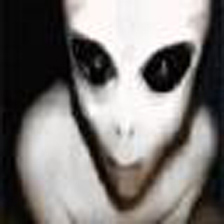
While I don't know, and refuse to make any claims without further direct experiences, if alien abductions really happen (and suspect these could be the imagination's way of covering up or describing otherwise even more inexplicable experiences), it seems clear that people have many reasons to feel and believe that they have or might be abducted, whether in fear or even desire for such extra-terrestrial intrusion, that has led to aliens becoming a potent symbol in our post-modern age. While often addressed through stereotypes of new-age fanaticism or pop-skepticism, alien beings may still say something vital about what it means or feels like to be human.
Mac Tonnies of Posthuman Blues seems to suggest that the image of the gray aliens may be either a projection of our desire to transcend being merely human in this post/trans-human age, or a metaphoric anxiety nightmare left over from the horrors of war and technology from the middle of last century.
I am not quite convinced however that aliens don't also cover an impulse or feeling that is an ancient one for which these are only the most recent and applicable symbol: that of feeling alienated or disconnected from the other. Consider for example Greek legends of people being kidnapped by fauns or waylaid by sirens, Victorian romances in which men become monsters and vampires, or even the Biblical angels, who contain that same longing to transcend our everyday experiences through external salvation (angels being technically depicted as eye-studded revolving spheres that sound more like UFOs than anything else). Looking at my relatives' experiences, they clearly were in extreme situations of alienation, which they only found words for in terms of alien abduction: I don't belong, therefor I must have been removed/transformed. I suffered from the same kind of alienation as a child, feeling that either I didn't belong or that no one else did, a feeling particularly strong as a tenager dealing with understanding one's place in the social spheres, much less the celestial spheres. After trying and failing to fit in I tried not to fit in, and didn't fit in there either, and only found some relief from this anxiety in music and art, listening to Bowie's Ziggy Stardust, his myth of the good alien come to save all the alienated youth certainly allowing me (and I imagine many others) to feel that they did belong, somewhere, even if that was in the distant stars, much like a modern day Ezekial, whose visions of angels the Jews turned to during the alienating reign of Nebuchadnezzar. "Look out your window I can see his light/ If we can sparkle he may land tonight/ Don't tell your poppa or he'll get us locked up in fright."
While children are certainly more inclined to describe or occlude their experiences in imaginistic terms or characters, I suspect this feeling of being alienated may belong to everyone. As rational creatures whose perceptions work through distinction rather than homogenization of experiences, it is no wonder that some of the hardest struggles of history have risen from our perceived human differences. Race, sex, class, customs, gender, age, intelligence, ability, etc, whether arbitrary or not, when taken as the primary signifier and worth of individuals, reduces up to a type or group often at odds with or misunderstood by others outside that group, leading to such bromides as "men are from Mars/ women from Venus," or more real conflicts like the recent racial profiling and arrest of the black professor Gates in his own home (not to mention centuries of national or racial warfare). Orson Scott Card, in his brilliant Ender's Quartet novels sets up the Hierarchy of Exclusion, which seems to operate on a function between familiarity and communicability:
"The Nordic language recognizes four orders of foreignness. The first is the otherlander, or utlanning, the stranger that we recognize as being a human of our world, but of another city or country. The second is the framling... This is the stranger that we recognize as human, but of another world. The third is the raman, the stranger that we recognize as human, but of another species. The fourth is the true alien, the varelse, which includes all the animals, for with them no conversation is possible. They live, but we cannot guess what purposes or causes make them act. They might be intelligent, they might be self-aware, but we cannot know it." -from Speaker for the Dead
Of course, when the other is so foreign to us that we can't communicate, it often ends in direct conflict, or goes further, beyond anything remotely conceivable and thus truly alien. While this final level of total alienness could be interpreted as encounters with the numinous or ineffable - I am partial to the idea that
God is the ultimate alien - it also points to our boundaries of knowledge and description, and more directly to the human experience of being bound in an individual consciousness. To some degree we are all alien to each other, and even sometimes to ourselves: this is a limit to our ability to express who we are and what our experiences of the world mean, and the alien may be the mask, the image we refer others to in order to describe what might otherwise be inexplicable, what feels out of this world, much like Freud's idea of the uncanny or un-homelike, except with Earth as Home, we react with fear and wonder to that which is extraordinarily unfamiliar. In an age when we can finally begin to say that we know most of what is on Earth, there is still more, roughly 98% more, in the Heavens than we can fit into our scientific philosophies, dark matter and gravity if not little gray beings (though the truth may still be out there... so might God for all we can prove or disprove).
I occasionally tell people that I'm in support of space exploration, which often (and more often than I'd have hoped in the 21st Century) draws blank or incredulous stares, as if I really am from outer space. As the author of the exceptional Red Mars,
Kim Stanley Robinson recently pointed out, in conjunction with the 40th anniversary of the first moon landing, there is still a reason for going to space. Forget interstellar exploration, forget contact with other potentially intelligent life in the universe, forget finding a habitable new home for when this one inevitably wears out, the current resurgence of space programs could be local; by living on other planets in our solar system we might better figure out how to live on and take care of this planet, which is in sore need of better stewardship. Though this may first mean resolving those lingering problems of otherness that still plague and alienate mankind.
Which isn't to say that we can't refamiliarlize ourselves with those who are other from us, a process of dealienazation, which can only begin at home. This was one of the lessons I learned from seeing my family this week, that our secrets are symptomatic of larger miscommunications that lead to conflicts and division the way they do in the larger world, that even though we are all involved in fields of communication (as more and more people are these days), we are still shockingly out of touch from each other, as if E.T. had never extended his finger for contact. But all it sometimes takes is a phone call or a letter, or even just a smile, to make our families familiar to us again, which can equally apply to strangers, enemies, the world. Though we are all aliens lost in space, we are all human on Earth together, one vast estranged family still learning to accept each other and explain what this all might mean. Perhaps one day we'll be able to look up at the stars together, and when we see the occasional peculiar lights zipping around like nothing but unidentifiable objects, we can finally discuss them openly, or just say hello.

 It's always interesting reading a book after watching (and being a big fan of) its movie version, especially in this case where the book's translation was only finished after the movie came out. Perhaps the main difference in this story about dreams taking over reality through stolen psychotherapy devices is that, unlike in Satoshi Kon's anime, where the more surreal imagery leaps from the screen within the first ten minutes, Tsutsui takes more than half the book for the content of dreams to become manifest. In fact, a quarter of the book passes before the dream detective Paprika enters someone's dream at all. Despite the potential for this to seem really slow, and less interesting than the more frantically paced movie, Paprika the novel actually works best by holding off the potential for surreality to manifest itself, because that allows the author to create a familiar and logical real world first, which is necessary in order to make the weirder elements read as believable. Another interesting twist is that many of the inter-character plot elements held till the end of the movie are given at the novel's beginning, making the story less about finding out how the characters interact but seeing how these interactions change in the face of embodied subconscious impulses.


