10.28.2009

Fictionology

In light of the Church of Scientology being convicted of Fraud in France, the Onion offers this brilliant mock competing religion, Fictionology [via mutate!]:

Fictionology’s central belief, that any imaginary construct can be incorporated into the church’s ever-growing set of official doctrines, continues to gain popularity. Believers in Santa Claus, his elves, or the Tooth Fairy are permitted—even encouraged—to view them as deities. Even corporate mascots like the Kool-Aid Man are valid objects of Fictionological worship.

“My personal savior is Batman,” said Beverly Hills plastic surgeon Greg Jurgenson. “My wife chooses to follow the teachings of the Gilmore Girls. Of course, we are still beginners. Some advanced-level Fictionologists have total knowledge of every lifetime they have ever lived for the last 80 trillion years.”

“Sure, it’s total bullshit,” Jurgenson added. “But that’s Fictionology. Praise Batman!” [...]

“Scientology can only offer data, such as how an Operating Thetan can control matter, energy, space, and time with pure thought alone,” McSavage said. “But truly spiritual people don’t care about data, especially those seeking an escape from very real physical, mental, or emotional problems.”

McSavage added, “As a Fictionologist, I live in a world of pretend. It’s liberating.”


Interestingly, I personally suspect that if there is any kind of contemporary folk mythology, this is essentially it, the belief in any literary or culture character as an object of worship, wisdom, or personal identification. Just because in the past the culture characters we did this with were gods does not mean contemporary characters are any less available for their symbolic significance. One just has to look at the hype surrounding the release of new superhero movies, the lines around theaters like ancient temples. Perhaps without intending to the Onion seems to have hit exactly on what makes pop culture tick in the human heart.


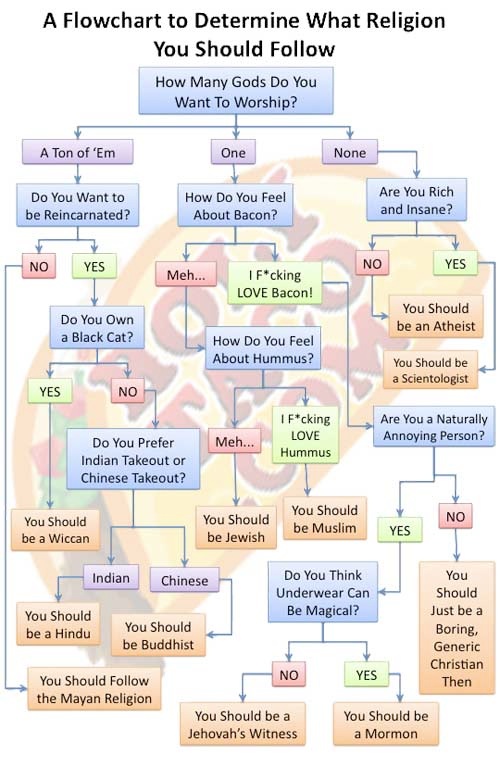
For further perusal, here's an interesting tor.com article on the role memory and recognition play in making quality stories, as well as a handy chart to help you determine (based off food preferences) what religion you should belong to.

10.25.2009

News Updates

The End of Philosophy. From Adbusters, interesting but the writer went to Pitt, and had one of the same philosophy classes I'm taking there this semester, and I agree its mostly irrelevant, except I'd have to say: don't expect other people to apply ideas for you, you have to think for yourself.

the Age of Universal Authorship. The one thing the author hasn't considered is that only will we have universal authorship when everyone has access to the technologies of communication and authorship.

Luther Blisset is now Wu Ming. Luther is one of the shared or multiple-use names phenomenon, which I first heard about in connection with Monty Cantsin and Neoism. Good to know these names are still out there.

Giant Orb Weaver Spider Discovered[image via riot rite right clit clip click]

Essential Plot Twists for Writers. Now in handy cartoon format.

Why Our Brains Will Never Live in a Matrix. Because they already live in bodies. Though the Internet is Altering our Brains.

The New End of the World Date is now 2068. Get Your calendars ready for the meteor crash.

In the mean time, don't forget to Live Life to the Full. A free guide to cognitive behavior therapy. Or, maybe depressed people are suffering from a lack of fun.

And finally, though science wants to stop aging, we still don't know exactly what is time?"

10.24.2009

RIP Mac Tonnies

This post was supposed to be another collection of links, but that will have to wait, as I just learned that ufologogist and fellow blogger Mac Tonnies has passed away. While I never met Mac, and maybe commented on his blog once or twice, nor am I all that obsessed with UFOs (being much more intrigued by the beings that reside in our imaginations than in the star systems), I have been following Mac's writings for six years now, since my brother first got me into blogging and pointed at Posthuman Blues as a site to follow. And it was.

The thing that always struck me about Mac (besides that he looked like an exact duplicate of a friend of mine), is that he exemplified that rare breed of person who has conviction in their obsessions, patience and curiosity for research, a balanced blend of believe and skepticism. In short, reading Posthuman Blues you knew this stuff was very important to him, and if you kept reading, his conviction would make it important to you too. I hope now that he's not stuck here Mac will find what he's looking for out in the beyond.

10.22.2009

Atheism 3.0 vs the Functions of Faith and God

More news from the front lines of the war between faith and rationalism [via disinfo]:

Bruce Sheiman doesn’t believe in God, but he does believe in religion.

Setting aside the question of whether God exists, it’s clear that the benefits of faith far outweigh its costs, he argues in his new book, An Atheist Defends Religion: Why Humanity is Better Off With Religion than Without It.

“I don’t know if anybody is going to be able to convince me that God exists,” Sheiman said in an interview, “but they can convince me that religion has intrinsic value.”

The old atheists said there was no God. The so-called “New Atheists” said there was no God, and they were vocally vicious about it. Now, the new “New Atheists” — call it Atheism 3.0 — say there’s still no God, but maybe religion isn’t all that bad.

Faith provides meaning and purpose for millions of believers, inspires people to tend to each other and build communities, gives them a sense of union with a transcendent force, and provides numerous health benefits, Sheiman says. Moreover, the galvanizing force behind many achievements in Western civilization has been faith, Sheiman argues, while conceding that he limits his analysis, for the most part, to modern Western religion.

“More than any other institution, religion deserves our appreciation and respect because it has persistently encouraged people to care deeply — for the self, for neighbors, for humanity, and for the natural world — and to strive for the highest ideals humans are able to envision,” Sheiman writes…


I'm glad to see that rationalists are beginning to rationally recognize that there are tangible evolutionary benefits to at least the tangible ephemera of the intangible. Certainly community, a sense of well-being, health, cultural growth, etc. are all valuable things for humanity, but (without reading his book yet) I still think Sheiman is missing the whole point about faith, which is that he may never get his coherent rational argument for the existence of God: Faith does not rely on rational proof but on acceptance of things as being true whether or not you can see or prove them, and there are distinct evolutionary advantages in that.

I will try to illustrate: I have faith that there are forces larger than myself at work in the Universe. I (personally) can not prove they are real, nor can I directly observe them, but my ability to prove or observe does not make these forces any less real, or any less active on my life. These statements could just as easily apply to black holes, electromagnetism or other not readily observable scientific phenomena just as much as they could apply to God. Yes I know I can see light from a light bulb, and someone could explain how light comes from a light bulb, but I dare anyone to show me an electromagnetic field directly, without pointing only to its effects. Science for many centuries refused to admit the existence of fields precisely for this reason, that it seemed you had to believe in them. Just because we do not see God, except for in its tangible effects (under which some might group religion, culture, even consciousness and life), does not mean that it is not just an active and real force. Faith just accepts that you may never see it, and gets right along to making use of its effects without all the rejection and consternation of reason.

But there are even clearer and more direct benefits of believing in God. Granted, I have much doubt myself, not that there are intangible forces, but whether these forces are God, rather than malevolent demons intent upon deceiving me and making life miserable. The thing is, at least demons would be an excuse; without them there is absolutely no explanation for why I often feel deceived or miserable, other than saying it is human nature, or my pscyhology or upbringing. Without reference to some larger, intelligent, or teleological force in the Universe, we are hard pressed to find any true meaning or reason for life existing at all, except to eventually die. As Buddhists say, life is suffering, and all an illusion. The thing that God grants (referring mainly to the traditional Western conception of God as all powerful, knowing, and, most particularly, good), is something that a friend of mine in AA pointed out recently: that we can give up to God our feelings of helplessness in the face of cosmic pointlessness, we can give up to God our need for responsibility for all the things in our lives which for the most part aren't in our control to begin with. Not that God or equivalent powers absolve us of responsibility or grant us ultimate meaning, but by standing as metaphors for the possible existence of an ultimate meaning, goodness, or responsibility, especially because unseen, we get to choose to believe that these things are possible, and are thus given a bit of leeway to seek out these things in our own lives where we can, without killing ourselves or each other first. Evolutionarily, belief in God gives us hope and grace, which allow just enough room to trust in and build relationships and civilizations and keep this whole mess going, until we find out if there really is some larger point to any of it.

10.19.2009

Space is the Place

Astronomical discoveries are all the rage right now, what with scientists finding a mysterious ribbon of atoms bounding the solar system's edge, along with a bounty of 32 new extrasolar planets.

What a shame that for the most part we are just stuck here looking up in marvel and wonder instead of out there exploring.

10.17.2009

Wild Things

Taking a break from such heavy cosmological topics as the Universe ending in heat death sooner than anticipated and a new translation of the Bible that shows God did not create heaven and earth but merely separate what was already there, Sophie and I went out last night to check out the opening night of Spike Jonze's adaptation of Maurice Sendak's Where the Wild Things Are. Despite reviews claiming the movie is too depressing or frightening we both found it highly charming, particularly the stellar acting of child-star Max Records, the intricate costumes from Jim Henson's Creature Shop, and upbeat soundtrack from the Yeah Yeah Yeah's Karen O [Found link, for preview purposes only, buy here]. It was interesting to note that the audience was primarily comprised of young adults, who probably were raised on Sendak's masterpiece and are perhaps the intended target demographic of Dave Egger's script (the whole movie really capturing the indie spirit of the times).


[Potential Spoilers Below]

The thing that really stuck out for me though was what this movie says about the human imagination. Despite our cultural love of monsters and fantasy, the imagination here is presented in its rawest or most primal. Shaggy monsters dance and tear up the woods and throw clods of dirt at each other. Everyone howls and growls. Certainly the monsters possess some amount of adult-like self-reflection (enough to come off as rather depressed), but no more than Max himself. In fact, one could take a psychological perspective that the monsters and their land are all projections of Max's own fears and desires, for friendship, against alienation and being young and misunderstood if not ignored.

But what is interesting was the choice of not stating whether the events of Max's journey really took place or not. The final return scene has no dialogue, so we aren't asked to chose with Max over what really happened, even if with all the day to night transitions he must have been gone for several weeks. This draws on elements of the Fantastic in art, that supernatural events are left ambiguous as to their reality. This is a necessary move because the audience, instead of being asked to decide what is real here, can instead suspend their disbelief and let the monsters be real. They are reflections of ourselves. Of course, this in turn adds more weight to what both Sophie and I decided was one of the pivotal scenes of the movie, when the monster Carrol rips the bird monster's arm off, and the camera focuses on a stream of sand spilling out. Up till this point, Max has taken the monsters as real, but they are shown to be not real, and he starts feeling the need of returning home to his flesh and blood family.

What this says for me is that despite how primal and raw we sometimes need to express our imaginations as children, this rawness sometimes tears holes in the stories we make up and tell ourselves, and shows us what is more importantly real in our lives. For another example, in a school scene at the beginning of the movie, Max is told that one day the sun is going to die, which when he tells the monsters makes them even more depressed and desperate (to tie this in with the links at the beginning of this entry). I think we are encouraged to equate those kinds of predictions of science with the imagination as well, as something that must ultimately give way to the reality of the present and the more immediate significance of our families and loves.

10.15.2009

Faith Ills...

... if your faith happens to be as bigoted and close minded as a parishioner denying a marriage license to an interracial couple or an NC church burning non-canonical religious texts as "satan's books."

Sadly, neither of these religious groups seemed to have been paying much attention to their own myths.

10.14.2009

Is the Large Hadron Collider being Sabotaged from the Future? (and other strange news)


This NY Times article was too good not to post, it reminds me of some of the flash science-fictions I was working on in the spring [via metafilter]:

A pair of otherwise distinguished physicists have suggested that the hypothesized Higgs boson, which physicists hope to produce with the collider, might be so abhorrent to nature that its creation would ripple backward through time and stop the collider before it could make one, like a time traveler who goes back in time to kill his grandfather.


It sounds like the funny thing is that this theory is getting valid coverage and consideration as a real reason why no Higgs-producing collider has yet worked. Though Chinese scientists have created a miniature black hole without the world exploding.


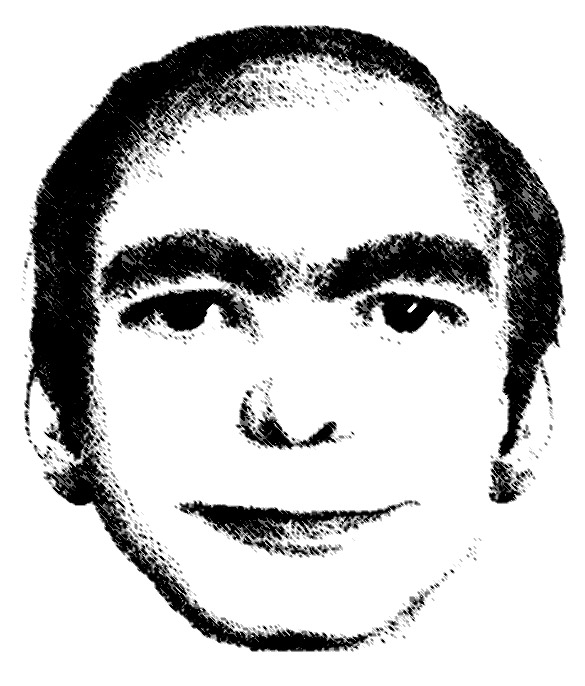
On the other side of the spectrum we have the case of this man [via disinfo]:

"From January 2006 until today, at least 2000 people have claimed they have seen this man in their dreams, in many cities all over the world: Los Angeles, Berlin, Sao Paulo, Tehran, Beijing, Rome, Barcelona, Stockholm, Paris, New Dehli, Moskow etc.

"At the moment there is no ascertained relation or common trait among the people that have dreamed of seeing this man. Moreover, no living man has ever been recognized as resembling the man of the portrait by the people who have seen this man in their dreams."


[Edit: or is this man just a marketing ploy?]

And lastly, the vegetarian spider, which prefers hunting plants to insects, of all the strange permutations nature could come up with.

10.13.2009

Where Science Ends and Magic Begins

From biochemist Rupert Sheldrake's response to the skeptical critics, of his book, A New Science of Life [via Daily Grail]:

"Magic is an attempt to control and forecast natural events. Sir James Frazer distinguished two categories. First, sympathetic magic by similarity: like produces like. For example, manipulating a model of something is believed to give power over that which is modelled. Second, magic by contact or contagion: objects that were once joined together retain a mysterious connection when separated, so that a change in one can affect the other.

"Science is also about controlling and forecasting natural events. Much of its power comes from making models of natural processes. Mathematical modelling gives scientists ever more power to predict and control. And many modern technologies depend on a sympathetic resonance between similar patterns of vibration at a distance. A hundred years ago, television would have been magic, and so would mobile telephones.

"Second, in quantum theory, objects that were once joined together retain a connection at a distance when separated, as in magic by contact or contagion. Einstein dismissed quantum non-locality as "spooky action at a distance". But quantum entanglement is real, and is applied technologically in quantum computing.

"Isaac Newton ran into the science/magic problem with gravity. The idea that the moon influenced the tides through empty space sounded like magic, and Newton was embarrassed by his failure to explain what he called the "occult" or hidden force of gravitation. His critics, mainly French, accused him of magical thinking."


As Arthur C. Clarke so brilliantly put it, "any sufficiently advanced technology is indistinguishable from magic." I would say that science is just magic repeated often enough that you know how it is works.

It's not the End of the World

I've been insisting on this point for years now, so it's finally good to see the Mayans argue that 2012 is not the end of the world.

The only thing the Mayan long count calendar suggests is that one period of time is finished and the next begins, somewhat like a new year or an odometer clicking over. As it is based on the position of astral bodies, in particular the alignments of Venus, the metaphor of an odometer clicking over on a galactic scale is really about the closest meaning to what the calendar says.

The Mayans contend that any notion of apocalypses and singularities is a Western construction, perhaps a projection of our values onto another culture's belief and measurement systems. Bear in mind it is only in Western traditions such as Christianity that a teleological endpoint to time and reality are posited, often in terms of the spectacular fiery cataclysms we seem to enjoy or desire. The notion of an apocalypse is only valid in a culture based on belief systems that suggest that there is only linear time, and that only in later times can we find true reality or happiness (ie, in an afterlife). Take the notion of heaven after death and apply it collectively and you get a desire for a collective death. This notion applies to the ancient Norse Ragnarok as a collective means of reaching Valhalla, but does not apply to cycle notions of time, such as in Buddhism or Mayan cosmologies. Why would the world end if the myths played themselves out year after year, eon after eon, in the heavens as well as on Earth?

What strikes me as strange is that, though many people in Western culture no longer treat our foundational myths as real or valid, we still have that understanding of time as linear and endable, and enjoy if not demand such endings. Why do we want the world to end? Why do we want to project our desire for that onto someone else's beliefs, as if we can justify the desire by saying it is prophesied, and therefor not our fault? Whether the Mayans like it or not, 2012 has become a contemporary Western myth of the end of time, and as such says something about how we experience the world we live in. Perhaps we are too scared, too ashamed, of the extent of of the damage Western cultural values have inflicted on the planet, which along with the looming resource crises and potential threat of technological transcendence/annihilation, we can point to the Mayans and say, look it's not our fault, they said it was going to happen first, and how can we change that? What our myth of 2012 does is allow us to evade responsibility for our actions in the world we live in for the world that our children may still inherit. Who needs to worry about the future if no one will be around to experience it?

The Future of Sex

from H+ magazine [via disinformation]:

“It is important to remember that sexual intercouse is a highly ancient, simplistic-at-its-core activity that we may choose to discard at some point in the future…”

In “Sex and the Singularity,” futurist magazine H+ asks radical techs (including Ray Kurzweil) to describe futuristic “sex after the Singularity.” They envision “more complex activities that generate even more pleasure and connection between people,” and suggest “The primary purpose of the Singularity will be seen, after the fact, to be Awesome Sex.

“There will be exponentially more sex, with exponentially more interfaces, and with exponentially more measures of pleasure.” With “millions of super computer-generated sex fantasies,” one technologist concludes “I love the future. Bring it on.”

“Whether we choose to call it ’sex’ will be entirely arbitrary, but it may bear little resemblance to the sex of today…”

From a Notebook that Never Was

From a Notebook that Never Was, by Fernando Pessoa [via 3:AM Magazine]:

"Believing in nothing firmly and therefore accepting as equally valid, in principle (which is as far as they go), all opinions, and considering that a theory is worth only as much as the theorist, an emotion as much as the emotion’s expresser, I could never take seriously the literary dogma that consists in the use of a personality. Personality is a form of belief and, like all belief, impossible for the reasoner.

"It’s a short step from believing in outer truth to believing in inner truth, from accepting a concept of the world as true to accepting a concept of our self as true. I don’t affirm that everything is fluid, since that would be an affirmation, but to our understanding everything is indeed fluid, and the truth, unfolding for us into various truths, disappears, since it cannot be multiple.

* * *

"Thank God for that ironic element in human destinies that makes dreams the mode of thought for the poor in life, even as it makes life the mode of thought—or thought the mode of life—for the poor in dreams.

"But even dreaming channeled through thinking ends up making me weary. At which point I open my eyes from dreaming, go to the window, and transfer my dream to the streets and rooftops. And it’s in my distracted and profound contemplation of so very many roof tiles divided into rooftops, covering the astral contagion of people organized into streets, that my soul becomes truly detached from me, and I don’t think, I don’t dream, I don’t see, I don’t need to. Then I truly contemplate the abstraction of Nature—of Nature, the difference between man and God."


This series of quotes, particularly the line about personality being a belief impossible to the reasoner, seemed an interesting response to a recent and frustrated rant from Black Sun Gazette on the struggle between rationalists and believers. As I keep pointing out, faith is about telling a story to contextualize our experiences, and what kind of story do rational atheists tell to cover the horror and randomness of being movements of particles? Are they even logically allowed to tell such stories?

10.11.2009

History is Fiction

Jim Shepard on fictionalizing true events:

The first worry writers have when they consider working with something like historical events has to do with the issue of authority: as in, where do I get off writing about that? Well, here’s the good and the bad news: where do you get off writing about anything? Where do you get off writing about someone of a different gender? A different person? Where do you get off writing about yourself, from twenty years ago?

Writers shouldn’t lose sight of the essential chutzpah involved in trying to imagine any other kind of sensibility. And that they should take heart from that chutzpah, as well. The whole project of literature – the entire project of the arts — is about the exercise of the empathetic imagination. Why were we given something as amazing as imagination, if we’re not going to use it?


[via The Millions]

10.07.2009

Possession and Schizophrenia


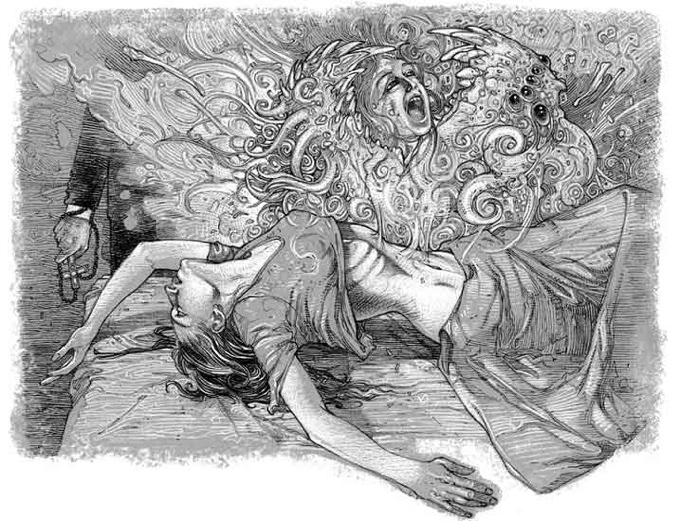
There is an interesting article from boingboing on exorcism and schizophrenia, which explains how patients in cultures with a strong belief in spirit possession, who have been possessed, have often been more successfully treated through schizophrenic medications than through exorcism. While this suggests that possession may be some cultures' ways of articulating the kinds of bizarre behaviors exhibited by schizophrenics, the article also cites a case where one of these medically treated possessees was actually seen to be possessed by other people.

So this might be an otherwise unremarkable psychiatric case if it were not for the fact that the prison chaplain, and several of the patient's cellmates, saw the spirit possess the patient as a ghostly mist. The chaplain was convinced this was a genuine case of possession, as had priests from several other faiths who had previously carried out exorcisms on the patient.

This begs the question, if the patient was treated for his belief in spirit possession and his apparent hallucinations as to the reality of the ghost, why were the chaplain and the others not considered to be ill ?


One could argue for mass hallucination, or conversely for some kind of cultural imagination at work, but perhaps it could mean that actual ghosts/spirits may be affected by chemical procedures? Not knowing off hand how medicines like trifluoperazine and clopenthixol work, I'd hazard a guess that whatever neural site/receptor these chemicals effect is also the neural site/receptor ghosts take possession of.