
Despite the fact that the Mayans have strongly emphasized that the western world has entirely misinterpreted and appropriated the year of 2012, that their myths say nothing about the end of the world, our telling of that story has become so hyped up by the media that the "2012 Prophecy" is actually sparking real fear and suicides. As the new movie convinces people that we are all going to die, others try to combat the myth by hopefully providing more accurate information. Or if that fails, suggestions on plans to ensure the continuity of our species. While asteroid defense, planet hacking, terrestrial seed vaults, lunar doomsday arcs, and off-world colonization all seem like noble, albeit sci-fi options (along with more actual attempts at space elevators and solar sails), it seems that culturally there is still the tendency to either believe that we are all going to die in 2012 (and perhaps that's a good thing) or that none of this is true (not even environmental degradation) and we should continue to live the technologically destructive lives we've been living throughout the last century.
Personally I hold the middle ground, that the whole 2012 phenomena is a myth, a story we have taken to heart because it is very suggestive to us of the possibilities of what might happen and what we ought to do about it. This means that 1). it is unlikely that anything untoward will actually happen on this date (besides perhaps some spectacular astronomical movements), and 2). despite this myth not being literally true, it is still figuratively significant in telling us that we really do fear the end of the world in some form, and that we are either responsible for bringing it about or for stopping it if at all possible. I feel that if we really are concerned with the continuity of our species, along with that of the planet that makes life possible for our species, instead of coming up with far fetched worse case scenarios or ignoring the mess altogether, we instead have to begin telling truthful stories about what is actually going on in the world, what might actually happen, and those immediate steps that will have to be taken to deal with it. No more fear-mongering or denial, but futurestance. We need stories that tell us how we are in the world, and why, and what we need to do.
Part of the problem here is a lack of any current mythology to address the rampant technological changes of the last century, which combined with the continually growing disbelief in the value of belief seems to spell disaster at every turn. One of the earliest functions of myth, as maps for human action, was casting reality in terms of ultimate significance. We are here and act as we do because the gods do it/ our ancestors do it, etc. The most we can say now is that we do because our celebrities and politicians do it, but we are as avid in taking them down to our level and know they are just as fallible, just as human. Not to advocate a return to belief in gods as really real, but our lack of contemporary myths of such large significance pushes us out to the meaningless edges of the cosmos where we no longer have any reason to believe or act with even the present in mind, let alone the future. I feel that what is lacking and most needed are new myths that replace us as central characters of our own story, not Earth as the physical center of the Universe, but us as the storytellers as the key for the meaning of our experiences, that is, myths that stress the responsibility we have as stewards of ourselves and the world which we've decided we control, stories that suggest that cooperation, multiple points of view, responsibility, awareness of actions, etc. are all heroic qualities that may have the most real effects in staving off whatever apocalypses we come up with to amuse and frighten ourselves.
Showing posts with label 2012. Show all posts
Showing posts with label 2012. Show all posts
11.10.2009


10.13.2009
It's not the End of the World
I've been insisting on this point for years now, so it's finally good to see the Mayans argue that 2012 is not the end of the world.
The only thing the Mayan long count calendar suggests is that one period of time is finished and the next begins, somewhat like a new year or an odometer clicking over. As it is based on the position of astral bodies, in particular the alignments of Venus, the metaphor of an odometer clicking over on a galactic scale is really about the closest meaning to what the calendar says.
The Mayans contend that any notion of apocalypses and singularities is a Western construction, perhaps a projection of our values onto another culture's belief and measurement systems. Bear in mind it is only in Western traditions such as Christianity that a teleological endpoint to time and reality are posited, often in terms of the spectacular fiery cataclysms we seem to enjoy or desire. The notion of an apocalypse is only valid in a culture based on belief systems that suggest that there is only linear time, and that only in later times can we find true reality or happiness (ie, in an afterlife). Take the notion of heaven after death and apply it collectively and you get a desire for a collective death. This notion applies to the ancient Norse Ragnarok as a collective means of reaching Valhalla, but does not apply to cycle notions of time, such as in Buddhism or Mayan cosmologies. Why would the world end if the myths played themselves out year after year, eon after eon, in the heavens as well as on Earth?
What strikes me as strange is that, though many people in Western culture no longer treat our foundational myths as real or valid, we still have that understanding of time as linear and endable, and enjoy if not demand such endings. Why do we want the world to end? Why do we want to project our desire for that onto someone else's beliefs, as if we can justify the desire by saying it is prophesied, and therefor not our fault? Whether the Mayans like it or not, 2012 has become a contemporary Western myth of the end of time, and as such says something about how we experience the world we live in. Perhaps we are too scared, too ashamed, of the extent of of the damage Western cultural values have inflicted on the planet, which along with the looming resource crises and potential threat of technological transcendence/annihilation, we can point to the Mayans and say, look it's not our fault, they said it was going to happen first, and how can we change that? What our myth of 2012 does is allow us to evade responsibility for our actions in the world we live in for the world that our children may still inherit. Who needs to worry about the future if no one will be around to experience it?
The only thing the Mayan long count calendar suggests is that one period of time is finished and the next begins, somewhat like a new year or an odometer clicking over. As it is based on the position of astral bodies, in particular the alignments of Venus, the metaphor of an odometer clicking over on a galactic scale is really about the closest meaning to what the calendar says.
The Mayans contend that any notion of apocalypses and singularities is a Western construction, perhaps a projection of our values onto another culture's belief and measurement systems. Bear in mind it is only in Western traditions such as Christianity that a teleological endpoint to time and reality are posited, often in terms of the spectacular fiery cataclysms we seem to enjoy or desire. The notion of an apocalypse is only valid in a culture based on belief systems that suggest that there is only linear time, and that only in later times can we find true reality or happiness (ie, in an afterlife). Take the notion of heaven after death and apply it collectively and you get a desire for a collective death. This notion applies to the ancient Norse Ragnarok as a collective means of reaching Valhalla, but does not apply to cycle notions of time, such as in Buddhism or Mayan cosmologies. Why would the world end if the myths played themselves out year after year, eon after eon, in the heavens as well as on Earth?
What strikes me as strange is that, though many people in Western culture no longer treat our foundational myths as real or valid, we still have that understanding of time as linear and endable, and enjoy if not demand such endings. Why do we want the world to end? Why do we want to project our desire for that onto someone else's beliefs, as if we can justify the desire by saying it is prophesied, and therefor not our fault? Whether the Mayans like it or not, 2012 has become a contemporary Western myth of the end of time, and as such says something about how we experience the world we live in. Perhaps we are too scared, too ashamed, of the extent of of the damage Western cultural values have inflicted on the planet, which along with the looming resource crises and potential threat of technological transcendence/annihilation, we can point to the Mayans and say, look it's not our fault, they said it was going to happen first, and how can we change that? What our myth of 2012 does is allow us to evade responsibility for our actions in the world we live in for the world that our children may still inherit. Who needs to worry about the future if no one will be around to experience it?
7.31.2008
The End Time Might Be Running A Little Late
If the hipsters don't kill us, here's a laugh out loud article about the possibility that 2012 might not be the end of the world from Reality Sandwich:
"Christmas morning 2012 should be a barrel of laughs. "Merry Christmas sweetie! I was going to get you that new hydrogen-powered Barbie Transporter you've been bugging me about, but I was pretty certain we'd all be dead by now. Sorry, my bad. Here, have a spoonful of rice."
"Christmas morning 2012 should be a barrel of laughs. "Merry Christmas sweetie! I was going to get you that new hydrogen-powered Barbie Transporter you've been bugging me about, but I was pretty certain we'd all be dead by now. Sorry, my bad. Here, have a spoonful of rice."
5.20.2008
When the Cosmic Clock Strikes
Having friends who have been fascinated by the modern resurgence of Mayan cosmology for the past decade, it has been rather interesting watching the hype growing around the year 2012 as a potential doomsday,, a cosmic awakening, or just another catastrophic letdown. While people are quick to jump to apocalypses whenever any ending is in sight, such as the end of centuries (and we all know how the world ended with Y2K), it seems important to keep in mind that what is essentially at stake is the end of a calendar cycle, much like midnight or new years, but on the scale of planetary revolutions. 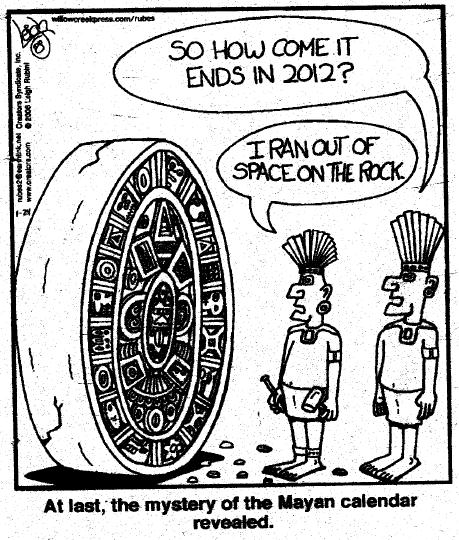 While it seems that the Mayans may not have predicted anything specific happening on December 21st of that swiftly approaching year, it is important to remember that people have a tendency to fulfill their own prophecies in any way possible. Though the ending of the solar year does not currently signal the end of the world, for centuries it did- cultures such as that of ancient Mesopotamia reenacted the destruction and recreation of reality on the new years, in elaborate, orgiastic festivals in which law was held at bay and chaos ruled, at least until tomorrow. Likewise it is possible that though no apocalyptic or revelatory event was predicted by the ancient Mayans, there is nothing to stop modern man from acting like it was, and putting on the kind of elaborate, psychotic dramas we're known for. Of course, the event of 2012 I'm most looking forward to is James Joyce's work going into the public domain.
While it seems that the Mayans may not have predicted anything specific happening on December 21st of that swiftly approaching year, it is important to remember that people have a tendency to fulfill their own prophecies in any way possible. Though the ending of the solar year does not currently signal the end of the world, for centuries it did- cultures such as that of ancient Mesopotamia reenacted the destruction and recreation of reality on the new years, in elaborate, orgiastic festivals in which law was held at bay and chaos ruled, at least until tomorrow. Likewise it is possible that though no apocalyptic or revelatory event was predicted by the ancient Mayans, there is nothing to stop modern man from acting like it was, and putting on the kind of elaborate, psychotic dramas we're known for. Of course, the event of 2012 I'm most looking forward to is James Joyce's work going into the public domain.
12.20.2007
The End of the States as We Know them
Writing my research paper on the failure of the 1890 Ghost Dance of the Lakota Sioux, it seemed that though the Lakota had been unable to bring about a millenarian destruction of the invading European-Americans, their fierce sense of independence and traditional religious practices still held strong, and has carried their culture through Western dominance till today. In this light it is fairly amazing, but not at all surprising to see that the Lakota People have declared independence from the U.S. government, finally able to overcome 150 years worth of broken treaties, and are inviting anyone who lives in the five surrounding states to join them in their new Nation. Furthermore, the Navajo are also seeking support for their own tribal Constitution, and it seems that there is a broad push across the country for American Indian tribes to take up the mantel of self-governance. I think this is splendid, and it's about time that peoples who have been oppressed for the last century and a half are finally able to take a stand for their autonomy. We can only wonder if states like Vermont will now make their own pushes to secede.
Over the summer I had a chance to check out the new National Museum of the American Indian, part of the Smithsonian Institute in D.C., and was informed of the some of the difficult problems faced with trying to establish representation for a people who are not one central body-politic, but countless tribes, each with their own distinct culture and mytho-historical milieu. While the museum is run by a tribal council, it turns out that only the richest tribes responded to the open call for artifacts, leading to claims of unfairness by the unrepresented tribes. Consequently, the museum exhibits suffered from trying to give the broadest view to the most distinct of tribes across the Americas, often loosing any sense of context that didn't seem to do any justice to the wealth of cultures, or the influence of Western European ideas and practices on traditional patterns of behavior, such as this ritual prayer circle marked with quotes from the Book of Revelations:

Such apocalyptic fantasizing may not always have a place in American Indian mythologies (the Mayans aside, but when you believe time is cyclical, would you predict that the world will end in 2012?), but the icy climes of Norway certainly lend themselves to their Ragnaroks, which might be why the Norwegians have built a 'doomsday vault' to house a collection of all the world's seeds. When Lif and Lifthrasir inherit the earth after the doom of the Aesir at the jaws of the Fenrir wolf and the Jormungand serpent, the surviving humans will surely want something to eat, and the means necessary to continue culture.
Personally I am in support of such "7th Generation" contingency plans, and while I'd like to believe I have a more enlightened (and less terrified) view these days of what the future holds, there's never any telling if crazy idiots with itching fingers wouldn't just release a nuclear apocalypse. Perhaps more likely, in my opinion, would be an immanent break down of technology. It frightens me that the world is moving all of its media onto digital, and that if one day the parts for computers are no longer available, or the tools to repair them, or any combination of technological failures, then what will become of culture? While storing seeds is a valiant idea, I would also like to see a "time-proof" vault created to store paper copies of the world's greatest literature, philosophies, scientific manuscripts, dictionaries, a true hermetic(ally sealed) library, so that in some distant age people can still maintain an idea of the history of culture, without having to figure out what to play these shiny little discs on.
Over the summer I had a chance to check out the new National Museum of the American Indian, part of the Smithsonian Institute in D.C., and was informed of the some of the difficult problems faced with trying to establish representation for a people who are not one central body-politic, but countless tribes, each with their own distinct culture and mytho-historical milieu. While the museum is run by a tribal council, it turns out that only the richest tribes responded to the open call for artifacts, leading to claims of unfairness by the unrepresented tribes. Consequently, the museum exhibits suffered from trying to give the broadest view to the most distinct of tribes across the Americas, often loosing any sense of context that didn't seem to do any justice to the wealth of cultures, or the influence of Western European ideas and practices on traditional patterns of behavior, such as this ritual prayer circle marked with quotes from the Book of Revelations:

Such apocalyptic fantasizing may not always have a place in American Indian mythologies (the Mayans aside, but when you believe time is cyclical, would you predict that the world will end in 2012?), but the icy climes of Norway certainly lend themselves to their Ragnaroks, which might be why the Norwegians have built a 'doomsday vault' to house a collection of all the world's seeds. When Lif and Lifthrasir inherit the earth after the doom of the Aesir at the jaws of the Fenrir wolf and the Jormungand serpent, the surviving humans will surely want something to eat, and the means necessary to continue culture.
Personally I am in support of such "7th Generation" contingency plans, and while I'd like to believe I have a more enlightened (and less terrified) view these days of what the future holds, there's never any telling if crazy idiots with itching fingers wouldn't just release a nuclear apocalypse. Perhaps more likely, in my opinion, would be an immanent break down of technology. It frightens me that the world is moving all of its media onto digital, and that if one day the parts for computers are no longer available, or the tools to repair them, or any combination of technological failures, then what will become of culture? While storing seeds is a valiant idea, I would also like to see a "time-proof" vault created to store paper copies of the world's greatest literature, philosophies, scientific manuscripts, dictionaries, a true hermetic(ally sealed) library, so that in some distant age people can still maintain an idea of the history of culture, without having to figure out what to play these shiny little discs on.
3.03.2005
which way's north?
Computer Models predict Magnetic pole reversal in Earth and Sun can bring end to human civilization in 2012.

"According to some computer scientists working together with a group geophysicists and astrophysicists, Earth and Sun both will go through a process of Magnetic Pole Reversal in 2012. This last happened millions of years back when the Dinosaurs disappeared. A private research and analysis company in Hyderabad is predicting a major upheaval in 2012.
Magnetic Pole reversal is a process when North Pole and South Pole reverse positions. When this happens, at some point of time Earth's magnetic field reaches zero Gauss which simply means, Earth at that point of time has zero magnetism. When this coincides with a eleven year cycle of Sun's Polar reversal, a major problem arises. "
via the india daily
"According to some computer scientists working together with a group geophysicists and astrophysicists, Earth and Sun both will go through a process of Magnetic Pole Reversal in 2012. This last happened millions of years back when the Dinosaurs disappeared. A private research and analysis company in Hyderabad is predicting a major upheaval in 2012.
Magnetic Pole reversal is a process when North Pole and South Pole reverse positions. When this happens, at some point of time Earth's magnetic field reaches zero Gauss which simply means, Earth at that point of time has zero magnetism. When this coincides with a eleven year cycle of Sun's Polar reversal, a major problem arises. "
via the india daily
Subscribe to:
Comments (Atom)

