Showing posts with label art. Show all posts

12.20.2009

Learning to See

Learning to See, new collage by Tait McKenzie

"Have I said it before? I am learning to see. Yes, I am beginning. It's still going badly. But I intend to make the most of my time." - Rilke, from The Notebooks of Malte Laurids Brigge

12.01.2009

Liber Novus: first impression of Jung's Red Book

I couldn't sleep last night, as inspired as I was having begun to read Carl Jung's Liber Novus, his "Red Book." My first impression is that this is a massive tome; at 16x12x2'' it is easily the largest book I've ever laid hand on, and just turning the pages takes a substantial effort. But it's well worth it.


The Liber Novus is Jung's account of his decades long process of psychological and subconscious self experimentation, through a technique called "active imagination;" a process that he claimed was the seeds to all his work. Written first in a series of Black Books, this masterpiece was later painstakingly copied into a red leather-bound book, though never finished. And by copy I mean create an entire illuminated manuscript, complete with exquisite calligraphy and full color mandala and dream illustrations, that Jung worked on till his fascination with alchemy took hold, and then sat in a box until long after he died.

This first edition presents not just a translation of the text (by Jung scholar Sonu Shamdasani), but a full facsimile of the original folio plates, which have been kept in a safe deposit box unlooked at for the last 80 years and so are in excellent condition. The edition also includes critical apparatuses; a historical essay to contextualize the significance of the Liber Novus in Jung's life and work (and was the main thrust to convince the Society for the Heirs of Jung to finally let the book be published), as well as paratextual citations to highlight the variety of references in the manuscript itself, which should make the read that much more insightful.

Flipping through the folio I was struck by the richness of the illustrations, some of which I would consider masterpieces in themselves, filled with fractals, swirling colors, archetypal situations, and a surreal dream-sense that was apparently under-appreciated by the Surrealists. The calligraphy is in German, which I unfortunately don't speak, and can only comment on the precise appearance of.

As for the text itself, that will be my next attempt. I will say that it begins with the title: "The way of what is to come," along with some prophetic quotations from Isaiah, and much of it is in dialogue form between Jung and his spirit guide (in the tradition of Mephistopheles), placing the work as a modern take of the tradition of revelatory literature, which isn't so far off considering the inclusion of Jung's dreams prophesying the World Wars.

On the whole, the book seems to be Jung's attempt to reconcile the scientific with the mythic and spiritual, the personal with collective, and as such could not be more timely than to finally see the light of people's eyes. As a writer interested in the use of dreams and personal narratives, as well as having taken this process to my own experimental, revelatory, self-mythology and understand the danger of attempting vs. the incredibly potent imagery that can come out of such a process, I suspect the Liber Novus may have far reaching cultural effects that we could only begin to imagine.

11.22.2009

The Artist's Mind/ the Public Eye

Last night I went out to reading held by the local Six Gallery Press, as I haven't been getting out of the house much lately and needed that creative inspiration. There I ran into my friend, the gentle giant Jessica Fenlon, who as always was gushing with her creative process. We stood on the corner talking about that moment when one is writing or making art, and everything starts to come together, not just in the work, but literally as if the contents of the art suddenly spilled over into reality with a great a-ha (such epiphanic moments being for me one of the strongest reasons to and for which to create, somewhat like the faulty pattern recognition of apophenia, except as artists, who else decides what patterns are real?)

Birdeyes

What was actually more inspiring than the reading was afterward finding Jessica's website, drawclose, which, besides having some of her rather fantastic and surreal videos, made me realize that I have far too many creative outlets that a). I've been terribly neglecting of late, and b). aren't as represented on the interwebs as they could be. At least not in one cohesive place. I realize I should probably bite it and get a domain name at some point, but for now I've taken the trouble to make the links to my various writings more visible in the sidebar here, as well as update a ton of artwork from the past 8 years to my flickr account, in particular making new sets for Collages, Inklings, and photographs of Modern Ruins. The next step will be figuring out the best way to host music so that I can put up recordings somewhere.

On the other hand, I am also reaching a point of frustration with the easy and public mediation of the Internet, which happens every couple of years, when I get too caught up in the public representations and analyzes and begin neglecting the creative process all together. It seems to me that we live in an age where everyone is creating (or at least "producing content") all the time, and is equally making that content available, all the time, except what is lost is the ability to step back, to edit, to build larger projects. Or, is lost the necessary silence, the magical space created when no one knows where or who you are or what you are doing, when out of the public eye the artist's mind is the total sphere of attention, and anything becomes possible. It is only when you disappear into the work that the epiphany truly starts to happen. And it won't if you're too busy telling people about it to let the threads weave and build up to something more than the just this.

9.18.2009

Mild-Mannered Physicist or Interplanetary Hero?

"This is the incredible true story of a physicist who believed he could project himself to another solar system and live as a swashbuckling interplanetary adventurer. When he was a teenager and living on a Polynesian island, he had read a series of "strange and adventurous" science fiction / fantasy books by an American writer. The protagonist shared his name, and eventually the physicist started thinking he really was the character. But he was still able to maintain a dual identity -- he sort of "astral projected" into that fantasy world while keeping the appearance of a skinny-tie wearing physicist." [via boingboing]


What strikes me as incredible is that this man brought to his court-ordered psychiatrist over 12,000 pages of painstakingly detailed stories, histories, architectural and sociological facts, all gathered from what, if not madness, was the product of an immensely hyper-active imagination. The physicist actually lived in that sci-fi world, to the extent that his psychiatrist feared curing the delusion might kill him. As someone who has intentionally created a complex and interwoven internal reality/story from dreams (which leads me to say that I have lived twice as much as those who don't dream, and the second life much wilder), I am fascinated and a little horrified, knowing very well the danger that lies in taking your fantasies to be more real than the normative reality, just as real, yes, but when our ability to take care of ourselves or others is threatened by just not paying enough attention, or acting out from the wrong attention: that way does lie madness. But not because you see things, that's still a real experience, communicated as best it can be.

I am reminded of the outsider artist Henry Darger (best depicted In the Realms of the Unreal), creating an elaborate mythology of armies of little girls till he died unknown in his attic and his neighbors found the bizarre 15,000 page illustrated manuscript. Talk about tomes. To some degree great works seem to take actually existing in these fantastic other places for extended periods of time, whole lives, yet we still have to do what we have to to be here, because living is a great work as well.

9.17.2009

The Surreal Improves Learning and Pattern Recognition

According to boingboing, "new research suggest that exposure to bizarre, surreal storylines such as Kafka's "The Country Doctor" can improve learning. Apparently, when your brain is presented with total absurdity or nonsense, it will work extra hard to find structure elsewhere. In the study by the University of British Columbia psychologists, subjects read The Country Doctor and then took a test where they had to identify patterns in strings of letters. They performed much better than the control group.


"In a second study, the same results were evident among people who were led to feel alienated about themselves as they considered how their past actions were often contradictory. "You get the same pattern of effects whether you're reading Kafka or experiencing a breakdown in your sense of identity," Proulx explained. "People feel uncomfortable when their expected associations are violated, and that creates an unconscious desire to make sense of their surroundings. That feeling of discomfort may come from a surreal story, or from contemplating their own contradictory behaviors, but either way, people want to get rid of it. So they're motivated to learn new patterns."


This study intrigues me and ties in with my thoughts about the use of surreal, magically-real, or dreamstate experiences both in art and reality. The way I tried to express it before is that non-real events create a category error in the way we perceive reality, thus requiring us to recheck our assumptions and patterns about what reality is. That being the case, the non- or supra-real can sometimes better get at what reality is like, because they sidestep the pitfalls and limitations of language and our basic assumption that the thing said is really the thing itself.

This also relates to all the current research on the link between creative genius and mental illness, in that people genetically predisposed towards perceiving the world as a fragmented and bizarre thing have to do that much more work to learn to put it together again, which, having schizophrenic and bipolar tendencies run in my family I can attest to seeing first hand.

8.10.2009

The Alchemical Visions of Alberto Almarza

I've been following the work of my good friend, the CMU graduate and Chilean visionary artist Alberto Almarza, for many years now. This weekend I had the opportunity to attend the first Pittsburgh Visionary Arts Festival, which Alberto organized and showed his work at, including his series of small intricate image boxes. It seems that in preparation for the event, Alberto has finally started putting his work online:


And for those interested in the creation of sacred geometries and hand-made mud flutes Alberto is also blogging lessons from his current Pittsburgh Center for the Arts classes.

5.05.2009

The Creative and the Insane

[from The Independent]

"At first glance, Einstein, Salvador Dali, Tony Hancock, and Beach Boy Brian Wilson would seem to have little in common. Their areas of physics, modern art, comedy, and rock music, are light years apart. So what, if anything, could possibly link minds that gave the world the theory of relativity, great surreal art, iconic comedy, and songs about surfing?

According to new research, psychosis could be the answer. Creative minds in all kinds of areas, from science to poetry, and mathematics to humour, may have traits associated with psychosis. Such traits may allow the unusual and sometimes bizarre thought processes associated with mental illness to fuel creativity. The theory is based on the idea that there is no clear dividing line between the healthy and the mentally ill. Rather, there is a continuum, with some people having psychotic traits without having the debilitating symptoms.

Mental illnesses have been around for thousands of years. Evolutionary theory suggests that in order for them to be still here, there must be some kind of survival advantage to them. If they were wholly bad, it's argued, natural selection would have seen them off long ago. In some cases the advantage is clear. Anxiety, for example, can be a mental illness with severe symptoms and consequences, but it is also a trait that at a non-clinical level has survival advantages. In healthy proportions, it keeps us alert and on our toes when threats are sensed."

3.08.2009

The Automata

Dexter Nyamainashe was having trouble starting his automata. For years he had been collecting scrap metal from the wasteland deserts and the ruined streets, which he welded together into little worlds of people, animals, buildings. When he stepped behind the contraption and turned the crank, these tiny, mechanical beings would spring to life: eating, loving, killing (for verisimilitude); a whole microcosmic reproduction of the world he saw around him. He called them the Global Villages of Peace. And yet, despite the infinite and infinitesimal care with which he crafted and operated his machines, Dexter’s Zimbabwean countrymen wanted nothing to do with them. The government called them charlatanry; the poor called them witchcraft, and fled with dark backwards glances as soon as he touched the crank. Those who might have understood, who could afford an education, could also unfortunately afford televisions, and preferred to spend their time watching reproductions of such a distant, sensational life that Dexter’s Global Villages seemed little more than the scraps they were made out of.

Eventually one of his friends, who owned a junk shop in town, suggested that Dexter set up his automata in the store window, where he could crank to his heart’s content without fear of persecution or misunderstanding, even if the purpose of his art had been reduced to selling the occasional shoddy good. When his arm got tired he would stop cranking and turn bitterly to the television that also blared behind the storefront’s glass, tuned often to the peculiar cartoons of the Fox Network. Stupid box that needed no human turning to bring it to life, that was witchcraft, he thought, an automaton of the finest and yet pernicious make. For who turned the crank? He couldn’t figure it out.

One day however, when he was taking such a break, Dexter was startled by an interruption of the moving, speaking drawings in the box. There for once was a real man, named Rupert Murdoch, the head fox himself, the Zimbabwean thought. After several minutes of hemming and hawing, Rupert sighed, and then admitted that he had been slyly using the content of his shows to brainwash the North American people (and, by extension of the technology, the rest of the world): his cartoons would cleverly contradict the immediacy of global warming, or spout the political rhetoric with which the last North American President had been trying to take over the world. Ah, Dexter smiled sadly when the old fox had finished, so they were just automata, but what a shame that they were used to such evil ends, especially as anyone and everyone can see them. Witchcraft indeed. With that, he turned off the television, and began cranking his Global Village of Peace to life, even though no one was on the street to watch.

3.04.2009

Galeano's Political Fables

Eduardo Galeano’s The Book of Embraces reads like a collection of politically charged fairy tales. He does this by drawing on the form, style, and tone of Aesop’s Fables (which was essentially the first collection of short short prose fiction) and inserting in moments of magic or myth at pivotal moments in his short narratives, such as the line, “he scoured heaven and earth in vain” (16) in the section The Origin of the World, the title of which also partakes and sets up this mythic scope. But what really makes these fables is the use of historical peoples, times, places, and events as the backdrop for whatever magical event or effect Galeano is trying to get at. Often these historical events detail the terrible political realities of South America, but the horror is tempered through the magical moment, such as JosĆ© Carrasco becoming a miracle worker after he is shot fourteen times in the head in Celebration of the Human Voice/ 3. These magic moments serve as indications of each vignette’s moral (as every fable has to have a moral), and for Galeano, the points that he is trying to make are about the intersection of language, art, reality, and politics. In short, Galeano’s lessons are about the power of language to create the world and keep it free. The story in The Function of the Reader/ 2, in which an army captain resigns after reading the oppressed poet CĆ©sar Vallejo, perhaps best highlights this theme of the power of language.

The use of historical events to ground the magical and moralizing elements allows these metaphors to become more real for us the reader (as is the function of magical realism), but there is also perhaps a reverse effect too which works against Galeano. By blending into an imaginative, magical sense of reality, these historical events also become less real, more figurative. Part of this might have to do with the 21st Century’s apathy towards images of violence, we are so attenuated to them in movies that the subtlety with which they are portrayed here looses a good deal of their intended horror. What we are left with, the most striking parts of the text, are the miraculous and whimsical non-real moments, though this might also be Galeano’s point, that the horrors of political reality are only real because they have been given power through language previously, power that can be likewise used to create beauty in the world.

Another reason however that I felt the vignettes were less powerful than they could be was that they were vignettes. Only in a few places, like the dream sequences, do we have larger narratives building from the separate and disparate historical events. But otherwise these events are isolated, and as such, can’t seem to add up to more than facets on Galeano’s ideas. They are too readily digested, where a longer narrative, or one with a more continuous structure might build up to a larger and more significant effect. If, as Galenao suggests, we can create reality through language, a fully crafted literary world, as one might find in a novel, might convey that idea on a much deeper level. Of course, if I had already written a poetic trilogy of books on the history of the Americas, as Galeano did in Memory of Fire, I would probably want to move towards shorter disconnected forms as well!

11.18.2008

Writing and the Duende (or, the pen is mightier than the keyboard)

Another point of contention I have with many authors of the technological age is their reliance on computers as a tool for writing. Personally I prefer writing by hand, as one can not stop to edit, even with all the scratch marks one is forced to forge ahead, to find a flow that doesn't cease, doesn't break, a voice that seems to well up unstoppable from the depths of the soul or the soil under your feet. As opposed to this I hear many computer writers fret over revising and revising one line for hours as they write, and I suppose one could do the same thing on paper (that is the classic and comic example of the writer's process after all), but the non-linear nature of the word-processing medium is not what I'd call conducive to a constant flow of words.

There is a difference in writing that is created in either of these ways. One can tell words that welled up, strung themselves together, the fast, unstoppable train of consciousness unbound by grammatical rules, the desire to be precise when sometimes the emotional torrent has the greater effect. This is comparable to Garcia Lorca's Theory and Play of the Duende:

"So, then, the duende is a force not a labour, a struggle not a thought. I heard an old maestro of the guitar say: ‘The duende is not in the throat: the duende surges up, inside, from the soles of the feet.’ Meaning, it’s not a question of skill, but of a style that’s truly alive: meaning, it’s in the veins: meaning, it’s of the most ancient culture of immediate creation."

While Lorca's excellent (and much recommended) essay focuses primarily on folk music, its premise is applicable to any art: that there is a force behind creation that has to be fought with, channeled, and ultimately allowed to burst forth from the throat, pen, or paintbrush regardless of one's artistic intentions and formal techniques. One struggles to find the right word, the correct phrase to get across a certain meaning, but at times, often, those meanings are not something that can be rationalized into precise thoughts. Instead there is the emotional and almost daemonic chaos of our souls demanding expression in whatever way it can get out, and the use of a medium that does not stand in the way of this process, as computer keyboards do in being discrete and removed from the direct creative process, is imperative in stepping out of one's own way to actually create.

11.17.2008

The Unsayable

As a writer, or more generally an artist, something that has become increasingly more important to me is the ability, desire, or perhaps necessity to express the inexpressible, to represent in some form those situations, characters, feelings, or ideas that either defy representation, or are shades of experience that others have not found ways of representing before. Heidegger, I believe, discussed experience or perception as being similar to driving over the surface of the world, that is, one can only or most readily articulate the outermost (or perhaps innermost) layer of reality. I take it for certain that many deep and true things have been said in the past, that language has been used in innumerable ways, that any subject has been discussed, any combination has been to some degree tried out (one only has to turn to Joyce’s “Finnegan’s Wake” for illustration of that). But I also resent how much schlock and ironic, surface content is thrown around these days, how easy it is to not have the courage to face the unfathomable in one’s self and in the world. A fellow student in my fiction class told me that he once wrote a story putting in a lot of himself and his real feelings and decided that it was so intense that he’d rather not do it again. I fear it’s indicative of our age.

And yet, as far as one can or chooses to push words, music, and visions, it seems that there will always be something more that is left unexpressed; that any art is ultimately a medium, a mediation of a reality that is still immediate and sensorially complete, and more, carrying in every moment associations to memory and imagination, references to culture and history, and gods know what else besides. Emotions, thoughts, sensations, intentions. And even then, if one where able to accurately convey all these modes of perspective, there still remains some ineffable and overwhelming quality, the spirit or life-ness of reality that has not yet come across through any artifice. Though one can come closer, through pushing ones’ perspectives and means of expression. Freud and other psychologists have called this inexpressibleness the ‘uncanny,’ or, by the religious theorist Rudolf Otto, the ‘numinous’. It reveals itself in what is weird, non-rational, fascinating, and terrifying, in the unexpected, unprecedented, and juxtaposed. It is processed in dreams, prayed to in religious rituals, and approached tentatively through an artist’s imagination and vision. Some have called it God but I think that’s just a symbol and it’s something else entirely, something wholly other than the surfaces we say it is.

For a visceral example take the body. For many the body as material is the surface, what it looks like, what’s on it, or the mass, the weight. For those trained to see it otherwise, like doctors, the body is series of elaborate processes, organs, meat, hidden beneath the outward skin. But how often do we have a total lived sense of this (excepting of course moments of illness and malfunction), on an aesthetic or even spiritual level? Or apply it outwards to the rest of the world? One of the most intense and inexpressible moments for me of this sort was not religious or drug-induced, but was the result of seeing the Bodyworlds exhibit several years back: the plasticization of human bodies and organ systems and parts of bodies, all splayed open in exact form, some refracted or expanded to bizarre, inhuman proportions. And yet all still recognizably human, still recognizably my form. One was split down the middle and folded open so that he was standing in two place at once, and I felt my own body trying to physically know what that felt like. I left acutely aware of my every organ, of every living layer within me, and when I walked out into the city and looked around I was just as aware of the insides of every other thing: the trees, machines, animals, building, the air itself even. It was awe-inspiring in such a way that I still don’t know if I’ve gotten it across.

Or on the other hand there are the psychological approaches toward memory and emotion, therapy or artistic transmutation. You could spend a lifetime tracing out the symbols and associations of your individual psyche, and still there might be some part of what makes you tick that you can’t quite lay your finger on. Or perhaps you begin to recognize feelings that you’ve never felt before and can’t yet explain. I am currently working on a story which the character goes through a transformation of a wide spectrum of emotions, and in doing so I am forced to similarly process my own emotions towards an emotional perspective that I know I’ve never felt before and certainly don’t yet know how to express. Several of my friends and classmates have asked why I am writing this piece if it is such an intense and inexplicable process, to which my response has invariably been that this is why I am writing: to experience something that hasn’t been experienced or expressed before in order to offer it up to others and the world.

8.11.2008

Miniature Worlds

Found through the newly redesigned tor.com website, the delightful miniature worlds of Red Nose Studio.


From the bio:

Chris Sickels, the creative force behind award-winning Red Nose Studio, creates an eccentric world we’d all like to visit. Endearing characters and intricate sets draw you in with wit, intelligence and charm. His three-dimensional illustrations are built from a variety of materials. Sets and puppets are a combination of wire, fabric, cardboard, wood, miniatures, found objects and anything else within arm’s reach.

7.30.2008

Bedtime Stories from the Universe

Today on my way out to work, I found a book in our doorway, no package, no note. "The Miraculous Journey of Edward Tulane," by Kate DiCamillo, which looks to be a dark, modern "Velveteen Rabbit," with gorgeous illustrations by Bagram Ibatoulline.

I picked the book up, put it on the table without really looking at it, and left, assuming that maybe one of Sophie's friends left it for her. When I got back from work though, Sophie confronted me, mystified, saying the book was perfect, just the thing since we'd been talking about reading bedtime stories to each other. I had to swear several times (and she still doesn't quite believe me) that I had nothing to do with the book's appearance. Talking it over, we realized that only a handful of people know where we live, and of those only one or two might have left the book, but with no note? And it's highly unlikely our crazy neighbors would have had anything to do with it. Very mysterious indeed, as if the Universe had wanted us to have a good befuddlement before bed.

7.23.2008

Bah Humbug

"Steampunking, with its commerce driven, faddish re-skinning of their own history, is closer to Disney than punk or sci-fi. A laptop styled like a Eastlake sideboard is merely a threat of bad taste, not a threatening reaction to massive social and economic disenfranchisement. In its essence Steampunk seems suburban in its attitude: nostalgic for an imagined, non-existent past, politically quietist, and culturally insular hidden behind cul-de-sacs of carefully styled anachronisms that let in no chaos or ferment. The larger, more impossible questions are missing. How would the Victorian imagination conceive and execute a functioning computer? The answer must be more interesting than adding wood veneers to your laptop or turning a mouse into a contraption of gears that looks more like a medieval torture device.


"I haven’t figured out whether cracking open your computer, attaching it to an Underwood typewriter, then inserting it into a combination Victorian mantel clock/desk and calling it “The Nagy Magical-Movable-Type Pixello-Dynamotronic Computational Engine” is some sort of daft wit or evidence of a pedantry bordering on the pathological. "

from design writer Randy Nakamura's "Steampunk'd, Or Humbug by Design"

7.18.2008

Urban Adventures

glasspath&tait

Yesterday I took Sophie to see one of the still hidden wonders that haunt the ruins of Pittsburgh's old steel and glass industry- what I like to call the glass burial grounds, but I have also seen called the broken glass path, a hillside overlooking the old Carrie Furnace featuring heaps covered in shards of colorful glass.

glasspath1

While Carrie Furnace has become somewhat of an underground hotspot for urban adventurers in Pittsburgh, mainly due to the artistic construction there of a forty-five foot tall deer head, the nearby trail of glass is almost unheard of, covered by weeds and missing even an iconic name or carefully preserved history:

"In 1885 the W. R. McCloy Glass Works were erected at Rankin Station, on a 5-acre tract of land fronting on the Union Siding of the P. McK. & Y. and B. & O. Railroads, and extending back to the Monongahela river, the property adjoining the ground of the Duquesne Forge on the south. Here one of the first tank furnaces ever built in the Pittsburgh district for making crystal blown glass was constructed. The product chiefly consisted of lantern globes, fruit and candy jars. In the year 1887 The Braddock Glass Company, Ltd. was organized and incorporated, and the capacity of the plant enlarged by the installation of one 10-pot furnace. This company employed about 150 men, and in addition to the former product, also turned out a complete line of lamp chimneys. In March, 1892, the plant was totally destroyed by fire, which is said to have originated from sparks emitted by a passing switching locomotive. The whole country was at that time entering a period of depression, and the works were consequently not rebuilt."

glasspath2
(flickr photos taken by Sophie Klahr)

It's rather fascinating, and otherworldly, to be walking among such kaleidoscopic rubble that has presumably been laying there for over a century! When I was first taken to this magical spot it was much less overgrown, and it seems that over the four years since then much of the glass has been scavenged, though I can only imagine (or hope) that the remaining huge heaps conceal enough colorful treasures to last another century. At the time I had gotten in an argument with the friend who had taken me there over whether or not to not just tell people where this place is, but if it even existed (though of course enough gifts of rainbowed glass were given that it's obvious it had to have come from somewhere). Surely we were not the first to discover it in over a hundred years, and, like the old adventuring spot of the Dixmont mental asylum, demolished several years back to become a Walmart instead of historical ruins, it is unlikely that the glass burial grounds will survive forever. I suppose the issue is that, while it is a beautiful and important landmark that people should know about, it is also one that should be respected (hopefully by someone not up and taking all the glass that's left in one foul scoop).

6.07.2008

Collections of the Night

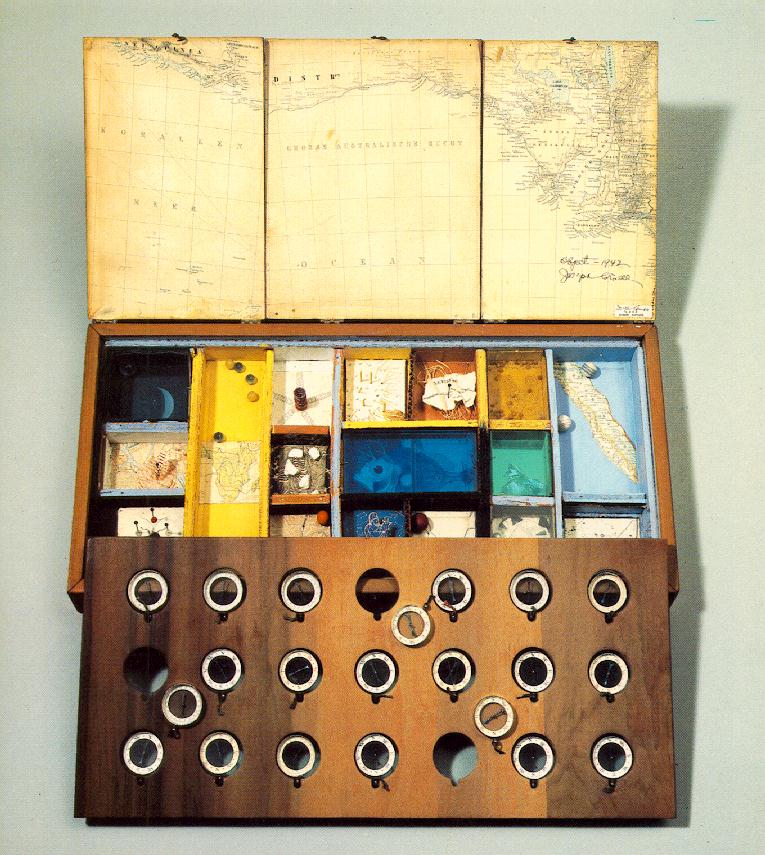
What do you get if you cross the detailed art cases of Joseph Cornell with the cosmic horror of H.P. Lovecraft?

You get the "cryptozoological pseudo-scientific assemblage art" of Alex CF [via].


For comparison here is one of Cornell's beautifully rendered assemblages

5.31.2008

Pittsburgh Cultural Thrust

I realize that I post very little here about my personal life/ activities, mainly because I've been spending the last couple months laying low, reading, writing, working and little else, which most of the time is really all I need to be doing. This weekend however proved to be different, we went out of the house not just once but several times to enjoy some of the cultural highlights of Pittsburgh.

On Thursday night, after going to a friend's birthday party in a swank storefront apartment in the up and coming Lawrenceville, we jetted up to the Shadow Lounge to see Nikki Allen read some poetry for the release of her new chapbook, "Quite Like Yes." While the poets kept their sets somewhat short, plagued by migraines and excessive drunkenness, the evening was stolen by Landmonster!, who ranted obsessively absurd phrases over pre-sampled Casio beats while wearing space pajamas and a Mardi Gras mask.

The next day we went down to the museum to check out the 55th Carnegie International exhibit, which for the first time was given a title, "Life on Mars," prompting the artists to look at what at means to be human from an outsider perspective. There has apparently been a lot of critique over this move, as well as the inclusion of certain artists whose work may not measure up to the "standards" of the Carnegie Museum. I thought some of the work was fantastic and, like any museum exhibit, there were certain artists who just didn't do it for me. Most impressive were Thomas Hirschorn's Cavemanman, a packing tape and media image labyrinth; Cao Fei's Whose Utopia, a film of a fairy-tale ballet in a Chinese light-bulb factory, and Friedrich Kunath's whimsically bittersweet paintings.


Afterwards we walked over to the Carnegie Library of Pittsburgh, which unfortunately I rarely visit (since I prefer collecting books), but was pleased to find they have an extensive music and film section, including drawers full of classical symphonies, which, despite mainly being in the public domain, are almost impossible to find on the internet.

Tonight happens to be our second anniversary (of the day Sophie and I met at the Quiet Storm), and so to celebrate we're planning to continue our hunt of good Thai restaurants in Pittsburgh with Sweet Basil and La Filipiniana (last week it was the stellar Smiling Banana Leaf). And then we will eat a decadent cake while playing Super Scrabble, which for a couple of real homebody bookworms like us (unlike people who only pretend to read [via]) is really the perfect evening.

And just to throw in a couple things about the rest of the world, one of the last un-contacted tribes was discovered in the Amazon, who brandished notched arrows at the plane taking pictures at them which (according to the article) they must have thought was "a spirit or a large bird." Of course, it may also have been one of these new luxury aircraft hotels in the shape of a large white whale [via].

5.28.2008

Sexing the Surreal (...NSFW)

I recently read George Bataille's "Story of the Eye" (available for download w/in link), which was hailed by Susan Sontag and Roland Barthes as a masterpiece of pornographic literature. While I don't generally find descriptions of teenagers pissing on each other and inserting eggs and eyeballs into their various orifices all that erotic, the symbolic and almost dreamlike imagery of the book was rather fascinating to read, like watching a train wreck. It is almost easy in this hyper-sexualized age to forget that even a hundred years ago, when this book was written, such intense and idiosyncratic fetishizing was actually taboo and unheard of, and I suppose it attests to the power of Bataille's twisted imagination that his imagery still has the power to shock. For every somewhat vanilla person like myself who thinks that the over-pornigrafication of sex is getting boring, there are certainly countless kids waiting to be turned on by this kind of thing.

When I had put the book down however I couldn't stop thinking about my own admittedly little-explored sexual proclivities, and realized that they have remained somewhat shadowed because when I was young and forming such appetites my desires mainly focused on mermaids, superheroines, and other unattainable fantasy figures, who held out a promise of sexual relations in impossible and therefore more erotic ways. Who did not read Douglas Adams' "So Long and Thanks for all the Fish" and fantasize about making love while flying thousands of feet in the air? During this reverie I recalled one art book that held particular interest to my young, romantic imagination- the odd and almost morbid paintings of Leonor Fini, who it turns out was one of the surrealists, and whose nudes, with their feline features, impossibly long legs, and mineral and vegetable bodies grabbed me when I was too young to "know better."


The erotically surreal often comes up in the work of some of my favorite writers, Bruno Schulz's "The Street of Crocodiles" (particularly in the Brothers Quay adaptation of it, parts one and two where it really gets good), or Felisberto Hernandez's "The Daisy Dolls," in the guise of mannequins, dolls, or otherwise sexualized but non-living torsos. Even modern photographers like Joel-Peter Witkin understand this fascination and desire for the outre and irreal.