Showing posts with label religion. Show all posts

12.02.2009

Belief confirms Belief

Taking a break from working on a philosophy paper about free will to comment on this research presented in New Scientist showing that people ascribe their own beliefs to God:

God may have created man in his image, but it seems we return the favour. Believers subconsciously endow God with their own beliefs on controversial issues.

"Intuiting God's beliefs on important issues may not produce an independent guide, but may instead serve as an echo chamber to validate and justify one's own beliefs," writes a team led by Nicholas Epley of the University of Chicago in Proceedings of the National Academy of Sciences.

The researchers started by asking volunteers who said they believe in God to give their own views on controversial topics, such as abortion and the death penalty. They also asked what the volunteers thought were the views of God, average Americans and public figures such as Bill Gates. Volunteers' own beliefs corresponded most strongly with those they attributed to God.

Next, the team asked another group of volunteers to undertake tasks designed to soften their existing views, such as preparing speeches on the death penalty in which they had to take the opposite view to their own. They found that this led to shifts in the beliefs attributed to God, but not in those attributed to other people.

"People may use religious agents as a moral compass, forming impressions and making decisions based on what they presume God as the ultimate moral authority would believe or want," the team write. "The central feature of a compass, however, is that it points north no matter what direction a person is facing. This research suggests that, unlike an actual compass, inferences about God's beliefs may instead point people further in whatever direction they are already facing."


I think this is very useful research, as the way our beliefs, and the stories we tell to authenticate those beliefs, influences our actions is, for me, one of the prime functions of mythology, and highly overlooked in our polarized age. I think it is very important right now to look at the way the stories we tell influence us, as culturally we are aflood with stories telling us all kinds of wondrous and troubling things. Violence in video games is just the tip of the iceberg. It's not surprising though to find that God is less a moral compass than a sounding board; people have been using the concept of an ultimate reference for this purpose since we've been able to conceive of such an "objective" stance. The difference I think though is that originally (as conceived in both ancient Greece and theology), God was a sounding board for our conception of the largest possible scope of reference and goodness, that is, one which was bigger than our individual perspectives and could thus serve as a map or guide to them. Nowadays though the popular conception of God has become much smaller, inimical to a total perspective of belief, and very specific beliefs have been attached to the attendant texts and rituals that support belief in God (ie: all the dogma and hatred and ignorance of religious fundamentalists that are in us and not in It). Unfortunately it seems that we have grown to believe more in the one-sided interpretations that have codified over history than in the total set of possibilities inherent in an ultimate god belief, and as such project those back on that image in order to reinforce these negative views.

As always, it is important to remember that whether or not you believe that we are created by God, we create gods ourselves through our belief in them, which allows us to believe in ourselves. As I like to put it, gods are solely everything that has been said or believed about them or has been done in their names.

11.24.2009

On Ultimate Realism

I haven't written much yet publicly on the new perspective or belief system I have been attempting to formulate over this past year, a perspective that I call Ultimate Realism, which is perhaps best summed up by the quote from Patchen's Memoirs of a Shy Pornogrpaher: "Everything which man can imagine, dream, or conceivably want to exist... does exist."

This view first occurred to me one day last year during a week of spiritual-existential difficulty. I had gone to a local bar and ran into an acquaintance, who said, having not seen me in ages due to my focus on school and writing, "welcome back to the real world," to which I could only reply, but isn't everywhere also just as real? and then wandered down the street struck by the total implications of everything around me being that real. There is some sense in which we tend to believe that only those habits and experiences that we usually have are really real, or at least of the most real importance to us, forgetting that other experiences we don't have are just as real. And beyond existing situations, every content of our imaginations and the stories we tell is real, in that these have real effects in the real world. And ultimately, any perspective that will allow us to articulate our lives in the whole of such a multifaceted reality, and perhaps allow us to formulate a perspective of global significance and understanding, will have to put us in relation to that whole, not just as it is scientifically and historically understood, but in relation to all that humans have said, imagined, believed, and dreamed.

This view has come out of years of questioning spiritual beliefs and the nature of the stories we tell. How do we, as human beings in a world with other human beings, deal with the fact that people have divergent and often contradictory views on what the world is and our place in it? Historically, belief systems have clashed, and continue to clash because each side takes their perspective as most true and right, whereas if one view was somehow objectively true and right there should be no cause for conflict; and yet there is. In my own life I have struggled with such limited perspectives, not knowing in what to believe, as the beliefs always seemed too small, and yet needing to believe in something, to tell some kind of story, and finally recognizing that any belief I would want to hold would have to be large enough to contain all possibilities of believing.

Similarly I fear global destruction due to the clash of these limited perspectives, and that we as a species do not have the stories to set us in relation to where we are now that might allow us to continue into the future in a meaningful, healthy, and positive way. The stories we are prone to tell today are often too small, quotidian, dealing with failure, comeuppance, and the meaningless joy ride of post-modernity, whereas we need a perspective that can address the Universe as a whole, for future generations of humanity in this Universe. These stories must be ultimate in order to place us and our actions in the widest set of meaning or significance necessary for survival.

My old professor, Dr. Fred Clothey (a student of famed mythographer Mircea Eliade), suggested that the stories we tell can tell us about ourselves, in effect modeling our understanding of reality in order to authenticate current actions and allow future actions. Our stories/ myths/ beliefs/ perspectives, etc. can do this precisely when they are cast in an "aura of ultimate significance," that is, by referring us to the widest possible scope of experience and understanding, to our cosmic and social beginnings, to our longed for and feared endings, to our ideals taking on human form. We find our place and being in between the limits of the real as we know it.

One such ultimate signifier, that has had a direct effect on real occurrences, is the concept of God(s). While belief in supernatural beings has allowed articulation of our relation to society and mortality, is has, perhaps most clearly and distressingly, served as a justification for centuries worth of horror and cruelty: crusades, inquisitions, terrorism, or just plain ignorance. But we are prone to forget in our polarized times that this personification of ultimate ideals was also a necessary and integral perspective for the development of scientific reasoning, framing an objective and total perspective that we humans could then hope to achieve ourselves, a belief that has existed coterminous to science up through the 20th century. Contemporary atheists might be glad that God is no longer a reference for rational understanding, but "His" death has negative impacts as well: God has traditionally not only been a signifier for ultimate perspective and knowing, but also for perfection and goodness, in short, ethical understanding of behavior, without which we do things like build the atomic bomb. Technology runs rampant when not placed in the widest relation to how it might rightly be used, or the lack of an ethical signifier allows the cultural insecurities that haunt us to become manifest, and such horrors not only be imagined but made real. One imagines a similar lack of ultimate significance in the perspectives that have allowed western culture's unparalleled material consumption, environmental destruction, and continued ideological warfare on the rest of humanity.

I am not arguing here for a return to a belief in the traditional monotheistic God or earlier gods. These stories, as we have seen, are just too small and conflict-provoking compared to those perspectives that now need to be adopted. I am arguing though for a greater belief in the reality and efficacy of the contents of our stories and imaginations, and an awareness of how these otherwise subconscious narratives influence the real world.

One of the problems to this approach is the primacy we give to literal truth, vs. the obvious falsity of our "true" representations of reality. I am a huge fan of stories of the fantastic, of the magical, supernatural, weird, heroic, or sci-fi, which, looking at the predominance of these themes in the current cultural media and imagination, I believe I am not alone in. But why do we love supermen, zombies, and the end of the world? There has been a trend in storytelling, dating from the late 18th century, of attempting to represent reality as it "really is," social or quotidian realism, and not as an allegorical reference for otherwise real things. Fiction, when it first was read as not literally true, was cast as "petite histories," in order to accept stories they had to mimic reality while being divorced from talking about reality. My immediate response to all this is, there's already too much of the world we experience on a daily basis, why create more of it, when stories beyond the everyday may raise possibilities of experience and understanding more than that which we are already familiar with. That familiarity constrains us, by being real, to the obviously inadequate belief systems we now live under. We hold up what we believe is a mirror and say, this is real, and because we say it, that marks the bounds up what we will allow to be really real.

My second issue with realism is that it is not reality despite how it primps and masquerades itself as such. It may represent aspects of reality, but does so by relying on and reaffirming our assumptions about how the world is and should be, which constrains us to accepting those views and realities as more true or valid, to the exclusion of wider views. And today it seems our view of the real is that it frankly sucks and nothing matters anymore. And any attempt to actually discuss real human issues in an emotionally valid way is negated by the irony and scorn with which we articulate the real world. The fantastic however, by being non-real and symbolic of the real (mythopoetic in Tolkien's terms), precisely allows us to highlight those human themes and conditions we want to examine in truthful ways. But in order to even accept the contents of fantastic stories we must (as Coleridge first suggested) suspend our disbelief of those things that couldn't be literally true in our everyday experience. We no longer have a problem leaping into wizard fights or across star systems, we can suspend disbelief but we are never asked to truly believe, and thus are not as prone to take such fantasies as being symbolic or ultimately significant for how we really are or could be in the world. We are content to let them be mere entertainments and diversions rather than suggestions of possibility.

Yet, are ghosts and gods really real, or is this even the right way of framing the question? There is a sense that certain things are existentially real, they commit us to accepting their physical reality, being right in front of us. The invisible and imaginative do not so commit us; one can not empirically and scientifically prove a god's actual existence. To argue one way or the other for this is to miss the entire point about gods. But one can clearly see the effects that belief in such unprovables has on our world, both on our perspectives and psychologies and in actual historical occurrences. Ignoring and belittling the immaterial causes of such beliefs and effects does little to add to our understanding of ourselves in the world, allows the results of inappropriate or too-small beliefs to continue unchecked, and limits the human imagination to articulate new possibilities of being and understanding being, which are necessary for our current and continued survival, let alone enjoyment and well being. On the other hand, if we do not remember that the stories we tell are only stories, that have been made up despite their real effects, we run the risk of mistaking the stories as literally true, thus causing us to act in dangerous and inappropriate ways, when imagining better stories to live by and through is always an option (and it is this lack of awareness of the power of our symbols that I mean by the absent narrative).

I do not know where we will go from here, but I am wary and sick of the post-modern skepticism that rejects any ultimate significance in favor of what we can directly lay our hands on (and in so doing, strangle it to death). I would prefer to see interconnections of the layers of reality rather than the whole's deconstruction and rebuttal. Acting as if we know everything and nothing really matters is perhaps the smallest and most dangerous perspective one could hold. Ultimately, we exist in a Universe which we barely understand, and in which we are a bare speck, and perhaps in that widest view humanity is indeed meaningless and fated to extinction for lack of any better options. And yet it is also possible to believe, and live by the belief, that life and our consciousness of life may be more than a random fluke or evolutionary mistake; not that we serve some clear teleological purpose or extant will of God, but that for all these unknowns we are still real, and still here, and confronted with the implications of that for all reality.

Though reality may be inherently meaningless we have the choice to take on meanings and act on those meanings, to continue to be and gather greater understanding and significance, both on this planet and in the Universe as a whole, should we choose to accept this mission. Anything less than such an Ultimately Realist perspective sells ourselves short, and will only propel us down the road of meaninglessness and destruction. But if we can perhaps articulate a perspective wide enough, not just for all humans, but all life in general and beyond life, then perhaps we can continue on until that perspective, and all else we can imagine, becomes real.

11.09.2009

Adaptive Fictions

This is an interesting look from evolutionist Erin Johnson at the adaptive role fictions play in helping humans survive (from an article on Atheism as a Stealth Religion), not just in religions' use of gods, but in any thought or belief, that is expression as mythology:

This leads to a crucial distinction between what I call factual and practical realism. Consider Hans and Igor, who are mortal enemies. Hans understands that Igor is much like himself, even to the point of competing for the same square of ground. Igor regards Hans as an inhuman monster, completely unlike himself. If Igor's belief makes him fight with greater determination, then it counts as practically realistic, even if it is factually incorrect. Now imagine similar contests among beliefs--and the brains that create beliefs--taking place over thousands of generations of genetic and cultural evolution. Voila! We arrive at a conception of human mentality that is far more nuanced and interesting than the black-and-white cartoon of atheism vs. religion.

Factual and practical realism are not always at odds. To pick an obvious example, a hunter needs to know the exact location of his quarry. The point is that the relationship between the two is complex and that our minds are prepared to massively depart from factual realism, when necessary, in ways that motivate effective action. This is not a sign of mental weakness but a time-tested survival strategy. Moreover, adaptive fictions are not restricted to religions. Patriotic histories of nations have the same distorted and purpose-driven quality as religions, a fact that becomes obvious as soon as we consider the histories of nations other than our own. Intellectual movements such as feminism and postmodernism are often shamelessly open about yoking acceptable truths to perceived consequences. That's what it means to be politically correct. Scientific theories are not immune. Many scientific theories of the past become weirdly implausible with the passage of time, just like religions. When this happens, they are often revealed as not just wrong but as purpose-driven. Scientific theories cannot be expected to approximate factual reality when they are proposed, but only after they have been winnowed by empirical evidence.

These and other belief systems are not classified as religions because they don't invoke supernatural agents, but they are just like religions when they sacrifice factual realism on the altar of practical realism. The presence or absence of supernatural agents--a particular departure from factual realism--is just a detail. It is humbling to contemplate that the concerns typically voiced about religion need to be extended to virtually all forms of human thought. If anything, non-religious belief systems are a greater cause for concern because they do a better job of masquerading as factual reality. Call them stealth religions.

10.28.2009

Fictionology

In light of the Church of Scientology being convicted of Fraud in France, the Onion offers this brilliant mock competing religion, Fictionology [via mutate!]:

Fictionology’s central belief, that any imaginary construct can be incorporated into the church’s ever-growing set of official doctrines, continues to gain popularity. Believers in Santa Claus, his elves, or the Tooth Fairy are permitted—even encouraged—to view them as deities. Even corporate mascots like the Kool-Aid Man are valid objects of Fictionological worship.

“My personal savior is Batman,” said Beverly Hills plastic surgeon Greg Jurgenson. “My wife chooses to follow the teachings of the Gilmore Girls. Of course, we are still beginners. Some advanced-level Fictionologists have total knowledge of every lifetime they have ever lived for the last 80 trillion years.”

“Sure, it’s total bullshit,” Jurgenson added. “But that’s Fictionology. Praise Batman!” [...]

“Scientology can only offer data, such as how an Operating Thetan can control matter, energy, space, and time with pure thought alone,” McSavage said. “But truly spiritual people don’t care about data, especially those seeking an escape from very real physical, mental, or emotional problems.”

McSavage added, “As a Fictionologist, I live in a world of pretend. It’s liberating.”


Interestingly, I personally suspect that if there is any kind of contemporary folk mythology, this is essentially it, the belief in any literary or culture character as an object of worship, wisdom, or personal identification. Just because in the past the culture characters we did this with were gods does not mean contemporary characters are any less available for their symbolic significance. One just has to look at the hype surrounding the release of new superhero movies, the lines around theaters like ancient temples. Perhaps without intending to the Onion seems to have hit exactly on what makes pop culture tick in the human heart.


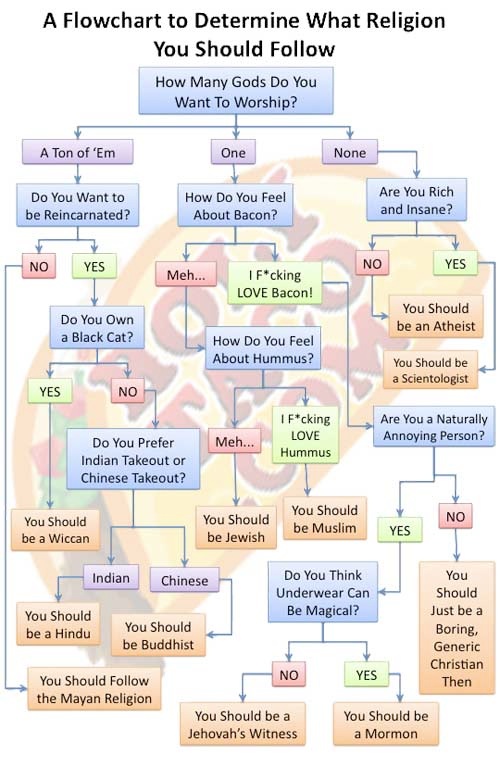
For further perusal, here's an interesting tor.com article on the role memory and recognition play in making quality stories, as well as a handy chart to help you determine (based off food preferences) what religion you should belong to.

10.22.2009

Atheism 3.0 vs the Functions of Faith and God

More news from the front lines of the war between faith and rationalism [via disinfo]:

Bruce Sheiman doesn’t believe in God, but he does believe in religion.

Setting aside the question of whether God exists, it’s clear that the benefits of faith far outweigh its costs, he argues in his new book, An Atheist Defends Religion: Why Humanity is Better Off With Religion than Without It.

“I don’t know if anybody is going to be able to convince me that God exists,” Sheiman said in an interview, “but they can convince me that religion has intrinsic value.”

The old atheists said there was no God. The so-called “New Atheists” said there was no God, and they were vocally vicious about it. Now, the new “New Atheists” — call it Atheism 3.0 — say there’s still no God, but maybe religion isn’t all that bad.

Faith provides meaning and purpose for millions of believers, inspires people to tend to each other and build communities, gives them a sense of union with a transcendent force, and provides numerous health benefits, Sheiman says. Moreover, the galvanizing force behind many achievements in Western civilization has been faith, Sheiman argues, while conceding that he limits his analysis, for the most part, to modern Western religion.

“More than any other institution, religion deserves our appreciation and respect because it has persistently encouraged people to care deeply — for the self, for neighbors, for humanity, and for the natural world — and to strive for the highest ideals humans are able to envision,” Sheiman writes…


I'm glad to see that rationalists are beginning to rationally recognize that there are tangible evolutionary benefits to at least the tangible ephemera of the intangible. Certainly community, a sense of well-being, health, cultural growth, etc. are all valuable things for humanity, but (without reading his book yet) I still think Sheiman is missing the whole point about faith, which is that he may never get his coherent rational argument for the existence of God: Faith does not rely on rational proof but on acceptance of things as being true whether or not you can see or prove them, and there are distinct evolutionary advantages in that.

I will try to illustrate: I have faith that there are forces larger than myself at work in the Universe. I (personally) can not prove they are real, nor can I directly observe them, but my ability to prove or observe does not make these forces any less real, or any less active on my life. These statements could just as easily apply to black holes, electromagnetism or other not readily observable scientific phenomena just as much as they could apply to God. Yes I know I can see light from a light bulb, and someone could explain how light comes from a light bulb, but I dare anyone to show me an electromagnetic field directly, without pointing only to its effects. Science for many centuries refused to admit the existence of fields precisely for this reason, that it seemed you had to believe in them. Just because we do not see God, except for in its tangible effects (under which some might group religion, culture, even consciousness and life), does not mean that it is not just an active and real force. Faith just accepts that you may never see it, and gets right along to making use of its effects without all the rejection and consternation of reason.

But there are even clearer and more direct benefits of believing in God. Granted, I have much doubt myself, not that there are intangible forces, but whether these forces are God, rather than malevolent demons intent upon deceiving me and making life miserable. The thing is, at least demons would be an excuse; without them there is absolutely no explanation for why I often feel deceived or miserable, other than saying it is human nature, or my pscyhology or upbringing. Without reference to some larger, intelligent, or teleological force in the Universe, we are hard pressed to find any true meaning or reason for life existing at all, except to eventually die. As Buddhists say, life is suffering, and all an illusion. The thing that God grants (referring mainly to the traditional Western conception of God as all powerful, knowing, and, most particularly, good), is something that a friend of mine in AA pointed out recently: that we can give up to God our feelings of helplessness in the face of cosmic pointlessness, we can give up to God our need for responsibility for all the things in our lives which for the most part aren't in our control to begin with. Not that God or equivalent powers absolve us of responsibility or grant us ultimate meaning, but by standing as metaphors for the possible existence of an ultimate meaning, goodness, or responsibility, especially because unseen, we get to choose to believe that these things are possible, and are thus given a bit of leeway to seek out these things in our own lives where we can, without killing ourselves or each other first. Evolutionarily, belief in God gives us hope and grace, which allow just enough room to trust in and build relationships and civilizations and keep this whole mess going, until we find out if there really is some larger point to any of it.

10.15.2009

Faith Ills...

... if your faith happens to be as bigoted and close minded as a parishioner denying a marriage license to an interracial couple or an NC church burning non-canonical religious texts as "satan's books."

Sadly, neither of these religious groups seemed to have been paying much attention to their own myths.

7.14.2009

Interim Novae

Yes I still exist, but have been too focused most of this summer so far working on my novel to post much here, though I still have been paying attention to all sorts of interesting news items that would make for great science flash fictions, some of which can be found in the massive dump of links below:

Culture:
*As a male with a unique name, I find it fascinating that the more uncommon or feminine a boy's first name is, the greater the likelihood that he will end up in prison.
*An interesting article from Adbusters about realizing that mystery is still an integral part of human existence, despite 21st century rational empiricism.
*In celebration of the 40th anniversary of the moon landing, the original landing tapes have finally been found.
*While Americans have been torn up about the death of Michael Jackson, Japan may decide to abolish money.

Religion:
*Ireland has just passed a blasphemy law, which besides seeming several centuries out of date has pissed off all the atheists who don't believe in blasphemy anyway.
*Meahwhile, The Pope's encyclical, Caritas in Veritate calls for a new global economic system based off of love.
*A Saudi genie is being sued for harassment after it stole one family's mobile phones (perhaps jealous of the telecommunications genie?).
*An interesting chart detailing the views of the dominant religions on sex.

Literature:
*In London, this coming weekend is World Literature Weekend.
*Ernest Hemingway may have actually been a failed KGB spy.
*From an article on porn and literature a list of 18 challenges in contemorary literature.
*An interesting look at Lithuanian Book Smugglers, like the outlaws in Bradbury's Fahrenheit 451.
*How does language shape or thinking?
*William Gibson on how culture shapes our language.
*The importance of the ineffable in literature, as opposed to the enormous novel of technical, scientific, or historical knowledge that has become the highest credential for contemporary male writers (though I don't see why mystery and fact have to be opposed...)
*And speaking of enormous novels of that type, I've been reading David Foster Wallace's Infinite Jest for Infinite Summer, which is really a long winded, uneventful yet gripping read. More on this soon.
*Whereas I am much more intrigued by the idea of writing down our dreams as a form of literary self-criticism.

Science:
*Speaking of dreams, here's an article on the evolutionary enigma of dream contents.
*Both bird's eyes and the photosynthesis of plants may work by quantum entanglement.
*Light that has either attractive or repulsive forces of "push" has been discovered.
*Frogs and toads around the world synchronise their mating behaviour to the full moon.
*Scientists are still searching for a three foot long spitting earthworm in Idaho.
*As if she was the fountain of youth, an infant-sized teenager may provide clues to reversing the aging process.
*A synthetic tree has been built able to capture carbon from the air 1,000 times faster than real trees.
*Scientists have also created artificial sperm from stem cells, making men progressively more obsolete.
*The new interplanatery internet just got its first node on the ISS.
*Stephen Hawkings in the meantime has decided that humans have entered a new stage of evolution, one based off our ability to exchange information.
*But only if NASA doesn't build self-replicating robots on Mars first.
*Whereas planets themselves might be living super-organisms.
*Perhaps we really do have twenty-one senses, which humanity is still learning to develop.
*Ants however have suddenly become a global super-colony.
*And lastly, a new theorem shows that if humans have free will, then so must elementary particles.

That seems about it for now. Hopefully now that my writing process is stabalized I will have more time to post here. Enjoy the summer!

6.12.2009

Religious news: OS Religion and the Dali Lama's woes

"Open-source religion is an amalgamation of two ways of thinking about the world. The first is religion, a common set of practices, rituals, and beliefs. It’s as old as the hills, one of the most enduring traits of humankind. The “open source” component is new, an unforeseen consequence of the Internet revolution of the 1990s. It’s a reference to open-source computer code, code that anyone is allowed to rewrite, add to, or delete. Adherents of open-source religion note that tradition can calcify into dogma, and if there’s one common trait to people who practice open-source religion, it’s distaste for dogma. Some open-source believers want to found entirely new religions, and some merely want to reinvigorate a mainstream faith. All want to change people’s perceptions of religion from something that’s handed down to them, something they receive, and make religion something people do. All religions evolve, of course, but the tinkering inherent to open-source religions can benefit founders and followers alike, Webster says. “When you share what you learn, you learn better,” he notes, “and the content evolves that much more efficiently.”

...

This is contrasted to the Dali Lama, whose Buddhist Foes claim he is violating the basic tenets of Buddhism. And if that wasn't bad enough, the boy chosen as the next Dali Lama turns his back on the order, now sporting "baggy trousers and long hair, and more likely to quote Jimi Hendrix than Buddha." Which I suppose shows some of the challenges when one's ancient practices fail to keep up with the times.

5.26.2009

On the total reaction to life

"Religion, whatever it is, is a man's total reaction upon life, so why not say that any total reaction upon life is a religion? Total reactions are different from casual reactions, and total attitudes are different from usual or professional attitudes. To get at them you must go behind the foreground of existence and reach down to that curious sense of the whole residual cosmos as an everlasting presence, intimate or alien, terrible or amusing, lovable or odious, which in some degree every one possesses. This sense of the world's presence, appealing as it does to our peculiar individual temperament, makes us either strenuous or careless, devout or blasphemous, gloomy or exultant, about life at large; and our reaction, involuntary and inarticulate and often half unconscious as it is, is the completest of all our answers to the question, "What is the character of this universe in which we dwell?" It expresses our individual sense of it in the most definite way. Why then not call these reactions our religion, no matter what specific character they may have?"

[William James, The Varieties of Religious Experience, 1902]

5.19.2009

Like a Holy Hand Grenade

And this is just crass:

Former Defense Secretary Donald Rumsfeld sent President George Bush top secret wartime memos with cover sheets that mixed Scripture and battle photos to cast the Iraq invasion as a holy Christian crusade. Rumsfeld, not a man who wore religion on his sleeve, appeared to be trying to manipulate - or curry favor with - the Bible-quoting Bush, according to an explosive story in GQ.Some Pentagon analysts worried that if the memo covers leaked, they would inflame the Islamic world, undercut Washington's Arab allies and bolster those who claimed America was out to Christianize the Muslim world.One official was so disturbed he kept the report covers and recently gave them to GQ writer Robert Draper, a leading chronicler of the Bush administration."Commit to the LORD, whatever you do, and your plans will succeed - Proverbs 16:3," appeared on a April 1, 2003 report over a photo of a U.S. soldier near a highway sign pointing to Baghdad. The next day, U.S. forces reached the Iraqi capital."Open the gates that the righteous nation may enter, the nation that keeps the faith - Isaiah 26:2," appeared on a April 3, 2003 memo...

3.09.2009

The Big Hunt

They say there’s no rest for the wicked, but perhaps it’s more apt to say there’s no explanation for the rational minded. At least there’s funding, even if it comes from eccentric billionaires.

“We’re cryptoxenologists,” I told him as I slid into the booth, shaking the last of the rain off my trench coat, “trained professionals in the scientific methods. Not ghost hunters.” Despite the expensive felt hat pulled low over his face, which was shadowed in the flashing light show of the Vegas club, I could still see a mad gleam in his eyes, like a kid setting his targets on the Holy Grail. So this was Robert Bigelow, I thought, of Bigelow Aerospace Advanced Space Studies, and my new patron.

“Don’t worry,” he smiled, the quivering of his fat jowls sending a shiver down my replaced spine, “I’m still talking aliens, UFOs, what have you. I need someone I can trust independent from the Mutual UFO Network to head a special division of my Star Impact Project: we’re after the big one, the biggest alien of them all.”

“Bigger than Roswell? Than the Vogans, than Xenu?”

“Very.”

“Hmm. You’ve got me intrigued, but I don’t come cheap. Is this supposed to be a Category Two or Three, physical traces, physiological effects in the witnesses?”

“Yes.” He smiled again; gesturing at the drink which a peculiarly androgynous waiter had set on the dark table. “Traces and effects of every imaginable kind. I didn’t believe it myself first either. This one’s beyond old Vallee’s categorizations. You want the run down?”

“Don’t you have a spec sheet? I’d like to get started before another bug hunter gets the goods.”

“No, I want you to understand the scope of what we’re dealing with here. Humor me.”

I shrugged back in the booth and took the drink, the first of many he’d be paying for I imagined. Its taste was impossible to pin down. While Bigelow talked I wondered what kind of alien we were hunting here, where it fit in Card’s Hierarchy of Foreignness, as varelse or raman: the other-as-enemy or other-as-self. I hoped the later; friendly aliens are always easier to negotiate with, and cover up after they leave town. But as the fat billionaire talked I began to think he was referring to the last function of foreignness, that ghost in the machine: the other as wholly and in-fucking-effably other.

“Wait, wait,” I stammered, sloshing the last of the weird blue drink on the tabletop, “did you just list as traces certain international monuments, text, rituals, and as physiological effects specific systems of belief and social codification, including the whole of our cultural value system?”

He smiled again, and this time the fear it caused me was almost enough to make me jump up and run screaming from the club, from the whole cursed city of Las Vegas, lit up like a giant welcoming beacon in the deserted night. “I told you I’m after that most alien of aliens…”

I gripped the table; the spilled drink sticky and surreal under my fingers. “You… you’re talking about God aren’t you?”

12.23.2008

God vs. the Scientific Method

A person's unconscious attitudes toward science and God may be fundamentally opposed, researchers report, depending on how religion and science are used to answer "ultimate" questions such as how the universe began or the origin of life.

"It seemed to me that both science and religion as systems were very good at explaining a lot, accounting for a lot of the information that we have in our environment. But if they are both ultimate explanations, at some point they have to conflict with each another because they can't possibly both explain everything."


As such, more Americans believe in the Devil, Hell and Angels than in Darwin’s Theory of Evolution, church attendance is projected to fall by 90% by the year 2050, and researchers are still trying to find a neurophysiological model of spiritual experience.

This fall I took a physics course in which we discussed quantum mechanics, relativity, cosmology, and other weird aspects of modern science. Far from finding these ideas in conflict with my perspectives on spirituality I found that science paints a picture of reality that is mysterious, open-ended, and ultimately not very different than many early spiritual beliefs. If the fact that the universe is made almost entirely of dark matter and energy that we know nothing about doesn't move one to contemplate the meaning of life then I am completely confused as to what makes for a spiritual or religious experience. According to Rudolf Otto in The Idea of the Holy anything that brings up this feeling of utter mystery and incomprehensibility in the face of reality is spiritual, and the closer science looks at the Universe there is only more and more that we don't understand.

On the other hand, science and religion could find another sort of common ground as the Vatican embraces iTunes prayer books.

11.24.2008

Dali Lama Unleashes Revolutionary New Reincarnation Techniques


[via]

"Deciding that they should be the ones to appoint all future Lamas, in an attempt to gain the upper hand in the mindspace of the people of Tibet in their struggle against them for independence, the Chinese government recently enacted a law giving themselves full authority over all reincarnations.

Well played China. Well played.

But the Dalai Lama knows how to play the game as well.

In response, at the end of 2007, the Dalai Lama proposed to hold a referendum among his millions of followers on whether he should be reincarnated at all, and, if the vote was in favor, to determine his reincarnation while he was still alive. He cited the example of one of his teachers as a precedent for a lama being reincarnated while still alive. But he also indicated that he would not be reborn in China or any other country which is “not free.”

In turn, the Dalai Lama has raised the possibility to forgo his rebirth, or to be reborn while still alive so that he, not China, can choose his successor.

The Dalai Lama has even suggested reincarnating as a woman.

I find it incredibly interesting that the Dalai Lama, a being who’s existence spans at least fourteen lifetimes, is now reincarnating only in free countries in order to stay free of the grasp of the ancient empire which seeks to trap and control him within it’s borders. That is, of course, unless he chooses not to reincarnate at all and instead transcends to a higher dimension.

I certainly hope they aren’t using Dielbolds to count the votes in that referendum, it would be an easy way for the Chinese to finally remove the Dalai Lama from this level of reality (at least for a while).

What’s especially interesting about this strange game of espionage and rebirth is how important it actually is to the future of Tibet, China, and the rest of the world, as well as to the lives of the individuals involved."

11.17.2008

The Unsayable

As a writer, or more generally an artist, something that has become increasingly more important to me is the ability, desire, or perhaps necessity to express the inexpressible, to represent in some form those situations, characters, feelings, or ideas that either defy representation, or are shades of experience that others have not found ways of representing before. Heidegger, I believe, discussed experience or perception as being similar to driving over the surface of the world, that is, one can only or most readily articulate the outermost (or perhaps innermost) layer of reality. I take it for certain that many deep and true things have been said in the past, that language has been used in innumerable ways, that any subject has been discussed, any combination has been to some degree tried out (one only has to turn to Joyce’s “Finnegan’s Wake” for illustration of that). But I also resent how much schlock and ironic, surface content is thrown around these days, how easy it is to not have the courage to face the unfathomable in one’s self and in the world. A fellow student in my fiction class told me that he once wrote a story putting in a lot of himself and his real feelings and decided that it was so intense that he’d rather not do it again. I fear it’s indicative of our age.

And yet, as far as one can or chooses to push words, music, and visions, it seems that there will always be something more that is left unexpressed; that any art is ultimately a medium, a mediation of a reality that is still immediate and sensorially complete, and more, carrying in every moment associations to memory and imagination, references to culture and history, and gods know what else besides. Emotions, thoughts, sensations, intentions. And even then, if one where able to accurately convey all these modes of perspective, there still remains some ineffable and overwhelming quality, the spirit or life-ness of reality that has not yet come across through any artifice. Though one can come closer, through pushing ones’ perspectives and means of expression. Freud and other psychologists have called this inexpressibleness the ‘uncanny,’ or, by the religious theorist Rudolf Otto, the ‘numinous’. It reveals itself in what is weird, non-rational, fascinating, and terrifying, in the unexpected, unprecedented, and juxtaposed. It is processed in dreams, prayed to in religious rituals, and approached tentatively through an artist’s imagination and vision. Some have called it God but I think that’s just a symbol and it’s something else entirely, something wholly other than the surfaces we say it is.

For a visceral example take the body. For many the body as material is the surface, what it looks like, what’s on it, or the mass, the weight. For those trained to see it otherwise, like doctors, the body is series of elaborate processes, organs, meat, hidden beneath the outward skin. But how often do we have a total lived sense of this (excepting of course moments of illness and malfunction), on an aesthetic or even spiritual level? Or apply it outwards to the rest of the world? One of the most intense and inexpressible moments for me of this sort was not religious or drug-induced, but was the result of seeing the Bodyworlds exhibit several years back: the plasticization of human bodies and organ systems and parts of bodies, all splayed open in exact form, some refracted or expanded to bizarre, inhuman proportions. And yet all still recognizably human, still recognizably my form. One was split down the middle and folded open so that he was standing in two place at once, and I felt my own body trying to physically know what that felt like. I left acutely aware of my every organ, of every living layer within me, and when I walked out into the city and looked around I was just as aware of the insides of every other thing: the trees, machines, animals, building, the air itself even. It was awe-inspiring in such a way that I still don’t know if I’ve gotten it across.

Or on the other hand there are the psychological approaches toward memory and emotion, therapy or artistic transmutation. You could spend a lifetime tracing out the symbols and associations of your individual psyche, and still there might be some part of what makes you tick that you can’t quite lay your finger on. Or perhaps you begin to recognize feelings that you’ve never felt before and can’t yet explain. I am currently working on a story which the character goes through a transformation of a wide spectrum of emotions, and in doing so I am forced to similarly process my own emotions towards an emotional perspective that I know I’ve never felt before and certainly don’t yet know how to express. Several of my friends and classmates have asked why I am writing this piece if it is such an intense and inexplicable process, to which my response has invariably been that this is why I am writing: to experience something that hasn’t been experienced or expressed before in order to offer it up to others and the world.

9.10.2008

End Times, by Lydia Lunch

End Times
By Lydia Lunch. [via, posted in full]

“In times of universal deceit telling the truth is a revolutionary act.”
– George Orwell

It took balls for Elton John to suggest banning all organized religion because it turned people into hateful lemmings devoid of compassion. And I may be putting my cock on the line here, but I think we need to go directly to the source and simply get rid of God. After all God was the first cop. The original tyrant. An egotistical dictator whose sadism was so immense that he insisted on the murder of his only begotten son just to prove what he was capable of after he condemned us all to rot in eternal damnation like flesh puppets in his own private dungeon. An amusement arcade full of fire and brimstone.

Religion used to be the opium of the masses. Now it’s the crack cocaine of assassins. Millions of addicts tripping on a celestial high. Throwing psychotic temper tantrums like little brats who forgot to take their Ritalin. Backyard bullies screaming MY GOD IS BIGGER THAN YOUR GOD. God junkies — dangerous and delirious. Drunk on blood and bombs and the smell of burning flesh. Painting the desert red in an attempt to appease BIG POPPA, that vengeful War Lord whose favorite blood sport has always been one of violence, torture and retribution.

And excuse me if I feel that John McCain is suffering from Stockholm Syndrome. If after five years of being held in captivity and forced to endure relentless tortures, he is simply too twisted to realize what the real price of war is, then we’re all doomed. After all if he could survive such mind numbing cruelty and still want to play war whore, what the hell are the rest of us all whining about?

War is as old as God himself. And the War is never over. The War is never ending. The War is just an orgy of blood and guts masterminded by testosterone-fueled dirty old men that get off on fucking the entire fucking planet. This is the REAL PORNOGRAPHY. An outrageous cockfight fought by gung-ho cowboys who have drawn a line in the sand and will challenge anyone to a duel foolish enough to threaten resistance against the advent of the rodeo mind.

And hold on to your hats because now entering the bullring is a petite pit-bull in lipstick with a hotline to God’s pipeline whose idiotic credo of “Intelligent Design” insults not only science and evolution but the individual’s ability to reason when presented with hundreds of thousands of pages of evidence to the contrary.

Man was not created in the image of God. God was created in the image of man so that man had someone to blame his infantile rage on. The need to believe in God is a pathological viral infection that has spread like an incurable disease infecting man’s ability to reason clearly. Belief acts as a psychic buffer against anxiety over the unavoidable reality of impending mortality. Scared shitless and still greedy for more than merely earthly delights, man, that all consuming piranha has wreaked havoc by gobbling up and devouring every other creature forcing predictions that unless a miracle happens even the fish will be wiped out before the midterm of this century. And with rifle-toting zealots like Sarah Palin and her Assembly of God clan smiling smugly and smirking about killing caribou, hunting moose, exterminating wolves and hounding polar bears into near extinction the death count will surely mount.

Only end times apocalypticians are demented enough to dream of a magnificent bounty to be served up in heaven by angels and virgins alike assuming it’s the just deserve of a hard fought battle for the glory of God and Cuntry. In the meantime, the rest of us better prepare to go hungry because soon enough we won’t even be able to afford food anyway.

Am I imagining it or were we a lot safer when the so-called leader of the free world was getting blowjobs in the White House? Isn’t it better to blow off a little steam in the face of a willing victim than to take out your sexual frustrations and pent-up aggression on endangered species or countries half way around the world, blatantly lying about democracy and freedom in a thinly-veiled disguise to suck the juice out of a hole in the ground, while the rest of us are stuck at the Exxon stations holding gas pumps in our fists like big limp dicks that we pay out the ass to get perpetually screwed by?

No one wins in War except the Military Industrial Complex. A Corporate Cabal run from inside the Pentagon’s walls set up to both build weapons of mass destructions and then repair the damage done by them. The astronomical expense of war, at last count $100,000 dollars a minute in maintenance fees seems paltry when you consider the estimated 37,000 corporations who have their hands in the till and are growing fat on the blood and bones of widows, orphans and soldiers piling up in mass graves strewn throughout the desert. An oasis of death and destruction.

A war which has utterly demolished the separation of church and state, is operating secret prisons across the globe, grants immunity to mercenaries and has turned America into a Police State whose own citizens are now under siege. A war in continuum, orchestrated by an arrogant pig-headed son of a military father whose status as head cop at the CIA lead him to believe that America has a divine duty to police the planet as his Soldiers of Christ commit whole sale slaughter in effort to push forth judgment day. Oh closer my God to thee! Holy War! Holy War!

I pity the fool who prays for life everlasting. I want my taste of Heaven and I want it now. I realize that at any moment I could become the next victim of this war without end. And Heaven to me would mean dying with a smile on my face, screwing a half a dozen returning amputee Iraqi war veterans. Hell, somebody’s gotta take care of the vets. Their own government sure as shit won’t. America has over 200,000 homeless veterans of war. Men tossed to the streets and forced to fend for themselves when they were no longer useful as mercenary cogs on the wheel of the world’s greatest killing machine; suffering from Post Traumatic Stress Disorder, tricked into a war and conned by doublespeak into believing that fighting will bring peace, domination will bring freedom, and that your Uncle Sam will take care of you after you’ve risked life and limb to safe guard his superiority complex.

We inhabit this vast potential Utopia, which is being destroyed by its abusers. Man has created a hell on earth, turning the world into a ghetto, a slaughterhouse, a refugee camp, an orphanage, a sweatshop, a bomb factory, a land mine, a shooting gallery, an insane asylum, a toxic dump. And the way I see it Mother Nature is getting pretty pissed off. Earthquakes, tornadoes, floods, mudslides, hurricanes, droughts, monsoons, famine. She is becoming more violent against the men who cause her violence.

And maybe after all, violence is only natural. All Creation bears the molecular memory of a terrible explosion of electricity, energy, matter and motion. A violent eruption of white light and white heat. Violence was the first act of creation. THE BIG BANG. Chaos is the law of Nature; it is the score upon which reality is written. Or to quote Mussolini “Blood alone moves the wheels of history.” Same as it ever was.

War is an incurable virus, forever mutating, that travels the globe feeding on man’s fears, spreading panic and terror, violence and death, which until we find a vaccine that finally inoculates the entire population against stupidity, arrogance, aggression and blind faith, we will be forced to forever repeat like stunted victims of Orwell’s Memory Hole.


ABOUT THE AUTHOR
Lydia Lunch is an art terrorist who has been confronting apathy and kicking its fucking teeth in for the past three decades.

7.31.2008

Anarchism, Mysticism, and Anamnesis

The other day James of that veiled gazelle and I were having an interesting conversation about the curious disconnect between anarchist philosophy and spiritual practices, and the handful of authors who write about both.

Anarchism comes from the Greek for "without archons (rulers)," and is defined by The Concise Oxford Dictionary of Politics as "the view that society can and should be organized without a coercive state." While this idea has divided into many (often conflicting) schools and sub-schools of thought, some general trends in belief emerge that are what originally attracted me to the ideal: Instead of meaning chaos and destruction, living without rulers, if it is to work at all, requires autonomy (self-rule/ DIY), equality (mutual respect for all others), pacifism (responsibility of getting along with oneself/ other/ the environment, etc), and not a small smattering of wide-eyed wonder. Of course, these are ideals, and like all social philosophies actual practice often falls far short of how people are expected to live (though it doesn't help that there are infinite negative interpretations on anarchism portrayed by the media and youth market). One of the main points where anarchist belief conflicts with itself is over what to do with religion and spirituality. For the most part, anarchists follow the creed of "no gods, no masters," rejecting religious behavior as no better than the opiate of the masses (probably a result of some of anarchism's roots in 18th Cent. Russian Communism). For example, a friend of mine considers herself both an anarchist and a Christian, which she does not see as being a conflict. However she has gotten an extraordinary amount of shit over the years from her anarchist friends because of her religious preferences, a kind of knee-jerk dogmatism that at times rejects anything remotely spiritual or mystical in favor of the pragmatic, rational, political, and all too real.

The irony being however that in its current incarnation, as a modern American youth movement drawing on its resurgence in the punk subculture, Anarchism has come to take on the trappings of a religion itself. A system of beliefs, a mode of dress (black, dirt, patches), a series of ritualistic practices (from train hopping to protesting), and a teleological doctrine (drawing on the Communist worker's uprising) that aims toward some utopia after the Revolution when everyone can take care of themselves and each other. Another common phrase: "Who will build the roads? We will!" It strikes me that even before this paradise is reached, it would be necessary for anarchists to apply their open ideals not just to themselves, but to everyone, drawing on a much more interesting belief that "nothing is true, everything is permitted," that all beliefs, even spiritual ones, are subjective and potentially valid. If one doubts the socio-political, revolutionary force of religion, look at Liberation Theology which in Latin America has attempted to do just that.

There are of course certain contemporary authors who have been somewhat successful in trying to unite principles of anarchism and spirituality (at least for a handful of people like James and I). The first one that comes to mind is Hakim Bey (full writings beyond link), whose tenets of Ontological Anarchy, and the Temporary Autonomous Zone find a direct correlation to certain occult ideas like the magic circle. In his more academic role as Peter Lamborn Wilson, he is an authority on the darker side of the Islamic mystical sect of Sufism. While criticized by anarchists for his mystical and individualist leanings, Bey is also openly a pederast, which is essentially waving a stick in the face of anyone who claims that they don't live by rules.

Another text that had a similar appeal was Days of War, Nights of Love. As an anarchist organization, Crimethinc. has gotten a lot of flack with the years, both at first for being too individualist and lifestyle, then for promoting irresponsible scrounging, and finally for becoming just another protest-centered anarcho-webpage. However, what first impressed me in their earlier writings, beyond the beautiful and often-times personal prose, was the sense of mystique they weaved around their organization: here were anarchists handing out secret invitations, discussing magic as direct action, and in fact weaving their own mythology in an effort to make it into their real world, which for a time actually seemed to work, and hopefully inspired countless other children to do the same.

Take for example this excerpt: "This world, the so-called “real world,” is just a front. Pull back the curtain and you’ll see the libraries are all filled with runaways writing novels, the highways are humming with escapees and sympathizers, all the receptionists and sensible mothers are straining at the leash for a chance to show how alive they still are. . . and all that talk of practicality and responsibility is just threats and bluffing to keep us from reaching out our hands to find that heaven lies in reach before us."

Perhaps one reason for Crimethinc.'s reliance on such mystical and utopian imagery was the involvement of one Mark Dixon, a friend of James, and a self-professed "folk scientist" most infamous for his use of think tanks (like highly focused temporary autonomous zones) for accomplishing all sorts of zany acts, like turning a bike into a record player. Most of the truly interesting, magical, and revolutionary writing in Days of War, Nights of Love seems to be credited to him. Among the many zines that he helped pen and pass around were two that I and others have come to call Anamnesis I and Anamnesis II, being absolutely chaotic and fun-house style (yes that is how the zines were originally formated) enquiries into many esoteric, yogic, and metaprogrammatic practices that are absolutely essential to anyone trying to live outside of even one's own rules (Anamnesis being the Platonic doctrine of psychic memory or the eternality of knowledge, an idea later articulated as the Theosophical Akashic Records, Hebrew Book of Life, or Sufi Khafi, and according to Wikipedia is "the closest that human minds can come to experiencing the freedom of the soul prior to its being encumbered by matter").

I am sure there are others writing about spirituality and anarchism in the same breath, though I am yet to find them. Any thoughts?

7.23.2008

The Comic Book of the Dead

The Tibetan Book of the Dead,or Bardo Thodol, a funerary text intended to guide one through the experiences that the consciousness has after death, during the interval between death and the next rebirth, is now presented in easy to read comic book form!


There are two things I find highly interesting about this text. One is that the traditional western depictions of the afterlife, heaven hell, or the layered cake of Dante's "Inferno," are merely distractions from the state of either rebirth or liberation from the entire process, and they are fairly early distractions at that. Of course religions like Catholicism have been known to be fairly self-punishing.


Second, is that this journey through the afterlife, and all its wild "retinal circus" of visions, is highly reminiscent of the dreaming state, particularly when one is asked to realize in the afterlife that all the gods and demons are not only aspects of each other but aspects of one's own projections. In fact this recognition that after-world experiences are similar to the visions of sleep is but an aspect of tibetan dream yoga, where through practices of lucid dreaming and recognizing that all reality is a dream one can learn to wake up and achieve liberation in the "clear light."

7.21.2008

Rabbi unveils the reversible name and gender of God

"Rabbi Mark Sameth contends in a soon-to-be-published article that the four-letter Hebrew name for God - held by Jewish tradition to be unpronounceable since the year 70 - should actually be read in reverse. When the four letters are flipped, he says, the new name makes the sounds of the Hebrew words for "he" and "she." God thus becomes a dual-gendered deity, bringing together all the male and female energy in the universe, the yin and the yang that have divided the sexes from Adam and Eve to Homer and Marge.

"The Hebrew name of God that is known as the Tetragrammaton - the four letters Yud-Hay-Vov-Hay - appears 6,823 times in the Hebrew Bible. Since early Hebrew script included no vowels, the pronunciation of the name was known by those who heard it. According to Sameth's footnotes, the name was said only by priests after the destruction of the First Temple in 586 BCE. After the destruction of the Second Temple in 70 CE, the name was no longer said and the pronunciation lost.

"Sameth doesn't believe that he has stumbled on a previously unknown understanding of God's name, but that he has been able to connect the dots in a fresh way. Those who find meaning in his work, he said, may encounter a different understanding of God that is comforting to feminists and those on many spiritual journeys. They may also read the Torah differently. "If this interpretation is correct, it says that the Torah is a mystical or esoteric text," he said. "The mystics have been saying all these years that the text conceals more than it reveals. It is structured with different levels of meaning and reveals itself over time. We're talking about one tradition that goes all the way back."

"Sameth has shared his image of a dual-gendered God with the seventh- and eighth-graders he teaches at his synagogue. He said they've been very receptive, which isn't surprising because they are growing up in a post-modern age. "As post-moderns, we've been conditioned to a different relationship with language," he said. "That's why there is all this interest now in Jewish mysticism." He wonders how, 2,000 years from now, people will understand the final chapter of "Ulysses," which includes no punctuation. Will they try to add punctuation, believing that it's been lost? Or will they grasp that James Joyce knew what he was doing? "Joyce was playing with language, using language to play with the medium," Sameth said. "And the Torah isn't just about Noah taking the animals, twosies by twosies. If that's what the Torah was all about, how could it have captivated Western civilization for 3,000 years? There had to be more."