
If the hipsters don't kill us, here's a laugh out loud article about the possibility that 2012 might not be the end of the world from Reality Sandwich:
"Christmas morning 2012 should be a barrel of laughs. "Merry Christmas sweetie! I was going to get you that new hydrogen-powered Barbie Transporter you've been bugging me about, but I was pretty certain we'd all be dead by now. Sorry, my bad. Here, have a spoonful of rice."
7.31.2008


Hipster: The Dead End of Western Civilization (?)
Excerpts from the latest Adbusters cover article:
"Ever since the Allies bombed the Axis into submission, Western civilization has had a succession of counter-culture movements that have energetically challenged the status quo. Each successive decade of the post-war era has seen it smash social standards, riot and fight to revolutionize every aspect of music, art, government and civil society. But after punk was plasticized and hip hop lost its impetus for social change, all of the formerly dominant streams of “counter-culture” have merged together. Now, one mutating, trans-Atlantic melting pot of styles, tastes and behavior has come to define the generally indefinable idea of the “Hipster.” An artificial appropriation of different styles from different eras, the hipster represents the end of Western civilization – a culture lost in the superficiality of its past and unable to create any new meaning. Not only is it unsustainable, it is suicidal. While previous youth movements have challenged the dysfunction and decadence of their elders, today we have the “hipster” – a youth subculture that mirrors the doomed shallowness of mainstream society.
"Punks wear their tattered threads and studded leather jackets with honor, priding themselves on their innovative and cheap methods of self-expression and rebellion. B-boys and b-girls announce themselves to anyone within earshot with baggy gear and boomboxes. But it is rare, if not impossible, to find an individual who will proclaim themself a proud hipster. It’s an odd dance of self-identity – adamantly denying your existence while wearing clearly defined symbols that proclaims it.
"The dance floor at a hipster party looks like it should be surrounded by quotation marks. While punk, disco and hip hop all had immersive, intimate and energetic dance styles that liberated the dancer from his/her mental states – be it the head-spinning b-boy or violent thrashings of a live punk show – the hipster has more of a joke dance. A faux shrug shuffle that mocks the very idea of dancing or, at its best, illustrates a non-committal fear of expression typified in a weird twitch/ironic twist. The dancers are too self-aware to let themselves feel any form of liberation; they shuffle along, shrugging themselves into oblivion.
"Hipsterdom is the first “counterculture” to be born under the advertising industry’s microscope, leaving it open to constant manipulation but also forcing its participants to continually shift their interests and affiliations. Less a subculture, the hipster is a consumer group – using their capital to purchase empty authenticity and rebellion. But the moment a trend, band, sound, style or feeling gains too much exposure, it is suddenly looked upon with disdain. Hipsters cannot afford to maintain any cultural loyalties or affiliations for fear they will lose relevance.
"We are a lost generation, desperately clinging to anything that feels real, but too afraid to become it ourselves. We are a defeated generation, resigned to the hypocrisy of those before us, who once sang songs of rebellion and now sell them back to us. We are the last generation, a culmination of all previous things, destroyed by the vapidity that surrounds us. The hipster represents the end of Western civilization – a culture so detached and disconnected that it has stopped giving birth to anything new."
"Ever since the Allies bombed the Axis into submission, Western civilization has had a succession of counter-culture movements that have energetically challenged the status quo. Each successive decade of the post-war era has seen it smash social standards, riot and fight to revolutionize every aspect of music, art, government and civil society. But after punk was plasticized and hip hop lost its impetus for social change, all of the formerly dominant streams of “counter-culture” have merged together. Now, one mutating, trans-Atlantic melting pot of styles, tastes and behavior has come to define the generally indefinable idea of the “Hipster.” An artificial appropriation of different styles from different eras, the hipster represents the end of Western civilization – a culture lost in the superficiality of its past and unable to create any new meaning. Not only is it unsustainable, it is suicidal. While previous youth movements have challenged the dysfunction and decadence of their elders, today we have the “hipster” – a youth subculture that mirrors the doomed shallowness of mainstream society.
"Punks wear their tattered threads and studded leather jackets with honor, priding themselves on their innovative and cheap methods of self-expression and rebellion. B-boys and b-girls announce themselves to anyone within earshot with baggy gear and boomboxes. But it is rare, if not impossible, to find an individual who will proclaim themself a proud hipster. It’s an odd dance of self-identity – adamantly denying your existence while wearing clearly defined symbols that proclaims it.
"The dance floor at a hipster party looks like it should be surrounded by quotation marks. While punk, disco and hip hop all had immersive, intimate and energetic dance styles that liberated the dancer from his/her mental states – be it the head-spinning b-boy or violent thrashings of a live punk show – the hipster has more of a joke dance. A faux shrug shuffle that mocks the very idea of dancing or, at its best, illustrates a non-committal fear of expression typified in a weird twitch/ironic twist. The dancers are too self-aware to let themselves feel any form of liberation; they shuffle along, shrugging themselves into oblivion.
"Hipsterdom is the first “counterculture” to be born under the advertising industry’s microscope, leaving it open to constant manipulation but also forcing its participants to continually shift their interests and affiliations. Less a subculture, the hipster is a consumer group – using their capital to purchase empty authenticity and rebellion. But the moment a trend, band, sound, style or feeling gains too much exposure, it is suddenly looked upon with disdain. Hipsters cannot afford to maintain any cultural loyalties or affiliations for fear they will lose relevance.
"We are a lost generation, desperately clinging to anything that feels real, but too afraid to become it ourselves. We are a defeated generation, resigned to the hypocrisy of those before us, who once sang songs of rebellion and now sell them back to us. We are the last generation, a culmination of all previous things, destroyed by the vapidity that surrounds us. The hipster represents the end of Western civilization – a culture so detached and disconnected that it has stopped giving birth to anything new."
Anarchism, Mysticism, and Anamnesis
The other day James of that veiled gazelle and I were having an interesting conversation about the curious disconnect between anarchist philosophy and spiritual practices, and the handful of authors who write about both.
Anarchism comes from the Greek for "without archons (rulers)," and is defined by The Concise Oxford Dictionary of Politics as "the view that society can and should be organized without a coercive state." While this idea has divided into many (often conflicting) schools and sub-schools of thought, some general trends in belief emerge that are what originally attracted me to the ideal: Instead of meaning chaos and destruction, living without rulers, if it is to work at all, requires autonomy (self-rule/ DIY), equality (mutual respect for all others), pacifism (responsibility of getting along with oneself/ other/ the environment, etc), and not a small smattering of wide-eyed wonder. Of course, these are ideals, and like all social philosophies actual practice often falls far short of how people are expected to live (though it doesn't help that there are infinite negative interpretations on anarchism portrayed by the media and youth market). One of the main points where anarchist belief conflicts with itself is over what to do with religion and spirituality. For the most part, anarchists follow the creed of "no gods, no masters," rejecting religious behavior as no better than the opiate of the masses (probably a result of some of anarchism's roots in 18th Cent. Russian Communism). For example, a friend of mine considers herself both an anarchist and a Christian, which she does not see as being a conflict. However she has gotten an extraordinary amount of shit over the years from her anarchist friends because of her religious preferences, a kind of knee-jerk dogmatism that at times rejects anything remotely spiritual or mystical in favor of the pragmatic, rational, political, and all too real.
The irony being however that in its current incarnation, as a modern American youth movement drawing on its resurgence in the punk subculture, Anarchism has come to take on the trappings of a religion itself. A system of beliefs, a mode of dress (black, dirt, patches), a series of ritualistic practices (from train hopping to protesting), and a teleological doctrine (drawing on the Communist worker's uprising) that aims toward some utopia after the Revolution when everyone can take care of themselves and each other. Another common phrase: "Who will build the roads? We will!" It strikes me that even before this paradise is reached, it would be necessary for anarchists to apply their open ideals not just to themselves, but to everyone, drawing on a much more interesting belief that "nothing is true, everything is permitted," that all beliefs, even spiritual ones, are subjective and potentially valid. If one doubts the socio-political, revolutionary force of religion, look at Liberation Theology which in Latin America has attempted to do just that.
There are of course certain contemporary authors who have been somewhat successful in trying to unite principles of anarchism and spirituality (at least for a handful of people like James and I). The first one that comes to mind is Hakim Bey (full writings beyond link), whose tenets of Ontological Anarchy, and the Temporary Autonomous Zone find a direct correlation to certain occult ideas like the magic circle. In his more academic role as Peter Lamborn Wilson, he is an authority on the darker side of the Islamic mystical sect of Sufism. While criticized by anarchists for his mystical and individualist leanings, Bey is also openly a pederast, which is essentially waving a stick in the face of anyone who claims that they don't live by rules.
Another text that had a similar appeal was Days of War, Nights of Love. As an anarchist organization, Crimethinc. has gotten a lot of flack with the years, both at first for being too individualist and lifestyle, then for promoting irresponsible scrounging, and finally for becoming just another protest-centered anarcho-webpage. However, what first impressed me in their earlier writings, beyond the beautiful and often-times personal prose, was the sense of mystique they weaved around their organization: here were anarchists handing out secret invitations, discussing magic as direct action, and in fact weaving their own mythology in an effort to make it into their real world, which for a time actually seemed to work, and hopefully inspired countless other children to do the same.
Take for example this excerpt: "This world, the so-called “real world,” is just a front. Pull back the curtain and you’ll see the libraries are all filled with runaways writing novels, the highways are humming with escapees and sympathizers, all the receptionists and sensible mothers are straining at the leash for a chance to show how alive they still are. . . and all that talk of practicality and responsibility is just threats and bluffing to keep us from reaching out our hands to find that heaven lies in reach before us."
Perhaps one reason for Crimethinc.'s reliance on such mystical and utopian imagery was the involvement of one Mark Dixon, a friend of James, and a self-professed "folk scientist" most infamous for his use of think tanks (like highly focused temporary autonomous zones) for accomplishing all sorts of zany acts, like turning a bike into a record player. Most of the truly interesting, magical, and revolutionary writing in Days of War, Nights of Love seems to be credited to him. Among the many zines that he helped pen and pass around were two that I and others have come to call Anamnesis I and Anamnesis II, being absolutely chaotic and fun-house style (yes that is how the zines were originally formated) enquiries into many esoteric, yogic, and metaprogrammatic practices that are absolutely essential to anyone trying to live outside of even one's own rules (Anamnesis being the Platonic doctrine of psychic memory or the eternality of knowledge, an idea later articulated as the Theosophical Akashic Records, Hebrew Book of Life, or Sufi Khafi, and according to Wikipedia is "the closest that human minds can come to experiencing the freedom of the soul prior to its being encumbered by matter").
I am sure there are others writing about spirituality and anarchism in the same breath, though I am yet to find them. Any thoughts?
Anarchism comes from the Greek for "without archons (rulers)," and is defined by The Concise Oxford Dictionary of Politics as "the view that society can and should be organized without a coercive state." While this idea has divided into many (often conflicting) schools and sub-schools of thought, some general trends in belief emerge that are what originally attracted me to the ideal: Instead of meaning chaos and destruction, living without rulers, if it is to work at all, requires autonomy (self-rule/ DIY), equality (mutual respect for all others), pacifism (responsibility of getting along with oneself/ other/ the environment, etc), and not a small smattering of wide-eyed wonder. Of course, these are ideals, and like all social philosophies actual practice often falls far short of how people are expected to live (though it doesn't help that there are infinite negative interpretations on anarchism portrayed by the media and youth market). One of the main points where anarchist belief conflicts with itself is over what to do with religion and spirituality. For the most part, anarchists follow the creed of "no gods, no masters," rejecting religious behavior as no better than the opiate of the masses (probably a result of some of anarchism's roots in 18th Cent. Russian Communism). For example, a friend of mine considers herself both an anarchist and a Christian, which she does not see as being a conflict. However she has gotten an extraordinary amount of shit over the years from her anarchist friends because of her religious preferences, a kind of knee-jerk dogmatism that at times rejects anything remotely spiritual or mystical in favor of the pragmatic, rational, political, and all too real.
The irony being however that in its current incarnation, as a modern American youth movement drawing on its resurgence in the punk subculture, Anarchism has come to take on the trappings of a religion itself. A system of beliefs, a mode of dress (black, dirt, patches), a series of ritualistic practices (from train hopping to protesting), and a teleological doctrine (drawing on the Communist worker's uprising) that aims toward some utopia after the Revolution when everyone can take care of themselves and each other. Another common phrase: "Who will build the roads? We will!" It strikes me that even before this paradise is reached, it would be necessary for anarchists to apply their open ideals not just to themselves, but to everyone, drawing on a much more interesting belief that "nothing is true, everything is permitted," that all beliefs, even spiritual ones, are subjective and potentially valid. If one doubts the socio-political, revolutionary force of religion, look at Liberation Theology which in Latin America has attempted to do just that.
There are of course certain contemporary authors who have been somewhat successful in trying to unite principles of anarchism and spirituality (at least for a handful of people like James and I). The first one that comes to mind is Hakim Bey (full writings beyond link), whose tenets of Ontological Anarchy, and the Temporary Autonomous Zone find a direct correlation to certain occult ideas like the magic circle. In his more academic role as Peter Lamborn Wilson, he is an authority on the darker side of the Islamic mystical sect of Sufism. While criticized by anarchists for his mystical and individualist leanings, Bey is also openly a pederast, which is essentially waving a stick in the face of anyone who claims that they don't live by rules.
Another text that had a similar appeal was Days of War, Nights of Love. As an anarchist organization, Crimethinc. has gotten a lot of flack with the years, both at first for being too individualist and lifestyle, then for promoting irresponsible scrounging, and finally for becoming just another protest-centered anarcho-webpage. However, what first impressed me in their earlier writings, beyond the beautiful and often-times personal prose, was the sense of mystique they weaved around their organization: here were anarchists handing out secret invitations, discussing magic as direct action, and in fact weaving their own mythology in an effort to make it into their real world, which for a time actually seemed to work, and hopefully inspired countless other children to do the same.
Take for example this excerpt: "This world, the so-called “real world,” is just a front. Pull back the curtain and you’ll see the libraries are all filled with runaways writing novels, the highways are humming with escapees and sympathizers, all the receptionists and sensible mothers are straining at the leash for a chance to show how alive they still are. . . and all that talk of practicality and responsibility is just threats and bluffing to keep us from reaching out our hands to find that heaven lies in reach before us."
Perhaps one reason for Crimethinc.'s reliance on such mystical and utopian imagery was the involvement of one Mark Dixon, a friend of James, and a self-professed "folk scientist" most infamous for his use of think tanks (like highly focused temporary autonomous zones) for accomplishing all sorts of zany acts, like turning a bike into a record player. Most of the truly interesting, magical, and revolutionary writing in Days of War, Nights of Love seems to be credited to him. Among the many zines that he helped pen and pass around were two that I and others have come to call Anamnesis I and Anamnesis II, being absolutely chaotic and fun-house style (yes that is how the zines were originally formated) enquiries into many esoteric, yogic, and metaprogrammatic practices that are absolutely essential to anyone trying to live outside of even one's own rules (Anamnesis being the Platonic doctrine of psychic memory or the eternality of knowledge, an idea later articulated as the Theosophical Akashic Records, Hebrew Book of Life, or Sufi Khafi, and according to Wikipedia is "the closest that human minds can come to experiencing the freedom of the soul prior to its being encumbered by matter").
I am sure there are others writing about spirituality and anarchism in the same breath, though I am yet to find them. Any thoughts?
7.30.2008
Bedtime Stories from the Universe
Today on my way out to work, I found a book in our doorway, no package, no note. "The Miraculous Journey of Edward Tulane," by Kate DiCamillo, which looks to be a dark, modern "Velveteen Rabbit," with gorgeous illustrations by Bagram Ibatoulline. 
I picked the book up, put it on the table without really looking at it, and left, assuming that maybe one of Sophie's friends left it for her. When I got back from work though, Sophie confronted me, mystified, saying the book was perfect, just the thing since we'd been talking about reading bedtime stories to each other. I had to swear several times (and she still doesn't quite believe me) that I had nothing to do with the book's appearance. Talking it over, we realized that only a handful of people know where we live, and of those only one or two might have left the book, but with no note? And it's highly unlikely our crazy neighbors would have had anything to do with it. Very mysterious indeed, as if the Universe had wanted us to have a good befuddlement before bed.
I picked the book up, put it on the table without really looking at it, and left, assuming that maybe one of Sophie's friends left it for her. When I got back from work though, Sophie confronted me, mystified, saying the book was perfect, just the thing since we'd been talking about reading bedtime stories to each other. I had to swear several times (and she still doesn't quite believe me) that I had nothing to do with the book's appearance. Talking it over, we realized that only a handful of people know where we live, and of those only one or two might have left the book, but with no note? And it's highly unlikely our crazy neighbors would have had anything to do with it. Very mysterious indeed, as if the Universe had wanted us to have a good befuddlement before bed.
7.29.2008
Quick Update
Some goodies to tide you over until an upcoming, larger post...
 A new issue of Arthur Magazine, featuring an excerpt from Alejandro Jodorowski's new book! (downloadable PDF)
And the Uysal-Walker Archive of Turkish Oral Narrative, which should be an interesting read (when I ever get the free time), as I am currently reading the Richard Burton translation of the "Tales of the Arabian Nights," and though there are certain trends that can be traced through folklore at an international level, many of the stories Westerners are familiar with are descended from a smaller group of Germanic/ Jewish stories.
Coming soon... the anarcho-mystical "Anamnesis" (when I can figure out how to make a PDF from a bunch of images of different sizes).

A new issue of Arthur Magazine, featuring an excerpt from Alejandro Jodorowski's new book! (downloadable PDF)And the Uysal-Walker Archive of Turkish Oral Narrative, which should be an interesting read (when I ever get the free time), as I am currently reading the Richard Burton translation of the "Tales of the Arabian Nights," and though there are certain trends that can be traced through folklore at an international level, many of the stories Westerners are familiar with are descended from a smaller group of Germanic/ Jewish stories.
Coming soon... the anarcho-mystical "Anamnesis" (when I can figure out how to make a PDF from a bunch of images of different sizes).

7.23.2008
Bah Humbug
"Steampunking, with its commerce driven, faddish re-skinning of their own history, is closer to Disney than punk or sci-fi. A laptop styled like a Eastlake sideboard is merely a threat of bad taste, not a threatening reaction to massive social and economic disenfranchisement. In its essence Steampunk seems suburban in its attitude: nostalgic for an imagined, non-existent past, politically quietist, and culturally insular hidden behind cul-de-sacs of carefully styled anachronisms that let in no chaos or ferment. The larger, more impossible questions are missing. How would the Victorian imagination conceive and execute a functioning computer? The answer must be more interesting than adding wood veneers to your laptop or turning a mouse into a contraption of gears that looks more like a medieval torture device.

"I haven’t figured out whether cracking open your computer, attaching it to an Underwood typewriter, then inserting it into a combination Victorian mantel clock/desk and calling it “The Nagy Magical-Movable-Type Pixello-Dynamotronic Computational Engine” is some sort of daft wit or evidence of a pedantry bordering on the pathological. "
from design writer Randy Nakamura's "Steampunk'd, Or Humbug by Design"
"I haven’t figured out whether cracking open your computer, attaching it to an Underwood typewriter, then inserting it into a combination Victorian mantel clock/desk and calling it “The Nagy Magical-Movable-Type Pixello-Dynamotronic Computational Engine” is some sort of daft wit or evidence of a pedantry bordering on the pathological. "
from design writer Randy Nakamura's "Steampunk'd, Or Humbug by Design"
The Logic of Dreams
"What is the logic behind dreams? Is dreaming only a pale imitation of our waking abilities, as some say, or does it represent an entirely different ability? This question has forever shadowed the scientific exploration of dreams.

The question can be summed up as: is dreaming a failure of cognition, a breakdown of logic, and otherwise deficient OR is dreaming an accomplishment of cognition, a creative fire that burns bright inside us, the original inspiration behind art, genius, and even religion?
It’s always been Either/or. Madness versus Creativity. Proto-mammalian gibberish versus Spiritual Ascent.
Thankfully, researcher Don Kuiken from the University of Alberta is questioning this false dualism. His paper at the Montreal Dreams conference was one of my favorites because of its far-reaching implications. Kuiken simply asked, “What if dreaming is both?” Focusing on the anomalies of dreams - those discontinuities of scene, memory, and thought - Kuiken illustrated how dreaming cognition can be seen as a “failure” and an “accomplishment” at the same time."
[via the Dream Studies Portal]
The question can be summed up as: is dreaming a failure of cognition, a breakdown of logic, and otherwise deficient OR is dreaming an accomplishment of cognition, a creative fire that burns bright inside us, the original inspiration behind art, genius, and even religion?
It’s always been Either/or. Madness versus Creativity. Proto-mammalian gibberish versus Spiritual Ascent.
Thankfully, researcher Don Kuiken from the University of Alberta is questioning this false dualism. His paper at the Montreal Dreams conference was one of my favorites because of its far-reaching implications. Kuiken simply asked, “What if dreaming is both?” Focusing on the anomalies of dreams - those discontinuities of scene, memory, and thought - Kuiken illustrated how dreaming cognition can be seen as a “failure” and an “accomplishment” at the same time."
[via the Dream Studies Portal]
The Comic Book of the Dead
The Tibetan Book of the Dead,or Bardo Thodol, a funerary text intended to guide one through the experiences that the consciousness has after death, during the interval between death and the next rebirth, is now presented in easy to read comic book form!

There are two things I find highly interesting about this text. One is that the traditional western depictions of the afterlife, heaven hell, or the layered cake of Dante's "Inferno," are merely distractions from the state of either rebirth or liberation from the entire process, and they are fairly early distractions at that. Of course religions like Catholicism have been known to be fairly self-punishing.

Second, is that this journey through the afterlife, and all its wild "retinal circus" of visions, is highly reminiscent of the dreaming state, particularly when one is asked to realize in the afterlife that all the gods and demons are not only aspects of each other but aspects of one's own projections. In fact this recognition that after-world experiences are similar to the visions of sleep is but an aspect of tibetan dream yoga, where through practices of lucid dreaming and recognizing that all reality is a dream one can learn to wake up and achieve liberation in the "clear light."
There are two things I find highly interesting about this text. One is that the traditional western depictions of the afterlife, heaven hell, or the layered cake of Dante's "Inferno," are merely distractions from the state of either rebirth or liberation from the entire process, and they are fairly early distractions at that. Of course religions like Catholicism have been known to be fairly self-punishing.
Second, is that this journey through the afterlife, and all its wild "retinal circus" of visions, is highly reminiscent of the dreaming state, particularly when one is asked to realize in the afterlife that all the gods and demons are not only aspects of each other but aspects of one's own projections. In fact this recognition that after-world experiences are similar to the visions of sleep is but an aspect of tibetan dream yoga, where through practices of lucid dreaming and recognizing that all reality is a dream one can learn to wake up and achieve liberation in the "clear light."
7.21.2008
Rabbi unveils the reversible name and gender of God
"Rabbi Mark Sameth contends in a soon-to-be-published article that the four-letter Hebrew name for God - held by Jewish tradition to be unpronounceable since the year 70 - should actually be read in reverse. When the four letters are flipped, he says, the new name makes the sounds of the Hebrew words for "he" and "she." God thus becomes a dual-gendered deity, bringing together all the male and female energy in the universe, the yin and the yang that have divided the sexes from Adam and Eve to Homer and Marge.
 "The Hebrew name of God that is known as the Tetragrammaton - the four letters Yud-Hay-Vov-Hay - appears 6,823 times in the Hebrew Bible. Since early Hebrew script included no vowels, the pronunciation of the name was known by those who heard it. According to Sameth's footnotes, the name was said only by priests after the destruction of the First Temple in 586 BCE. After the destruction of the Second Temple in 70 CE, the name was no longer said and the pronunciation lost.
"Sameth doesn't believe that he has stumbled on a previously unknown understanding of God's name, but that he has been able to connect the dots in a fresh way. Those who find meaning in his work, he said, may encounter a different understanding of God that is comforting to feminists and those on many spiritual journeys. They may also read the Torah differently. "If this interpretation is correct, it says that the Torah is a mystical or esoteric text," he said. "The mystics have been saying all these years that the text conceals more than it reveals. It is structured with different levels of meaning and reveals itself over time. We're talking about one tradition that goes all the way back."
 "Sameth has shared his image of a dual-gendered God with the seventh- and eighth-graders he teaches at his synagogue. He said they've been very receptive, which isn't surprising because they are growing up in a post-modern age. "As post-moderns, we've been conditioned to a different relationship with language," he said. "That's why there is all this interest now in Jewish mysticism." He wonders how, 2,000 years from now, people will understand the final chapter of "Ulysses," which includes no punctuation. Will they try to add punctuation, believing that it's been lost? Or will they grasp that James Joyce knew what he was doing? "Joyce was playing with language, using language to play with the medium," Sameth said. "And the Torah isn't just about Noah taking the animals, twosies by twosies. If that's what the Torah was all about, how could it have captivated Western civilization for 3,000 years? There had to be more."
"The Hebrew name of God that is known as the Tetragrammaton - the four letters Yud-Hay-Vov-Hay - appears 6,823 times in the Hebrew Bible. Since early Hebrew script included no vowels, the pronunciation of the name was known by those who heard it. According to Sameth's footnotes, the name was said only by priests after the destruction of the First Temple in 586 BCE. After the destruction of the Second Temple in 70 CE, the name was no longer said and the pronunciation lost."Sameth doesn't believe that he has stumbled on a previously unknown understanding of God's name, but that he has been able to connect the dots in a fresh way. Those who find meaning in his work, he said, may encounter a different understanding of God that is comforting to feminists and those on many spiritual journeys. They may also read the Torah differently. "If this interpretation is correct, it says that the Torah is a mystical or esoteric text," he said. "The mystics have been saying all these years that the text conceals more than it reveals. It is structured with different levels of meaning and reveals itself over time. We're talking about one tradition that goes all the way back."
"Sameth has shared his image of a dual-gendered God with the seventh- and eighth-graders he teaches at his synagogue. He said they've been very receptive, which isn't surprising because they are growing up in a post-modern age. "As post-moderns, we've been conditioned to a different relationship with language," he said. "That's why there is all this interest now in Jewish mysticism." He wonders how, 2,000 years from now, people will understand the final chapter of "Ulysses," which includes no punctuation. Will they try to add punctuation, believing that it's been lost? Or will they grasp that James Joyce knew what he was doing? "Joyce was playing with language, using language to play with the medium," Sameth said. "And the Torah isn't just about Noah taking the animals, twosies by twosies. If that's what the Torah was all about, how could it have captivated Western civilization for 3,000 years? There had to be more."
7.18.2008
Urban Adventures

Yesterday I took Sophie to see one of the still hidden wonders that haunt the ruins of Pittsburgh's old steel and glass industry- what I like to call the glass burial grounds, but I have also seen called the broken glass path, a hillside overlooking the old Carrie Furnace featuring heaps covered in shards of colorful glass.

While Carrie Furnace has become somewhat of an underground hotspot for urban adventurers in Pittsburgh, mainly due to the artistic construction there of a forty-five foot tall deer head, the nearby trail of glass is almost unheard of, covered by weeds and missing even an iconic name or carefully preserved history:
"In 1885 the W. R. McCloy Glass Works were erected at Rankin Station, on a 5-acre tract of land fronting on the Union Siding of the P. McK. & Y. and B. & O. Railroads, and extending back to the Monongahela river, the property adjoining the ground of the Duquesne Forge on the south. Here one of the first tank furnaces ever built in the Pittsburgh district for making crystal blown glass was constructed. The product chiefly consisted of lantern globes, fruit and candy jars. In the year 1887 The Braddock Glass Company, Ltd. was organized and incorporated, and the capacity of the plant enlarged by the installation of one 10-pot furnace. This company employed about 150 men, and in addition to the former product, also turned out a complete line of lamp chimneys. In March, 1892, the plant was totally destroyed by fire, which is said to have originated from sparks emitted by a passing switching locomotive. The whole country was at that time entering a period of depression, and the works were consequently not rebuilt."

(flickr photos taken by Sophie Klahr)
It's rather fascinating, and otherworldly, to be walking among such kaleidoscopic rubble that has presumably been laying there for over a century! When I was first taken to this magical spot it was much less overgrown, and it seems that over the four years since then much of the glass has been scavenged, though I can only imagine (or hope) that the remaining huge heaps conceal enough colorful treasures to last another century. At the time I had gotten in an argument with the friend who had taken me there over whether or not to not just tell people where this place is, but if it even existed (though of course enough gifts of rainbowed glass were given that it's obvious it had to have come from somewhere). Surely we were not the first to discover it in over a hundred years, and, like the old adventuring spot of the Dixmont mental asylum, demolished several years back to become a Walmart instead of historical ruins, it is unlikely that the glass burial grounds will survive forever. I suppose the issue is that, while it is a beautiful and important landmark that people should know about, it is also one that should be respected (hopefully by someone not up and taking all the glass that's left in one foul scoop).
Amusica
Gil Alterovitz, a research fellow at Harvard Medical School, is developing a computer program that translates protein and gene expression into music. In his acoustic translation, harmony represents good health, and discord indicates disease. [via] Using data collected from a study of protein expression in colon cancer, Alterovitz analyzed more than three thousand related proteins involved in the disease. He found four key networks, using various genetic databases that catalog relationships between genes and proteins. He then assigned a note to each network, and together, these notes formed a harmonic chord. He compared the "music" of normal, healthy human data sets to that of the colon-cancer samples and found that, according to his model, colon cancer sounded "inharmonious."

Also, a recently uncovered musical experiment by pioneering electronic musician Delia Derbyshire predicted the sound of modern dance music three decades before it became fashionable. [via]
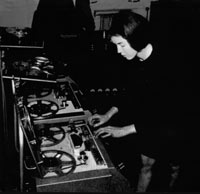
Also, a recently uncovered musical experiment by pioneering electronic musician Delia Derbyshire predicted the sound of modern dance music three decades before it became fashionable. [via]
7.16.2008
The Incomprehensible and the Forgotten
As I have been reading a lot of French and Latin American literature recently the issue of translations has been coming up, namely that it's often hard to know which translation of a foreign book to go for, and if you choose the wrong one you might be turned off from an author. In light of this, the Translators Association of the Society of Authors is celebrating their fiftieth year by compiling a list of the fifty best translation in the last fifty years. [via] While there are certainly some highlights on the list, some I've read and others I've been meaning to, I was disappointed to not find one of my favorite translators on the list, Stephen Mitchell, whose translations of Rainer Maria Rilke's works are some of the most breathtaking I have ever read. Equally masterful is Coleman Barks' translation of the spiritual poetry of Jalal al-Din Rumi.
Sometimes as an American it is easy to forget the difficulties that come in trying to get one's work read internationally. Beyond the barriers of communication there are also the challenges of time and space: dying before one's work is published, loosing it on a train... Here's a great article on forgotten and lost masterpieces that certainly got me drooling to think that one day someone might discover in a Polish attic Bruno Schulz's missing novel, The Messiah.
Sometimes as an American it is easy to forget the difficulties that come in trying to get one's work read internationally. Beyond the barriers of communication there are also the challenges of time and space: dying before one's work is published, loosing it on a train... Here's a great article on forgotten and lost masterpieces that certainly got me drooling to think that one day someone might discover in a Polish attic Bruno Schulz's missing novel, The Messiah.
7.11.2008
The Soundtracks of Leszek Jankowski
Over the past several weeks I have become obsessed with tracking down the music of Leszek (or Lech) Jankowski, particularly with the soundtracks he wrote for the animations of the Brother's Quay. While there are a few songs available on his website, and there is a link to download his soundtrack to The Street of Crocodiles, there is remarkably little else available from him online (and it seems that he has not yet released an album of his work). Of course there's the avant-jam album Kultikula he released with a group of Polish jazz musicians, but that sounds about like many other pick-up groups jamming out on a batch of acid, and is a far cry from the dream-like and discordant soundtrack to Rehearsals For Extinct Anatomies:
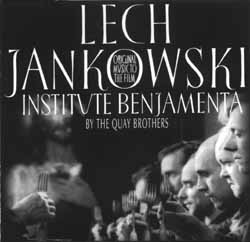
There's also vague torrents out there, but was no good link to his soundtrack to Institute Benjamenta, which was released on cd, but only in a very limited number.
I'm not quite sure what the best way of financially supporting Leszek might be, but it felt to me that since I find his music so brilliant that the best thing I could do was to make it more widely available. Enjoy and pass it on.
There's also vague torrents out there, but was no good link to his soundtrack to Institute Benjamenta, which was released on cd, but only in a very limited number.
I'm not quite sure what the best way of financially supporting Leszek might be, but it felt to me that since I find his music so brilliant that the best thing I could do was to make it more widely available. Enjoy and pass it on.
7.10.2008
Review: "Blindness" by José Saramago
By writing a book where all but one character has suddenly been struck blind, Saramago presents himself with several challenges of technique. It is impressive to see a story written where visual descriptions have so little meaning and the best way of explaining events is to refer to tangible objects, sounds, feelings. Also an interesting literary choice is that up till more than half way through the book the characters are all passively acted upon, generally in increasingly negative ways as they are locked in an insane asylum and subject to the worst instincts of humanity in distress. While both these techniques challenge more conventional ways of storytelling, the second in particular made it difficult for me to really give myself to the story. We are generally given characters who have some realm of action that we can root for, and the choice to limit the protagonists to cowering in their blindness seems to suggest a moral stance on modern life and human ability that I personally don't agree with. Added to this is Saramago's slow and considered voice, page long paragraphs, punctuated regularly with commas, which read almost more like poetry than prose. While it is a unique and masterful narrative voice it was also somewhat distracting from reading the story itself- the language never quite disappeared (a problem I've had with all the Saramago I've read so far). Nonetheless, Saramago knows how to write a brilliant and gripping tale, and once the inmates finally escaped I was bound, curious to find out if they would survive and if everyone would regain their sight...

Here's also Walter Benjamin's 1940 Survey of French Literature and the discovery of some of Kafka's missing papers [via].
In further literary news, Salmon Rushdie wins the all-time best of Booker prize.
Here's also Walter Benjamin's 1940 Survey of French Literature and the discovery of some of Kafka's missing papers [via].
In further literary news, Salmon Rushdie wins the all-time best of Booker prize.
7.09.2008
Interim
I apologize for the lack of posts recently, but I've been a bit consumed by my life. Beyond many personal challenges I've been going through this summer, which this isn't the space to get into, I've been working a lot more and pursuing my various creative outlets. After a year spent not playing music I've started working on some multi-instrument recordings using the handy Garageband, a bit of a cross of Sigur Ros, Bill Frisell, Dvorak, and Leszek Jankowski (most famous for his soundtracks to the films of the Brothers Quay). I have also begun teaching guitar lessons (thanks in part to the lesson plans on this site), which has been an interesting challenge so far, and is teaching me more about the instrument than I "actually knew" in my fifteen years playing. On top of this I have also been writing a hundred+ page personal history of my lifelong relationship to spiritual questions and practices, from Catholicism to the occult, anarchism to the I Ching, entheogens and yoga to mythology and dreams, from all of which I could say that one of my foundational beliefs has been that world views are (or can be) remarkably subjective and flexible. Perhaps more on this later.

Subscribe to:
Comments (Atom)

