Showing posts with label music. Show all posts

10.17.2009

Wild Things

Taking a break from such heavy cosmological topics as the Universe ending in heat death sooner than anticipated and a new translation of the Bible that shows God did not create heaven and earth but merely separate what was already there, Sophie and I went out last night to check out the opening night of Spike Jonze's adaptation of Maurice Sendak's Where the Wild Things Are. Despite reviews claiming the movie is too depressing or frightening we both found it highly charming, particularly the stellar acting of child-star Max Records, the intricate costumes from Jim Henson's Creature Shop, and upbeat soundtrack from the Yeah Yeah Yeah's Karen O [Found link, for preview purposes only, buy here]. It was interesting to note that the audience was primarily comprised of young adults, who probably were raised on Sendak's masterpiece and are perhaps the intended target demographic of Dave Egger's script (the whole movie really capturing the indie spirit of the times).


[Potential Spoilers Below]

The thing that really stuck out for me though was what this movie says about the human imagination. Despite our cultural love of monsters and fantasy, the imagination here is presented in its rawest or most primal. Shaggy monsters dance and tear up the woods and throw clods of dirt at each other. Everyone howls and growls. Certainly the monsters possess some amount of adult-like self-reflection (enough to come off as rather depressed), but no more than Max himself. In fact, one could take a psychological perspective that the monsters and their land are all projections of Max's own fears and desires, for friendship, against alienation and being young and misunderstood if not ignored.

But what is interesting was the choice of not stating whether the events of Max's journey really took place or not. The final return scene has no dialogue, so we aren't asked to chose with Max over what really happened, even if with all the day to night transitions he must have been gone for several weeks. This draws on elements of the Fantastic in art, that supernatural events are left ambiguous as to their reality. This is a necessary move because the audience, instead of being asked to decide what is real here, can instead suspend their disbelief and let the monsters be real. They are reflections of ourselves. Of course, this in turn adds more weight to what both Sophie and I decided was one of the pivotal scenes of the movie, when the monster Carrol rips the bird monster's arm off, and the camera focuses on a stream of sand spilling out. Up till this point, Max has taken the monsters as real, but they are shown to be not real, and he starts feeling the need of returning home to his flesh and blood family.

What this says for me is that despite how primal and raw we sometimes need to express our imaginations as children, this rawness sometimes tears holes in the stories we make up and tell ourselves, and shows us what is more importantly real in our lives. For another example, in a school scene at the beginning of the movie, Max is told that one day the sun is going to die, which when he tells the monsters makes them even more depressed and desperate (to tie this in with the links at the beginning of this entry). I think we are encouraged to equate those kinds of predictions of science with the imagination as well, as something that must ultimately give way to the reality of the present and the more immediate significance of our families and loves.

9.25.2008

Punk Rock and Irish Literature

The Sick Bag Of Cuchulainn

[from The Blog of Revelations]

The folks from the Edge08 festival invited a few of us up to Ballina recently to talk about how punk rock influenced Irish literature. That’s a big question. The short answer is ‘not enough’, but of course it’s a little more complicated than that. The corollary is that Irish literature influenced punk rock – or at least the Irish strain of the virus – a lot more than punk subsequently re-influenced modern Irish writing.

Irish punk bands and their new wave cousins swallowed Joyce, Beckett, Wilde and Flann O’Brien, chewed them up in a blender and spewed them back out in a great technicolour yawn. By contrast, modern Irish fiction writers, even the ones who treasured their copies of Never Mind The Bollocks and London Calling, seemed to be looking the other way when the punk stinkbomb let off. The influence is there, but in the most staggered and splintered way, a series of sporadically tossed pipe bombs rather than one big atomic bang.

Punk rock was a musical – some say cultural – revolution that happened in New York circa 1975, instigated by the Bowery bands who played Max’s Kansas City and CBGBs: The Ramones, Television, the Patti Smith Group, the Heartbreakers. Latter-day New York Dolls manager Malcolm McClaren caught the bug from Johnny Thunders and Richard Hell and passed it onto his charges the Sex Pistols a year later. But if the New York strain was an art movement conspired by misfits who’d never been to university, its English counterpart was more seditious. The Sex Pistols were the ultimate Oedipal act: ‘Anarchy In the UK’ attempted to kill the King; ‘God Save The Queen’ stuck it to her Majesty.

These were leery, sneering rebel songs played at high volume, sung by a London-Irish misfit with a wicked mouth and eyes like headlights. The Pistols were a horror show, and like the best horror shows they were conceived on a shoestring, with the production values of a snuff movie, and so their music felt scarily real. Never Mind The Bollocks ripped a fissure in reality through which could be glimpsed a whole new wave of horrors: The Clash, The Damned, The Buzzcocks, Siouxsie & the Banshees, the Dead Kennedys, Black Flag.

But despite the Year Zero propaganda, punk wasn’t conceived in a void. It was a mutant Eraserhead baby with many fathers: the 60s garage acts collected by Patti Smith Group guitarist Lenny Kaye on the Nuggets box set, Detroit’s Stooges and the MC5, the Velvet Underground and the New York Dolls, Alice Cooper, David Bowie and Roxy Music.

Punk lifted bits of its aesthetic from the Decadents, the Symbolists, the Modernists, the Lettrists, the Dada-ists and Surrealists and Situationists, from the Paris Communes and the 1968 riots. It was Un Chien Andalou and Howl and A Clockwork Orange and Catcher In the Rye. Its icons included Rimbaud, Genet, Beckett and Burroughs. It produced poets and writers like Patti Smith, Richard Hell, Jim Carroll and John Cooper Clark, artists like Raymond Pettibon and Ray Lowry, filmmakers like Don Letts, Julien Temple, Alex Cox and Mary Harron, was documented by journalists like Lester Bangs, Nick Kent, Tony Parsons and Julie Burchill, and inspired a hundred fanzines and indie labels.

But if punk began as an homogenous skinny whiteboy noise, it evolved with the speed of mutagen into something that transgressed genre. It refused to know its place, wouldn’t stay within the prescribed lines. It had the gall to speak in bad taste, to venerate energy and innovation over technique, to thieve from previously prohibited sources. By comparison with the old boys’ club of stadium rock acts, punk was multicultural, homo-friendly and equal opportunities.

It acknowledged Captain Beefheart and Neu and Can, ska and dub and street poets like Lynton Kwesi Johnson, and through The Clash’s appropriation of ghetto blaster chic, Grandmaster Flash & the Furious Five. When John Lydon teamed up with Afrika Bambaataa for the one-off single ‘World Destruction’ in 1984, it sounded like a replay of ‘Anarchy in The UK’ set in a New York dance club, and prophesised Public Enemy’s armagedddon effects, the smash and grab sample larceny of hip-hop.

Punk was, on the face of it, aggressively Modernist bordering on dystopian Futurist, even if many of its avatars were of the old guard. Pete Shelley was a Beckett fan. Joy Division channelled JG Ballard’s Atrocity Exhibition. The Clash co-opted Allen Ginsberg for Combat Rock. Martin Scorsese considered casting the Clash as a street gang in his earliest imaginings of Gangs of New York. Eraserhead’s Jack Nance looked like a member of Pere Ubu.

Burroughs was celebrated by the punk set at the Nova Convention in New York in 1978. Debbie Harry collaborated with HR Giger, appeared in Cronenberg’s Videodrome, and but for her management’s intervention might have secured Darryl Hannah’s part in Blade Runner. She and Chris Stein forged a friendship with William Gibson, chief visionary of the literary movement that would become termed ‘cyberpunk’, a new wave of streetwise noirish sci fi that proliferated in the early 80s, and whose Neuromancer mantra – “the street finds its own use for things” – could have been a neo-Situationist slogan.

“1977 seemed kind of like a roots moment,” Gibson said. “My take on it wasn’t that it was brand new nihilism, it was like a return to something that had been the real beginning of the ’60s but had been collectively forgotten. I had forgotten it to some extent myself.

“And it actually wasn’t so much the punk from England that did that for me, it was the stuff from New York that slightly predated what happened in London: Television and the first Patti Smith album. They were very consciously subversively retro in a really irony-free way, they seemed very, very sincere about it, and what I was seeing and hearing out of London was much more self-conscious material.

“Now, decades later, I know that Malcolm McClaren had been reading the Situationists, and the stuff from New York was somehow way less considered and in fact didn’t really go anywhere. Most of those people vanished or took too much heroin or wound up pumping gas, which is actually a more traditional fate for young artists at that time.”

Here in Ireland, punk did something unprecedented: it occurred in real time. Pre 1977, the future was on a five year sattelite delay. Ireland received its inklings of a brave new world via Radio Luxembourg. The country didn’t have a pop music station until 1979. But London and New York punk generated a direct current that jumpstarted The Radiators, The Boomtown Rats, U2, The Virgin Prunes, The Atrix, Stiff Little Fingers, the Outcasts, DC Nien, The Blades, The Undertones.

Except Irish punk acts were different. They resisted the Oedipal pose, acknowledged rather than erased history. On The Radiators’ second album Ghostown, Philip Chevron wrote about ‘Kitty Ricketts’, one of the prosititutes from the Nightown section of Ulysses. U2’s debut album Boy namechecked Dorian Gray and stole from William Goldman’s Lord Of The Flies, a sacred text shared by The Virgin Prunes. Gavin Friday took Wilde as his oracle on Each Man Kills The Thing He Loves. The Pogues’ brilliant, bawdy carnivalesque songs referenced Brendan Behan and James Clarence Mangan and James Stephens.

Nor did Irish punk bands necessarily disassociate from their musical predecessors. They were more likely to consult members of Horslips or Thin Lizzy for advice than badmouth them in the press, and if they didn’t exactly pay homage to Rory Gallagher and Van Morrison, they didn’t deny them either.

Van, always a contrary figure, started out with Them, a snotnosed Belfast R&B band who wrote the all time great garage staple ‘Gloria’, but he made his reputation with Astral Weeks, an emigrant’s recurring dream of an East Belfast demimonde populated by hustlers, heroin casualties and persecuted drag queens.

The songs had strong literary associations – the dirty old man obsessed with a thirteen year old schoolgirl in ‘Cypress Avenue’ could’ve been Nabokov’s Humbert Humbert; the tragic drag queen Madame George was straight out of Last Exit To Brooklyn by way of Tennessee Williams.

Like its weirder twin, the Velvet Underground & Nico, Astral Weeks was a seminal album dealing with adult themes of vice, mortality and deviance. And like the Velvets, its influence vastly overshadowed its sales. In time it came to occupy the same place in pop music as Joyce’s Ulysses does in literature.

But if Irish musicians were galvanised and inspired by the country’s literary history, its post-war writers were always in danger of being paralysed by the towering figures of Oscar Wilde, Brendan Behan, Sean O’ Casey, George Bernard Shaw, Samuel Beckett, Eugene O’ Neill – the litany invoked by by Kevin Rowland in Dexy’s Midnight Runners’ ‘Dance Stance’. To any young scribbler, such figures could seem as ancient and ominous as the Tuatha De Danaan, mythic beings, ten feet tall, casting shadows of influence in which few new forms could grow.

The revolutionary example of punk rock – and the free for all polyglot of styles and sounds that it permitted – did not find expression in an identifiable Irish literary movement akin to the Beats of ’50s New York, or Scotland’s Children of Albion Rovers in the 90s. Throughout the 1970s it seemed more furtive, more covert. There were secret meetings and small presses, cellar rendezvous and writers’ groups that numbered among their suspects Dermot Bolger, Neil Jordan, John Banville, Colm Toibin.

Punk’s impact on writers like Clash fan Roddy Doyle was manifest in form rather than content. His first novel The Commitments chose proletarian soul rather than white noise as its motif, although the book’s self-published DIY ethic, plus its use of sawn off rapid fire dialogue and Northside Dublin vernacular, was pure punk. Elsewhere, the cover of Boomtown Rats disciple Joe O’ Connor’s Cowboys and Indians featured a London postcard mohawk. Novelist and playwright Billy Roche started out as singer with The Roach Band, who combined Springsteen-ish smalltown visions with a the taut energy of Elvis Costello and Graham Parker; his first play A Handful of Stars climaxed with a James Cagney stand-off soundtracked by PiL’s ‘Rise’.

Despite these strobe flashes, Irish fiction seemed still preoccupied with trying to make sense of the grim and grey preceding decades – a landscape of domineering fathers, martyred mothers, ogre-like Christian Brothers, despotic priests, skeletons in family closets, valleys of squinting windows, incessant rainfall. Throughout the 1980s it operated under the influence of the late John McGahern, the big daddy of rainy realism, a writer many modern Irish novelists still feel compelled to define themselves in alliance with or opposition to.

Maybe the satellite delay was still in effect, because 1977 finally arrived in 1993, in the unholy form of Pat McCabe’s The Butcher Boy. Notwithstanding the fact that it was written in the late early 90s and set 30 years before, this was the first true Irish punk novel, the Never Mind The Bollocks of letters, and its impact on modern Irish fiction was analogous to that of Irvine Welsh’s Trainspotting on Scottish writing: an adrenaline jab to the heart. Pitched halfway between slapstick and horror, the tale of Francie Brady was a shocking but moving hybrid of Huckleberry Finn, A Clockwork Orange and Lord Of The Flies, and Pat McCabe became the dragon young upstarts had to slay – or at least sneak past – before they gained entry to the crypt.

“I remember reading The Butcher Boy and recognising something about small town Ireland, and the dialogue struck me as amazingly vivid,” says Mayo writer Mike McCormick. “I was really sickened, because I was about halfway through the writing of the Getting It In The Head when I read it. McCabe’s work was important, as was Roddy Doyle’s, in that it also allowed people to use popular culture, songs and comic books.”

McCormack is, as the old saw goes, a man out standing in his own field: in this case a wind-blasted pasture in a mythologised Co. Mayo where the natives veer between decent skinnery and intemperent religiosity, where speaking statues of the Sacred Virgin drive local women to apocalyptic ministry, where earthbound angels coast across bay waves the colour of hammered lead, where you can’t move but for masonry saints and shrines and visitations and plastic Jesuses luminescing day-glo green.

Both McCormack’s full-length novels Crowe’s Requiem (1998) and Notes From A Coma (2006) meld the fantastical and future-shocked with the local and parochial. If Pat McCabe’s feverish inner monologues trace the southern gothic bloodlines of Faulkner and O’Connor back to their Irish origins, McCormack’s yarns are rendered with a rigorous, almost Anglo-Irish formalism on a par with Patrick McGrath.

“I was asked to describe Notes From A Coma towards the ending of my writing of it,” McCormack recalls, “and I say this respectfully now the man is dead, and I respected his work hugely, but the book was like if you imagined John McGahern and Philip K Dick were contracted to write an episode of the X Files, this would be the result.”

This, I believe, is under-explored territory in Irish fiction. We’ve had books like Eoin McNamee’s Belfast noir classic Resurrection Man, Joe Ambrose’s squat culture dispatch Serious Time, Conor McPherson’s rewiring of ghost stories and strange tales for the modern depopulated rural Ireland, Julian Gough’s metafictional Jude trology, John Connolly’s Nocturnes, Claire Keegan’s tales from the county hell. But the literary chattering classes are still more likely to cite John Banville over Blade Runner.

Maybe writers like Roddy Doyle and Joe O’Connor and Colm Toibin confuse the argument when they produce their richest writing in the guise of stately historical novels like A Star Called Henry, Star Of the Sea and The Master. But imagine a climate where Irish writers, and, crucially, non-Irish writers resident here, co-opted punk’s refusal to observe protocol, where there’s no confining delineation between so called serious and popular literature, where language, theme, storytelling craft and imagination all co-exist.

The equivalent, maybe, of the generation of writers who’ve thrived in the realm of the slipstream, an umbrella term wide enough to encompass Michael Chabon, Jonathan Lethem, Kelly Link, Joe Hill, AM Homes, David Foster Wallace, Steven Hall, Jeffrey Eugenides, Dave Eggars, George Saunders, Katherine Dunne and Tom Spanbauer.

The compost theory of culture holds that what was once held as ‘low’ entertainment – gothic, southern gothic, pulp fiction, westerns, post-war noir, horror, magic realism, new journalism, the new wave of 60s sci-fi, EC and Marvel comics, tales from the crypt, performance poetry, graffitti art, graphic novels – gets turned to precious metal by the pressure of successive decades heaped on top of each other, until, at this end of the process, what was once derided as common has become retroactively transmuted into art.

Anybody feeling queasy here should note that Cormac McCarthy, maybe the most respected living American writer, has worked exclusively in genre for decades, be it the post-apocalyptic (The Road), modern noir, (No Country For Old Men), western (The Border Trilogy) horror masquerading as western (Blood Meridian) or southern gothic (Child of God, Outer Dark).

The Serious Fiction Factory, the Man Booker mill, seems a long way from the surreal, funny, hyperbolic, fantastical tales that reside in the national body of mythology, legend, folk tale, gothic yarns, murder ballads and outrageously tall tales. Celtic storytelling has always been by turns bawdy, mystical, absurdist, and prone to gross exagerration. The Midnight Court contained lusty couplets that’d make a sailor blush. The Song of Amergin was a visionary shape-shifter hymn. And there’s an account of Cuchulainn’s bersker fit in Thomas Kinsella’s translation of The Táin that reads like a live review of Iggy & the Stooges:

“The first warp-spasm seized Cuchulainn, and made him into a monstrous thing, hideous and shapeless, unheard of… His face and features became a red bowl: he sucked one eye so deep into his head that a wild crane couldn’t poke it onto his cheek out of the depths of his skull; the other eye fell out along his cheek.

“His mouth weirdly distorted: his cheek peeled back from his jaws until the gullet appeared, his lungs and liver flapped in his mouth and throat, his lower jaw struck the upper a lion-killing blow, and fiery flakes large as a ram’s fleece reached his mouth from his throat.

“His heart boomed loud in his breast like the baying of a watch-dog at its feed or the sound of a lion among bears. Malignant mists and spurts of fire – the torches of the Badb – flickered red in the vaporous clouds that rose boiling above his head, so fierce was his fury.”

Now that’s what I call punk rock.

7.18.2008

Amusica

Gil Alterovitz, a research fellow at Harvard Medical School, is developing a computer program that translates protein and gene expression into music. In his acoustic translation, harmony represents good health, and discord indicates disease. [via] Using data collected from a study of protein expression in colon cancer, Alterovitz analyzed more than three thousand related proteins involved in the disease. He found four key networks, using various genetic databases that catalog relationships between genes and proteins. He then assigned a note to each network, and together, these notes formed a harmonic chord. He compared the "music" of normal, healthy human data sets to that of the colon-cancer samples and found that, according to his model, colon cancer sounded "inharmonious."


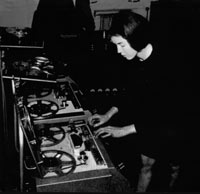
Also, a recently uncovered musical experiment by pioneering electronic musician Delia Derbyshire predicted the sound of modern dance music three decades before it became fashionable. [via]

7.11.2008

The Soundtracks of Leszek Jankowski

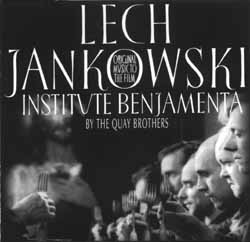
Over the past several weeks I have become obsessed with tracking down the music of Leszek (or Lech) Jankowski, particularly with the soundtracks he wrote for the animations of the Brother's Quay. While there are a few songs available on his website, and there is a link to download his soundtrack to The Street of Crocodiles, there is remarkably little else available from him online (and it seems that he has not yet released an album of his work). Of course there's the avant-jam album Kultikula he released with a group of Polish jazz musicians, but that sounds about like many other pick-up groups jamming out on a batch of acid, and is a far cry from the dream-like and discordant soundtrack to Rehearsals For Extinct Anatomies:


There's also vague torrents out there, but was no good link to his soundtrack to Institute Benjamenta, which was released on cd, but only in a very limited number.


I'm not quite sure what the best way of financially supporting Leszek might be, but it felt to me that since I find his music so brilliant that the best thing I could do was to make it more widely available. Enjoy and pass it on.

7.09.2008

Interim

I apologize for the lack of posts recently, but I've been a bit consumed by my life. Beyond many personal challenges I've been going through this summer, which this isn't the space to get into, I've been working a lot more and pursuing my various creative outlets. After a year spent not playing music I've started working on some multi-instrument recordings using the handy Garageband, a bit of a cross of Sigur Ros, Bill Frisell, Dvorak, and Leszek Jankowski (most famous for his soundtracks to the films of the Brothers Quay). I have also begun teaching guitar lessons (thanks in part to the lesson plans on this site), which has been an interesting challenge so far, and is teaching me more about the instrument than I "actually knew" in my fifteen years playing. On top of this I have also been writing a hundred+ page personal history of my lifelong relationship to spiritual questions and practices, from Catholicism to the occult, anarchism to the I Ching, entheogens and yoga to mythology and dreams, from all of which I could say that one of my foundational beliefs has been that world views are (or can be) remarkably subjective and flexible. Perhaps more on this later.

5.31.2008

Pittsburgh Cultural Thrust

I realize that I post very little here about my personal life/ activities, mainly because I've been spending the last couple months laying low, reading, writing, working and little else, which most of the time is really all I need to be doing. This weekend however proved to be different, we went out of the house not just once but several times to enjoy some of the cultural highlights of Pittsburgh.

On Thursday night, after going to a friend's birthday party in a swank storefront apartment in the up and coming Lawrenceville, we jetted up to the Shadow Lounge to see Nikki Allen read some poetry for the release of her new chapbook, "Quite Like Yes." While the poets kept their sets somewhat short, plagued by migraines and excessive drunkenness, the evening was stolen by Landmonster!, who ranted obsessively absurd phrases over pre-sampled Casio beats while wearing space pajamas and a Mardi Gras mask.

The next day we went down to the museum to check out the 55th Carnegie International exhibit, which for the first time was given a title, "Life on Mars," prompting the artists to look at what at means to be human from an outsider perspective. There has apparently been a lot of critique over this move, as well as the inclusion of certain artists whose work may not measure up to the "standards" of the Carnegie Museum. I thought some of the work was fantastic and, like any museum exhibit, there were certain artists who just didn't do it for me. Most impressive were Thomas Hirschorn's Cavemanman, a packing tape and media image labyrinth; Cao Fei's Whose Utopia, a film of a fairy-tale ballet in a Chinese light-bulb factory, and Friedrich Kunath's whimsically bittersweet paintings.


Afterwards we walked over to the Carnegie Library of Pittsburgh, which unfortunately I rarely visit (since I prefer collecting books), but was pleased to find they have an extensive music and film section, including drawers full of classical symphonies, which, despite mainly being in the public domain, are almost impossible to find on the internet.

Tonight happens to be our second anniversary (of the day Sophie and I met at the Quiet Storm), and so to celebrate we're planning to continue our hunt of good Thai restaurants in Pittsburgh with Sweet Basil and La Filipiniana (last week it was the stellar Smiling Banana Leaf). And then we will eat a decadent cake while playing Super Scrabble, which for a couple of real homebody bookworms like us (unlike people who only pretend to read [via]) is really the perfect evening.

And just to throw in a couple things about the rest of the world, one of the last un-contacted tribes was discovered in the Amazon, who brandished notched arrows at the plane taking pictures at them which (according to the article) they must have thought was "a spirit or a large bird." Of course, it may also have been one of these new luxury aircraft hotels in the shape of a large white whale [via].

2.20.2008

The Angel as Absent Narrative: Wim Wenders' "Wings of Desire"

Last night Sophie and I watched a movie about an angel that falls in love with a human woman. From the title, "Wings of Desire," I thought that it might be a piece of romantic schlock, but I was quite surprised to watch what is undoubtedly a cinematic masterpiece. Set in Berlin in 1987, this movie is shot in a stark black and white that is reminiscent of early silent films. The "plot" focuses on a group of invisible angels wearing beat up trench coats who live in a public library and spend their time listening in on and sharing with each other the thoughts of the humans around them. One of these angels, in his wanderings around Berlin, discovers a circus and falls in love with the trapeze artist, a woman wearing chicken-feather wings whose thoughts are constantly filled with existential angst, and decides that he wants to become human in order to understand what it is actually like to feel, touch, live. Along the way we meet a comic film star who is an ex-angel, and an archangel who ruminates on the dying art of storytelling while searching for neighborhoods that were destroyed in the war.


Besides these and other revealing scenes, including the final meeting between the angel and the girl at a goth club where Nick Cave and the Badseeds are performing (!), the movie was made more poignant through the director's commentary, which to our delight revealed that the movie was conceived during a period in which Wim Wenders was reading Rilke's poetry every day as the ultimate expression of German Romanticism. What was really interesting though was that the whole movie was shot without a script, using a series of existential monologues, which mirrored one of the primary points of the movie: that the angels were absent from reality and the flow of time. Though they were able to look into the flow of humanity from their eternal vantage point, they could only experience this life second hand, and that in order to be part of the narrative of history they had to enter into time, into human emotions, bodily concerns, etc., raising the question of how much we humans are really a part of our own narratives. Are we responsible for our lives or just living out the stories that have been woven for us in our thoughts?

12.18.2007

Magic Chords

Taking a break from working on my dream novel, I was trying to catch up on the internet, and decided that I haven't written much under the topics of magic, music, and ritual. These three modalities often go hand in hand, and Dr. Clothey even suggested that it would be interesting for someone to look closer at the intersection of music and religion.

Music and performance in the modern world often take on highly ritual aspects, a charged atmosphere, the priestly musicians encanting powerful rhythms that effect the audience on a deep physiological level. From the reunion of Led Zeppelin a band charged with magical iconography and Crowleyan flair, to a description of watching someone play Guitar Hero as a spiritual experience, people are often caught up in what seems to be the sheer mysticism of music. Certainly rhythms have pervaded ritualizing throughout history, and the act of playing music can seem to transcend time, but it is the effect on the listener that holds the most magic and mystery, whether as a cue for emotional catharsis, ecstatic dancing, social communitas or revolution. Woodstock and the Beatles, punk rock as a determining factor in culture, spilling far beyond the edge of the stage. No one knows quite how the tension caused by the dissonance and resolution of vibrating air molecules can have such profound effects, even to the point of certain chord patterns like the tritone being cast as unholy, and countless stories arising of songs being taught by the devil (from Tartini to Robert Johnson). In my dreams the devil plays the violin, and I am a priest in a rock and roll cathedral.

From my years of experience playing music to packed crowds, I can say that it was always somewhat breathtaking to be able to cast such swaying spells over so many people with just the movement of fingers on a guitar, to see everyone break into song on the chorus and afterwards spill into the streets still singing into the night. Even the act of playing with other people, regardless of an audience, is ritualistic in itself, the way that musicians jamming together will stumble upon a song, and suddenly find themselves transported, carried on waves of sound that seem to come from a much deeper place, where it is not the musicians writing the song, but riding it, the music a great beast writhing to its own rhythm for all eternity that we can just tap into sometimes, like the ancient alchemists debating the harmonic song of the spheres. Talk about a reaffirmation and transcendence of the self, or better yet, sing.

As music guru David Byrne suggests in a discussion of the future of music with Radiohead frontman Thom Yorke, "You create a community with music, not just at concerts but by talking about it with your friends," and in his survival guide for emerging artists, "in the past, music was something you heard and experienced — it was as much a social event as a purely musical one. Before recording technology existed, you could not separate music from its social context. Epic songs and ballads, troubadours, courtly entertainments, church music, shamanic chants, pub sing-alongs, ceremonial music, military music, dance music — it was pretty much all tied to specific social functions. It was communal and often utilitarian. You couldn't take it home, copy it, sell it as a commodity (except as sheet music, but that's not music), or even hear it again. Music was an experience, intimately married to your life. You could pay to hear music, but after you did, it was over, gone — a memory."

10.15.2007

All You Need Is Love

The other night Sophie and I went to go see the new movie "Across the Universe," a love story set in the turbulence of the 60s and narrated through the songs of the Beatles. Though the use of visual overlays in some scenes was a little cheesy, the selection of songs was impressive, and for most of the flick I was close to tears, which I will admit takes a really good movie to bring me to.

The movie also brought up my interest of looking for modern mythemes, as the Beatles' cultural influence has been coming up recently each time I play them at work. The Beatles clearly represent one of the largest modern set of culture heroes, especially in the 60s. Not to downplay the works and influence of Leary, Kesey, et al., but the Beatles' popularity and rise to fame had a dramatic effect on American youth, and was perhaps paradigmatic of the ideals of that generation. That four "lads from Liverpool" could rise to international stardom not only exemplary of the American mytheme of 'rags to riches,' but may also have created that mythic idea of bands "making it" from humble, anonymous beginnings, certainly not an easy task, as any musician can tell you. Not only that, but the Beatles' whole aesthetic, politics, etc. had deep repercussions on fashion, social consciousness, and, though maybe not an enormously positive effect depending on your stance, the use of mind-altering substances. When the Beatles began experimenting with psychedelics, when they went to India to learn transcendental meditation and incorporated such Asiatic sounds and styles in their own feel, they took American youth along for the ride. How many peace activists may have been moved to non-violent protest after hearing "You Say You Want a Revolution?" Of course, it's hard to say whether the Beatles caused these changes themselves, or were just the most visible public figures riding the waves of social change, but as they were such figureheads, their actions fed-back on culture, became an example of what was possible in the world. That it was possible for a "small group of dedicated individuals"(to quote Margaret Meed) to sing "All You Need Is Love," and mean that enough to make a difference.

As Mircea Eliade and Charles Long both discuss, new myths and hierophanies come into affect by being truer 'over against' older, worn out social and sacred realities, and many were tired of the social staidness of the post-World War fifties. Whose to say that a hundred, a thousand years from now the Beatles might not be mythologized as the Heroes who through the magic of song defeated the demons of war, social mores, etc.? If they are not already attributed with these epic victories. Perhaps the only other band who comes close to this role, for me at least, was Crass, whose political stance against the Thatcher administration, and rejection of the colorful, commodified punk look of the 70s I suspect became the model for the resurgence of Anarchism asa valid modern youth movement in these decades following the 80s. But this influence is more contestable than that of the Beatles, whose sheer legacy of hits and continued mass appeal assures their heroic place in the cultural imagination.

Ironically, it was precisely this inordinate mass appeal that turned me off from the Beatles' music for a long time. My parents had been hippies back in the 60s and I vividly recall my father playing both "Rocky Raccoon" and "Cry, Baby, Cry" to us on his guitar when we were children. Though from my childhood intimately familiar with most of their material, I always associated it first as "something my parents listened to," and then with all the stoned, tie-dye clad hippies I knew in high school, as being just too weak and feel-goody, in contrast to the aggressive and directly political music I was listening to then. It wasn't until many years later, after performing in many bands and intentionally broadening my musical horizons to anything remotely influential, that I realized how effective the Beatles' music really was. Even on just a compositional level they still blow away any other rock/pop band before or since. Not to mention the effect those songs had in helping shape the beliefs of an entire generation, and many of the generations since. No overtly political punk band can boast to having such a deep effect on culture, not by directly singing about what they were against, but by singing about love, and coming together.

The Beatles continue to be the biggest selling band of all time, with movies, toys, and even a circus show in Las Vegas dedicated to their legacy. Despite this commodification, the reason why they continue to serve as an paradigm is that their music was just that good, and still speaks with just as strong a voice these forty years later.

8.14.2007

emergent narratives

"Emergent narrative? Can there be such a thing as a narrative that emerges, by itself, from a seemingly random or chaotic structure or series of events? The way forms, fractal shapes and complex structures arise out of certain kinds of chaos. Are there “forms” — narrative cells I guess you could call them — that in sufficient quantity spontaneously give rise to what we call stories? If the existence of these things is possible then perhaps emotionally moving arcs, transformations and series of events could simply emerge by themselves given the right conditions — and could those conditions sometimes be man-made?"

from an article on interactive video games vs. narrative storytelling in David Byrne's blog (7.21.07)

My response is, of course, a resounding "Yes," having spent the last five years tracking out a narrative that has emerged from my own dreams. It is all in the power of the human mind to form connections.

9.21.2006

restless folk arcana

Ill-lit by xmas lights, no one notices a shabby figure warming up his pump organ, mashing the chords like it's 1885 and you're strolling restless on a boardwalk at coney island. in no hurry he sets a sampler to carry a a few sparse notes, kills the lights, and pulling out an old diver's lamp begins creating his world. out of a box comes a red and black striped carnival barker's jacket, and a faded parasol protecting the organ from the dark. out of a decrepit traveling chest comes a paper mache head, followed by hands, one covering the mouth, one pointing still into the dark of the box. from another chest comes more lamps, colored gels, a miniature record player, the atmosphere of a winsor mccay comic. with care he places them just so, and casually picks up a trumpet to accompany the procedures in small plaintive squawks. and then a tiny case with a tiny chair reverently deposited on the turntable, a tiny man even more reverently set on the chair, which begins to spin as the boardwalk descends into some dark jangley rhythm from your dreams. the jerk and start of sine wave switches all one-handed with organ and trumpet key saloon songs like some old-timey analog sequencer. he's telling a story, about his father and 4000 year old finubulae. questions accosted by the melody. and back to the boardwalk for a last stroll into the crooked sunset.

followed by a punk cowgirl singing a sad ukulele in front of old twenties' silent films, keaton and chaplin, journey to the moon; and my favorite 22nd century blues singer rocking caveman songs to scrambled porn.

7.04.2006

skipping tracks of territory

Behind the box drab rowhouses, the stoplights and straight streets, a road winds down beneath the bridge. taken back by nature, kudzu and trees covering the hillsides and we're not in the city anymore. some kids sit howling on the crumbling steps, a last bastion of civilized life. and down, past the graffiti and gates, down to the tracks were minutes before a train went screaming by. it is dark except for distant streetlamps on the busway, and the fireflies swarming in the green, innumerable fairies or magic lanterns hung. soon you can hear movement, people, vagabonds and outlaws sitting on the tracks, tuning up instruments, sharing the stories of the day and a jug of whisky while swatting off mesquitos and slight paranoia of getting caught, dogs running around sniffing everything and even a family with a stroller. soon one of them begins to sing to the clapping of hands, an old timey folk balad sound with yum diddly ayes and sweet warble and wrapping back time to the contents of this modern life. and guitars, and the hoedown; bass, banjo, fiddle, spoons, mouthharp, harmonies and hallelujahs in their natural environment, and the lightning coming in fast. the kids getting drunk on moments of freedom, in forgotten spaces of true autonomy, we did this together, singing to the one still star and the wide open night where anything's possible. and the wind picks up as the music continues and the baby's started to fall asleep.

"Train!" someone yells, and with that the tracks are cleared, everyone diving into the bushes while one drunk stands defiant against the onrushing light, only to be pulled off quick but still reach out and slap the train as it passes, the expectation of loud roaring thunder and cheers. but it stops. uncertain moments. and everyone takes off running, diving up through the brambles, back towards the tunnel, ahead, afraid, have they already called the cops? walking past the conductor steps out, more concerned than angry, "is everyone okay? i thought i heard something hit." "we're fine, and all accounted for." laughing and running. "what happened?" "nothing, nothing, sorry to stop your schedule, but we're going now." punks running off into the night, and onboard the passengers look around in confusion. one of them, older and tattooed, sees our stream of unruly and begins making cheering fists and signs of success, as if our interruption saved him from the monotony of the journey. as if he'd rather be out here with us and stopping the trains with song. "alright, next year remember, we got to wrap it up before 2:20 so we don't." but how else could the evening have ended?

5.11.2006

velvetine radicals

up late researching the history of Chezk literature and poetry I stumbled across a fascinating bit of rock and roll history: The Plastic People of the Universe.

Influenced heavily by early Velvet Underground and Frank Zappa, and sounding like a precursor to such modern groups like Guts Pie Earshot, !!!, and most industrial music, the PPU were the driving force of the Chezk underground in the late 60's-80's when the communist regime was pushing their campaign of normalization. Though they didn't have a specifically political agenda, they refused to fit in to the standards for performers and ended up playing underground barn shows for thousands until they were all arrested for disturbing the peace in '76. This is where things get interesting: these arrests are said to have led playwrite Vaclav Havel to pen the Charter 77, the main opposition to communist rule that eventually led to the Velvet Revolution in 89 and the overthrowing of communist power in the Chezk Republic.

Despite not being activists, here is an incredible example of music becoming a force for social change, the name of the revolution itself harking back to the Velvet Underground, who represented to the members of the Plastic People all that was right and unique in rock and roll. Despite the fact that the "underground" in New York in the 70's had nothing to do with political oppression, that spirit of rejecting normalcy and pushing the arts to new edges carried through to the Chezk people and gave them the courage to reject the stifling influence of the communist regime. Of course, once the Iron Curtain was dropped, and the emigre' writer's books were finally sold in their native country again, the anger and intensity that had fueled the arts scene almost completely died out, and in some articles I've read from recent Chezk musicians they almost wished they were living back under communist rule so there would be something to inspire them to create art against.

I also went to see the Dada exhibit at the National Gallery yesterday (odd to see such art up on gallery walls), and was struck that what fueled these artists, besides a desire to be doing their own thing, was the horror and absurdity of World War I. That their art was the only way for them to express their outrage and fear at what was going on in the world around them. The collage, scrap art and military aesthetic of their art later went on to shape the aesthetics of punk, the feminist collages of Hannah Höch being the almost direct precursor of the work of Crass artist Gee Vaucher, Crass being another rock band that had a vast political impact, during their time singing out against the Falklands War and Margaret Thatcher's regime in 80's England, but also (in my opinion) as the main reason anarchism and hard politics got integrated into rock music as a youth movement, making them responsible for the current anti-globalization movement.

The irony being that despite the continuation of the Iraq war and the tightening civil rights at home, most modern american musicians and artists don't seem all that oppressed or horrified by what's going on in the world enough to make a really clear statement against it, or if they do, such messages have been heard so many times before that they don't stand apart from the spectacle to make any sort of real impact on it, and even punk is distancing itself from an explicit political message, as if that was so last century. it's not like anyone's telling them that if they don't confirm they will not be allowed to continue playing.

4.09.2006

Richard Hell says:

on the self:

"All that "growing up" means is that if you are lucky you learn how to better cope with who you are - who you are doesn't change. In fact, that is probably the very definition of who one is- that which doesn't change. Living and identity are a kind of artform. You have this material- yourself- and the challenge is to explore or present it, to find a language or style for its display, its manifestation, that correspond to and are suited to tracking its nature. Anything seen in its fullness is beautiful. Or that's the only hope we have anyway."

on music:

"The power of music- what it gives you and does to you, where it takes you- seems impossible, like sorcery or subatomic physics, considering its simplicity. It's like the sun; and then the moon. How does it do that? I guess it must have something to do with the way music comes to you, you don't need to go at it the way you do with words. Then it encompasses, more dimensional even than light, instantly, and not by force but sympathy. It changes everything. And songs: The series and combinations of notes and how they are played and the nature of the instrument producing them, those sounds, are direct emotion itself; unlikely as it seems that that could be, there's a pure correspondence, you could probably analyze it like a scientist, and something in the design is in fact mathematical, giving you purely abstract pleasure too, and then that's all mixed with the possibilities of the message and purposes of the words, and the rhythm physically taking and compelling you, the whole mess shooting all around bruised and popping and breathing, threatening and begging, projected in miniscule waves that carom and vibrate so you literally move inside it and are penetrated by it. And that doesn't even touch on the appeal of a given person's voice and how it is a friend or not, or a sex thing, or an oracle, smart, sweet, honest, or angry or tough- all the character that's carried in a voice exposed to where it gives you something you get nowhere but your most intimate intense relationships. It seems amazingly good of them to do this for us.
-And it can be produced by one person holding a guitar. And you can have it all and all the different kinds for a few dollars worth of tape and a cassette player. Push a button and there it is."

4.02.2006

scene and veneration

[Published by Encyclopedia Destructica]

David's dead. her voice has taken on an edge of older and I know it's never going back. he's been fading for awhile and just sort of faded away all together. We all thought he'd die years ago, that all the drugs would finally kill him. Maybe they still did. At least he didn't overdose. I'm so sorry mom, how are you handling this? I'm... I'm okay. I miss my brother. It's okay that he's dead, you know? What hurts is not having him around anymore. The funeral's saturday if you can come down for that, but if not, I understand. I hope you're doing okay, I know you always are.

Yeah, I'm okay. history just slipped a little bit, but it does that. I remember watching David play guitar, his arm was broken then, or his spirit, and he was just coming out of one rehab program before the binge that would really knock him down. I don't even know what his fix was anymore. Coke, booze, weed, life? It doesn't matter. I was young and mesmerized by his fingers plucking away at the nylon strings and thought to myself, I can do that. I got my first guitar that next birthday, but I never got to play it for him. Though I guess, every time I play, it's for him. Because I'm still young and full of life and not crushed by drugs and society. refuse to die under the thumb. God it must have been hard being one of the true hippies and seeing the world set up to fulfill all your dreams of love and peace and happy endings and then to have it crash down into modern capitalism and war machines, punk rock the funeral dirge to the age of light, the clarion call to the apocalypse.

The house is filling up slowly, and Matty's getting anxious that we should play before it gets too late and the neighbors consider calling the cops. Stacking up amps inside the small garage and a rudimentary sound check nervous shifting. I played some pinball earlier to work up my endorphins and was ready as I'd ever be. Always ready. You can't second guess just getting up there. I didn't cut off a finger at work, and the cops drove by without stopping, so nothing can stop it now. So they pack in and we tear into it offkilter and hesitant, by the third song have built up enough momentum to really rock out. slow building blues. reality ends in the feedback and I'm floating through it, burning the high notes and banging my head off the carpet. Ecstasy. Nothing else matters. all the politics and evasions. love, dreams, highs, heartbreaks, anyone. I succumb and music rides me.

Afterwards Spat says, well, your band's official, but I can't answer. playing out hits harder than any hallucinogen and language makes no more sense. I'm riding off the coffee and alcohol and smoke, standing by the keg with no clue how anyone can just stand there and talk. Dana curls up that was incredible. all I can do is smile and nod and give myself to the evening. The more people there are at a party the less I can talk to any of them. Not antisocial, but overwhelmed, sensory integration dysfunction acting up again, all the talk just builds around me, every conversation happening at once, blurs into the chirping of birds and a general howling. who needs drugs when sensation is already so immediate? I drink anyway and run back into the garage to dance to Fangs of the Panda, my whole body following Mike's fingers on the strings, making sure they play their Eno cover for the few who actually care to listen at this point.

get swept inside between sets, all the punks and posturing. Too much stimulation. This has all happened countless times before in different variations of frivolity. Lay on Lorraine's bed with Dana and Joy in my arms. Continue the obliteration. Brad has set up his lights up in Lacy's room and is documenting the evening in portrait shot shoutouts. I drag Dana up there for a shot, but she's nervous until Nikki says I hate it when beautiful people won't get their picture taken. we pose, she asks me to kiss her on the cheek. Then Nikki and I grab Carry and Joe and we do some band photos, laughing and thuggish and that was the shot. the memory of the times. no matter what happens, where this band goes where we go, we can look back at this photo and say we were there. Two shows under the belt and ready to take on the world. always ready to take it on.

Pony Pants takes it on, rearing up in the backlights and shaking the floorboards. Lorraine grabs me, there you are, now get over here and do your thing. get over here and dance. I dance. It's the next best thing to playing. Riding the soundwaves shaking out the soul. I think of that Dead Milkmen lyric "you dance to anything." I do, if there's a shred of passion and a solid rhythm. It's either that or be bored and critical of everything, and where does that get you? I wander out, ruing the needs of the bladder and belly, and end up upstairs heckling the snotty young punks to front for the camera. Stop to consider, I've accomplished everything and can barely stand up. Looks like it's time to go home.

But not yet. Alexis calls, she was there earlier but I was so swept in the music and madness to pay much attention. she wants to come pick me up. let me do this? I feel bad about how I treated you the other day and I think if I come get you we can go lay down together and be quiet and you'll understand. I say no. but why? because I want to go home and puke and pass out. by myself. but why? she whines and keeps repeating that line, like banging your head off a wall will change your opinions. Insanity is doing the same thing over and over again and expecting different results. aren't you supposed to get over that when you're young? what is wrong with society? I remain adamant. Why? because that's what I want. But I don't think you know what you want. That does it. Where do these people come from? My imagination. Listen, don't tell me I don't know what I want, this is what I want. I know you want me to bow to your will, but I won't. Just days ago you told me you wanted to destroy me, and maybe that was just the solar eclipse or your fears talking, but you tried and I came out of it stronger then ever and knowing just what makes me happy and keeps me going, and if I go with you now that will really destroy all that. So no. I don't particularly like being set on fire ...but why? back to square one. I don't think you're listening here. I'm sorry but that's it. why why why?

click.

the word still echoes after the connection's severed. it's written on everyone's faces buzzing in the drunk haze. that's it, that's the horror, the sucking, the eternal need to find satisfaction. that hollow spot in the gut that nothing quite fills, no drug love toy, money memory or civilization. all the need to not feel empty and alone. what's your fix? does it fall flat? look around and all the needs pulling everyone from their bellies into the howling, stuck in the grooves of the record the scratched habits of our parents. we are here partying against the night, decadence dancing on the edge, the end of all meaning all future. this is all there is left. A crumbled masque binging itself into oblivion. I laugh and step out the door.

The alley is unbearably quiet after all the noise. I adjust and there are birds in it, the call of the jungle, the faint rushing of traffic like a distant river, peace. I sway in it, stumble up against someone's steps and breathe for a bit, wondering if I could bottle up that feeling and drink it whenever I forget the simple beauties of just being here. yesterday's rainbow made the front page like it was the most important news to report. for a moment it seemed like everything was right and made sense. bear up and throw on some mental armor for the main drag, but it's empty too. all the dealers caught wind of the major bust about to go down up here. all the cops and cameras around and it's scary to walk on the street anymore. if you have something to hide or hold onto. i have nothing but my drunken feet and a big grin. so what if they stopped me nights ago and told me if I didn't want any trouble I'd get off the street? so what if I'm white in the wrong part of town? This is my home too. my streets, my city, my life. You can't be guilty for existing. You can't let them make you live in fear. It's a power struggle, and if you accept the game, you've already lost and have to fill your needs in all the prescribed options and opinions. That's what ultimately defeated my uncle. the fear just builds up and builds up and if you don't get it out of your guts however possible it will reach up through them and strangle you. he sold his guitar to buy a bag some year past, and the rest was just inevitable fading. it's always the end of the world for someone.

I know I can't pass out until I get it out of my system. I know I'm not satisfied with my day unless I look all my fears in the face and laugh. that's why I continually put myself in these impossible situations. There are rituals for this sort of thing. writing, playing guitar, howling at the moon, running forever in the streetlights. tonight I pray to the porcelain and with a quick finger flick let out all the poisons until the world stops spinning and settles with heads up. What did I accomplish? I lived. and will live again tomorrow and the next till there are no more tomorrows left. the specific events just garnish that feeling. I lived.

end of record. the faint center scritching soothes me to sleep.

9.09.2005

heroes underground

"The great heroes, the mythic heroes of our times are going to be the rock and roll musicians and the dealers... you know you're on the right track in the pursuit of freedom and ecstatic pleasure and God if you're in trouble with the law, and if you're not you have to worry a little bit."

-Timothy Leary, from The Delicious Grace of Moving One's Hand

7.31.2005

a choir

I awoke to church bells and singing next door: "If you believe in yourself, if you believe in yourself, never look down again."