Showing posts with label surreal. Show all posts

12.01.2009

Liber Novus: first impression of Jung's Red Book

I couldn't sleep last night, as inspired as I was having begun to read Carl Jung's Liber Novus, his "Red Book." My first impression is that this is a massive tome; at 16x12x2'' it is easily the largest book I've ever laid hand on, and just turning the pages takes a substantial effort. But it's well worth it.


The Liber Novus is Jung's account of his decades long process of psychological and subconscious self experimentation, through a technique called "active imagination;" a process that he claimed was the seeds to all his work. Written first in a series of Black Books, this masterpiece was later painstakingly copied into a red leather-bound book, though never finished. And by copy I mean create an entire illuminated manuscript, complete with exquisite calligraphy and full color mandala and dream illustrations, that Jung worked on till his fascination with alchemy took hold, and then sat in a box until long after he died.

This first edition presents not just a translation of the text (by Jung scholar Sonu Shamdasani), but a full facsimile of the original folio plates, which have been kept in a safe deposit box unlooked at for the last 80 years and so are in excellent condition. The edition also includes critical apparatuses; a historical essay to contextualize the significance of the Liber Novus in Jung's life and work (and was the main thrust to convince the Society for the Heirs of Jung to finally let the book be published), as well as paratextual citations to highlight the variety of references in the manuscript itself, which should make the read that much more insightful.

Flipping through the folio I was struck by the richness of the illustrations, some of which I would consider masterpieces in themselves, filled with fractals, swirling colors, archetypal situations, and a surreal dream-sense that was apparently under-appreciated by the Surrealists. The calligraphy is in German, which I unfortunately don't speak, and can only comment on the precise appearance of.

As for the text itself, that will be my next attempt. I will say that it begins with the title: "The way of what is to come," along with some prophetic quotations from Isaiah, and much of it is in dialogue form between Jung and his spirit guide (in the tradition of Mephistopheles), placing the work as a modern take of the tradition of revelatory literature, which isn't so far off considering the inclusion of Jung's dreams prophesying the World Wars.

On the whole, the book seems to be Jung's attempt to reconcile the scientific with the mythic and spiritual, the personal with collective, and as such could not be more timely than to finally see the light of people's eyes. As a writer interested in the use of dreams and personal narratives, as well as having taken this process to my own experimental, revelatory, self-mythology and understand the danger of attempting vs. the incredibly potent imagery that can come out of such a process, I suspect the Liber Novus may have far reaching cultural effects that we could only begin to imagine.

9.17.2009

The Surreal Improves Learning and Pattern Recognition

According to boingboing, "new research suggest that exposure to bizarre, surreal storylines such as Kafka's "The Country Doctor" can improve learning. Apparently, when your brain is presented with total absurdity or nonsense, it will work extra hard to find structure elsewhere. In the study by the University of British Columbia psychologists, subjects read The Country Doctor and then took a test where they had to identify patterns in strings of letters. They performed much better than the control group.


"In a second study, the same results were evident among people who were led to feel alienated about themselves as they considered how their past actions were often contradictory. "You get the same pattern of effects whether you're reading Kafka or experiencing a breakdown in your sense of identity," Proulx explained. "People feel uncomfortable when their expected associations are violated, and that creates an unconscious desire to make sense of their surroundings. That feeling of discomfort may come from a surreal story, or from contemplating their own contradictory behaviors, but either way, people want to get rid of it. So they're motivated to learn new patterns."


This study intrigues me and ties in with my thoughts about the use of surreal, magically-real, or dreamstate experiences both in art and reality. The way I tried to express it before is that non-real events create a category error in the way we perceive reality, thus requiring us to recheck our assumptions and patterns about what reality is. That being the case, the non- or supra-real can sometimes better get at what reality is like, because they sidestep the pitfalls and limitations of language and our basic assumption that the thing said is really the thing itself.

This also relates to all the current research on the link between creative genius and mental illness, in that people genetically predisposed towards perceiving the world as a fragmented and bizarre thing have to do that much more work to learn to put it together again, which, having schizophrenic and bipolar tendencies run in my family I can attest to seeing first hand.

5.26.2009

Paprika, by Yasutaka Tsutsui

This is also exciting: Made it into an incredible animated feature by Satoshi Kon in 2006 that I longed to read the original of, Paprika, the surrealist dream/detective novel By Yasutaka Tsutsui, is finally being released in English translation!

"The setting is Tokyo's Institute for Psychiatric Research. Major breakthroughs are taking place, using new machines which access the minds of sleeping patients. A couple of top psychoanalysts are in line for the Nobel Prize for this revolutionary innovation. One is the young and beautiful Atsuko Chiba, who uses the equipment at night to cure some of Tokyo's leading citizens of mental trauma. Atsuko has to be discreet because there are strict restrictions upon the machines, so she disguises herself as an alter ego – the eponymous Paprika. Unfortunately, back at the Institute the machines are being misused by her enemies on the staff, and the most powerful versions have gone missing."

[Edit: Of course it only seems to be available in the UK so far, and they won't ship stateside...]

5.24.2009

Manifestoes from Beyond the Real

Artists from all times have attempted to escape or transcend the constraints they saw in the culturally constructed realities in which they found themselves, often through the penning of manifestoes as statements of purpose for the new realities they wanted to instead create. I have also often struggled with this desperation against the day, in this age against the quotidian, the snarky, the postmodern, the realism that is "just this," when clearly there is so much more to living that can not be contained by pale reiterations of last century's visionaries whose words and worlds no longer apply, at the edge of the future, the crumbling edge of what may be left for us, the necessity of human survival let alone all the possibilities of the imagination, which are vast and untapped except by scattered madmen and genre writers. Despite the beauty of the manifestoes given below though, I have been trying to formulate a new perspective, not against reality or realism, because obviously we do live in the real world, if a limited constructed one, but a sense of reality that contains all that, all the horror and wonder, all the magic, dreams, the future, alternative histories and galactic alignments with the stars spiraling out of all expected orbits, the sense that every day, every moment, is an ultimate moment, reality being pushed to the furthest edges of where we have been, with the realization that we are only now barely learning just how far and fantastic we can go.


"The Transrealist writes about immediate perceptions in a fantastic way. Any literature which is not about actual reality is weak and enervated. But the genre of straight realism is all burnt out. Who needs more straight novels? The tools of fantasy and SF offer a means to thicken and intensify realistic fiction. By using fantastic devices it is actually possible to manipulate subtext. The familiar tools of SF — time travel, antigravity, alternate worlds, telepathy, etc. — are in fact symbolic of archetypal modes of perception. Time travel is memory, flight is enlightenment, alternate worlds symbolize the great variety of individual world-views, and telepathy stands for the ability to communicate fully. This is the “Trans” aspect. The “realism” aspect has to do with the fact that a valid work of art should deal with the world the way it actually is. Transrealism tries to treat not only immediate reality, but also the higher reality in which life is embedded." [from Rudy Rucker's A Transrealist Manifesto]

"Leave it all, new... the entrance is in the area and the entry into adventure: the poem as a journey and the poet as a hero of heroes unveiled. Tenderness as an exercise in speed. Respiration and heat. Experience fired, structures that are devouring themselves, crazy contradictions. If the poet is interfered, the reader will have to interfere... The true imagination is one that dynamite elucidated, injected into other microbes esmeraldas imaginations. In poetry and whatever, the entry must be in the area and the entry into adventure. Create tools for the subversion of everyday life. The stations of the subjective human being, with its beautiful trees and huge obscene, as laboratories of experimentation. Fix parallel glimpse situations and so heartbreaking as a large scratch on the chest, in the face. Analogy endless gestures. There are so many that are new or when we notice, although we are doing / watching in front of a mirror. Stormy night. The perception is opened by an ethical-aesthetic brought to the last." [from Roberto Bolaño's "Primer Manifiesto Infrarrealista" (translated by Googlebots)]

"We will sing of the great crowds agitated by work, pleasure and revolt; the multi-colored and polyphonic surf of revolutions in modern capitals: the nocturnal vibration of the arsenals and the workshops beneath their violent electric moons: the gluttonous railway stations devouring smoking serpents; factories suspended from the clouds by the thread of their smoke; bridges with the leap of gymnasts flung across the diabolic cutlery of sunny rivers: adventurous steamers sniffing the horizon; great-breasted locomotives, puffing on the rails like enormous steel horses with long tubes for bridle, and the gliding flight of aeroplanes whose propeller sounds like the flapping of a flag and the applause of enthusiastic crowds." [from F. T. Marinetti's The Futurist Manifesto]

"The realistic attitude, inspired by positivism, from Saint Thomas Aquinas to Anatole France, clearly seems to me to be hostile to any intellectual or moral advancement. I loathe it, for it is made up of mediocrity, hate, and dull conceit. It is this attitude which today gives birth to these ridiculous books, these insulting plays. It constantly feeds on and derives strength from the newspapers and stultifies both science and art by assiduously flattering the lowest of tastes; clarity bordering on stupidity... Taking into consideration only the time of pure dreaming, that is the dreams of sleep, is not inferior to the sum of the moments of reality, or, to be more precisely limiting, the moments of waking, has still today been so grossly neglected. I have always been amazed at the way an ordinary observer lends so much more credence and attaches so much more importance to waking events than to those occurring in dreams" [from Andre Breton's Manifesto of Surrealism]

"So what really is the situation? It's the realization of a better game, which more exactly is provoked by the human presence." [from The Situationist Manifesto

12.25.2008

Murakami's "The Wind-up Bird Chronicle"


In this beautifully strange book Murakami tries to present a reality that is eventually broken open into an increasing irreality, and the narrator's struggle to get back to the "real" life he once led. Along the way we are presented with a colorful cast of characters, intense and vivid sensory/ consciousness details, a stunning use of dream sequences and imagery, a series of intriguing stories within the main story, and synchronistic interconnections between all the events, details, and characters that left me quite curious to keep turning each page to see just where it was all leading.

While being rather brilliantly written in these terms, enough that I highly enjoyed it, I was left slightly unsatisfied at the end for several technical reasons. The reality which the narrator originally inhabits is never clearly fleshed out so it is difficult to tell how far from it he moves (most likely due to cultural assumptions). The intense use of details and consciousness sometimes seem overwritten and don't add to the flow of the story's already tenuous plot. And for a story that relies on the interconnectedness of events and small details, many of the characters and events seem to randomly vanish as if they were threads that the author either never figured out what to do with or just forgot about when another more exciting detail suggested itself. This last point really irked me because it seemed as if the story could never quite figure out whether randomness or interconnectedness was more important to the total effect, and consequently the total effect seemed much more haphazard then I imagine it was meant to be. Add on top of that passages that accidentally change tense and case, which I would like to blame on the translation rather than the writing style. On the whole I felt that I was only getting half of what was supposed to be on the page.

Nonetheless this was a really wonderful read and points to all sorts of interesting directions for the use of fractured narratives, alternative histories, and perceptual irrealities that harken to the best of magical realist and post-modern literatures. I highly recommend this book and look forward to reading more of Murakami's work in the future.

5.28.2008

Sexing the Surreal (...NSFW)

I recently read George Bataille's "Story of the Eye" (available for download w/in link), which was hailed by Susan Sontag and Roland Barthes as a masterpiece of pornographic literature. While I don't generally find descriptions of teenagers pissing on each other and inserting eggs and eyeballs into their various orifices all that erotic, the symbolic and almost dreamlike imagery of the book was rather fascinating to read, like watching a train wreck. It is almost easy in this hyper-sexualized age to forget that even a hundred years ago, when this book was written, such intense and idiosyncratic fetishizing was actually taboo and unheard of, and I suppose it attests to the power of Bataille's twisted imagination that his imagery still has the power to shock. For every somewhat vanilla person like myself who thinks that the over-pornigrafication of sex is getting boring, there are certainly countless kids waiting to be turned on by this kind of thing.

When I had put the book down however I couldn't stop thinking about my own admittedly little-explored sexual proclivities, and realized that they have remained somewhat shadowed because when I was young and forming such appetites my desires mainly focused on mermaids, superheroines, and other unattainable fantasy figures, who held out a promise of sexual relations in impossible and therefore more erotic ways. Who did not read Douglas Adams' "So Long and Thanks for all the Fish" and fantasize about making love while flying thousands of feet in the air? During this reverie I recalled one art book that held particular interest to my young, romantic imagination- the odd and almost morbid paintings of Leonor Fini, who it turns out was one of the surrealists, and whose nudes, with their feline features, impossibly long legs, and mineral and vegetable bodies grabbed me when I was too young to "know better."


The erotically surreal often comes up in the work of some of my favorite writers, Bruno Schulz's "The Street of Crocodiles" (particularly in the Brothers Quay adaptation of it, parts one and two where it really gets good), or Felisberto Hernandez's "The Daisy Dolls," in the guise of mannequins, dolls, or otherwise sexualized but non-living torsos. Even modern photographers like Joel-Peter Witkin understand this fascination and desire for the outre and irreal.


5.09.2008

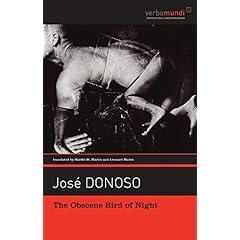
José Donoso's Multiplication of "The Obscene Bird of Night"

I just finished reading what I consider one of the strangest and most fascinating novels I've ever read, José Donoso's "The Obscene Bird of Night." It's hard to describe exactly what the book is about, the back cover blurb says it's the story of the last member of an aristocratic family who is born a monster and locked up in a labyrinth of other monsters so that he never learns what he really is, but at the same time this is only a small part of what are many other interwoven plots in the book. However, what was almost more fascinating than the oftentimes decadent and disturbing content, is the way that Donoso manages of weaving the entire story together, so that each plot seems to reflect or multiply the other plots, making the novel itself the labyrinth that entraps monstrosities.


One of the first techniques I noticed was the use of an unreliable and supernumerary first person narrator. Not only is the narrator potentially lying, insane, or obsessed about what is going on in the plot, making it difficult to believe whether the perspective on the events we are told is true or real, but he also becomes several different people, letting the first person narrative drift into the perspectives of the rest of the novel's characters. The story of the aristocratic monster is framed by the cloistered life of a nunnery, and the plot jumps forward and backwards in time in order to confuse and commingle these events. Donoso also relies heavily on repetition, of words, phrases, events, both the narrator and other characters becoming obsessed with and circling around certain themes from all angles in order to suggest their mirrored nature and importance to the plot. Lastly, and most fascinating, is a technique described on the back of the book as Donoso's ability to "multiply by myth." Early in the story, characters tell a legend about the family that all the rest of the events in the story somehow reflect or reference, whether by repeating the whole, or by stealing small parts from it to suggest the connection of the entire plot back to a mythic archetype.

On the whole this is an impressive literary work, both from the perspective of a reader and a writer. Highly worth checking out for those looking for something different to read this summer.

4.30.2008

Library of Unique Experiences

As a writer and avid reader it often worries me that in this hyper-modern world literature is becoming a rather insular art form: those who read read, and the rest, the majority, don't. This is one reason why I am fascinated by book lists such as these lists of the 50 best cult books or banned and challenged books. Hell, I even geek out over lists on Amazon, because sometimes these kinds of arbitrary collections can point me to books I ought to read, and even more importantly, suggest the extreme influence literature has had, and still has, on individuals.

For me however it is often not enough to read, or list, books that are inspiring, deviant, and fantastic for their own sake. Who hasn't tripped through the imaginations of Kafka, Burroughs, Vonnegut, or Poe? The more I read the more I become aware that one thing literature can do is describe, and allow us to experience, ever finer shades of being- much the way good classical music can create subtle emotional tensions through the contrast of chords, a masterful narrative can create as equally refined tensions through the tools of plot, language, identification. Of course, this has also meant for me a quest to discover ever more complex psychological narratives and descriptions of irreality, somewhat along the lines of Italo Calvino's idea of a library created out of books that only belong on the periphery of the established canon, the shamans and madmen of the book world, that by their tentative inclusion change our perceptions on the rest of our literally conjured experiences. On that note I want to present my own list of authors and texts that by haunting and redefining the canonical texts have been rather indispensable in my understanding of what is possible to experience.

Samuel Beckett- "Stories and Texts for Nothing," "Molloy," "Malone Dies," "The Unnamable," etc. While most people are familiar with "Waiting for Godot," the play that made him famous, few have braved Beckett's prose writing. Dense and dreamlike only scratch the surface, having been influenced heavily by Joyce and Proust, Beckett sets out to destroy every convention and form of thought available to language, so that we are left with plotless, settingless, and even characterless stories that nonetheless explore the despair and consciousness of what it means to be alive. Not for the casual reader, or even most experienced ones.

Nick Blinko- "Primal Screamer." The singer and artist of seminal anarcho-punk band Rudimentary Peni, Blinko followed in the footsteps of many great artists by going insane. From the asylum he produced an album dedicated entirely to H.P. Lovecraft, and this novel. "Primal Screamer" charts his descent into madness and childhood regression from the perspective of his psychiatrist, who may also be going mad.

Jorge Luis Borges- "Labyrinths," etc. I won't say much because he's more well known these days. Storytelling as the philosophy of infinite regression. A must read.

Julio Cortázar- "Hopscotch," "All Fires the Fire," etc. Though Borges, Márquez, Fuentes, and Vargas Llosa are perhaps the more widely known Latin American authors, Cortázar was also highly responsible for the Boom of Latin American Fiction in the 60s-70s. More urbane than Márquez's colonial-themed magical realism, Cortázar's work often deals with the loose boundaries of history and desire. Furthermore, his work "Hopscotch" has been hailed as the first hypertext novel or literary choose-your-own-adventure, featuring several chapters that can be inserted into the main text while remaining an immanently lyrical read.

Mark Z. Danielewski- "House of Leaves," "Only Revolutions." Also becoming more popular as his latest novel was nominated for several awards, Danielewski's "House of Leaves" was for years a cult classic circling around the internets. Personally I was not too impressed by his powers of storytelling, but was fascinated by the innovative, non-linear, and self-referential form of his texts, which are like reading trembling, labyrinthian, academic papers. And the idea of a house that continues to get larger inside itself gave me exquisite nightmares for about a week.

Mircea Eliade- "The Forbidden Forest," "Two Occult Tales," etc. Most famous as a scholar and founder of comparative religions, the Romanian Eliade always considered himself more of a storyteller. While the vast erudition of his academic work has a way of looping in on itself, his fiction does nothing but benefit from an intricate understanding of world mythological themes, put at the service of describing the psychological effects of time and the World Wars. He also writes some rather fantastic short stories based on his wide occult knowledge. A personal favorite.

Richard Hell- "Godlike," "Go Now." Another punk turned poet and author, Hell was most famous for his song "Blank Generation" with the Voidoids. His work offers a curious modern updating of several literary traditions that inspired his life. "Go Now" corrupts the Beat spirit of Kerouac and Clellon Holmes, while "Godlike" re-imagines the life of Rimbaud and Verlaine as gay New York poets on acid, all the while retaining a grasp on the frailness or pointlessness of humanity.

John Clellon Holmes- "Go." The novel that made the Beats a household word, and yet now falls outside the Beat canon. In the same vein as many other good author-wandering-around-aimlessly stories (cf. Henry Miller), "Go" gives an accurate portrait of the drunken striving and frightened insignificance of the best minds of his generation.

J.K. Huysmans- "Au Rebours (Against the Grain)," "Lá-Bas (Down There)." In the widely read "Portrait of Dorian Grey," Oscar Wilde has his character read a peculiar text that changes his life. That book happens to be "Au Rebours," which depicts the kind of decadent French lifestyle that Wilde only dreamed of living. Starting from this decadence, Huysmans manages to span the gamut of extreme experience in his works, from attending satanic masses to eventually joining a monastery.

Comte de Lautréamont- "Les Chants de Maldoror." Entirely unknown in its time, this work was eventually rediscovered by the surrealists who hailed it as one of the two masterpieces that informed their movement, especially the line: "The chance encounter on a dissecting table of a sewing machine and an umbrella." "The Songs of Maldoror" is a long imagistic prose poem about a relentless and possibly demonic anti-hero who has renounced God, mankind, and ultimately himself. Camus was also fascinated about this work and there are shadows of Maldoror in "The Stranger."

Stéphane Mallarmé- "Divigations," var. prose poems. While more often poetic then a prose writer, the Symbolist Mallarmé, along with Baudelaire in "Paris Spleen" and Rimbaud in "Seasons of Hell," attempted to destroy the boundary between poetry and prose, creating narratives outside of traditional syntactic forms that could be read for both the story and images at once. These works also capture the picture of the distraught French writer so eloquently distilled later in Sartre's "Nausea." On the other hand, Mallarmé's most famous poem, "A Throw of the Dice Will Never Abolish Chance," is a sprawling meta-poem about writing where words strewn everywhere on the page can be read in whatever order the reader chooses.

Gérard de Nerval- "Aurélia," etc. The other major influence on the Surrealists, as well as on Proust and Joseph Cornell, Nerval manages to record the fantastic dreams and hallucinations that accompany his descent into madness. Before and after his madness he paints vivid scenes of childhood love, Parisian neighborhoods, and occult rituals.

Kenneth Patchen- "The Journal of Albion Moonlight." A major influence on the Beats and collaborator with jazz musicians, Patchen somehow taps into the collective horror of World War II, penning a disjointed and surreal journal of a group of people fleeing and raging against a ubiquitous army of wolves. Phenomenal and chilling, this is the 40s, an emotional intensity never reached in the work of Pynchon, including the ballsy move of making both Jesus and Hitler misunderstood minor characters to his plot. A must read.

Milorad Pavić- "Dictionary of the Khazars," etc. More experiments with non-linear narratives. This text weaves a mythic story over several centuries through tentatively connected encyclopedia articles that can be read in any order and sound like masterful fairy-tales. Pavić's other works take the form of crossword puzzles and tarot readings.

Victor Pelevin- "The Yellow Arrow." I haven't read any of Pelevin's other work, but the Yellow Arrow is a personal favorite. A dark allegory about life and the Russian State, in which a man who is riding on a train that never stops, houses countries of people, and the dead are thrown out the windows, begins to wonder what would happen if he were able to get off. Beautiful and simple.

Fernando Pessoa- "The Book of Disquiet." Pessoa distinguished himself by creating several distinct literary heteronyms, who are the authors of their own works. In "The Book of Disquiet," one of these invented authors muses about the uncertainty and tedium of his life, and desire to imagine something different. For some reason I couldn't get through the book (mostly due to my own disquiet), though lines and images from it come back to me from time to time.

Rainer Maria Rilke- "The Notebooks of Malte Laurids Brigge." Many are familiar with his "Duino Elegies," and some colleges even require his "Letters to a Young Poet" in freshmen classes, but Rilke's only novel remains somewhat of a mystery. Much like other existential, man-about-town texts, in which not much happens but a character's obsession becomes fully lived (cf. Sartre and nausea, Lautréamont and evil, Miller and sex), Rilke's Malte is troubled by the question of death and transcendence, and that place where the veil of reality is torn to reveal poetic meaning. Though as a whole the "Notebooks" wanders off without a proper finish, many of the scenes display a linguistic and imagistic virtuosity that I don't think is rivaled in any other piece of literature. A personal favorite, try to find Stephen Mitchell's masterful translation.

Bruno Schulz- "The Street of Crocodiles." An obscure Polish art teacher, Schulz wrote down his childhood memories as letters to a fellow teacher and later published them as short stories. While drawing on the clarity and warmth of early Proust, as well as the ability to let incidental objects trigger emotional memories, Schulz sets himself apart by being able to see the extreme magic and dark possibilities that are peculiar to childhood. A personal favorite. The title piece also later served as inspiration for a short film by the Brothers Quay.

Of course, like all lists, this one is far from comprehensive. Other authors I am just discovering now deserve to be on here, such as Felisberto Hernandez, José Donoso, and E.T.A. Hoffmann, each of whom refines this library of unique experiences further. Hopefully others may read this and discover an author worth checking into, and if there are any texts that you have found inspirational or experientially exquisite, please post a comment.

4.29.2008

Dream and Dementia

"From that moment on I devoted myself to trying to find the meaning of my dreams, and this anxiety influenced my waking thoughts. I seemed to understand that there was a bond between the external and internal worlds: that only inattention of spiritual confusion distorted the outward affinities between them, - and this explained the strangeness of certain pictures, which are like grimacing reflections of real objects on a surface of troubled water." -Nerval, from "Aurélia"

In 1854 Gérard de Nerval, the French Romantic poet most famous for walking a lobster on a leash through the streets of Paris, was ordered by his doctor to record the series of fantastic visions and hallucinations he was having during a bout of mental insanity caused by his obsession with an actress he called Aurélia.


This document of dreams, dementia, and spiritual longing, subtitled "Life and the Dream," was considered foundational by such artists and writers as the Surrealists, Marcel Proust, and Joseph Cornell, and was hailed as a masterpiece of fantastic imagery. In his critique of the fantastic as a literary genre, Tzvetan Todorov continually turns to Nerval's "Aurelia" as exemplary of both syntactic and semantic techniques for articulating the essential ambiguity (near magic) of our perceptions of reality. Throughout this mostly autobiographical story, Nerval or the narrator finds himself and other people doubled, causality is called into a synchronistic question when putting on a ring begins a mass and throwing that same ring away stops a ferocious storm, and hosts of angels and gods recreate all of reality before the narrator's eyes. In order to stress the utter subjectivity and ambiguity of these scenes, Nerval uses a literary device that anyone who writes down their dreams may be familiar with: sentences are modified by phrases like "it seemed that," "I imagined myself," "I felt," "for some reason," each time putting into question the reality of what seems to be occurring for the narrator. This ambiguity is further intensified by the narrator's use of dream sequences, which he not only claims help explain the visions he just had, but further become seemingly real experiences in their own right. In particular the narrator dreams of an angel, first sculpted out of the actress he desires, who in turn gets projected onto every other woman he meets in the story, each of whom he thinks is that now dead actress.

While these scenes and devices certainly make for a magical read, and if they were actually dreamt by Nerval then a rather fantastic experience, but I'm not quite convinced that they add up to a full narrative, or that they produce the fantastic effect of a hesitation on the reader's part as to whether the events may actually be happening. Though the narrator seems slightly unsure that what he dreamt may be true, and despite the lucidity of the narration, he is much more likely to tell the reader that he is dreaming, that he is indeed going crazy. Several times throughout "Aurélia" the narrator is locked up in mental institutions, which frames the fantastic events in such a way that we are never led to believe that they are anything but the workings of a demented (although spiritually romantic) mind. These visions may spill out into the narrator's life and interactions with other characters, but never in such a way that these other characters are also led to believe the visions are true, which would make them much more believably ambiguous. Similarly, the narrative chooses to focus so much of its attention around the bizarre content of the visions that we loose what may have been the more important story behind them. We are told briefly about the narrator's obsession with Aurélia, but the rest of the manuscript is solely dreams and madness, through which the reader might look at their watch from time to time saying "well you're dreaming and mad, so what?" What might have been more interesting, and possibly more gripping, would have been to document that decline between sanity and insanity, how these visions played off against the normal content of a man's life. This draws on another important aspect of fantastic or magical literature, which is that they have to establish a stronger reality first before stepping out of that reality. Nerval however assumes that his readers know the world he lives in and the everyday content of his thoughts.

There is however a rather touching and realistic moment at the end of the story, which more then, or almost, makes up for the dérive of the narrator's visions. While locked in a hospital the narrator befriends a man in a torpor or coma who slowly awakens seemingly because of the narrator's attention. When asked why he won't eat, the man says that he is in hell, which causes the narrator to reflect on his own thought processes and outlandish beliefs throughout the rest of the story. Though the narrator ultimately refuses to give up his own convictions, this scene raises that subtle point that each of us can contain such bizarrely subjective worlds of dream and dementia, which we must articulate in whatever manner we can.

8.20.2006

spells on the wall

It was rather disconcerting to find that someone had posted a magic spell on our bulletin board at work. a shoddily photocopied sigil of an upside-down pentagram surrounded by almost illegible hebrew letters above a cutup poem that claimed to be "a piece of machinery for the advent of the meat-eating masses backstroke" with a bunch of seeming drivel, including something about the inferno of Liza Minelli, and ending with a call for the targets of the spell (presumably meat-eaters?) to get cleft lips for christmas. i won't reprint the whole of it here, as it was put in a public place it probably works mimetically and i don't want to inadvertently infect anyone with it. and who knows what the intentions of the poster were, if it was just some random piece of junk someone put up or if they really do want to give people cleft lips, and are fully capable of doing so. either way, it bothered me on some deep level, enough that i didn't even take it down because who knows what sort of wards people put up on these kind of things. i've seen too much to take any bit of random symbols and mumbling as just that. they have a power only at the edges of our comprehension.

7.26.2006

digging through pages of time

Long days of welling memories between the mechanics of living. engineering the sounds and sayings, looking for work and a roof, flashes of each time i've looked for work, a roof, strum and song and all the harsh grating of details. i almost got a whole house for cheap, but not cheap enough, so instead i went to goodwill to look for books to sell and came home with a stack for my own library. i can't help myself. of course there were some excellent finds. a copy of PKDick's Exegesis, a book on missing myths in america, a pocket edition of the surrealist poet Apollinaire's "alcools" who coined the term surrealism (in french unfortunately, but it was only a dollar. these texts can not be lost to time).

the greatest find, comparable to a DJ's record crate digging, was a copy of the Comte de Lautreamont's "les chants de maldoror" which i've been meaning to acquire for awhile and never expected in the snooty shadyside thrift shop. hailed as a masterpiece by the surrealists (it contains their founding quote "beautiful as the chance encounter of a sewing machine and an umbrella on a dissection table") this prose poem was written in the late 1800's by a mysterious youth who died at the age of 24. many of the writers i admire, and the ones they admired, relied heavily on this text, which from the sound of it falls in the same type of journalistic literature as my two favorite novels, rilke's "the notebooks of malte-laurides brigge" or sartre's "nausea". where the "hero" of the notebooks is obsessed with and sees through Death, and in "nausea" with the existential horror of Emptiness, Lautreamont's anti-hero Maldoror is obsessed with Evil and the absence of god and how this is acted out (in apparently disturbing and imagistic passages that almost had the book banned for obscenity when it was first published). i look forward to reading this when i'm done with Henry Miller's "Plexus", along with the copy of Yeat's symbolist text "a vision" which i also recently tracked down. now if i can only find a copy of stephen mallarme's poetry in the trash...

lautreamont is also credited with saying: "Plagiarism is necessary. Progress implies it. It closely grasps an author's sentence, uses his expressions, deletes a false idea, replaces it with a right one."

and

"Poetry must be made by all and not by one."

7.17.2006

word is gold

i knew i wouldn't be able to sleep, so i went on a long walk around bloomfield from the hollow to the playground swings behind Ritter's, scheming up the next piece of 'anamnesia' and a counterpoint to last night's ramblings on language. then when i might have passed out i got my nose stuck in the anthology of surrealist poetry i picked up last week and ended up with this whimsical little ditty about four in the morning (the excessive ellipses are only in leu of indentation, and not morse code):

I am beginning to see whatever I say becomes real.
Birds
. . . . . fly fluttering feathers from lips,
cakes and carousals
. . . . . . . . . . . . . . . . . turn round the tongue
and every secret is illumined with
. . . . . . . . . . . . . .. . . . . . . . .. . . . .starlight.
I will never thirst again, sleep when I whisper
can tell the helicopters to finally
. . . . . . . . . . . . . . . . . . . . . . . . . be quiet
and always have the most exquisite
. . . . . . . . . .. . . .. . . . . . . . . . . .beautiful day.
Immediately I called for a parade:
. . . . ... . . . . . .. . . . . .. . . . .. ... . .elephants
acrobats,
. .. . . .. . . brassband banners
. . . . . . . . . . . . .. .. . . . . .. .. . billowing out,
huge crowds promenading down the boulevards.
Called for
. . . . . . . . . insane ecstasy
. . . . . . . .. . . . . . .. . .. .. . . nonstop laughter,
what the gods felt when they spoke the world.
I began to experiment,
. . . . . .. . .. ... ... . . . ... porcelain cacophony
rained tea cups and toilet seats for weeks
and no one could keep their hands off
the insatiable piano
. . . . . . . . . . . . . .. . .or the velvet sunrise,
even if it burned a little on the edges.
I quickly learned to not say words like
pain or police or palpitate
. . . . . . . . . . . .. .. . . . . . .. . for fear
of the red jagged beating and woe
if I ever uttered
. . . . . . . . . .. . . a final Armageddon;
loose, these lips really could sink ships.
But this is no big thing, we do it every day,
most of us never noticing how with a word
we bring the heavens down on our heads.
So I kept at it, crying for
. . . . . . . . . . . . . . .. . . .. . peace
possibility,
. . . . . . . . . . full bellies
. . . . . . . . . . . . . . . . . . ..and free speech,
and all the war machines sprouted flowers
prison bars bent into ornamental gates
groceries exploded across the streets
and everyone said exactly what was on their minds.
It was sheer chaos and reveling and many asked
me to say
. . . . . . . . .normalcy
. . . . . . . . . . . . .. . .. .or at least
. . . . . . . ... .. . . . . . ... . . . . .. .. .silence,
but I only smiled, and said
. . . .. . . . . . . . .... . . . . . .. everything.

when language spills over...as opposed to that purity and fullness of language in which every word becomes real, which harks back to the work Ezra Pound and others did in showing how ideogramatic (Chinese) poetry relied purely on images working out their own fate, words also have a tendency to fill up with so much meaning that they overflow, and produce all manner of absurd juxtapositions. This is pointed at in Hakim Bey's article on the taoist philosopher Chaung-Tzu's idea of spillover language, refers to the process by which images fill up with so much meaning, or minds with so many images, that they spill over like a full gourd and create new unprecedented ways of looking at the world. This idea found its peak as a body of technique in the surrealists with their automatic writing and exquisite corpses, that while sometimes being just ridiculous (like the meeting of an umbrella and a sewing machine on a dissecting table, the line that sparked their movement) also have a way of recreating the way one looks at the world in every moment. in relation to the pure expression of language, this sense of bizarre juxtaposition can both mask the image being presented and express more facets of it, for example saying "oceanic swiss" both masks the reference to the moon, and highlights its cratered landmass and gravitational pull on water, and has the added benefit of positing a fleet of scuba-diving mice upon the moons surface, if your brain takes you there. of course, not all these images really carry such a surplus of meaning, and we haven't yet accounted for where these divulgent images come from...

7.13.2006

on the climb

Wandering around last night decided to stop by sarah and alberto's to tell them of my absurd revelations and see how his art is ticking along. without knowing it i was jsut in time to watch one of my favorite movies ever, alejandro jodorowsky's "the holy mountain"...


Filmed (and set?) in mexico in the 70's, this is the surreal tale of a jesus coming back from the dead and fighting off his personal monsters and the horrors of the modern world learning the secrets of self-transformation from an alchemist and going on a quest to the holy mountain in order step out of time and become immortal. not only is this movie incredible for its use of disturbing sound collages and almost no dialogue, but the symbolism! my gods is just too blatant, nothing couched or hidden and drawing on so many sources at once it hits like a ton of gold bricks, especially the scene where the romans get jesus drunk and he wakes up in a warehouse surrounded by a thousand plaster copies of himself. simply harrowing in the best way. i'd recommend this movie to anyone with a keen eye, but forget that so much of it draws on occult literature and shamanic visions that not everyone can relate to or even has experience of. nevertheless it is a brilliant surreal adventure.

2.20.2006

close this world. open the next

(written at that point in the night where I stop writing intentionally and it's like a flood gate breaking and speaking from this strange other place I don't always understand. All I wanted to do was jot down a conversation I'd had earlier...)

"The problem," she said, "is that everything's buzzing. You can't go anywhere without feeling it pressed up against you, all jittery."

"Well certainly, all the appliances and gadgetry always on everywhere, creates quite an audible hum."

"No, it's not that, something in the way we communicate, we're all so close and information's so fast.

"Not like in the old days when you could really be alone, silent and uninformed. It's growing louder too, everyone feels like we're on the verge of something big, all this nervous energy. I don't know what, history happening. The sound of change like growing pains."

"But don't you think people always feel this way, like things are changing irreperably, like that moment they're alive is sort of always the end of the past and the beginning of something entirely different?"

"Sure, I guess it's always the end of the world for somebody. People get to be adults and suddenly time and the weight of the world closes in around them. But this..."

"It's getting more intense."

"Yes. You can almost feel it buzzing, almost see it in the air. The information. Ever since we've been able to record stories and pass on knowledge, probably before then, but now. The internet. We just bounce off each other and all the gaps are closing in and there's nowhere else to go. It's like, I don't know what's going to happen. But it is."

I don't know either, but I've heard people call it the Singularity. But that little bit of data'll just add to the buzz, so I keep shut. She's in prophet mode and the bees are still dripping out her mouth, sticky swollen secrets of a goddess no one worships anymore. Last year she did this to me, and I'm still shaking, faint traces outline that thing sitting there, waiting. Non-event, inevitability, something like the dead center scratch of a record, or a deep breath. Maybe the core of all, what, intelligence? A gathering up of knowledge and tongues beyond the names of things, where traditions and half-truths fall like spent masks, all the glittering deities and philosophies that couldn't get enough air time, where all the myths are shown to refer to exactly the same theme.

I don't say, of course it's buzzing, it's all energy anyway, vibrating back and forth and making life and we're all just excited in it cuz we're getting to a point we can just rest, or look sideways and approach it all from a different angle. A point we can talk about what the point is. No wonder what's wrong with kids these days, myself included with all our glorious lack of attention spans. Raised in the buzz. We don't want stability, the same old streets and routines till we die like older generations capitulated to entropy and the inertia of the familiar. We want change, novelty, excitement. The next big thing. None of which is fulfilled by this materialistic monoculture with its spectacle of cheap disposable distractions, all of it invented to fill that void and reduce us to one blank slate. None of it's real and we all know it. Don't know what's going to happen, but nothing lasts forever and this beast sure ain't sustainable much longer.

Maybe that's what all the buzz is about, this subliminal whispering of fear and longing and oh my god (if you still exist) what in your name are we gonna do to get by? The cover's blown off this whole mess we made and we can start to see it for what it is, naked and writhing, and we have all this knowledge and systems but what the hell are we using them for if not our most intimate needs of survival? Porn and online shopping? Reality TV and better gas mileage? Maybe a war or two's worth of high fangled space age killing devices. Glorified clubs.

We're buzzing cuz we're getting close. Cuz it's cold out and the air's thin & crisp and sound carries so well it falls off and crunches on the ground,* a tinkle of grace notes and grumbling, like Snoopy knocking the notes off that music staff always hanging out over Schroedder's piano. Charles Schultz was a genius, saw the matrix crumbling and sketched it out with whimsy, before it was just innumerable floating green digits and bad action sequences. Australian aborigines tell a never ending story of the world's creation from the dreamtime. They can't stop telling it cuz the story is this creation. So's the Torah. Language is a virus and man the medium. The idea of ideas conflicting and trying to survive is infinitely amusing in this light. We are just the Universe trying to explain itself, without eating foot. The master meme behind the madness.

*The way winter light falters and flattens out around the edges so everything seems false and distinct, a flimsy film over the mechanisms. The way people's faces are coming off, if you've noticed that, twisting about and unable to contain the horde of emotions and contradictions behind a single coherent veneer of calm or dignity, making both lies and truth equally impossible to comport. It's really quite horrifying if you didn't think everyone else is probably looking right through your face too. Like the eyes of the window of the soul suddenly spilled over into great yawning chasms of expression that were always there but lay only barely concealed beneath flesh and social mores. The big king eye at the center of the storm...

[end transcript]