Showing posts with label psychogeography. Show all posts

1.08.2010

The Method of Loci: Place and the Imagination

The other day I finished moving into a new apartment in the Friendship neighborhood, and in the morning after my first night there I looked out my third story window and was shocked to realize that the view corresponds almost exactly to the view from the window of the house I lived in years ago in my dreams: the playground, the prison-like school, the distant gothic cathedral, the park, each of which carry for me certain symbolic resonances, associating to emotional states, ideas, layers of memory and history. I actually can not see the park - it is only a small triangle compared to the overgrown woodlands in my dreams - but I've had so many powerful and life-changing experiences in that physical location that it is clearly vast and visible in the mind's eye, where such settings take on an imaginistic life of their own. The whole experience would have been uncanny, except that word means "un-homelike," and I felt very much at home. As Gaston Bachelard says in his study of the psychological effects of architecture, The Poetics of Space, "through dreams, the various dwelling-places in our lives co-penetrate and retain the treasures of former days."

I have been intrigued by this concept of psychogeography for years now. Not being a driver, I have the fortune of going on long meandering walks through the city in the dérive style of the early Situationists. However, over and above Debord's aim of psychogeography as the study of the effects of the environment on the emotions and behaviors of individuals, that is, the psychological effect of physical environments, I have grown curious about the representations of locations within the psyche itself, the way people dream, imagine, or narrate settings in which the images of their psychological processes take place, in short, a cartography of the soul.

Granted, there is a correlation between the physical environments we move through and the way we use familiar places to represent psychic states. The view from my dream window does not look out on anywhere that I've not actually walked countless times, but simultaneously, my inner world contains vast deserts, towers spiring into the cosmos, the labyrinthine depths of Hell. The real physical environments are sometimes not big or wild enough to articulate certain feelings and experiences. I was struck with this while readings Jung's Red Book (before I got caught up in moving out of the literal pit of my old neighborhood), particularly that he described his soul as a desert in need of regrowth. I admittedly have not read enough Jung to verify this, but in the popular or casual understanding of Jung's work, while character archetypes play a central role, there is much less thought given to the settings in which those archetypes exist and act. None of us exist in a void (or for that matter in the strange hinterlands our psyches generate, just as very few have actually met living versions of their animas or shadows outside their dreams and projections onto other people). At the most there is discussions of mandalas as the Center, in terms of sacred centers and axis mundis as Eliade discusses in The Sacred and the Profane, but this seems but crude generalization of the array of unique settings in the cultural imagination.

So where do these psychogeographies come from? I am not convinced, as Jung seems to have been, that our archetypal symbols are biologically rooted, or easily divisible into collective vs. individual, conscious vs. subconscious. Instead I currently believe our symbols are mimetic, passed down in the cultural imagination through stories and other media and our personal experiences of and relationship to these cultural expressions. I only started dreaming of the desert after briefly visiting New Mexico, but its psychic power is proportional to the sway that the image of the Wild West still holds on the American imagination, even projected out into space as Tatooine, the desert planet of the Star Wars movie of my childhood. Similarly, the towers and hells could have been evoked by various fantasy stories and video games, and became over my life subconscious settings for the feelings of the epic and apocalyptic that reside in us (these are our oldest modes of storytelling), but seem to have no physical place in the modern world.

On the other hand, people in various times and cultures have imagined precisely such a location where all contents of the human psyche reside. Most popularly articulated in the Theosophist's Akashic Records, this "storehouse of all knowledge" finds earlier analogue in the Islamic Al-Lawh Al-Mahfudh or Hebraic Book of Life. I can vouch for this location from my own psychic experiments, or point to the documented use of it for healing by the medium Edgar Cayce, while also suggesting that it, or there, is a potent metaphor for the possibility of a place for all knowledge, like one of Borges's infinite libraries or Alephs. This is similar to the metaphor of God as the possibility of all knowing, but where we seem today to no longer believe that one consciousness can know all, we are actively working to manifest that place that contains all knowledge. As the Internet expands, the metaphor of the Akashic Records becomes either real or unnecessary (though there are certainly still unknowns, dragons and edges of the world in the tubes of our epistemological maps). The Internet itself has become the imaginal place par excellence, existing nowhere and everywhere and as large as we can populate it, this terrain of our virtual representations which is literally the Sanskrit akasa: the all-pervasive space. Interestingly, it was through various science fiction authors imagining what a virtual reality would feel like - Stephenson's Metaverse, Vinge's Other World, Gibson's matrix - that the Internet as we know it, along with its spatial metaphors, came into being.
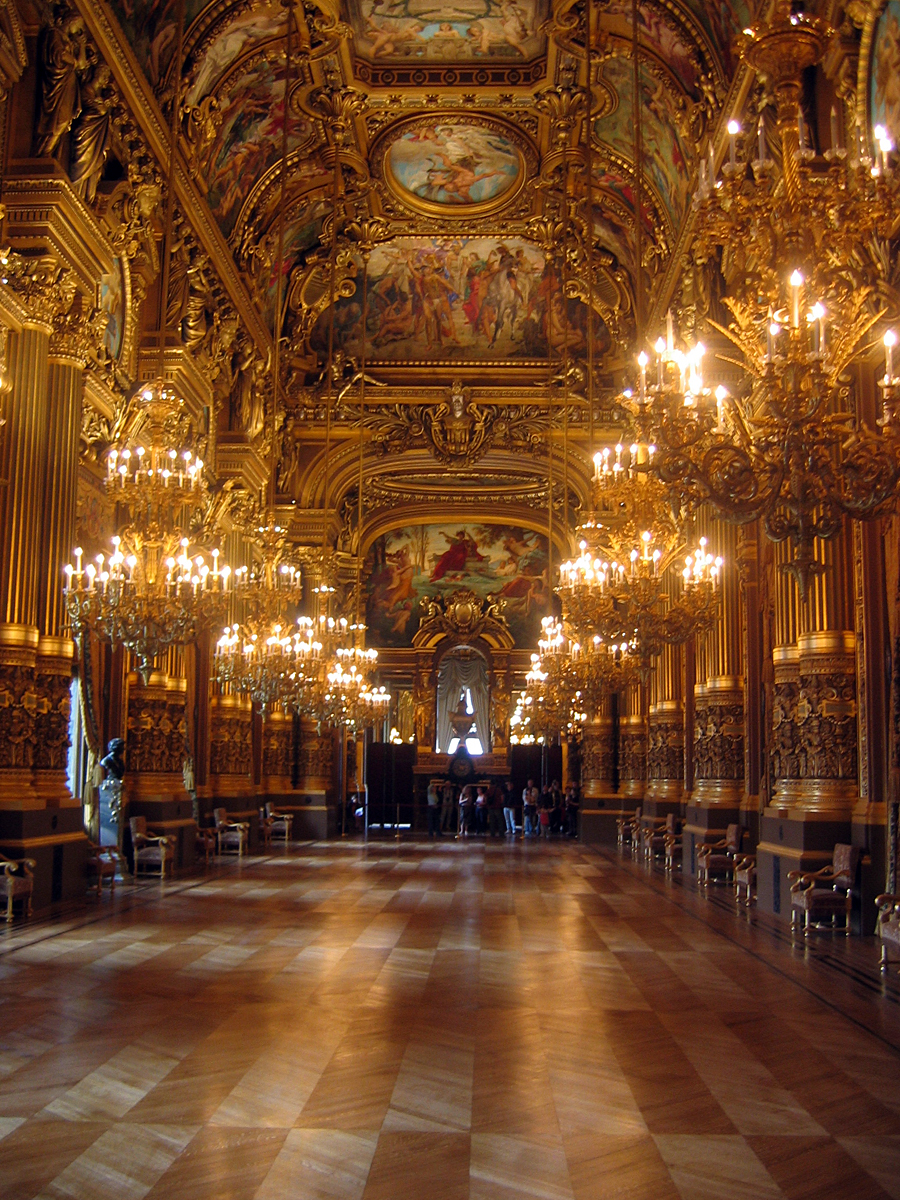
While unparalleled as the location for our conscious representations, glimmerings in the cultural imagination suggest that, as a psychogeography, the Internet is too real, or not real enough to fully articulate the more subconscious aspects of human experience, and other settings may have to be found. Last year I watched the TV show Battlestar Galactica, which (beyond its interesting treatment of the role of belief in the contemporary world) made use of a particular psychic location as a symbolic layer over the real world, directly experienced in visions by a number of the characters: the location of the Opera House. While in the show's plot this location ultimately served as only a cheap visual metaphor, its implications for the cultural imagination are far more suggestive. As an academic colleague pointed out, the Opera House replaces the sci-fi trope of virtual reality with a deeper psychic or subconscious reality, the theater as the place where the contents of our imaginations are made real for all of us. I have dreamt of the Opera House many times (though I was once an actor); it is, as Kerouac says in his own Book of Dreams, the Theater... that old spooky opera house and high school auditorium and classmeet hall of all my days, with hints from all the stages of Time's earth and actors too." While the symbol of the Opera House is still uncharted territory on the Internets, one only has to consider the mythological and ritual bombast of Wagner's operas, or just go see a movie. The drawing of the curtains, or now the darkening of the lights, acts as a veil torn between worlds, so that we sensually enter into the realities of our imaginations; the 3D wonderland of Pandora, the barely repressed longings to rescue Gotham, the Theater as the latest incarnation of the temple sanctum, where the gods become real in us. As Shakespeare said, all the world's a stage. We dream of the day (as Vinge does in Rainbows End) when our technologies allow us to visually project the settings of our imaginations onto the physical landscapes around us, so that we really will inhabit the lands of our dreams.

But where is this place (if not in us), and how are we to get there? The ancient Roman orators had a technique for memorizing long speeches and poems called the Method of Loci: one is asked to create a Memory Palace, taking a highly familiar location and placing in it associated images for the information to be recalled, so that all one has to do is stroll through the loci in the correct order. Personally I am interested in reverse-engineering this process, not further associating psychic terrains but unpacking all the cultural references that have been associated over time to various settings (a hermeneutics of the Opera House, of the Badlands, even of my dreams, whose consistent world this house is a cipher). The cities we inhabit may have a psychological effect on us, but we built the cities in our own image, and buried in them strata of meaning and longing. Perhaps we may uncover the ancient fear of Wilderness that has led so gradually to the current environmental destruction, or just learn to feel at home again, wherever we find ourselves.

12.14.2009

The Somnolent Territories

Inspired by recent poetry readings, I've started working on some new verses for the first time in years, and in the process went back through some older unpublished works to find and edit this piece, which is essentially a catalog of places I visit in my sleep. Enjoy!


The Somnolent Territories

roving insomniac landscapes
cities hung off the cliffs of mind’s eye
no windows and a blurry clock
peeling the hours between dim alleys
crooked wooden dovecote homes
and the diagonal drift of vague
symbol-choked bars and opera halls
rocknroll dripping from the walls of

haunted hallucinating forests
footsteps cobwebbed off a too-close moon
searching for that one winged book
and a lock to lost love’s keystone
crumpled across the dunes and obelisks
of memory’s striated bedrock
vast with sand in the hourglass eye
and only one light on in the ruins
where they mine for replicating relics
to prove the world was ever here
but only in the lone of night when

the desert of soul ripples with worms
worm holes and the witch’s grotto
she’ll sell you charms and insurance
against early morning amnesia
and the mountains of shivering ice
carved to statues of flayed godsflesh
down the porcelain-leaved road of trials
all highways pass the convex lake
to the city of crystal and conveyors
floating on the edge of that abyss
where they fight off tooth decay
and visions of apocalypse by fire
and you don’t want to know
what lurks in the subbasement

but down to the beach
which we still can never reach
straddling tall mossy barrier reefs
beyond pirated jungle villas
to watch the spume of whalebacks
and the underwater sun slope
out of this rose colored sea of dreams
while the lighthouse keeps blinking
on the shelf of my father’s study
calling out to some greater tower
lying leagues offshore maybe north or

in an Oakland you can’t reach either
and or the walls are all façades and or
labyrinthine with jeebering horrors
you shouldn’t have asked about
and just like every childhood nightmare
it’s hiding around the corners
and or those walls are actually
a hostile alien life form maybe
a dark chaotic maelstrom that will
transport you to another dimension
like endless stairwells or the gates of hell
you can’t seem to stay away from
those worm holes rippling
and somewhere in the middle where
spiders spin the worlds together
is maybe a good night’s sleep.

12.11.2009

In the Desert of the Soul: Early Symbols in Jung's Red Book

I finally started reading the text of Jung's Red Book last night, and it is as revelatory, revolutionary, and vitally important as I suspected it would be, not just in terms of Jung's psychological theories but in taking a stance for a broader spiritual approach to reality that is even more lacking now than when Jung was writing. Reading this is like reading Blake, I want to quote every passage (as they are almost all brilliant), but if my cat will get off the tome I'll constrain myself to just one before looking at some of the important symbols and themes that Jung was attempting to articulate.

"The spirit of the depths took my understanding and all my knowledge and placed them at the service of the inexplicable and the paradoxical. He robbed me of speech and writing for everything that was not in his service, namely the melting together of sense and nonsense, which produces the supreme meaning.

But the supreme meaning is the path, the way and the bridge to what is to come. That is the God yet to come. It is not the coming God himself, but his image which appears in the supreme meaning. God is an image, and those who worship him must worship him in the images of the supreme meaning.

The supreme meaning is not a meaning and not an absurdity, it is image and force in one, magnificence and force together.

The supreme meaning is the beginning and the end. It is the bridge of going across and fulfillment
[a reference to the way of becoming the superman from Nietzsche's Zarathustra].

The other gods died of their temporality, yet the supreme meaning never dies, it turns into meaning and then into absurdity, and out of the fire and the blood of their collision the supreme meaning rises up rejuvenated anew.

The image of God has a shadow. The supreme meaning is real and casts a shadow. For what can be actual and corporeal and have no shadow?

The shadow is nonsense. It lacks force and has no continued existence through itself. But nonsense is the inseparable and undying brother of the supreme meaning...

The image of God throws a shadow that is as great as itself.

The supreme meaning is great and small, it is as wide as the starry Heaven and as narrow as the cell of the living body.


The spirit of this time in me wanted to recognize the greatness and extent of the supreme meaning, but not its littleness. The spirit of the depths, however, conquered this arrogance, and I had to swallow the small as a means of healing the immortal in me. It completely burnt up my innards since it was inglorious and unheroic. It was even ridiculous and revolting."


Potent symbols and themes in the first seven sections:

The spirit of the times vs. the spirit of the depths - Jung makes a distinction between the spirit or stance of the time in which he lives vs. the spirit of a greater, ancient, and universal reality that is entirely overlooked by the present, and is striving to come forth through Jung. This is historical consciousness vs. the mythic subconsciousness, and Jung frames the Red Book as a way of getting past all the small-minded, violent, materialistic impulses of his age (including a harsh criticism of Christianity), while recognizing that this present world may entirely ignore his warning and call for an understanding of the subconscious.

The supreme meaning - Jung claims that God and gods are only images of an eternal supreme meaning oscillating between meaning and absurdity, and it is this supreme meaning that men must come to recognize as a solution to the spirit of the times. This is entirely consistent with my concept of ultimate significance, in that the supreme meaning is more truly real than the images we conceive of it through.

Dreams and epiphanic visions - Jung recounts a number of visions prophesying the world wars as well as his own future work. He claims an uncontrollable compulsion to record these dreams, though he never did before. Similarly, a number of the passages Jung claims are actually the spirit of the depths or his soul speaking through him as a medium.

The soul - Much of the early part of this book is Jung's attempt to reconnect with his soul. This is the formation of his archetype of the anima/animus, but it is not made explicit in his academic writings that the archetype is not just an image but one's actual, living soul, which encourages us to live and do everything we dream of living and doing. The soul is one's God and opposite, which perfects us in the supreme meaning. The soul is not part of us, we are only the expression and symbol of our soul in the world.

The desert - Though Jung's academic writings discuss the archetypes they do not discuss (as far as I've read) the importance of subconscious locations. In particular Jung discusses here the image of the desert, which is the conception of oneself and soul that one must journey into and rejuvenate in order to overcome the spirit of the times. Jung believes he saw a desert because his soul had been withered (and perhaps those in touch with their souls experience a garden). From my own explorations of the subconscious I also found this "desert of the soul" as the location for the deeper, mythic realities I had to contend with outside of the city (the symbol for the everyday world and times). As my own process continued, this desert was first flooded and became a garden before the entire inner world was set to flames so that a new internal reality could form. I am curious how these locations change through Jung's process in the remainder of the Red Book, as I find such psychogeographies an essential compliment to the character archetypes.

The descent into hell - Jung has a vision in which he realizes that he must descend to hell in order to individuate himself and find the supreme meaning. Such descensus avernum are common in mythic and revelatory literature and serve as another example of the importance of place as symbol for Jung's theories. Jung equates this descent with the possibility of going mad, and sees himself as a sacrificed hero who must overcome that potential madness for a more divine madness lacking in the spirit of the times. This section (and the titles of the other sections) suggest that Jung is on a hero's journey comparable to that described by Joseph Campbell. This hell is all the absurd meaninglessness of our times that we must go through in order to construct our own meaning of events, which is the supreme meaning.

Alright, I'll close with another short passage: "You thought you knew the abyss? Oh you clever people! It is another thing to experience it. Everything will happen to you."

10.17.2009

Wild Things

Taking a break from such heavy cosmological topics as the Universe ending in heat death sooner than anticipated and a new translation of the Bible that shows God did not create heaven and earth but merely separate what was already there, Sophie and I went out last night to check out the opening night of Spike Jonze's adaptation of Maurice Sendak's Where the Wild Things Are. Despite reviews claiming the movie is too depressing or frightening we both found it highly charming, particularly the stellar acting of child-star Max Records, the intricate costumes from Jim Henson's Creature Shop, and upbeat soundtrack from the Yeah Yeah Yeah's Karen O [Found link, for preview purposes only, buy here]. It was interesting to note that the audience was primarily comprised of young adults, who probably were raised on Sendak's masterpiece and are perhaps the intended target demographic of Dave Egger's script (the whole movie really capturing the indie spirit of the times).


[Potential Spoilers Below]

The thing that really stuck out for me though was what this movie says about the human imagination. Despite our cultural love of monsters and fantasy, the imagination here is presented in its rawest or most primal. Shaggy monsters dance and tear up the woods and throw clods of dirt at each other. Everyone howls and growls. Certainly the monsters possess some amount of adult-like self-reflection (enough to come off as rather depressed), but no more than Max himself. In fact, one could take a psychological perspective that the monsters and their land are all projections of Max's own fears and desires, for friendship, against alienation and being young and misunderstood if not ignored.

But what is interesting was the choice of not stating whether the events of Max's journey really took place or not. The final return scene has no dialogue, so we aren't asked to chose with Max over what really happened, even if with all the day to night transitions he must have been gone for several weeks. This draws on elements of the Fantastic in art, that supernatural events are left ambiguous as to their reality. This is a necessary move because the audience, instead of being asked to decide what is real here, can instead suspend their disbelief and let the monsters be real. They are reflections of ourselves. Of course, this in turn adds more weight to what both Sophie and I decided was one of the pivotal scenes of the movie, when the monster Carrol rips the bird monster's arm off, and the camera focuses on a stream of sand spilling out. Up till this point, Max has taken the monsters as real, but they are shown to be not real, and he starts feeling the need of returning home to his flesh and blood family.

What this says for me is that despite how primal and raw we sometimes need to express our imaginations as children, this rawness sometimes tears holes in the stories we make up and tell ourselves, and shows us what is more importantly real in our lives. For another example, in a school scene at the beginning of the movie, Max is told that one day the sun is going to die, which when he tells the monsters makes them even more depressed and desperate (to tie this in with the links at the beginning of this entry). I think we are encouraged to equate those kinds of predictions of science with the imagination as well, as something that must ultimately give way to the reality of the present and the more immediate significance of our families and loves.

5.26.2009

On the total reaction to life

"Religion, whatever it is, is a man's total reaction upon life, so why not say that any total reaction upon life is a religion? Total reactions are different from casual reactions, and total attitudes are different from usual or professional attitudes. To get at them you must go behind the foreground of existence and reach down to that curious sense of the whole residual cosmos as an everlasting presence, intimate or alien, terrible or amusing, lovable or odious, which in some degree every one possesses. This sense of the world's presence, appealing as it does to our peculiar individual temperament, makes us either strenuous or careless, devout or blasphemous, gloomy or exultant, about life at large; and our reaction, involuntary and inarticulate and often half unconscious as it is, is the completest of all our answers to the question, "What is the character of this universe in which we dwell?" It expresses our individual sense of it in the most definite way. Why then not call these reactions our religion, no matter what specific character they may have?"

[William James, The Varieties of Religious Experience, 1902]

5.05.2009

Upcreation

[from The Technium]

"Upcreation is the term for the peculiar, profound, and still mysterious way by which complex structures appear in the universe. By complex structures I mean galaxies, stars, planets, life, DNA, termite mounds, rain forests, human minds, and the internet. These complexities tend to "emerge" from simpler systems (clouds of gas, pools of molecules, nodes of communication) in a fashion we broadly call self-organization. But in the right circumstances self-organization can often also be legitimately called self-creation. Without an outside agent, the parts cohere into a new organization that brings forth an "emergent" level or self not present before. Since the new emergent level of complexity encompasses, without destruction, the previous "lower" levels of organization, I call this self-creation of higher levels "upcreation." A set of entities lifts itself up to a new level of organization in a new entity. By this perspective, DNA chemistry "upcreates" life, and life upcreates minds, and a mind might upcreate a supermind. Upcreation takes place in smaller increments as well: Honey bees upcreate a hive, protists upcreate multicellular organisms, corals upcreate a reef, shoppers upcreate a market, web surfers upcreate Google PageRank.

But while this emergence usually "happens" in an almost passive way in the past, we humans would like to be able to make it happen on command. We would like to upcreate artificial minds and artificial life. However, much to our dismay, upcreation turns out to be something very hard to imitate. For some goals, like making a human-like artificial intelligence in computers, bumping a system up to the next level of complexity has so far been a total failure. A large part of the difficulty lies in our lack of a good understanding of what happens during emergence. What does it mean to make a new level, how do we recognize one, and what are its preconditions?"

11.18.2008

Place Names as Reality Effect in Joyce's “Portrait of the Artist as a Young Man”

Place Names as Reality Effect in Joyce's “Portrait of the Artist as a Young Man”

While it is tempting to read James Joyce’s “Portrait of the Artist as a Young Man" purely in terms of the spiritual and artistic growth of its main character, it is also profitable to look at the way in which Joyce uses details to construct the reality of the world of his novel. In his essay, “The Reality Effect,” Roland Barthes argues that authors include incidental details – details that don’t add to plot, character development, or atmosphere – which indicate the reality of the story in which they are deployed. While Barthes’ argument is primarily applied to Realist authors, the inclusion of seemingly insignificant details in a modern text, such as the use of specific place names in “Portrait of the Artist as a Young Man,” can also produce this ‘reality effect,’ while raising questions as to whether these kinds of detail in Joyce’s novel are actually incidental.

One of the most obvious uses of specific detail in Joyce’s novel is the inclusion of place names in the text. Throughout the book the protagonist Stephen Dedalus goes on numerous walks through Dublin and its environs, where the story is set: “Along the Goatstown road and thence into Dundrum,” or, “from the door of Byron’s publichouse to the gate of Clontarf Chapel” (Joyce, 64 and 128). It is arguable that if the novel focused solely on the apotheosis of Stephen’s character, these specific place names would be incidental to both plot and character. Their inclusion primarily sets the story in a reality – that of the recognizable and historically accurate Ireland – and as such produces Barthes’ ‘reality effect.’

To say that this use of place names is incidental however seems to evade the fact that the novel is essentially a working out of the protagonist’s perspective in relation to the reality in which he exists. That the place names set the novel in a ‘real’ Ireland is not insignificant to the plot, as Stephen is trying to grapple with the nets of Irish “nationality, language, religion” (Joyce, 220). The place names make the references to Parnellian politics, the revival of the Gaelic tongue, and the intricacies of Irish Catholicism more specific and valid for the character. For example, “the name of [Maple’s Hotel]… stung him like a glance of polite disdain. He stared angrily back at the softly lit drawingroom of the hotel in which he imagined the sleek lives of the patricians of Ireland housed in calm” (Joyce, 258). Without these specific locations, it might be easier to read this story as taking place anywhere, but in doing so we would miss the way in which Stephen’s character is driven by his specific culture.

We furthermore see that Stephen has a fascination with language throughout the novel: “We are in Cork, in Ireland. Cork is a city. Our room is in the Victoria Hotel. Victoria and Stephen and Simon. Simon and Stephen and Victoria. Names” (Joyce, 98). It is essential to the protagonist’s development into a writer that he pays attention to names in this way. As he later suggests in his aesthetic theory, “that is beautiful the apprehension of which pleases” (Joyce, 225), and as such, the apprehension of specific place names adds to this artistic aspect of Stephen’s character. He is the kind of character who finds names and language beautiful, or at least worth attending to.

There is another, brief passage that illuminates a third way in which the use of place names in “Portrait of the Artist as a Young Man” is intimately related to the character and structure of the story. In an aside, Stephen remarks that his friend Cranly has a “way of remembering thoughts in connection with places” (Joyce, 267). Place names do not just serve as cultural or aesthetic signs, but are also markers for memory and association. As the novel is directly concerned with Stephen’s associations, it is possible to take the inclusion of specific places in the story as a structure on which the events of Stephen’s life are hung.

This connection between location and personal association furthermore suggests an identification between the character and specific places, as when Stephen remarks in his journal: “Crossing Stephen’s, that is, my green” (Joyce, 271), identifying himself with the actual Stephen’s Green. From a young boy living in Ireland but feeling culturally separate from it, Stephen is able to identify with his country through specific place names to the extent that he feels “the thoughts and desires of the race to which he belonged flitting like bats, across the dark country lanes” (Joyce, 259). This identification with Ireland, as a real place full of memories and associations, ultimately allows Stephen to both leave the country and begin creating the conscience of his race, a conscience that that is born nowhere but in the specific setting of Ireland. So though Joyce’s use of place names does at some basic level create Barthes’ ‘reality effect,’ this specific kind of detail is crucial to the development of plot and character through the story, and as such is hardly what Barthes might call incidental.

11.17.2008

The Unsayable

As a writer, or more generally an artist, something that has become increasingly more important to me is the ability, desire, or perhaps necessity to express the inexpressible, to represent in some form those situations, characters, feelings, or ideas that either defy representation, or are shades of experience that others have not found ways of representing before. Heidegger, I believe, discussed experience or perception as being similar to driving over the surface of the world, that is, one can only or most readily articulate the outermost (or perhaps innermost) layer of reality. I take it for certain that many deep and true things have been said in the past, that language has been used in innumerable ways, that any subject has been discussed, any combination has been to some degree tried out (one only has to turn to Joyce’s “Finnegan’s Wake” for illustration of that). But I also resent how much schlock and ironic, surface content is thrown around these days, how easy it is to not have the courage to face the unfathomable in one’s self and in the world. A fellow student in my fiction class told me that he once wrote a story putting in a lot of himself and his real feelings and decided that it was so intense that he’d rather not do it again. I fear it’s indicative of our age.

And yet, as far as one can or chooses to push words, music, and visions, it seems that there will always be something more that is left unexpressed; that any art is ultimately a medium, a mediation of a reality that is still immediate and sensorially complete, and more, carrying in every moment associations to memory and imagination, references to culture and history, and gods know what else besides. Emotions, thoughts, sensations, intentions. And even then, if one where able to accurately convey all these modes of perspective, there still remains some ineffable and overwhelming quality, the spirit or life-ness of reality that has not yet come across through any artifice. Though one can come closer, through pushing ones’ perspectives and means of expression. Freud and other psychologists have called this inexpressibleness the ‘uncanny,’ or, by the religious theorist Rudolf Otto, the ‘numinous’. It reveals itself in what is weird, non-rational, fascinating, and terrifying, in the unexpected, unprecedented, and juxtaposed. It is processed in dreams, prayed to in religious rituals, and approached tentatively through an artist’s imagination and vision. Some have called it God but I think that’s just a symbol and it’s something else entirely, something wholly other than the surfaces we say it is.

For a visceral example take the body. For many the body as material is the surface, what it looks like, what’s on it, or the mass, the weight. For those trained to see it otherwise, like doctors, the body is series of elaborate processes, organs, meat, hidden beneath the outward skin. But how often do we have a total lived sense of this (excepting of course moments of illness and malfunction), on an aesthetic or even spiritual level? Or apply it outwards to the rest of the world? One of the most intense and inexpressible moments for me of this sort was not religious or drug-induced, but was the result of seeing the Bodyworlds exhibit several years back: the plasticization of human bodies and organ systems and parts of bodies, all splayed open in exact form, some refracted or expanded to bizarre, inhuman proportions. And yet all still recognizably human, still recognizably my form. One was split down the middle and folded open so that he was standing in two place at once, and I felt my own body trying to physically know what that felt like. I left acutely aware of my every organ, of every living layer within me, and when I walked out into the city and looked around I was just as aware of the insides of every other thing: the trees, machines, animals, building, the air itself even. It was awe-inspiring in such a way that I still don’t know if I’ve gotten it across.

Or on the other hand there are the psychological approaches toward memory and emotion, therapy or artistic transmutation. You could spend a lifetime tracing out the symbols and associations of your individual psyche, and still there might be some part of what makes you tick that you can’t quite lay your finger on. Or perhaps you begin to recognize feelings that you’ve never felt before and can’t yet explain. I am currently working on a story which the character goes through a transformation of a wide spectrum of emotions, and in doing so I am forced to similarly process my own emotions towards an emotional perspective that I know I’ve never felt before and certainly don’t yet know how to express. Several of my friends and classmates have asked why I am writing this piece if it is such an intense and inexplicable process, to which my response has invariably been that this is why I am writing: to experience something that hasn’t been experienced or expressed before in order to offer it up to others and the world.

7.18.2008

Urban Adventures

glasspath&tait

Yesterday I took Sophie to see one of the still hidden wonders that haunt the ruins of Pittsburgh's old steel and glass industry- what I like to call the glass burial grounds, but I have also seen called the broken glass path, a hillside overlooking the old Carrie Furnace featuring heaps covered in shards of colorful glass.

glasspath1

While Carrie Furnace has become somewhat of an underground hotspot for urban adventurers in Pittsburgh, mainly due to the artistic construction there of a forty-five foot tall deer head, the nearby trail of glass is almost unheard of, covered by weeds and missing even an iconic name or carefully preserved history:

"In 1885 the W. R. McCloy Glass Works were erected at Rankin Station, on a 5-acre tract of land fronting on the Union Siding of the P. McK. & Y. and B. & O. Railroads, and extending back to the Monongahela river, the property adjoining the ground of the Duquesne Forge on the south. Here one of the first tank furnaces ever built in the Pittsburgh district for making crystal blown glass was constructed. The product chiefly consisted of lantern globes, fruit and candy jars. In the year 1887 The Braddock Glass Company, Ltd. was organized and incorporated, and the capacity of the plant enlarged by the installation of one 10-pot furnace. This company employed about 150 men, and in addition to the former product, also turned out a complete line of lamp chimneys. In March, 1892, the plant was totally destroyed by fire, which is said to have originated from sparks emitted by a passing switching locomotive. The whole country was at that time entering a period of depression, and the works were consequently not rebuilt."

glasspath2
(flickr photos taken by Sophie Klahr)

It's rather fascinating, and otherworldly, to be walking among such kaleidoscopic rubble that has presumably been laying there for over a century! When I was first taken to this magical spot it was much less overgrown, and it seems that over the four years since then much of the glass has been scavenged, though I can only imagine (or hope) that the remaining huge heaps conceal enough colorful treasures to last another century. At the time I had gotten in an argument with the friend who had taken me there over whether or not to not just tell people where this place is, but if it even existed (though of course enough gifts of rainbowed glass were given that it's obvious it had to have come from somewhere). Surely we were not the first to discover it in over a hundred years, and, like the old adventuring spot of the Dixmont mental asylum, demolished several years back to become a Walmart instead of historical ruins, it is unlikely that the glass burial grounds will survive forever. I suppose the issue is that, while it is a beautiful and important landmark that people should know about, it is also one that should be respected (hopefully by someone not up and taking all the glass that's left in one foul scoop).

6.22.2008

"to wound the autumnal city"

Early thursday morning I took the train down to Virginia for various family occasions (littlest brother graduating high school, parents' 40th anniversary, father's 60th birthday, helping them pack to move to a new home). I spent most of the trip looking out the windows, listening to the new Sigur Ros and Bill Frisell albums (along with several symphonies), and reading what is now one of my favorite books, "Dhalgren" by Samuel R. Delaney. Written in the 60s it reads like a sci-fi Pynchon or Joyce, about a mid-western city where some mysterious catastrophe took place and into which people arrive, looking for freedom. Many reviews tout the book's labyrinthine incomprehensibility along with its almost shocking questioning of issues of race, gender, and sexuality, which are certainly more than enough reason for anyone to pick up this tome. What really impressed me however were the masterful use of psychogeography and the fantastic, which rarely get enough play in modern literature. The entire city in the book shifts to correspond with the characters' moods and emotions, especially with the nameless protagonist, who thinks he is going mad. This plays into the element of the fantastic, in the sense used by the critic Todorov- that a potentially un- or hyper-real situation is presented and then doubts are established in the character and readers' minds (madness, dreams, drugs, etc) as to whether the event was real or just a fault of perception. I haven't finished it yet, so I'm not sure whether he will reveal just what happened to the city (I hope he doesn't!), but combined with its stellar discussions on artistic meaning and viscerally rendered sex scenes, "Dhalgren" is one of the most enjoyable, epic, and important books I've ever read. (Ironically enough it was hated within the sci-fi community, especially by Philip K. Dick and Harlan Ellison...which I suppose says something about its attempt to rise out of the genre).


While sorting through boxes to make more room to pack, I came across several fun books, a bestiary by T.H. White, a novel by Lord Dunsany and another by H.G. Wells, and a collection of literary ghost stories by many of the famous sci-fi and fantasy writers that should be a scream to flip through. I also just found (via Neil Gaiman's blog), that for its 85th anniversary issue Weird Tales magazine has released a list of the 85 weirdest storytellers of the past 85 years, including not just the expected authors but a wide selection of musicians, directors, and artists as well (Delaney is on the list for "Dhalgren"). It's a goldmine for anyone interested in the outré and peculiar, especially since they set up a permanent page for readers to share their own selection of weird storytellers, which I imagine will quickly become a rather interesting resource.

6.13.2008

170 Million Atheists Might Be Wrong

New research suggests that intelligent people are "less likely to believe in God," a fact which seems to raise some interesting questions when juxtaposed with this handy map of the world's religions:


But none of that effects the fact that a unicorn was born in Italy.


The universe still works in mysterious ways...

6.04.2008

Nomadology

Here's a couple of interesting psychogeographical research papers/ essays:

Paul Graham's Cities and Ambition. "...each city sends its inhabitants a distinct message about how they should live their lives. New York City sends the message that you should be richer. Cambridge sends the message that you should be smarter. Berkeley sends the message that you should live better. Consequently, the city you live in has a profound effect on what you strive for, what you value, and how you channel your ambitions." [via]

Erik Ottoson of Uppsala University's Seeking One's Own: On Encounters Between Individuals and Objects. "...The people in the study are not just looking for certain things – they are also seeking to come to terms with what they are actually looking for. Ideals of what is beautiful, useful and reasonable materialise in conjunction with the experience of what is available and what is absent or out of reach. It is suggested that this mode of looking for goods is not only about purchase deliberations, but more importantly is a specific way of interacting with the world and making places meaningful. It can be viewed as a way of creating and moderating anticipation, and thereby cultivating affect. Searching for things thus becomes an experiential horizon." [via]


As for the title of this post, "Nomadology is a science of the moment for the moment," a moment in which I highly encourage you to loose yourself.

5.15.2008

A Stop Motion Day

I've been having an incredibly déjà vued day, starting with dreams about certain books I should read, wandering down to the Strip to do some shopping and seeing two aging hippies smiling with wonder and glee at the origami in the dashboard of Sophie's car, and then after a nice walk along the river and some writing, this insane stop-motion animation done as paintings entirely on public spaces. Not only do I feel like I've seen this before but I feel that everyone else really has to watch it as well, immensely incredible stuff!


MUTO a wall-painted animation by BLU from blu on Vimeo.

[via Boingboing]

5.06.2008

Living in the City

“Men can see nothing around them that is not their own image; everything speaks to them of themselves. Their very landscape is alive.”-Karl Marx

Italo Calvino's Invisible Cities says that what makes up a city is not so much its physical structure but the impression it imparts upon its visitors, the way its inhabitants move within it.


Descending from psychogeographical techniques that started with the Situationist dérive, one now even finds artists measuring the Chi of their cities with giant acupuncture needles. Such attempts at urban holism however go back to ancient China, where feng shui was used not just to make sure one's room is copacetic, but to determine that the proper building place for every house, shrine, and tomb in the city was aligned to the entirety of the cosmos. Thanks to modern technologies we can now also map the psychology of locations.

4.30.2008

Trip through the Mind's Gate

While I generally veer away from the topic of drugs these days it is interesting to note the pace with which the news of Albert Hoffman's death has been flying around the internet since yesterday afternoon. The inventor of LSD died at the ripe old age of 102, which if anything is some proof that hallucinations aren't necessarily bad for your physical health. What I am most struck by is not the stellar portrait of the late Hoffman by visionary artist Alex Grey, but the realization of the sheer amount of people whose lives have been intimately and psychologically influenced by this man's first accidental trip through the door's of perception.


Personally I stopped experimenting with psychedelics several years ago, focusing instead on subtler, less chemical, and less potentially harmful modes of altering perception (such as yoga, dreaming, literature, etc). I recall that my last several trips, and in all reality the majority of my LSD trips, were fraught with social anxiety, a pressing need to drink water (and then use the bathroom), and an astoundingly exasperating lack of visions. The last time I did acid I ended up wandering in progressively larger circles through the city, went into the graveyard where I passed a herd of thirty deer, sat at the foot of an oak tree, got accosted by the searchlights of police helicopters, and then at the peak saw a spot of brilliant white light hanging in the sky which I thought was like a hole poked through the veil of existence. It turned out to just be another helicopter, and somewhat afraid that there might be a serial killer lurking about I got up from my meditation to run away (unfortunately unlike Buddha) and found within arms length from me a baby deer who led me back out of the cemetery past the strange glowing red lights coming from the tombs. While it was a somewhat wild and almost mythic experience, as most of my hallucinations were, it is worth noting that what these kinds of trips gave me was an increased sense of the interconnectedness of experience, the realization that mind and all its demons has some influence over matter, and at the very least some pretty wild experiences that may never have been able to happen under my everyday modes of perception. Certainly there have been many people who have abused these drugs and found themselves in the dark side of Alice's Wonderland, but what LSD did for me was show me that the world is a much bigger, more awesome place, and that once you've "cleansed the doors of perception" (to take Blake at his word) it is difficult to see things the small way again.

3.12.2008

Psychogeography and You

As I had mentioned in my brief raving about Beckett the other day, I am fascinated by psychogeography, that peculiar relationship between people and the spaces they inhabit. Currently I am interested in the way that fictive narratives can use setting as a reflection of a character's consciousness, but admittedly this concept only grabbed me from seeing it play out night after night in my dreams. I'm not sure what particular dream theory this falls under, but I've noticed that the locations that appear in dreams often are more expressive of my moods and psychic phenomena than they are of real places. Even real places in my dreams take on a greater significance, and it may even be possible that this same phenomena happens when we are awake.

I found a great link [via the Dream Studies Portal] to a woman charting the urban dreamscape of her life in San Francisco. While San Fran is already a dream-laden city, due to the somewhat surreal events of the '60s that still linger in the collective unconscious, it is interesting to see someone taking the psychogeographical approach and actually mapping out specific dreams onto locations in the city. There is a great article on the front page about the practice of psychogeography, what it means, how it works, and its historical roots in the Dérive of the Situationists (long aimless walks being another fascination of mine). Great food for thought for anyone who is curious about how we invest our environments with meaning.

Perhaps one of the most in depth looks at our emotional involvement in locality is Gaston Bachelard's "The Poetics of Space," which draws on Bachelard's phenomenological ideas of reverie and the imagination to suggest the intimate way our thoughts, memories, and emotions, are wrapped up in our lived experience of intimate spaces such as closets, stairwells, and seashells, though of course the same could apply to cities, landscapes, and other environments at large.

11.15.2006

exercise in caving in

I want to collapse. Walking home from work, late at night, with the stars beating out a restless compass behind the clouds and streetlamps, and the flood of red and gold bleeding from piles in the gutters into puddles of decayed parchment on the streets, the loathsome rot of ginko berries crushed underfoot like dog shit or sexual frustration. There will be a sudden gust of wind, the face of a friend gliding ghostlike by on the whir of a bicycle, a song heard with such deep emotional undertones that it sunk into my bones and lays there a melancholy twang for each love lost, each moment slipped through cut fingers. And falling into that depression like an old well I’ll be unable to take another step, and if it weren’t for the force of habit drilled into these limbs I would stop completely and sit down overwhelmed on a cracked porch. Or tumble directly into the leaves with the fingers worn out of my gloves and overcoat grunged and melting into the reek of the street. On these days I feel like a bum or one of those crazies who are already lost in their own worlds, who have no need left for society, to hold together that face that was always caving in for other people and leaves them mumbling incoherently in the edges of vision or back tables of cafés. One wonders what realms they have vanished to behind those ill-fitting masks.

I lay down and pull the night over my head like a thick winter blanket to ward off the nightmares and wonder that I have managed to make anything of my life so far. Just a few copied poems, a couple unreleased demos, no degrees, years wasted on the clock making wings and sandwiches, a bare minimum of friends I can still only vaguely relate to. I have had too many dreams and not enough follow-through. Each time I begin with the full intention to create great works of art, lasting relationships, I trip up and collapse mid-sentence into the hairy arms of lethargy and despair. Even this never ending novel, which haunts me each night for years now, lurking even through the day. All the effort I seem to put to it produces maybe an hour or two of results occasionally. The rest is spent lost in that world wondering how I might get out, or get it out of my head. For that’s it, if I was just content to dream and falling through that city of symbols wander aimlessly and mesmerized and never wake up, It’s not the dreams that haunt me, but the desire and effort needed to articulate them. The force of mountains.

It would be easy to get lost, to become one with the bums. That’s why I haven’t stopped yet, for if I collapsed, laid down just for a moment to rest in the raw emotions of the gutter, I might never get back up. I would live there pecking crumbs with the pigeons until moss grew on my coat and my shoes stretched roots into the concrete and perhaps countless years later I would make a good tree stump for someone else to rest their mind on. That would not be such a horrible fate, a stump serves at least some useful service.

But no! I must keep moving. Those lights in the windows are beckoning me to sit, to spell the interplay of shadows through the bare branches, and if I do so I’m finished. I must keep moving, as far and as fast as possible, before this entropy kills me, the atrophy of each daily routine, each stale lead-bound instinct, creeps into my bones and freezes them in mid-fall. That is what I struggle against, the ruts worn so deep in the sidewalk from each and every walk this same way, that there is nowhere left to tread and the caving concrete collapses over my head, my grave eventually marked by some illegible and inappropriate scrawl left by some equally bored vagabond not yet submitted to his own tomb.

I have considered alternatives, racked my brain on ways to extricate myself from these aching streets. A change, of work, of going back to school, of building some career for myself here. And yet I fear it would not be enough, that I’ll still be here walking these same streets for even longer duller years, caught in just as much of a habit in all the meaningless work that would require. Not that I feel I couldn’t do it, but why? I am sick of habits. I am sick of being sick of habits. I grow nauseous at the very idea of having to get up again.

Perhaps I should learn to fly instead, escape entirely to some foreign country where I have no habits, where everything is as of yet still unknown, even myself, and I can look in the mirror and see an infinite number of new lives to lead each morning in this new and breathtaking place. I will ex-patriate, go live in Paris. I have always felt I belonged there for all its history of literary existentialists. I will sit at the cafes on the sidewalk, write furiously, and look at everything, and dream as often as possible. It sounds idyllic, but how long would that last before habit caught up with me again and I grew bored and listless and ready for another chang? One month, two? Perhaps a whole year if I really pushed myself to explore each and every alleyway before they too become mapped onto the veins on the back of my hands. And then what? I could go everywhere and even grow bored of going (as I already am), and still not find peace. I would have to leave the Earth altogether, chart the depths of the stars from my dreaming mind, wander a nomad from galaxy to galaxy until I come to the unknown edge of the Universe, and even that would not be enough to contain me. I shudder at the mere notion of immortality, what could fill it?

Better to abandon that plan and just lock myself in my room, where lying curled on my bed with a cat nosing at my elbow I can descend to the inner edges of the mind. The psych has no known bottom, no final borderline, no accurate maps except those still marked with the winds blowing cherub-like in the four corners and fantastic beasts prowling the seas where they fall off the sides and drown infinity. Here be dragons. If only I can get back to my room without collapsing first. Perhaps there will be a dragon on the way (that would be something), perhaps one must finally accept boredom and reality and grow accustomed of amusing oneself in whatever manner available until you die, occasionally amusing others as well in the process. If that is the case than hopefully the hours spent on this have not been in vain.


[this was written a few days ago in a stressful weekend of falling apart]

6.06.2006

written on the hollow

we have a map of the future
a bodygraph of heartbeats
hitting the wall of smalltown lust
under a hlaf-holy compass moon
and building blocked starlight

we have scars in this surface of streetskin
too many back-balanced books
shoes worn thin were the sidewalks revolt
and all these traced too deep
filled w/ ink to make more permanent
landmarks on the cityslide

we have no desire to be where we are
on a couch in a secret garden behind the ballpark
w/ birds flying lost in the bridge rafters
lights and roaring traffic-tide make them forget
when to sleep and after hours they circle
crying for nests the can no longer find

we have short attention spans
and shorter lives to get lost in
and the soul of the country has been canvassed
under the safety of crosscolored bordermaps
and knowing no matter how far
you find the same countertop coffee smiles
channeled through the tv for convenience sake
but beneath the blanket lies another story

we have escape mechanisms made
of rusty bikeparts and unatrophied muscle
the velocity of longing
certain sunlit parks were the clouds
still daydream of being butterflies
lovers around the world yet to meet
days were the drugs have worn thin
and nothing numbs the need to keep moving
or rot where you stand

we have a map of the future
let's burn it for fuel and get going

4.02.2006

scene and veneration

[Published by Encyclopedia Destructica]

David's dead. her voice has taken on an edge of older and I know it's never going back. he's been fading for awhile and just sort of faded away all together. We all thought he'd die years ago, that all the drugs would finally kill him. Maybe they still did. At least he didn't overdose. I'm so sorry mom, how are you handling this? I'm... I'm okay. I miss my brother. It's okay that he's dead, you know? What hurts is not having him around anymore. The funeral's saturday if you can come down for that, but if not, I understand. I hope you're doing okay, I know you always are.

Yeah, I'm okay. history just slipped a little bit, but it does that. I remember watching David play guitar, his arm was broken then, or his spirit, and he was just coming out of one rehab program before the binge that would really knock him down. I don't even know what his fix was anymore. Coke, booze, weed, life? It doesn't matter. I was young and mesmerized by his fingers plucking away at the nylon strings and thought to myself, I can do that. I got my first guitar that next birthday, but I never got to play it for him. Though I guess, every time I play, it's for him. Because I'm still young and full of life and not crushed by drugs and society. refuse to die under the thumb. God it must have been hard being one of the true hippies and seeing the world set up to fulfill all your dreams of love and peace and happy endings and then to have it crash down into modern capitalism and war machines, punk rock the funeral dirge to the age of light, the clarion call to the apocalypse.

The house is filling up slowly, and Matty's getting anxious that we should play before it gets too late and the neighbors consider calling the cops. Stacking up amps inside the small garage and a rudimentary sound check nervous shifting. I played some pinball earlier to work up my endorphins and was ready as I'd ever be. Always ready. You can't second guess just getting up there. I didn't cut off a finger at work, and the cops drove by without stopping, so nothing can stop it now. So they pack in and we tear into it offkilter and hesitant, by the third song have built up enough momentum to really rock out. slow building blues. reality ends in the feedback and I'm floating through it, burning the high notes and banging my head off the carpet. Ecstasy. Nothing else matters. all the politics and evasions. love, dreams, highs, heartbreaks, anyone. I succumb and music rides me.

Afterwards Spat says, well, your band's official, but I can't answer. playing out hits harder than any hallucinogen and language makes no more sense. I'm riding off the coffee and alcohol and smoke, standing by the keg with no clue how anyone can just stand there and talk. Dana curls up that was incredible. all I can do is smile and nod and give myself to the evening. The more people there are at a party the less I can talk to any of them. Not antisocial, but overwhelmed, sensory integration dysfunction acting up again, all the talk just builds around me, every conversation happening at once, blurs into the chirping of birds and a general howling. who needs drugs when sensation is already so immediate? I drink anyway and run back into the garage to dance to Fangs of the Panda, my whole body following Mike's fingers on the strings, making sure they play their Eno cover for the few who actually care to listen at this point.

get swept inside between sets, all the punks and posturing. Too much stimulation. This has all happened countless times before in different variations of frivolity. Lay on Lorraine's bed with Dana and Joy in my arms. Continue the obliteration. Brad has set up his lights up in Lacy's room and is documenting the evening in portrait shot shoutouts. I drag Dana up there for a shot, but she's nervous until Nikki says I hate it when beautiful people won't get their picture taken. we pose, she asks me to kiss her on the cheek. Then Nikki and I grab Carry and Joe and we do some band photos, laughing and thuggish and that was the shot. the memory of the times. no matter what happens, where this band goes where we go, we can look back at this photo and say we were there. Two shows under the belt and ready to take on the world. always ready to take it on.

Pony Pants takes it on, rearing up in the backlights and shaking the floorboards. Lorraine grabs me, there you are, now get over here and do your thing. get over here and dance. I dance. It's the next best thing to playing. Riding the soundwaves shaking out the soul. I think of that Dead Milkmen lyric "you dance to anything." I do, if there's a shred of passion and a solid rhythm. It's either that or be bored and critical of everything, and where does that get you? I wander out, ruing the needs of the bladder and belly, and end up upstairs heckling the snotty young punks to front for the camera. Stop to consider, I've accomplished everything and can barely stand up. Looks like it's time to go home.

But not yet. Alexis calls, she was there earlier but I was so swept in the music and madness to pay much attention. she wants to come pick me up. let me do this? I feel bad about how I treated you the other day and I think if I come get you we can go lay down together and be quiet and you'll understand. I say no. but why? because I want to go home and puke and pass out. by myself. but why? she whines and keeps repeating that line, like banging your head off a wall will change your opinions. Insanity is doing the same thing over and over again and expecting different results. aren't you supposed to get over that when you're young? what is wrong with society? I remain adamant. Why? because that's what I want. But I don't think you know what you want. That does it. Where do these people come from? My imagination. Listen, don't tell me I don't know what I want, this is what I want. I know you want me to bow to your will, but I won't. Just days ago you told me you wanted to destroy me, and maybe that was just the solar eclipse or your fears talking, but you tried and I came out of it stronger then ever and knowing just what makes me happy and keeps me going, and if I go with you now that will really destroy all that. So no. I don't particularly like being set on fire ...but why? back to square one. I don't think you're listening here. I'm sorry but that's it. why why why?

click.

the word still echoes after the connection's severed. it's written on everyone's faces buzzing in the drunk haze. that's it, that's the horror, the sucking, the eternal need to find satisfaction. that hollow spot in the gut that nothing quite fills, no drug love toy, money memory or civilization. all the need to not feel empty and alone. what's your fix? does it fall flat? look around and all the needs pulling everyone from their bellies into the howling, stuck in the grooves of the record the scratched habits of our parents. we are here partying against the night, decadence dancing on the edge, the end of all meaning all future. this is all there is left. A crumbled masque binging itself into oblivion. I laugh and step out the door.

The alley is unbearably quiet after all the noise. I adjust and there are birds in it, the call of the jungle, the faint rushing of traffic like a distant river, peace. I sway in it, stumble up against someone's steps and breathe for a bit, wondering if I could bottle up that feeling and drink it whenever I forget the simple beauties of just being here. yesterday's rainbow made the front page like it was the most important news to report. for a moment it seemed like everything was right and made sense. bear up and throw on some mental armor for the main drag, but it's empty too. all the dealers caught wind of the major bust about to go down up here. all the cops and cameras around and it's scary to walk on the street anymore. if you have something to hide or hold onto. i have nothing but my drunken feet and a big grin. so what if they stopped me nights ago and told me if I didn't want any trouble I'd get off the street? so what if I'm white in the wrong part of town? This is my home too. my streets, my city, my life. You can't be guilty for existing. You can't let them make you live in fear. It's a power struggle, and if you accept the game, you've already lost and have to fill your needs in all the prescribed options and opinions. That's what ultimately defeated my uncle. the fear just builds up and builds up and if you don't get it out of your guts however possible it will reach up through them and strangle you. he sold his guitar to buy a bag some year past, and the rest was just inevitable fading. it's always the end of the world for someone.

I know I can't pass out until I get it out of my system. I know I'm not satisfied with my day unless I look all my fears in the face and laugh. that's why I continually put myself in these impossible situations. There are rituals for this sort of thing. writing, playing guitar, howling at the moon, running forever in the streetlights. tonight I pray to the porcelain and with a quick finger flick let out all the poisons until the world stops spinning and settles with heads up. What did I accomplish? I lived. and will live again tomorrow and the next till there are no more tomorrows left. the specific events just garnish that feeling. I lived.

end of record. the faint center scritching soothes me to sleep.

3.13.2006

horizontal rain

Gravity's growing giddy again and everything's falling down. coins weaving through pockets and liquids through lips. screws turn loose and wiggle free with a crash of pictures and mechanical parts. I stumble every fourth step and find it near impossible to peal myself from the pillow in the morning. The moon pulling oppressive on personal tides, 80 percent drained. The faucet won't stop leaking, all the buttons stopped working too, the ones marked print, record, wake up, and stand here to teleport are the most finicky. No matter when I set my alarm for I wake to it flashing an untimely midnight and trip several times to get it set straight. It all seems so trivial, a slight technical failure of physical laws, which were never more than hypothetic suggestions to begin with. Could chalk it up to clumsiness or human error, but how many chipped plates fly crumbling from clenched grip does it take before some other force of failure becomes evident?

[edit- oh, the moon is really almost full right now, and huge in the night sky. No wonder]