Showing posts with label sci-fi. Show all posts

1.08.2010

The Method of Loci: Place and the Imagination

The other day I finished moving into a new apartment in the Friendship neighborhood, and in the morning after my first night there I looked out my third story window and was shocked to realize that the view corresponds almost exactly to the view from the window of the house I lived in years ago in my dreams: the playground, the prison-like school, the distant gothic cathedral, the park, each of which carry for me certain symbolic resonances, associating to emotional states, ideas, layers of memory and history. I actually can not see the park - it is only a small triangle compared to the overgrown woodlands in my dreams - but I've had so many powerful and life-changing experiences in that physical location that it is clearly vast and visible in the mind's eye, where such settings take on an imaginistic life of their own. The whole experience would have been uncanny, except that word means "un-homelike," and I felt very much at home. As Gaston Bachelard says in his study of the psychological effects of architecture, The Poetics of Space, "through dreams, the various dwelling-places in our lives co-penetrate and retain the treasures of former days."

I have been intrigued by this concept of psychogeography for years now. Not being a driver, I have the fortune of going on long meandering walks through the city in the dérive style of the early Situationists. However, over and above Debord's aim of psychogeography as the study of the effects of the environment on the emotions and behaviors of individuals, that is, the psychological effect of physical environments, I have grown curious about the representations of locations within the psyche itself, the way people dream, imagine, or narrate settings in which the images of their psychological processes take place, in short, a cartography of the soul.

Granted, there is a correlation between the physical environments we move through and the way we use familiar places to represent psychic states. The view from my dream window does not look out on anywhere that I've not actually walked countless times, but simultaneously, my inner world contains vast deserts, towers spiring into the cosmos, the labyrinthine depths of Hell. The real physical environments are sometimes not big or wild enough to articulate certain feelings and experiences. I was struck with this while readings Jung's Red Book (before I got caught up in moving out of the literal pit of my old neighborhood), particularly that he described his soul as a desert in need of regrowth. I admittedly have not read enough Jung to verify this, but in the popular or casual understanding of Jung's work, while character archetypes play a central role, there is much less thought given to the settings in which those archetypes exist and act. None of us exist in a void (or for that matter in the strange hinterlands our psyches generate, just as very few have actually met living versions of their animas or shadows outside their dreams and projections onto other people). At the most there is discussions of mandalas as the Center, in terms of sacred centers and axis mundis as Eliade discusses in The Sacred and the Profane, but this seems but crude generalization of the array of unique settings in the cultural imagination.

So where do these psychogeographies come from? I am not convinced, as Jung seems to have been, that our archetypal symbols are biologically rooted, or easily divisible into collective vs. individual, conscious vs. subconscious. Instead I currently believe our symbols are mimetic, passed down in the cultural imagination through stories and other media and our personal experiences of and relationship to these cultural expressions. I only started dreaming of the desert after briefly visiting New Mexico, but its psychic power is proportional to the sway that the image of the Wild West still holds on the American imagination, even projected out into space as Tatooine, the desert planet of the Star Wars movie of my childhood. Similarly, the towers and hells could have been evoked by various fantasy stories and video games, and became over my life subconscious settings for the feelings of the epic and apocalyptic that reside in us (these are our oldest modes of storytelling), but seem to have no physical place in the modern world.

On the other hand, people in various times and cultures have imagined precisely such a location where all contents of the human psyche reside. Most popularly articulated in the Theosophist's Akashic Records, this "storehouse of all knowledge" finds earlier analogue in the Islamic Al-Lawh Al-Mahfudh or Hebraic Book of Life. I can vouch for this location from my own psychic experiments, or point to the documented use of it for healing by the medium Edgar Cayce, while also suggesting that it, or there, is a potent metaphor for the possibility of a place for all knowledge, like one of Borges's infinite libraries or Alephs. This is similar to the metaphor of God as the possibility of all knowing, but where we seem today to no longer believe that one consciousness can know all, we are actively working to manifest that place that contains all knowledge. As the Internet expands, the metaphor of the Akashic Records becomes either real or unnecessary (though there are certainly still unknowns, dragons and edges of the world in the tubes of our epistemological maps). The Internet itself has become the imaginal place par excellence, existing nowhere and everywhere and as large as we can populate it, this terrain of our virtual representations which is literally the Sanskrit akasa: the all-pervasive space. Interestingly, it was through various science fiction authors imagining what a virtual reality would feel like - Stephenson's Metaverse, Vinge's Other World, Gibson's matrix - that the Internet as we know it, along with its spatial metaphors, came into being.

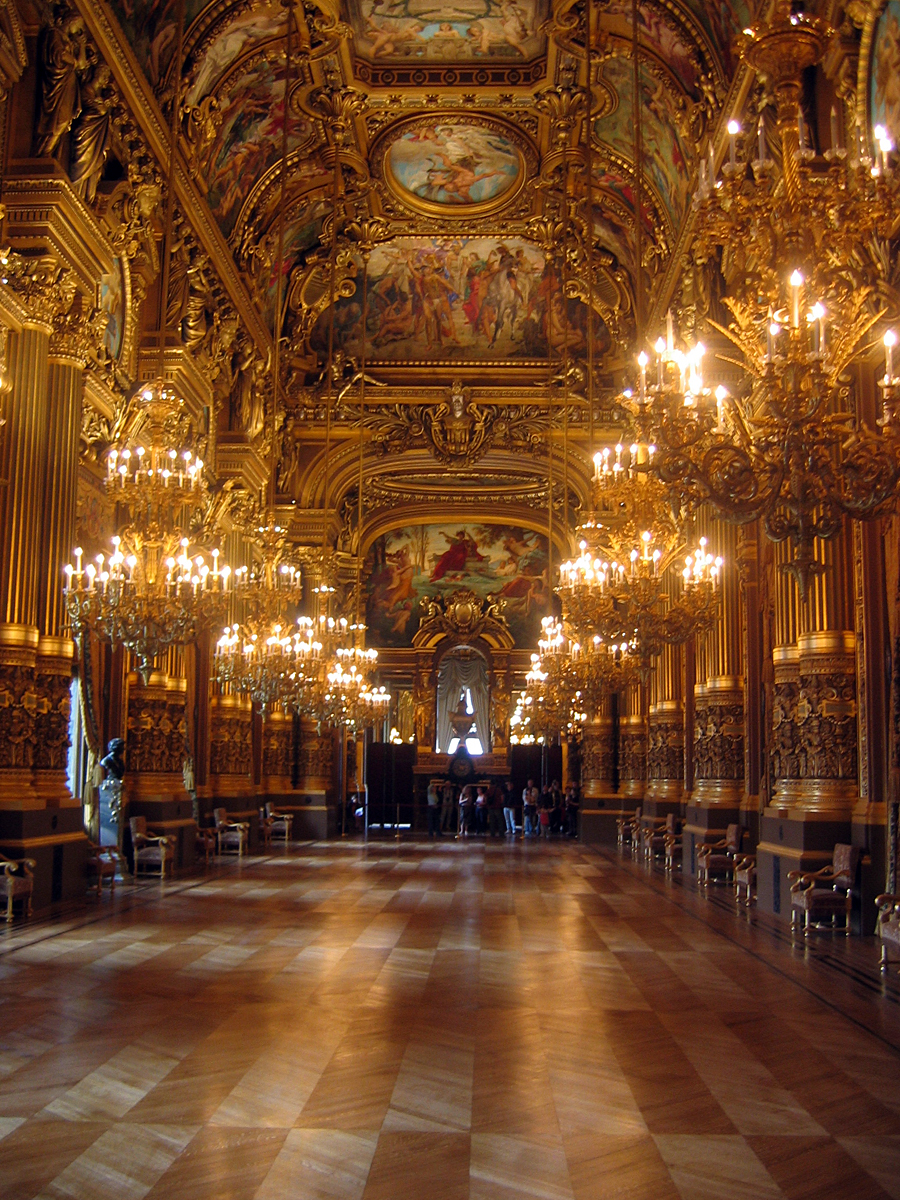
While unparalleled as the location for our conscious representations, glimmerings in the cultural imagination suggest that, as a psychogeography, the Internet is too real, or not real enough to fully articulate the more subconscious aspects of human experience, and other settings may have to be found. Last year I watched the TV show Battlestar Galactica, which (beyond its interesting treatment of the role of belief in the contemporary world) made use of a particular psychic location as a symbolic layer over the real world, directly experienced in visions by a number of the characters: the location of the Opera House. While in the show's plot this location ultimately served as only a cheap visual metaphor, its implications for the cultural imagination are far more suggestive. As an academic colleague pointed out, the Opera House replaces the sci-fi trope of virtual reality with a deeper psychic or subconscious reality, the theater as the place where the contents of our imaginations are made real for all of us. I have dreamt of the Opera House many times (though I was once an actor); it is, as Kerouac says in his own Book of Dreams, the Theater... that old spooky opera house and high school auditorium and classmeet hall of all my days, with hints from all the stages of Time's earth and actors too." While the symbol of the Opera House is still uncharted territory on the Internets, one only has to consider the mythological and ritual bombast of Wagner's operas, or just go see a movie. The drawing of the curtains, or now the darkening of the lights, acts as a veil torn between worlds, so that we sensually enter into the realities of our imaginations; the 3D wonderland of Pandora, the barely repressed longings to rescue Gotham, the Theater as the latest incarnation of the temple sanctum, where the gods become real in us. As Shakespeare said, all the world's a stage. We dream of the day (as Vinge does in Rainbows End) when our technologies allow us to visually project the settings of our imaginations onto the physical landscapes around us, so that we really will inhabit the lands of our dreams.

But where is this place (if not in us), and how are we to get there? The ancient Roman orators had a technique for memorizing long speeches and poems called the Method of Loci: one is asked to create a Memory Palace, taking a highly familiar location and placing in it associated images for the information to be recalled, so that all one has to do is stroll through the loci in the correct order. Personally I am interested in reverse-engineering this process, not further associating psychic terrains but unpacking all the cultural references that have been associated over time to various settings (a hermeneutics of the Opera House, of the Badlands, even of my dreams, whose consistent world this house is a cipher). The cities we inhabit may have a psychological effect on us, but we built the cities in our own image, and buried in them strata of meaning and longing. Perhaps we may uncover the ancient fear of Wilderness that has led so gradually to the current environmental destruction, or just learn to feel at home again, wherever we find ourselves.

11.20.2009

Heavens and Alchemy (fiction)


It was Love at first light, the interconnection of subatomics leaping across the solar winds and the vast gulfs between star systems, our photons rejoicing in that immediate recognition. It was always this way, since the People first flew the Cradle of Worlds into these wider Heavens, replacing the primitive Einsteinian relativities with bonds that knew no bounds or bodies in too small space-time. Strife was vanquished with the false god Physics, and Love reigned supreme.

Or it had, while the People sailed out on Love’s fast fields, connecting the Cosmos as She saw fit. And wherever they alit, greeting the beings they found there as they would greet themselves: in joyous recognition. For they too were One and All, as we, my Beloved, should have been One and All, when the waves we reflected first lit each other’s senses. We sailed across the ecliptic and the trajectory of meteor showers, in search of that Dark Flow, the path that still leads to other Verses, which each god-to-be must traverse in our youth, in order to shower all the Verses with Love’s light, or so our stories go. We were still mortals then, little sparks, foolish as we raced across the terminator, your wings shimmering in Orion’s rays, each of us trying to sail ahead, to stay abreast the revolving darkness, but knowing that no matter how far apart we spanned the aether, our subtle bodies would always be in communication.

Oh Heavens and alchemy, I would have caught the stars for you that rained like angels on our orbits, I would have voiced whole new worlds, with their strange uncertain histories, I would say yes, as you reached the Event Horizon first, and leapt into the dark heart of the Cosmos, all giddy and aglow. As the People have done since we left that cradle Gaia, our split across the interstellar divide should have set a new Verse spinning, should have began the Creation anew. And yet, as I traversed, only moments after your wings brushed the Eternal, I felt you slip away. I know not where or to what Verse you fell, for as I alit in this one I felt all the celestial orbits tremble, and the suns race away as if they were afraid. For the connection to your presence, my Beloved, was nowhere to be found. No, not any beings here to recognize as ourselves in the joyous bonds of Love, no, not any One and All, only myself, particled in the scattering dark. And the stars fly apart, faster and faster than you could have imagined, than any of the stories say. Perhaps Love has been vanquished too in this here-now, for without your connection there is no force powerful enough to hold the worlds together, nothing to reflect and no light left to leap between us.

Yet perhaps this too is story, our secret untold chapter, that in each new Verse, Love must begin anew, alone, in search of its Beloved. That somewhere in these vasts and gulfs you still await, or not yet popped back into existence, specks of stardust accumulating in the warps, gathering into stars and planets that some day may birth beings to reflect Love’s light. And so I must wait, and search, and connect the One and All in the rays beyond space-time, until space and time are born anew, and so are you, and Strife is vanquished, and we fly the worlds and finally meet, in joyous recognition, beyond the edges of everything we are yet to imagine.

10.14.2009

Is the Large Hadron Collider being Sabotaged from the Future? (and other strange news)


This NY Times article was too good not to post, it reminds me of some of the flash science-fictions I was working on in the spring [via metafilter]:

A pair of otherwise distinguished physicists have suggested that the hypothesized Higgs boson, which physicists hope to produce with the collider, might be so abhorrent to nature that its creation would ripple backward through time and stop the collider before it could make one, like a time traveler who goes back in time to kill his grandfather.


It sounds like the funny thing is that this theory is getting valid coverage and consideration as a real reason why no Higgs-producing collider has yet worked. Though Chinese scientists have created a miniature black hole without the world exploding.


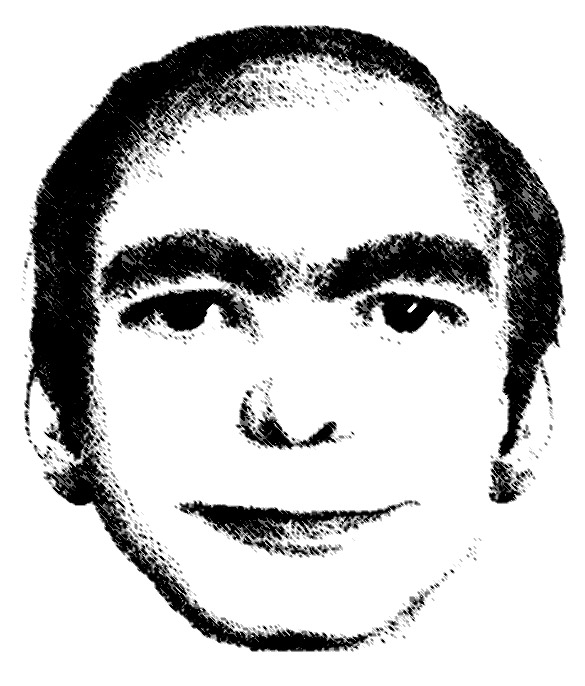
On the other side of the spectrum we have the case of this man [via disinfo]:

"From January 2006 until today, at least 2000 people have claimed they have seen this man in their dreams, in many cities all over the world: Los Angeles, Berlin, Sao Paulo, Tehran, Beijing, Rome, Barcelona, Stockholm, Paris, New Dehli, Moskow etc.

"At the moment there is no ascertained relation or common trait among the people that have dreamed of seeing this man. Moreover, no living man has ever been recognized as resembling the man of the portrait by the people who have seen this man in their dreams."


[Edit: or is this man just a marketing ploy?]

And lastly, the vegetarian spider, which prefers hunting plants to insects, of all the strange permutations nature could come up with.

10.13.2009

The Future of Sex

from H+ magazine [via disinformation]:

“It is important to remember that sexual intercouse is a highly ancient, simplistic-at-its-core activity that we may choose to discard at some point in the future…”

In “Sex and the Singularity,” futurist magazine H+ asks radical techs (including Ray Kurzweil) to describe futuristic “sex after the Singularity.” They envision “more complex activities that generate even more pleasure and connection between people,” and suggest “The primary purpose of the Singularity will be seen, after the fact, to be Awesome Sex.

“There will be exponentially more sex, with exponentially more interfaces, and with exponentially more measures of pleasure.” With “millions of super computer-generated sex fantasies,” one technologist concludes “I love the future. Bring it on.”

“Whether we choose to call it ’sex’ will be entirely arbitrary, but it may bear little resemblance to the sex of today…”

8.29.2009

Review of Tsutsui's Paprika

It's always interesting reading a book after watching (and being a big fan of) its movie version, especially in this case where the book's translation was only finished after the movie came out. Perhaps the main difference in this story about dreams taking over reality through stolen psychotherapy devices is that, unlike in Satoshi Kon's anime, where the more surreal imagery leaps from the screen within the first ten minutes, Tsutsui takes more than half the book for the content of dreams to become manifest. In fact, a quarter of the book passes before the dream detective Paprika enters someone's dream at all. Despite the potential for this to seem really slow, and less interesting than the more frantically paced movie, Paprika the novel actually works best by holding off the potential for surreality to manifest itself, because that allows the author to create a familiar and logical real world first, which is necessary in order to make the weirder elements read as believable. Another interesting twist is that many of the inter-character plot elements held till the end of the movie are given at the novel's beginning, making the story less about finding out how the characters interact but seeing how these interactions change in the face of embodied subconscious impulses.

As someone who has spent a lot of time working with my own dreams in a narrative context, it was interesting seeing some of the ideas that Tsutsui uses for his dream detective's dream interpretation methods, such as having dream characters really represent other people from our memories, which I find a little too simplifying with how dreams actually seem to work, but was necessary for the novel's cohesion. One unique concept is that of "dreason," which opposed to the reason in dreams that allows us to control our subconscious imagery (the translator should have called this lucidity, but for some reason didn't), dreason is the awareness of where logic falls apart in dreams, which keeps us from accomplishing even the most simple task and eventually wakes us up through being startled by frustration, guilt, etc, an idea that I've come up against in my own dreamwork and have called thwartedness, though I think the term dreason captures the scope of it better, and Tsutsui does a good job of displaying this in action, letting dream scenes and characters morph into each other, startling the dreamers who aren't always quite aware when they are dreaming.

One of the deeper themes of the novel, and a necessary one in talking about dreams vs. reality, is unfortunately not introduced (either directly or indirectly) until near the end of the novel, and I would have liked to see be played out from the beginning, more as it is in the Kon's movie: that goodness and evil (or god and the devil in religious terms), are imaginal constructs that are not opposed to each other but are opposed to the banality of everyday life/ human waking existence, the idea being that such extreme aspects of psyche necessitate each other, and the wilder, surreal parts of life, whether desired or feared, are at odds with life as it is lived on a daily basis. Unfortunately this idea just seems tossed off or unfinished, as the setting of a cutting-edge psychiatric institute is not exactly everyday enough to see the range/ struggle between reality and the dreams. Similarly, there is no resolve: good triumphs over evil as if it was reality triumphing over the dreams, which is certainly a common ending, but it perhaps would have been more interesting, and more in line with some of the Jungian psychology that the book draws on, to have the characters find a balance, a place where both good and evil, dreams and the everyday, could coexist as equally real and important, since humans after all are the ones who created these ideas of psychic extremes in the first place and still must learn what to do with them through our imaginations.

Those critiques aside, this book is fantastic, mesmerizing, and full of so many novel ideas and writing techniques that it is a must read for anyone interested in dreams, science fiction, psychology, and plain human behavior.

6.18.2009

Writing and the Future

Story That Takes 1,000 Years to Read [may be] Antidote to Media Whirlwind: "San Francisco conceptual artist and journalist Jonathon Keats is trying to rejuvenate literature in the age of hyperspeed media by writing a story that will take a millennium to tell. The printing process in question is a simple but, as usual with Keats, pretty clever idea. The cover is printed in a double layer of standard black ink, with an incrementally screened overlay masking the nine words. Exposed over time to ultraviolet light, the words will be appear at different rates, supposedly one per century."

I'm not sure if I consider a thousand years to be rejuvenation, more like a clever gimmick that no one will remember tomorrow.

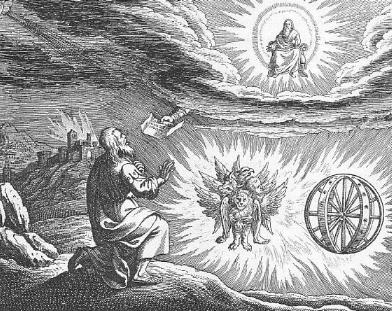
In other news though, physicist Richard Obousy has proposed a "scientifically accurate" design for a "warpship" that closely resembles Ezekiel's vision of "wheels within wheels." Right now the warship is only theoretical, awaiting our ability to harness dark energy. The Discovery Channel website reports that "the shape of the warpship was chosen to optimize the manipulation of surrounding dark energy, creating a spacetime bubble. How exactly the bubble would be created is still a mystery."

The one thing this article doesn't mention is that the wheels within wheels were not supernatural crafts but were the angels themselves. Nor does it mention that every square inch of them is covered in eyeballs. Though that would make for a pretty wild spaceship...

5.08.2009

The Bird Watchers (for Renée)

Little black eyes tremble nervously in the grass, always nervous, always trembling, always prey to the above – blinking – on a tall branch hooded eyes scan the ground, spot the vole, prey, predate, a tension in the claw and feather, to strike – blinking – beyond the camera, a falcon web cam, blue eyes barely catch the peregrine in flight, the beauty of nature’s butchery for the beholder, turn to their companions – blinking – did you catch that? No, we were watching the bald eagles, did she catch that mouse? It wasn’t a, let me play it again so you can see – blinking – eyeless, roving, the camera catches the bird watchers, zooms from street view to aerial, ascending geo-synchronous orbits (we know where you live) – blinking – all the data trapped by satellite, coalesced in a thousand retinaless, searching, sending, the visions of a lifetime in digital format – blinking – spiderbots serving the servers, into the empty iris of the IRS, FBI, tax companies, social networks, Google, empty neural tubes, crawling, webworks, who’s – blinking – watching – blinking – in a back room of the Audubon Society, attentions are measured like Big Brother or reality TV, to monitor which species no one might miss, the prey, the forgotten – blinking –

4.21.2009

Cyberpunk and the Technological Magic of Language

Cyberpunk and the Technological Magic of Language

As the renowned science fiction author Arthur C. Clarke famously quipped: “any sufficiently advanced technology is indistinguishable from magic.” It is certainly true that advanced technologies, such as the intricate logic boards of computers, may seem magical because we do not know how they work, but as Erik Davis, author of Techgnosis: Myth, Magic + Mysticism in the Age of Information, also suggests, “powerful new technologies are magical because they function as magic, opening up novel and protean spaces of possibility within social reality” (180-1).
One of the most important contemporary examples of these magical “spaces of possibility” is cyberspace – a metaphor for the visualization of complex information structures and exchanges endemic to computer networks (191) – which arose from the cyberpunk fictions of Vinge, Gibson, and Stephenson beginning in the mid-‘80s, when such technologies were descending from the realm of literature and fantasy to the actuality of home computer systems. Perhaps anticipating that the technological spaces they described might seem like magic, these cyberpunk authors employed the terminology of the occult as a metaphor for how computer and information systems work. As we will see, this use of magical terminology is entirely apt, as it not only allowed the conceptualization necessary for the creation of our current information technologies, but also articulated one of the primary concerns of our age: that language – the symbolic exchange of information which magic, computers, and literature have in common – has the power to cause real effects in the real world.

True Names and the Magical Metaphor
The occult theorist Aleister Crowley (though undoubtedly one of the most infamous charlatans of modern history) offers in his Magick in Theory and Practice what is considered the best definition of actual magic: “the Science and Art of causing Change to occur in conformity with Will… by the application of the proper kind and degree of Force in the proper manner through the proper medium to the proper object” (xii-i), and gives as an example the publication of a book as a magical way of conveying information to people at a distance. This definition seems contrary to what most people might think of when they hear the term magic, which is either the hocus-pocus of stage magicians or the sword-and-sorcery tropes of fantasy literature and video games. In short we are generally aware of the imagery or the metaphor, but not that magic is primarily a tool (albeit a symbolic one) for getting things done. Erik Davis suggests that by “using language, costumes, gestures, song, and stagecraft, magicians applied techne to the social imagination, actively tweaking the images, desires, and stories that partly structure the collective psyche… which in turn impacted the construction of native reality as a whole” (173).

In his short story True Names – which offered the first fictional representation of that virtual “space of possibility” later called cyberspace (239) – Vernor Vinge uses magical terms drawn explicitly from early computer games in order to describe his information technologies. Cyberspace is called the “Other World” or “Other Plane” and is accessed through “Portals,” hackers are called “warlocks,” and a group or network of hackers is called a “coven” (243-4). The process of navigating through this visualization of information also reads like a fantasy adventure; the hackers have to manipulate symbols, face tests and elementals, and “trade spells and counterspells” (essentially passwords) (254). The story itself critiques and explains this use of jargon and imagery. While the news networks “made it clear there was nothing supernatural about… the Other Plane, that the magical jargon was at best a romantic convenience and at worst obscurantism,” and the world governments refuse “to indulge in the foolish imaginings of fantasy,” the warlock-hackers themselves suggest that “sprites, reincarnation, spells, and castles were the natural tools here, more natural than the atomic twentieth-century notions of data structures, programs, files, and communications protocols… more convenient for the mind to use the global ideas of magic as the tokens to manipulate this new environment” (252, 271).

According to Davis in Techgnosis, this metaphor is effective because “the allegorical and hieroglyphic language of magic works well with the fact that the Other Plane exists simultaneously on two levels of reality” (215). Shamans, Gnostics, and other practical magicians have historically manipulated symbolic representations of information about reality (planetary sigils and runes, angelic or demonic gatekeepers, etc.) in order to concretely effect the world around them, similar to the way that hypertext or the icons of the World Wide Web “function as symbols, inscriptions, and operational buttons; they are both a writing and a reality” (201). Computer programming languages are likewise such symbolic representations that can create realities and make things happen. As the warlock programmer Mr. Slippery puts it in True Names: “even a poor writer… can evoke complete internal imagery with a few dozen words of description. The difference now is that the imagery has interactive significance, just as sensations in the real world do” (252). For an example of computer technology demonstrating Crowley’s definition of magic, one only has to look at the AI the Mailman using its hacking skills to nearly blow up the entire planet, a kind of ‘cyber-magic’ terrorism that the United States government currently states is a very real and dangerous threat to national security.

This issue of security and the danger inherent in both magic and information technologies is made clear in the title of Vinge’s True Names. The power of names is an ancient occult concept summed up in the introduction to the story: “the prudent sorcerer regarded his own true name as his most valued possession but also the greatest threat to his continued good health, for… once an enemy… learned the sorcerer’s true name, then routine and widely known spells could destroy or enslave even the most powerful” (241). Vinge himself believed that “the ‘true names’ of fantasy were like object ID numbers in a large database,” somewhat like modern passwords and IP addresses (16). Early computer scientists, such as Timothy C. May, explicitly used the ideas inherent in this metaphor of magical true names when dealing with issues of “anonymous interaction, reputation-based systems, digital pseudonyms, digital signatures, data havens, and public-key encryption” that were necessary to securely transform the fictional cyberspace into the actual Internet of today (35-6). As Davis suggests in Techgnosis, Vinge was eerily prophetic: “over a decade after his story appeared, the federal government and digital librarians became embroiled in similar debates [as those in the story] over encryption standards, privacy, and online security” (217). One of Vinge’s predictions however is yet to play itself out, the issue of controlling and interacting with self-aware computer systems like the Mailman, called Artificial Intelligences.

Neuromancer and the Spirits in the Machine
William Gibson’s Neuromancer brought the term cyberspace, and the idea of virtual “spaces of possibility,” more fully into the public consciousness, while at the same time abandoning many of the obvious magical metaphors of True Names. Unlike Mr. Slippery, who accesses the Other World Portal through “a certain amount of self-denial – or at least self-hypnosis” reminiscent of shamanic trance states (Vinge 250), Gibson’s cyber-cowboy Case “jacked into a custom cyberspace deck that projected his disembodied consciousness into the consensual hallucination that was the matrix,” which is imagined as “bright lattices of logic unfolding across that colorless void” (5).

Despite the more technological and even gritty, noir descriptions that permeate the novel, Neuromancer still refers to occult language and concepts when discussing the relationship of man to Artificial Intelligence programs, which are still sufficiently advanced enough to be indistinguishable from magic. As the Turing Registry agents warn Case about his dealings with the AI Wintermute, “For thousands of years men dreamed of pacts with demons. Only now are such things possible” (163). Even the AIs’ creators have an uneasy, occult relationship with the beings; Ashpool calls Wintermute “a name… to conjure with, perhaps. A lord of hell, surely,” while Lady 3Jane believes the AIs are “ghosts in the corporate cores” (185, 229). The AI Neuromancer itself echoes a prominent magical axiom, “to call up a demon you must learn its name” (243).

Artificial Intelligences act as the traditional dues ex machina, the god or ghost in the machine, patterns of information that act as if they are intelligent and cause real effects in the world. As Erik Davis suggests, this issue of self-aware digital agents raises the same questions that magicians and ritualists encounter when summoning gods, angels, or demons: how do we know that AIs are sentient beings and not just simulations (197)? Many occult manuals, such as Bill Whitcomb’s The Magician’s Companion, warn: “any concepts, forces, or objects which manifest as entities should be treated as real beings;” just because they can be viewed as patterns of energy or objectified aspects of human personality doesn’t mean it isn’t dangerous to treat them as only non-living (15). The warlocks in True Names likewise treat the were-robot DON.MAC “as though he were a real person. Usually it was easier to behave that way toward simulators” (Vinge 295). Though it may not be possible to know if spirits or self-aware programs are really sentient or real, Crowley suggests, “it is immaterial whether they exist or not. By doing certain things certain results follow” (Davis 183).

For the time being, Artificial Intelligences still remain on the pages of sci-fi novels (though there are certainly many computer scientists working to make them a reality), but the perils highlighted in Neuromancer of dealing with runaway patterns of information are still applicable to our contemporary world. Science fiction author Philip K. Dick worried that our technological environment is becoming increasingly alive; as Davis points out in Techgnosis: “the Internet has already become home to a variety of autonomous and rather parasitic programs – including viruses, Trojan horses, spiders, worms, smartshoppers, and bots” (187). Just because a computer virus, like the recent Conificker Worm, is only made of ones and zeroes, doesn’t mean it can’t wipe out your entire operating system (unless of course you have the correct magical spells of protection, ie: anti-virus software). It is also worth noting that due to the cryptographic near-anonymity of Internet interactions, it is possible to treat other human computer users as merely patterns of information instead of intelligent beings. The flip side of Neuromancer’s artificially aware entities may be a process of technological de-humanization, such as Case’s divorce from the “meat” in favor of mediated virtual experiences (for us, TV, video games, etc.) that reduce us to being passive nodes or routers in a global network of information exchanges, which seem to have more of a life of their own than we do.

Snow Crash and the Power of the Word
In the world of Neal Stephenson’s Snow Crash, “information is power” (379). We can see the beginnings of this concept in True Names, when the warlock Erythrina suggests that hackers “probably understand the System better than anyone on Earth. That should equate to power” (Vinge 268). In Snow Crash however, this equation drives every level of society, from the global media network owned by L. Bob Rife, to the hacker Hiro Protagonist’s job selling potentially useful scraps of information to the Central Intelligence Corporation. This is also a world very much like our own (or at least only a few steps ahead), full of advertisements, strip malls, corporate-controlled politics, and a virtual network “space of possibility” called the Metaverse.

In the story, people access the Metaverse through “audiovisual body” software simulations called avatars (33), a term originally indicating the incarnations of Hindu deities, but popularized to such a degree by Stephenson’s novel that it now applies to any representation of a self in a digital world (Davis, 223). Descriptions in Snow Crash of the Metaverse, which is “subject to development,” the construction of “buildings, parks, signs, as well as things that do not exist in Reality” (23), could easily apply to contemporary virtual realities and MMOs, massively multiplayer online worlds such as Second Life. Even information tools in the novel, like the CIC software Earth, which tracks spatial information of “maps, weather data, architectural plans, and satellite surveillance” (99), are now almost fully realized in programs like Google Earth.

If the techno-socio-economic world portrayed in Snow Crash seems viably realistic, then so to is the novel’s depiction of magic. Stephenson does not rely on fantasy tropes as a metaphor for information technologies, but instead presents magic as a historically researched plot element, modernizing the ancient concept that language – the symbolic exchange of information – causes real effects in the real world. The central conflict in Snow Crash is the resurrection of an ancient Sumerian nam-shub, described as a neurolinguistic virus, essentially “speech with magical force “(197), which Rife wants to use to gain greater control over people’s minds. This concept of language as “both a story and an incantation… a self-fulfilling fiction” is explicated in the novel through several chapters of researched information, and relies on the Sumerian concept of me: linguistic units that functioned as “algorithms for carrying out certain activities essential to society” (202, 240).

Stephenson is quick to draw a connection between the concept of me and the functioning of computer technology. He suggests, “The Metaverse is a fictional structure made out of code. And code is a form of speech – the form that computers understand. The Metaverse in its entirety could be considered a single vast nam-shub,” but also that “the belief in the magical power of language is not unusual, both in mystical and academic literature” (197, 256). As Davis points out in Techgnosis, language is perhaps the earliest and most pervasive human technology, and the supernatural or performative power of names haunts the majority of early linguistic cultures and religious traditions (23-5). It is not just a coincidence that we use the same word “spell” to describe both the construction of words and the performance of magic. Contemporary scientific studies echo Stephenson’s position that learning new information forms neurolinguistic pathways in the deep structure of the brain (117); language effectively creates our perception of reality.

As we see in Snow Crash, the issue inherent in such operational or performative language is in who controls its use: “someone who knows the right words can speak words, or show you visible symbols, that go past all your defenses and sink right into your brainstem” (369). In our contemporary world, like in the novel, this is done through advertisements, viral marketing campaigns, the three-ring binders that allow franchises to operate, and any and all media and information technologies. We have even come up with an equivalent to the Sumerian me: memes, a term coined by the scientist Richard Dawkins that refers to a unit of cultural information virally transmitted between people through speech. As Hiro explains in Snow Crash, “we are all susceptible to the pull of viral ideas. Like mass hysteria. Or a tune that gets into your head” (373). Information does not have to be self-aware like AIs in order to be dangerous! On a much broader scale, whole social, political, and economic realities can be magically constructed from a single linguistic document. As the Metaverse “is just a computer-graphics protocol written down on a piece of paper somewhere” (23), so to is the United States of America a “space of possibility” constructed from the language of the Declaration of Independence.

One can easily see the problems that arise when we passively relinquish our operational relationship with information to vast media conglomerates and religious or political ideologues like those in Snow Crash, or those in our own world. As Nietzsche expresses it, quoted in one of the articles that prefaces True Names, “The master’s right of naming goes so far that it is accurate to say that language itself is the expression of the power of the masters” (43) On the other hand, those of us fortunate enough to be literate can, like Hiro Protagonist, write our own codes and stories that present equally valid linguistic realities. Vernor Vinge claims that, “up until the personal computer came along, Orwell’s vision [in 1984] of technology as the enabler of tyranny was the mainstream view. But in the 1980s… people with PCs began to realize that computers might bring the end of tyranny” (22). Ultimately, the true magic espoused in the fictions of Vinge, Gibson, and Stephenson is not merely their envisioning of technological “spaces of possibility,” but their insistence on inhabiting those spaces with neuromancers, literally magicians of the mind, willing to confront the dangers and complexities of informational systems, in a manner that upholds our human freedom to linguistically construct the worlds that are our future.


Works Cited

Crowley, Aleister. “Magick in Theory and Practice.” Dover Publications, Inc. New
York: 1976

Davis, Erik. “Techgnosis: Myth, Magic + Mysticism in the Age of Information.” Three
Rivers Press. New York: 1998

Gibson, William. “Neuromancer.” Ace Books. New York: 1984

Stephenson, Neal. “Snow Crash.” Bantam Books. New York: 2000

Vinge, Vernor. “True Names: and the Opening of the Cyberspace Frontier.” Ed. James
Frankel. Tor Books. New York: 2001

Whitcomb, Bill. “The Magician’s Companion: a Practical and Encyclopedic Guide to
Magical and Religious Symbolism.” Llewellyn Publications. St. Paul: 1993

3.13.2009

The Circles (in the style of Faulkner)

We laid ‘em low. Pa said to grab the scythe an the lantern, an head out to the am’ranth, e’en of itn so dark it scares me. He grabbed the bundle an when he done buryin it Pa come out ta help me cut. I ask him why’rd it gottena be circles if they was commin out anyways, an he jus’ slap me an say ta keep on cutting ‘em. Aftern hour or so we’d gotten three circles down an half the lines, an he finally say cause thatn what Snopes did when they’da come out for them horses he stolen. Snopes jus’ cut the circles an when the goverm’t come out they jus’ paid him off ta hushn it up. Never asked about no horses. Why’d they do that, I say, an Pa jus’ give me that look, liken what he gave me when he found me still holden the shotgun in ma hands, an he say keepn cuttin. Ifn only yarn brother was here to help, we’da get these crops laid low afore morn.

Well, when we’sa finally done, an the sun start to dis’pate the witchin’ lights of the fog offna highway, Pa, he took a deep sigh, leanin thar on the handle the scythe like he’n a skinny grey shadow, when finally he ses it: alyens. Whatn ya mean alyens, I ses, like the ‘drigez family thatn come up narth an you ses a stealin all the jobs atn the plant? Nome, he cuffed me agan, an stared up trembling atn the silent orange dawn. I don’t mean no man asa come across a natchel border. I mean alyens, from upn stars. Goverm’t don’ like ‘em none. An I nodded, an I knew then whatn he meant, cause Jed’d read them stories to me at night and say theys a comin and it scaren me so bad that I… So I’sa started runnin, lookin up at ‘em fadin night an them hostile stars as ifn some fant’sy ship is gonna come sail’n outna ma nightmares.

So when they foun me, hidin in the hedges, I hollered good, them flashin lights an beams I thoughtn was some space monster, an I started holler’n real good then. We did it, I ses, cause’n me ‘at shot Jed, an so we made ‘em crop circles, but we’s did it, not yarn, I swear. Please don’ taken me up in yar mothernship or noth’n. Son, they ses, watchu holler’n ‘bout, an then I don’ know whetherna laugh orn cry, cause’n it was only the goverm’t an’ I scared it was some bug-eyed alyen!

3.12.2009

The Small Storm

How disappointing, she thought as she strode down the hall of the National Museum, where Lincoln’s gold pocket watch had just been opened up to reveal a message engraved inside by an erstwhile jeweler on the first day of the Civil War. The miniscule words were not nearly as exciting as the apocryphal version, but then again, she tweeted, kicking her long legs into the shoebox-sized taxi, most of what people say nowadays is drivel too. It was like some anachronistic twitter, a linguistic Kilroy that had taken 150 years to upload. And besides, what gadget was still large enough to engrave something on its surface?

Everything was getting smaller. She blinked in the article on her thumbnail-sized cell phone while checking her bags. Cars, microchips, certain species of mammals, even the lines at the airport were microsized, she smiled, whisking through security, now that the economy’s shrinking. Of course, so are the airplanes. She scrunched up her legs, trying to get comfortable in the clownishly small seat, graciously accepting a complementary peanut and thimbleful of ginger ale. It’s a good thing I’m on a diet, though these bones won’t start shrinking for another few decades yet!

But then, just before they reached Boston, where the technological conference was to be held and she hoped to find something smarmy to tweet about, a tremendous thwomping noise resounded through the cabin. Why, she thought, just before everything went black, maybe it’s one of those mysterious sonic booms that have been occurring up and down the Eastern Seaboard all week I was just reading about on my RSS feed.

Miraculously, she found when she woke up, everyone had survived the crash landing. They were in a deserted grassy field with no civilization in sight, perhaps one of the last places in the country, she speculated, without at least power lines. At least she could stretch her legs now, but just as she stood up and threw back her hair another loud boom sounded, and then another, knocking her over, flattening small patches of grass about the field. It’s like the Tunguska Event, she wanted to report, that whole Russian forest flattened in one fell whoomp, except much smaller, as if the electrons in the air were suddenly all speeding up, popping into and out of existence. It was almost magical, except that she had no wi-fi to share it with the rest of the world.

But then, what should appear, but a team of the new emergency response microcopters, little dust mote sized hotspots battling against the small storm of booming electromagnetic chaos to establish for one moment a local network of internet connectivity. She danced up and down, she could tweet at last, but then she stopped, uncertain and trembling, for how was she going to describe this to anyone, this patently absurd series of events, in 140 words or less?

3.05.2009

The Instant Engine

Struggling to reconstruct the speculative technologies lost when the Great Singularity had collapsed all centuries into one interpenetrating pan-spacetime, they had first succeeded in reimagining the now whimsical Faster-Than-Light and Faster-Than-Dark drives. But it was patently clear in this hyper-connected agelessness that though one couldn’t go faster than discrete energy fields, one, or many, could easily outrace light by already being in the temporality in which the pre-probability waves would shortly quantize. And so the Faster-Than-Now drive was born, called in popular parlance the Instant Engine, or by the retro-fantasists a time travel machine: a small plastic torus set spinning in the belly of a large plastic torus, which was the vessel, and looked like nothing except a large plastic donut, without wings, or any other evident aerodynamic or propulsionary devices.

The team had been assembled with great care and the exaggeratedly patient expediency with which everything was done now that time had been abolished. Scientists of the highest caliber, archeologists, linguists and interpreters, and technicians in case of the inevitable breakdown all stood trembling in the hanger bay, for this was to be (and immediately should already have been) the first attempt to connect the everlasting present with one of the disparate moments in history with which humanity had always been plagued before, an event that would itself be historical if it didn’t already exist outside of such temporally-absurd, arbitrary perspectives. But to be on the safe side, they had decided not to risk all the bugaboos and paradoxes of the extant prophecies – the few remaining pre-collapse science-fictions – and instantize in a somewhere, a somewhen, that would not unduly traumatize the pre-atemporal mentalities of those they might encounter. To this end, a young and already ancient ahistorian suggested they leap to a less unwieldy and potentially awkward moment then say, Hitler’s bunker at the end of the second great war, or Roswell in the late ‘40s, and appear instead somewhere out of the way, but no less rich in historical data. So they picked the Archives of Cologne, just prior to their collapse in what had been considered in the old frameworks early 2009. As all of the Archive’s records and artifacts had been demolished when the bunker, which had been designed to outlast the apocalypse, clearly didn’t outlast much of anything, it would be an easy thing to jump in, pick up some noteworthy pieces of time, and jump back out without causing much of a rift or reversal.

After the brief but interminable speeches by each member of the planetary congress, the crew boarded and began spooling up the FTN drive. There was a pause, a blink of the eye, an almost miniscule yet monstrous gap, on the other side of which the crew might have wondered if they’d gone anywhen at all, except for the epic tearing noises and cascading rustles caused as the Archive’s massive concrete walls and towering stacks of old newspapers and estate files all fell around and on top of them at once, in that one momentous instant when they did indeed intersect history by causing the Archives of Cologne to collapse, through their arrival, half an hour earlier than it had collapsed in all previous spacetimes. From the limited, one-way perspective of most in-timers however, there was nothing odd about this at all: it was simply when this event happened. As for the crew of the timeship, in order to forestall the embarrassment of discovery, they made one last sudden and uncalculated jump, to some distant and farflung spacetime from which they have not yet been heard from again.

3.02.2009

The Operating Manual

Worried over the global economic crises and wondering where he was going to get the budget to balance the lot, Obama was invited on a personal space tour (which was also looking for funding). Pondering if the ship had an operating manual as they alit up the gravity well, or at least an abort button, he turned to the window and soon money lost its weight. There was Earth, a little cloudier and muddied than he imagined. But, Obama smiled, that’s what made it real. The planet was breathtaking, all sun soaked amidst the embering stars, if not a little on the small side.


I apologize for the lack of posting in the last several months. I have been inordinately busy with school and going through what is most likely my Saturn Returns, attempting to find new perspectives on reality and how I can best approach it in the coming decades without giving up, getting jaded, or going crazy. On the other hand I have become obsessed with the concise narratives of flash or short short fiction, and so hopefully I will post more like the above here in the future as I work out some aesthetic and global theories. I have been particularly distraught over the news that the increased rate of expansion of the Universe will one day mean the vanishing of all the stars from the sky. Of most use in formulating more hopeful positions on life today has been R. Buckminster Fuller's Operating Manual for Spaceship Earth (full text online).

In the mean time, I posted a new story called In the Moment on my Goodreads account, a sort of absurdist tour diary of my rock and roll days in which a stolen book of censored songs precipitates the end of the world as we know it. Enjoy!

12.12.2008

The Imaging of Dreams

Many years back I had a dream in which there had been invented the technology for people to record their dreams while asleep so that others could later view/ dream them for themselves. I called it the Subjunctive Dream Network, and many years worth of hilarity ensued in which I would be having a particularly terrible dream only to wake up (in another dream), take off the sleep mask and wires, and be thankful it was only someone else's dream I had been viewing.

It now seems that a group of Japanese scientists are in the process of developing software that can actually process and display the images of thoughts and dreams on a computer screen, which is a step closer to making the Subjunctive Dream Network and actual reality (though one imagines there's still lots of kinks, if this is actually true). Of course, it also means that instead of writing out all my dreams to use as material, I could just be making a movie while sleeping!

11.16.2008

Snowy Day Update


I realize I haven't been posting here in a while, not once all October! School's been rather consuming this semester, as has my writing (not just the storytelling but notes on aesthetic and spiritual systems and the use of fiction as a tool for processing the emotions, but more on that later perhaps), and as always my personal life seems to take more precedence. It also doesn't help that I no longer have home internet access, though I find I'm now getting more done with myself, which is a blessing. Except for when I pick up a stray wireless signal.

Anyway here are some links for your perusal:

The life and work of James Joyce explained
The life and work of Joseph Campbell
Big Dreams and Archetypal Visions
The Future of Science Fiction
Obama on Faith

"I believe that there are many paths to the same place, and that is a belief that there is a higher power, a belief that we are connected as a people. That there are values that transcend race or culture, that move us forward, and there's an obligation for all of us individually as well as collectively to take responsibility to make those values lived." - Barack Obama

11.02.2008

Dystopian Symbols and Counter-Symbols in V for Vendetta and Alphaville

Dystopian Symbols and Counter-Symbols in V for Vendetta and Alphaville

In “Our Future – Our Past: Fascism, Postmodernism, and Starship Troopers,” Florentine Strzelczyk argues that Hollywood is fascinated with the aesthetic of fascism, especially that of Nazi Germany. Filmmakers use fascist-styled uniforms, symbols, and other elements of mise-en-scène in order to create recognizable dystopian societies – science fiction fascisms. It is interesting to note however that the Nazi Party’s primary symbol, the swastika, was already a recontextualization of an ancient Indo-European sun symbol, through which they were able to express their own dystopic aspirations for the future. The films “V for Vendetta” and “Alphaville” both present dystopian societies that recontextualize familiar symbols through their mise-en-scènes in order to represent the content and style of their particular fascistic worlds, as well as the counter-revolutions to those worlds.

James McTeigue’s 2006 film, “V for Vendetta,” depicts the Norsefire party, a religiously conservative dictatorship that has taken over England in the year 2038. Beyond their Nazi-esque uniforms and Orwellian surveillance and slogans, the Norsefire Party’s primary symbol is a doubled cross, shown in red on a black background. This symbol was originally the Cross of Lorraine, used by the French to counter the Nazi swastika during World War II. In the film this symbol also perverts St. George’s Cross, a single-armed red cross on a white background that historically served as the flag of England and the Church of England, as well as distorts the more familiar Christian cross. The Norsefire party has practiced Nazi (and Christian)-style religious discrimination against Muslims, Jews, and racial and sexual minorities in order to achieve power, and in the movie’s opening newscast the Voice of the Party argues that England prevails because of its faith in a judgmental God watching over the country.

The Norsefire Party’s doubled cross appears many places in “V for Vendetta,” on the Party posters, on the fingermen’s badges, and in news clips, suggesting the ubiquity of the regime. The symbol most predominately appears though along side the massive view screen on which is projected Chancellor Sutler’s face. As the leader of the fascist party, Sutler’s video appearance next to these monstrous doubled crosses suggests that he himself is the removed and ever-watchful God of England, or at least an omnipresent figure reminiscent of Big Brother in George Orwell’s dystopian “1984.” While it is implied that the crosses are always next to the Chancellor’s view screen, we only see them in specific shots, such as when Sutler demands the falsification of news or a desire to speak “directly” to the people. What is made clear about the symbol’s appearance is that it seems to occur only whenever the government is telling blatant lies. The Norsefire Party’s favorite political technique is double crossing the English people, and the symbol of the doubled cross directly illustrates this each time it is depicted on camera. Even during the art-terrorist V’s newscast early in the film, the doubled cross is shown next to him when he suggests that the people let themselves be tricked by the war, terror, and disease orchestrated by their government.

As opposed to the Norsefire Party’s doubled cross, V employs his own counter symbol, a circled letter V. V’s V does not directly reference or distort the government’s symbol, it is instead a depiction of his historical reasons for vengeance; V was held in room five (the Latin numeral V) of the Larkhill detention center where he was horribly burned and many minorities were killed by the government. This symbol however is displayed in the film in the same red on black as the doubled cross: in V’s newscast, slashed or painted over the Party posters, and even in fireworks over the exploding Bailey and Parliament buildings. Aesthetically, the image of red spray-painted lines over the posters most directly references the pop-culture image of the anarchist symbol, a red, circled letter A. V’s revolution depends exactly on the kind of people-driven chaos discussed in anarchist theories and misrepresented by current popular media. In “V for Vendetta” it is a young girl shot for spray painting V’s symbol that pushes the English people over the edge towards anarchistic rebellion.

While V’s symbol appears all throughout the film, he also employs the V on a linguistic level, taking it out of the level of mise-en-scène. In his opening speech to Evey, V sums up his own political theory using fifty words beginning with the letter V. We also later see that V’s motto is the Latin phrase from Faust, “Vi Veri Verdiversum Vivus Vici,” by the power of truth, I, while living, have conquered the Universe. In his newscast, V tells the people of England that words will always maintain their power as an annunciation of truth, and his speeches clearly illustrate this power of language. Unlike the Norsefire Party, V understands that a symbol (like the act of blowing up a building) is by itself meaningless, and must be given an actual voice by actual people in order to have a real affect on the world.

The dystopian symbols and counter-symbols in “V for Vendetta” are clearly depicted, but such is not the case in Jean-Luc Godard’s 1965 film, “Alphaville.” The dystopic government in this movie is a technocracy run by the scientific-logical computer Alpha 60. While Alpha 60 does not employ a direct or ubiquitous symbol like the Norsefire Party’s doubled cross, a set of scientific symbols occurs that can represent the regime: Einstein’s famous formula for mass-energy equivalence, E = mc2, and Planck’s equation for the quantization of light energy, E = hf. Historically, Einstein’s equation stood as a revolution in physics, unifying specific conservation laws of mass and energy into a larger theory under the specific speed of light, though the formula is also linked popularly with ideas of scientific destruction through its use in the creation of the atomic bomb. “Alphaville” plays on this idea that light energy is a logical, destructive power, as, according to Professor Von Braun, the creator of Alphaville, they are entering a Light Civilization attempting to take over the universe.

Planck’s equation states that the energy of light is carried in discrete amounts in relation to its frequency; light is quantized, or, in popular terms, it is digital rather than containing a continuous spectrum of possibilities. In “Alphaville,” the computer Alpha 60 is described by the agent Henry as being 150 light years more powerful than any previous computer, a discrete number he returns to later in his tale about ant societies. This dystopic society similarly operates under the idea that certain words have certain, discrete meanings: any uncertain words are removed from the Bible-dictionary and replaced by more specific ones. Language, like light, has become quantized, and is used as an element of control, much as it is in “V for Vendetta.” This use of scientific equations as fascist symbols in “Alphaville” echoes the head programmer’s statement to agent Lemmy Caution that an order is a logical conclusion; the logic of science cannot be disobeyed.

The biggest challenge in interpreting these scientific formulas as dystopian symbols in “Alphaville,” and in determining the appropriate counter-symbols, is that they only appear in two specific scenes, in brief flashes during moments when Lemmy Caution is figuring out how to counter Alpha 60’s control. In the first of these scenes, Lemmy has just learned from Henry about the computer, and directly following the symbols he says that people have become slaves of probability, statistics and equations being science’s way of controlling people’s perception of what is possible in reality. Henry goes on to tell a story however about a similarly technocratic ant society that 150 light years ago had artists like those in Alphaville, and then the equations flash again, remixed into the statement hf=mc2. Several things are happening here: the equivalence of E in the two formulas could imply that the particle scale of hf, or of the ants in Henry’s story, is the same as the galactic scale of mc2, that Alpha 60 is not only killing artists in Alphaville but would do the same throughout the universe.

Secondly, there is the suggestion that artists offer an alternative to scientific-logical control of how people perceive the world. Throughout the scene and film both of the agents reference popular and artistic culture in their dialogues: comic book detectives of the time; women from French literature; and after being given the poetry book of Éluard, Lemmy says that he is going on a “journey to the end of the night,” a reference to another French novel of the same name that apparently satirizes scientific research. We see the same thing in “V for Vendetta,” where V (and other outlaws like Gordon) attempts to keep human culture alive through collecting censored cultural artifacts and referencing them in dialogue that contrasts with the fascist regime.

During the Institute of General Semantics scene of “Alphaville,” Alpha 60 says that life and death are discreet events on the circle of time. This is echoed later when the scientific equations are flashed again, while Lemmy is being shown a tour of the computer. At this point the symbols flash slower, from left to right, while the computer says that Lemmy thinks more of the past than the future, and then again while Lemmy remarks that he is too old, and that shooting first is his only weapon against fatality. This differentiation between kinds or perspectives of time echoes the earlier symbol scene, most importantly the instant when Lemmy questions the specific 150 light year time frame of Henry’s story and then sets the bare light bulb swinging. This moment suggests that instead of the discrete, logical quantities of energy or power utilized by Alpha 60 through the E=hf equation, light, and life itself, exist in a continuous spectrum that can be accessed through the illogic and uncertainty of art. The past, with its implied reference to artifacts of human culture, can become a weapon against the cultureless dystopian future envisioned by the machine. Most precisely, or creatively, Lemmy uses the culturally subjective meanings of poetic words – symbols without the fixed meanings of scientific equations – to destroy the computer and its fascist society.

There is thus no clear counter-symbol that Lemmy uses in “Alphaville;” poetry is not an emblem to be flashed quickly on a screen or be represented as a direct element of mise-en-scène. Even when we are shown the supposed copy of Éluard’s “The Capital of Pain,” the camera has to slowly pan over the text in order to give the viewer time to interpret the meaning of the words, much the way that Alpha 60 destroys itself slowly by searching for the answer to Lemmy’s poetic riddle. But, as we saw in “V for Vendetta,” it is not V’s fast, iconic V symbol that changes his world either. It is instead the meanings given to symbols and words by people themselves over culturally continuous times (or despite culturally-destroying times) that make symbols powerful, and ultimately keep us free.

9.08.2008

Water Bears in Space


While I don't usually post stuff like this here, I've been somewhat fascinated by tardigrades, more commonly known as water bears, for years now. What's not to love about a cute little microscopic critter that can repair its DNA and survive radiation and exposure to extreme elements by essentially dehydrating itself? In fact, water bears are so hardy that they can survive direct exposure to outer space.

8.11.2008

Miniature Worlds

Found through the newly redesigned tor.com website, the delightful miniature worlds of Red Nose Studio.


From the bio:

Chris Sickels, the creative force behind award-winning Red Nose Studio, creates an eccentric world we’d all like to visit. Endearing characters and intricate sets draw you in with wit, intelligence and charm. His three-dimensional illustrations are built from a variety of materials. Sets and puppets are a combination of wire, fabric, cardboard, wood, miniatures, found objects and anything else within arm’s reach.

6.15.2008

New Writings

I've added several more short stories to my Goodreads page for your reading pleasure: In The Roof, an older piece of psychic-fiction; Beast In The Eye Of, a recent story about a golem, religion, and control; and Echoplex, an unexpected horror story about love and underground shopping malls.

I also present to you this interesting and somewhat Beckettian blog, the fall and demise of the artist as a young man.