Showing posts with label news. Show all posts

12.17.2009

The Unlimited Story Deck is now online!

I finally finished designing the website for my final project for my Narrative and Technology class, and the Unlimited Story Deck is now available online!


On the site you'll find an introduction, rules, playtested stories and analyzes, and downloadable versions of all the cards (licensed under Creative Commons). I will be continuing to test out the limitations of the deck and revise it for a gamma version and eventual publication, so if anyone's still interested in trying it out, either download the Deck or get a hold of me to play it.


It's been one hell of a process banging my eyes off html code the last couple days and I am in much need of a break!

11.10.2009

Disasters are Waiting for All of Us

Despite the fact that the Mayans have strongly emphasized that the western world has entirely misinterpreted and appropriated the year of 2012, that their myths say nothing about the end of the world, our telling of that story has become so hyped up by the media that the "2012 Prophecy" is actually sparking real fear and suicides. As the new movie convinces people that we are all going to die, others try to combat the myth by hopefully providing more accurate information. Or if that fails, suggestions on plans to ensure the continuity of our species. While asteroid defense, planet hacking, terrestrial seed vaults, lunar doomsday arcs, and off-world colonization all seem like noble, albeit sci-fi options (along with more actual attempts at space elevators and solar sails), it seems that culturally there is still the tendency to either believe that we are all going to die in 2012 (and perhaps that's a good thing) or that none of this is true (not even environmental degradation) and we should continue to live the technologically destructive lives we've been living throughout the last century.

Personally I hold the middle ground, that the whole 2012 phenomena is a myth, a story we have taken to heart because it is very suggestive to us of the possibilities of what might happen and what we ought to do about it. This means that 1). it is unlikely that anything untoward will actually happen on this date (besides perhaps some spectacular astronomical movements), and 2). despite this myth not being literally true, it is still figuratively significant in telling us that we really do fear the end of the world in some form, and that we are either responsible for bringing it about or for stopping it if at all possible. I feel that if we really are concerned with the continuity of our species, along with that of the planet that makes life possible for our species, instead of coming up with far fetched worse case scenarios or ignoring the mess altogether, we instead have to begin telling truthful stories about what is actually going on in the world, what might actually happen, and those immediate steps that will have to be taken to deal with it. No more fear-mongering or denial, but futurestance. We need stories that tell us how we are in the world, and why, and what we need to do.

Part of the problem here is a lack of any current mythology to address the rampant technological changes of the last century, which combined with the continually growing disbelief in the value of belief seems to spell disaster at every turn. One of the earliest functions of myth, as maps for human action, was casting reality in terms of ultimate significance. We are here and act as we do because the gods do it/ our ancestors do it, etc. The most we can say now is that we do because our celebrities and politicians do it, but we are as avid in taking them down to our level and know they are just as fallible, just as human. Not to advocate a return to belief in gods as really real, but our lack of contemporary myths of such large significance pushes us out to the meaningless edges of the cosmos where we no longer have any reason to believe or act with even the present in mind, let alone the future. I feel that what is lacking and most needed are new myths that replace us as central characters of our own story, not Earth as the physical center of the Universe, but us as the storytellers as the key for the meaning of our experiences, that is, myths that stress the responsibility we have as stewards of ourselves and the world which we've decided we control, stories that suggest that cooperation, multiple points of view, responsibility, awareness of actions, etc. are all heroic qualities that may have the most real effects in staving off whatever apocalypses we come up with to amuse and frighten ourselves.

11.09.2009

Adaptive Fictions

This is an interesting look from evolutionist Erin Johnson at the adaptive role fictions play in helping humans survive (from an article on Atheism as a Stealth Religion), not just in religions' use of gods, but in any thought or belief, that is expression as mythology:

This leads to a crucial distinction between what I call factual and practical realism. Consider Hans and Igor, who are mortal enemies. Hans understands that Igor is much like himself, even to the point of competing for the same square of ground. Igor regards Hans as an inhuman monster, completely unlike himself. If Igor's belief makes him fight with greater determination, then it counts as practically realistic, even if it is factually incorrect. Now imagine similar contests among beliefs--and the brains that create beliefs--taking place over thousands of generations of genetic and cultural evolution. Voila! We arrive at a conception of human mentality that is far more nuanced and interesting than the black-and-white cartoon of atheism vs. religion.

Factual and practical realism are not always at odds. To pick an obvious example, a hunter needs to know the exact location of his quarry. The point is that the relationship between the two is complex and that our minds are prepared to massively depart from factual realism, when necessary, in ways that motivate effective action. This is not a sign of mental weakness but a time-tested survival strategy. Moreover, adaptive fictions are not restricted to religions. Patriotic histories of nations have the same distorted and purpose-driven quality as religions, a fact that becomes obvious as soon as we consider the histories of nations other than our own. Intellectual movements such as feminism and postmodernism are often shamelessly open about yoking acceptable truths to perceived consequences. That's what it means to be politically correct. Scientific theories are not immune. Many scientific theories of the past become weirdly implausible with the passage of time, just like religions. When this happens, they are often revealed as not just wrong but as purpose-driven. Scientific theories cannot be expected to approximate factual reality when they are proposed, but only after they have been winnowed by empirical evidence.

These and other belief systems are not classified as religions because they don't invoke supernatural agents, but they are just like religions when they sacrifice factual realism on the altar of practical realism. The presence or absence of supernatural agents--a particular departure from factual realism--is just a detail. It is humbling to contemplate that the concerns typically voiced about religion need to be extended to virtually all forms of human thought. If anything, non-religious belief systems are a greater cause for concern because they do a better job of masquerading as factual reality. Call them stealth religions.

11.06.2009

Ancient Verse

I've been doing a lot of research recently for an essay to submit to the upcoming Immanence of Myth anthology, and have particularly grown fascinated by the scope of history, and particularly the birth of writing in the Mesopotamia river valley. Most well known is the Epic of Gilgamesh,a hero-myth written down in the 23rd century BCE Akkadian Empire, and for all intents the first action story as well as model for how kings and men ought to behave.


Around the same time though we also apparently find Enheduanna (above), daughter of Sargon the Great of Akkad, high En (priestess) of Nanna, and the first poet known by name, if not the first recorded author. The link contains links to some of her poems, which seem for the most part to be temple hymns to Innana and other Sumerian goddesses. It is interesting to note that after the development of writing, it seems most myths and stories were told in poetic verse, and most narratives were mythic, which lasts until the second emergence of Greek culture and the prose myths of Hesiod's Theogony (800 BCE).

Non-mythic literature doesn't arise until the Japanese serialized "novel", The Tale of the Genji (finished 1021 CE), and European Medieval allegories of the 1300s. We don't start taking stories as literally fictive until Robinson Crusoe in 1719, and even then it had to be published as a "petite historie," a private, little, or dubious history, perhaps because it was still hard to believe that something you hear is true in itself though not true in reality, a bit of doublethink those of us who've grown up in the present are accustomed to.


And just because this is now becoming an absurd saga, Baguette Dropped From Bird's Beak Shuts Down the Large Hadron Collider (Really), from Popular Science.

10.28.2009

Fictionology

In light of the Church of Scientology being convicted of Fraud in France, the Onion offers this brilliant mock competing religion, Fictionology [via mutate!]:

Fictionology’s central belief, that any imaginary construct can be incorporated into the church’s ever-growing set of official doctrines, continues to gain popularity. Believers in Santa Claus, his elves, or the Tooth Fairy are permitted—even encouraged—to view them as deities. Even corporate mascots like the Kool-Aid Man are valid objects of Fictionological worship.

“My personal savior is Batman,” said Beverly Hills plastic surgeon Greg Jurgenson. “My wife chooses to follow the teachings of the Gilmore Girls. Of course, we are still beginners. Some advanced-level Fictionologists have total knowledge of every lifetime they have ever lived for the last 80 trillion years.”

“Sure, it’s total bullshit,” Jurgenson added. “But that’s Fictionology. Praise Batman!” [...]

“Scientology can only offer data, such as how an Operating Thetan can control matter, energy, space, and time with pure thought alone,” McSavage said. “But truly spiritual people don’t care about data, especially those seeking an escape from very real physical, mental, or emotional problems.”

McSavage added, “As a Fictionologist, I live in a world of pretend. It’s liberating.”


Interestingly, I personally suspect that if there is any kind of contemporary folk mythology, this is essentially it, the belief in any literary or culture character as an object of worship, wisdom, or personal identification. Just because in the past the culture characters we did this with were gods does not mean contemporary characters are any less available for their symbolic significance. One just has to look at the hype surrounding the release of new superhero movies, the lines around theaters like ancient temples. Perhaps without intending to the Onion seems to have hit exactly on what makes pop culture tick in the human heart.


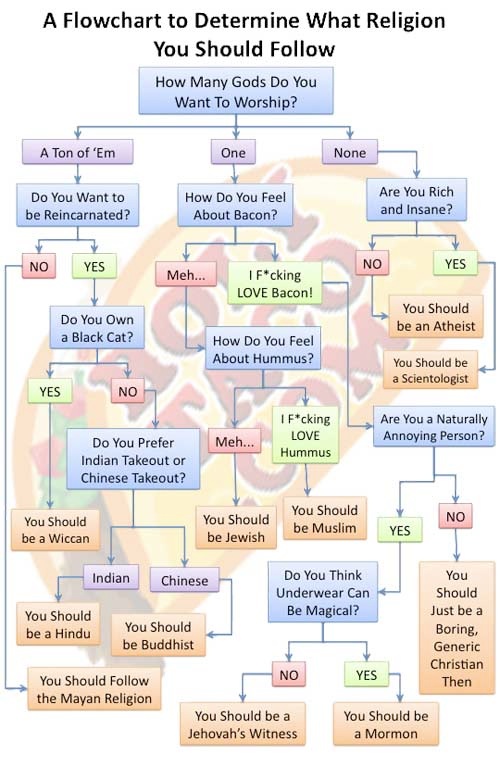
For further perusal, here's an interesting tor.com article on the role memory and recognition play in making quality stories, as well as a handy chart to help you determine (based off food preferences) what religion you should belong to.

10.25.2009

News Updates

The End of Philosophy. From Adbusters, interesting but the writer went to Pitt, and had one of the same philosophy classes I'm taking there this semester, and I agree its mostly irrelevant, except I'd have to say: don't expect other people to apply ideas for you, you have to think for yourself.

the Age of Universal Authorship. The one thing the author hasn't considered is that only will we have universal authorship when everyone has access to the technologies of communication and authorship.

Luther Blisset is now Wu Ming. Luther is one of the shared or multiple-use names phenomenon, which I first heard about in connection with Monty Cantsin and Neoism. Good to know these names are still out there.

Giant Orb Weaver Spider Discovered[image via riot rite right clit clip click]

Essential Plot Twists for Writers. Now in handy cartoon format.

Why Our Brains Will Never Live in a Matrix. Because they already live in bodies. Though the Internet is Altering our Brains.

The New End of the World Date is now 2068. Get Your calendars ready for the meteor crash.

In the mean time, don't forget to Live Life to the Full. A free guide to cognitive behavior therapy. Or, maybe depressed people are suffering from a lack of fun.

And finally, though science wants to stop aging, we still don't know exactly what is time?"

10.19.2009

Space is the Place

Astronomical discoveries are all the rage right now, what with scientists finding a mysterious ribbon of atoms bounding the solar system's edge, along with a bounty of 32 new extrasolar planets.

What a shame that for the most part we are just stuck here looking up in marvel and wonder instead of out there exploring.

10.15.2009

Faith Ills...

... if your faith happens to be as bigoted and close minded as a parishioner denying a marriage license to an interracial couple or an NC church burning non-canonical religious texts as "satan's books."

Sadly, neither of these religious groups seemed to have been paying much attention to their own myths.

10.07.2009

Possession and Schizophrenia


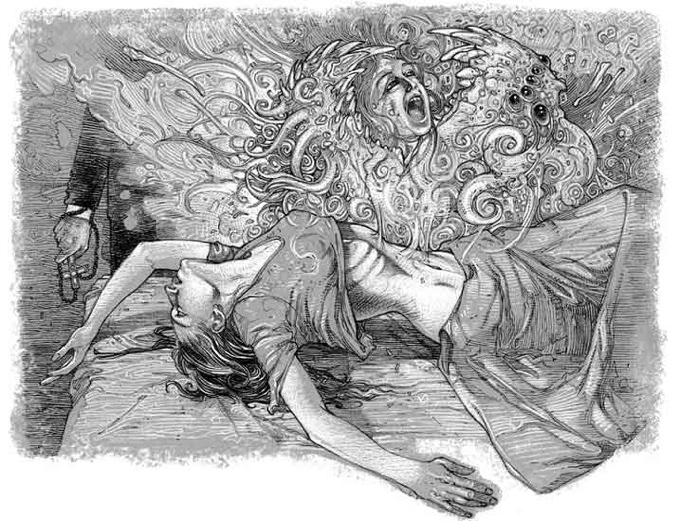
There is an interesting article from boingboing on exorcism and schizophrenia, which explains how patients in cultures with a strong belief in spirit possession, who have been possessed, have often been more successfully treated through schizophrenic medications than through exorcism. While this suggests that possession may be some cultures' ways of articulating the kinds of bizarre behaviors exhibited by schizophrenics, the article also cites a case where one of these medically treated possessees was actually seen to be possessed by other people.

So this might be an otherwise unremarkable psychiatric case if it were not for the fact that the prison chaplain, and several of the patient's cellmates, saw the spirit possess the patient as a ghostly mist. The chaplain was convinced this was a genuine case of possession, as had priests from several other faiths who had previously carried out exorcisms on the patient.

This begs the question, if the patient was treated for his belief in spirit possession and his apparent hallucinations as to the reality of the ghost, why were the chaplain and the others not considered to be ill ?


One could argue for mass hallucination, or conversely for some kind of cultural imagination at work, but perhaps it could mean that actual ghosts/spirits may be affected by chemical procedures? Not knowing off hand how medicines like trifluoperazine and clopenthixol work, I'd hazard a guess that whatever neural site/receptor these chemicals effect is also the neural site/receptor ghosts take possession of.

9.17.2009

The Surreal Improves Learning and Pattern Recognition

According to boingboing, "new research suggest that exposure to bizarre, surreal storylines such as Kafka's "The Country Doctor" can improve learning. Apparently, when your brain is presented with total absurdity or nonsense, it will work extra hard to find structure elsewhere. In the study by the University of British Columbia psychologists, subjects read The Country Doctor and then took a test where they had to identify patterns in strings of letters. They performed much better than the control group.


"In a second study, the same results were evident among people who were led to feel alienated about themselves as they considered how their past actions were often contradictory. "You get the same pattern of effects whether you're reading Kafka or experiencing a breakdown in your sense of identity," Proulx explained. "People feel uncomfortable when their expected associations are violated, and that creates an unconscious desire to make sense of their surroundings. That feeling of discomfort may come from a surreal story, or from contemplating their own contradictory behaviors, but either way, people want to get rid of it. So they're motivated to learn new patterns."


This study intrigues me and ties in with my thoughts about the use of surreal, magically-real, or dreamstate experiences both in art and reality. The way I tried to express it before is that non-real events create a category error in the way we perceive reality, thus requiring us to recheck our assumptions and patterns about what reality is. That being the case, the non- or supra-real can sometimes better get at what reality is like, because they sidestep the pitfalls and limitations of language and our basic assumption that the thing said is really the thing itself.

This also relates to all the current research on the link between creative genius and mental illness, in that people genetically predisposed towards perceiving the world as a fragmented and bizarre thing have to do that much more work to learn to put it together again, which, having schizophrenic and bipolar tendencies run in my family I can attest to seeing first hand.

7.14.2009

Interim Novae

Yes I still exist, but have been too focused most of this summer so far working on my novel to post much here, though I still have been paying attention to all sorts of interesting news items that would make for great science flash fictions, some of which can be found in the massive dump of links below:

Culture:
*As a male with a unique name, I find it fascinating that the more uncommon or feminine a boy's first name is, the greater the likelihood that he will end up in prison.
*An interesting article from Adbusters about realizing that mystery is still an integral part of human existence, despite 21st century rational empiricism.
*In celebration of the 40th anniversary of the moon landing, the original landing tapes have finally been found.
*While Americans have been torn up about the death of Michael Jackson, Japan may decide to abolish money.

Religion:
*Ireland has just passed a blasphemy law, which besides seeming several centuries out of date has pissed off all the atheists who don't believe in blasphemy anyway.
*Meahwhile, The Pope's encyclical, Caritas in Veritate calls for a new global economic system based off of love.
*A Saudi genie is being sued for harassment after it stole one family's mobile phones (perhaps jealous of the telecommunications genie?).
*An interesting chart detailing the views of the dominant religions on sex.

Literature:
*In London, this coming weekend is World Literature Weekend.
*Ernest Hemingway may have actually been a failed KGB spy.
*From an article on porn and literature a list of 18 challenges in contemorary literature.
*An interesting look at Lithuanian Book Smugglers, like the outlaws in Bradbury's Fahrenheit 451.
*How does language shape or thinking?
*William Gibson on how culture shapes our language.
*The importance of the ineffable in literature, as opposed to the enormous novel of technical, scientific, or historical knowledge that has become the highest credential for contemporary male writers (though I don't see why mystery and fact have to be opposed...)
*And speaking of enormous novels of that type, I've been reading David Foster Wallace's Infinite Jest for Infinite Summer, which is really a long winded, uneventful yet gripping read. More on this soon.
*Whereas I am much more intrigued by the idea of writing down our dreams as a form of literary self-criticism.

Science:
*Speaking of dreams, here's an article on the evolutionary enigma of dream contents.
*Both bird's eyes and the photosynthesis of plants may work by quantum entanglement.
*Light that has either attractive or repulsive forces of "push" has been discovered.
*Frogs and toads around the world synchronise their mating behaviour to the full moon.
*Scientists are still searching for a three foot long spitting earthworm in Idaho.
*As if she was the fountain of youth, an infant-sized teenager may provide clues to reversing the aging process.
*A synthetic tree has been built able to capture carbon from the air 1,000 times faster than real trees.
*Scientists have also created artificial sperm from stem cells, making men progressively more obsolete.
*The new interplanatery internet just got its first node on the ISS.
*Stephen Hawkings in the meantime has decided that humans have entered a new stage of evolution, one based off our ability to exchange information.
*But only if NASA doesn't build self-replicating robots on Mars first.
*Whereas planets themselves might be living super-organisms.
*Perhaps we really do have twenty-one senses, which humanity is still learning to develop.
*Ants however have suddenly become a global super-colony.
*And lastly, a new theorem shows that if humans have free will, then so must elementary particles.

That seems about it for now. Hopefully now that my writing process is stabalized I will have more time to post here. Enjoy the summer!

5.04.2009

Culture may be encoded in DNA

[from Wired Science]

"Knowledge is passed down directly from generation to generation in the animal kingdom as parents teach their children the things they will need to survive. But a new study has found that, even when the chain is broken, nature sometimes finds a way.

Zebra finches, which normally learn their complex courtship songs from their fathers, spontaneously developed the same songs all on their own after only a few generations.

“Song culture can emerge ‘from the egg,’ as it were, if one allows for multiple generations to elapse,” Mitra said. ”In a similar way, we may ‘grow’ our languages.”

Though there are approximately 6,000 different languages in the world, they all share certain structural and syntactic elements. Even when a language arises spontaneously, as it did in the 1970s among deaf school children in Nicaragua, it adheres to these stereotypical human language features.

The study’s findings might have implications beyond language to other culturally-transmitted systems, said evolutionary biologist and cognitive scientist Tecumseh Fitch, at the University of St. Andrews.

“We can think about both birdsong and human culture — especially language but including other aspects of human culture, like music, cuisine, dance styles, rituals, technological achievements, clothing styles, pottery decoration and a host of others — in similar terms,” he said. These culturally-transmitted systems must all pass through the filter of biology."


This is good to know... that long after contemporary communications technologies have absolutely butchered language, our ability to say things clearly and beautifully may one day reemerge from our genes.

3.12.2009

The Small Storm

How disappointing, she thought as she strode down the hall of the National Museum, where Lincoln’s gold pocket watch had just been opened up to reveal a message engraved inside by an erstwhile jeweler on the first day of the Civil War. The miniscule words were not nearly as exciting as the apocryphal version, but then again, she tweeted, kicking her long legs into the shoebox-sized taxi, most of what people say nowadays is drivel too. It was like some anachronistic twitter, a linguistic Kilroy that had taken 150 years to upload. And besides, what gadget was still large enough to engrave something on its surface?

Everything was getting smaller. She blinked in the article on her thumbnail-sized cell phone while checking her bags. Cars, microchips, certain species of mammals, even the lines at the airport were microsized, she smiled, whisking through security, now that the economy’s shrinking. Of course, so are the airplanes. She scrunched up her legs, trying to get comfortable in the clownishly small seat, graciously accepting a complementary peanut and thimbleful of ginger ale. It’s a good thing I’m on a diet, though these bones won’t start shrinking for another few decades yet!

But then, just before they reached Boston, where the technological conference was to be held and she hoped to find something smarmy to tweet about, a tremendous thwomping noise resounded through the cabin. Why, she thought, just before everything went black, maybe it’s one of those mysterious sonic booms that have been occurring up and down the Eastern Seaboard all week I was just reading about on my RSS feed.

Miraculously, she found when she woke up, everyone had survived the crash landing. They were in a deserted grassy field with no civilization in sight, perhaps one of the last places in the country, she speculated, without at least power lines. At least she could stretch her legs now, but just as she stood up and threw back her hair another loud boom sounded, and then another, knocking her over, flattening small patches of grass about the field. It’s like the Tunguska Event, she wanted to report, that whole Russian forest flattened in one fell whoomp, except much smaller, as if the electrons in the air were suddenly all speeding up, popping into and out of existence. It was almost magical, except that she had no wi-fi to share it with the rest of the world.

But then, what should appear, but a team of the new emergency response microcopters, little dust mote sized hotspots battling against the small storm of booming electromagnetic chaos to establish for one moment a local network of internet connectivity. She danced up and down, she could tweet at last, but then she stopped, uncertain and trembling, for how was she going to describe this to anyone, this patently absurd series of events, in 140 words or less?

12.23.2008

God vs. the Scientific Method

A person's unconscious attitudes toward science and God may be fundamentally opposed, researchers report, depending on how religion and science are used to answer "ultimate" questions such as how the universe began or the origin of life.

"It seemed to me that both science and religion as systems were very good at explaining a lot, accounting for a lot of the information that we have in our environment. But if they are both ultimate explanations, at some point they have to conflict with each another because they can't possibly both explain everything."


As such, more Americans believe in the Devil, Hell and Angels than in Darwin’s Theory of Evolution, church attendance is projected to fall by 90% by the year 2050, and researchers are still trying to find a neurophysiological model of spiritual experience.

This fall I took a physics course in which we discussed quantum mechanics, relativity, cosmology, and other weird aspects of modern science. Far from finding these ideas in conflict with my perspectives on spirituality I found that science paints a picture of reality that is mysterious, open-ended, and ultimately not very different than many early spiritual beliefs. If the fact that the universe is made almost entirely of dark matter and energy that we know nothing about doesn't move one to contemplate the meaning of life then I am completely confused as to what makes for a spiritual or religious experience. According to Rudolf Otto in The Idea of the Holy anything that brings up this feeling of utter mystery and incomprehensibility in the face of reality is spiritual, and the closer science looks at the Universe there is only more and more that we don't understand.

On the other hand, science and religion could find another sort of common ground as the Vatican embraces iTunes prayer books.

11.14.2008

Stealing Your Library

OCLC, owners of WorldCat, are getting greedy. It's now demanding that every library that uses WorldCat give control over all its catalog records to OCLC. It literally is asking libraries to put an OCLC policy notice on every book record in their catalog. It wants to own every library. It's not just Open Library that's at risk here -- LibraryThing, Zotero, even some new Wikipedia features being developed are threatened. Basically anything that uses information about books is going to be a victim of this unprecedented power[ ]grab. It's a scary thought.

Open Library provides a free alternative to WorldCat, provided it doesn't get sued into oblivion.

[via metafilter]

6.08.2008

Returning the Land

Oglala Sioux Could Regain Badlands National Parkland.

"BADLANDS NATIONAL PARK, S.D. - The southern half of this swath of grasslands and chiseled pink spires looks untouched from a distance. Closer up, the scars of history are easy to see.


Unexploded bombs lie in ravines, a reminder of when the military confiscated the land from the Oglala Sioux tribe during World War II and turned it into an artillery range. Poachers who have stolen thousands of fossils over the years have left gouges in the landscape. On a plateau, a solitary makeshift hut sits ringed by empty Coke cans and shaving cream canisters. It is the only remnant of a three-year occupation by militant tribal activists who had demanded that the land be returned.

Now the National Park Service is contemplating doing just that: giving the 133,000-acre southern half of Badlands National Park back to the tribe. The northern half, which has a paved road and a visitor center, would remain with the park system.
The park service has dissolved 23 parks and historic sites since 1930, but none has been returned to tribes. “It’s really exciting for us to think about walking down this road,” said Sandra J. Washington, head of planning for the service’s Omaha office, which oversees Badlands. “The intention is to be as honorable as possible."