
[This one's inspired by a bunch of puns from work today, and the ridiculousness of the anxiety that manifests itself in Pittsburgh this time of year. Enjoy!]
Bananarchy in the Bowl of Winds
It was third down in the final minutes of the third quarter, and Jerry was on the edge of his seat. C’mon, he screamed, just catch the ball! I can’t believe that call, he was clearly across the line… I couldn’t tell how Jerry knew; it was almost impossible to see the field from as high up as we were in the stands. But the seats were cheap, even if in this terrible weather the wind just whipped down into the bowl of the arena and froze our faces off, even though the group of fans in bright yellow suits right below us seemed jovially unconcerned.
Touchdown! No it’s not, Jerry howled, wringing his towel and jumping up and down. One of the fans cast an odd glance up our way, but his friends were occupied, huddled around something I couldn’t see, probably watching a replay on the Net as the JumboTron screen was having a hard time staying focused. The fan’s face was inexplicably painted like a clown’s, in a yellow as garish as his suit. Jerry had warned me the fans often dressed quite strange to show their team spirit. I’ve never understood football myself, being more of a story man. What’s the entertainment value of watching large men you can’t even see tumbling all over each other? But Jerry’s enthusiasm was contagious, so when he begged me to come along with him to the game I agreed, not realizing how miserably wretched the weather would be, even in the chintzy team windbreaker Jerry leant me that did nothing to keep out the wind. Those thick yellow suits were starting to look appealing right now.
The game wore on, Pittsburgh falling behind as Dallas caught a second wind, and then a third. Unable to make out the ant-like players below, my attention kept wandering, returning to the yellow-suited fans who seemed to be having a lot more fun. It looked like they were busy constructing some apparatus, what after a moment my brain told me was a catapult. A catapult? I wanted to ask Jerry if this was for some post-game ritual, but he was too busy chewing his mittens to shreds over the last foul to listen, so I sat back again to watch, finally a little curious.
Third down in the final minutes of the last quarter, and the Steelers had just used their last timeout, hopefully planning how to turn their game around before poor Jerry threw himself from the bleachers in despair. The whole crowd was on the edge of their seats, except for me, unable to see why this was so important, and the yellow suits, who’d finished building their contraption and all leaned back, opening their jackets despite the chill. Suddenly, just as one of the Cowboys was about to claim another first down (I think that’s what it’s called), a small flapping object went whirling out of the stands, landing right in front of the runner, whose feet flew out from under him in an inglorious pratfall.
The crowd went wild as the cameras zoomed in to reveal a banana peel on the jittery JumboTron screen. The announcers all mumbled, uncertain where it had come from. The crowd was actually aghast, but they couldn’t keep from laughing at the absurdity of it, the yellow-suited fans most of all. Finally the field calmed down again so the Cowboy could redo his play without interruptions. But no! This time with an audible thwang another yellow whirl went sailing, and another. Suddenly the arena’s cold air was filled with banana peels, all landing whichever way the winds blew them! Looking around I realized that the top rows of the stands were dotted with yellow-suited individuals, each group of them busy at their own little catapult. They must have planned this whole caper in case the Steelers began to loose, unless it was a political statement, hiding the bananas in their jackets to keep them from freezing.
No one else seemed to notice the characters depart, all eyes intent on the field, where the game carried on now despite the rain of peels, the players slipping and tumbling all over the place, the ball slick with juice and a fruity reek wafting up to the stands. It was chaos, sheer bananarchy! Jerry could only shake his head as his cherished pastime was reduced to the buffoonery I’d always told him it looked like, while I laughed and laughed, entirely forgetting about the cold. Eventually the game was called on account of the mushy sabotage, and as we were walking to the lot I turned to Jerry and said, you know what, that was a lot more fun then I expected, you wanna go get a smoothie? For some reason he only grumbled and kept walking.
Showing posts with label culture. Show all posts
Showing posts with label culture. Show all posts


12.08.2009
Updates from the World

A Lost European Culture, Pulled From Obscurity
New Model of the Universe Says Past Crystallises out of the Future
Trees Communicate with Aspirin-like Chemical
Rudiments of Language Discovered in Monkeys
David Foster Wallace's Toy Cement Mixer
"Nothing is more free than the imagination of man; and though it cannot exceed that original stock of ideas furnished by the internal and external senses, it has unlimited power of mixing, compounding, separating, and dividing these ideas, in all the varieties of fiction and vision. It can feign a train of events, with all the appearance of reality, ascribe to them a particular time and place, conceive them as existent, and paint them out to itself with every circumstance, that belongs to any historical fact, which it believes with the greatest certainty. Wherein, therefor, consists the difference between such a fiction and belief?"
-David Hume, from An Enquiry Concerning Human Understanding
11.24.2009
On Ultimate Realism
I haven't written much yet publicly on the new perspective or belief system I have been attempting to formulate over this past year, a perspective that I call Ultimate Realism, which is perhaps best summed up by the quote from Patchen's Memoirs of a Shy Pornogrpaher: "Everything which man can imagine, dream, or conceivably want to exist... does exist."
This view first occurred to me one day last year during a week of spiritual-existential difficulty. I had gone to a local bar and ran into an acquaintance, who said, having not seen me in ages due to my focus on school and writing, "welcome back to the real world," to which I could only reply, but isn't everywhere also just as real? and then wandered down the street struck by the total implications of everything around me being that real. There is some sense in which we tend to believe that only those habits and experiences that we usually have are really real, or at least of the most real importance to us, forgetting that other experiences we don't have are just as real. And beyond existing situations, every content of our imaginations and the stories we tell is real, in that these have real effects in the real world. And ultimately, any perspective that will allow us to articulate our lives in the whole of such a multifaceted reality, and perhaps allow us to formulate a perspective of global significance and understanding, will have to put us in relation to that whole, not just as it is scientifically and historically understood, but in relation to all that humans have said, imagined, believed, and dreamed.
This view has come out of years of questioning spiritual beliefs and the nature of the stories we tell. How do we, as human beings in a world with other human beings, deal with the fact that people have divergent and often contradictory views on what the world is and our place in it? Historically, belief systems have clashed, and continue to clash because each side takes their perspective as most true and right, whereas if one view was somehow objectively true and right there should be no cause for conflict; and yet there is. In my own life I have struggled with such limited perspectives, not knowing in what to believe, as the beliefs always seemed too small, and yet needing to believe in something, to tell some kind of story, and finally recognizing that any belief I would want to hold would have to be large enough to contain all possibilities of believing.
Similarly I fear global destruction due to the clash of these limited perspectives, and that we as a species do not have the stories to set us in relation to where we are now that might allow us to continue into the future in a meaningful, healthy, and positive way. The stories we are prone to tell today are often too small, quotidian, dealing with failure, comeuppance, and the meaningless joy ride of post-modernity, whereas we need a perspective that can address the Universe as a whole, for future generations of humanity in this Universe. These stories must be ultimate in order to place us and our actions in the widest set of meaning or significance necessary for survival.
My old professor, Dr. Fred Clothey (a student of famed mythographer Mircea Eliade), suggested that the stories we tell can tell us about ourselves, in effect modeling our understanding of reality in order to authenticate current actions and allow future actions. Our stories/ myths/ beliefs/ perspectives, etc. can do this precisely when they are cast in an "aura of ultimate significance," that is, by referring us to the widest possible scope of experience and understanding, to our cosmic and social beginnings, to our longed for and feared endings, to our ideals taking on human form. We find our place and being in between the limits of the real as we know it.
One such ultimate signifier, that has had a direct effect on real occurrences, is the concept of God(s). While belief in supernatural beings has allowed articulation of our relation to society and mortality, is has, perhaps most clearly and distressingly, served as a justification for centuries worth of horror and cruelty: crusades, inquisitions, terrorism, or just plain ignorance. But we are prone to forget in our polarized times that this personification of ultimate ideals was also a necessary and integral perspective for the development of scientific reasoning, framing an objective and total perspective that we humans could then hope to achieve ourselves, a belief that has existed coterminous to science up through the 20th century. Contemporary atheists might be glad that God is no longer a reference for rational understanding, but "His" death has negative impacts as well: God has traditionally not only been a signifier for ultimate perspective and knowing, but also for perfection and goodness, in short, ethical understanding of behavior, without which we do things like build the atomic bomb. Technology runs rampant when not placed in the widest relation to how it might rightly be used, or the lack of an ethical signifier allows the cultural insecurities that haunt us to become manifest, and such horrors not only be imagined but made real. One imagines a similar lack of ultimate significance in the perspectives that have allowed western culture's unparalleled material consumption, environmental destruction, and continued ideological warfare on the rest of humanity.
I am not arguing here for a return to a belief in the traditional monotheistic God or earlier gods. These stories, as we have seen, are just too small and conflict-provoking compared to those perspectives that now need to be adopted. I am arguing though for a greater belief in the reality and efficacy of the contents of our stories and imaginations, and an awareness of how these otherwise subconscious narratives influence the real world.
One of the problems to this approach is the primacy we give to literal truth, vs. the obvious falsity of our "true" representations of reality. I am a huge fan of stories of the fantastic, of the magical, supernatural, weird, heroic, or sci-fi, which, looking at the predominance of these themes in the current cultural media and imagination, I believe I am not alone in. But why do we love supermen, zombies, and the end of the world? There has been a trend in storytelling, dating from the late 18th century, of attempting to represent reality as it "really is," social or quotidian realism, and not as an allegorical reference for otherwise real things. Fiction, when it first was read as not literally true, was cast as "petite histories," in order to accept stories they had to mimic reality while being divorced from talking about reality. My immediate response to all this is, there's already too much of the world we experience on a daily basis, why create more of it, when stories beyond the everyday may raise possibilities of experience and understanding more than that which we are already familiar with. That familiarity constrains us, by being real, to the obviously inadequate belief systems we now live under. We hold up what we believe is a mirror and say, this is real, and because we say it, that marks the bounds up what we will allow to be really real.
My second issue with realism is that it is not reality despite how it primps and masquerades itself as such. It may represent aspects of reality, but does so by relying on and reaffirming our assumptions about how the world is and should be, which constrains us to accepting those views and realities as more true or valid, to the exclusion of wider views. And today it seems our view of the real is that it frankly sucks and nothing matters anymore. And any attempt to actually discuss real human issues in an emotionally valid way is negated by the irony and scorn with which we articulate the real world. The fantastic however, by being non-real and symbolic of the real (mythopoetic in Tolkien's terms), precisely allows us to highlight those human themes and conditions we want to examine in truthful ways. But in order to even accept the contents of fantastic stories we must (as Coleridge first suggested) suspend our disbelief of those things that couldn't be literally true in our everyday experience. We no longer have a problem leaping into wizard fights or across star systems, we can suspend disbelief but we are never asked to truly believe, and thus are not as prone to take such fantasies as being symbolic or ultimately significant for how we really are or could be in the world. We are content to let them be mere entertainments and diversions rather than suggestions of possibility.
Yet, are ghosts and gods really real, or is this even the right way of framing the question? There is a sense that certain things are existentially real, they commit us to accepting their physical reality, being right in front of us. The invisible and imaginative do not so commit us; one can not empirically and scientifically prove a god's actual existence. To argue one way or the other for this is to miss the entire point about gods. But one can clearly see the effects that belief in such unprovables has on our world, both on our perspectives and psychologies and in actual historical occurrences. Ignoring and belittling the immaterial causes of such beliefs and effects does little to add to our understanding of ourselves in the world, allows the results of inappropriate or too-small beliefs to continue unchecked, and limits the human imagination to articulate new possibilities of being and understanding being, which are necessary for our current and continued survival, let alone enjoyment and well being. On the other hand, if we do not remember that the stories we tell are only stories, that have been made up despite their real effects, we run the risk of mistaking the stories as literally true, thus causing us to act in dangerous and inappropriate ways, when imagining better stories to live by and through is always an option (and it is this lack of awareness of the power of our symbols that I mean by the absent narrative).
I do not know where we will go from here, but I am wary and sick of the post-modern skepticism that rejects any ultimate significance in favor of what we can directly lay our hands on (and in so doing, strangle it to death). I would prefer to see interconnections of the layers of reality rather than the whole's deconstruction and rebuttal. Acting as if we know everything and nothing really matters is perhaps the smallest and most dangerous perspective one could hold. Ultimately, we exist in a Universe which we barely understand, and in which we are a bare speck, and perhaps in that widest view humanity is indeed meaningless and fated to extinction for lack of any better options. And yet it is also possible to believe, and live by the belief, that life and our consciousness of life may be more than a random fluke or evolutionary mistake; not that we serve some clear teleological purpose or extant will of God, but that for all these unknowns we are still real, and still here, and confronted with the implications of that for all reality.
Though reality may be inherently meaningless we have the choice to take on meanings and act on those meanings, to continue to be and gather greater understanding and significance, both on this planet and in the Universe as a whole, should we choose to accept this mission. Anything less than such an Ultimately Realist perspective sells ourselves short, and will only propel us down the road of meaninglessness and destruction. But if we can perhaps articulate a perspective wide enough, not just for all humans, but all life in general and beyond life, then perhaps we can continue on until that perspective, and all else we can imagine, becomes real.
This view first occurred to me one day last year during a week of spiritual-existential difficulty. I had gone to a local bar and ran into an acquaintance, who said, having not seen me in ages due to my focus on school and writing, "welcome back to the real world," to which I could only reply, but isn't everywhere also just as real? and then wandered down the street struck by the total implications of everything around me being that real. There is some sense in which we tend to believe that only those habits and experiences that we usually have are really real, or at least of the most real importance to us, forgetting that other experiences we don't have are just as real. And beyond existing situations, every content of our imaginations and the stories we tell is real, in that these have real effects in the real world. And ultimately, any perspective that will allow us to articulate our lives in the whole of such a multifaceted reality, and perhaps allow us to formulate a perspective of global significance and understanding, will have to put us in relation to that whole, not just as it is scientifically and historically understood, but in relation to all that humans have said, imagined, believed, and dreamed.
This view has come out of years of questioning spiritual beliefs and the nature of the stories we tell. How do we, as human beings in a world with other human beings, deal with the fact that people have divergent and often contradictory views on what the world is and our place in it? Historically, belief systems have clashed, and continue to clash because each side takes their perspective as most true and right, whereas if one view was somehow objectively true and right there should be no cause for conflict; and yet there is. In my own life I have struggled with such limited perspectives, not knowing in what to believe, as the beliefs always seemed too small, and yet needing to believe in something, to tell some kind of story, and finally recognizing that any belief I would want to hold would have to be large enough to contain all possibilities of believing.
Similarly I fear global destruction due to the clash of these limited perspectives, and that we as a species do not have the stories to set us in relation to where we are now that might allow us to continue into the future in a meaningful, healthy, and positive way. The stories we are prone to tell today are often too small, quotidian, dealing with failure, comeuppance, and the meaningless joy ride of post-modernity, whereas we need a perspective that can address the Universe as a whole, for future generations of humanity in this Universe. These stories must be ultimate in order to place us and our actions in the widest set of meaning or significance necessary for survival.
My old professor, Dr. Fred Clothey (a student of famed mythographer Mircea Eliade), suggested that the stories we tell can tell us about ourselves, in effect modeling our understanding of reality in order to authenticate current actions and allow future actions. Our stories/ myths/ beliefs/ perspectives, etc. can do this precisely when they are cast in an "aura of ultimate significance," that is, by referring us to the widest possible scope of experience and understanding, to our cosmic and social beginnings, to our longed for and feared endings, to our ideals taking on human form. We find our place and being in between the limits of the real as we know it.
One such ultimate signifier, that has had a direct effect on real occurrences, is the concept of God(s). While belief in supernatural beings has allowed articulation of our relation to society and mortality, is has, perhaps most clearly and distressingly, served as a justification for centuries worth of horror and cruelty: crusades, inquisitions, terrorism, or just plain ignorance. But we are prone to forget in our polarized times that this personification of ultimate ideals was also a necessary and integral perspective for the development of scientific reasoning, framing an objective and total perspective that we humans could then hope to achieve ourselves, a belief that has existed coterminous to science up through the 20th century. Contemporary atheists might be glad that God is no longer a reference for rational understanding, but "His" death has negative impacts as well: God has traditionally not only been a signifier for ultimate perspective and knowing, but also for perfection and goodness, in short, ethical understanding of behavior, without which we do things like build the atomic bomb. Technology runs rampant when not placed in the widest relation to how it might rightly be used, or the lack of an ethical signifier allows the cultural insecurities that haunt us to become manifest, and such horrors not only be imagined but made real. One imagines a similar lack of ultimate significance in the perspectives that have allowed western culture's unparalleled material consumption, environmental destruction, and continued ideological warfare on the rest of humanity.
I am not arguing here for a return to a belief in the traditional monotheistic God or earlier gods. These stories, as we have seen, are just too small and conflict-provoking compared to those perspectives that now need to be adopted. I am arguing though for a greater belief in the reality and efficacy of the contents of our stories and imaginations, and an awareness of how these otherwise subconscious narratives influence the real world.
One of the problems to this approach is the primacy we give to literal truth, vs. the obvious falsity of our "true" representations of reality. I am a huge fan of stories of the fantastic, of the magical, supernatural, weird, heroic, or sci-fi, which, looking at the predominance of these themes in the current cultural media and imagination, I believe I am not alone in. But why do we love supermen, zombies, and the end of the world? There has been a trend in storytelling, dating from the late 18th century, of attempting to represent reality as it "really is," social or quotidian realism, and not as an allegorical reference for otherwise real things. Fiction, when it first was read as not literally true, was cast as "petite histories," in order to accept stories they had to mimic reality while being divorced from talking about reality. My immediate response to all this is, there's already too much of the world we experience on a daily basis, why create more of it, when stories beyond the everyday may raise possibilities of experience and understanding more than that which we are already familiar with. That familiarity constrains us, by being real, to the obviously inadequate belief systems we now live under. We hold up what we believe is a mirror and say, this is real, and because we say it, that marks the bounds up what we will allow to be really real.
My second issue with realism is that it is not reality despite how it primps and masquerades itself as such. It may represent aspects of reality, but does so by relying on and reaffirming our assumptions about how the world is and should be, which constrains us to accepting those views and realities as more true or valid, to the exclusion of wider views. And today it seems our view of the real is that it frankly sucks and nothing matters anymore. And any attempt to actually discuss real human issues in an emotionally valid way is negated by the irony and scorn with which we articulate the real world. The fantastic however, by being non-real and symbolic of the real (mythopoetic in Tolkien's terms), precisely allows us to highlight those human themes and conditions we want to examine in truthful ways. But in order to even accept the contents of fantastic stories we must (as Coleridge first suggested) suspend our disbelief of those things that couldn't be literally true in our everyday experience. We no longer have a problem leaping into wizard fights or across star systems, we can suspend disbelief but we are never asked to truly believe, and thus are not as prone to take such fantasies as being symbolic or ultimately significant for how we really are or could be in the world. We are content to let them be mere entertainments and diversions rather than suggestions of possibility.
Yet, are ghosts and gods really real, or is this even the right way of framing the question? There is a sense that certain things are existentially real, they commit us to accepting their physical reality, being right in front of us. The invisible and imaginative do not so commit us; one can not empirically and scientifically prove a god's actual existence. To argue one way or the other for this is to miss the entire point about gods. But one can clearly see the effects that belief in such unprovables has on our world, both on our perspectives and psychologies and in actual historical occurrences. Ignoring and belittling the immaterial causes of such beliefs and effects does little to add to our understanding of ourselves in the world, allows the results of inappropriate or too-small beliefs to continue unchecked, and limits the human imagination to articulate new possibilities of being and understanding being, which are necessary for our current and continued survival, let alone enjoyment and well being. On the other hand, if we do not remember that the stories we tell are only stories, that have been made up despite their real effects, we run the risk of mistaking the stories as literally true, thus causing us to act in dangerous and inappropriate ways, when imagining better stories to live by and through is always an option (and it is this lack of awareness of the power of our symbols that I mean by the absent narrative).
I do not know where we will go from here, but I am wary and sick of the post-modern skepticism that rejects any ultimate significance in favor of what we can directly lay our hands on (and in so doing, strangle it to death). I would prefer to see interconnections of the layers of reality rather than the whole's deconstruction and rebuttal. Acting as if we know everything and nothing really matters is perhaps the smallest and most dangerous perspective one could hold. Ultimately, we exist in a Universe which we barely understand, and in which we are a bare speck, and perhaps in that widest view humanity is indeed meaningless and fated to extinction for lack of any better options. And yet it is also possible to believe, and live by the belief, that life and our consciousness of life may be more than a random fluke or evolutionary mistake; not that we serve some clear teleological purpose or extant will of God, but that for all these unknowns we are still real, and still here, and confronted with the implications of that for all reality.
Though reality may be inherently meaningless we have the choice to take on meanings and act on those meanings, to continue to be and gather greater understanding and significance, both on this planet and in the Universe as a whole, should we choose to accept this mission. Anything less than such an Ultimately Realist perspective sells ourselves short, and will only propel us down the road of meaninglessness and destruction. But if we can perhaps articulate a perspective wide enough, not just for all humans, but all life in general and beyond life, then perhaps we can continue on until that perspective, and all else we can imagine, becomes real.
11.06.2009
Ancient Verse
I've been doing a lot of research recently for an essay to submit to the upcoming Immanence of Myth anthology, and have particularly grown fascinated by the scope of history, and particularly the birth of writing in the Mesopotamia river valley. Most well known is the Epic of Gilgamesh,a hero-myth written down in the 23rd century BCE Akkadian Empire, and for all intents the first action story as well as model for how kings and men ought to behave.

Around the same time though we also apparently find Enheduanna (above), daughter of Sargon the Great of Akkad, high En (priestess) of Nanna, and the first poet known by name, if not the first recorded author. The link contains links to some of her poems, which seem for the most part to be temple hymns to Innana and other Sumerian goddesses. It is interesting to note that after the development of writing, it seems most myths and stories were told in poetic verse, and most narratives were mythic, which lasts until the second emergence of Greek culture and the prose myths of Hesiod's Theogony (800 BCE).
Non-mythic literature doesn't arise until the Japanese serialized "novel", The Tale of the Genji (finished 1021 CE), and European Medieval allegories of the 1300s. We don't start taking stories as literally fictive until Robinson Crusoe in 1719, and even then it had to be published as a "petite historie," a private, little, or dubious history, perhaps because it was still hard to believe that something you hear is true in itself though not true in reality, a bit of doublethink those of us who've grown up in the present are accustomed to.
And just because this is now becoming an absurd saga, Baguette Dropped From Bird's Beak Shuts Down the Large Hadron Collider (Really), from Popular Science.
Around the same time though we also apparently find Enheduanna (above), daughter of Sargon the Great of Akkad, high En (priestess) of Nanna, and the first poet known by name, if not the first recorded author. The link contains links to some of her poems, which seem for the most part to be temple hymns to Innana and other Sumerian goddesses. It is interesting to note that after the development of writing, it seems most myths and stories were told in poetic verse, and most narratives were mythic, which lasts until the second emergence of Greek culture and the prose myths of Hesiod's Theogony (800 BCE).
Non-mythic literature doesn't arise until the Japanese serialized "novel", The Tale of the Genji (finished 1021 CE), and European Medieval allegories of the 1300s. We don't start taking stories as literally fictive until Robinson Crusoe in 1719, and even then it had to be published as a "petite historie," a private, little, or dubious history, perhaps because it was still hard to believe that something you hear is true in itself though not true in reality, a bit of doublethink those of us who've grown up in the present are accustomed to.
And just because this is now becoming an absurd saga, Baguette Dropped From Bird's Beak Shuts Down the Large Hadron Collider (Really), from Popular Science.
11.05.2009
A Spectacle of Behemoths
*Claude Lévi-Strauss, French anthropologist and founder of structuralism, has passed away at 100.
*Slate on how Ayn Rand became an American icon
*The Index of Supernatural Collective Nouns
*Persuasion and the art of storytelling.
*A giant crack in Africa may create a new ocean
*US Troops in Afghanistan are burning copies of the Koran.
*Corey Doctorow on science fiction as an indicator of the present.
*Talking about interactive fiction in my narrative and technology class, here's a boingboing post about keeping interactive fiction alive.
*Nuclear accidents and the origins of superhero origins
*Alejandro Jodorowsky gets funding for his dream project 'Abel Cain'.
*And Horacio Castellanos Moya on the myth of Roberto Bolaño. What's exciting is that I'll be taking a class on contemporary fiction next semester from this irascible exile.
*Slate on how Ayn Rand became an American icon
*The Index of Supernatural Collective Nouns
*Persuasion and the art of storytelling.
*A giant crack in Africa may create a new ocean
*US Troops in Afghanistan are burning copies of the Koran.
*Corey Doctorow on science fiction as an indicator of the present.
*Talking about interactive fiction in my narrative and technology class, here's a boingboing post about keeping interactive fiction alive.
*Nuclear accidents and the origins of superhero origins
*Alejandro Jodorowsky gets funding for his dream project 'Abel Cain'.
*And Horacio Castellanos Moya on the myth of Roberto Bolaño. What's exciting is that I'll be taking a class on contemporary fiction next semester from this irascible exile.
10.28.2009
Fictionology
In light of the Church of Scientology being convicted of Fraud in France, the Onion offers this brilliant mock competing religion, Fictionology [via mutate!]:
Interestingly, I personally suspect that if there is any kind of contemporary folk mythology, this is essentially it, the belief in any literary or culture character as an object of worship, wisdom, or personal identification. Just because in the past the culture characters we did this with were gods does not mean contemporary characters are any less available for their symbolic significance. One just has to look at the hype surrounding the release of new superhero movies, the lines around theaters like ancient temples. Perhaps without intending to the Onion seems to have hit exactly on what makes pop culture tick in the human heart.
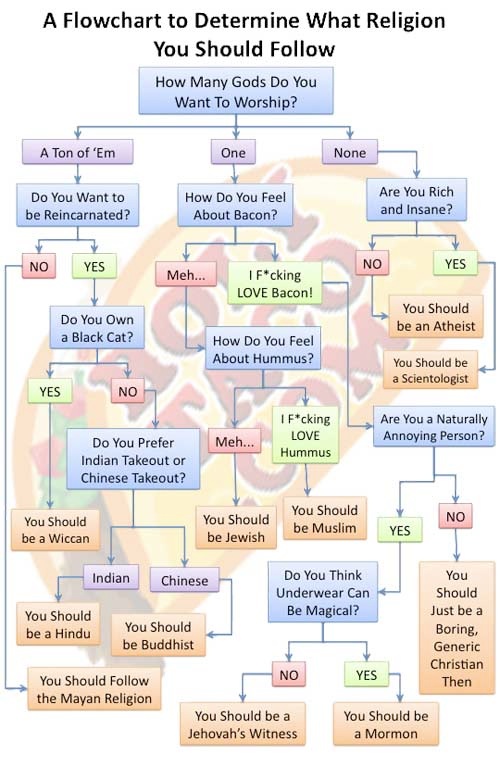
For further perusal, here's an interesting tor.com article on the role memory and recognition play in making quality stories, as well as a handy chart to help you determine (based off food preferences) what religion you should belong to.
Fictionology’s central belief, that any imaginary construct can be incorporated into the church’s ever-growing set of official doctrines, continues to gain popularity. Believers in Santa Claus, his elves, or the Tooth Fairy are permitted—even encouraged—to view them as deities. Even corporate mascots like the Kool-Aid Man are valid objects of Fictionological worship.
“My personal savior is Batman,” said Beverly Hills plastic surgeon Greg Jurgenson. “My wife chooses to follow the teachings of the Gilmore Girls. Of course, we are still beginners. Some advanced-level Fictionologists have total knowledge of every lifetime they have ever lived for the last 80 trillion years.”
“Sure, it’s total bullshit,” Jurgenson added. “But that’s Fictionology. Praise Batman!” [...]
“Scientology can only offer data, such as how an Operating Thetan can control matter, energy, space, and time with pure thought alone,” McSavage said. “But truly spiritual people don’t care about data, especially those seeking an escape from very real physical, mental, or emotional problems.”
McSavage added, “As a Fictionologist, I live in a world of pretend. It’s liberating.”
Interestingly, I personally suspect that if there is any kind of contemporary folk mythology, this is essentially it, the belief in any literary or culture character as an object of worship, wisdom, or personal identification. Just because in the past the culture characters we did this with were gods does not mean contemporary characters are any less available for their symbolic significance. One just has to look at the hype surrounding the release of new superhero movies, the lines around theaters like ancient temples. Perhaps without intending to the Onion seems to have hit exactly on what makes pop culture tick in the human heart.
For further perusal, here's an interesting tor.com article on the role memory and recognition play in making quality stories, as well as a handy chart to help you determine (based off food preferences) what religion you should belong to.
10.25.2009
News Updates
The End of Philosophy. From Adbusters, interesting but the writer went to Pitt, and had one of the same philosophy classes I'm taking there this semester, and I agree its mostly irrelevant, except I'd have to say: don't expect other people to apply ideas for you, you have to think for yourself.
the Age of Universal Authorship. The one thing the author hasn't considered is that only will we have universal authorship when everyone has access to the technologies of communication and authorship.
Luther Blisset is now Wu Ming. Luther is one of the shared or multiple-use names phenomenon, which I first heard about in connection with Monty Cantsin and Neoism. Good to know these names are still out there.
Giant Orb Weaver Spider Discovered [image via riot rite right clit clip click]
Essential Plot Twists for Writers. Now in handy cartoon format.
Why Our Brains Will Never Live in a Matrix. Because they already live in bodies. Though the Internet is Altering our Brains.
The New End of the World Date is now 2068. Get Your calendars ready for the meteor crash.
In the mean time, don't forget to Live Life to the Full. A free guide to cognitive behavior therapy. Or, maybe depressed people are suffering from a lack of fun.
And finally, though science wants to stop aging, we still don't know exactly what is time?"
the Age of Universal Authorship. The one thing the author hasn't considered is that only will we have universal authorship when everyone has access to the technologies of communication and authorship.
Luther Blisset is now Wu Ming. Luther is one of the shared or multiple-use names phenomenon, which I first heard about in connection with Monty Cantsin and Neoism. Good to know these names are still out there.
Giant Orb Weaver Spider Discovered
[image via riot rite right clit clip click]Essential Plot Twists for Writers. Now in handy cartoon format.
Why Our Brains Will Never Live in a Matrix. Because they already live in bodies. Though the Internet is Altering our Brains.
The New End of the World Date is now 2068. Get Your calendars ready for the meteor crash.
In the mean time, don't forget to Live Life to the Full. A free guide to cognitive behavior therapy. Or, maybe depressed people are suffering from a lack of fun.
And finally, though science wants to stop aging, we still don't know exactly what is time?"
10.15.2009
Faith Ills...
... if your faith happens to be as bigoted and close minded as a parishioner denying a marriage license to an interracial couple or an NC church burning non-canonical religious texts as "satan's books."
Sadly, neither of these religious groups seemed to have been paying much attention to their own myths.
Sadly, neither of these religious groups seemed to have been paying much attention to their own myths.
10.13.2009
It's not the End of the World
I've been insisting on this point for years now, so it's finally good to see the Mayans argue that 2012 is not the end of the world.
The only thing the Mayan long count calendar suggests is that one period of time is finished and the next begins, somewhat like a new year or an odometer clicking over. As it is based on the position of astral bodies, in particular the alignments of Venus, the metaphor of an odometer clicking over on a galactic scale is really about the closest meaning to what the calendar says.
The Mayans contend that any notion of apocalypses and singularities is a Western construction, perhaps a projection of our values onto another culture's belief and measurement systems. Bear in mind it is only in Western traditions such as Christianity that a teleological endpoint to time and reality are posited, often in terms of the spectacular fiery cataclysms we seem to enjoy or desire. The notion of an apocalypse is only valid in a culture based on belief systems that suggest that there is only linear time, and that only in later times can we find true reality or happiness (ie, in an afterlife). Take the notion of heaven after death and apply it collectively and you get a desire for a collective death. This notion applies to the ancient Norse Ragnarok as a collective means of reaching Valhalla, but does not apply to cycle notions of time, such as in Buddhism or Mayan cosmologies. Why would the world end if the myths played themselves out year after year, eon after eon, in the heavens as well as on Earth?
What strikes me as strange is that, though many people in Western culture no longer treat our foundational myths as real or valid, we still have that understanding of time as linear and endable, and enjoy if not demand such endings. Why do we want the world to end? Why do we want to project our desire for that onto someone else's beliefs, as if we can justify the desire by saying it is prophesied, and therefor not our fault? Whether the Mayans like it or not, 2012 has become a contemporary Western myth of the end of time, and as such says something about how we experience the world we live in. Perhaps we are too scared, too ashamed, of the extent of of the damage Western cultural values have inflicted on the planet, which along with the looming resource crises and potential threat of technological transcendence/annihilation, we can point to the Mayans and say, look it's not our fault, they said it was going to happen first, and how can we change that? What our myth of 2012 does is allow us to evade responsibility for our actions in the world we live in for the world that our children may still inherit. Who needs to worry about the future if no one will be around to experience it?
The only thing the Mayan long count calendar suggests is that one period of time is finished and the next begins, somewhat like a new year or an odometer clicking over. As it is based on the position of astral bodies, in particular the alignments of Venus, the metaphor of an odometer clicking over on a galactic scale is really about the closest meaning to what the calendar says.
The Mayans contend that any notion of apocalypses and singularities is a Western construction, perhaps a projection of our values onto another culture's belief and measurement systems. Bear in mind it is only in Western traditions such as Christianity that a teleological endpoint to time and reality are posited, often in terms of the spectacular fiery cataclysms we seem to enjoy or desire. The notion of an apocalypse is only valid in a culture based on belief systems that suggest that there is only linear time, and that only in later times can we find true reality or happiness (ie, in an afterlife). Take the notion of heaven after death and apply it collectively and you get a desire for a collective death. This notion applies to the ancient Norse Ragnarok as a collective means of reaching Valhalla, but does not apply to cycle notions of time, such as in Buddhism or Mayan cosmologies. Why would the world end if the myths played themselves out year after year, eon after eon, in the heavens as well as on Earth?
What strikes me as strange is that, though many people in Western culture no longer treat our foundational myths as real or valid, we still have that understanding of time as linear and endable, and enjoy if not demand such endings. Why do we want the world to end? Why do we want to project our desire for that onto someone else's beliefs, as if we can justify the desire by saying it is prophesied, and therefor not our fault? Whether the Mayans like it or not, 2012 has become a contemporary Western myth of the end of time, and as such says something about how we experience the world we live in. Perhaps we are too scared, too ashamed, of the extent of of the damage Western cultural values have inflicted on the planet, which along with the looming resource crises and potential threat of technological transcendence/annihilation, we can point to the Mayans and say, look it's not our fault, they said it was going to happen first, and how can we change that? What our myth of 2012 does is allow us to evade responsibility for our actions in the world we live in for the world that our children may still inherit. Who needs to worry about the future if no one will be around to experience it?
9.16.2009
Faith and the Pattern
Over the past year I have been going through an extreme crisis of faith. Due to a number of physical, emotional, and psychic challenges I found myself last winter in a state of disillusionment, that everything I had previously held to be good, desirable, possible, and expected in the world may not have been the case at all, a state close to feeling jaded, except that the crisis is precisely in trying to find some reason to carry on, to still believe: in love, the power of the human spirit, self-growth, god, some point to life as we know it, or at least a deeper understanding. But the closer I looked at any of these things the further they seemed to recede, from view, from understanding, so I was left wondering if they really existed. In centuries of the human quest for the truth and goodness we are still no closer to truth it seems, and people can be as ignorant, violent, and uncaring as they always have been, if not more so, which is rather disheartening to someone who feels they have spent their life searching for and hoping to bring these positive qualities into being. More recently I have summed up my quandary in asking, what is the point of self-growth, of struggling to improve how one is in the world, when the work is hard and there seems to be no real “reward” no incentive from society to do so (though that I take this as a valid question shows at least some will towards growing). How can I spend roughly the same amount of time writing on my novel as watching a TV show, and find the same amount of satisfaction in both? And sometimes more in the casual, indulgent activities, because they are easier? This is baffling to me. I believe that everything is real, even those things we can only imagine, but nevertheless there seems to be a primacy to the everyday, to those things, which when we pick ourselves off the floor or put down our books we still have to deal with, of which we can sigh and say, well maybe this is it. But is it? Ultimately everything is real, but some things are more real than others. Worrying about money or physical pain unfortunately feel to be some of the most real there is.
The problem, I know, is one of perspective. To say, this is it, is to presuppose that we know everything there is to know about life, enough to cast some judgment on it, when really we can know nothing with any such certainty. I am aware that the mystery of the Universe is far deeper than we can fathom. Not even the scientific method can say what is really true, either point at a position or velocity of a particle but not both, or how and why they are entangled and add up to all this. Any other human effort to value one mode of the world over another is based on subjective claims, of perception, of intuition, of faith. On some level even an atheist claims, I believe God doesn’t exist, because it is a statement that can’t be proven one way or another. For centuries scientists laughed at the notion of atoms, of forces and fields, because they couldn’t be seen, only to find that maybe they really are there, and though still unseen may be more real than this, but just as inexplicable and mystic as when the ancient Greeks first made up the story. How can I know this is just it, when my intuitions, the evidence my senses have gathered over a lifetime of searching, have suggested otherwise, if but to say, maybe it’s too hard to keep looking, no one else is really looking, not everywhere at once, and the whole edifice of Western knowledge is constructed on the basis of looking only at the visible and provable, and when confronted with a reality greater than that which can be known, it crumbles, is shown to be a charade based on the misapplication of ancient dialectical devices and assumptions: that dialectics can really tell us anything about anything, for when you point at or name something it always creates the thing it is not, and the thing neither of those are, ad nauseum, the way a proton pulled from an atomic nucleus mysteriously creates another proton in its place. This is beautiful and mysterious, but then you still have to go to work, or patch up an argument with your beloved. And there is no place to escape from that reality to, no one to turn to in our need outside this predicament. No matter what your perspective is on the world/Universe, or what you believe is our place and purpose in it, we are still within that system, like an existential Goedel’s Theorem, constrained by our physical senses and abilities and ways of knowing, and still have to find some reason to get out of bed in the morning, some small joy, and maybe the courage to choose to act as decent human beings, for ourselves and others, if we have any strength and calmness left over.
But how, and why? Because most days I feel full of rage, time slipping through the eye of it and feeling there is something more I could be doing that is the thing I really am meant to be doing, except I only have a vague, limited notion of what that is and no one has stepped down from on high to let me in on the secret plan for the Universe and my role in it. I feel a lot like the character John Locke from the show Lost, who, unlike the more reason-based characters trying to escape from the Island,, has an intuitive faith that he can and is meant to solve the labyrinthine puzzle and mystery that surrounds the place, following his gut, connecting scraps of information, seeking ever deeper in the mystery, and yet still plagued by doubts, hoping someone will tell him where to look next, constrained like the original philosopher Locke to the empiricism of believing what he can see, yet unable to explain that he has seen things beyond what most people would ever believe could be real. I relate to this and wonder how many others can. I think of my neighbor, watching sports on his big-screened TV, driving his motorcycle noisily up and down our street. He seems totally fulfilled in this, as far as I can see. There is not a question or even a need for a question of is this it.
The Presocratics (who I am studying in a class on the historical roots of science in mythology), were the first to systematically ask the questions, what is really real, can and do things change, can and what do we know? These ontological and epistemological questions are the foundation of any philosophy or metaphysics, and without before realizing that, they have also been my pivotal questions (along with that bugaboo, are we free/active agents). In answer to what is really real, they posit everything from water, to air, to numbers as the foundational substance of reality, or there is Anaximander, who believed it was the Apeiron, the unlimited storehouse of potential qualities of all things as the one underlying substance. My teacher, a younger grad student, laughed, this all seems absurd or primitive in light of our current scientific conceptions of reality, and the class all nodded. Except for me it doesn’t. For me the idea of some fount, of imagination or possibility, seems more intuitively true than the random motion of subatomic particles. In fact, it is an idea recorded in a number of different spiritual traditions: the Theosophic Akashic Records, the Sufi Scriptorum, the Hebraic Book of Life, even the Platonic Forms as an underlying reality. Is this really so absurd then, or are they all wrong? And more confounding, it is something that I have experienced, with my own senses (admittedly under a mystical trance state), but without knowing of it beforehand or expecting anything of the sort. But how could I explain this in class, in the face of the entire academic apparatus that is not about my experiences but recorded “facts?” These are two entirely different views of reality, like the conflict between Evolution and Creationism, both of which are mistaken for Truth, when they can never be anything more than descriptions, stories, metaphors for processes we can never really know anything about. Pirsig’s “Zen and the Art of Motorcycle Maintenance,” (reading in my class on Narrative and Technlogy), does a good job of framing this problem, n the context of a metaphysical detective story: we can either romantically-intuitively appreciate the surface aesthetic of things, or logically seek out the structures beneath them. But not both, though that is exactly what it seems we must do. That ability and desire however were lost centuries ago, when Aristotle argued down the Sophists in the forum, paving the way for Dialectical Materialism. And the world has been a cold calculating place since, lit by moments of decadence and revelry, but with no real new understanding or wisdom, meaning or faith to guide us out of this spiritual morass.
To what can we turn then, if not to our own experiences and the way we choose to pick them up in our daily lives (this division between events and our intentions or them being my definitions of fate and destiny). Are we just trapped on this island in space or do we choose to explore what being here could mean? When the stars that guided the ancients (both in sea travel and in mythic timekeeping) now begin to fade, there are still the stars in our hearts, which is the meaning of that word desire. As Crowley said, each and every one of us is a star. For most of my life I have been a proponent of a magical worldview, most clearly as spelled out in Bill Whitcomb’s Axioms, the first three of which are that reality is created from our worldviews that can be changed, that we reaffirm or change our worldviews through attention, and that seemingly disconnected events can strike us as being intricately connected, what Jung called synchronicity, or meaningful coincidence, but I call constellations of meaning, because meaning does not exist in events but in our interpretation of the relationships between them in relation to the patterns of our worldviews. Though I have actively sought out such constellations of meaning, in the last several years they have grown few and far between, a feeling I keep expressing as that always before the pattern of meanings suggested where to look next, except recently they haven’t, and everywhere has felt like a dead end, not at all that personal Eureka moment I recall first feeling reading James Joyce’s description of that Eureka moment in “Portrait of the Artist as a Young Man” and I’ve chased after ever since. Perhaps I have stopped looking in as active or connected a manner. Or perhaps, as I fear, that though I’ve looked and connected, the net of my looking wasn’t wide enough, and the pattern or destiny I found meaningful for myself in following certain dreams and ideas is too small, is not interrelated to Reality as a whole, as was the case with the Apeiron in class. Am I crazy for having experienced something no one else has, or are they for not even considering that such things could be? So that I lost faith with any of it being meaningful. And lastly, I have been afraid, for to connect our own meanings to any larger collective meaning takes work, and forces us to confront ourselves in wholly new ways, and precisely where our old maps no longer fit the territory of actual existence.
I have come to recognize recently that my novel, and indeed my task as a creative being, is an attempt to create such interconnected maps of our experience of Reality, a daunting and seemingly impossible task (though less impossible due to our current information technologies), yet one I am driven to through whatever genetic or spiritual reasons. To this end I have to start experiencing again the world, the larger world, as synchronistically connected, however those mechanisms work, but from scratch. Because if my patterns before are what I expected to find, but clearly didn’t, then I have to forgo faith in my expectations and recreate a new pattern from nothing, from everything, but not with the certainty in thinking that Descates had in his doubting of all. And in this letting go was confronted yesterday with a number of synchronicities if not answering than at least pointing to ways out of my current crisis. I wrote a letter to my beloved discussing love in terms of encouraging another’s and our own self-growth, an idea from Peck’s “The Road Less Traveled,” and immediately after in my Wisdom class in which we are reading that book, I had to write a letter as if to a distant friend on that very subject, allowing me to better clarify my questions. Then, finishing “Zen and the Art of…” came upon a summation passage equating Pirsig’s concept of Quality (as that missing from the Western dialectical tradition) to the Presocratic Ariste, excellence or heroic virtue, virtue already being a term personally loaded with positive meaning of acting right in the world, here defined not as virtue for others but of the self, improvement and growth into what one can most be, a joy in the process that I had forgotten, also connected to the Buddhist Dharma (further constellated in relation to the mystery in Lost as well as the self-mythologizing of Kerouac). All of which left me with a big Yes! And further constellated into this essay, which before I started writing I found a blog on synchronicities, cementing the point.
But the question remains, as much as I live this and find it necessary to my life, it seems mainly like a metaphysical thought experiment, and still does not connect back to the mundane, having to work sleep, relate to other people, go the bathroom, let alone all the wars and environmental degradation and illness at large in the world. Years ago I had a chance to sit in on a Zen retreat and told the Monk that it felt like I was in a dream from which I couldn’t wake up. He said, all our ideas, knowledge, stories, expectations, these are the dream, when Reality is just this. But now I realize that what I really meant was that that just this is what feels dreamlike, or actually worse, nightmarish, when the stories and ideas would be much more wonderful if they were that primarily real. I may find joy in contemplating quantum entanglement or synchronicity, but I see my friends struggling daily to find jobs or housing, getting robbed, sick, or mentally ill, and I wonder, why is that more real? Why am I not satisfied with it, except for perhaps being raised with some religious notion of an afterlife that has crushed me on idealism and hope for more? I understand that I am in a way very privileged to be able to even ask these questions. I have a steady job, a home, friends and family and fairly good health, I was raised with an education of intelligence, creativity, and faith, and questioning. Many do not have this, or if they did they got bogged down in the tribulations of the everyday, or just don’t care. I doubt for instance that my neighbor, if he were to take time away from his TV and motortoys, would he feel inclined to ask any of this? The meaning of his everyday life and material possessions seems to be enough for him (if they really are). Does he not want to spiritually grow, or is that process different for each person? Who can answer any of this? I on the other hand do not feel like I have a choice; even at my poorest and most downtrodden I have always felt the urge and made the time to ask these questions. I suspect that, being raised to have a capacity and willingness towards belief, but always questioning the presumed things one might believe in, it is like this large, too large hole that no material thing and few non-material things have ever come close to filling, or even fitting into, that leaves me with this internal tension, a spiritual angst like a spring about to burst, that might only find ease with ordering the whole reality in myself, and then what of everything out of reality? And then what of still having to live, and share this with others? It is as if, what are these questions for if they cannot be interconnected and applied in our daily lives, for everyone’s lives? What god is a map or pattern if other people can’t follow it somewhere they want to go? That I do not know, and only raises further questions. As Rilke put it, the pattern grows more intricate and subtle & being swept along is no longer enough.
The problem, I know, is one of perspective. To say, this is it, is to presuppose that we know everything there is to know about life, enough to cast some judgment on it, when really we can know nothing with any such certainty. I am aware that the mystery of the Universe is far deeper than we can fathom. Not even the scientific method can say what is really true, either point at a position or velocity of a particle but not both, or how and why they are entangled and add up to all this. Any other human effort to value one mode of the world over another is based on subjective claims, of perception, of intuition, of faith. On some level even an atheist claims, I believe God doesn’t exist, because it is a statement that can’t be proven one way or another. For centuries scientists laughed at the notion of atoms, of forces and fields, because they couldn’t be seen, only to find that maybe they really are there, and though still unseen may be more real than this, but just as inexplicable and mystic as when the ancient Greeks first made up the story. How can I know this is just it, when my intuitions, the evidence my senses have gathered over a lifetime of searching, have suggested otherwise, if but to say, maybe it’s too hard to keep looking, no one else is really looking, not everywhere at once, and the whole edifice of Western knowledge is constructed on the basis of looking only at the visible and provable, and when confronted with a reality greater than that which can be known, it crumbles, is shown to be a charade based on the misapplication of ancient dialectical devices and assumptions: that dialectics can really tell us anything about anything, for when you point at or name something it always creates the thing it is not, and the thing neither of those are, ad nauseum, the way a proton pulled from an atomic nucleus mysteriously creates another proton in its place. This is beautiful and mysterious, but then you still have to go to work, or patch up an argument with your beloved. And there is no place to escape from that reality to, no one to turn to in our need outside this predicament. No matter what your perspective is on the world/Universe, or what you believe is our place and purpose in it, we are still within that system, like an existential Goedel’s Theorem, constrained by our physical senses and abilities and ways of knowing, and still have to find some reason to get out of bed in the morning, some small joy, and maybe the courage to choose to act as decent human beings, for ourselves and others, if we have any strength and calmness left over.
But how, and why? Because most days I feel full of rage, time slipping through the eye of it and feeling there is something more I could be doing that is the thing I really am meant to be doing, except I only have a vague, limited notion of what that is and no one has stepped down from on high to let me in on the secret plan for the Universe and my role in it. I feel a lot like the character John Locke from the show Lost, who, unlike the more reason-based characters trying to escape from the Island,, has an intuitive faith that he can and is meant to solve the labyrinthine puzzle and mystery that surrounds the place, following his gut, connecting scraps of information, seeking ever deeper in the mystery, and yet still plagued by doubts, hoping someone will tell him where to look next, constrained like the original philosopher Locke to the empiricism of believing what he can see, yet unable to explain that he has seen things beyond what most people would ever believe could be real. I relate to this and wonder how many others can. I think of my neighbor, watching sports on his big-screened TV, driving his motorcycle noisily up and down our street. He seems totally fulfilled in this, as far as I can see. There is not a question or even a need for a question of is this it.
The Presocratics (who I am studying in a class on the historical roots of science in mythology), were the first to systematically ask the questions, what is really real, can and do things change, can and what do we know? These ontological and epistemological questions are the foundation of any philosophy or metaphysics, and without before realizing that, they have also been my pivotal questions (along with that bugaboo, are we free/active agents). In answer to what is really real, they posit everything from water, to air, to numbers as the foundational substance of reality, or there is Anaximander, who believed it was the Apeiron, the unlimited storehouse of potential qualities of all things as the one underlying substance. My teacher, a younger grad student, laughed, this all seems absurd or primitive in light of our current scientific conceptions of reality, and the class all nodded. Except for me it doesn’t. For me the idea of some fount, of imagination or possibility, seems more intuitively true than the random motion of subatomic particles. In fact, it is an idea recorded in a number of different spiritual traditions: the Theosophic Akashic Records, the Sufi Scriptorum, the Hebraic Book of Life, even the Platonic Forms as an underlying reality. Is this really so absurd then, or are they all wrong? And more confounding, it is something that I have experienced, with my own senses (admittedly under a mystical trance state), but without knowing of it beforehand or expecting anything of the sort. But how could I explain this in class, in the face of the entire academic apparatus that is not about my experiences but recorded “facts?” These are two entirely different views of reality, like the conflict between Evolution and Creationism, both of which are mistaken for Truth, when they can never be anything more than descriptions, stories, metaphors for processes we can never really know anything about. Pirsig’s “Zen and the Art of Motorcycle Maintenance,” (reading in my class on Narrative and Technlogy), does a good job of framing this problem, n the context of a metaphysical detective story: we can either romantically-intuitively appreciate the surface aesthetic of things, or logically seek out the structures beneath them. But not both, though that is exactly what it seems we must do. That ability and desire however were lost centuries ago, when Aristotle argued down the Sophists in the forum, paving the way for Dialectical Materialism. And the world has been a cold calculating place since, lit by moments of decadence and revelry, but with no real new understanding or wisdom, meaning or faith to guide us out of this spiritual morass.
To what can we turn then, if not to our own experiences and the way we choose to pick them up in our daily lives (this division between events and our intentions or them being my definitions of fate and destiny). Are we just trapped on this island in space or do we choose to explore what being here could mean? When the stars that guided the ancients (both in sea travel and in mythic timekeeping) now begin to fade, there are still the stars in our hearts, which is the meaning of that word desire. As Crowley said, each and every one of us is a star. For most of my life I have been a proponent of a magical worldview, most clearly as spelled out in Bill Whitcomb’s Axioms, the first three of which are that reality is created from our worldviews that can be changed, that we reaffirm or change our worldviews through attention, and that seemingly disconnected events can strike us as being intricately connected, what Jung called synchronicity, or meaningful coincidence, but I call constellations of meaning, because meaning does not exist in events but in our interpretation of the relationships between them in relation to the patterns of our worldviews. Though I have actively sought out such constellations of meaning, in the last several years they have grown few and far between, a feeling I keep expressing as that always before the pattern of meanings suggested where to look next, except recently they haven’t, and everywhere has felt like a dead end, not at all that personal Eureka moment I recall first feeling reading James Joyce’s description of that Eureka moment in “Portrait of the Artist as a Young Man” and I’ve chased after ever since. Perhaps I have stopped looking in as active or connected a manner. Or perhaps, as I fear, that though I’ve looked and connected, the net of my looking wasn’t wide enough, and the pattern or destiny I found meaningful for myself in following certain dreams and ideas is too small, is not interrelated to Reality as a whole, as was the case with the Apeiron in class. Am I crazy for having experienced something no one else has, or are they for not even considering that such things could be? So that I lost faith with any of it being meaningful. And lastly, I have been afraid, for to connect our own meanings to any larger collective meaning takes work, and forces us to confront ourselves in wholly new ways, and precisely where our old maps no longer fit the territory of actual existence.
I have come to recognize recently that my novel, and indeed my task as a creative being, is an attempt to create such interconnected maps of our experience of Reality, a daunting and seemingly impossible task (though less impossible due to our current information technologies), yet one I am driven to through whatever genetic or spiritual reasons. To this end I have to start experiencing again the world, the larger world, as synchronistically connected, however those mechanisms work, but from scratch. Because if my patterns before are what I expected to find, but clearly didn’t, then I have to forgo faith in my expectations and recreate a new pattern from nothing, from everything, but not with the certainty in thinking that Descates had in his doubting of all. And in this letting go was confronted yesterday with a number of synchronicities if not answering than at least pointing to ways out of my current crisis. I wrote a letter to my beloved discussing love in terms of encouraging another’s and our own self-growth, an idea from Peck’s “The Road Less Traveled,” and immediately after in my Wisdom class in which we are reading that book, I had to write a letter as if to a distant friend on that very subject, allowing me to better clarify my questions. Then, finishing “Zen and the Art of…” came upon a summation passage equating Pirsig’s concept of Quality (as that missing from the Western dialectical tradition) to the Presocratic Ariste, excellence or heroic virtue, virtue already being a term personally loaded with positive meaning of acting right in the world, here defined not as virtue for others but of the self, improvement and growth into what one can most be, a joy in the process that I had forgotten, also connected to the Buddhist Dharma (further constellated in relation to the mystery in Lost as well as the self-mythologizing of Kerouac). All of which left me with a big Yes! And further constellated into this essay, which before I started writing I found a blog on synchronicities, cementing the point.
But the question remains, as much as I live this and find it necessary to my life, it seems mainly like a metaphysical thought experiment, and still does not connect back to the mundane, having to work sleep, relate to other people, go the bathroom, let alone all the wars and environmental degradation and illness at large in the world. Years ago I had a chance to sit in on a Zen retreat and told the Monk that it felt like I was in a dream from which I couldn’t wake up. He said, all our ideas, knowledge, stories, expectations, these are the dream, when Reality is just this. But now I realize that what I really meant was that that just this is what feels dreamlike, or actually worse, nightmarish, when the stories and ideas would be much more wonderful if they were that primarily real. I may find joy in contemplating quantum entanglement or synchronicity, but I see my friends struggling daily to find jobs or housing, getting robbed, sick, or mentally ill, and I wonder, why is that more real? Why am I not satisfied with it, except for perhaps being raised with some religious notion of an afterlife that has crushed me on idealism and hope for more? I understand that I am in a way very privileged to be able to even ask these questions. I have a steady job, a home, friends and family and fairly good health, I was raised with an education of intelligence, creativity, and faith, and questioning. Many do not have this, or if they did they got bogged down in the tribulations of the everyday, or just don’t care. I doubt for instance that my neighbor, if he were to take time away from his TV and motortoys, would he feel inclined to ask any of this? The meaning of his everyday life and material possessions seems to be enough for him (if they really are). Does he not want to spiritually grow, or is that process different for each person? Who can answer any of this? I on the other hand do not feel like I have a choice; even at my poorest and most downtrodden I have always felt the urge and made the time to ask these questions. I suspect that, being raised to have a capacity and willingness towards belief, but always questioning the presumed things one might believe in, it is like this large, too large hole that no material thing and few non-material things have ever come close to filling, or even fitting into, that leaves me with this internal tension, a spiritual angst like a spring about to burst, that might only find ease with ordering the whole reality in myself, and then what of everything out of reality? And then what of still having to live, and share this with others? It is as if, what are these questions for if they cannot be interconnected and applied in our daily lives, for everyone’s lives? What god is a map or pattern if other people can’t follow it somewhere they want to go? That I do not know, and only raises further questions. As Rilke put it, the pattern grows more intricate and subtle & being swept along is no longer enough.
9.02.2009
Magic Shoes
Contemporary Americans generally do not wear magical amulets, or other specially-endowed articles of clothing, as in other times or cultures, such as the ghost shirts of the Lakota Indians. Certainly there are superstitions, lucky sports caps or underwear for the winning game or date, but clothing as a statement and symbolically intentional affect has declined somewhat in the last several decades. We may still wear suits to work or funerals, jerseys to games, jewelry to dinner, the usual ritual uniforms, but it is just as likely to see someone on the street in merely jeans and a t-shirt (what up till recently was considered underwear), or worse, kids in classrooms wearing sweatpants, what are essentially pajamas, or hats on their heads which at any other time would have signified either a lack of respect or a desire to not be indoors. This isn't to say that clothes no longer signify anything, one only has to look at the inordinate amount of money and attention that is put into the tennis-shoe industry, people buying brand new expensive designer brand sneakers instead of food to live on, people robbing other people for said same sneakers. Also the resurgence of boots, as a casual footwear encountered on a daily basis, but also an aesthetic and symbolic one, laden with connotations of toughness, travel, endurance (often sexualized), etc. The desire once filled by the role of the high heel in the cultural imagination, idealized in the Ruby Slippers Dorothy wore to escape from the childhood fantasy of Oz into sexual adulthood, has been replaced it seems with a new desire for distance-durability or strength, groundedness, or a thick solid place to stand and move from.
I have worn boots for the last 15 years, my first pair being black army boots (of the kind favored in the punk/outcast subculture of the late '90s, though I never owned a pair of Docs), that carried that significance of toughness, integrity (of a military persuasion), etc. For the last four years however I have owned a pair of hand-made, custom-fitted moccasin-style boots from Catskill Mountain Moccasins, of a dark blue-green leather with laced up sides that as long as I take care of will last probably the most of my life. While an expensive purchase, these boots were actually a gift from some friends who had come into some money, and were gifted as something to "help me on my journey/ adventure," which is the spirit I have always tried to wear them in, somewhat like the legendary Seven League Boots, or perhaps more exactly as if they were magic boots from some role-playing game, not quite boots of speed as much as boots of doubled experience, as I have worn them through many situations of extreme, unique, self-changing experience. The significance being that because the boots were a gift and are already unique looking (people call them my elf boots), wearing them is a reminder that when I am in the world it is not just the casual going about the day, but that every day is an adventure, a quest in the sense of a search after deeper questions and significance.
After a couple years and wearing them on a cross-country road trip, my boots were pretty worn down at the heel and needed to be resoled, which I was thankfully able to find someone to do, and then a year later they needed to be resoled again. This was last fall, a time of great personal inner turmoil and questioning, and I took that the soles of the boots were worn through to be indicative of a deeper spiritual uncertainty, as in that my soul was worn through (a not inappropriate homophone, as the ancient Egyptian symbol for the person's steps through life, the ankh, was represented by a sandal-strap). In preparation for this fall semester, in which I am taking a number of philosophy courses and will need, not answers, but a renewed sense of my quest/ions, I thought it made sense to get the boots fixed, with thicker heels, which I did this week and finally picked up today, biking out to Edgewood to get them. Since I was already out and coming through East Liberty, I decided to stop by the Cathedral of Hope, which on Wednesdays sets up their labyrinth for people to walk, which in other years has been an extraordinarily centering and spiritual practice for me and I already felt the need of recently. Labyrinth's the symbol of life's journey, the winding of questions in the neural pathways, long ruminative walks mapped onto the backstreets of the city, and I thought this labyrinth walk was a good time to reconsecrate my boots for the future, putting them on afterward and remembering that, as they are custom-fit, they are more comfortable than anything else I've worn on my feet, and almost begging to walk out into the world again.
I have worn boots for the last 15 years, my first pair being black army boots (of the kind favored in the punk/outcast subculture of the late '90s, though I never owned a pair of Docs), that carried that significance of toughness, integrity (of a military persuasion), etc. For the last four years however I have owned a pair of hand-made, custom-fitted moccasin-style boots from Catskill Mountain Moccasins, of a dark blue-green leather with laced up sides that as long as I take care of will last probably the most of my life. While an expensive purchase, these boots were actually a gift from some friends who had come into some money, and were gifted as something to "help me on my journey/ adventure," which is the spirit I have always tried to wear them in, somewhat like the legendary Seven League Boots, or perhaps more exactly as if they were magic boots from some role-playing game, not quite boots of speed as much as boots of doubled experience, as I have worn them through many situations of extreme, unique, self-changing experience. The significance being that because the boots were a gift and are already unique looking (people call them my elf boots), wearing them is a reminder that when I am in the world it is not just the casual going about the day, but that every day is an adventure, a quest in the sense of a search after deeper questions and significance.
After a couple years and wearing them on a cross-country road trip, my boots were pretty worn down at the heel and needed to be resoled, which I was thankfully able to find someone to do, and then a year later they needed to be resoled again. This was last fall, a time of great personal inner turmoil and questioning, and I took that the soles of the boots were worn through to be indicative of a deeper spiritual uncertainty, as in that my soul was worn through (a not inappropriate homophone, as the ancient Egyptian symbol for the person's steps through life, the ankh, was represented by a sandal-strap). In preparation for this fall semester, in which I am taking a number of philosophy courses and will need, not answers, but a renewed sense of my quest/ions, I thought it made sense to get the boots fixed, with thicker heels, which I did this week and finally picked up today, biking out to Edgewood to get them. Since I was already out and coming through East Liberty, I decided to stop by the Cathedral of Hope, which on Wednesdays sets up their labyrinth for people to walk, which in other years has been an extraordinarily centering and spiritual practice for me and I already felt the need of recently. Labyrinth's the symbol of life's journey, the winding of questions in the neural pathways, long ruminative walks mapped onto the backstreets of the city, and I thought this labyrinth walk was a good time to reconsecrate my boots for the future, putting them on afterward and remembering that, as they are custom-fit, they are more comfortable than anything else I've worn on my feet, and almost begging to walk out into the world again.
7.21.2009
The Pursuit of
"Most of the mistakes [in the War on Drugs] have roots in an elementary error, the inability to accept that "altering one's consciousness is a fundamental human desire." The craving to be more relaxed or more alert, more outgoing or more reflective, happier or deeper or even just sillier and less bored -- in one form other another, this drive has always been and always will be with us, though many of us refuse to admit it. As a result, our political response to drug problems tends to be blinkered."
from Why we say yes to drugs, a Salon review of a new book on the futility of anti-drug laws.
I would agree that "altering one's consciousness is a fundamental human desire," as humans have been seeking out in their rituals new ways of perceiving themselves and the world since we've had a consciousness to alter. This is also a pertinent theme in Infinite Jest, whether people given the choice to pursue some form of happiness regardless if they know it's bad for them will still choose to do so. Of course I don't think the issue is as simple as the pursuit of novelty and entertainment vs. conservative policies. On one hand is the issue of addiction, that some people are perhaps more prone to continually harmfully altering themselves, and on the other is the double standard with which America has presented drug policy: Not only that programs like DARE actually encourage drug experimentation, as the article claims, but even more so that media and entertainment options are generally passive and consumptive by nature (ie TV), and other active forms of enjoyment such as creating art require some skill and drive, neither of which are encouraged or actively taught in contemporary culture. Which, for our country's bored youth left drugs as one of the few choices of how to spend one's time. Of course nowadays there's the internet, which seems to give that kind of choice, though is perhaps as equally addictive.
from Why we say yes to drugs, a Salon review of a new book on the futility of anti-drug laws.
I would agree that "altering one's consciousness is a fundamental human desire," as humans have been seeking out in their rituals new ways of perceiving themselves and the world since we've had a consciousness to alter. This is also a pertinent theme in Infinite Jest, whether people given the choice to pursue some form of happiness regardless if they know it's bad for them will still choose to do so. Of course I don't think the issue is as simple as the pursuit of novelty and entertainment vs. conservative policies. On one hand is the issue of addiction, that some people are perhaps more prone to continually harmfully altering themselves, and on the other is the double standard with which America has presented drug policy: Not only that programs like DARE actually encourage drug experimentation, as the article claims, but even more so that media and entertainment options are generally passive and consumptive by nature (ie TV), and other active forms of enjoyment such as creating art require some skill and drive, neither of which are encouraged or actively taught in contemporary culture. Which, for our country's bored youth left drugs as one of the few choices of how to spend one's time. Of course nowadays there's the internet, which seems to give that kind of choice, though is perhaps as equally addictive.
7.14.2009
Interim Novae
Yes I still exist, but have been too focused most of this summer so far working on my novel to post much here, though I still have been paying attention to all sorts of interesting news items that would make for great science flash fictions, some of which can be found in the massive dump of links below:
Culture:
*As a male with a unique name, I find it fascinating that the more uncommon or feminine a boy's first name is, the greater the likelihood that he will end up in prison.
*An interesting article from Adbusters about realizing that mystery is still an integral part of human existence, despite 21st century rational empiricism.
*In celebration of the 40th anniversary of the moon landing, the original landing tapes have finally been found.
*While Americans have been torn up about the death of Michael Jackson, Japan may decide to abolish money.
Religion:
*Ireland has just passed a blasphemy law, which besides seeming several centuries out of date has pissed off all the atheists who don't believe in blasphemy anyway.
*Meahwhile, The Pope's encyclical, Caritas in Veritate calls for a new global economic system based off of love.
*A Saudi genie is being sued for harassment after it stole one family's mobile phones (perhaps jealous of the telecommunications genie?).
*An interesting chart detailing the views of the dominant religions on sex.
Literature:
*In London, this coming weekend is World Literature Weekend.
*Ernest Hemingway may have actually been a failed KGB spy.
*From an article on porn and literature a list of 18 challenges in contemorary literature.
*An interesting look at Lithuanian Book Smugglers, like the outlaws in Bradbury's Fahrenheit 451.
*How does language shape or thinking?
*William Gibson on how culture shapes our language.
*The importance of the ineffable in literature, as opposed to the enormous novel of technical, scientific, or historical knowledge that has become the highest credential for contemporary male writers (though I don't see why mystery and fact have to be opposed...)
*And speaking of enormous novels of that type, I've been reading David Foster Wallace's Infinite Jest for Infinite Summer, which is really a long winded, uneventful yet gripping read. More on this soon.
*Whereas I am much more intrigued by the idea of writing down our dreams as a form of literary self-criticism.
Science:
*Speaking of dreams, here's an article on the evolutionary enigma of dream contents.
*Both bird's eyes and the photosynthesis of plants may work by quantum entanglement.
*Light that has either attractive or repulsive forces of "push" has been discovered.
*Frogs and toads around the world synchronise their mating behaviour to the full moon.
*Scientists are still searching for a three foot long spitting earthworm in Idaho.
*As if she was the fountain of youth, an infant-sized teenager may provide clues to reversing the aging process.
*A synthetic tree has been built able to capture carbon from the air 1,000 times faster than real trees.
*Scientists have also created artificial sperm from stem cells, making men progressively more obsolete.
*The new interplanatery internet just got its first node on the ISS.
*Stephen Hawkings in the meantime has decided that humans have entered a new stage of evolution, one based off our ability to exchange information.
*But only if NASA doesn't build self-replicating robots on Mars first.
*Whereas planets themselves might be living super-organisms.
*Perhaps we really do have twenty-one senses, which humanity is still learning to develop.
*Ants however have suddenly become a global super-colony.
*And lastly, a new theorem shows that if humans have free will, then so must elementary particles.
That seems about it for now. Hopefully now that my writing process is stabalized I will have more time to post here. Enjoy the summer!
Culture:
*As a male with a unique name, I find it fascinating that the more uncommon or feminine a boy's first name is, the greater the likelihood that he will end up in prison.
*An interesting article from Adbusters about realizing that mystery is still an integral part of human existence, despite 21st century rational empiricism.
*In celebration of the 40th anniversary of the moon landing, the original landing tapes have finally been found.
*While Americans have been torn up about the death of Michael Jackson, Japan may decide to abolish money.
Religion:
*Ireland has just passed a blasphemy law, which besides seeming several centuries out of date has pissed off all the atheists who don't believe in blasphemy anyway.
*Meahwhile, The Pope's encyclical, Caritas in Veritate calls for a new global economic system based off of love.
*A Saudi genie is being sued for harassment after it stole one family's mobile phones (perhaps jealous of the telecommunications genie?).
*An interesting chart detailing the views of the dominant religions on sex.
Literature:
*In London, this coming weekend is World Literature Weekend.
*Ernest Hemingway may have actually been a failed KGB spy.
*From an article on porn and literature a list of 18 challenges in contemorary literature.
*An interesting look at Lithuanian Book Smugglers, like the outlaws in Bradbury's Fahrenheit 451.
*How does language shape or thinking?
*William Gibson on how culture shapes our language.
*The importance of the ineffable in literature, as opposed to the enormous novel of technical, scientific, or historical knowledge that has become the highest credential for contemporary male writers (though I don't see why mystery and fact have to be opposed...)
*And speaking of enormous novels of that type, I've been reading David Foster Wallace's Infinite Jest for Infinite Summer, which is really a long winded, uneventful yet gripping read. More on this soon.
*Whereas I am much more intrigued by the idea of writing down our dreams as a form of literary self-criticism.
Science:
*Speaking of dreams, here's an article on the evolutionary enigma of dream contents.
*Both bird's eyes and the photosynthesis of plants may work by quantum entanglement.
*Light that has either attractive or repulsive forces of "push" has been discovered.
*Frogs and toads around the world synchronise their mating behaviour to the full moon.
*Scientists are still searching for a three foot long spitting earthworm in Idaho.
*As if she was the fountain of youth, an infant-sized teenager may provide clues to reversing the aging process.
*A synthetic tree has been built able to capture carbon from the air 1,000 times faster than real trees.
*Scientists have also created artificial sperm from stem cells, making men progressively more obsolete.
*The new interplanatery internet just got its first node on the ISS.
*Stephen Hawkings in the meantime has decided that humans have entered a new stage of evolution, one based off our ability to exchange information.
*But only if NASA doesn't build self-replicating robots on Mars first.
*Whereas planets themselves might be living super-organisms.
*Perhaps we really do have twenty-one senses, which humanity is still learning to develop.
*Ants however have suddenly become a global super-colony.
*And lastly, a new theorem shows that if humans have free will, then so must elementary particles.
That seems about it for now. Hopefully now that my writing process is stabalized I will have more time to post here. Enjoy the summer!
5.24.2009
Manifestoes from Beyond the Real
Artists from all times have attempted to escape or transcend the constraints they saw in the culturally constructed realities in which they found themselves, often through the penning of manifestoes as statements of purpose for the new realities they wanted to instead create. I have also often struggled with this desperation against the day, in this age against the quotidian, the snarky, the postmodern, the realism that is "just this," when clearly there is so much more to living that can not be contained by pale reiterations of last century's visionaries whose words and worlds no longer apply, at the edge of the future, the crumbling edge of what may be left for us, the necessity of human survival let alone all the possibilities of the imagination, which are vast and untapped except by scattered madmen and genre writers. Despite the beauty of the manifestoes given below though, I have been trying to formulate a new perspective, not against reality or realism, because obviously we do live in the real world, if a limited constructed one, but a sense of reality that contains all that, all the horror and wonder, all the magic, dreams, the future, alternative histories and galactic alignments with the stars spiraling out of all expected orbits, the sense that every day, every moment, is an ultimate moment, reality being pushed to the furthest edges of where we have been, with the realization that we are only now barely learning just how far and fantastic we can go.
"The Transrealist writes about immediate perceptions in a fantastic way. Any literature which is not about actual reality is weak and enervated. But the genre of straight realism is all burnt out. Who needs more straight novels? The tools of fantasy and SF offer a means to thicken and intensify realistic fiction. By using fantastic devices it is actually possible to manipulate subtext. The familiar tools of SF — time travel, antigravity, alternate worlds, telepathy, etc. — are in fact symbolic of archetypal modes of perception. Time travel is memory, flight is enlightenment, alternate worlds symbolize the great variety of individual world-views, and telepathy stands for the ability to communicate fully. This is the “Trans” aspect. The “realism” aspect has to do with the fact that a valid work of art should deal with the world the way it actually is. Transrealism tries to treat not only immediate reality, but also the higher reality in which life is embedded." [from Rudy Rucker's A Transrealist Manifesto]
"Leave it all, new... the entrance is in the area and the entry into adventure: the poem as a journey and the poet as a hero of heroes unveiled. Tenderness as an exercise in speed. Respiration and heat. Experience fired, structures that are devouring themselves, crazy contradictions. If the poet is interfered, the reader will have to interfere... The true imagination is one that dynamite elucidated, injected into other microbes esmeraldas imaginations. In poetry and whatever, the entry must be in the area and the entry into adventure. Create tools for the subversion of everyday life. The stations of the subjective human being, with its beautiful trees and huge obscene, as laboratories of experimentation. Fix parallel glimpse situations and so heartbreaking as a large scratch on the chest, in the face. Analogy endless gestures. There are so many that are new or when we notice, although we are doing / watching in front of a mirror. Stormy night. The perception is opened by an ethical-aesthetic brought to the last." [from Roberto Bolaño's "Primer Manifiesto Infrarrealista" (translated by Googlebots)]
"We will sing of the great crowds agitated by work, pleasure and revolt; the multi-colored and polyphonic surf of revolutions in modern capitals: the nocturnal vibration of the arsenals and the workshops beneath their violent electric moons: the gluttonous railway stations devouring smoking serpents; factories suspended from the clouds by the thread of their smoke; bridges with the leap of gymnasts flung across the diabolic cutlery of sunny rivers: adventurous steamers sniffing the horizon; great-breasted locomotives, puffing on the rails like enormous steel horses with long tubes for bridle, and the gliding flight of aeroplanes whose propeller sounds like the flapping of a flag and the applause of enthusiastic crowds." [from F. T. Marinetti's The Futurist Manifesto]
"The realistic attitude, inspired by positivism, from Saint Thomas Aquinas to Anatole France, clearly seems to me to be hostile to any intellectual or moral advancement. I loathe it, for it is made up of mediocrity, hate, and dull conceit. It is this attitude which today gives birth to these ridiculous books, these insulting plays. It constantly feeds on and derives strength from the newspapers and stultifies both science and art by assiduously flattering the lowest of tastes; clarity bordering on stupidity... Taking into consideration only the time of pure dreaming, that is the dreams of sleep, is not inferior to the sum of the moments of reality, or, to be more precisely limiting, the moments of waking, has still today been so grossly neglected. I have always been amazed at the way an ordinary observer lends so much more credence and attaches so much more importance to waking events than to those occurring in dreams" [from Andre Breton's Manifesto of Surrealism]
"So what really is the situation? It's the realization of a better game, which more exactly is provoked by the human presence." [from The Situationist Manifesto
"The Transrealist writes about immediate perceptions in a fantastic way. Any literature which is not about actual reality is weak and enervated. But the genre of straight realism is all burnt out. Who needs more straight novels? The tools of fantasy and SF offer a means to thicken and intensify realistic fiction. By using fantastic devices it is actually possible to manipulate subtext. The familiar tools of SF — time travel, antigravity, alternate worlds, telepathy, etc. — are in fact symbolic of archetypal modes of perception. Time travel is memory, flight is enlightenment, alternate worlds symbolize the great variety of individual world-views, and telepathy stands for the ability to communicate fully. This is the “Trans” aspect. The “realism” aspect has to do with the fact that a valid work of art should deal with the world the way it actually is. Transrealism tries to treat not only immediate reality, but also the higher reality in which life is embedded." [from Rudy Rucker's A Transrealist Manifesto]
"Leave it all, new... the entrance is in the area and the entry into adventure: the poem as a journey and the poet as a hero of heroes unveiled. Tenderness as an exercise in speed. Respiration and heat. Experience fired, structures that are devouring themselves, crazy contradictions. If the poet is interfered, the reader will have to interfere... The true imagination is one that dynamite elucidated, injected into other microbes esmeraldas imaginations. In poetry and whatever, the entry must be in the area and the entry into adventure. Create tools for the subversion of everyday life. The stations of the subjective human being, with its beautiful trees and huge obscene, as laboratories of experimentation. Fix parallel glimpse situations and so heartbreaking as a large scratch on the chest, in the face. Analogy endless gestures. There are so many that are new or when we notice, although we are doing / watching in front of a mirror. Stormy night. The perception is opened by an ethical-aesthetic brought to the last." [from Roberto Bolaño's "Primer Manifiesto Infrarrealista" (translated by Googlebots)]
"We will sing of the great crowds agitated by work, pleasure and revolt; the multi-colored and polyphonic surf of revolutions in modern capitals: the nocturnal vibration of the arsenals and the workshops beneath their violent electric moons: the gluttonous railway stations devouring smoking serpents; factories suspended from the clouds by the thread of their smoke; bridges with the leap of gymnasts flung across the diabolic cutlery of sunny rivers: adventurous steamers sniffing the horizon; great-breasted locomotives, puffing on the rails like enormous steel horses with long tubes for bridle, and the gliding flight of aeroplanes whose propeller sounds like the flapping of a flag and the applause of enthusiastic crowds." [from F. T. Marinetti's The Futurist Manifesto]
"The realistic attitude, inspired by positivism, from Saint Thomas Aquinas to Anatole France, clearly seems to me to be hostile to any intellectual or moral advancement. I loathe it, for it is made up of mediocrity, hate, and dull conceit. It is this attitude which today gives birth to these ridiculous books, these insulting plays. It constantly feeds on and derives strength from the newspapers and stultifies both science and art by assiduously flattering the lowest of tastes; clarity bordering on stupidity... Taking into consideration only the time of pure dreaming, that is the dreams of sleep, is not inferior to the sum of the moments of reality, or, to be more precisely limiting, the moments of waking, has still today been so grossly neglected. I have always been amazed at the way an ordinary observer lends so much more credence and attaches so much more importance to waking events than to those occurring in dreams" [from Andre Breton's Manifesto of Surrealism]
"So what really is the situation? It's the realization of a better game, which more exactly is provoked by the human presence." [from The Situationist Manifesto
5.06.2009
The Pandemic
By the time Rosita and I got to the Recovery Room the Pandemic had already begun: all the hip young bods dancing in their tightlegged latex, the girls sporting the new antimicrobial kid gloves, in varying shades of neon like floral radiation warnings, clapping and waving in the sterile blue lights. DJ Grippe was spinning the latest off N1H1 Records, Afro-Iberian dance beats that’d make your heart skip, the club the perfect vessel to blend all the strains of young international health into one rollicking party. You can see it in the eyes, every one of us still living, not like the alleys full of victims we had to pass on our ride here, choking and swelling in the endless dry winter, spreading the disease molecules with even one careless breath.
We got drinks – thin-necked bottles sipped through straws like delicate proboscises – and found a table with an empty table on either side of it so we could breathe freely within the current World Health Organization regulations. Rosita made sure to swipe each surface with a sanitary napkin before she sat down. Without actually touching anything I gave the appearance of leaning against the wallpaper, velvety winged pigs this month, the design sported by all the bartenders. It would all be burnt tomorrow and decontaminated for next month anyway. The owners of the Recovery Room tried to keep up with the latest fashions, since the first club to host the Pandemic fell into quarantine for hosting what would have been an ironic barbecue, except everyone fell sick. You couldn’t get kicked out of here for anything faster than an errant cough or sneeze. And everyone was watching, because the latest fashions were swathed around our faces.
I pointed them out to Rosita: The Japanese folkpunks in their austere Kabuki and Kami prints, several clowns and mock-stars (famous politicians, actors, etc… the Barack wasn’t so popular this season after a failure to provide national healthcare), it seemed the abstract contingent had done away with representing the mouth altogether in favor of Mandrian-like lines. There was even some old rocker sporting the Rolling Stones lips over his own, everyone with their projected desires plastered like smiles across their plastic faces. Rosita sipped discreetly through the side of her mask while I explained how the first international influenza pandemic wasn’t nearly so colorful, at least, you didn’t get your vaccine in a shot glass at the door. It’s all a big blast, don’t you think? Not as contagious like the Red Death, now that would be some gala!
What about her? Rosita asked, pointing a violet trembling glove across the room. Wandering through the crowd, stumbling as if actually ill, and leaving a wide empty void around her as she moved, was a girl clearly breaking some taboo or illusion of sanitary. We could hear it in the whispers behind the masks around us. Look at that shaved head, so last century, so chemo-chic. And those eyes, gaunt, horrific, what does she think she’s carrying? And then she turned our way and we saw what was causing the stir. Of everyone in the Recovery Room, this girl alone was not wearing a protective facemask. But no, it was something else, a thick scar running along the exposed collarbone as if some vital gland had been removed, and there, at the base of her thin-necked throat, a growth like a rotting blossom, dead set on consuming the otherwise unblemished skin from within.
Does she want to catch the flu? Rosita asked as the girl moved away, her delicate ungloved hands trailing on every dirty countertop, a pariah in this land of hermetically sealed emotions and collisions. She couldn’t go home like the rest of us and wash away the germs and be well again. I couldn’t get my mind off that tumescent flesh, so real, so malignant. I’ve never seen a neck so smooth and sorrowful. A reminder of the anarchy trembling at the cell walls of each of us, an endemic that can’t be hidden or held off by any pretty face. No, I sighed, that’s cancer. Don’t worry it’s not contagious. Ugh, Rosita shuddered, I wish they’d kick her out anyway. You ready to dance yet? Hold on, I said, and then brazenly pulled off my mask to drain the rest of the bottle, even though people stared at my own naked uplifted cheeks, pallid from months without sunlight or fresh air.
We got drinks – thin-necked bottles sipped through straws like delicate proboscises – and found a table with an empty table on either side of it so we could breathe freely within the current World Health Organization regulations. Rosita made sure to swipe each surface with a sanitary napkin before she sat down. Without actually touching anything I gave the appearance of leaning against the wallpaper, velvety winged pigs this month, the design sported by all the bartenders. It would all be burnt tomorrow and decontaminated for next month anyway. The owners of the Recovery Room tried to keep up with the latest fashions, since the first club to host the Pandemic fell into quarantine for hosting what would have been an ironic barbecue, except everyone fell sick. You couldn’t get kicked out of here for anything faster than an errant cough or sneeze. And everyone was watching, because the latest fashions were swathed around our faces.
I pointed them out to Rosita: The Japanese folkpunks in their austere Kabuki and Kami prints, several clowns and mock-stars (famous politicians, actors, etc… the Barack wasn’t so popular this season after a failure to provide national healthcare), it seemed the abstract contingent had done away with representing the mouth altogether in favor of Mandrian-like lines. There was even some old rocker sporting the Rolling Stones lips over his own, everyone with their projected desires plastered like smiles across their plastic faces. Rosita sipped discreetly through the side of her mask while I explained how the first international influenza pandemic wasn’t nearly so colorful, at least, you didn’t get your vaccine in a shot glass at the door. It’s all a big blast, don’t you think? Not as contagious like the Red Death, now that would be some gala!
What about her? Rosita asked, pointing a violet trembling glove across the room. Wandering through the crowd, stumbling as if actually ill, and leaving a wide empty void around her as she moved, was a girl clearly breaking some taboo or illusion of sanitary. We could hear it in the whispers behind the masks around us. Look at that shaved head, so last century, so chemo-chic. And those eyes, gaunt, horrific, what does she think she’s carrying? And then she turned our way and we saw what was causing the stir. Of everyone in the Recovery Room, this girl alone was not wearing a protective facemask. But no, it was something else, a thick scar running along the exposed collarbone as if some vital gland had been removed, and there, at the base of her thin-necked throat, a growth like a rotting blossom, dead set on consuming the otherwise unblemished skin from within.
Does she want to catch the flu? Rosita asked as the girl moved away, her delicate ungloved hands trailing on every dirty countertop, a pariah in this land of hermetically sealed emotions and collisions. She couldn’t go home like the rest of us and wash away the germs and be well again. I couldn’t get my mind off that tumescent flesh, so real, so malignant. I’ve never seen a neck so smooth and sorrowful. A reminder of the anarchy trembling at the cell walls of each of us, an endemic that can’t be hidden or held off by any pretty face. No, I sighed, that’s cancer. Don’t worry it’s not contagious. Ugh, Rosita shuddered, I wish they’d kick her out anyway. You ready to dance yet? Hold on, I said, and then brazenly pulled off my mask to drain the rest of the bottle, even though people stared at my own naked uplifted cheeks, pallid from months without sunlight or fresh air.
5.04.2009
Culture may be encoded in DNA
[from Wired Science]
"Knowledge is passed down directly from generation to generation in the animal kingdom as parents teach their children the things they will need to survive. But a new study has found that, even when the chain is broken, nature sometimes finds a way.
Zebra finches, which normally learn their complex courtship songs from their fathers, spontaneously developed the same songs all on their own after only a few generations.
“Song culture can emerge ‘from the egg,’ as it were, if one allows for multiple generations to elapse,” Mitra said. ”In a similar way, we may ‘grow’ our languages.”
Though there are approximately 6,000 different languages in the world, they all share certain structural and syntactic elements. Even when a language arises spontaneously, as it did in the 1970s among deaf school children in Nicaragua, it adheres to these stereotypical human language features.
The study’s findings might have implications beyond language to other culturally-transmitted systems, said evolutionary biologist and cognitive scientist Tecumseh Fitch, at the University of St. Andrews.
“We can think about both birdsong and human culture — especially language but including other aspects of human culture, like music, cuisine, dance styles, rituals, technological achievements, clothing styles, pottery decoration and a host of others — in similar terms,” he said. These culturally-transmitted systems must all pass through the filter of biology."
This is good to know... that long after contemporary communications technologies have absolutely butchered language, our ability to say things clearly and beautifully may one day reemerge from our genes.
"Knowledge is passed down directly from generation to generation in the animal kingdom as parents teach their children the things they will need to survive. But a new study has found that, even when the chain is broken, nature sometimes finds a way.
Zebra finches, which normally learn their complex courtship songs from their fathers, spontaneously developed the same songs all on their own after only a few generations.
“Song culture can emerge ‘from the egg,’ as it were, if one allows for multiple generations to elapse,” Mitra said. ”In a similar way, we may ‘grow’ our languages.”
Though there are approximately 6,000 different languages in the world, they all share certain structural and syntactic elements. Even when a language arises spontaneously, as it did in the 1970s among deaf school children in Nicaragua, it adheres to these stereotypical human language features.
The study’s findings might have implications beyond language to other culturally-transmitted systems, said evolutionary biologist and cognitive scientist Tecumseh Fitch, at the University of St. Andrews.
“We can think about both birdsong and human culture — especially language but including other aspects of human culture, like music, cuisine, dance styles, rituals, technological achievements, clothing styles, pottery decoration and a host of others — in similar terms,” he said. These culturally-transmitted systems must all pass through the filter of biology."
This is good to know... that long after contemporary communications technologies have absolutely butchered language, our ability to say things clearly and beautifully may one day reemerge from our genes.
4.23.2009
The American Hologram
[Highlights rom a speech by Joe Bageant]
"No matter how smart we may think we are, the larger world cannot and does not exist for most of us in this room, except through media and maybe through the shallow experience of tourism, or in the minority instance, we may know of it through higher education. The world however, is not a cultural history course, a National Geographic special or recreational destination. It is a real place with many fast developing disasters, economic and ecological collapse being just two. The more aware among us grasp that there is much at stake. Yet, even the most informed and educated Americans have cultural conditioning working against them round the clock.
"This financialization of our consciousness under American style capitalism has become all we know. That's why we fear its loss. Hence the bailouts of the thousands of "zombie banks," dead but still walking, thanks to the people's taxpayer offerings to the money god so that banks will not die. We believe that we dare not let corporations die. Corporations feed us. They entertain us. Corporations occupy one full half of our waking hours of our lives, through employment, either directly or indirectly. They heal us when we are sick. So it's easy to see why the corporations feel like a friendly benevolent entity in the larger American consciousness. Corporations are, of course, deathless and faceless machines, and have no soul or human emotions. That we look to them for so much makes us a corporate cult, and makes corporations a fetish of our culture. Yet to us, they are like the weather just there.
"Fortunately though, we can meaningfully differentiate our lives (at least in the Western sense) in the way we choose to employ our consciousness. Which is to say, to own our consciousness. If we exercise enough personal courage, we can possess the freedom to discover real meaning and value in our all-too-brief lives. We either wake up to life, or we do not. We are either in charge of our own awareness or we let someone else manage it by default. That we have a choice is damned good news.
"So how is it that we Americans came to live in such a parallel universe? How is it that we prefer such things as Facebook (don't get me wrong, I'm on Facebook too), and riding around the suburbs with an iPod plugged into our brain looking for fried chicken in a Styrofoam box? Why prefer these expensive earth destroying things over love and laughter with real people, and making real human music together with other human beings -- lifting our voices together, dancing and enjoying the world that was given to us? Absolutely for free.
"And the answer is this: We suffer under a mass national hallucination. Americans, regardless of income or social position, now live in a culture entirely perceived inside a self-referential media hologram of a nation and world that does not exist. Our national reality is staged and held together by media, chiefly movie and television images. We live in a "theater state."
"Now for a national mythology to work, it has to be accessible to everyone all the time, it has to be all in one bundle. For example, in North Korea, it is wrapped up in a single man, Kim. In America, as we have said, it is the media and Hollywood in particular. Hollywood accommodates Imperial myths, melting pot myths, and hegemonic military masculinity myths, and glamour myths. It articulates our culture's social imaginary: "the prevailing images a society needs to project about itself in order to maintain certain features of its organization." And the features of our media mythology are terrifying when you think about them."
"No matter how smart we may think we are, the larger world cannot and does not exist for most of us in this room, except through media and maybe through the shallow experience of tourism, or in the minority instance, we may know of it through higher education. The world however, is not a cultural history course, a National Geographic special or recreational destination. It is a real place with many fast developing disasters, economic and ecological collapse being just two. The more aware among us grasp that there is much at stake. Yet, even the most informed and educated Americans have cultural conditioning working against them round the clock.
"This financialization of our consciousness under American style capitalism has become all we know. That's why we fear its loss. Hence the bailouts of the thousands of "zombie banks," dead but still walking, thanks to the people's taxpayer offerings to the money god so that banks will not die. We believe that we dare not let corporations die. Corporations feed us. They entertain us. Corporations occupy one full half of our waking hours of our lives, through employment, either directly or indirectly. They heal us when we are sick. So it's easy to see why the corporations feel like a friendly benevolent entity in the larger American consciousness. Corporations are, of course, deathless and faceless machines, and have no soul or human emotions. That we look to them for so much makes us a corporate cult, and makes corporations a fetish of our culture. Yet to us, they are like the weather just there.
"Fortunately though, we can meaningfully differentiate our lives (at least in the Western sense) in the way we choose to employ our consciousness. Which is to say, to own our consciousness. If we exercise enough personal courage, we can possess the freedom to discover real meaning and value in our all-too-brief lives. We either wake up to life, or we do not. We are either in charge of our own awareness or we let someone else manage it by default. That we have a choice is damned good news.
"So how is it that we Americans came to live in such a parallel universe? How is it that we prefer such things as Facebook (don't get me wrong, I'm on Facebook too), and riding around the suburbs with an iPod plugged into our brain looking for fried chicken in a Styrofoam box? Why prefer these expensive earth destroying things over love and laughter with real people, and making real human music together with other human beings -- lifting our voices together, dancing and enjoying the world that was given to us? Absolutely for free.
"And the answer is this: We suffer under a mass national hallucination. Americans, regardless of income or social position, now live in a culture entirely perceived inside a self-referential media hologram of a nation and world that does not exist. Our national reality is staged and held together by media, chiefly movie and television images. We live in a "theater state."
"Now for a national mythology to work, it has to be accessible to everyone all the time, it has to be all in one bundle. For example, in North Korea, it is wrapped up in a single man, Kim. In America, as we have said, it is the media and Hollywood in particular. Hollywood accommodates Imperial myths, melting pot myths, and hegemonic military masculinity myths, and glamour myths. It articulates our culture's social imaginary: "the prevailing images a society needs to project about itself in order to maintain certain features of its organization." And the features of our media mythology are terrifying when you think about them."
11.16.2008
Snowy Day Update

I realize I haven't been posting here in a while, not once all October! School's been rather consuming this semester, as has my writing (not just the storytelling but notes on aesthetic and spiritual systems and the use of fiction as a tool for processing the emotions, but more on that later perhaps), and as always my personal life seems to take more precedence. It also doesn't help that I no longer have home internet access, though I find I'm now getting more done with myself, which is a blessing. Except for when I pick up a stray wireless signal.
Anyway here are some links for your perusal:
The life and work of James Joyce explained
The life and work of Joseph Campbell
Big Dreams and Archetypal Visions
The Future of Science Fiction
Obama on Faith
"I believe that there are many paths to the same place, and that is a belief that there is a higher power, a belief that we are connected as a people. That there are values that transcend race or culture, that move us forward, and there's an obligation for all of us individually as well as collectively to take responsibility to make those values lived." - Barack Obama
9.28.2008
Poetry Bailout Will Restore Confidence of Readers
[from Harper's]
As you know, the glut of illiquid, insolvent, and troubled poems is clogging the literary arteries of the West. These debt-ridden poems threaten to infect other areas of the literary sector and ultimately to topple our culture industry.
Cultural leaders have come together to announce a massive poetry buyout: leveraged and unsecured poems, poetry derivatives, delinquent poems, and subprime poems will be removed from circulation in the biggest poetry bailout since the Victorian era. We believe the plan is a comprehensive approach to relieving the stresses on our literary institutions and markets.
Let there be no mistake: the fundamentals of our poetry are sound. The problem is not poetry but poems. The crisis has been precipitated by the escalation of poetry debt—poems that circulate in the market at an economic loss due to their difficulty, incompetence, or irrelevance.
Illiquid poetry assets are choking off the flow of imagination that is so vital to our literature. When the literary system works as it should, poetry and poetry assets flow to and from readers and writers to create a productive part of the cultural field. As toxic poetry assets block the system, the poisoning of literary markets has the potential to damage our cultural institutions irreparably.
As we know, lax composition practices since the advent of modernism led to irresponsible poets and irresponsible readers. Simply put, too many poets composed works they could not justify. We are seeing the impact on poetry, with a massive loss of confidence on the part of readers. What began as a subprime poetry problem on essentially unregulated poetry websites has spread to other, more stable, literary magazines and presses and contributed to excess poetry inventories that have pushed down the value of responsible poems.
As you know, the glut of illiquid, insolvent, and troubled poems is clogging the literary arteries of the West. These debt-ridden poems threaten to infect other areas of the literary sector and ultimately to topple our culture industry.
Cultural leaders have come together to announce a massive poetry buyout: leveraged and unsecured poems, poetry derivatives, delinquent poems, and subprime poems will be removed from circulation in the biggest poetry bailout since the Victorian era. We believe the plan is a comprehensive approach to relieving the stresses on our literary institutions and markets.
Let there be no mistake: the fundamentals of our poetry are sound. The problem is not poetry but poems. The crisis has been precipitated by the escalation of poetry debt—poems that circulate in the market at an economic loss due to their difficulty, incompetence, or irrelevance.
Illiquid poetry assets are choking off the flow of imagination that is so vital to our literature. When the literary system works as it should, poetry and poetry assets flow to and from readers and writers to create a productive part of the cultural field. As toxic poetry assets block the system, the poisoning of literary markets has the potential to damage our cultural institutions irreparably.
As we know, lax composition practices since the advent of modernism led to irresponsible poets and irresponsible readers. Simply put, too many poets composed works they could not justify. We are seeing the impact on poetry, with a massive loss of confidence on the part of readers. What began as a subprime poetry problem on essentially unregulated poetry websites has spread to other, more stable, literary magazines and presses and contributed to excess poetry inventories that have pushed down the value of responsible poems.
9.25.2008
Punk Rock and Irish Literature
The Sick Bag Of Cuchulainn
[from The Blog of Revelations]
The folks from the Edge08 festival invited a few of us up to Ballina recently to talk about how punk rock influenced Irish literature. That’s a big question. The short answer is ‘not enough’, but of course it’s a little more complicated than that. The corollary is that Irish literature influenced punk rock – or at least the Irish strain of the virus – a lot more than punk subsequently re-influenced modern Irish writing.
Irish punk bands and their new wave cousins swallowed Joyce, Beckett, Wilde and Flann O’Brien, chewed them up in a blender and spewed them back out in a great technicolour yawn. By contrast, modern Irish fiction writers, even the ones who treasured their copies of Never Mind The Bollocks and London Calling, seemed to be looking the other way when the punk stinkbomb let off. The influence is there, but in the most staggered and splintered way, a series of sporadically tossed pipe bombs rather than one big atomic bang.
Punk rock was a musical – some say cultural – revolution that happened in New York circa 1975, instigated by the Bowery bands who played Max’s Kansas City and CBGBs: The Ramones, Television, the Patti Smith Group, the Heartbreakers. Latter-day New York Dolls manager Malcolm McClaren caught the bug from Johnny Thunders and Richard Hell and passed it onto his charges the Sex Pistols a year later. But if the New York strain was an art movement conspired by misfits who’d never been to university, its English counterpart was more seditious. The Sex Pistols were the ultimate Oedipal act: ‘Anarchy In the UK’ attempted to kill the King; ‘God Save The Queen’ stuck it to her Majesty.
These were leery, sneering rebel songs played at high volume, sung by a London-Irish misfit with a wicked mouth and eyes like headlights. The Pistols were a horror show, and like the best horror shows they were conceived on a shoestring, with the production values of a snuff movie, and so their music felt scarily real. Never Mind The Bollocks ripped a fissure in reality through which could be glimpsed a whole new wave of horrors: The Clash, The Damned, The Buzzcocks, Siouxsie & the Banshees, the Dead Kennedys, Black Flag.
But despite the Year Zero propaganda, punk wasn’t conceived in a void. It was a mutant Eraserhead baby with many fathers: the 60s garage acts collected by Patti Smith Group guitarist Lenny Kaye on the Nuggets box set, Detroit’s Stooges and the MC5, the Velvet Underground and the New York Dolls, Alice Cooper, David Bowie and Roxy Music.
Punk lifted bits of its aesthetic from the Decadents, the Symbolists, the Modernists, the Lettrists, the Dada-ists and Surrealists and Situationists, from the Paris Communes and the 1968 riots. It was Un Chien Andalou and Howl and A Clockwork Orange and Catcher In the Rye. Its icons included Rimbaud, Genet, Beckett and Burroughs. It produced poets and writers like Patti Smith, Richard Hell, Jim Carroll and John Cooper Clark, artists like Raymond Pettibon and Ray Lowry, filmmakers like Don Letts, Julien Temple, Alex Cox and Mary Harron, was documented by journalists like Lester Bangs, Nick Kent, Tony Parsons and Julie Burchill, and inspired a hundred fanzines and indie labels.
But if punk began as an homogenous skinny whiteboy noise, it evolved with the speed of mutagen into something that transgressed genre. It refused to know its place, wouldn’t stay within the prescribed lines. It had the gall to speak in bad taste, to venerate energy and innovation over technique, to thieve from previously prohibited sources. By comparison with the old boys’ club of stadium rock acts, punk was multicultural, homo-friendly and equal opportunities.
It acknowledged Captain Beefheart and Neu and Can, ska and dub and street poets like Lynton Kwesi Johnson, and through The Clash’s appropriation of ghetto blaster chic, Grandmaster Flash & the Furious Five. When John Lydon teamed up with Afrika Bambaataa for the one-off single ‘World Destruction’ in 1984, it sounded like a replay of ‘Anarchy in The UK’ set in a New York dance club, and prophesised Public Enemy’s armagedddon effects, the smash and grab sample larceny of hip-hop.
Punk was, on the face of it, aggressively Modernist bordering on dystopian Futurist, even if many of its avatars were of the old guard. Pete Shelley was a Beckett fan. Joy Division channelled JG Ballard’s Atrocity Exhibition. The Clash co-opted Allen Ginsberg for Combat Rock. Martin Scorsese considered casting the Clash as a street gang in his earliest imaginings of Gangs of New York. Eraserhead’s Jack Nance looked like a member of Pere Ubu.
Burroughs was celebrated by the punk set at the Nova Convention in New York in 1978. Debbie Harry collaborated with HR Giger, appeared in Cronenberg’s Videodrome, and but for her management’s intervention might have secured Darryl Hannah’s part in Blade Runner. She and Chris Stein forged a friendship with William Gibson, chief visionary of the literary movement that would become termed ‘cyberpunk’, a new wave of streetwise noirish sci fi that proliferated in the early 80s, and whose Neuromancer mantra – “the street finds its own use for things” – could have been a neo-Situationist slogan.
“1977 seemed kind of like a roots moment,” Gibson said. “My take on it wasn’t that it was brand new nihilism, it was like a return to something that had been the real beginning of the ’60s but had been collectively forgotten. I had forgotten it to some extent myself.
“And it actually wasn’t so much the punk from England that did that for me, it was the stuff from New York that slightly predated what happened in London: Television and the first Patti Smith album. They were very consciously subversively retro in a really irony-free way, they seemed very, very sincere about it, and what I was seeing and hearing out of London was much more self-conscious material.
“Now, decades later, I know that Malcolm McClaren had been reading the Situationists, and the stuff from New York was somehow way less considered and in fact didn’t really go anywhere. Most of those people vanished or took too much heroin or wound up pumping gas, which is actually a more traditional fate for young artists at that time.”
Here in Ireland, punk did something unprecedented: it occurred in real time. Pre 1977, the future was on a five year sattelite delay. Ireland received its inklings of a brave new world via Radio Luxembourg. The country didn’t have a pop music station until 1979. But London and New York punk generated a direct current that jumpstarted The Radiators, The Boomtown Rats, U2, The Virgin Prunes, The Atrix, Stiff Little Fingers, the Outcasts, DC Nien, The Blades, The Undertones.
Except Irish punk acts were different. They resisted the Oedipal pose, acknowledged rather than erased history. On The Radiators’ second album Ghostown, Philip Chevron wrote about ‘Kitty Ricketts’, one of the prosititutes from the Nightown section of Ulysses. U2’s debut album Boy namechecked Dorian Gray and stole from William Goldman’s Lord Of The Flies, a sacred text shared by The Virgin Prunes. Gavin Friday took Wilde as his oracle on Each Man Kills The Thing He Loves. The Pogues’ brilliant, bawdy carnivalesque songs referenced Brendan Behan and James Clarence Mangan and James Stephens.
Nor did Irish punk bands necessarily disassociate from their musical predecessors. They were more likely to consult members of Horslips or Thin Lizzy for advice than badmouth them in the press, and if they didn’t exactly pay homage to Rory Gallagher and Van Morrison, they didn’t deny them either.
Van, always a contrary figure, started out with Them, a snotnosed Belfast R&B band who wrote the all time great garage staple ‘Gloria’, but he made his reputation with Astral Weeks, an emigrant’s recurring dream of an East Belfast demimonde populated by hustlers, heroin casualties and persecuted drag queens.
The songs had strong literary associations – the dirty old man obsessed with a thirteen year old schoolgirl in ‘Cypress Avenue’ could’ve been Nabokov’s Humbert Humbert; the tragic drag queen Madame George was straight out of Last Exit To Brooklyn by way of Tennessee Williams.
Like its weirder twin, the Velvet Underground & Nico, Astral Weeks was a seminal album dealing with adult themes of vice, mortality and deviance. And like the Velvets, its influence vastly overshadowed its sales. In time it came to occupy the same place in pop music as Joyce’s Ulysses does in literature.
But if Irish musicians were galvanised and inspired by the country’s literary history, its post-war writers were always in danger of being paralysed by the towering figures of Oscar Wilde, Brendan Behan, Sean O’ Casey, George Bernard Shaw, Samuel Beckett, Eugene O’ Neill – the litany invoked by by Kevin Rowland in Dexy’s Midnight Runners’ ‘Dance Stance’. To any young scribbler, such figures could seem as ancient and ominous as the Tuatha De Danaan, mythic beings, ten feet tall, casting shadows of influence in which few new forms could grow.
The revolutionary example of punk rock – and the free for all polyglot of styles and sounds that it permitted – did not find expression in an identifiable Irish literary movement akin to the Beats of ’50s New York, or Scotland’s Children of Albion Rovers in the 90s. Throughout the 1970s it seemed more furtive, more covert. There were secret meetings and small presses, cellar rendezvous and writers’ groups that numbered among their suspects Dermot Bolger, Neil Jordan, John Banville, Colm Toibin.
Punk’s impact on writers like Clash fan Roddy Doyle was manifest in form rather than content. His first novel The Commitments chose proletarian soul rather than white noise as its motif, although the book’s self-published DIY ethic, plus its use of sawn off rapid fire dialogue and Northside Dublin vernacular, was pure punk. Elsewhere, the cover of Boomtown Rats disciple Joe O’ Connor’s Cowboys and Indians featured a London postcard mohawk. Novelist and playwright Billy Roche started out as singer with The Roach Band, who combined Springsteen-ish smalltown visions with a the taut energy of Elvis Costello and Graham Parker; his first play A Handful of Stars climaxed with a James Cagney stand-off soundtracked by PiL’s ‘Rise’.
Despite these strobe flashes, Irish fiction seemed still preoccupied with trying to make sense of the grim and grey preceding decades – a landscape of domineering fathers, martyred mothers, ogre-like Christian Brothers, despotic priests, skeletons in family closets, valleys of squinting windows, incessant rainfall. Throughout the 1980s it operated under the influence of the late John McGahern, the big daddy of rainy realism, a writer many modern Irish novelists still feel compelled to define themselves in alliance with or opposition to.
Maybe the satellite delay was still in effect, because 1977 finally arrived in 1993, in the unholy form of Pat McCabe’s The Butcher Boy. Notwithstanding the fact that it was written in the late early 90s and set 30 years before, this was the first true Irish punk novel, the Never Mind The Bollocks of letters, and its impact on modern Irish fiction was analogous to that of Irvine Welsh’s Trainspotting on Scottish writing: an adrenaline jab to the heart. Pitched halfway between slapstick and horror, the tale of Francie Brady was a shocking but moving hybrid of Huckleberry Finn, A Clockwork Orange and Lord Of The Flies, and Pat McCabe became the dragon young upstarts had to slay – or at least sneak past – before they gained entry to the crypt.
“I remember reading The Butcher Boy and recognising something about small town Ireland, and the dialogue struck me as amazingly vivid,” says Mayo writer Mike McCormick. “I was really sickened, because I was about halfway through the writing of the Getting It In The Head when I read it. McCabe’s work was important, as was Roddy Doyle’s, in that it also allowed people to use popular culture, songs and comic books.”
McCormack is, as the old saw goes, a man out standing in his own field: in this case a wind-blasted pasture in a mythologised Co. Mayo where the natives veer between decent skinnery and intemperent religiosity, where speaking statues of the Sacred Virgin drive local women to apocalyptic ministry, where earthbound angels coast across bay waves the colour of hammered lead, where you can’t move but for masonry saints and shrines and visitations and plastic Jesuses luminescing day-glo green.
Both McCormack’s full-length novels Crowe’s Requiem (1998) and Notes From A Coma (2006) meld the fantastical and future-shocked with the local and parochial. If Pat McCabe’s feverish inner monologues trace the southern gothic bloodlines of Faulkner and O’Connor back to their Irish origins, McCormack’s yarns are rendered with a rigorous, almost Anglo-Irish formalism on a par with Patrick McGrath.
“I was asked to describe Notes From A Coma towards the ending of my writing of it,” McCormack recalls, “and I say this respectfully now the man is dead, and I respected his work hugely, but the book was like if you imagined John McGahern and Philip K Dick were contracted to write an episode of the X Files, this would be the result.”
This, I believe, is under-explored territory in Irish fiction. We’ve had books like Eoin McNamee’s Belfast noir classic Resurrection Man, Joe Ambrose’s squat culture dispatch Serious Time, Conor McPherson’s rewiring of ghost stories and strange tales for the modern depopulated rural Ireland, Julian Gough’s metafictional Jude trology, John Connolly’s Nocturnes, Claire Keegan’s tales from the county hell. But the literary chattering classes are still more likely to cite John Banville over Blade Runner.
Maybe writers like Roddy Doyle and Joe O’Connor and Colm Toibin confuse the argument when they produce their richest writing in the guise of stately historical novels like A Star Called Henry, Star Of the Sea and The Master. But imagine a climate where Irish writers, and, crucially, non-Irish writers resident here, co-opted punk’s refusal to observe protocol, where there’s no confining delineation between so called serious and popular literature, where language, theme, storytelling craft and imagination all co-exist.
The equivalent, maybe, of the generation of writers who’ve thrived in the realm of the slipstream, an umbrella term wide enough to encompass Michael Chabon, Jonathan Lethem, Kelly Link, Joe Hill, AM Homes, David Foster Wallace, Steven Hall, Jeffrey Eugenides, Dave Eggars, George Saunders, Katherine Dunne and Tom Spanbauer.
The compost theory of culture holds that what was once held as ‘low’ entertainment – gothic, southern gothic, pulp fiction, westerns, post-war noir, horror, magic realism, new journalism, the new wave of 60s sci-fi, EC and Marvel comics, tales from the crypt, performance poetry, graffitti art, graphic novels – gets turned to precious metal by the pressure of successive decades heaped on top of each other, until, at this end of the process, what was once derided as common has become retroactively transmuted into art.
Anybody feeling queasy here should note that Cormac McCarthy, maybe the most respected living American writer, has worked exclusively in genre for decades, be it the post-apocalyptic (The Road), modern noir, (No Country For Old Men), western (The Border Trilogy) horror masquerading as western (Blood Meridian) or southern gothic (Child of God, Outer Dark).
The Serious Fiction Factory, the Man Booker mill, seems a long way from the surreal, funny, hyperbolic, fantastical tales that reside in the national body of mythology, legend, folk tale, gothic yarns, murder ballads and outrageously tall tales. Celtic storytelling has always been by turns bawdy, mystical, absurdist, and prone to gross exagerration. The Midnight Court contained lusty couplets that’d make a sailor blush. The Song of Amergin was a visionary shape-shifter hymn. And there’s an account of Cuchulainn’s bersker fit in Thomas Kinsella’s translation of The Táin that reads like a live review of Iggy & the Stooges:
“The first warp-spasm seized Cuchulainn, and made him into a monstrous thing, hideous and shapeless, unheard of… His face and features became a red bowl: he sucked one eye so deep into his head that a wild crane couldn’t poke it onto his cheek out of the depths of his skull; the other eye fell out along his cheek.
“His mouth weirdly distorted: his cheek peeled back from his jaws until the gullet appeared, his lungs and liver flapped in his mouth and throat, his lower jaw struck the upper a lion-killing blow, and fiery flakes large as a ram’s fleece reached his mouth from his throat.
“His heart boomed loud in his breast like the baying of a watch-dog at its feed or the sound of a lion among bears. Malignant mists and spurts of fire – the torches of the Badb – flickered red in the vaporous clouds that rose boiling above his head, so fierce was his fury.”
Now that’s what I call punk rock.
[from The Blog of Revelations]
The folks from the Edge08 festival invited a few of us up to Ballina recently to talk about how punk rock influenced Irish literature. That’s a big question. The short answer is ‘not enough’, but of course it’s a little more complicated than that. The corollary is that Irish literature influenced punk rock – or at least the Irish strain of the virus – a lot more than punk subsequently re-influenced modern Irish writing.
Irish punk bands and their new wave cousins swallowed Joyce, Beckett, Wilde and Flann O’Brien, chewed them up in a blender and spewed them back out in a great technicolour yawn. By contrast, modern Irish fiction writers, even the ones who treasured their copies of Never Mind The Bollocks and London Calling, seemed to be looking the other way when the punk stinkbomb let off. The influence is there, but in the most staggered and splintered way, a series of sporadically tossed pipe bombs rather than one big atomic bang.
Punk rock was a musical – some say cultural – revolution that happened in New York circa 1975, instigated by the Bowery bands who played Max’s Kansas City and CBGBs: The Ramones, Television, the Patti Smith Group, the Heartbreakers. Latter-day New York Dolls manager Malcolm McClaren caught the bug from Johnny Thunders and Richard Hell and passed it onto his charges the Sex Pistols a year later. But if the New York strain was an art movement conspired by misfits who’d never been to university, its English counterpart was more seditious. The Sex Pistols were the ultimate Oedipal act: ‘Anarchy In the UK’ attempted to kill the King; ‘God Save The Queen’ stuck it to her Majesty.
These were leery, sneering rebel songs played at high volume, sung by a London-Irish misfit with a wicked mouth and eyes like headlights. The Pistols were a horror show, and like the best horror shows they were conceived on a shoestring, with the production values of a snuff movie, and so their music felt scarily real. Never Mind The Bollocks ripped a fissure in reality through which could be glimpsed a whole new wave of horrors: The Clash, The Damned, The Buzzcocks, Siouxsie & the Banshees, the Dead Kennedys, Black Flag.
But despite the Year Zero propaganda, punk wasn’t conceived in a void. It was a mutant Eraserhead baby with many fathers: the 60s garage acts collected by Patti Smith Group guitarist Lenny Kaye on the Nuggets box set, Detroit’s Stooges and the MC5, the Velvet Underground and the New York Dolls, Alice Cooper, David Bowie and Roxy Music.
Punk lifted bits of its aesthetic from the Decadents, the Symbolists, the Modernists, the Lettrists, the Dada-ists and Surrealists and Situationists, from the Paris Communes and the 1968 riots. It was Un Chien Andalou and Howl and A Clockwork Orange and Catcher In the Rye. Its icons included Rimbaud, Genet, Beckett and Burroughs. It produced poets and writers like Patti Smith, Richard Hell, Jim Carroll and John Cooper Clark, artists like Raymond Pettibon and Ray Lowry, filmmakers like Don Letts, Julien Temple, Alex Cox and Mary Harron, was documented by journalists like Lester Bangs, Nick Kent, Tony Parsons and Julie Burchill, and inspired a hundred fanzines and indie labels.
But if punk began as an homogenous skinny whiteboy noise, it evolved with the speed of mutagen into something that transgressed genre. It refused to know its place, wouldn’t stay within the prescribed lines. It had the gall to speak in bad taste, to venerate energy and innovation over technique, to thieve from previously prohibited sources. By comparison with the old boys’ club of stadium rock acts, punk was multicultural, homo-friendly and equal opportunities.
It acknowledged Captain Beefheart and Neu and Can, ska and dub and street poets like Lynton Kwesi Johnson, and through The Clash’s appropriation of ghetto blaster chic, Grandmaster Flash & the Furious Five. When John Lydon teamed up with Afrika Bambaataa for the one-off single ‘World Destruction’ in 1984, it sounded like a replay of ‘Anarchy in The UK’ set in a New York dance club, and prophesised Public Enemy’s armagedddon effects, the smash and grab sample larceny of hip-hop.
Punk was, on the face of it, aggressively Modernist bordering on dystopian Futurist, even if many of its avatars were of the old guard. Pete Shelley was a Beckett fan. Joy Division channelled JG Ballard’s Atrocity Exhibition. The Clash co-opted Allen Ginsberg for Combat Rock. Martin Scorsese considered casting the Clash as a street gang in his earliest imaginings of Gangs of New York. Eraserhead’s Jack Nance looked like a member of Pere Ubu.
Burroughs was celebrated by the punk set at the Nova Convention in New York in 1978. Debbie Harry collaborated with HR Giger, appeared in Cronenberg’s Videodrome, and but for her management’s intervention might have secured Darryl Hannah’s part in Blade Runner. She and Chris Stein forged a friendship with William Gibson, chief visionary of the literary movement that would become termed ‘cyberpunk’, a new wave of streetwise noirish sci fi that proliferated in the early 80s, and whose Neuromancer mantra – “the street finds its own use for things” – could have been a neo-Situationist slogan.
“1977 seemed kind of like a roots moment,” Gibson said. “My take on it wasn’t that it was brand new nihilism, it was like a return to something that had been the real beginning of the ’60s but had been collectively forgotten. I had forgotten it to some extent myself.
“And it actually wasn’t so much the punk from England that did that for me, it was the stuff from New York that slightly predated what happened in London: Television and the first Patti Smith album. They were very consciously subversively retro in a really irony-free way, they seemed very, very sincere about it, and what I was seeing and hearing out of London was much more self-conscious material.
“Now, decades later, I know that Malcolm McClaren had been reading the Situationists, and the stuff from New York was somehow way less considered and in fact didn’t really go anywhere. Most of those people vanished or took too much heroin or wound up pumping gas, which is actually a more traditional fate for young artists at that time.”
Here in Ireland, punk did something unprecedented: it occurred in real time. Pre 1977, the future was on a five year sattelite delay. Ireland received its inklings of a brave new world via Radio Luxembourg. The country didn’t have a pop music station until 1979. But London and New York punk generated a direct current that jumpstarted The Radiators, The Boomtown Rats, U2, The Virgin Prunes, The Atrix, Stiff Little Fingers, the Outcasts, DC Nien, The Blades, The Undertones.
Except Irish punk acts were different. They resisted the Oedipal pose, acknowledged rather than erased history. On The Radiators’ second album Ghostown, Philip Chevron wrote about ‘Kitty Ricketts’, one of the prosititutes from the Nightown section of Ulysses. U2’s debut album Boy namechecked Dorian Gray and stole from William Goldman’s Lord Of The Flies, a sacred text shared by The Virgin Prunes. Gavin Friday took Wilde as his oracle on Each Man Kills The Thing He Loves. The Pogues’ brilliant, bawdy carnivalesque songs referenced Brendan Behan and James Clarence Mangan and James Stephens.
Nor did Irish punk bands necessarily disassociate from their musical predecessors. They were more likely to consult members of Horslips or Thin Lizzy for advice than badmouth them in the press, and if they didn’t exactly pay homage to Rory Gallagher and Van Morrison, they didn’t deny them either.
Van, always a contrary figure, started out with Them, a snotnosed Belfast R&B band who wrote the all time great garage staple ‘Gloria’, but he made his reputation with Astral Weeks, an emigrant’s recurring dream of an East Belfast demimonde populated by hustlers, heroin casualties and persecuted drag queens.
The songs had strong literary associations – the dirty old man obsessed with a thirteen year old schoolgirl in ‘Cypress Avenue’ could’ve been Nabokov’s Humbert Humbert; the tragic drag queen Madame George was straight out of Last Exit To Brooklyn by way of Tennessee Williams.
Like its weirder twin, the Velvet Underground & Nico, Astral Weeks was a seminal album dealing with adult themes of vice, mortality and deviance. And like the Velvets, its influence vastly overshadowed its sales. In time it came to occupy the same place in pop music as Joyce’s Ulysses does in literature.
But if Irish musicians were galvanised and inspired by the country’s literary history, its post-war writers were always in danger of being paralysed by the towering figures of Oscar Wilde, Brendan Behan, Sean O’ Casey, George Bernard Shaw, Samuel Beckett, Eugene O’ Neill – the litany invoked by by Kevin Rowland in Dexy’s Midnight Runners’ ‘Dance Stance’. To any young scribbler, such figures could seem as ancient and ominous as the Tuatha De Danaan, mythic beings, ten feet tall, casting shadows of influence in which few new forms could grow.
The revolutionary example of punk rock – and the free for all polyglot of styles and sounds that it permitted – did not find expression in an identifiable Irish literary movement akin to the Beats of ’50s New York, or Scotland’s Children of Albion Rovers in the 90s. Throughout the 1970s it seemed more furtive, more covert. There were secret meetings and small presses, cellar rendezvous and writers’ groups that numbered among their suspects Dermot Bolger, Neil Jordan, John Banville, Colm Toibin.
Punk’s impact on writers like Clash fan Roddy Doyle was manifest in form rather than content. His first novel The Commitments chose proletarian soul rather than white noise as its motif, although the book’s self-published DIY ethic, plus its use of sawn off rapid fire dialogue and Northside Dublin vernacular, was pure punk. Elsewhere, the cover of Boomtown Rats disciple Joe O’ Connor’s Cowboys and Indians featured a London postcard mohawk. Novelist and playwright Billy Roche started out as singer with The Roach Band, who combined Springsteen-ish smalltown visions with a the taut energy of Elvis Costello and Graham Parker; his first play A Handful of Stars climaxed with a James Cagney stand-off soundtracked by PiL’s ‘Rise’.
Despite these strobe flashes, Irish fiction seemed still preoccupied with trying to make sense of the grim and grey preceding decades – a landscape of domineering fathers, martyred mothers, ogre-like Christian Brothers, despotic priests, skeletons in family closets, valleys of squinting windows, incessant rainfall. Throughout the 1980s it operated under the influence of the late John McGahern, the big daddy of rainy realism, a writer many modern Irish novelists still feel compelled to define themselves in alliance with or opposition to.
Maybe the satellite delay was still in effect, because 1977 finally arrived in 1993, in the unholy form of Pat McCabe’s The Butcher Boy. Notwithstanding the fact that it was written in the late early 90s and set 30 years before, this was the first true Irish punk novel, the Never Mind The Bollocks of letters, and its impact on modern Irish fiction was analogous to that of Irvine Welsh’s Trainspotting on Scottish writing: an adrenaline jab to the heart. Pitched halfway between slapstick and horror, the tale of Francie Brady was a shocking but moving hybrid of Huckleberry Finn, A Clockwork Orange and Lord Of The Flies, and Pat McCabe became the dragon young upstarts had to slay – or at least sneak past – before they gained entry to the crypt.
“I remember reading The Butcher Boy and recognising something about small town Ireland, and the dialogue struck me as amazingly vivid,” says Mayo writer Mike McCormick. “I was really sickened, because I was about halfway through the writing of the Getting It In The Head when I read it. McCabe’s work was important, as was Roddy Doyle’s, in that it also allowed people to use popular culture, songs and comic books.”
McCormack is, as the old saw goes, a man out standing in his own field: in this case a wind-blasted pasture in a mythologised Co. Mayo where the natives veer between decent skinnery and intemperent religiosity, where speaking statues of the Sacred Virgin drive local women to apocalyptic ministry, where earthbound angels coast across bay waves the colour of hammered lead, where you can’t move but for masonry saints and shrines and visitations and plastic Jesuses luminescing day-glo green.
Both McCormack’s full-length novels Crowe’s Requiem (1998) and Notes From A Coma (2006) meld the fantastical and future-shocked with the local and parochial. If Pat McCabe’s feverish inner monologues trace the southern gothic bloodlines of Faulkner and O’Connor back to their Irish origins, McCormack’s yarns are rendered with a rigorous, almost Anglo-Irish formalism on a par with Patrick McGrath.
“I was asked to describe Notes From A Coma towards the ending of my writing of it,” McCormack recalls, “and I say this respectfully now the man is dead, and I respected his work hugely, but the book was like if you imagined John McGahern and Philip K Dick were contracted to write an episode of the X Files, this would be the result.”
This, I believe, is under-explored territory in Irish fiction. We’ve had books like Eoin McNamee’s Belfast noir classic Resurrection Man, Joe Ambrose’s squat culture dispatch Serious Time, Conor McPherson’s rewiring of ghost stories and strange tales for the modern depopulated rural Ireland, Julian Gough’s metafictional Jude trology, John Connolly’s Nocturnes, Claire Keegan’s tales from the county hell. But the literary chattering classes are still more likely to cite John Banville over Blade Runner.
Maybe writers like Roddy Doyle and Joe O’Connor and Colm Toibin confuse the argument when they produce their richest writing in the guise of stately historical novels like A Star Called Henry, Star Of the Sea and The Master. But imagine a climate where Irish writers, and, crucially, non-Irish writers resident here, co-opted punk’s refusal to observe protocol, where there’s no confining delineation between so called serious and popular literature, where language, theme, storytelling craft and imagination all co-exist.
The equivalent, maybe, of the generation of writers who’ve thrived in the realm of the slipstream, an umbrella term wide enough to encompass Michael Chabon, Jonathan Lethem, Kelly Link, Joe Hill, AM Homes, David Foster Wallace, Steven Hall, Jeffrey Eugenides, Dave Eggars, George Saunders, Katherine Dunne and Tom Spanbauer.
The compost theory of culture holds that what was once held as ‘low’ entertainment – gothic, southern gothic, pulp fiction, westerns, post-war noir, horror, magic realism, new journalism, the new wave of 60s sci-fi, EC and Marvel comics, tales from the crypt, performance poetry, graffitti art, graphic novels – gets turned to precious metal by the pressure of successive decades heaped on top of each other, until, at this end of the process, what was once derided as common has become retroactively transmuted into art.
Anybody feeling queasy here should note that Cormac McCarthy, maybe the most respected living American writer, has worked exclusively in genre for decades, be it the post-apocalyptic (The Road), modern noir, (No Country For Old Men), western (The Border Trilogy) horror masquerading as western (Blood Meridian) or southern gothic (Child of God, Outer Dark).
The Serious Fiction Factory, the Man Booker mill, seems a long way from the surreal, funny, hyperbolic, fantastical tales that reside in the national body of mythology, legend, folk tale, gothic yarns, murder ballads and outrageously tall tales. Celtic storytelling has always been by turns bawdy, mystical, absurdist, and prone to gross exagerration. The Midnight Court contained lusty couplets that’d make a sailor blush. The Song of Amergin was a visionary shape-shifter hymn. And there’s an account of Cuchulainn’s bersker fit in Thomas Kinsella’s translation of The Táin that reads like a live review of Iggy & the Stooges:
“The first warp-spasm seized Cuchulainn, and made him into a monstrous thing, hideous and shapeless, unheard of… His face and features became a red bowl: he sucked one eye so deep into his head that a wild crane couldn’t poke it onto his cheek out of the depths of his skull; the other eye fell out along his cheek.
“His mouth weirdly distorted: his cheek peeled back from his jaws until the gullet appeared, his lungs and liver flapped in his mouth and throat, his lower jaw struck the upper a lion-killing blow, and fiery flakes large as a ram’s fleece reached his mouth from his throat.
“His heart boomed loud in his breast like the baying of a watch-dog at its feed or the sound of a lion among bears. Malignant mists and spurts of fire – the torches of the Badb – flickered red in the vaporous clouds that rose boiling above his head, so fierce was his fury.”
Now that’s what I call punk rock.
Subscribe to:
Comments (Atom)

