
As part of the current process of integrating my various creative works onto the Internet, I've decided to post some of the more interesting academic papers I've written over the last several years for school (backdated to when they were written, including a couple pieces of fiction, not including any work from the current semester):
Manifesting Power: Indra’s Slaying of Vṛtra as Kratophany of the Vedic Kings, 10.6.07
Vivid Wanderings: The Gunwinggu Rainbow Serpent as Symbol for Indigenous Australian Life, 11.3.07
Speaking the World: Pico della Mirandola’s Cabalism and the Languages of Science, 11.20.07
Dreams of Identity in Everett's Erasure, 11.28.07
Haunting Tradition: Ritual Failure in the Lakota Ghost Dance, 12.10.07
The Incoherence of the Sentence in Kafka’s “In the Penal Colony”, 1.30.08
Analyzing the Mystery of Poe's The Murders in the Rue Morgue, 2.15.08
Distorted Reflections of Reality in Borges' “Tlön, Uqbar, Orbis Tertius”, 4.16.08
The Mythic Narrative of Beckett's “The Calmative”, 4.24.08
The Legend of the Forbidden Treasure in Conrad’s “Nostromo”, 9.11.08
Simultaneity of Tradition in Eliot’s “The Wasteland", 10.2.08
Dystopian Symbols and Counter-Symbols in V for Vendetta and Alphaville, 11.2.08
Place Names as Reality Effect in Joyce's “Portrait of the Artist as a Young Man”, 11.18.08
Saving Middle-Earth: The Power of Recording Reality in Tolkien's The Lord of the Rings, 2.20.09
The Anthropological Perspective in LeGuin's The Left Hand of Darkness, 2.22.09
Apocryphal Narratives in Pynchon's Slow Learner, 4.13.09
Believing in the Fantastic of Gaiman's Neverwhere, 4.8.09
Cyberpunk and the Magical Power of Language, 4.21.09
Please feel free to cite these papers and ideas if of interest and use. I would prefer not to be plagiarized. Thanks!
A Personal Myth (fiction), 10.1.07
The Death of the Author as a Young Man (autobiographical fiction), 2.27.09
I've also gone back and updated tags for all entries on this blog and transferred the posts from my old blog True Names to here (but haven't gotten to their tags yet).
Showing posts with label Kafka. Show all posts
Showing posts with label Kafka. Show all posts
11.25.2009


10.04.2009
Mass Link Updates
It's been a while since I've posted a number of links to interesting articles that have caught my eye in my daily journeys through the internets. I often just don't have the time to say something insightful about everything that catches my eye, so the world will just have to speak for itself.
Muthos:
-Interactive Fiction Competition 09
-Submissions wanted for an anthology on The Immanence of Myth
-Fair Use copyright:1 the Estate of James Joyce:0
-Best Fiction of the Millennium so far (and critics vs. readers)
-Most challenged books of 2008 for banned book week
-Exquisite Corpse Adventure
-School of Witchcraft opens in Taiwan
-Nabokov Edits Kafka's Metamorphosis
-Horacio Castellanos Moya's Disgust with the Bolaño Myth
-Dan Brown gets D.C. all Wrong
-More youths write today than ever before
-Post-medium publishing
-Tolkien trained as British Spy
Logos:
-The Psychology of anxiety
-Religious experience linked to the social regions of the brain
-The connection between Schizophrenia and smoking
-Quantum Entanglement now visible to the naked eye
-The Decline of Polymathy and General Knowledge
-Indians find Water on the Moon
-Brain Scans closer to Revealing what we have seen
-the Sun gets its Spots back
-Cities Organized like Human Brains, and as battlesuits for surviving the future
-Earth's oldest living organism cloned
Muthos:
-Interactive Fiction Competition 09
-Submissions wanted for an anthology on The Immanence of Myth
-Fair Use copyright:1 the Estate of James Joyce:0
-Best Fiction of the Millennium so far (and critics vs. readers)
-Most challenged books of 2008 for banned book week
-Exquisite Corpse Adventure
-School of Witchcraft opens in Taiwan
-Nabokov Edits Kafka's Metamorphosis
-Horacio Castellanos Moya's Disgust with the Bolaño Myth
-Dan Brown gets D.C. all Wrong
-More youths write today than ever before
-Post-medium publishing
-Tolkien trained as British Spy
Logos:
-The Psychology of anxiety
-Religious experience linked to the social regions of the brain
-The connection between Schizophrenia and smoking
-Quantum Entanglement now visible to the naked eye
-The Decline of Polymathy and General Knowledge
-Indians find Water on the Moon
-Brain Scans closer to Revealing what we have seen
-the Sun gets its Spots back
-Cities Organized like Human Brains, and as battlesuits for surviving the future
-Earth's oldest living organism cloned
9.17.2009
The Surreal Improves Learning and Pattern Recognition
According to boingboing, "new research suggest that exposure to bizarre, surreal storylines such as Kafka's "The Country Doctor" can improve learning. Apparently, when your brain is presented with total absurdity or nonsense, it will work extra hard to find structure elsewhere. In the study by the University of British Columbia psychologists, subjects read The Country Doctor and then took a test where they had to identify patterns in strings of letters. They performed much better than the control group.

"In a second study, the same results were evident among people who were led to feel alienated about themselves as they considered how their past actions were often contradictory. "You get the same pattern of effects whether you're reading Kafka or experiencing a breakdown in your sense of identity," Proulx explained. "People feel uncomfortable when their expected associations are violated, and that creates an unconscious desire to make sense of their surroundings. That feeling of discomfort may come from a surreal story, or from contemplating their own contradictory behaviors, but either way, people want to get rid of it. So they're motivated to learn new patterns."
This study intrigues me and ties in with my thoughts about the use of surreal, magically-real, or dreamstate experiences both in art and reality. The way I tried to express it before is that non-real events create a category error in the way we perceive reality, thus requiring us to recheck our assumptions and patterns about what reality is. That being the case, the non- or supra-real can sometimes better get at what reality is like, because they sidestep the pitfalls and limitations of language and our basic assumption that the thing said is really the thing itself.
This also relates to all the current research on the link between creative genius and mental illness, in that people genetically predisposed towards perceiving the world as a fragmented and bizarre thing have to do that much more work to learn to put it together again, which, having schizophrenic and bipolar tendencies run in my family I can attest to seeing first hand.
"In a second study, the same results were evident among people who were led to feel alienated about themselves as they considered how their past actions were often contradictory. "You get the same pattern of effects whether you're reading Kafka or experiencing a breakdown in your sense of identity," Proulx explained. "People feel uncomfortable when their expected associations are violated, and that creates an unconscious desire to make sense of their surroundings. That feeling of discomfort may come from a surreal story, or from contemplating their own contradictory behaviors, but either way, people want to get rid of it. So they're motivated to learn new patterns."
This study intrigues me and ties in with my thoughts about the use of surreal, magically-real, or dreamstate experiences both in art and reality. The way I tried to express it before is that non-real events create a category error in the way we perceive reality, thus requiring us to recheck our assumptions and patterns about what reality is. That being the case, the non- or supra-real can sometimes better get at what reality is like, because they sidestep the pitfalls and limitations of language and our basic assumption that the thing said is really the thing itself.
This also relates to all the current research on the link between creative genius and mental illness, in that people genetically predisposed towards perceiving the world as a fragmented and bizarre thing have to do that much more work to learn to put it together again, which, having schizophrenic and bipolar tendencies run in my family I can attest to seeing first hand.
8.11.2008
Kafka's Porn
"A stash of explicit pornography to which Franz Kafka subscribed has emerged for the first time after being studiously ignored by scholars anxious to preserve the iconic writer's saintly image.
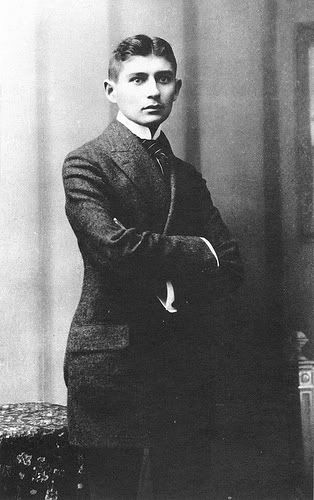 Having stumbled by chance across copies in the British Library in London and the Bodleian in Oxford while doing unrelated research, James Hawes, the academic and Kafka expert, reveals some of this erotic material in Excavating Kafka, to be published this month. His book seeks to explode important myths surrounding the literary icon, a "quasi-saintly" image which hardly fits with the dark and shocking pictures contained in these banned journals.
Even today, the pornography would be "on the top shelf", Dr Hawes said, noting that his American publisher did not want him to publish it at first. "These are not naughty postcards from the beach. They are undoubtedly porn, pure and simple. Some of it is quite dark, with animals committing fellatio and girl-on-girl action... It's quite unpleasant."
"Academics have pretended it did not exist," Dr Hawes said. “The Kafka industry doesn’t want to know such things about its idol."
He added: "Perhaps Kafka's biographers simply don't like the idea that their literary idol was helped out in this... way in the vital early stages of his career... Of the world's authors, only Shakespeare generates more PhDs, more biographies, more coffee-table books... Everything Kafka wrote, every postcard he ever sent, every page of his diary... is regarded as a potential Ark of the Covenant... Yet no-one has ever shown his readers Kafka's porn."
Having stumbled by chance across copies in the British Library in London and the Bodleian in Oxford while doing unrelated research, James Hawes, the academic and Kafka expert, reveals some of this erotic material in Excavating Kafka, to be published this month. His book seeks to explode important myths surrounding the literary icon, a "quasi-saintly" image which hardly fits with the dark and shocking pictures contained in these banned journals.Even today, the pornography would be "on the top shelf", Dr Hawes said, noting that his American publisher did not want him to publish it at first. "These are not naughty postcards from the beach. They are undoubtedly porn, pure and simple. Some of it is quite dark, with animals committing fellatio and girl-on-girl action... It's quite unpleasant."
"Academics have pretended it did not exist," Dr Hawes said. “The Kafka industry doesn’t want to know such things about its idol."
He added: "Perhaps Kafka's biographers simply don't like the idea that their literary idol was helped out in this... way in the vital early stages of his career... Of the world's authors, only Shakespeare generates more PhDs, more biographies, more coffee-table books... Everything Kafka wrote, every postcard he ever sent, every page of his diary... is regarded as a potential Ark of the Covenant... Yet no-one has ever shown his readers Kafka's porn."
7.10.2008
Review: "Blindness" by José Saramago
By writing a book where all but one character has suddenly been struck blind, Saramago presents himself with several challenges of technique. It is impressive to see a story written where visual descriptions have so little meaning and the best way of explaining events is to refer to tangible objects, sounds, feelings. Also an interesting literary choice is that up till more than half way through the book the characters are all passively acted upon, generally in increasingly negative ways as they are locked in an insane asylum and subject to the worst instincts of humanity in distress. While both these techniques challenge more conventional ways of storytelling, the second in particular made it difficult for me to really give myself to the story. We are generally given characters who have some realm of action that we can root for, and the choice to limit the protagonists to cowering in their blindness seems to suggest a moral stance on modern life and human ability that I personally don't agree with. Added to this is Saramago's slow and considered voice, page long paragraphs, punctuated regularly with commas, which read almost more like poetry than prose. While it is a unique and masterful narrative voice it was also somewhat distracting from reading the story itself- the language never quite disappeared (a problem I've had with all the Saramago I've read so far). Nonetheless, Saramago knows how to write a brilliant and gripping tale, and once the inmates finally escaped I was bound, curious to find out if they would survive and if everyone would regain their sight...

Here's also Walter Benjamin's 1940 Survey of French Literature and the discovery of some of Kafka's missing papers [via].
In further literary news, Salmon Rushdie wins the all-time best of Booker prize.
Here's also Walter Benjamin's 1940 Survey of French Literature and the discovery of some of Kafka's missing papers [via].
In further literary news, Salmon Rushdie wins the all-time best of Booker prize.
4.30.2008
Library of Unique Experiences
As a writer and avid reader it often worries me that in this hyper-modern world literature is becoming a rather insular art form: those who read read, and the rest, the majority, don't. This is one reason why I am fascinated by book lists such as these lists of the 50 best cult books or banned and challenged books. Hell, I even geek out over lists on Amazon, because sometimes these kinds of arbitrary collections can point me to books I ought to read, and even more importantly, suggest the extreme influence literature has had, and still has, on individuals.
For me however it is often not enough to read, or list, books that are inspiring, deviant, and fantastic for their own sake. Who hasn't tripped through the imaginations of Kafka, Burroughs, Vonnegut, or Poe? The more I read the more I become aware that one thing literature can do is describe, and allow us to experience, ever finer shades of being- much the way good classical music can create subtle emotional tensions through the contrast of chords, a masterful narrative can create as equally refined tensions through the tools of plot, language, identification. Of course, this has also meant for me a quest to discover ever more complex psychological narratives and descriptions of irreality, somewhat along the lines of Italo Calvino's idea of a library created out of books that only belong on the periphery of the established canon, the shamans and madmen of the book world, that by their tentative inclusion change our perceptions on the rest of our literally conjured experiences. On that note I want to present my own list of authors and texts that by haunting and redefining the canonical texts have been rather indispensable in my understanding of what is possible to experience.
Samuel Beckett- "Stories and Texts for Nothing," "Molloy," "Malone Dies," "The Unnamable," etc. While most people are familiar with "Waiting for Godot," the play that made him famous, few have braved Beckett's prose writing. Dense and dreamlike only scratch the surface, having been influenced heavily by Joyce and Proust, Beckett sets out to destroy every convention and form of thought available to language, so that we are left with plotless, settingless, and even characterless stories that nonetheless explore the despair and consciousness of what it means to be alive. Not for the casual reader, or even most experienced ones.
Nick Blinko- "Primal Screamer." The singer and artist of seminal anarcho-punk band Rudimentary Peni, Blinko followed in the footsteps of many great artists by going insane. From the asylum he produced an album dedicated entirely to H.P. Lovecraft, and this novel. "Primal Screamer" charts his descent into madness and childhood regression from the perspective of his psychiatrist, who may also be going mad.
Jorge Luis Borges- "Labyrinths," etc. I won't say much because he's more well known these days. Storytelling as the philosophy of infinite regression. A must read.
Julio Cortázar- "Hopscotch," "All Fires the Fire," etc. Though Borges, Márquez, Fuentes, and Vargas Llosa are perhaps the more widely known Latin American authors, Cortázar was also highly responsible for the Boom of Latin American Fiction in the 60s-70s. More urbane than Márquez's colonial-themed magical realism, Cortázar's work often deals with the loose boundaries of history and desire. Furthermore, his work "Hopscotch" has been hailed as the first hypertext novel or literary choose-your-own-adventure, featuring several chapters that can be inserted into the main text while remaining an immanently lyrical read.
Mark Z. Danielewski- "House of Leaves," "Only Revolutions." Also becoming more popular as his latest novel was nominated for several awards, Danielewski's "House of Leaves" was for years a cult classic circling around the internets. Personally I was not too impressed by his powers of storytelling, but was fascinated by the innovative, non-linear, and self-referential form of his texts, which are like reading trembling, labyrinthian, academic papers. And the idea of a house that continues to get larger inside itself gave me exquisite nightmares for about a week.
Mircea Eliade- "The Forbidden Forest," "Two Occult Tales," etc. Most famous as a scholar and founder of comparative religions, the Romanian Eliade always considered himself more of a storyteller. While the vast erudition of his academic work has a way of looping in on itself, his fiction does nothing but benefit from an intricate understanding of world mythological themes, put at the service of describing the psychological effects of time and the World Wars. He also writes some rather fantastic short stories based on his wide occult knowledge. A personal favorite.
Richard Hell- "Godlike," "Go Now." Another punk turned poet and author, Hell was most famous for his song "Blank Generation" with the Voidoids. His work offers a curious modern updating of several literary traditions that inspired his life. "Go Now" corrupts the Beat spirit of Kerouac and Clellon Holmes, while "Godlike" re-imagines the life of Rimbaud and Verlaine as gay New York poets on acid, all the while retaining a grasp on the frailness or pointlessness of humanity.
John Clellon Holmes- "Go." The novel that made the Beats a household word, and yet now falls outside the Beat canon. In the same vein as many other good author-wandering-around-aimlessly stories (cf. Henry Miller), "Go" gives an accurate portrait of the drunken striving and frightened insignificance of the best minds of his generation.
J.K. Huysmans- "Au Rebours (Against the Grain)," "Lá-Bas (Down There)." In the widely read "Portrait of Dorian Grey," Oscar Wilde has his character read a peculiar text that changes his life. That book happens to be "Au Rebours," which depicts the kind of decadent French lifestyle that Wilde only dreamed of living. Starting from this decadence, Huysmans manages to span the gamut of extreme experience in his works, from attending satanic masses to eventually joining a monastery.
Comte de Lautréamont- "Les Chants de Maldoror." Entirely unknown in its time, this work was eventually rediscovered by the surrealists who hailed it as one of the two masterpieces that informed their movement, especially the line: "The chance encounter on a dissecting table of a sewing machine and an umbrella." "The Songs of Maldoror" is a long imagistic prose poem about a relentless and possibly demonic anti-hero who has renounced God, mankind, and ultimately himself. Camus was also fascinated about this work and there are shadows of Maldoror in "The Stranger."
Stéphane Mallarmé- "Divigations," var. prose poems. While more often poetic then a prose writer, the Symbolist Mallarmé, along with Baudelaire in "Paris Spleen" and Rimbaud in "Seasons of Hell," attempted to destroy the boundary between poetry and prose, creating narratives outside of traditional syntactic forms that could be read for both the story and images at once. These works also capture the picture of the distraught French writer so eloquently distilled later in Sartre's "Nausea." On the other hand, Mallarmé's most famous poem, "A Throw of the Dice Will Never Abolish Chance," is a sprawling meta-poem about writing where words strewn everywhere on the page can be read in whatever order the reader chooses.
Gérard de Nerval- "Aurélia," etc. The other major influence on the Surrealists, as well as on Proust and Joseph Cornell, Nerval manages to record the fantastic dreams and hallucinations that accompany his descent into madness. Before and after his madness he paints vivid scenes of childhood love, Parisian neighborhoods, and occult rituals.
Kenneth Patchen- "The Journal of Albion Moonlight." A major influence on the Beats and collaborator with jazz musicians, Patchen somehow taps into the collective horror of World War II, penning a disjointed and surreal journal of a group of people fleeing and raging against a ubiquitous army of wolves. Phenomenal and chilling, this is the 40s, an emotional intensity never reached in the work of Pynchon, including the ballsy move of making both Jesus and Hitler misunderstood minor characters to his plot. A must read.
Milorad Pavić- "Dictionary of the Khazars," etc. More experiments with non-linear narratives. This text weaves a mythic story over several centuries through tentatively connected encyclopedia articles that can be read in any order and sound like masterful fairy-tales. Pavić's other works take the form of crossword puzzles and tarot readings.
Victor Pelevin- "The Yellow Arrow." I haven't read any of Pelevin's other work, but the Yellow Arrow is a personal favorite. A dark allegory about life and the Russian State, in which a man who is riding on a train that never stops, houses countries of people, and the dead are thrown out the windows, begins to wonder what would happen if he were able to get off. Beautiful and simple.
Fernando Pessoa- "The Book of Disquiet." Pessoa distinguished himself by creating several distinct literary heteronyms, who are the authors of their own works. In "The Book of Disquiet," one of these invented authors muses about the uncertainty and tedium of his life, and desire to imagine something different. For some reason I couldn't get through the book (mostly due to my own disquiet), though lines and images from it come back to me from time to time.
Rainer Maria Rilke- "The Notebooks of Malte Laurids Brigge." Many are familiar with his "Duino Elegies," and some colleges even require his "Letters to a Young Poet" in freshmen classes, but Rilke's only novel remains somewhat of a mystery. Much like other existential, man-about-town texts, in which not much happens but a character's obsession becomes fully lived (cf. Sartre and nausea, Lautréamont and evil, Miller and sex), Rilke's Malte is troubled by the question of death and transcendence, and that place where the veil of reality is torn to reveal poetic meaning. Though as a whole the "Notebooks" wanders off without a proper finish, many of the scenes display a linguistic and imagistic virtuosity that I don't think is rivaled in any other piece of literature. A personal favorite, try to find Stephen Mitchell's masterful translation.
Bruno Schulz- "The Street of Crocodiles." An obscure Polish art teacher, Schulz wrote down his childhood memories as letters to a fellow teacher and later published them as short stories. While drawing on the clarity and warmth of early Proust, as well as the ability to let incidental objects trigger emotional memories, Schulz sets himself apart by being able to see the extreme magic and dark possibilities that are peculiar to childhood. A personal favorite. The title piece also later served as inspiration for a short film by the Brothers Quay.
Of course, like all lists, this one is far from comprehensive. Other authors I am just discovering now deserve to be on here, such as Felisberto Hernandez, José Donoso, and E.T.A. Hoffmann, each of whom refines this library of unique experiences further. Hopefully others may read this and discover an author worth checking into, and if there are any texts that you have found inspirational or experientially exquisite, please post a comment.
For me however it is often not enough to read, or list, books that are inspiring, deviant, and fantastic for their own sake. Who hasn't tripped through the imaginations of Kafka, Burroughs, Vonnegut, or Poe? The more I read the more I become aware that one thing literature can do is describe, and allow us to experience, ever finer shades of being- much the way good classical music can create subtle emotional tensions through the contrast of chords, a masterful narrative can create as equally refined tensions through the tools of plot, language, identification. Of course, this has also meant for me a quest to discover ever more complex psychological narratives and descriptions of irreality, somewhat along the lines of Italo Calvino's idea of a library created out of books that only belong on the periphery of the established canon, the shamans and madmen of the book world, that by their tentative inclusion change our perceptions on the rest of our literally conjured experiences. On that note I want to present my own list of authors and texts that by haunting and redefining the canonical texts have been rather indispensable in my understanding of what is possible to experience.
Samuel Beckett- "Stories and Texts for Nothing," "Molloy," "Malone Dies," "The Unnamable," etc. While most people are familiar with "Waiting for Godot," the play that made him famous, few have braved Beckett's prose writing. Dense and dreamlike only scratch the surface, having been influenced heavily by Joyce and Proust, Beckett sets out to destroy every convention and form of thought available to language, so that we are left with plotless, settingless, and even characterless stories that nonetheless explore the despair and consciousness of what it means to be alive. Not for the casual reader, or even most experienced ones.
Nick Blinko- "Primal Screamer." The singer and artist of seminal anarcho-punk band Rudimentary Peni, Blinko followed in the footsteps of many great artists by going insane. From the asylum he produced an album dedicated entirely to H.P. Lovecraft, and this novel. "Primal Screamer" charts his descent into madness and childhood regression from the perspective of his psychiatrist, who may also be going mad.
Jorge Luis Borges- "Labyrinths," etc. I won't say much because he's more well known these days. Storytelling as the philosophy of infinite regression. A must read.
Julio Cortázar- "Hopscotch," "All Fires the Fire," etc. Though Borges, Márquez, Fuentes, and Vargas Llosa are perhaps the more widely known Latin American authors, Cortázar was also highly responsible for the Boom of Latin American Fiction in the 60s-70s. More urbane than Márquez's colonial-themed magical realism, Cortázar's work often deals with the loose boundaries of history and desire. Furthermore, his work "Hopscotch" has been hailed as the first hypertext novel or literary choose-your-own-adventure, featuring several chapters that can be inserted into the main text while remaining an immanently lyrical read.
Mark Z. Danielewski- "House of Leaves," "Only Revolutions." Also becoming more popular as his latest novel was nominated for several awards, Danielewski's "House of Leaves" was for years a cult classic circling around the internets. Personally I was not too impressed by his powers of storytelling, but was fascinated by the innovative, non-linear, and self-referential form of his texts, which are like reading trembling, labyrinthian, academic papers. And the idea of a house that continues to get larger inside itself gave me exquisite nightmares for about a week.
Mircea Eliade- "The Forbidden Forest," "Two Occult Tales," etc. Most famous as a scholar and founder of comparative religions, the Romanian Eliade always considered himself more of a storyteller. While the vast erudition of his academic work has a way of looping in on itself, his fiction does nothing but benefit from an intricate understanding of world mythological themes, put at the service of describing the psychological effects of time and the World Wars. He also writes some rather fantastic short stories based on his wide occult knowledge. A personal favorite.
Richard Hell- "Godlike," "Go Now." Another punk turned poet and author, Hell was most famous for his song "Blank Generation" with the Voidoids. His work offers a curious modern updating of several literary traditions that inspired his life. "Go Now" corrupts the Beat spirit of Kerouac and Clellon Holmes, while "Godlike" re-imagines the life of Rimbaud and Verlaine as gay New York poets on acid, all the while retaining a grasp on the frailness or pointlessness of humanity.
John Clellon Holmes- "Go." The novel that made the Beats a household word, and yet now falls outside the Beat canon. In the same vein as many other good author-wandering-around-aimlessly stories (cf. Henry Miller), "Go" gives an accurate portrait of the drunken striving and frightened insignificance of the best minds of his generation.
J.K. Huysmans- "Au Rebours (Against the Grain)," "Lá-Bas (Down There)." In the widely read "Portrait of Dorian Grey," Oscar Wilde has his character read a peculiar text that changes his life. That book happens to be "Au Rebours," which depicts the kind of decadent French lifestyle that Wilde only dreamed of living. Starting from this decadence, Huysmans manages to span the gamut of extreme experience in his works, from attending satanic masses to eventually joining a monastery.
Comte de Lautréamont- "Les Chants de Maldoror." Entirely unknown in its time, this work was eventually rediscovered by the surrealists who hailed it as one of the two masterpieces that informed their movement, especially the line: "The chance encounter on a dissecting table of a sewing machine and an umbrella." "The Songs of Maldoror" is a long imagistic prose poem about a relentless and possibly demonic anti-hero who has renounced God, mankind, and ultimately himself. Camus was also fascinated about this work and there are shadows of Maldoror in "The Stranger."
Stéphane Mallarmé- "Divigations," var. prose poems. While more often poetic then a prose writer, the Symbolist Mallarmé, along with Baudelaire in "Paris Spleen" and Rimbaud in "Seasons of Hell," attempted to destroy the boundary between poetry and prose, creating narratives outside of traditional syntactic forms that could be read for both the story and images at once. These works also capture the picture of the distraught French writer so eloquently distilled later in Sartre's "Nausea." On the other hand, Mallarmé's most famous poem, "A Throw of the Dice Will Never Abolish Chance," is a sprawling meta-poem about writing where words strewn everywhere on the page can be read in whatever order the reader chooses.
Gérard de Nerval- "Aurélia," etc. The other major influence on the Surrealists, as well as on Proust and Joseph Cornell, Nerval manages to record the fantastic dreams and hallucinations that accompany his descent into madness. Before and after his madness he paints vivid scenes of childhood love, Parisian neighborhoods, and occult rituals.
Kenneth Patchen- "The Journal of Albion Moonlight." A major influence on the Beats and collaborator with jazz musicians, Patchen somehow taps into the collective horror of World War II, penning a disjointed and surreal journal of a group of people fleeing and raging against a ubiquitous army of wolves. Phenomenal and chilling, this is the 40s, an emotional intensity never reached in the work of Pynchon, including the ballsy move of making both Jesus and Hitler misunderstood minor characters to his plot. A must read.
Milorad Pavić- "Dictionary of the Khazars," etc. More experiments with non-linear narratives. This text weaves a mythic story over several centuries through tentatively connected encyclopedia articles that can be read in any order and sound like masterful fairy-tales. Pavić's other works take the form of crossword puzzles and tarot readings.
Victor Pelevin- "The Yellow Arrow." I haven't read any of Pelevin's other work, but the Yellow Arrow is a personal favorite. A dark allegory about life and the Russian State, in which a man who is riding on a train that never stops, houses countries of people, and the dead are thrown out the windows, begins to wonder what would happen if he were able to get off. Beautiful and simple.
Fernando Pessoa- "The Book of Disquiet." Pessoa distinguished himself by creating several distinct literary heteronyms, who are the authors of their own works. In "The Book of Disquiet," one of these invented authors muses about the uncertainty and tedium of his life, and desire to imagine something different. For some reason I couldn't get through the book (mostly due to my own disquiet), though lines and images from it come back to me from time to time.
Rainer Maria Rilke- "The Notebooks of Malte Laurids Brigge." Many are familiar with his "Duino Elegies," and some colleges even require his "Letters to a Young Poet" in freshmen classes, but Rilke's only novel remains somewhat of a mystery. Much like other existential, man-about-town texts, in which not much happens but a character's obsession becomes fully lived (cf. Sartre and nausea, Lautréamont and evil, Miller and sex), Rilke's Malte is troubled by the question of death and transcendence, and that place where the veil of reality is torn to reveal poetic meaning. Though as a whole the "Notebooks" wanders off without a proper finish, many of the scenes display a linguistic and imagistic virtuosity that I don't think is rivaled in any other piece of literature. A personal favorite, try to find Stephen Mitchell's masterful translation.
Bruno Schulz- "The Street of Crocodiles." An obscure Polish art teacher, Schulz wrote down his childhood memories as letters to a fellow teacher and later published them as short stories. While drawing on the clarity and warmth of early Proust, as well as the ability to let incidental objects trigger emotional memories, Schulz sets himself apart by being able to see the extreme magic and dark possibilities that are peculiar to childhood. A personal favorite. The title piece also later served as inspiration for a short film by the Brothers Quay.
Of course, like all lists, this one is far from comprehensive. Other authors I am just discovering now deserve to be on here, such as Felisberto Hernandez, José Donoso, and E.T.A. Hoffmann, each of whom refines this library of unique experiences further. Hopefully others may read this and discover an author worth checking into, and if there are any texts that you have found inspirational or experientially exquisite, please post a comment.
4.17.2008
Rewriting Reality
Yesterday I finished my classes for the semester, and despite the gorgeous weather drifting into the stuffy wooden room through the blue stain-glass windows, the students in my short story class were somehow excited to continue discussing the functions of literature. Debating Salman Rushdie's use of both magical realist elements and the English language in his collection "East, West" as a move towards a broader global perspective, one of my classmates asked why is any of this important to talk about, he's just a writer trying to make some money. Just a writer? Both my teacher and I had to bite our tongues, certainly one does not write in order to make money (just ask any aspiring author and many acclaimed ones). Something that we've been discussing all semester, through the writings of Poe, Kafka, Joyce, Beckett, Borges, and Rushdie, is the way in which literature can present the expectations and conventions both of literature and of life itself back to the reader, reaching for ever larger perspectives on what it means to write, to inhabit a culture, to create reality. While not explicitly addressed in class I have been debating with my classmates over what I see as being one of the most important functions of fiction: that it can create reality, if even at the very least by suggesting new and other ways of being and perceiving the world and ourselves. If there's anything I've gotten out of this semester it is the recognition that writing has the power and responsibility to shape reality.
Of course, this has also meant that I have been entirely exasperated by the current trend in American literature, which for the past fifty years has been dominated by a "quotidian realism," that is, by snarky loosers sarcastically bemoaning the inconsequentiality of their everyday lives while trying to find moments of pale truth in the arms of their ex-wives, addictions, and academic pretensions. The biggest difficulty I see in this approach to literature is that it only confirms what is base and common about real life, while utterly refusing to allow any grander emotions or events room to occur. Personally I think that while art can be a mirror held up to reality, I also agree with Bertolt Brecht that art can be a hammer with which to shape it. My biggest philosophical influences here would be Robert Anton Wilson's quote that "reality is what you can get away with," and the Hashashin mystic Hassan ibn Sabbā's apocryphal assertion that "nothing is true; everything is permitted." While realism may claim to reflect everyday life, we forget that all it does is reflect literary trends and arch/stereotypes. No story is "true" outside of being a story, and consequently, one does not have to be bound by any proscriptions against that which is not typically real or true. Take Borges' work for example, in which fictional worlds ultimately overpower conventional reality, showing that it itself is nothing but a fiction of language.
According to the structuralist critic Tzvetan Todorov in his brilliant discussion of the fantastic as a literary genre, the supernatural, or even just the hyper-real and magically real, can function in narratives to express those things that might otherwise be inexpressible, whether cultural taboos or a Daoist ineffability of reality itself. Certainly psychoanalysis has taken the modern place of saying the unsayable, so that one could today write about rather taboo subjects in a realist style, but it still does not address the more imaginative aspects of what might be possible in the world. Not that one has to include magically real elements to do this, but this function of imagination is the place at which myth and folktales function. Italo Calvino suggests the way the earliest storytellers took the elements of life around them, caves, hunting, tigers, reproduction, etc. and recombined them in all possible ways, creating both a boundary on what had been seen and done before, and the possibility of other things that hadn't and either could be desired or feared. In myth, dreams are born, and the ability for culture to advance. This process is still continuing today. The human imagination in stories has more recently created both the internet (Vernor Vinge's "True Names") and the modern totalitarian state (Orwell's "1984"). If these aren't everyday enough examples for you, consider the now ubiquitous and almost bromidic myth of the American Dream. Thousands of people believe that they can raise themselves from rags to riches, and many actually do, precisely because in the late 1800s Horatio Alger Jr. happened to write a particular kind of dime novel in which that was possible. Maybe it was possible before that, but due to his stories it seems to many to be much more possible now. I know that my own life was intimately shaped by reading certain kinds of heroic fiction as a child (what always impressed me about Anne McCaffrey's "Dragonriders of Pern" series was not a desire to actually ride dragons, but the utter integrity of her characters in the face of societal pressure and change). I can only think of the current generation of children, who in reading the "Harry Potter" series may grow up with an increased sense of the possibility of true magic. Who, on the other hand, wants to grow up to be one of the bitter anti-heroes of a tepid realism, who himself is only a a second-order shadow of the much more interesting and articulate underdog, Henry Miller?
This post is of course not meant to be an exhaustive essay on the topic of rewriting reality, it is more along the lines of a tentative aesthetic statement or a whispered call to action. I'll only briefly point people to Grant Morrison's idea of art as a hypersigil, or to Paulo Coelho's idea of the Personal Legend. Why was his book "The Alchemist" on bestseller lists for the past year? Because he is telling people quite simply that they can create and live out their own stories. And if even just one reader believes him, then he has done his job as a writer. Never doubt that you too can be living in the greatest story ever told.
Of course, this has also meant that I have been entirely exasperated by the current trend in American literature, which for the past fifty years has been dominated by a "quotidian realism," that is, by snarky loosers sarcastically bemoaning the inconsequentiality of their everyday lives while trying to find moments of pale truth in the arms of their ex-wives, addictions, and academic pretensions. The biggest difficulty I see in this approach to literature is that it only confirms what is base and common about real life, while utterly refusing to allow any grander emotions or events room to occur. Personally I think that while art can be a mirror held up to reality, I also agree with Bertolt Brecht that art can be a hammer with which to shape it. My biggest philosophical influences here would be Robert Anton Wilson's quote that "reality is what you can get away with," and the Hashashin mystic Hassan ibn Sabbā's apocryphal assertion that "nothing is true; everything is permitted." While realism may claim to reflect everyday life, we forget that all it does is reflect literary trends and arch/stereotypes. No story is "true" outside of being a story, and consequently, one does not have to be bound by any proscriptions against that which is not typically real or true. Take Borges' work for example, in which fictional worlds ultimately overpower conventional reality, showing that it itself is nothing but a fiction of language.
According to the structuralist critic Tzvetan Todorov in his brilliant discussion of the fantastic as a literary genre, the supernatural, or even just the hyper-real and magically real, can function in narratives to express those things that might otherwise be inexpressible, whether cultural taboos or a Daoist ineffability of reality itself. Certainly psychoanalysis has taken the modern place of saying the unsayable, so that one could today write about rather taboo subjects in a realist style, but it still does not address the more imaginative aspects of what might be possible in the world. Not that one has to include magically real elements to do this, but this function of imagination is the place at which myth and folktales function. Italo Calvino suggests the way the earliest storytellers took the elements of life around them, caves, hunting, tigers, reproduction, etc. and recombined them in all possible ways, creating both a boundary on what had been seen and done before, and the possibility of other things that hadn't and either could be desired or feared. In myth, dreams are born, and the ability for culture to advance. This process is still continuing today. The human imagination in stories has more recently created both the internet (Vernor Vinge's "True Names") and the modern totalitarian state (Orwell's "1984"). If these aren't everyday enough examples for you, consider the now ubiquitous and almost bromidic myth of the American Dream. Thousands of people believe that they can raise themselves from rags to riches, and many actually do, precisely because in the late 1800s Horatio Alger Jr. happened to write a particular kind of dime novel in which that was possible. Maybe it was possible before that, but due to his stories it seems to many to be much more possible now. I know that my own life was intimately shaped by reading certain kinds of heroic fiction as a child (what always impressed me about Anne McCaffrey's "Dragonriders of Pern" series was not a desire to actually ride dragons, but the utter integrity of her characters in the face of societal pressure and change). I can only think of the current generation of children, who in reading the "Harry Potter" series may grow up with an increased sense of the possibility of true magic. Who, on the other hand, wants to grow up to be one of the bitter anti-heroes of a tepid realism, who himself is only a a second-order shadow of the much more interesting and articulate underdog, Henry Miller?
This post is of course not meant to be an exhaustive essay on the topic of rewriting reality, it is more along the lines of a tentative aesthetic statement or a whispered call to action. I'll only briefly point people to Grant Morrison's idea of art as a hypersigil, or to Paulo Coelho's idea of the Personal Legend. Why was his book "The Alchemist" on bestseller lists for the past year? Because he is telling people quite simply that they can create and live out their own stories. And if even just one reader believes him, then he has done his job as a writer. Never doubt that you too can be living in the greatest story ever told.
2.17.2008
The Myth-Killer: Krystian Bala Runs Amok
Last year, Polish writer and intellectual Krystian Bala was convicted of the gruesome murder of a businessman who was found years before tortured and drowned in a river. The primary evidence was Bala's novel "Amok," written two years after the murder, in which a group of Polish intellectuals grow bored with modernity and turn to drugs, sex, and eventually murder, including explicitly detailed descriptions of the crime that apparently could only have been known by the police, or the killer. Other evidence has since surfaced, such as Bala's possession of the victim's cell phone, and the businessman's friendship with Bala's ex-wife.

This may be somewhat old news, but the New Yorker just printed an in-depth article on the case, which goes beyond the details of the murder and trial into Bala's philosophical and creative influences, as well as includes dialogue from an interview conducted by the reporter with Bala in prison. According to this article, Bala leaned on the nihilistic writings of Nietzsche and Dostoevsky as well as the postmodernism of Derrida and Wittgenstein's idea that truth can never ultimately be known. "Bala cast himself as an enfant terrible who sought out what Foucault had called a 'limit-experience': he wanted to push the boundaries of language and human existence, to break free of what he deemed to be the hypocritical and oppressive 'truths' of Western society, including taboos on sex and drugs." Similarly, the interview paints Bala as sadistic and un-remorseful (though the novel is full of guilt and apologies for his sins), and leads the reader to suspect that Bala is much more interested in the narrative surrounding his case than in being innocent.
I want to put aside for a moment the question of whether the truth of Bala's guilt can ever been known, and discuss what that might mean. If Bala were innocent, and his depiction of the murder merely based on faithfully rendered news reports as he argued in his defense, then this whole story ends as a Kafkaesque irony. However, the article suggests that Bala was obsessed with what he called "mytho-creativity," the act of telling stories about oneself that become truth. In this light, the act of killing someone and then writing a novel about it later has the potential to become a legendary questioning of the boundaries between art and "real life." I am also somewhat fascinated by this power of language to shape reality, whether in creating stories of how we want to live our own lives (cf. the hypersigils of Grant Morrison's "The Invisibles"), or how we want others to perceive our lives (cf. the discussion on Proust in Roland Barthe's "Death of the Author"), and the question raised for me is at what point is art just art: a piece of work that can be detached from its creator and moment/method of creation? Can we really write our myths into reality? Of course, the act of killing a man, as art, is perhaps the most perverse and inhuman use of this kind of question, and if Bala had admitted to this crime it would have been little more than a horrendous piece of performance art taken too far. That he refuses to admit guilt suggests to me that he either didn't think he would get caught, is really a sick and twisted man, or actually thinks his work has the potential of raising such startling questions as his philosophy aims at.
Despite Bala's arrest making "Amok" an overnight bestseller in Poland, the final irony may be that any legendary or mythic historicity to be had by the piece relies on whether or not it is actually artistically crafted. Is "Amok" a work of literary importance, or is it merely the savage and shocking hack-job the media is portraying it as, which can only add to the spectacle of postmodern culture? As the book has not yet (if it will ever be) translated into English, I must refrain from likewise making this judgment, but the case is interesting enough that if it was translated I would probably have to read it, at least to see how someone else chose to weave their mythic escape from the "real world." Personally, I'm glad that my own dissatisfaction with postmodernity is tempered by a spiritual upbringing that finds recourse in dreams and the attempt to transcend one's condition, instead of in an abject philosophy that only reaffirms what is most base in life.
This may be somewhat old news, but the New Yorker just printed an in-depth article on the case, which goes beyond the details of the murder and trial into Bala's philosophical and creative influences, as well as includes dialogue from an interview conducted by the reporter with Bala in prison. According to this article, Bala leaned on the nihilistic writings of Nietzsche and Dostoevsky as well as the postmodernism of Derrida and Wittgenstein's idea that truth can never ultimately be known. "Bala cast himself as an enfant terrible who sought out what Foucault had called a 'limit-experience': he wanted to push the boundaries of language and human existence, to break free of what he deemed to be the hypocritical and oppressive 'truths' of Western society, including taboos on sex and drugs." Similarly, the interview paints Bala as sadistic and un-remorseful (though the novel is full of guilt and apologies for his sins), and leads the reader to suspect that Bala is much more interested in the narrative surrounding his case than in being innocent.
I want to put aside for a moment the question of whether the truth of Bala's guilt can ever been known, and discuss what that might mean. If Bala were innocent, and his depiction of the murder merely based on faithfully rendered news reports as he argued in his defense, then this whole story ends as a Kafkaesque irony. However, the article suggests that Bala was obsessed with what he called "mytho-creativity," the act of telling stories about oneself that become truth. In this light, the act of killing someone and then writing a novel about it later has the potential to become a legendary questioning of the boundaries between art and "real life." I am also somewhat fascinated by this power of language to shape reality, whether in creating stories of how we want to live our own lives (cf. the hypersigils of Grant Morrison's "The Invisibles"), or how we want others to perceive our lives (cf. the discussion on Proust in Roland Barthe's "Death of the Author"), and the question raised for me is at what point is art just art: a piece of work that can be detached from its creator and moment/method of creation? Can we really write our myths into reality? Of course, the act of killing a man, as art, is perhaps the most perverse and inhuman use of this kind of question, and if Bala had admitted to this crime it would have been little more than a horrendous piece of performance art taken too far. That he refuses to admit guilt suggests to me that he either didn't think he would get caught, is really a sick and twisted man, or actually thinks his work has the potential of raising such startling questions as his philosophy aims at.
Despite Bala's arrest making "Amok" an overnight bestseller in Poland, the final irony may be that any legendary or mythic historicity to be had by the piece relies on whether or not it is actually artistically crafted. Is "Amok" a work of literary importance, or is it merely the savage and shocking hack-job the media is portraying it as, which can only add to the spectacle of postmodern culture? As the book has not yet (if it will ever be) translated into English, I must refrain from likewise making this judgment, but the case is interesting enough that if it was translated I would probably have to read it, at least to see how someone else chose to weave their mythic escape from the "real world." Personally, I'm glad that my own dissatisfaction with postmodernity is tempered by a spiritual upbringing that finds recourse in dreams and the attempt to transcend one's condition, instead of in an abject philosophy that only reaffirms what is most base in life.
1.30.2008
The Incoherence of the Sentence in Kafka’s “In the Penal Colony”
The Incoherence of the Sentence in Kafka’s “In the Penal Colony”
“Forgive me if my explanations seem rather incoherent” (Kafka 144). Such is the officer’s response, in Kafka’s “In the Penal Colony,” when he discovers that the explorer sent to witness the execution does not yet understand the method by which the sentence is executed on the condemned prisoners. The officer claims that by having the sentence inscribed into their bodies, the prisoners have an enlightening moment in which they fully comprehend their crime, but this claim is continually undermined by the theme of inexpressibility that runs throughout the story. Though the method of execution seems inhumane to the explorer, the circuitous explanation of the device of torture, the practice of not informing prisoners of the terms of their guilt, and several miscommunications that beset the characters suggest that the officer’s plea for clemency in his use of the apparatus is incoherent, and the meaning of the sentence will inevitably remain unrevealed.
While the officer becomes shocked that the method of execution had not previously been explained to the explorer, he is at first pleased, and wants nothing more than to give his own description of the apparatus. However, he is unable to do this in a manner that the explorer fully understands. When the officer notices the explorer’s first interest in the machine and “stop[s] explaining in order to leave a space… for quiet observation” (143), it is the first hint that he wants the explorer to give his own judgment of the execution. Yet the officer does not let the explorer utter a full sentence before butting in with a technical description of the apparatus’s parts, which still leaves out the main detail of how the device actually works. The officer later shows the explorer the old Commandant’s plans for the apparatus, but the explorer only sees “a labyrinth of lines crossing and recrossing each other” (148), and cannot understand the sentence. Though the officer points out each letter of his own verdict, “BE JUST” (161), the explorer still cannot see the sentence in the confusion of lines. Like the validity of using the apparatus, the elaborate script of its sentences is only clear to the officer, and does nothing to convince the explorer of the machine’s rightness.
Similarly, the prisoner does not understand the machine or even the charges against him, which further displeases the explorer. When asked about the penal colony’s judicial process, the officer explains that the prisoner does not know his sentence, does not know that this or any sentence has been passed on him, and has not been given a chance to defend himself. The only evidence of the man’s guilt is the word of his captain, and the officer suggests that if he had interrogated the prisoner, “things would have got into a confused tangle” (146). While this already seems a barbaric lack of judicial clarification, the incoherence of the sentence for the prisoner is exacerbated by the condemned man’s inability to understand the officer’s French language. Through the story, the prisoner tries to follow the officer’s explanations, but even when he is placed under the Harrow, the part of the apparatus that does the inscribing, it is not indicated that he has any comprehension of what is going to happen to him. It is shortly after this incoherent parody of justice that the explorer is first tempted “to denounce this execution or actually try to stop it” (151).
Despite the officer’s gradually more insistent pleas for help, it is this desire to intervene that stays with the explorer. But when he finally passes his own sentence on the apparatus of execution, he does not directly explain to the officer that he disapproves of the procedure because it is inhumane. Due to this miscommunication, the officer is led to believe that the apparatus has been negatively judged because the explorer “did not find the procedure convincing” (160). Consequently, he decides to condemn both himself and the machine. While earlier describing the moment of enlightenment that comes to the prisoners, the officer suggests that this “might tempt one to get under the Harrow oneself” (150). When the machine is finally put into motion however, it does not produce a sentence on the officer’s back, but merely stabs him to death, and the explorer notes that there is no such moment of understanding on the man’s face.
Through these instances of inexpressibility in “In the Penal Colony,” Kafka is suggesting that it may be impossible to pass a sentence, whether on a person or a cultural practice, and have that sentence by understood.
Works Cited
Kafka, Franz. “In the Penal Colony.” The Complete Stories. Ed. Nahum N. Glatzer. Trans. Willa and Edwin Muir. New York: Schocken Books, 1971. Pgs 140-167
“Forgive me if my explanations seem rather incoherent” (Kafka 144). Such is the officer’s response, in Kafka’s “In the Penal Colony,” when he discovers that the explorer sent to witness the execution does not yet understand the method by which the sentence is executed on the condemned prisoners. The officer claims that by having the sentence inscribed into their bodies, the prisoners have an enlightening moment in which they fully comprehend their crime, but this claim is continually undermined by the theme of inexpressibility that runs throughout the story. Though the method of execution seems inhumane to the explorer, the circuitous explanation of the device of torture, the practice of not informing prisoners of the terms of their guilt, and several miscommunications that beset the characters suggest that the officer’s plea for clemency in his use of the apparatus is incoherent, and the meaning of the sentence will inevitably remain unrevealed.
While the officer becomes shocked that the method of execution had not previously been explained to the explorer, he is at first pleased, and wants nothing more than to give his own description of the apparatus. However, he is unable to do this in a manner that the explorer fully understands. When the officer notices the explorer’s first interest in the machine and “stop[s] explaining in order to leave a space… for quiet observation” (143), it is the first hint that he wants the explorer to give his own judgment of the execution. Yet the officer does not let the explorer utter a full sentence before butting in with a technical description of the apparatus’s parts, which still leaves out the main detail of how the device actually works. The officer later shows the explorer the old Commandant’s plans for the apparatus, but the explorer only sees “a labyrinth of lines crossing and recrossing each other” (148), and cannot understand the sentence. Though the officer points out each letter of his own verdict, “BE JUST” (161), the explorer still cannot see the sentence in the confusion of lines. Like the validity of using the apparatus, the elaborate script of its sentences is only clear to the officer, and does nothing to convince the explorer of the machine’s rightness.
Similarly, the prisoner does not understand the machine or even the charges against him, which further displeases the explorer. When asked about the penal colony’s judicial process, the officer explains that the prisoner does not know his sentence, does not know that this or any sentence has been passed on him, and has not been given a chance to defend himself. The only evidence of the man’s guilt is the word of his captain, and the officer suggests that if he had interrogated the prisoner, “things would have got into a confused tangle” (146). While this already seems a barbaric lack of judicial clarification, the incoherence of the sentence for the prisoner is exacerbated by the condemned man’s inability to understand the officer’s French language. Through the story, the prisoner tries to follow the officer’s explanations, but even when he is placed under the Harrow, the part of the apparatus that does the inscribing, it is not indicated that he has any comprehension of what is going to happen to him. It is shortly after this incoherent parody of justice that the explorer is first tempted “to denounce this execution or actually try to stop it” (151).
Despite the officer’s gradually more insistent pleas for help, it is this desire to intervene that stays with the explorer. But when he finally passes his own sentence on the apparatus of execution, he does not directly explain to the officer that he disapproves of the procedure because it is inhumane. Due to this miscommunication, the officer is led to believe that the apparatus has been negatively judged because the explorer “did not find the procedure convincing” (160). Consequently, he decides to condemn both himself and the machine. While earlier describing the moment of enlightenment that comes to the prisoners, the officer suggests that this “might tempt one to get under the Harrow oneself” (150). When the machine is finally put into motion however, it does not produce a sentence on the officer’s back, but merely stabs him to death, and the explorer notes that there is no such moment of understanding on the man’s face.
Through these instances of inexpressibility in “In the Penal Colony,” Kafka is suggesting that it may be impossible to pass a sentence, whether on a person or a cultural practice, and have that sentence by understood.
Works Cited
Kafka, Franz. “In the Penal Colony.” The Complete Stories. Ed. Nahum N. Glatzer. Trans. Willa and Edwin Muir. New York: Schocken Books, 1971. Pgs 140-167
10.20.2005
thinking problems
Thinking [via Bodarniset]
It started out innocently enough. I began to think at parties now and then -- to loosen up. Inevitably, though, one thought led to another, and soon I was more than just a social thinker.
I began to think alone -- "to relax," I told myself -- but I knew it wasn't true. Thinking became more and more important to me, and finally I was thinking all the time.
That was when things began to sour at home. One evening I had turned off the TV and asked my wife about the meaning of life. She spent that night at her mother's.
I began to think on the job. I knew that thinking and employment don't mix, but I couldn't stop myself. I began to avoid friends at lunchtime so I could read Thoreau and Kafka. I would return to the office dizzy and confused, asking, "What is it exactly we are doing here?"
One day the boss called me in. He said, "Listen, I like you, and it hurts me to say this, but your thinking has become a real problem. If you don't stop thinking on the job, you'll have to find another job." This gave me a lot to think about.
I came home early after my conversation with the boss. "Honey," I confessed, "I've been thinking..." "I know you've been thinking," she said, "and I want a divorce!" "But Honey, surely it's not that serious." "It is serious," she said, lower lip aquiver. "You think as much as college professors, and college professors don't make any money, so if you keep on thinking, we won't have any money!" "That's a faulty syllogism," I said impatiently.
She exploded in tears of rage and frustration, but I was in no mood to deal with the emotional drama. "I'm going to the library," I snarled as I stomped out the door. I headed for the library, in the mood for some Nietzsche. I roared into the parking lot with NPR on the radio and ran up to the big glass doors... They didn't open. The library was closed.
To this day, I believe that a Higher Power was looking out for me that night. Leaning on the unfeeling glass, whimpering for Zarathustra, a poster caught my eye. "Friend, is heavy thinking ruining your life?" it asked. You probably recognize that line. It comes from the standard Thinker's Anonymous poster. Which is why I am what I am today: a recovering thinker. I never miss a TA meeting.
At each meeting we watch a non-educational video; last week it was "Porky's." Then we share experiences about how we avoided thinking since the last meeting. I still have my job, and things are a lot better at home. Life just seemed...easier, somehow, as soon as I stopped thinking. I think the road to recovery is nearly complete for me.
Today, I registered to vote as a Republican...
Source: /Kate/A/blog
It started out innocently enough. I began to think at parties now and then -- to loosen up. Inevitably, though, one thought led to another, and soon I was more than just a social thinker.
I began to think alone -- "to relax," I told myself -- but I knew it wasn't true. Thinking became more and more important to me, and finally I was thinking all the time.
That was when things began to sour at home. One evening I had turned off the TV and asked my wife about the meaning of life. She spent that night at her mother's.
I began to think on the job. I knew that thinking and employment don't mix, but I couldn't stop myself. I began to avoid friends at lunchtime so I could read Thoreau and Kafka. I would return to the office dizzy and confused, asking, "What is it exactly we are doing here?"
One day the boss called me in. He said, "Listen, I like you, and it hurts me to say this, but your thinking has become a real problem. If you don't stop thinking on the job, you'll have to find another job." This gave me a lot to think about.
I came home early after my conversation with the boss. "Honey," I confessed, "I've been thinking..." "I know you've been thinking," she said, "and I want a divorce!" "But Honey, surely it's not that serious." "It is serious," she said, lower lip aquiver. "You think as much as college professors, and college professors don't make any money, so if you keep on thinking, we won't have any money!" "That's a faulty syllogism," I said impatiently.
She exploded in tears of rage and frustration, but I was in no mood to deal with the emotional drama. "I'm going to the library," I snarled as I stomped out the door. I headed for the library, in the mood for some Nietzsche. I roared into the parking lot with NPR on the radio and ran up to the big glass doors... They didn't open. The library was closed.
To this day, I believe that a Higher Power was looking out for me that night. Leaning on the unfeeling glass, whimpering for Zarathustra, a poster caught my eye. "Friend, is heavy thinking ruining your life?" it asked. You probably recognize that line. It comes from the standard Thinker's Anonymous poster. Which is why I am what I am today: a recovering thinker. I never miss a TA meeting.
At each meeting we watch a non-educational video; last week it was "Porky's." Then we share experiences about how we avoided thinking since the last meeting. I still have my job, and things are a lot better at home. Life just seemed...easier, somehow, as soon as I stopped thinking. I think the road to recovery is nearly complete for me.
Today, I registered to vote as a Republican...
Source: /Kate/A/blog
Subscribe to:
Comments (Atom)

