Showing posts with label pittsburgh. Show all posts

1.08.2010

The Method of Loci: Place and the Imagination

The other day I finished moving into a new apartment in the Friendship neighborhood, and in the morning after my first night there I looked out my third story window and was shocked to realize that the view corresponds almost exactly to the view from the window of the house I lived in years ago in my dreams: the playground, the prison-like school, the distant gothic cathedral, the park, each of which carry for me certain symbolic resonances, associating to emotional states, ideas, layers of memory and history. I actually can not see the park - it is only a small triangle compared to the overgrown woodlands in my dreams - but I've had so many powerful and life-changing experiences in that physical location that it is clearly vast and visible in the mind's eye, where such settings take on an imaginistic life of their own. The whole experience would have been uncanny, except that word means "un-homelike," and I felt very much at home. As Gaston Bachelard says in his study of the psychological effects of architecture, The Poetics of Space, "through dreams, the various dwelling-places in our lives co-penetrate and retain the treasures of former days."

I have been intrigued by this concept of psychogeography for years now. Not being a driver, I have the fortune of going on long meandering walks through the city in the dérive style of the early Situationists. However, over and above Debord's aim of psychogeography as the study of the effects of the environment on the emotions and behaviors of individuals, that is, the psychological effect of physical environments, I have grown curious about the representations of locations within the psyche itself, the way people dream, imagine, or narrate settings in which the images of their psychological processes take place, in short, a cartography of the soul.

Granted, there is a correlation between the physical environments we move through and the way we use familiar places to represent psychic states. The view from my dream window does not look out on anywhere that I've not actually walked countless times, but simultaneously, my inner world contains vast deserts, towers spiring into the cosmos, the labyrinthine depths of Hell. The real physical environments are sometimes not big or wild enough to articulate certain feelings and experiences. I was struck with this while readings Jung's Red Book (before I got caught up in moving out of the literal pit of my old neighborhood), particularly that he described his soul as a desert in need of regrowth. I admittedly have not read enough Jung to verify this, but in the popular or casual understanding of Jung's work, while character archetypes play a central role, there is much less thought given to the settings in which those archetypes exist and act. None of us exist in a void (or for that matter in the strange hinterlands our psyches generate, just as very few have actually met living versions of their animas or shadows outside their dreams and projections onto other people). At the most there is discussions of mandalas as the Center, in terms of sacred centers and axis mundis as Eliade discusses in The Sacred and the Profane, but this seems but crude generalization of the array of unique settings in the cultural imagination.

So where do these psychogeographies come from? I am not convinced, as Jung seems to have been, that our archetypal symbols are biologically rooted, or easily divisible into collective vs. individual, conscious vs. subconscious. Instead I currently believe our symbols are mimetic, passed down in the cultural imagination through stories and other media and our personal experiences of and relationship to these cultural expressions. I only started dreaming of the desert after briefly visiting New Mexico, but its psychic power is proportional to the sway that the image of the Wild West still holds on the American imagination, even projected out into space as Tatooine, the desert planet of the Star Wars movie of my childhood. Similarly, the towers and hells could have been evoked by various fantasy stories and video games, and became over my life subconscious settings for the feelings of the epic and apocalyptic that reside in us (these are our oldest modes of storytelling), but seem to have no physical place in the modern world.

On the other hand, people in various times and cultures have imagined precisely such a location where all contents of the human psyche reside. Most popularly articulated in the Theosophist's Akashic Records, this "storehouse of all knowledge" finds earlier analogue in the Islamic Al-Lawh Al-Mahfudh or Hebraic Book of Life. I can vouch for this location from my own psychic experiments, or point to the documented use of it for healing by the medium Edgar Cayce, while also suggesting that it, or there, is a potent metaphor for the possibility of a place for all knowledge, like one of Borges's infinite libraries or Alephs. This is similar to the metaphor of God as the possibility of all knowing, but where we seem today to no longer believe that one consciousness can know all, we are actively working to manifest that place that contains all knowledge. As the Internet expands, the metaphor of the Akashic Records becomes either real or unnecessary (though there are certainly still unknowns, dragons and edges of the world in the tubes of our epistemological maps). The Internet itself has become the imaginal place par excellence, existing nowhere and everywhere and as large as we can populate it, this terrain of our virtual representations which is literally the Sanskrit akasa: the all-pervasive space. Interestingly, it was through various science fiction authors imagining what a virtual reality would feel like - Stephenson's Metaverse, Vinge's Other World, Gibson's matrix - that the Internet as we know it, along with its spatial metaphors, came into being.
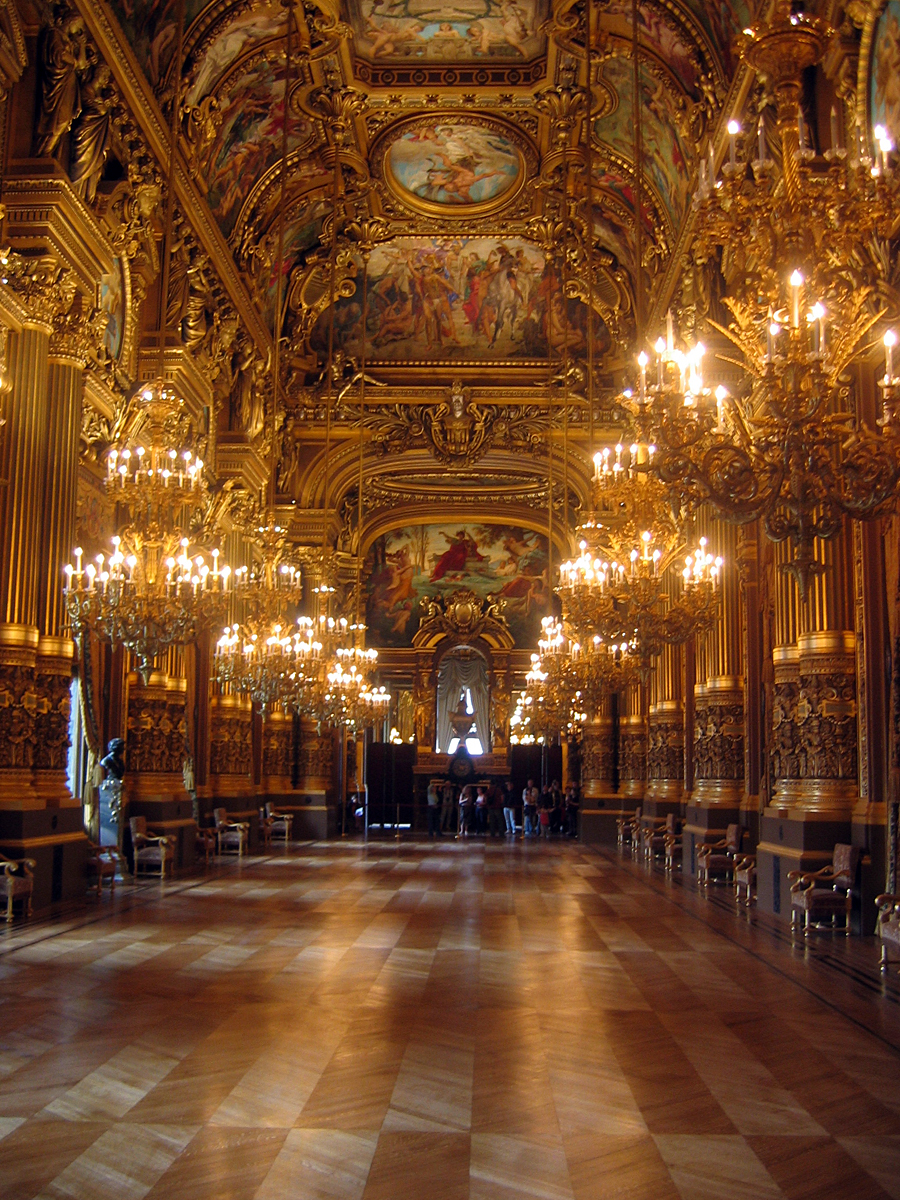
While unparalleled as the location for our conscious representations, glimmerings in the cultural imagination suggest that, as a psychogeography, the Internet is too real, or not real enough to fully articulate the more subconscious aspects of human experience, and other settings may have to be found. Last year I watched the TV show Battlestar Galactica, which (beyond its interesting treatment of the role of belief in the contemporary world) made use of a particular psychic location as a symbolic layer over the real world, directly experienced in visions by a number of the characters: the location of the Opera House. While in the show's plot this location ultimately served as only a cheap visual metaphor, its implications for the cultural imagination are far more suggestive. As an academic colleague pointed out, the Opera House replaces the sci-fi trope of virtual reality with a deeper psychic or subconscious reality, the theater as the place where the contents of our imaginations are made real for all of us. I have dreamt of the Opera House many times (though I was once an actor); it is, as Kerouac says in his own Book of Dreams, the Theater... that old spooky opera house and high school auditorium and classmeet hall of all my days, with hints from all the stages of Time's earth and actors too." While the symbol of the Opera House is still uncharted territory on the Internets, one only has to consider the mythological and ritual bombast of Wagner's operas, or just go see a movie. The drawing of the curtains, or now the darkening of the lights, acts as a veil torn between worlds, so that we sensually enter into the realities of our imaginations; the 3D wonderland of Pandora, the barely repressed longings to rescue Gotham, the Theater as the latest incarnation of the temple sanctum, where the gods become real in us. As Shakespeare said, all the world's a stage. We dream of the day (as Vinge does in Rainbows End) when our technologies allow us to visually project the settings of our imaginations onto the physical landscapes around us, so that we really will inhabit the lands of our dreams.

But where is this place (if not in us), and how are we to get there? The ancient Roman orators had a technique for memorizing long speeches and poems called the Method of Loci: one is asked to create a Memory Palace, taking a highly familiar location and placing in it associated images for the information to be recalled, so that all one has to do is stroll through the loci in the correct order. Personally I am interested in reverse-engineering this process, not further associating psychic terrains but unpacking all the cultural references that have been associated over time to various settings (a hermeneutics of the Opera House, of the Badlands, even of my dreams, whose consistent world this house is a cipher). The cities we inhabit may have a psychological effect on us, but we built the cities in our own image, and buried in them strata of meaning and longing. Perhaps we may uncover the ancient fear of Wilderness that has led so gradually to the current environmental destruction, or just learn to feel at home again, wherever we find ourselves.

1.01.2010

More USD reviews

Post-Gazette review of the Unlimited Story Deck

Reviews and articles continue to come in, along with emails from teachers who want to purchase copies once the deck is eventually published!

This is a very exciting way to begin the new year, and I hope everyone has as blessed a 2010 as I plan on having.


12.19.2009

Bananarchy in the Bowl of Winds (fiction)

[This one's inspired by a bunch of puns from work today, and the ridiculousness of the anxiety that manifests itself in Pittsburgh this time of year. Enjoy!]


Bananarchy in the Bowl of Winds


It was third down in the final minutes of the third quarter, and Jerry was on the edge of his seat. C’mon, he screamed, just catch the ball! I can’t believe that call, he was clearly across the line… I couldn’t tell how Jerry knew; it was almost impossible to see the field from as high up as we were in the stands. But the seats were cheap, even if in this terrible weather the wind just whipped down into the bowl of the arena and froze our faces off, even though the group of fans in bright yellow suits right below us seemed jovially unconcerned.

Touchdown! No it’s not, Jerry howled, wringing his towel and jumping up and down. One of the fans cast an odd glance up our way, but his friends were occupied, huddled around something I couldn’t see, probably watching a replay on the Net as the JumboTron screen was having a hard time staying focused. The fan’s face was inexplicably painted like a clown’s, in a yellow as garish as his suit. Jerry had warned me the fans often dressed quite strange to show their team spirit. I’ve never understood football myself, being more of a story man. What’s the entertainment value of watching large men you can’t even see tumbling all over each other? But Jerry’s enthusiasm was contagious, so when he begged me to come along with him to the game I agreed, not realizing how miserably wretched the weather would be, even in the chintzy team windbreaker Jerry leant me that did nothing to keep out the wind. Those thick yellow suits were starting to look appealing right now.

The game wore on, Pittsburgh falling behind as Dallas caught a second wind, and then a third. Unable to make out the ant-like players below, my attention kept wandering, returning to the yellow-suited fans who seemed to be having a lot more fun. It looked like they were busy constructing some apparatus, what after a moment my brain told me was a catapult. A catapult? I wanted to ask Jerry if this was for some post-game ritual, but he was too busy chewing his mittens to shreds over the last foul to listen, so I sat back again to watch, finally a little curious.

Third down in the final minutes of the last quarter, and the Steelers had just used their last timeout, hopefully planning how to turn their game around before poor Jerry threw himself from the bleachers in despair. The whole crowd was on the edge of their seats, except for me, unable to see why this was so important, and the yellow suits, who’d finished building their contraption and all leaned back, opening their jackets despite the chill. Suddenly, just as one of the Cowboys was about to claim another first down (I think that’s what it’s called), a small flapping object went whirling out of the stands, landing right in front of the runner, whose feet flew out from under him in an inglorious pratfall.

The crowd went wild as the cameras zoomed in to reveal a banana peel on the jittery JumboTron screen. The announcers all mumbled, uncertain where it had come from. The crowd was actually aghast, but they couldn’t keep from laughing at the absurdity of it, the yellow-suited fans most of all. Finally the field calmed down again so the Cowboy could redo his play without interruptions. But no! This time with an audible thwang another yellow whirl went sailing, and another. Suddenly the arena’s cold air was filled with banana peels, all landing whichever way the winds blew them! Looking around I realized that the top rows of the stands were dotted with yellow-suited individuals, each group of them busy at their own little catapult. They must have planned this whole caper in case the Steelers began to loose, unless it was a political statement, hiding the bananas in their jackets to keep them from freezing.

No one else seemed to notice the characters depart, all eyes intent on the field, where the game carried on now despite the rain of peels, the players slipping and tumbling all over the place, the ball slick with juice and a fruity reek wafting up to the stands. It was chaos, sheer bananarchy! Jerry could only shake his head as his cherished pastime was reduced to the buffoonery I’d always told him it looked like, while I laughed and laughed, entirely forgetting about the cold. Eventually the game was called on account of the mushy sabotage, and as we were walking to the lot I turned to Jerry and said, you know what, that was a lot more fun then I expected, you wanna go get a smoothie? For some reason he only grumbled and kept walking.

11.22.2009

The Artist's Mind/ the Public Eye

Last night I went out to reading held by the local Six Gallery Press, as I haven't been getting out of the house much lately and needed that creative inspiration. There I ran into my friend, the gentle giant Jessica Fenlon, who as always was gushing with her creative process. We stood on the corner talking about that moment when one is writing or making art, and everything starts to come together, not just in the work, but literally as if the contents of the art suddenly spilled over into reality with a great a-ha (such epiphanic moments being for me one of the strongest reasons to and for which to create, somewhat like the faulty pattern recognition of apophenia, except as artists, who else decides what patterns are real?)

Birdeyes

What was actually more inspiring than the reading was afterward finding Jessica's website, drawclose, which, besides having some of her rather fantastic and surreal videos, made me realize that I have far too many creative outlets that a). I've been terribly neglecting of late, and b). aren't as represented on the interwebs as they could be. At least not in one cohesive place. I realize I should probably bite it and get a domain name at some point, but for now I've taken the trouble to make the links to my various writings more visible in the sidebar here, as well as update a ton of artwork from the past 8 years to my flickr account, in particular making new sets for Collages, Inklings, and photographs of Modern Ruins. The next step will be figuring out the best way to host music so that I can put up recordings somewhere.

On the other hand, I am also reaching a point of frustration with the easy and public mediation of the Internet, which happens every couple of years, when I get too caught up in the public representations and analyzes and begin neglecting the creative process all together. It seems to me that we live in an age where everyone is creating (or at least "producing content") all the time, and is equally making that content available, all the time, except what is lost is the ability to step back, to edit, to build larger projects. Or, is lost the necessary silence, the magical space created when no one knows where or who you are or what you are doing, when out of the public eye the artist's mind is the total sphere of attention, and anything becomes possible. It is only when you disappear into the work that the epiphany truly starts to happen. And it won't if you're too busy telling people about it to let the threads weave and build up to something more than the just this.

9.14.2009

Literacy Narrative

For my class on Narrative and Technology I was asked to create what's called a literacy narrative, the story of my development as as "content producer/consumer" (to use the parlance of the age, focusing also on how our experiences with media have helped us develop standards of quality. The results were interesting and integrating, somewhat like a statement of intention or a road map, if a bit lengthy and abstract (I am trying to write a novel dealing with some of these similar themes). Thought it was worth posting here:


Long before the written word meant anything to me I loved a good story. Weekend nights growing up my father would tell my brothers and I bedtime stories; made up on the spot, featuring our stuffed animals as characters, a continuing series of tales that always intertwined with the previous nights’ adventures and with the content of our lives. Years later, when my father lost his job as a graphic designer and turned to his passion for genealogy, his stories became an ongoing collection of family legends that he hasn’t finished discovering or telling us. Encouraged more than anything to use our imaginations, my twin brother and I would go on long walks on the beach each summer and make up our own stories, often placing ourselves as characters in our favorite books and video games, but also creating between us an entire internal world through our words, which we would explore and return to year after year.

When our father was at work late, our mother would read us books, from “Alice in Wonderland” to “The Wizard of Oz,” and when I learned to read, sometime before kindergarten (roughly 1985), I became a voracious reader, consuming the entire sci-fi and fantasy sections of our local libraries before turning to more realistic literatures. I was such an avid reader that I would often stay up all night reading with a flashlight under the covers, or read books beyond the reading level of my peers, which I realized in 6th grade when I read the entire unabridged “Les Misérables” back to back with the Bible. Though I read everything I could get my hands on I became most intrigued by ancient mythologies, which I discovered in dusty large-prints in the school library, containing that epic and symbolic sense that reality contains much larger stories than those we experience on a daily basis, which we are also participating in, a sense furthered through role-playing video games and the choose your own adventure novels of the ‘80s.

Most of my love of reading was due to certain challenges I experienced as a child. The first was a sensory integration dysfunction, which eventually resulted in encouragement towards more physical and multi-modal forms of expression: music, art, acting, and gymnastics. Secondly, though, or perhaps due to being, intelligent and imaginative, I was entirely outcasted from my peers, and turned instead to a richer inner life, full of imagined stories and made up games. When I became aware of popular cultures, I explored alternate ways that teenagers express who they are in the world, researching the aesthetic and arts of various subcultures, settling eventually into the narrative of punk rock, with its Do It Yourself and world-changing ideals, the idea that anyone can say anything in any way they want, giving up my viola and books for a guitar, which was my main tool for creative expression for many years, though not the one that would become ultimately important to me.

I never wrote much when I was young, a few fantasy stories in grade school, one journal filled mostly with imaginary maps and drawings. It wasn’t until the first time I tried going to college that I learned that was what I wanted to learn to do. In a philosophy class on the meaning of death I had to keep a daily journal, assumedly so the teacher could keep track of our emotional responses, but this combined with a really droll fiction class and the encouragement of my poetess girlfriend convinced me I had to apprentice myself to recording my thoughts and experiences before I could ever tell a good story. Though my family members are mainly computer programmers/designers and I was raised with several old machines in the house, I always rejected using them for my writing, in somewhat of a luddite or romantic stance (in Pirsig’s sense) combined with being too poor to afford a decent machine. Though most importantly I write by hand, and in cursive, because this method replicates the flow of my thoughts better than my mediocre typing skills, and while typing the urge to go back and edit is too strong/easy, and the sense of flow this creates is generally apparent in the finished work.

An equally important lesson from the class of death was the idea that it is possible and necessary to more fully experience life, which I took to with a vengeance, immediately dropping out of school and moving from the DC area to Pittsburgh. Due to this idea, my imagination, literariness, and love of mythology, as well as several conversations on the subject with my new likeminded band-mates, I realized that instead of experiencing life fully in a random way, a person’s life could become a story, a narrative, a work of art or self-made mythology (an idea that many associate with Kerouac, though his wasn’t at all the story I wanted to live, because it wouldn’t be a good story if it had already been told). To this end I pursued a variety of novel and extreme experiences: protest/activism/street performance, rock and roll, romance, making fairie wings, web design, blogging (and before it was called blogging), circus performances, collective living, children’s storytelling, entheogenic drugs, various spiritual and occult rituals/experiences, psychological and philosophical studies, going crazy a couple times, writing poetry, cooking, traveling, etc. Through all of which I journaled what happened and what it could mean in terms of a larger personal narrative, making several attempts to write it into a novel that was some combination of a Proustian autobiography (as in not necessarily factual) with Grant Morrison’s idea of the hypersigil, that extended works of art are akin to magic spells created in order to realize and chart the course of one’s intentions in and for the world. This magical use of writing is important, as language as a technology may also originally have been a form of magic (spelling as a spell): words have power to cause changes in how we think/look/act in the world, as well as conjure real sensory experience in our imaginations.

In order that my particular personal narrative be interesting or applicable to other people, I have attempted to tie it into common human themes and symbols culled from psychology and mythology. At the same time I have explored the deeper symbolic content of my own life through a study of my dreams, which are admittedly rather wild and epic, which have added to my personal story and sense of meaning as well as help develop my memory and sense making apparatuses. Dreams eventually took on a greater significance as a source or form of narrative, as they are contained, symbolic even when dealing with everyday concerns, and contain a weird or thwarting element in which the thing itself escapes (a concern with the possibility of description I find in Magical Realist literatures, that the imaginative and the non-real can sometimes express more about reality by sidestepping the inefficacy of language to actually capture what really is, best summed up in the Emily Dickinson line, “Tell all the truth but tell it slant...”). At the very least, dreams are like personalized narratives or an internal TV show, offering some of the most interesting inspirations to one’s artistic process.

As for my definition of Quality, it is expressed in four parts relating back to the above narrative. First I find Quality in that which is rare, unique, or novel, that is, not what can be found in the everyday or in mass consumer culture. I recall throwing my TV out the window in 7th grade and wearing a shard of the screen around my neck for many years after, though more recently I’ve been appreciating some of the higher quality TV programming (Battlestar Galactica, Lost, Deadwood), art that pushes its medium to new places or beyond the mean and expected. Quality as not yet been done.

Second, that which has Quality contains an element of intention or ability to evoke a response. Quality art always moves people in some way. Prior to an academic response it is felt viscerally, if you love it or even if you hate it the work is doing something worthwhile, allowing the viewer to experience a fullness or depth of experience. This is somewhat like Garcia Lorca’s concept of the Duende, the clear emotional depth to a performance that sets it above more rote ways of creating. Quality as authentic.

Next, Quality implies to me a harmony or reflexivity across scales, which comes from two pivotal ideas: Marshall McLuhan’s concept that the medium is the message, that form and content reflect each other, and the alchemical idea of as above so below, that the smallest scale of a work has to be reflexive of the whole, that when the parts reinforce each other they add up to something complete and larger than the sum of the parts. In terms of Quality storytelling, this means personal or local stories are reflexive of global concerns and the human condition. Quality as interconnected.

Last, I find Quality in those things that strike me as being connected to my own creative or learning processes, the eureka! or synchronistic moment where that thing is exactly what I was looking for next. Of course, this is entirely subjective and implies that Quality is conditional to the time and place of a person’s encounter with the thing, but things that don’t have that Quality don’t force themselves on our attentions in the same way (if at all). Quality as immediate and personal.

Since returning to school for creative fiction writing, in the last two years I have been trying to hone my writing process, getting a number of stories published in print and online [1] [2], making the rest of my creative output available, blogging (though I rarely have the time for this), reading more than ever, and attempting to finally finish my first novel, as there are two more pushing at the back of my brain to be written. My current literary concerns focus around the interplay of very short and very long forms, that is, flash fiction’s ability to capture the immediacy of a moment vs. the tome (800+ pages), which allows an author to create a full and changing world; second, ergodic or non-linear narratives, and last the use of storytelling and memory as a way of literally saving the world (as in backing it up so it won’t be lost), writing as a collage of personal experiences, global events and narratives, ideas, imaginations, &c. which I wish that I'd thought of two decades ago before my father's bedtime stories were mostly forgotten.

8.10.2009

The Alchemical Visions of Alberto Almarza

I've been following the work of my good friend, the CMU graduate and Chilean visionary artist Alberto Almarza, for many years now. This weekend I had the opportunity to attend the first Pittsburgh Visionary Arts Festival, which Alberto organized and showed his work at, including his series of small intricate image boxes. It seems that in preparation for the event, Alberto has finally started putting his work online:


And for those interested in the creation of sacred geometries and hand-made mud flutes Alberto is also blogging lessons from his current Pittsburgh Center for the Arts classes.

2.20.2009

Saving Middle-Earth: The Power of Recording Reality in Tolkien's The Lord of the Rings

Saving Middle-Earth: The Power of Recording Reality in Tolkien's Lord of the Rings

Every quest has a goal, but sometimes these goals contain subtler, more far-reaching effects than their stated purpose. In J.R.R. Tolkien’s The Lord of the Rings, the explicit goal is to save the world of Middle-Earth from the evil of Sauron by destroying the One Ring. While this act certainly rids the world of evil, it also serves another purpose for its inhabitants, cultures, and environment: that of allowing this reality to continue into the future. In this sense, ‘saving the world’ preserves or records what has come before for those who are yet to come. And though we do not find ourselves slaying evil warlocks in our daily lives, we too can participate in this quest through the symbolic applicability of the ideals in The Lord of the Rings to our modern life. This paper will examine the ways in which this preservationist sense of ‘saving the world’ is illustrated in the history of Middle-Earth, in the early stages of the ring quest, and in the writing and reception of Tolkien’s masterpiece in our own reality.

If the whole world is at stake in the quest, we must first understand what that world is before it can be saved. The epic story told in The Lord of the Rings is only the tip of the iceberg, or the dénouement, of a long and winding history stretching back thousands of years before men, much less hobbits, were even conceived. In many places in the text, references are made to historical persons and events that, while not bearing directly on the tale, are still an integral part of that reality. In a letter to his publisher, Milton Waldman, Tolkien discusses this history, suggesting that Middle-Earth grew out of or was invented to house his imaginary languages of the Elves (143). Already we can see this world as a kind of record, moving from creation myths to the histories of the Elven people, respectively recorded by Tolkien in the Music of the Ainur and the Silmarillion (146). Middle-Earth is a world created by the gods (who imagined it as a story), but it is incomplete. In order for the world to be fully made it has to be made for someone: the Children of the Gods, who are the Elves, and later Men (147). The world is made in order to pass it on, like a grand inheritance, including all the cultures and ideals that world contains.

As the history of Middle-Earth deals primarily with the Elves, it is necessary to look at how Elven culture helped shape the Middle-Earthian ideals of preserving the world. Elves are immortal, and thus concerned with, “the griefs and burdens of deathlessness in time and change” (146). Elven magic is a sub-creative art rather than a dominating power, and they desire to use magic to “benefit the world and others,” including the environment, through the “adornment of earth, and the healing of its hurts” (146, 151). Tolkien similarly points out that Elrond’s house represents Lore; the art of the Elves includes, “the preservation in reverent memory of all tradition concerning the good, wise, and beautiful” (153). If the elves have a flaw however, it is in wanting to preserve this beautiful world around them as it is, despite the passage of time. But as the world inevitably changes, their art eventually becomes ineffectual, “a kind of embalming” (151). The main purpose of the Rings of Power stems from (and perverts) this Elven desire: “the prevention and slowing of decay” (152). This brings out another facet of ‘saving the world,’ that we can only safeguard reality for those who come after us, and not for ourselves.

While the Elves are First-born, it is their duty in turn to fade like the gods, and to pass Middle-Earth on to the Followers, Men. Having no magic of their own, Men are not as concerned with the preservation of goodness and beauty in their world, and they more readily fall prey to the dark forces at work in Middle-Earth. The elves however passed on to Men a “strand of ‘blood’ and inheritance” on which the art and poetry of man depends (149), that is, the ability and desire to pass on their own ideals through the art of cultural transmission. This is highly significant, because unlike Elves, Men are mortal. In his article, The Quest Hero, W.H. Auden suggests that quests serve as “symbolic descriptions of our personal experience of existence as historical” (33). The telos, the goal or end point, of any life is in death, and as such the quest is always in some way an attempt to defy death, which is attempted in two drastically different ways. The Men in the Second Age of Middle-Earth are denied immortality, but still act out of the received Elven ideals of preserving themselves, by desiring either more time in life or to escape death altogether (Tolkien Letters, 154-5). This desire for eternal life unfortunately results in the aligning of the kingdoms of Men with Sauron against the gods in a terrible and world-twisting battle (ibid, 156). On the other hand, Men can face death by saving the world: by both defeating the evil forces that encourage destruction and by leaving behind cultural records for the benefit of the world that follows. At stake in the Third Age of Middle-Earth, in which The Lord of the Rings takes place, are not only the world itself, but also the ability to continue to save the world through the preserved legacies of mankind.

Sauron is not defeated until the end of the third book of The Lord of the Rings, but the ways in which the story’s heroes can save the world through cultural legacy are already suggested early on in the quest, in The Fellowship of the Ring. The history of the One Ring itself highlights some of the personal challenges reflected in this theme of inheritance. As Elrond recalls the story during the Council of Elrond, the Ring was taken from the hand of Sauron and then lost by the human Isildur (320), who wanted to keep its power for himself. Isildur’s heir, Aragorn, inherits the Sword of Elendil, the broken blade of which symbolizes Aragorn’s duty to mend the damage caused by his ancestor’s greed. Aragorn does this by first protecting the peoples of the North, and then joining the quest that will restore him to his inherited place on the throne at Minas Tirith. While the One Ring passes from Isildur to Golem, these characters loose the ring because they want to preserve themselves and not their world. The next inheritor though, Bilbo Baggins, chooses to give up the ring to his nephew Frodo on his own accord (79). Frodo is Biblo’s heir, for his property, wealth, and stories. But it is the act of being given the Ring freely that allows Frodo the ability and desire to want to, “save the Shire” (96), and by extension, the rest of the world of Middle-Earth, which he does by going on the quest to destroy the Ring. The Ring is passed on for the sake of the future.

The quest to resolve the inheritance of the Ring is not the only way that the inhabitants of Middle-Earth in the Third Age are attempting to save their world. One might even say from the amount of stories, songs, and knowledge recorded in the text that the chief pastime of the Middle-Earthian races is the preservation and transmission of their cultural realities. Beyond the large-scale histories preserved through their retelling by Gandalf and Elrond, other historical events are recorded in the Elf-songs to Elbereth, Gil-galad, and Eärendil (117, 250, and 308), sung not just by Elves, but also by Samwise and Bilbo. Though the Elves are fading into legend their history is preserved in song, and more importantly their language is also being preserved, as Bilbo teaches Frodo the Ancient Tongue of the Elves (119). And it is not just the high culture of the Elves that is preserved; Glóin reounts the Dwarven attempt to reclaim their own cultural heritage by excavating Moria (316), and even Hobbit history is recorded, as in the legend of Gorhendad Oldbuck and the school song about trolls (141 and 276). Beyond these cultural inheritances, knowledge of the land itself is preserved in the stories of Tom Bombadil. The ancient Tom not only knows the secret stories of the trees and environment of Middle-Earth, but also willingly shares these with the Hobbits, so that they too can pass on the full history of their world (181). As we see from the Notes on the Shire Records that opens the text, Frodo’s three Hobbit companions go on after the quest is finished to record information on the legends, names, languages, calendars, and herblore of Middle-Earth (37), effectively preserving everything that has come before for the future ages of their world.

While these introductory Notes on the Shire Records bodes well for the result of the quest, they are only possible by the quest being both completed and recorded. And these are achieved through two instances of the intersection of individual inheritance and cultural legacy that highlight the theme of saving the world in The Fellowship of the Ring. The first of these instances is Gandalf’s search through the libraries of Minas Tirath for proof of the One Ring: a scroll written by Isildur that accounts for the inscription on the Ring. Despite Isildur’s desire to keep the ring for his own inheritance, he leaves this account, “lest a time come when the memory of these great matters shall grow dim” (331). Even the caretakers of the library had forgotten this scroll, and if Gandalf had not had the knowledge to find these memories of the past, the inhabitants of Middle-Earth would have been condemned to repeat their forefathers’ desire to hide or use the One Ring. It is the finding of the record of the inscription that ends Gandalf’s quest and begins Frodo’s journey. But once the journey is finished, how are the future inhabitants of the world supposed to remember the quest, much less we the readers, unless better records are left behind? To this end, Bilbo wants to record Frodo’s story as a book, and even asks him to bring back any old songs and tales he comes across on the way (327 and 364). Bilbo is already recording Middle-Earthian cultures and legends; a selection of his Red book of Westmarch has been published (in our own world) as The Hobbit (20). As such, Bilbo’s act of recording Frodo’s journey ultimately saves their world, as it becomes for us the books of The Lord of the Rings.

While the world of Middle-Earth began as a linguistic exercise, Tolkien suggests in his letters that he wrote The Lord of the Rings as an attempt to conclude and encapsulate all the histories and themes of his imagined world (159). There was however another goal at stake in Tolkien’s invention of Middle-Earth: the creation of a mythology which would fill a lack of that kind of story in his own country (144), if not in our whole modern world. Though there is no agreed upon definition of mythology, contemporary myth-theorists like University of Pittsburgh’s own Fred Clothey might argue that myths are symbolic narratives that order a people’s experience of reality and serve as paradigms for how that reality is to be lived. The reality in which Tolkien was writing The Lord of the Rings was a chaotic and rapidly changing one. The world was involved in a second global war, new technologies were destroying the environment, and cultural transmission was being devalued by the new medium of movies into mere entertainment. Tolkien stresses in his foreword to The Fellowship of the Ring that while his story is not allegorical for the real world it is certainly applicable. The war over the Ring serves as a symbol for the dangers of global warfare; the concern of the Elves for the environment of Middle-Earth, and the living desires of that landscape itself, serve as symbols for the need to preserve our own respect of nature. The focus on acts of remembering and recording the past serve as a strikingly paradigmatic symbol for us to not forget our own histories and cultural traditions.

Tolkien’s The Lord of the Rings thus fulfills its author’s intention of being written as a myth, but it cannot fully become one until it too is passed on, and is accepted as myth by the people whose reality it records and symbolizes. While it was relatively unread during the first decade of its publication, Tolkien’s story eventually became the second most read book after the Bible. During the ‘60s, “Frodo lives!” was graffitied in New York subways, a suitably mythic response to that decade’s need for new cultural explanations. What really attests to the books’ power as myth is that they continue to hold such fascination and relevance for our contemporary century. These stories were recently made into a series of critically acclaimed and high-grossing films that seem likely to continue to pass on Tolkien’s vision and ordering of reality for generations to come. As such, the stories of Middle-Earth, in their history, text, and modern relevance, serve as Tolkien’s own inheritance to us. The Lord of the Rings literally saves his world and its cultural values so that we in turn will remember to keep saving our own world.


Bibliography

Auden, W.H. “The Quest Hero.” Understanding the Lord of the Rings. Eds. Rose
Zimbardo and Neil Isaacs. Houghton Mifflin Co. Boston: 2004

Tolkien, J.R.R. “The Fellowship of the Ring.” Ballantine Books. New York: 1965

Tolkien, J.R.R. “The Letters of J.R.R. Tolkien.” Ed. Humphrey Carpenter. Houghton
Mifflin Co. Boston

7.18.2008

Urban Adventures

glasspath&tait

Yesterday I took Sophie to see one of the still hidden wonders that haunt the ruins of Pittsburgh's old steel and glass industry- what I like to call the glass burial grounds, but I have also seen called the broken glass path, a hillside overlooking the old Carrie Furnace featuring heaps covered in shards of colorful glass.

glasspath1

While Carrie Furnace has become somewhat of an underground hotspot for urban adventurers in Pittsburgh, mainly due to the artistic construction there of a forty-five foot tall deer head, the nearby trail of glass is almost unheard of, covered by weeds and missing even an iconic name or carefully preserved history:

"In 1885 the W. R. McCloy Glass Works were erected at Rankin Station, on a 5-acre tract of land fronting on the Union Siding of the P. McK. & Y. and B. & O. Railroads, and extending back to the Monongahela river, the property adjoining the ground of the Duquesne Forge on the south. Here one of the first tank furnaces ever built in the Pittsburgh district for making crystal blown glass was constructed. The product chiefly consisted of lantern globes, fruit and candy jars. In the year 1887 The Braddock Glass Company, Ltd. was organized and incorporated, and the capacity of the plant enlarged by the installation of one 10-pot furnace. This company employed about 150 men, and in addition to the former product, also turned out a complete line of lamp chimneys. In March, 1892, the plant was totally destroyed by fire, which is said to have originated from sparks emitted by a passing switching locomotive. The whole country was at that time entering a period of depression, and the works were consequently not rebuilt."

glasspath2
(flickr photos taken by Sophie Klahr)

It's rather fascinating, and otherworldly, to be walking among such kaleidoscopic rubble that has presumably been laying there for over a century! When I was first taken to this magical spot it was much less overgrown, and it seems that over the four years since then much of the glass has been scavenged, though I can only imagine (or hope) that the remaining huge heaps conceal enough colorful treasures to last another century. At the time I had gotten in an argument with the friend who had taken me there over whether or not to not just tell people where this place is, but if it even existed (though of course enough gifts of rainbowed glass were given that it's obvious it had to have come from somewhere). Surely we were not the first to discover it in over a hundred years, and, like the old adventuring spot of the Dixmont mental asylum, demolished several years back to become a Walmart instead of historical ruins, it is unlikely that the glass burial grounds will survive forever. I suppose the issue is that, while it is a beautiful and important landmark that people should know about, it is also one that should be respected (hopefully by someone not up and taking all the glass that's left in one foul scoop).

6.23.2008

More news of the word

I'm always glad to see news about literature and narratives out in the world, even if they are often cast in other mediums then good old paper.

Cormac McCarthy's "The Road," a father and son bonding story set in an ambiguous and bleak apocalypse, was arguably the best book published this past year. It has just finished filming [via reality sandwich], mainly around the Pittsburgh area (which of course to me is really the perfect post-apocalyptic landscape). The movie adaptation of McCarthy's "No Country For Old Men" was also pretty stellar, so I'm quite excited to go see this when it comes out.


In other news, Cory Doctorow at Boing Boing reports that the Stormworm computer virus is now inventing fictional events to entrap people, playing on such natural disaster and celebrity fears as 'Eiffel Tower damaged by massive earthquake' and 'Donald Trump missing, feared kidnapped.' It would be a rather interesting twist if some of these events started to become true...

For Sophie, here is a great collection of links on the writing of and critical controversy surrounding the poet Anne Carson for her birthday, whose novel-in-verse "Autobiography of Red" recasts the mythic monster Geryon as a a modern photographer and lover of Herakles, and really shows some of the ways that old stories can be recycled to reexamine their hidden themes.

And finally, laser-cut typographic scarves!

5.31.2008

Pittsburgh Cultural Thrust

I realize that I post very little here about my personal life/ activities, mainly because I've been spending the last couple months laying low, reading, writing, working and little else, which most of the time is really all I need to be doing. This weekend however proved to be different, we went out of the house not just once but several times to enjoy some of the cultural highlights of Pittsburgh.

On Thursday night, after going to a friend's birthday party in a swank storefront apartment in the up and coming Lawrenceville, we jetted up to the Shadow Lounge to see Nikki Allen read some poetry for the release of her new chapbook, "Quite Like Yes." While the poets kept their sets somewhat short, plagued by migraines and excessive drunkenness, the evening was stolen by Landmonster!, who ranted obsessively absurd phrases over pre-sampled Casio beats while wearing space pajamas and a Mardi Gras mask.

The next day we went down to the museum to check out the 55th Carnegie International exhibit, which for the first time was given a title, "Life on Mars," prompting the artists to look at what at means to be human from an outsider perspective. There has apparently been a lot of critique over this move, as well as the inclusion of certain artists whose work may not measure up to the "standards" of the Carnegie Museum. I thought some of the work was fantastic and, like any museum exhibit, there were certain artists who just didn't do it for me. Most impressive were Thomas Hirschorn's Cavemanman, a packing tape and media image labyrinth; Cao Fei's Whose Utopia, a film of a fairy-tale ballet in a Chinese light-bulb factory, and Friedrich Kunath's whimsically bittersweet paintings.


Afterwards we walked over to the Carnegie Library of Pittsburgh, which unfortunately I rarely visit (since I prefer collecting books), but was pleased to find they have an extensive music and film section, including drawers full of classical symphonies, which, despite mainly being in the public domain, are almost impossible to find on the internet.

Tonight happens to be our second anniversary (of the day Sophie and I met at the Quiet Storm), and so to celebrate we're planning to continue our hunt of good Thai restaurants in Pittsburgh with Sweet Basil and La Filipiniana (last week it was the stellar Smiling Banana Leaf). And then we will eat a decadent cake while playing Super Scrabble, which for a couple of real homebody bookworms like us (unlike people who only pretend to read [via]) is really the perfect evening.

And just to throw in a couple things about the rest of the world, one of the last un-contacted tribes was discovered in the Amazon, who brandished notched arrows at the plane taking pictures at them which (according to the article) they must have thought was "a spirit or a large bird." Of course, it may also have been one of these new luxury aircraft hotels in the shape of a large white whale [via].

5.08.2008

The New Steam Age

It's sometimes strange living in the world of the internet where cultural trends like Steampunk are almost ubiquitous, but then in talking to friends who've never heard of it here in the often small-town Pittsburgh realize that Steampunk is still somewhat of an underground phenomena. Of course, thanks to this article on Steampunk in The New York Times, and a new Steampunk Anthology [both via Boing Boing], the whimsical neo-Victorian aesthetic of this sub-sub-genre may be coming to more public spotlight.


I first became aware of the term Steampunk in relation to Neil Stephenson's Baroque Cycle, a somewhat sci-fi styled series of novels set in 17-18th Century Europe. As opposed to the term Cyberpunk, which designated a genre of similarly-themed but slightly futuristic works, Steampunk began being used for works set in historical periods that nonetheless focused on the advent of technology, adventure, etc. Apparently such authors as Jules Verne with "Around the World in Eighty Days" and H.G. Wells with "The Time Machine" could be considered the grandfather's of Steampunk fiction. Personally I was always considered the "Little Nemo in Slumberland" comics of Winsor McCay, with their airships and Victorian sensibilities, to be another foreshadowing of this aesthetic (though perhaps the aesthetic yet to come of "Dreampunk"). From a slim genre of writing, Steampunk quickly became a fashion statement full of vests and petticoats and a DIY tinkering model full of brass plating and clockwork, and is slowly taking over other mediums such as music, video games, and film (at least according to the New York Times article and depending on how one wants to slice your sub-cultural definition). One of the biggest challenges apparently is that still being a rapidly growing sub-culture there is no exact definition of what makes something Steampunk. Similarly there are many artists who are currently drawing from this Victorian aesthetic, from Burlesque shows to fashion designers, without being aware that they might fall under a sub-cultural umbrella. Either way, what appeals to me in all this is Steampunk's sense of whimsy and elegance, the appeal to DIY ethics and a sense of adventure somewhat lost in the post-post modern world.

4.07.2008

Projecting Synapses into the Otherwise Chaos

The other evening I went out to a local bar to hear my friends Nikki Allen and Renee Alberts read poetry between bands. As always, and despite the ubiquitous conversations throughout their sets, I was deeply impressed by these ladies' words, though I couldn't tell you exactly why. When I got home, Sophie asked me about the reading, and if I could offer anything in the way of critique, to which I replied that without a text in front of me, and even then, sometimes poetry really escapes me. To be honest, I have not read very much poetry, certainly more than the majority of Americans, but only enough to know just how little I know about it. Give me a novel any day. This became a rather interesting discussion on the authority of critique, and Sophie suggested that it might apply to any art: she likes music, but there are a much broader range of bands I appreciate, because being a musician myself I know the skill/ technique/ references/ etc. that go in to making songs. Sophie was trained in dance, but despite a vague understanding of the human body through doing yoga for years I could not be able to tell you anything about a dance performance. Personally I think this situation is most clear when you look at an activity such as juggling. When you see someone juggling five flaming clubs you think, that is amazing, and it is. If you happen to have learned how to juggle three balls, the feat of flaming clubs is even more amazing, and perhaps to some it even seems impossible, because you know just how preposterously hard it is to juggle anything. But the more you learn the more you are able to start talking about someone's techniques, and perhaps learn some of them yourself.

Of course, this isn't to say that offering critique is an inclusive thing, that one has to be initiated into that secret club of poetry, music, juggling, in order to understand and talk about what is going on. As baffling as art is for some people it is not stage magic (and even that one can learn). All one has to do is to read closely, to listen or watch, to frame an argument. But this is also not to say that there aren't some people, from having read a lot and listened for a long time, that actually do have authority in their particular field. Whether unfortunately or not, to paraphrase Orwell: though all perspectives are interesting, some perspectives are more interesting than others. Especially since there is an oh so fine line between perspective and opinion, and we can bring nothing with us to a reading outside of our own store of assumptions and references. It would seem then that if one wanted to offer an interesting, or at least articulate, perspective, one should attempt to become informed in a wide variety of cultural activities and perspectives. Either that or play the fool, and say the most asinine, obtuse things that somehow strive towards profundity.

3.26.2008

Spring Cleaning

I generally dislike posting only links, but right now all my original content is wrapped up in school and in other creative pursuits. Thankfully the end of the semester is soon, and I'll have more time to write some of the curious pieces that have been floating around my head this last month or so. But until then...

Army's New PTSD Treatments: Yoga, Reiki, 'Bioenergy' [via Boingboing]
Where angels no longer fear to tread: science's search for God [via The Daily Grail]
An upcoming lecture at the University of Pittsburgh on ritual and the spectator
The continued battle between atheism and magic and between science and religion
The mythology of eucatastrophe (that sudden turn of events at the end of a story which result in the protagonist’s well-being )
Living Monsters and dead ones from the deep
D&D Character Alignment as a child's introduction to moral philosophy [via Technoccult]
The Fantastic in art and fiction[via Technoccult]
The Art of mazes
R Crumb's 'The Religious Experience of Philip K. Dick'
Myth and Science Fiction [via Technoccult]
Art made from Books


And lastly, this video of Korean Shamans from youtube, in order to encourage me to finish writing my paper on the subject for class :

3.17.2008

On Being Green: St. Paddy's Day and the Degradation of Irish Culture

One year ago I found myself in one of the city's most active bar districts on Saint Patrick's Day, and was quite disgusted to see so many drunk college kids wandering around in large green lucky charms hats and shamrock beaded necklaces like it was Mardi Gras in the Emerald City. It is somewhat disheartening to think of how commercialized modern holidays have become, what I call the trinketization of celebration; there isn't one major American holiday where you can't find enormous amounts of junk decorations for sale, as if that was the only way to show one's enthusiasm for whatever given time of year, and Saint Patrick's Day certainly falls under that kitschy subset. Of course, and especially in an alcoholic town like Pittsburgh, that might be rephrased as drinketization, for Saint Patrick's Day is perhaps even more infamous for its green food-colored toll on people's livers. Certainly there is the notion that drinking is a national pastime for the Irish, but this may be due to the extreme cultural deprivations that Ireland has suffered throughout its history.


As this Cracked.com article points out, the fabled luck of the Irish may indeed be only a fable. The Irish have been routinely trounced by the vikings, British, and famine, and they have a running tally of all the political saviors who have unfortuitously died before liberating the country. Perhaps the greatest irony is Saint Patrick's Day itself. A British Roman Catholic missionary, Saint Patrick was kidnapped by Irish pirates at a young age and later returned to convert the Irish to Catholicism, perhaps as an effort at revenge. Those snakes he drove out of Ireland in legend? Those were the celtic druids and the traditional Irish culture and religion. There seems to be something highly dubious in celebrating Irish culture by those who are not Irish themselves worshipping the first person to prominently suppress it, through an excess of hangovers. If one wants to actually pay homage to Irish culture, they should probably read James Joyce's "Dubliners," which paints a fairly depressing portrait of the cultural decline suffered in Ireland at the turn of the last century. Or better yet, go visit Ireland itself and actively support their culture. When I was over there several years ago many people were bitterly complaining about how the switch to the new EU monetary system had all but wrecked their economy. I'm sure that buying a shamrock necklace that was probably made in China helps.

As someone who is actually proud of my Irish heritage, I want nothing to do with this holiday, and the closest I've come to celebrating Irish culture is in immersing myself in Beckett's fiction. Like Joyce, Beckett was an Irish native by birth who expatriated in order to help the older writer edit "Finnegan's Wake." Forsaking what Joyce has mainly described as the provincial perspective of their homeland, Beckett lived in Paris, writing his stories first in French and then translating them into English in order to avoid any Irish or English colloquialisms. Of course, unlike Joyce who still wanted to describe his native land, Beckett seems much more content to avoid describing any reality altogether, which itself is not an un-Irish pastime, as much of the Irish mythology collected by Lady Gregory and Yeats describe heroes who almost always want to get off of the island or out of their everyday lives.

2.28.2008

Tales from the Dark Woods

Since 1937, when Disney released their animated version of Snow White and the Seven Dwarves, children everywhere have been able to grow up believing that fairy tales really do end "happily ever after." It is surprising to many modern readers to find out that even in the earliest Brothers Grimm renditions, things weren't always quite so happy. In fact many folk tales were gruesome or aberrantly sexual. Little Red Riding Hood got naked for the wolf after eating her grandmother's remains, Cinderella didn't loose a glass slipper but a "fur slipper," with all the connotations that phrase contains. If the tone of these five popular fairy tale origins (from cracked.com) isn't convincing, then check out this massive library of online folklore and mythology texts (collected by a professor Ashliman who unfortunately retired from the University of Pittsburgh before I got there), which contains many original and chilling versions of all your favorite fairy tales.


If some of the sexual themes seem enough to have made Freud salivate, keep in mind that his disciple, Géza Róheim, made his career studying folk stories from around the world and not surprisingly was able to interpret every single one as containing themes of regression, Oedipal complexes, etc. But just as these stories might harbor sexual fantasies, they might also hint at social instabilities, or even be the remnants of mythologies when the gods no longer serve a purpose beyond entertaining children. Regardless of their origin or thematic scope, the important thing to keep in mind is that folk tales were passed down orally, in an age when there was little else in the way of entertainment and life was often dark and cruel. There really might be a wolf stalking you when you walk to your grandmother's house and stories might serve as warnings as much as amusement. And there was much less need to sugar-coat the stories we told.

2.20.2008

The Stories of Our Lives

Earlier today in my Religion in Asia class we watched a film called "Among White Clouds," about Buddhist monks currently practicing in remote hilltop monasteries in China. While the film itself presented interviews with the monks, skewed through the interpretations of the American filmmaker to an incongruous Western soundtrack, it grabbed me in some way that I haven't felt in some time. Afterwards the teacher asked if any of us were inspired by the film to want to go on a similar hermitage and I realized that I have certainly had that dream, both figuratively and literally, from time to time. I began to feel sad, thinking that while I have certainly chosen the life that I am leading as the best one for me, there are moments when, if I could live in another reality, I would have gone and hermited in a remote monastery.

Later I was sitting in a café reading Joyce's "The Dead," in which a party is held in a Dublin mansion with much dancing and feasting. On the way home in the morning, the main character Gilbert is struck by memories of all the ecstatic times his wife and he had once had together, which makes him desire her as they draw closer to the hotel. Once inside, he is shocked to discover that a song heard at the party sparked reminiscences in her, but of her first lover, a young man who had died for her. At the end, Gilbert looks out the window at a rare snow falling over Ireland, and thinks that it is falling over the living and the dead, as if the climate and culture around them is a great equalizer. I was deeply moved, and putting down the book looked out the window at the snow falling over PIttsburgh, thinking how much we can get caught up in the stories of our memories, our desires, which never seem to match up with the world around us. In a Joycean moment, my reveries were interrupted by a man canvassing for a local political organization, asking if I was registered to vote. Needing to change my address, I stepped outside to fill out the forms and smoke a cigarette, and saw an old lover of mine walking down the street, someone who had been deeply wrapped up in my memories, dreams, and this story I live in not such a pleasant way, though much of that sorrow has only ever been in my head.

Feeling that all this was building towards something, I went to my Short Story in Context class, where we continued our discussion of the stylistic use of language in Joyce's "Dubliners," specifically trying to untangle why many characters are cast in the narrative voice of Arthurian legends. Someone asked if this might be ironic on Joyce's part, and, preempting my teacher's response, I suggested that perhaps Joyce was trying to suggest the way that people use myths and stories in general to frame how they look at and talk about the world, which becomes particularly clear in the rest of Joyce's oeuvre. My teacher went on to posit that our use of stories in this way is what causes the paralysis and unrequited longing suffered by many all of the characters in the volume.

Walking home after school, with the snow falling through patches of setting sunlight, I realized how true this really is. Certainly, from a very young age, I have shaped my life from stories, they fill my dreams, and everything I have done, everything I've wanted, everyone I've loved, has been part of a script that could be traced back to particular literary and cultural narratives. While something like this idea has occurred to me before, I felt for the first time just how trapped we become by the stories we tell ourselves. We weave a reality from words, indeed have nothing else but the constraints of language to articulate existence. I thought back to the Zen retreat I attended years ago, and how I told the master that I often felt that I was living in a dream from which I couldn't wake up. He said, our lives, the work, habits, longings, loves, stories, these are all the dream. The first step of waking up is realizing that this is the case, which makes wanting to go live in a monastery sound quite pleasant, though even the desire to do that is still just another story, another dream. And yet, I realize, it is often not such a bad dream, and as a storyteller there is a certain power, even a responsibility, in trying to weave the kinds of stories that people might want to live in.

6.06.2006

written on the hollow

we have a map of the future
a bodygraph of heartbeats
hitting the wall of smalltown lust
under a hlaf-holy compass moon
and building blocked starlight

we have scars in this surface of streetskin
too many back-balanced books
shoes worn thin were the sidewalks revolt
and all these traced too deep
filled w/ ink to make more permanent
landmarks on the cityslide

we have no desire to be where we are
on a couch in a secret garden behind the ballpark
w/ birds flying lost in the bridge rafters
lights and roaring traffic-tide make them forget
when to sleep and after hours they circle
crying for nests the can no longer find

we have short attention spans
and shorter lives to get lost in
and the soul of the country has been canvassed
under the safety of crosscolored bordermaps
and knowing no matter how far
you find the same countertop coffee smiles
channeled through the tv for convenience sake
but beneath the blanket lies another story

we have escape mechanisms made
of rusty bikeparts and unatrophied muscle
the velocity of longing
certain sunlit parks were the clouds
still daydream of being butterflies
lovers around the world yet to meet
days were the drugs have worn thin
and nothing numbs the need to keep moving
or rot where you stand

we have a map of the future
let's burn it for fuel and get going

4.07.2006

pittsburgh spleen

perspectives from Baudelaire on crowds:

"-it is not given to every man to take a bath of multitude; enjoying a crowd is an art; and only he can relish a debauch of vitality at the expense of the human species, on whom, in his cradle, a fairy bestowed the love of masks and masquerading, the hate of home, and the passion for roaming.
-multitude, solitude: identical terms, and interchangeable by the active and fertile poet. The man who is unable to people his solitude is equally unable to be alone in a bustling crowd.
-the poet enjoys the incomparable privilege of being able to be himself or some one else, as he chooses. Like those wandering souls who go looking for a body, he enters as he likes into each man's personality. For him alone everything is vacant; and if certain places seem closed to him, it is only because in his eyes they are not worth visiting.
-the solitary and thoughtful stroller finds a singular intoxication in this universal communion. The man who loves to love himself in a crowd enjoys feverish delights that the egoist locked up in himself as in a box, and the slothful man like a mollusk in his shell, will be eternally deprived of. He adopts as his own all the occupations, all the joys and all the sorrows that chance offers.
-what men call love is a very small, restricted, feeble thing compared with this ineffable orgy, this divine prostitution of the soul giving itself entire, all its poetry and all its charity, to the unexpected as it comes along, to the stranger as he passes."

3.25.2006

for the poets of pittsburgh ought 6

all my heroes don't give a fuck
they laugh at all the wrong moments
cry at all the right ones
and dance everywhere like you can't
find freedom outside loose limb flying.

all my heroes say exactly what's on their mind
whenever the mood strikes hot
pour out their most intimate tragedies
and delirious sexcapades without a beat
unmediated by microphones beer bottles
and if they break hearts or bruise egos
and everyone gets up and walks out disgusted
the more power to them.

all my heroes ask how are you doing
and expect an honest answer
not just "oh good, you?"
they wear armor around their private hearts
but aren't afraid to take it all off
when push comes to love.
they wear glitter and dresses in public
and shine around the edges of normalcy.

all my heroes are assholes, ghosts
and self proffesed deitites who read Ayn Rand
but didn't buy the bullshit. Dagney Taggart
was a bitch but she didn't compromise her line
for anyone, they were all just grey fading.

all my heroes are on drugs or in asylums
or crushed by poverty and boredom or dead
young but didn't let that stop them
wore their fingers raw to rub out
genius in a few aching lines
of explanation no one ever understood
cuz it was never about that.

all my heroes live in attics and let
their dreams stray onto the roof tops
with the cats hunting pigeons for fresh air.
they talk to old men in bars break all
the laws let themselves be crucified
by their peers never apologize for doing
whatever they want and coming back
to do it again and again.

all my heroes don't give a fuck
and when I believe in them
neither do I.

1.24.2006

self rule vs mob rule, social games and how we play them

I don't like organized sports. I think they are a waste of time, a distraction, a smokescreen, whathaveyou. But at the same time they play a powerful part in the psyche of Pittsburgh right now, and offer up an illustration of what's wrong with society at whole, and how people act in mob situations. As someone whose interested in how people organize themselves and reclaim their own power, I decided that studying the absurdity of Steelers mania is worthwhile from a sociological perspective. Look at the WTO protests in Seattle several years ago, how a bunch of young dispirited anarchists managed to create a national stir over such a fuzzy political issue through exploiting the crowd situation of a political rally. All it took was one person throwing a brick through a Starbucks' window to slingshot the whole issue into the national spotlight. Granted, the "revolution" has gone back underground since then, but the general population now has a better idea of what the WTO is and what's wrong with our current economic position.

Now we have a similar situation here where whatever the outcome of the Superbowl, there will most likely be rioting in Pittsburgh, and potentially in other cities across the United States. Now, I don't particularly think ochlocracy (rule by the mob) is a particularly useful form of governance, but mob situations offer up opportunities for more to happen, for the people to feel that they can take some amount of power back into their lives and wield it for a change instead of having it wielded over them. Of course, it would be a shame to see wanton violence erupt over something as silly as a football game, and as much as I dislike the Southside, seeing it burn would be mostly embarrassing for someone like myself who would like to see my revolts actually revolt against something. But even still, I am curious about this situation, because it would be an example of people coming together and finding power in each other throwing all the rules out the window, and potentially making there own.

In a previous comment I tried to make a distinction about that word "rule" because it means many different things. In a political sense it is to hold power over someone else. In a game/ social setting it means the guidelines or mores by which people consent to interact. As an anarchist I am opposed to ruling in the sense of exerting power over another, and am opposed to the "rules of the game" only so much as they are used by those in power to continue their rule over others. But like any ideology this is a gray area, to some degree rules, or set guidelines for interaction, are still necessary (in a society in which people do not hold themselves ultimately responsible for the affects of their actions and respectful of those affects on other people). We do not live in a utopia currently, there are still people who will try and get away with whatever they can to the detriment of others. The system of stoplights for instance is a set of rules whereby pedestrians can still cross the street safely and accidents not occur. Without these we could have pure chaos and mob rule, because the majority of people are trying to get where they're going as fast as fucking possible without a shit who they might hit. Yes, I know there are procedures for if stoplights go out, but these are also socially sanctioned rules. In the event of a major blackout would they be followed? Most likely the law will step in and establish order and we won't be given a chance to find out if people can govern themselves.

There is a third definition of the phrase "to rule" coming from the modern street vernacular which defines ruling as a). playing the game well, ie. being able to utilize the current set of rules to win (which doesn't necessarily mean winning over someone else, the best games to play are the ones where we all win). and b). to create one's own set of rules or game entirely, and then win by playing that. In relation to organized sports, the only rules being played are those set up for the game itself and the socio-political rules for how the spectators should behave towards the game and each other, as a vicarious past-time with no other social repercussions. However, in the event of rioting or other mob situations, those rules are discarded and a situation occurs in which anything might happen. Granted without a sense of collective direction, or some force stepping in to rule the situation one way or the other, the best that can be hoped for is a short lived chaos with a modicum of violence and property damage. What I'm interested in is how this can be utilized for some sort of greater good. Organized sports is one of the few things that can get large amounts of people riled up and onto the streets. War holds nothing on football here anymore, the Superbowl could be the next WTO. Regardless what happens, it may offer up some unique insights in how people choose to rule themselves and how new rules and games are created when the old ones don't apply. Perhaps somewhere in there is hints at a game we can all play to win.