Showing posts with label myth. Show all posts

12.01.2009

Liber Novus: first impression of Jung's Red Book

I couldn't sleep last night, as inspired as I was having begun to read Carl Jung's Liber Novus, his "Red Book." My first impression is that this is a massive tome; at 16x12x2'' it is easily the largest book I've ever laid hand on, and just turning the pages takes a substantial effort. But it's well worth it.


The Liber Novus is Jung's account of his decades long process of psychological and subconscious self experimentation, through a technique called "active imagination;" a process that he claimed was the seeds to all his work. Written first in a series of Black Books, this masterpiece was later painstakingly copied into a red leather-bound book, though never finished. And by copy I mean create an entire illuminated manuscript, complete with exquisite calligraphy and full color mandala and dream illustrations, that Jung worked on till his fascination with alchemy took hold, and then sat in a box until long after he died.

This first edition presents not just a translation of the text (by Jung scholar Sonu Shamdasani), but a full facsimile of the original folio plates, which have been kept in a safe deposit box unlooked at for the last 80 years and so are in excellent condition. The edition also includes critical apparatuses; a historical essay to contextualize the significance of the Liber Novus in Jung's life and work (and was the main thrust to convince the Society for the Heirs of Jung to finally let the book be published), as well as paratextual citations to highlight the variety of references in the manuscript itself, which should make the read that much more insightful.

Flipping through the folio I was struck by the richness of the illustrations, some of which I would consider masterpieces in themselves, filled with fractals, swirling colors, archetypal situations, and a surreal dream-sense that was apparently under-appreciated by the Surrealists. The calligraphy is in German, which I unfortunately don't speak, and can only comment on the precise appearance of.

As for the text itself, that will be my next attempt. I will say that it begins with the title: "The way of what is to come," along with some prophetic quotations from Isaiah, and much of it is in dialogue form between Jung and his spirit guide (in the tradition of Mephistopheles), placing the work as a modern take of the tradition of revelatory literature, which isn't so far off considering the inclusion of Jung's dreams prophesying the World Wars.

On the whole, the book seems to be Jung's attempt to reconcile the scientific with the mythic and spiritual, the personal with collective, and as such could not be more timely than to finally see the light of people's eyes. As a writer interested in the use of dreams and personal narratives, as well as having taken this process to my own experimental, revelatory, self-mythology and understand the danger of attempting vs. the incredibly potent imagery that can come out of such a process, I suspect the Liber Novus may have far reaching cultural effects that we could only begin to imagine.

11.25.2009

Academicia

As part of the current process of integrating my various creative works onto the Internet, I've decided to post some of the more interesting academic papers I've written over the last several years for school (backdated to when they were written, including a couple pieces of fiction, not including any work from the current semester):

Manifesting Power: Indra’s Slaying of Vṛtra as Kratophany of the Vedic Kings, 10.6.07

Vivid Wanderings: The Gunwinggu Rainbow Serpent as Symbol for Indigenous Australian Life, 11.3.07

Speaking the World: Pico della Mirandola’s Cabalism and the Languages of Science, 11.20.07

Dreams of Identity in Everett's Erasure, 11.28.07

Haunting Tradition: Ritual Failure in the Lakota Ghost Dance, 12.10.07

The Incoherence of the Sentence in Kafka’s “In the Penal Colony”, 1.30.08

Analyzing the Mystery of Poe's The Murders in the Rue Morgue, 2.15.08

Distorted Reflections of Reality in Borges' “Tlön, Uqbar, Orbis Tertius”, 4.16.08

The Mythic Narrative of Beckett's “The Calmative”, 4.24.08

The Legend of the Forbidden Treasure in Conrad’s “Nostromo”, 9.11.08

Simultaneity of Tradition in Eliot’s “The Wasteland", 10.2.08

Dystopian Symbols and Counter-Symbols in V for Vendetta and Alphaville, 11.2.08

Place Names as Reality Effect in Joyce's “Portrait of the Artist as a Young Man”, 11.18.08

Saving Middle-Earth: The Power of Recording Reality in Tolkien's The Lord of the Rings, 2.20.09

The Anthropological Perspective in LeGuin's The Left Hand of Darkness, 2.22.09

Apocryphal Narratives in Pynchon's Slow Learner, 4.13.09

Believing in the Fantastic of Gaiman's Neverwhere, 4.8.09

Cyberpunk and the Magical Power of Language, 4.21.09

Please feel free to cite these papers and ideas if of interest and use. I would prefer not to be plagiarized. Thanks!


A Personal Myth (fiction), 10.1.07

The Death of the Author as a Young Man (autobiographical fiction), 2.27.09


I've also gone back and updated tags for all entries on this blog and transferred the posts from my old blog True Names to here (but haven't gotten to their tags yet).

11.10.2009

Disasters are Waiting for All of Us

Despite the fact that the Mayans have strongly emphasized that the western world has entirely misinterpreted and appropriated the year of 2012, that their myths say nothing about the end of the world, our telling of that story has become so hyped up by the media that the "2012 Prophecy" is actually sparking real fear and suicides. As the new movie convinces people that we are all going to die, others try to combat the myth by hopefully providing more accurate information. Or if that fails, suggestions on plans to ensure the continuity of our species. While asteroid defense, planet hacking, terrestrial seed vaults, lunar doomsday arcs, and off-world colonization all seem like noble, albeit sci-fi options (along with more actual attempts at space elevators and solar sails), it seems that culturally there is still the tendency to either believe that we are all going to die in 2012 (and perhaps that's a good thing) or that none of this is true (not even environmental degradation) and we should continue to live the technologically destructive lives we've been living throughout the last century.

Personally I hold the middle ground, that the whole 2012 phenomena is a myth, a story we have taken to heart because it is very suggestive to us of the possibilities of what might happen and what we ought to do about it. This means that 1). it is unlikely that anything untoward will actually happen on this date (besides perhaps some spectacular astronomical movements), and 2). despite this myth not being literally true, it is still figuratively significant in telling us that we really do fear the end of the world in some form, and that we are either responsible for bringing it about or for stopping it if at all possible. I feel that if we really are concerned with the continuity of our species, along with that of the planet that makes life possible for our species, instead of coming up with far fetched worse case scenarios or ignoring the mess altogether, we instead have to begin telling truthful stories about what is actually going on in the world, what might actually happen, and those immediate steps that will have to be taken to deal with it. No more fear-mongering or denial, but futurestance. We need stories that tell us how we are in the world, and why, and what we need to do.

Part of the problem here is a lack of any current mythology to address the rampant technological changes of the last century, which combined with the continually growing disbelief in the value of belief seems to spell disaster at every turn. One of the earliest functions of myth, as maps for human action, was casting reality in terms of ultimate significance. We are here and act as we do because the gods do it/ our ancestors do it, etc. The most we can say now is that we do because our celebrities and politicians do it, but we are as avid in taking them down to our level and know they are just as fallible, just as human. Not to advocate a return to belief in gods as really real, but our lack of contemporary myths of such large significance pushes us out to the meaningless edges of the cosmos where we no longer have any reason to believe or act with even the present in mind, let alone the future. I feel that what is lacking and most needed are new myths that replace us as central characters of our own story, not Earth as the physical center of the Universe, but us as the storytellers as the key for the meaning of our experiences, that is, myths that stress the responsibility we have as stewards of ourselves and the world which we've decided we control, stories that suggest that cooperation, multiple points of view, responsibility, awareness of actions, etc. are all heroic qualities that may have the most real effects in staving off whatever apocalypses we come up with to amuse and frighten ourselves.

11.06.2009

Ancient Verse

I've been doing a lot of research recently for an essay to submit to the upcoming Immanence of Myth anthology, and have particularly grown fascinated by the scope of history, and particularly the birth of writing in the Mesopotamia river valley. Most well known is the Epic of Gilgamesh,a hero-myth written down in the 23rd century BCE Akkadian Empire, and for all intents the first action story as well as model for how kings and men ought to behave.


Around the same time though we also apparently find Enheduanna (above), daughter of Sargon the Great of Akkad, high En (priestess) of Nanna, and the first poet known by name, if not the first recorded author. The link contains links to some of her poems, which seem for the most part to be temple hymns to Innana and other Sumerian goddesses. It is interesting to note that after the development of writing, it seems most myths and stories were told in poetic verse, and most narratives were mythic, which lasts until the second emergence of Greek culture and the prose myths of Hesiod's Theogony (800 BCE).

Non-mythic literature doesn't arise until the Japanese serialized "novel", The Tale of the Genji (finished 1021 CE), and European Medieval allegories of the 1300s. We don't start taking stories as literally fictive until Robinson Crusoe in 1719, and even then it had to be published as a "petite historie," a private, little, or dubious history, perhaps because it was still hard to believe that something you hear is true in itself though not true in reality, a bit of doublethink those of us who've grown up in the present are accustomed to.


And just because this is now becoming an absurd saga, Baguette Dropped From Bird's Beak Shuts Down the Large Hadron Collider (Really), from Popular Science.

10.28.2009

Fictionology

In light of the Church of Scientology being convicted of Fraud in France, the Onion offers this brilliant mock competing religion, Fictionology [via mutate!]:

Fictionology’s central belief, that any imaginary construct can be incorporated into the church’s ever-growing set of official doctrines, continues to gain popularity. Believers in Santa Claus, his elves, or the Tooth Fairy are permitted—even encouraged—to view them as deities. Even corporate mascots like the Kool-Aid Man are valid objects of Fictionological worship.

“My personal savior is Batman,” said Beverly Hills plastic surgeon Greg Jurgenson. “My wife chooses to follow the teachings of the Gilmore Girls. Of course, we are still beginners. Some advanced-level Fictionologists have total knowledge of every lifetime they have ever lived for the last 80 trillion years.”

“Sure, it’s total bullshit,” Jurgenson added. “But that’s Fictionology. Praise Batman!” [...]

“Scientology can only offer data, such as how an Operating Thetan can control matter, energy, space, and time with pure thought alone,” McSavage said. “But truly spiritual people don’t care about data, especially those seeking an escape from very real physical, mental, or emotional problems.”

McSavage added, “As a Fictionologist, I live in a world of pretend. It’s liberating.”


Interestingly, I personally suspect that if there is any kind of contemporary folk mythology, this is essentially it, the belief in any literary or culture character as an object of worship, wisdom, or personal identification. Just because in the past the culture characters we did this with were gods does not mean contemporary characters are any less available for their symbolic significance. One just has to look at the hype surrounding the release of new superhero movies, the lines around theaters like ancient temples. Perhaps without intending to the Onion seems to have hit exactly on what makes pop culture tick in the human heart.


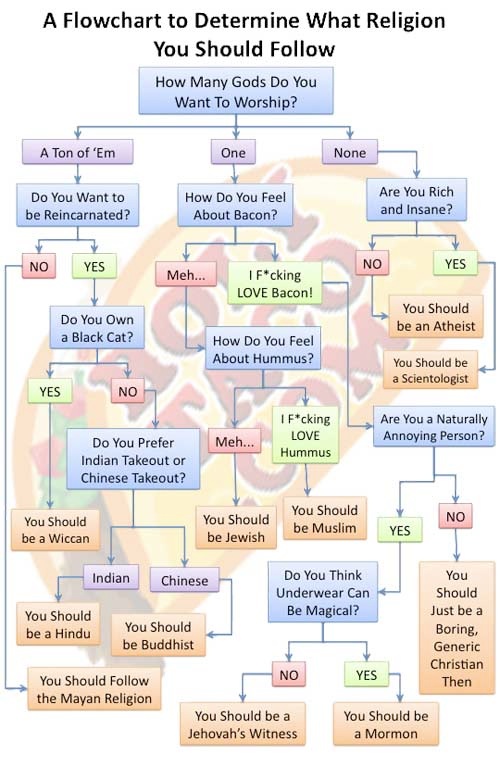
For further perusal, here's an interesting tor.com article on the role memory and recognition play in making quality stories, as well as a handy chart to help you determine (based off food preferences) what religion you should belong to.

10.13.2009

It's not the End of the World

I've been insisting on this point for years now, so it's finally good to see the Mayans argue that 2012 is not the end of the world.

The only thing the Mayan long count calendar suggests is that one period of time is finished and the next begins, somewhat like a new year or an odometer clicking over. As it is based on the position of astral bodies, in particular the alignments of Venus, the metaphor of an odometer clicking over on a galactic scale is really about the closest meaning to what the calendar says.

The Mayans contend that any notion of apocalypses and singularities is a Western construction, perhaps a projection of our values onto another culture's belief and measurement systems. Bear in mind it is only in Western traditions such as Christianity that a teleological endpoint to time and reality are posited, often in terms of the spectacular fiery cataclysms we seem to enjoy or desire. The notion of an apocalypse is only valid in a culture based on belief systems that suggest that there is only linear time, and that only in later times can we find true reality or happiness (ie, in an afterlife). Take the notion of heaven after death and apply it collectively and you get a desire for a collective death. This notion applies to the ancient Norse Ragnarok as a collective means of reaching Valhalla, but does not apply to cycle notions of time, such as in Buddhism or Mayan cosmologies. Why would the world end if the myths played themselves out year after year, eon after eon, in the heavens as well as on Earth?

What strikes me as strange is that, though many people in Western culture no longer treat our foundational myths as real or valid, we still have that understanding of time as linear and endable, and enjoy if not demand such endings. Why do we want the world to end? Why do we want to project our desire for that onto someone else's beliefs, as if we can justify the desire by saying it is prophesied, and therefor not our fault? Whether the Mayans like it or not, 2012 has become a contemporary Western myth of the end of time, and as such says something about how we experience the world we live in. Perhaps we are too scared, too ashamed, of the extent of of the damage Western cultural values have inflicted on the planet, which along with the looming resource crises and potential threat of technological transcendence/annihilation, we can point to the Mayans and say, look it's not our fault, they said it was going to happen first, and how can we change that? What our myth of 2012 does is allow us to evade responsibility for our actions in the world we live in for the world that our children may still inherit. Who needs to worry about the future if no one will be around to experience it?

10.07.2009

Possession and Schizophrenia


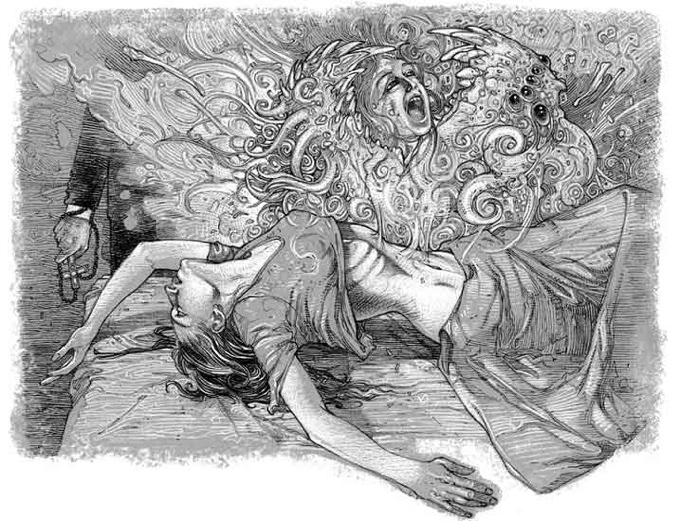
There is an interesting article from boingboing on exorcism and schizophrenia, which explains how patients in cultures with a strong belief in spirit possession, who have been possessed, have often been more successfully treated through schizophrenic medications than through exorcism. While this suggests that possession may be some cultures' ways of articulating the kinds of bizarre behaviors exhibited by schizophrenics, the article also cites a case where one of these medically treated possessees was actually seen to be possessed by other people.

So this might be an otherwise unremarkable psychiatric case if it were not for the fact that the prison chaplain, and several of the patient's cellmates, saw the spirit possess the patient as a ghostly mist. The chaplain was convinced this was a genuine case of possession, as had priests from several other faiths who had previously carried out exorcisms on the patient.

This begs the question, if the patient was treated for his belief in spirit possession and his apparent hallucinations as to the reality of the ghost, why were the chaplain and the others not considered to be ill ?


One could argue for mass hallucination, or conversely for some kind of cultural imagination at work, but perhaps it could mean that actual ghosts/spirits may be affected by chemical procedures? Not knowing off hand how medicines like trifluoperazine and clopenthixol work, I'd hazard a guess that whatever neural site/receptor these chemicals effect is also the neural site/receptor ghosts take possession of.

9.26.2009

Mythos vs. Logos

Here is an interesting article titled Man vs. God, pitting religious thinker Karen Armstrong against noted atheist Richard Dawkins on the evolutionary role of God. Armstrong points out something rather important, that literal belief in God only dates back to the 17th century, and stresses the distinction between rational logos and narrative mythos as serving very different purposes in human development and culture:
Most cultures believed that there were two recognized ways of arriving at truth. The Greeks called them mythos and logos. Both were essential and neither was superior to the other; they were not in conflict but complementary, each with its own sphere of competence. Logos ("reason") was the pragmatic mode of thought that enabled us to function effectively in the world and had, therefore, to correspond accurately to external reality. But it could not assuage human grief or find ultimate meaning in life's struggle. For that people turned to mythos, stories that made no pretensions to historical accuracy but should rather be seen as an early form of psychology; if translated into ritual or ethical action, a good myth showed you how to cope with mortality, discover an inner source of strength, and endure pain and sorrow with serenity.

Our challenge is that the mythic way of viewing the world has been almost entirely forgotten in the contemporary Western world. As I've been trying to articulate recently, science can not tell you what love feels like, hearing of Orpheus's descent into the underworld after Eurydice does. Or, science taught J. Oppenheimer how to build the atomic bomb, but only the Bhagavad Gita gave him the words to express how unleashing that much power feels. At this point in our collective evolution, it is I believe necessary to learn to re-express the world through both of these perspectives, though as of yet we are far from seeing how that worldview might look, or feel like.

9.14.2009

Literacy Narrative

For my class on Narrative and Technology I was asked to create what's called a literacy narrative, the story of my development as as "content producer/consumer" (to use the parlance of the age, focusing also on how our experiences with media have helped us develop standards of quality. The results were interesting and integrating, somewhat like a statement of intention or a road map, if a bit lengthy and abstract (I am trying to write a novel dealing with some of these similar themes). Thought it was worth posting here:


Long before the written word meant anything to me I loved a good story. Weekend nights growing up my father would tell my brothers and I bedtime stories; made up on the spot, featuring our stuffed animals as characters, a continuing series of tales that always intertwined with the previous nights’ adventures and with the content of our lives. Years later, when my father lost his job as a graphic designer and turned to his passion for genealogy, his stories became an ongoing collection of family legends that he hasn’t finished discovering or telling us. Encouraged more than anything to use our imaginations, my twin brother and I would go on long walks on the beach each summer and make up our own stories, often placing ourselves as characters in our favorite books and video games, but also creating between us an entire internal world through our words, which we would explore and return to year after year.

When our father was at work late, our mother would read us books, from “Alice in Wonderland” to “The Wizard of Oz,” and when I learned to read, sometime before kindergarten (roughly 1985), I became a voracious reader, consuming the entire sci-fi and fantasy sections of our local libraries before turning to more realistic literatures. I was such an avid reader that I would often stay up all night reading with a flashlight under the covers, or read books beyond the reading level of my peers, which I realized in 6th grade when I read the entire unabridged “Les Misérables” back to back with the Bible. Though I read everything I could get my hands on I became most intrigued by ancient mythologies, which I discovered in dusty large-prints in the school library, containing that epic and symbolic sense that reality contains much larger stories than those we experience on a daily basis, which we are also participating in, a sense furthered through role-playing video games and the choose your own adventure novels of the ‘80s.

Most of my love of reading was due to certain challenges I experienced as a child. The first was a sensory integration dysfunction, which eventually resulted in encouragement towards more physical and multi-modal forms of expression: music, art, acting, and gymnastics. Secondly, though, or perhaps due to being, intelligent and imaginative, I was entirely outcasted from my peers, and turned instead to a richer inner life, full of imagined stories and made up games. When I became aware of popular cultures, I explored alternate ways that teenagers express who they are in the world, researching the aesthetic and arts of various subcultures, settling eventually into the narrative of punk rock, with its Do It Yourself and world-changing ideals, the idea that anyone can say anything in any way they want, giving up my viola and books for a guitar, which was my main tool for creative expression for many years, though not the one that would become ultimately important to me.

I never wrote much when I was young, a few fantasy stories in grade school, one journal filled mostly with imaginary maps and drawings. It wasn’t until the first time I tried going to college that I learned that was what I wanted to learn to do. In a philosophy class on the meaning of death I had to keep a daily journal, assumedly so the teacher could keep track of our emotional responses, but this combined with a really droll fiction class and the encouragement of my poetess girlfriend convinced me I had to apprentice myself to recording my thoughts and experiences before I could ever tell a good story. Though my family members are mainly computer programmers/designers and I was raised with several old machines in the house, I always rejected using them for my writing, in somewhat of a luddite or romantic stance (in Pirsig’s sense) combined with being too poor to afford a decent machine. Though most importantly I write by hand, and in cursive, because this method replicates the flow of my thoughts better than my mediocre typing skills, and while typing the urge to go back and edit is too strong/easy, and the sense of flow this creates is generally apparent in the finished work.

An equally important lesson from the class of death was the idea that it is possible and necessary to more fully experience life, which I took to with a vengeance, immediately dropping out of school and moving from the DC area to Pittsburgh. Due to this idea, my imagination, literariness, and love of mythology, as well as several conversations on the subject with my new likeminded band-mates, I realized that instead of experiencing life fully in a random way, a person’s life could become a story, a narrative, a work of art or self-made mythology (an idea that many associate with Kerouac, though his wasn’t at all the story I wanted to live, because it wouldn’t be a good story if it had already been told). To this end I pursued a variety of novel and extreme experiences: protest/activism/street performance, rock and roll, romance, making fairie wings, web design, blogging (and before it was called blogging), circus performances, collective living, children’s storytelling, entheogenic drugs, various spiritual and occult rituals/experiences, psychological and philosophical studies, going crazy a couple times, writing poetry, cooking, traveling, etc. Through all of which I journaled what happened and what it could mean in terms of a larger personal narrative, making several attempts to write it into a novel that was some combination of a Proustian autobiography (as in not necessarily factual) with Grant Morrison’s idea of the hypersigil, that extended works of art are akin to magic spells created in order to realize and chart the course of one’s intentions in and for the world. This magical use of writing is important, as language as a technology may also originally have been a form of magic (spelling as a spell): words have power to cause changes in how we think/look/act in the world, as well as conjure real sensory experience in our imaginations.

In order that my particular personal narrative be interesting or applicable to other people, I have attempted to tie it into common human themes and symbols culled from psychology and mythology. At the same time I have explored the deeper symbolic content of my own life through a study of my dreams, which are admittedly rather wild and epic, which have added to my personal story and sense of meaning as well as help develop my memory and sense making apparatuses. Dreams eventually took on a greater significance as a source or form of narrative, as they are contained, symbolic even when dealing with everyday concerns, and contain a weird or thwarting element in which the thing itself escapes (a concern with the possibility of description I find in Magical Realist literatures, that the imaginative and the non-real can sometimes express more about reality by sidestepping the inefficacy of language to actually capture what really is, best summed up in the Emily Dickinson line, “Tell all the truth but tell it slant...”). At the very least, dreams are like personalized narratives or an internal TV show, offering some of the most interesting inspirations to one’s artistic process.

As for my definition of Quality, it is expressed in four parts relating back to the above narrative. First I find Quality in that which is rare, unique, or novel, that is, not what can be found in the everyday or in mass consumer culture. I recall throwing my TV out the window in 7th grade and wearing a shard of the screen around my neck for many years after, though more recently I’ve been appreciating some of the higher quality TV programming (Battlestar Galactica, Lost, Deadwood), art that pushes its medium to new places or beyond the mean and expected. Quality as not yet been done.

Second, that which has Quality contains an element of intention or ability to evoke a response. Quality art always moves people in some way. Prior to an academic response it is felt viscerally, if you love it or even if you hate it the work is doing something worthwhile, allowing the viewer to experience a fullness or depth of experience. This is somewhat like Garcia Lorca’s concept of the Duende, the clear emotional depth to a performance that sets it above more rote ways of creating. Quality as authentic.

Next, Quality implies to me a harmony or reflexivity across scales, which comes from two pivotal ideas: Marshall McLuhan’s concept that the medium is the message, that form and content reflect each other, and the alchemical idea of as above so below, that the smallest scale of a work has to be reflexive of the whole, that when the parts reinforce each other they add up to something complete and larger than the sum of the parts. In terms of Quality storytelling, this means personal or local stories are reflexive of global concerns and the human condition. Quality as interconnected.

Last, I find Quality in those things that strike me as being connected to my own creative or learning processes, the eureka! or synchronistic moment where that thing is exactly what I was looking for next. Of course, this is entirely subjective and implies that Quality is conditional to the time and place of a person’s encounter with the thing, but things that don’t have that Quality don’t force themselves on our attentions in the same way (if at all). Quality as immediate and personal.

Since returning to school for creative fiction writing, in the last two years I have been trying to hone my writing process, getting a number of stories published in print and online [1] [2], making the rest of my creative output available, blogging (though I rarely have the time for this), reading more than ever, and attempting to finally finish my first novel, as there are two more pushing at the back of my brain to be written. My current literary concerns focus around the interplay of very short and very long forms, that is, flash fiction’s ability to capture the immediacy of a moment vs. the tome (800+ pages), which allows an author to create a full and changing world; second, ergodic or non-linear narratives, and last the use of storytelling and memory as a way of literally saving the world (as in backing it up so it won’t be lost), writing as a collage of personal experiences, global events and narratives, ideas, imaginations, &c. which I wish that I'd thought of two decades ago before my father's bedtime stories were mostly forgotten.

8.07.2009

The Rational Fallacy (or, in the future noone can hear you dream)

Several rather unsettling potential futures have been trickling across the aether the past several days: the Semantic Apocalypse (or the evolutionary dead end of human consciousness), the death of free will (as the last grasp of the unenlightened), and what really makes me sad and/or laugh, the need(?) to get out of the narrative fallacy, that our evolutionary ability to make meaning out of sense-events by stringing them into recognizable narratives is perhaps no longer necessary, and from the sound of the article all rational beings ought to immediately stop telling themselves stories. The irony being that these are all stories that speak of both a need for control and meaning, and more so indicate to me some peculiar postmodern desire to no longer be human, to escape from the weird impulses of our bodies and all our non-linear reasons for doing what we do. As if in a fully rational world we can all finally be sterile passionless robots or programs, rows of ones and zeroes doing nothing unexpected, nothing out of bounds, a dystopia predicted long before 1984 in Zamyatin's "We." As if just because the Universe is a mysterious ungraspable place, on the largest and smallest scales, the only way we rational beings can bear its unfathomableness is by killing off our own mysterious uncertain selves. This is a future in which art, magic, even love would no longer be possible, because the rational fallacy seeks to do away with the fact that just as much as we are analytical beings we are also batshit crazy, I mean, that we crave meaning and find value in our lives from novelty and personal experience and not from predictable routines or the scientific rigor mortis of western materialism. What is the point of learning how the Universe works if not to better understand how we exist in it, or could better exist. What is the point of knowing if our knowings don't add up to a larger picture, and who would be looking at the picture? As PK Dick asked, do androids dream of electric sheep? We are still, and hopefully will remain, more than just our neurochemical programs, our biological probabilities.

Besides allowing us to learn how to evade saber tooth tigers, or even get up in the morning, stories always have and continue to serve a vital human function, that of allowing us to express how we are or should be in the world. What this means to us, individually or collectively, and where we are going next. Even prior to ethics or mythological taboos, without a sense of narrative there is literally no future, no reason to believe in the consequences of our current actions. Logic divorced from muthos will not allow us to better exist on earth tomorrow, let alone two minutes from now. Science for science's sake, without a grander story to guide its research and invention, produced the atomic bomb and conditions for global warming (though to be very clear, it was the rather fucked up stories of those in power that allowed such atrocities to happen), and without finding a balance, the solely rational mindset could produce further horrors. If our dreams can't become reality there will cease to be one. This is rather similar to how I see the contemporary atheist movement, cultishly trying to kill the religious impulse when it is impossible to prove or disprove whether or not gods exist, without even trying to understand what purpose they, their worship, and belief in general might still serve in helping people determine how to be in the world and with each other. The greatest irony is that any argument for atheism ultimately relies solely on faith, that there is stubbornly not more on heaven and earth than can ever be dreamed of in our philosophies. Personally I believe that everything is real or has the potential to be real, tangible or intangible, anything ever conceived of, no matter how surreal or unfathomable, exists. As Pablo Picasso put it, "everything we can imagine is real." To believe otherwise is to close your mind, or dare I say soul, to all that is beautiful, marvelous, or deep in what it is to be human, in what it still could mean to be human. This is my fear of arguments for such rational post/trans-humanism: that if we don't learn to accept, or even revel in, all the psychotic, creative, baffling irrationales with which humankind has always struggled, than any transcended intelligent being may find these repressed instincts come back to haunt them more so... assuming we have stories, consciousness, and the will to get us that far first.

6.18.2009

Writing and the Future

Story That Takes 1,000 Years to Read [may be] Antidote to Media Whirlwind: "San Francisco conceptual artist and journalist Jonathon Keats is trying to rejuvenate literature in the age of hyperspeed media by writing a story that will take a millennium to tell. The printing process in question is a simple but, as usual with Keats, pretty clever idea. The cover is printed in a double layer of standard black ink, with an incrementally screened overlay masking the nine words. Exposed over time to ultraviolet light, the words will be appear at different rates, supposedly one per century."

I'm not sure if I consider a thousand years to be rejuvenation, more like a clever gimmick that no one will remember tomorrow.

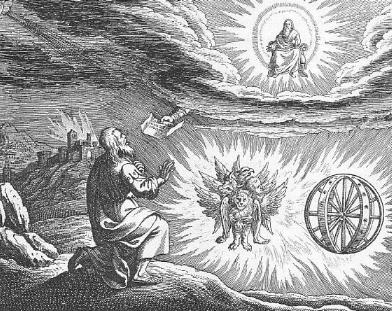
In other news though, physicist Richard Obousy has proposed a "scientifically accurate" design for a "warpship" that closely resembles Ezekiel's vision of "wheels within wheels." Right now the warship is only theoretical, awaiting our ability to harness dark energy. The Discovery Channel website reports that "the shape of the warpship was chosen to optimize the manipulation of surrounding dark energy, creating a spacetime bubble. How exactly the bubble would be created is still a mystery."

The one thing this article doesn't mention is that the wheels within wheels were not supernatural crafts but were the angels themselves. Nor does it mention that every square inch of them is covered in eyeballs. Though that would make for a pretty wild spaceship...

5.18.2009

The Convergence of the Dynamo and the Virgin

I'm currently rereading, well, trying to finally finish Gravity's Rainbow, before Pynchon's newest novel comes out (a 60s noir novel Inherent Vice) and wanted to share these angles on Pynchon's trajectory and early influence:


"The larger principle of the V, the allegory of increasing death and dehumanization as the Modern world begins the downward slope of the parabola of “gravity’s rainbow,” the parable of self-destruction inscribed in the history of the nineteenth and twentieth centuries. Distinctions, political and otherwise, disappear, revealing a broader concept, the V, the idea of convergence of possibility into certainty, of diversity into uniformity.

"We discover in “Entropy” the origin of Pynchon’s symbol of the V... "Henry Adams, three generations before [Callisto’s] own, had stared aghast at Power; Callisto found himself now in much the same state over Thermodynamics, the inner life of that power, realizing like his predecessor that the Virgin and the dynamo stands as much for love as for power “ (280). Pynchon may have found the title for V--and the concept of the V as allegory--in Henry Adams’s Education. In the novel V, the V is embodied in a female principle of death, the Lady V. In Gravity’s Rainbow, it is the V-2 rocket.

"Pynchon also shows in “Entropy” that he has copied Henry Adams’s historical method and that his novels are “historical” in the sense that, like Adams, he rewrites history to deal with events and signs that conventional history tends to ignore.

[from allegoria paranoia on Pynchon's early short story Entropy]


"But to [Henry] Adams the dynamo became a symbol of infinity. As he grew accustomed to the great gallery of machines, he began to feel the forty-foot dynamos as a moral force, much as the early Christians felt the Cross. The planet itself seemed less impressive, in its old-fashioned, deliberate, annual or daily revolution, than this huge wheel... Before the end, one began to pray to it; inherited instinct taught the natural expression of man before silent and infinite force. Among the thousand symbols of ultimate energy the dynamo was not so human as some, but it was the most expressive.

"[The virgin and the dynamo] were as different as a magnet is from gravitation, supposing one knew what a magnet was, or gravitation, or love. The force of the Virgin was still felt at Lourdes, and seemed to be as potent as X-rays; but in America neither Venus nor Virgin ever had value as force -- at most as sentiment. No American had ever been truly afraid of either.

"The symbol was force, as a compass-needle or a triangle was force, as the mechanist might prove by losing it, and nothing could be gained by ignoring their value. Symbol or energy, the Virgin had acted as the greatest force the Western world ever felt, and had drawn man's activities to herself more strongly than any other power, natural or supernatural, had ever done; the historian's business was to follow the track of the energy."

(This one also supports what I would call Pynchon's apocryphal use of history and culture) "Historians undertake to arrange sequences, -- called stories, or histories -- assuming in silence a relation of cause and effect These assumptions, hidden in the depths of dusty libraries, have been astounding, but commonly unconscious and childlike; so much so, that if any captious critic were to drag them to light, historians would probably reply, with one voice, that they had never supposed themselves required to know what they were talking about."

[from The Education of Henry Adams]

The whole idea of a converging point of history seems similar to Bolano's use of the year 2666, a date set far enough in the future that the meaning of current events is like a shadow leading toward it. A similar concept is the singularity; technological, astronomical, apocalyptic, or otherwise. Pynchon's beauty is setting the horror and sublimity of any inevitable future against the possibility of that future also containing love, Adam's virgin. From Gravity's Rainbow: "The whole point is that lovers always get together, isolation is overcome, and like it or not that is the one great centripetal movement of the World. Throuh the machineries of greed, pettiness, and the abuse of power, love occurs."


[from the internet]

4.23.2009

The American Hologram

[Highlights rom a speech by Joe Bageant]

"No matter how smart we may think we are, the larger world cannot and does not exist for most of us in this room, except through media and maybe through the shallow experience of tourism, or in the minority instance, we may know of it through higher education. The world however, is not a cultural history course, a National Geographic special or recreational destination. It is a real place with many fast developing disasters, economic and ecological collapse being just two. The more aware among us grasp that there is much at stake. Yet, even the most informed and educated Americans have cultural conditioning working against them round the clock.

"This financialization of our consciousness under American style capitalism has become all we know. That's why we fear its loss. Hence the bailouts of the thousands of "zombie banks," dead but still walking, thanks to the people's taxpayer offerings to the money god so that banks will not die. We believe that we dare not let corporations die. Corporations feed us. They entertain us. Corporations occupy one full half of our waking hours of our lives, through employment, either directly or indirectly. They heal us when we are sick. So it's easy to see why the corporations feel like a friendly benevolent entity in the larger American consciousness. Corporations are, of course, deathless and faceless machines, and have no soul or human emotions. That we look to them for so much makes us a corporate cult, and makes corporations a fetish of our culture. Yet to us, they are like the weather just there.

"Fortunately though, we can meaningfully differentiate our lives (at least in the Western sense) in the way we choose to employ our consciousness. Which is to say, to own our consciousness. If we exercise enough personal courage, we can possess the freedom to discover real meaning and value in our all-too-brief lives. We either wake up to life, or we do not. We are either in charge of our own awareness or we let someone else manage it by default. That we have a choice is damned good news.

"So how is it that we Americans came to live in such a parallel universe? How is it that we prefer such things as Facebook (don't get me wrong, I'm on Facebook too), and riding around the suburbs with an iPod plugged into our brain looking for fried chicken in a Styrofoam box? Why prefer these expensive earth destroying things over love and laughter with real people, and making real human music together with other human beings -- lifting our voices together, dancing and enjoying the world that was given to us? Absolutely for free.

"And the answer is this: We suffer under a mass national hallucination. Americans, regardless of income or social position, now live in a culture entirely perceived inside a self-referential media hologram of a nation and world that does not exist. Our national reality is staged and held together by media, chiefly movie and television images. We live in a "theater state."

"Now for a national mythology to work, it has to be accessible to everyone all the time, it has to be all in one bundle. For example, in North Korea, it is wrapped up in a single man, Kim. In America, as we have said, it is the media and Hollywood in particular. Hollywood accommodates Imperial myths, melting pot myths, and hegemonic military masculinity myths, and glamour myths. It articulates our culture's social imaginary: "the prevailing images a society needs to project about itself in order to maintain certain features of its organization." And the features of our media mythology are terrifying when you think about them."

3.04.2009

Galeano's Political Fables

Eduardo Galeano’s The Book of Embraces reads like a collection of politically charged fairy tales. He does this by drawing on the form, style, and tone of Aesop’s Fables (which was essentially the first collection of short short prose fiction) and inserting in moments of magic or myth at pivotal moments in his short narratives, such as the line, “he scoured heaven and earth in vain” (16) in the section The Origin of the World, the title of which also partakes and sets up this mythic scope. But what really makes these fables is the use of historical peoples, times, places, and events as the backdrop for whatever magical event or effect Galeano is trying to get at. Often these historical events detail the terrible political realities of South America, but the horror is tempered through the magical moment, such as José Carrasco becoming a miracle worker after he is shot fourteen times in the head in Celebration of the Human Voice/ 3. These magic moments serve as indications of each vignette’s moral (as every fable has to have a moral), and for Galeano, the points that he is trying to make are about the intersection of language, art, reality, and politics. In short, Galeano’s lessons are about the power of language to create the world and keep it free. The story in The Function of the Reader/ 2, in which an army captain resigns after reading the oppressed poet César Vallejo, perhaps best highlights this theme of the power of language.

The use of historical events to ground the magical and moralizing elements allows these metaphors to become more real for us the reader (as is the function of magical realism), but there is also perhaps a reverse effect too which works against Galeano. By blending into an imaginative, magical sense of reality, these historical events also become less real, more figurative. Part of this might have to do with the 21st Century’s apathy towards images of violence, we are so attenuated to them in movies that the subtlety with which they are portrayed here looses a good deal of their intended horror. What we are left with, the most striking parts of the text, are the miraculous and whimsical non-real moments, though this might also be Galeano’s point, that the horrors of political reality are only real because they have been given power through language previously, power that can be likewise used to create beauty in the world.

Another reason however that I felt the vignettes were less powerful than they could be was that they were vignettes. Only in a few places, like the dream sequences, do we have larger narratives building from the separate and disparate historical events. But otherwise these events are isolated, and as such, can’t seem to add up to more than facets on Galeano’s ideas. They are too readily digested, where a longer narrative, or one with a more continuous structure might build up to a larger and more significant effect. If, as Galenao suggests, we can create reality through language, a fully crafted literary world, as one might find in a novel, might convey that idea on a much deeper level. Of course, if I had already written a poetic trilogy of books on the history of the Americas, as Galeano did in Memory of Fire, I would probably want to move towards shorter disconnected forms as well!

3.03.2009

Steps to Futurity

After reading Fuller's "Operating Manual for Sapceship Earth," I began thinking of what we need to do now as a species in order to survive in the long run, starting from the premise that we are fucked now but that we can survive, if we allow that the narratives and perspectives we have on what is possible actually do determine reality.

In the long run, the sun, which is our primary fuel source, will die out, so by that point we will have needed to develop the technology to find and inhabit other Earth-like, life-sustaining planets. Previously the challenge to this has been inventing faster than light travel, but, as the rate of expansion of the Universe is increasing due to the heretofore unknown dark energy, we should instead focus on FTD (faster than dark) technology, or methods of alternate universe travel.

In order to create technologies on this level, and even to develop the scientific perspectives on which this technology might be based, we must first resolve local problems of time, resources, and education. The sun is our main energy source. We must develop technologies to harness this continually radiant and free energy source in order to stop using our non-renewable resources at all costs. This in turn requires a new model of wealth, not as debt, scarcity, or "not enough to go around" which rules the current economic markets, but as Fuller suggests as a measure of futurity: the number of forward-projected days per person that we as a species can live. Secondly we need to curb global consumption, in particularly North American culture's rampant production and consumption of readily-disposable, non-biodegradable, resource-wasting doohickeys. Perhaps new plastic-like materials can be invented from renewable resources.

But for either wealth or consumption to change we need a global, cultural paradigm shift towards sustainability, equality, conservation, etc, in short a shift towards looking at humanity as something with a future. This requires mass education and conscientious media engagement to raise awareness of the issues at hand, offer alternatives, and stop promoting the reckless, passive lifestyles and worldviews that currently infest our world. After this, resources need to be redistributed evenly to all peoples, as well as free access to health care, education, and technologies, in order that the largest number of people are freed of time and mind to be able to address the large social and technological problems of energy transformations, space travel, universal acceptance, etc.

The primary challenge to all of this utopian idealism is the mythologies of nationality and spiritual scarcity that promote global warfare. Wars may be fought over ideologies, money, resources, land, etc, but they result from the misguided notion of us vs. them, that there are only limited resources and that superficial differences between people determine who should acquire what goods and who should be obliterated. The new paradigm must be that we are all in this together. The more subtle and dangerous myth currently creating global hostilities, especially in the Middle East, is the religious myths of the Armageddon - that is, over who will control the end of their world by wiping out their cultural enemies and thus insuring the victors a place in Heaven, because clearly there is an age old belief that there is also not enough heaven or salvation to go around. This is the greatest fallacy being fought over between East and West. Any attempt to win, with any one side over the others, will inevitably result in the greatest expenditure of non-renewable resources and wealth as futurity, the loss of multicultural perspectives, and eventually or immediately the destruction of the human race. This was the threat of the Cold War and is has not gone away. Any total war will mean total destruction.

The only way to win will be by getting along and getting out of this mess, which is in creating Heaven on Earth, prior to exploring out into the very real heavens which are all around us. To this end education/ media narratives must encourage global, multicultural perspectives converging on the essential humanity of all of us in the face of the totality of Universal experience we as a species have so far attained or imagined, as well as a focus on grassroots community organizing via the internets, and the encouragement and sharing of ideas, instructions, perspectives, etc for people to once again take control of their own lives and futures.

10.02.2008

Simultaneity of Tradition in Eliot’s “The Wasteland”

Simultaneity of Tradition in Eliot’s “The Wasteland”

In “Tradition and Individual Talent,” T. S. Eliot suggests that it is important for poets to recognize themselves as part of a long literary tradition and to develop a consciousness of the past. This “historical sense” is for Eliot a “feeling that the whole of the literature of Europe… has a simultaneous existence” (Eliot, 115). While Eliot stresses that a work of art changes all the art that precedes it, this simultaneity of tradition also suggests that all these works of art can be present in one work. In “The Wasteland,” and in particular Book III, “The Fire Sermon,” we see a simultaneity of traditions that allows Eliot to comment on modern life through reference to the past.

Eliot suggests that for the poet it is not enough just to study the past. Tradition is another element that, along with emotions, feelings, impressions, and experiences, can “combine in peculiar and unexpected ways” (Eliot, 118). In “The Wasteland,” Eliot combines tradition with experience through a large number of references to various literary traditions. He is Just as likely to quote from the Bible or Shakespeare as paraphrase his fellow poet Baudelaire or the Buddha’s Fire Sermon. Eliot himself might argue that his radically new poem remains entrenched in the established tradition precisely in drawing so freely from it.

But what is the effect of this literary mash-up, where lines from different times and places are combined in even the same stanza? For some perhaps it is a labyrinthine mess of time, though as Eliot points out, “History has cunning passages, contrived corridors/ And issues” (Rainey, 89). It is precisely this maze of traditions that allows works of art to influence each other. By juxtaposing Augustine and the Buddha in the lines, “To Catharge then I came/ Burning burning burning burning” (Eliot, 15), Eliot is able to illuminate similarities between Eastern and Western traditions that the individual quotes could not have done on their own.

This technique of combining divergent references does not just apply to the past. The situating of ancient mythologies in and against modern settings and actions is the particular genius of “The Wasteland.” Sweeny approaches Mrs. Porter on the dirty Thames and bustling London streets, but they are enacting the classical roles of Actaeon and Diana. Ancient Teresias watches and comments on a pair of modern lovers as he once did for Jove and Juno. And lest we forget that the relationships in Eliot’s unreal cities are doomed to failure, there is the almost nonsensical insertion of, “Jug jug jug jug jug jug/ So rudely forc’d./ Tereu” (Eliot, 12), which keeps Tereus’s rape of Philomela clear in the educated reader’s mind.

So what ultimately does “The Wasteland” say about the age in which it was composed? The answer probably depends on the interpretation of all the other experiences and feelings combined in the poem with the more academically accessible literary references. Eliot’s use of the simultaneity of traditions might at the least suggest that all of these historical and mythological occurrences still exist within the modern age. The inhabitants of London or any Twentieth Century city have the potential of reenacting the tragedy of Tereus and Philomela or the passions of Augustine and the Buddha. The message of “The Wasteland” is perhaps that it is not just poets who need to develop Eliot’s “historical sense.” Unless we learn to recognize the influence of the past and present on each other, we may too be condemned to repeating all the cruel and cunning passages of history.

9.11.2008

The Legend of the Forbidden Treasure in Conrad’s “Nostromo”

The Legend of the Forbidden Treasure in Conrad’s “Nostromo”

“The poor, associating by an obscure instinct of consolation the ideas of evil and wealth, will tell you that [the peninsula of Azuera] is deadly because of its forbidden treasures. The common folk of the neighbourhood, peons of the estancias, vaqueros of the seaboard plains, tame Indians coming miles to market with a bundle of sugar-cane or a basket of maize worth about threepence, are well aware that heaps of shining gold lie in the gloom of the deep precipices cleaving the stony levels of Azuera. Tradition has it that many adventurers of olden time had perished in the search. The story goes also that within men's memory two wandering sailors -- Americanos, perhaps, but gringos of some sort for certain -- talked over a gambling, good-for-nothing mozo, and the three stole a donkey to carry for them a bundle of dry sticks, a water-skin, and provisions enough to last a few days. Thus accompanied, and with revolvers at their belts, they had started to chop their way with machetes through the thorny scrub on the neck of the peninsula.

“On the second evening an upright spiral of smoke (it could only have been from their camp-fire) was seen for the first time within memory of man standing up faintly upon the sky above a razor-backed ridge on the stony head… The impious adventurers gave no other sign. The sailors, the Indian, and the stolen burro were never seen again… the two gringos, spectral and alive, are believed to be dwelling to this day amongst the rocks, under the fatal spell of their success. Their souls cannot tear themselves away from their bodies mounting guard over the discovered treasure. They are now rich and hungry and thirsty.”

Conrad, Joseph. “Nostromo.” Penguin Classics edition. 1990. Pgs. 39-40


This passage, which stands at the beginning of Conrad’s Nostromo, tells of two sailors who go in search of a buried treasure, in the process becoming ghosts. This story is told stylistically as a folk legend or local fairytale of the people of Sulaco, that is, an event that may not have actually happened, or occurred only in some mythical, non-historic time. The use of fairytale sets up a tone that this story may not be important to the following events, as it is something that did not happen, perhaps only suggesting some background about the people or place of the book. Linguistically however, Conrad uses the same kinds of descriptive language that abound through the rest of the novel. The depictions of the folk of the neighborhood or the gringos’ provisions clearly place this legend within a setting and cultural context similar to that in which Nostromo as a whole takes place. It is important to notice that despite this clarity of detail, the two gringos are not given names; in fact it is not even certain that they are actually Americans. They only thing definite is that they are sailors, and as gringos they may most likely be foreigners to Sulaco.

Several images appear in the legend of the forbidden treasure that hold thematic importance for Nostromo, and can be tied up in the opening sentence’s equating of evil and wealth. Beyond the almost insignificant details mentioned above, the story focuses on a treasure hidden in a ravine on the peninsula of Azuera, off the coast of Sulaco, suggesting the lure and inaccessibility of money. Secondly, there is the pair of foreigners who go searching for the treasure with the help of a mozo, a native youth. This image points to the way that foreign interests have exploited the local populaces of Latin America in order to grow wealthy. Then there is the fate of the gringos, who become hungry ghosts, unable to either use or abandon the treasure once they find it. This idea of money as a curse or “fatal spell” most clearly illustrates the evil inherent in wealth, and leads the way into the actual story of Nostromo.

Legends and fairytales hold an important place for the people of Sulaco, even though the rest of the novel unfolds in actions clearly bound to a historical chain of events (though often a labyrinthine one). There is for instance a popular legend that the former dictator Guzman Bento became a specter whose body is carried off by the devil after his death, a fitting apotheosis for a man who had many put to death under his regime. This local folktale can be contrasted with the names of classical Roman mythology, the old deities of the Spanish upper class, which are household words in Sulaco only because the O.S.N. Company ships are named after them. Costaguana had “never been ruled by the gods of Olympus” (Conrad, 43). Another more basic local story concerns a treasure supposedly buried under the house of Giorgio Viola, echoing the legend of the gringos’ treasure and foreshadowing both the treasure that is his daughters as well as the lost silver that ends up under his lighthouse. As the engineer-in-chief puts it, the events of the novel are “like a comic fairy tale… true to the very spirit of the country” (Conrad, 273).

Many of the characters in Nostromo not only tell, but live their lives based on such fantasies, which they identify with or make up about themselves. One case of this is the mine owner Charles Gould, who Decoud claims idealizes everything and does not believe his own motives if they are not part of a fairytale. When first introduced to Charles Gould’s fascination with the San Tomé mine, we are even told that he personifies mines as living beings. The journalist Decoud claims that his own life is not “a moral romance derived from… a pretty fairy tale” (Conrad, 202), yet while trying to save the silver he later admits to living an imaginative existence: the desire to form an independent state out of his love of Antonia. It is not just the book’s “heroes” who contain this flaw of self-mythologizing. General Montero’s brother Pedrito helps bring about the Monterist Revolution because he wants to live out the political splendor depicted in stories of the Duc de Morny. Colonel Sotillo is similarly possessed by the delusion that the silver has been sunk in the harbor, and eventually gets killed by his own man for refusing to give in to reality. As Mrs. Gould says of her husband, though it could apply to almost any character in the book, “A man haunted by a fixed idea is insane. He is dangerous even if that idea is an idea of justice; for may he not bring the heaven down pitilessly upon a loved head” (Conrad, 322)?

There is no clearer place where we see this tragic self-mythologizing than in the character of Nostromo, especially since he directly identifies himself with the gringos of Azuera in the legend of the forbidden treasure. While trying to save the silver, Nostromo says that the treasure of the mine is greater than the one guarded by ghosts on Azuera, and that their task is more dangerous than trying to get the forbidden treasure. Nostromo also tells Dr. Monygham that if he fails he won’t linger like the dead sailors, while at the same time suggesting that having the silver is like a curse. After the treasure is hidden it does indeed become a curse on the sailor, and we really begin to see the association of evil and wealth. Where Nostromo had been an integral, though proud, man, after becoming a slave to the silver “the genuineness of all his qualities was destroyed” (Conrad, 432). He compares himself to the gringos again, as unable to forget the treasure until he is dead, and “belonging body and soul to the unlawfulness of his audacity” (Conrad, 438) in stealing the silver.

“There are spirits of good and evil that hover near every concealed treasure” (Conrad, 416), spirits that seem to make Decoud fascinated with the power of the silver until he kills himself, spirits that turn Mrs. Gould’s heart into a wall of silver-bricks. It is perhaps these same evil spirits, trapped in the ghosts of Azuera, that keep Nostromo coming back for more treasure until he is accidentally killed for it (by his old friend Viola, who thought he was another man trying to run off with the treasure of his daughter). On his deathbed Nostromo says that the silver has killed him, when his killer was perhaps his own fascination with its mythology. Yet even still he offers to pass that curse on. Thankfully Mrs. Gould decides to let the legend of the forbidden treasure die with him.

9.07.2008

Review: "Nostromo" by Joseph Conrad

The most important of Joseph Conrad's novels, Nostromo (full online text) is probably one of the densest stories I've ever read (Joyce's writing aside). Detailing the history, landscape, political struggles, and desperate citizens of an entire imaginary South American country takes a lot of attention on the part of the reader, but is was well worth it for intricate plot and brilliantly written characters (although it offers a rather bleak picture of human nature in which every major protagonist fails due to their internal flaws). Written in 1904, Nostromo was ahead of its time, addressing issues of colonialism and psychological depth, but also made more complex by several almost post modern literary techniques. The story is told in a bizarre folding of time that circle around one main event, a failed revolution on the town of Saluco and the fate of its infamous silver mine that hangs like a weight around the characters' necks. Similarly the whole novel begins with a folk tale about buried treasure and the foreigners who were cursed trying to find it, a legend that not only finds symbolic repercussion in the significance and danger of material wealth, but also gets reenacted by characters within the plot. Conrad also claimed his major source for the country was a book called "Fifty Years of Misrule," fictitiously written by one of the characters in the novel. These projections of myth, alternative and lavish timelines, and the breaking of the facade of reality are techniques that predate, but are later much used by the Latin American magical realist writers such as Marquez or Borges, lending one to wonder if there is something in that land itself that breeds such labyrinthine histories.

8.20.2008

Review: "Youth Without Youth" by Mircea Eliade

When I saw the Coppola adaptation of this book I somewhat understood why the movie had received so many negative reviews: it was not the action-packed, World War II movie that it's setting might have lent itself towards. Instead, and in true fashion to Eliade's work, the movie dealt primarily with the metaphysical, spiritual, and even paranormal possibilities lurking behind every age, when the aging Romanian professor Dominic Matei is struck by lightning and suddenly rejuvenated, not just physically but with an hypermnesia that allows him to know anything he desires. However, I was somewhat displeased, as much of this came off as slightly removed from the action of the story itself, as if the plot was but an ill-fitting coat hanger for the ideas presented.

As far as Eliade's novella, there is perhaps even less action and drama, and more focus on the possibility of ideas, including a random side adventure into Ireland to witness the Committee to Celebrate the Centennial of the Commemoration of the Death of Irish Poet, Magus, and Irredentist Sean Bran, a scene that seems entirely unrelated to the rest of the book, was dropped from the movie, and yet is one of the more enjoyable sections. "Youth Without Youth" reads more like a synopsis than a fleshed out work of fiction; one could easily imagine it expanded into a tome much like his masterful "Forbidden Forest." However, it also seems possible (the notorious "death of the author" aside) that as this was written at the end of Eliade's life he may have been slightly more concerned with getting the ideas down rather than developing them. If anything it could be a dying scholar and storyteller's wish to have one more chance at life to complete his work, while at the same time realizing the futility of that desire, here cast in terms of Chaungtzu's butterfly parable. Dominic Matei, perhaps Eliade himself, is an old man dreaming that he is a young man dreaming that he is every man, eventually falling into Eliade's spiritual catch-22 of the Eternal Return, bringing the still youthful Matei full circle to die where he had originally desired to commit suicide, having still not completed his life's work but learned to love life in the process.