Showing posts with label Jung. Show all posts

1.08.2010

The Method of Loci: Place and the Imagination

The other day I finished moving into a new apartment in the Friendship neighborhood, and in the morning after my first night there I looked out my third story window and was shocked to realize that the view corresponds almost exactly to the view from the window of the house I lived in years ago in my dreams: the playground, the prison-like school, the distant gothic cathedral, the park, each of which carry for me certain symbolic resonances, associating to emotional states, ideas, layers of memory and history. I actually can not see the park - it is only a small triangle compared to the overgrown woodlands in my dreams - but I've had so many powerful and life-changing experiences in that physical location that it is clearly vast and visible in the mind's eye, where such settings take on an imaginistic life of their own. The whole experience would have been uncanny, except that word means "un-homelike," and I felt very much at home. As Gaston Bachelard says in his study of the psychological effects of architecture, The Poetics of Space, "through dreams, the various dwelling-places in our lives co-penetrate and retain the treasures of former days."

I have been intrigued by this concept of psychogeography for years now. Not being a driver, I have the fortune of going on long meandering walks through the city in the dérive style of the early Situationists. However, over and above Debord's aim of psychogeography as the study of the effects of the environment on the emotions and behaviors of individuals, that is, the psychological effect of physical environments, I have grown curious about the representations of locations within the psyche itself, the way people dream, imagine, or narrate settings in which the images of their psychological processes take place, in short, a cartography of the soul.

Granted, there is a correlation between the physical environments we move through and the way we use familiar places to represent psychic states. The view from my dream window does not look out on anywhere that I've not actually walked countless times, but simultaneously, my inner world contains vast deserts, towers spiring into the cosmos, the labyrinthine depths of Hell. The real physical environments are sometimes not big or wild enough to articulate certain feelings and experiences. I was struck with this while readings Jung's Red Book (before I got caught up in moving out of the literal pit of my old neighborhood), particularly that he described his soul as a desert in need of regrowth. I admittedly have not read enough Jung to verify this, but in the popular or casual understanding of Jung's work, while character archetypes play a central role, there is much less thought given to the settings in which those archetypes exist and act. None of us exist in a void (or for that matter in the strange hinterlands our psyches generate, just as very few have actually met living versions of their animas or shadows outside their dreams and projections onto other people). At the most there is discussions of mandalas as the Center, in terms of sacred centers and axis mundis as Eliade discusses in The Sacred and the Profane, but this seems but crude generalization of the array of unique settings in the cultural imagination.

So where do these psychogeographies come from? I am not convinced, as Jung seems to have been, that our archetypal symbols are biologically rooted, or easily divisible into collective vs. individual, conscious vs. subconscious. Instead I currently believe our symbols are mimetic, passed down in the cultural imagination through stories and other media and our personal experiences of and relationship to these cultural expressions. I only started dreaming of the desert after briefly visiting New Mexico, but its psychic power is proportional to the sway that the image of the Wild West still holds on the American imagination, even projected out into space as Tatooine, the desert planet of the Star Wars movie of my childhood. Similarly, the towers and hells could have been evoked by various fantasy stories and video games, and became over my life subconscious settings for the feelings of the epic and apocalyptic that reside in us (these are our oldest modes of storytelling), but seem to have no physical place in the modern world.

On the other hand, people in various times and cultures have imagined precisely such a location where all contents of the human psyche reside. Most popularly articulated in the Theosophist's Akashic Records, this "storehouse of all knowledge" finds earlier analogue in the Islamic Al-Lawh Al-Mahfudh or Hebraic Book of Life. I can vouch for this location from my own psychic experiments, or point to the documented use of it for healing by the medium Edgar Cayce, while also suggesting that it, or there, is a potent metaphor for the possibility of a place for all knowledge, like one of Borges's infinite libraries or Alephs. This is similar to the metaphor of God as the possibility of all knowing, but where we seem today to no longer believe that one consciousness can know all, we are actively working to manifest that place that contains all knowledge. As the Internet expands, the metaphor of the Akashic Records becomes either real or unnecessary (though there are certainly still unknowns, dragons and edges of the world in the tubes of our epistemological maps). The Internet itself has become the imaginal place par excellence, existing nowhere and everywhere and as large as we can populate it, this terrain of our virtual representations which is literally the Sanskrit akasa: the all-pervasive space. Interestingly, it was through various science fiction authors imagining what a virtual reality would feel like - Stephenson's Metaverse, Vinge's Other World, Gibson's matrix - that the Internet as we know it, along with its spatial metaphors, came into being.

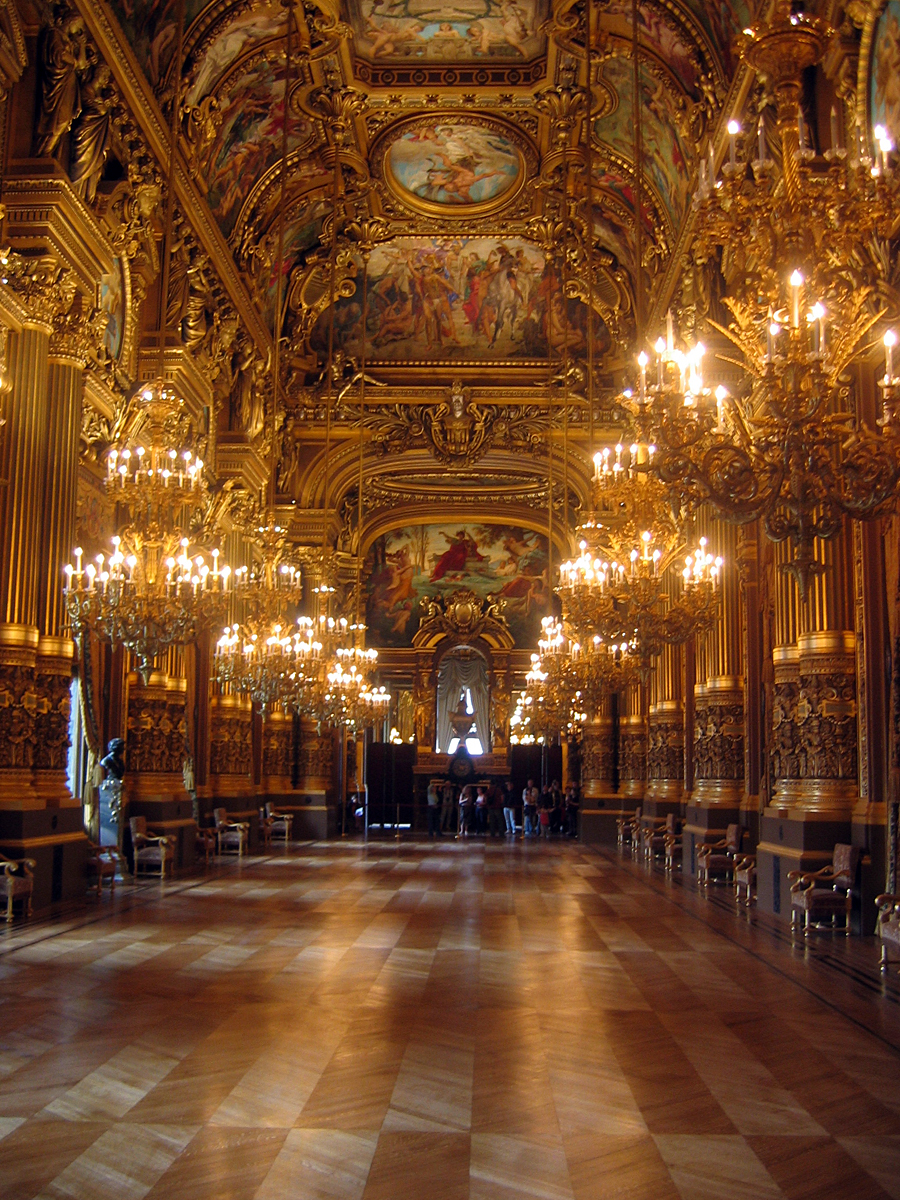
While unparalleled as the location for our conscious representations, glimmerings in the cultural imagination suggest that, as a psychogeography, the Internet is too real, or not real enough to fully articulate the more subconscious aspects of human experience, and other settings may have to be found. Last year I watched the TV show Battlestar Galactica, which (beyond its interesting treatment of the role of belief in the contemporary world) made use of a particular psychic location as a symbolic layer over the real world, directly experienced in visions by a number of the characters: the location of the Opera House. While in the show's plot this location ultimately served as only a cheap visual metaphor, its implications for the cultural imagination are far more suggestive. As an academic colleague pointed out, the Opera House replaces the sci-fi trope of virtual reality with a deeper psychic or subconscious reality, the theater as the place where the contents of our imaginations are made real for all of us. I have dreamt of the Opera House many times (though I was once an actor); it is, as Kerouac says in his own Book of Dreams, the Theater... that old spooky opera house and high school auditorium and classmeet hall of all my days, with hints from all the stages of Time's earth and actors too." While the symbol of the Opera House is still uncharted territory on the Internets, one only has to consider the mythological and ritual bombast of Wagner's operas, or just go see a movie. The drawing of the curtains, or now the darkening of the lights, acts as a veil torn between worlds, so that we sensually enter into the realities of our imaginations; the 3D wonderland of Pandora, the barely repressed longings to rescue Gotham, the Theater as the latest incarnation of the temple sanctum, where the gods become real in us. As Shakespeare said, all the world's a stage. We dream of the day (as Vinge does in Rainbows End) when our technologies allow us to visually project the settings of our imaginations onto the physical landscapes around us, so that we really will inhabit the lands of our dreams.

But where is this place (if not in us), and how are we to get there? The ancient Roman orators had a technique for memorizing long speeches and poems called the Method of Loci: one is asked to create a Memory Palace, taking a highly familiar location and placing in it associated images for the information to be recalled, so that all one has to do is stroll through the loci in the correct order. Personally I am interested in reverse-engineering this process, not further associating psychic terrains but unpacking all the cultural references that have been associated over time to various settings (a hermeneutics of the Opera House, of the Badlands, even of my dreams, whose consistent world this house is a cipher). The cities we inhabit may have a psychological effect on us, but we built the cities in our own image, and buried in them strata of meaning and longing. Perhaps we may uncover the ancient fear of Wilderness that has led so gradually to the current environmental destruction, or just learn to feel at home again, wherever we find ourselves.

12.11.2009

In the Desert of the Soul: Early Symbols in Jung's Red Book

I finally started reading the text of Jung's Red Book last night, and it is as revelatory, revolutionary, and vitally important as I suspected it would be, not just in terms of Jung's psychological theories but in taking a stance for a broader spiritual approach to reality that is even more lacking now than when Jung was writing. Reading this is like reading Blake, I want to quote every passage (as they are almost all brilliant), but if my cat will get off the tome I'll constrain myself to just one before looking at some of the important symbols and themes that Jung was attempting to articulate.

"The spirit of the depths took my understanding and all my knowledge and placed them at the service of the inexplicable and the paradoxical. He robbed me of speech and writing for everything that was not in his service, namely the melting together of sense and nonsense, which produces the supreme meaning.

But the supreme meaning is the path, the way and the bridge to what is to come. That is the God yet to come. It is not the coming God himself, but his image which appears in the supreme meaning. God is an image, and those who worship him must worship him in the images of the supreme meaning.

The supreme meaning is not a meaning and not an absurdity, it is image and force in one, magnificence and force together.

The supreme meaning is the beginning and the end. It is the bridge of going across and fulfillment
[a reference to the way of becoming the superman from Nietzsche's Zarathustra].

The other gods died of their temporality, yet the supreme meaning never dies, it turns into meaning and then into absurdity, and out of the fire and the blood of their collision the supreme meaning rises up rejuvenated anew.

The image of God has a shadow. The supreme meaning is real and casts a shadow. For what can be actual and corporeal and have no shadow?

The shadow is nonsense. It lacks force and has no continued existence through itself. But nonsense is the inseparable and undying brother of the supreme meaning...

The image of God throws a shadow that is as great as itself.

The supreme meaning is great and small, it is as wide as the starry Heaven and as narrow as the cell of the living body.


The spirit of this time in me wanted to recognize the greatness and extent of the supreme meaning, but not its littleness. The spirit of the depths, however, conquered this arrogance, and I had to swallow the small as a means of healing the immortal in me. It completely burnt up my innards since it was inglorious and unheroic. It was even ridiculous and revolting."


Potent symbols and themes in the first seven sections:

The spirit of the times vs. the spirit of the depths - Jung makes a distinction between the spirit or stance of the time in which he lives vs. the spirit of a greater, ancient, and universal reality that is entirely overlooked by the present, and is striving to come forth through Jung. This is historical consciousness vs. the mythic subconsciousness, and Jung frames the Red Book as a way of getting past all the small-minded, violent, materialistic impulses of his age (including a harsh criticism of Christianity), while recognizing that this present world may entirely ignore his warning and call for an understanding of the subconscious.

The supreme meaning - Jung claims that God and gods are only images of an eternal supreme meaning oscillating between meaning and absurdity, and it is this supreme meaning that men must come to recognize as a solution to the spirit of the times. This is entirely consistent with my concept of ultimate significance, in that the supreme meaning is more truly real than the images we conceive of it through.

Dreams and epiphanic visions - Jung recounts a number of visions prophesying the world wars as well as his own future work. He claims an uncontrollable compulsion to record these dreams, though he never did before. Similarly, a number of the passages Jung claims are actually the spirit of the depths or his soul speaking through him as a medium.

The soul - Much of the early part of this book is Jung's attempt to reconnect with his soul. This is the formation of his archetype of the anima/animus, but it is not made explicit in his academic writings that the archetype is not just an image but one's actual, living soul, which encourages us to live and do everything we dream of living and doing. The soul is one's God and opposite, which perfects us in the supreme meaning. The soul is not part of us, we are only the expression and symbol of our soul in the world.

The desert - Though Jung's academic writings discuss the archetypes they do not discuss (as far as I've read) the importance of subconscious locations. In particular Jung discusses here the image of the desert, which is the conception of oneself and soul that one must journey into and rejuvenate in order to overcome the spirit of the times. Jung believes he saw a desert because his soul had been withered (and perhaps those in touch with their souls experience a garden). From my own explorations of the subconscious I also found this "desert of the soul" as the location for the deeper, mythic realities I had to contend with outside of the city (the symbol for the everyday world and times). As my own process continued, this desert was first flooded and became a garden before the entire inner world was set to flames so that a new internal reality could form. I am curious how these locations change through Jung's process in the remainder of the Red Book, as I find such psychogeographies an essential compliment to the character archetypes.

The descent into hell - Jung has a vision in which he realizes that he must descend to hell in order to individuate himself and find the supreme meaning. Such descensus avernum are common in mythic and revelatory literature and serve as another example of the importance of place as symbol for Jung's theories. Jung equates this descent with the possibility of going mad, and sees himself as a sacrificed hero who must overcome that potential madness for a more divine madness lacking in the spirit of the times. This section (and the titles of the other sections) suggest that Jung is on a hero's journey comparable to that described by Joseph Campbell. This hell is all the absurd meaninglessness of our times that we must go through in order to construct our own meaning of events, which is the supreme meaning.

Alright, I'll close with another short passage: "You thought you knew the abyss? Oh you clever people! It is another thing to experience it. Everything will happen to you."

12.05.2009

Truth and the Transcendent Function

Still preparing to dive into "The Red Book," I reread Jung's essay, "The Transcendent Function," in which he describes the technique that he used for his process of self-experimentation, a method for consciously delving into the subconscious and uniting them, which was also the practice he recommended to patients in order to continue working on their subconscious materials after or outside of therapy.

The method is one of active imagining, and involves taking whatever emotional state one is in and allowing that mood to become more conscious, at the same time writing down associations of that state (in a controlled manner, in order to not go off into other areas of the subconscious), until the unconscious emotion is enriched and clarified. Or, if there is no particular emotion to focus on, one should remove critical attention and let inner images, voices, or movements emerge, taking similar associative or symbolic notes. Once this material has been collected, Jung suggests (here from his own experience, viz. the Red Book), to either subject it to creative formulation or analytical understanding, that is, to give the unconscious an aesthetic form or concrete meaning, depending on one's tendencies towards either art or logic. The important thing though, is not to get caught up in either the form or meaning alone, but to be able to go back and forth between the two, essentially creating an internal dialogue by which the antipathy between the unconscious and conscious minds is transcended.

I have personally had much success with such methods of active imagination, particularly through dreaming (which Jung claims was too difficult to generally recommend as a method) and elaboration as internal fiction, which over the years has put me into direct contact with many of the subconscious forces and symbols that hold play over my psychology. My intention in reading "The Red Book" slowly and through Jung's techniques is in order to return to another stage in my own psychic self-experimentations.

One of the more interesting things I've discovered through becoming more in tune with my subconscious is a decreasing need for such conscious graspings as truth, non-contradiction, and blunt logic (while at the same time being able, ideally, to apply these to a wider scope). As Jung so deftly puts it in this essay:
"One of the greatest obstacles to psychological understanding is the inquisitive desire to know whether the psychological factor is "true" or "correct." If the description of it is not erroneous or false, then the factor is valid in itself and proves its validity by its very existence. One might just as well ask if the duck-billed platypus is a "true" or "correct" invention of the Creator's will. Equally childish is the prejudice against the role which mythological assumptions play in the life of the psyche. Since they are not "true," it is argued, they have no place in a scientific explanation. But mythologems exist, even though their statements do not coincide with our incommensurable idea of "truth."
Of course, one runs into such grasping for truth and consistency almost everywhere you turn, spying every day yet another atheistic rebuttal of belief, such as this article from Alternet on demanding evidence from religious believers (which asks: “Why do you think God or the supernatural exists? What makes you think this is true? What evidence do you have for this belief?”), when the important thing about belief is that one believes without proof, to demand evidence or a truth behind beliefs is to entirely miss the point of believing (at least for me; I will never apologize or condone dogmatism of any flavor). And furthermore, as Jung seems to agree, the important thing is not whether the contents of our belief are true or false, but what those beliefs allow us to feel or do in the real world. The belief exists, and extends beyond truthiness.

I encountered this kind of grasping in my Wisdom class the other day, discussing Berger's concept of the social construction of reality, which my teacher wanted to refute logically, at all costs. Granted, this teacher has applied logical arguments and the principle of truth = non-contradiction to everything we've read this semester, from Aristotle to Lao-tzu, and seems to find all of them lacking as logically consistent systems of wisdom, while I sit there baffled, wondering how logic will ever get you to wisdom, which for me seems at least equal parts belief. Now if this wasn't frustrating enough, the teacher's specific beef with Berger's theory (which I haven't read, so won't comment on myself), was that: to construct reality implies that reality has been made up or fabricated, and as a fiction it is thus false and a pack of lies of no value, etc. And that's the rub, the assumption that fiction necessarily equals falsehood, that things imagined can not convey truth or really effect the world, regardless of if the contents represent any historical, existent reality. Even the too-smart-for-his-britches philosophy major I usually disagree with was aghast, and despite our best arguments the teacher refused to listen to that his "truth" might be wrong.

It seems to me that this perspective is like someone only using the conscious part of their mind, ignoring or fending off the "demons of the irrational" subconscious instead of accepting them as equally a part of who we are, which they are, and if that boundary is transcended then we can begin to enjoy ourselves more fully in the world and more fully accept this world in all its irrational and boundless glory.

12.01.2009

Liber Novus: first impression of Jung's Red Book

I couldn't sleep last night, as inspired as I was having begun to read Carl Jung's Liber Novus, his "Red Book." My first impression is that this is a massive tome; at 16x12x2'' it is easily the largest book I've ever laid hand on, and just turning the pages takes a substantial effort. But it's well worth it.


The Liber Novus is Jung's account of his decades long process of psychological and subconscious self experimentation, through a technique called "active imagination;" a process that he claimed was the seeds to all his work. Written first in a series of Black Books, this masterpiece was later painstakingly copied into a red leather-bound book, though never finished. And by copy I mean create an entire illuminated manuscript, complete with exquisite calligraphy and full color mandala and dream illustrations, that Jung worked on till his fascination with alchemy took hold, and then sat in a box until long after he died.

This first edition presents not just a translation of the text (by Jung scholar Sonu Shamdasani), but a full facsimile of the original folio plates, which have been kept in a safe deposit box unlooked at for the last 80 years and so are in excellent condition. The edition also includes critical apparatuses; a historical essay to contextualize the significance of the Liber Novus in Jung's life and work (and was the main thrust to convince the Society for the Heirs of Jung to finally let the book be published), as well as paratextual citations to highlight the variety of references in the manuscript itself, which should make the read that much more insightful.

Flipping through the folio I was struck by the richness of the illustrations, some of which I would consider masterpieces in themselves, filled with fractals, swirling colors, archetypal situations, and a surreal dream-sense that was apparently under-appreciated by the Surrealists. The calligraphy is in German, which I unfortunately don't speak, and can only comment on the precise appearance of.

As for the text itself, that will be my next attempt. I will say that it begins with the title: "The way of what is to come," along with some prophetic quotations from Isaiah, and much of it is in dialogue form between Jung and his spirit guide (in the tradition of Mephistopheles), placing the work as a modern take of the tradition of revelatory literature, which isn't so far off considering the inclusion of Jung's dreams prophesying the World Wars.

On the whole, the book seems to be Jung's attempt to reconcile the scientific with the mythic and spiritual, the personal with collective, and as such could not be more timely than to finally see the light of people's eyes. As a writer interested in the use of dreams and personal narratives, as well as having taken this process to my own experimental, revelatory, self-mythology and understand the danger of attempting vs. the incredibly potent imagery that can come out of such a process, I suspect the Liber Novus may have far reaching cultural effects that we could only begin to imagine.

9.16.2009

Faith and the Pattern

Over the past year I have been going through an extreme crisis of faith. Due to a number of physical, emotional, and psychic challenges I found myself last winter in a state of disillusionment, that everything I had previously held to be good, desirable, possible, and expected in the world may not have been the case at all, a state close to feeling jaded, except that the crisis is precisely in trying to find some reason to carry on, to still believe: in love, the power of the human spirit, self-growth, god, some point to life as we know it, or at least a deeper understanding. But the closer I looked at any of these things the further they seemed to recede, from view, from understanding, so I was left wondering if they really existed. In centuries of the human quest for the truth and goodness we are still no closer to truth it seems, and people can be as ignorant, violent, and uncaring as they always have been, if not more so, which is rather disheartening to someone who feels they have spent their life searching for and hoping to bring these positive qualities into being. More recently I have summed up my quandary in asking, what is the point of self-growth, of struggling to improve how one is in the world, when the work is hard and there seems to be no real “reward” no incentive from society to do so (though that I take this as a valid question shows at least some will towards growing). How can I spend roughly the same amount of time writing on my novel as watching a TV show, and find the same amount of satisfaction in both? And sometimes more in the casual, indulgent activities, because they are easier? This is baffling to me. I believe that everything is real, even those things we can only imagine, but nevertheless there seems to be a primacy to the everyday, to those things, which when we pick ourselves off the floor or put down our books we still have to deal with, of which we can sigh and say, well maybe this is it. But is it? Ultimately everything is real, but some things are more real than others. Worrying about money or physical pain unfortunately feel to be some of the most real there is.

The problem, I know, is one of perspective. To say, this is it, is to presuppose that we know everything there is to know about life, enough to cast some judgment on it, when really we can know nothing with any such certainty. I am aware that the mystery of the Universe is far deeper than we can fathom. Not even the scientific method can say what is really true, either point at a position or velocity of a particle but not both, or how and why they are entangled and add up to all this. Any other human effort to value one mode of the world over another is based on subjective claims, of perception, of intuition, of faith. On some level even an atheist claims, I believe God doesn’t exist, because it is a statement that can’t be proven one way or another. For centuries scientists laughed at the notion of atoms, of forces and fields, because they couldn’t be seen, only to find that maybe they really are there, and though still unseen may be more real than this, but just as inexplicable and mystic as when the ancient Greeks first made up the story. How can I know this is just it, when my intuitions, the evidence my senses have gathered over a lifetime of searching, have suggested otherwise, if but to say, maybe it’s too hard to keep looking, no one else is really looking, not everywhere at once, and the whole edifice of Western knowledge is constructed on the basis of looking only at the visible and provable, and when confronted with a reality greater than that which can be known, it crumbles, is shown to be a charade based on the misapplication of ancient dialectical devices and assumptions: that dialectics can really tell us anything about anything, for when you point at or name something it always creates the thing it is not, and the thing neither of those are, ad nauseum, the way a proton pulled from an atomic nucleus mysteriously creates another proton in its place. This is beautiful and mysterious, but then you still have to go to work, or patch up an argument with your beloved. And there is no place to escape from that reality to, no one to turn to in our need outside this predicament. No matter what your perspective is on the world/Universe, or what you believe is our place and purpose in it, we are still within that system, like an existential Goedel’s Theorem, constrained by our physical senses and abilities and ways of knowing, and still have to find some reason to get out of bed in the morning, some small joy, and maybe the courage to choose to act as decent human beings, for ourselves and others, if we have any strength and calmness left over.

But how, and why? Because most days I feel full of rage, time slipping through the eye of it and feeling there is something more I could be doing that is the thing I really am meant to be doing, except I only have a vague, limited notion of what that is and no one has stepped down from on high to let me in on the secret plan for the Universe and my role in it. I feel a lot like the character John Locke from the show Lost, who, unlike the more reason-based characters trying to escape from the Island,, has an intuitive faith that he can and is meant to solve the labyrinthine puzzle and mystery that surrounds the place, following his gut, connecting scraps of information, seeking ever deeper in the mystery, and yet still plagued by doubts, hoping someone will tell him where to look next, constrained like the original philosopher Locke to the empiricism of believing what he can see, yet unable to explain that he has seen things beyond what most people would ever believe could be real. I relate to this and wonder how many others can. I think of my neighbor, watching sports on his big-screened TV, driving his motorcycle noisily up and down our street. He seems totally fulfilled in this, as far as I can see. There is not a question or even a need for a question of is this it.

The Presocratics (who I am studying in a class on the historical roots of science in mythology), were the first to systematically ask the questions, what is really real, can and do things change, can and what do we know? These ontological and epistemological questions are the foundation of any philosophy or metaphysics, and without before realizing that, they have also been my pivotal questions (along with that bugaboo, are we free/active agents). In answer to what is really real, they posit everything from water, to air, to numbers as the foundational substance of reality, or there is Anaximander, who believed it was the Apeiron, the unlimited storehouse of potential qualities of all things as the one underlying substance. My teacher, a younger grad student, laughed, this all seems absurd or primitive in light of our current scientific conceptions of reality, and the class all nodded. Except for me it doesn’t. For me the idea of some fount, of imagination or possibility, seems more intuitively true than the random motion of subatomic particles. In fact, it is an idea recorded in a number of different spiritual traditions: the Theosophic Akashic Records, the Sufi Scriptorum, the Hebraic Book of Life, even the Platonic Forms as an underlying reality. Is this really so absurd then, or are they all wrong? And more confounding, it is something that I have experienced, with my own senses (admittedly under a mystical trance state), but without knowing of it beforehand or expecting anything of the sort. But how could I explain this in class, in the face of the entire academic apparatus that is not about my experiences but recorded “facts?” These are two entirely different views of reality, like the conflict between Evolution and Creationism, both of which are mistaken for Truth, when they can never be anything more than descriptions, stories, metaphors for processes we can never really know anything about. Pirsig’s “Zen and the Art of Motorcycle Maintenance,” (reading in my class on Narrative and Technlogy), does a good job of framing this problem, n the context of a metaphysical detective story: we can either romantically-intuitively appreciate the surface aesthetic of things, or logically seek out the structures beneath them. But not both, though that is exactly what it seems we must do. That ability and desire however were lost centuries ago, when Aristotle argued down the Sophists in the forum, paving the way for Dialectical Materialism. And the world has been a cold calculating place since, lit by moments of decadence and revelry, but with no real new understanding or wisdom, meaning or faith to guide us out of this spiritual morass.

To what can we turn then, if not to our own experiences and the way we choose to pick them up in our daily lives (this division between events and our intentions or them being my definitions of fate and destiny). Are we just trapped on this island in space or do we choose to explore what being here could mean? When the stars that guided the ancients (both in sea travel and in mythic timekeeping) now begin to fade, there are still the stars in our hearts, which is the meaning of that word desire. As Crowley said, each and every one of us is a star. For most of my life I have been a proponent of a magical worldview, most clearly as spelled out in Bill Whitcomb’s Axioms, the first three of which are that reality is created from our worldviews that can be changed, that we reaffirm or change our worldviews through attention, and that seemingly disconnected events can strike us as being intricately connected, what Jung called synchronicity, or meaningful coincidence, but I call constellations of meaning, because meaning does not exist in events but in our interpretation of the relationships between them in relation to the patterns of our worldviews. Though I have actively sought out such constellations of meaning, in the last several years they have grown few and far between, a feeling I keep expressing as that always before the pattern of meanings suggested where to look next, except recently they haven’t, and everywhere has felt like a dead end, not at all that personal Eureka moment I recall first feeling reading James Joyce’s description of that Eureka moment in “Portrait of the Artist as a Young Man” and I’ve chased after ever since. Perhaps I have stopped looking in as active or connected a manner. Or perhaps, as I fear, that though I’ve looked and connected, the net of my looking wasn’t wide enough, and the pattern or destiny I found meaningful for myself in following certain dreams and ideas is too small, is not interrelated to Reality as a whole, as was the case with the Apeiron in class. Am I crazy for having experienced something no one else has, or are they for not even considering that such things could be? So that I lost faith with any of it being meaningful. And lastly, I have been afraid, for to connect our own meanings to any larger collective meaning takes work, and forces us to confront ourselves in wholly new ways, and precisely where our old maps no longer fit the territory of actual existence.

I have come to recognize recently that my novel, and indeed my task as a creative being, is an attempt to create such interconnected maps of our experience of Reality, a daunting and seemingly impossible task (though less impossible due to our current information technologies), yet one I am driven to through whatever genetic or spiritual reasons. To this end I have to start experiencing again the world, the larger world, as synchronistically connected, however those mechanisms work, but from scratch. Because if my patterns before are what I expected to find, but clearly didn’t, then I have to forgo faith in my expectations and recreate a new pattern from nothing, from everything, but not with the certainty in thinking that Descates had in his doubting of all. And in this letting go was confronted yesterday with a number of synchronicities if not answering than at least pointing to ways out of my current crisis. I wrote a letter to my beloved discussing love in terms of encouraging another’s and our own self-growth, an idea from Peck’s “The Road Less Traveled,” and immediately after in my Wisdom class in which we are reading that book, I had to write a letter as if to a distant friend on that very subject, allowing me to better clarify my questions. Then, finishing “Zen and the Art of…” came upon a summation passage equating Pirsig’s concept of Quality (as that missing from the Western dialectical tradition) to the Presocratic Ariste, excellence or heroic virtue, virtue already being a term personally loaded with positive meaning of acting right in the world, here defined not as virtue for others but of the self, improvement and growth into what one can most be, a joy in the process that I had forgotten, also connected to the Buddhist Dharma (further constellated in relation to the mystery in Lost as well as the self-mythologizing of Kerouac). All of which left me with a big Yes! And further constellated into this essay, which before I started writing I found a blog on synchronicities, cementing the point.

But the question remains, as much as I live this and find it necessary to my life, it seems mainly like a metaphysical thought experiment, and still does not connect back to the mundane, having to work sleep, relate to other people, go the bathroom, let alone all the wars and environmental degradation and illness at large in the world. Years ago I had a chance to sit in on a Zen retreat and told the Monk that it felt like I was in a dream from which I couldn’t wake up. He said, all our ideas, knowledge, stories, expectations, these are the dream, when Reality is just this. But now I realize that what I really meant was that that just this is what feels dreamlike, or actually worse, nightmarish, when the stories and ideas would be much more wonderful if they were that primarily real. I may find joy in contemplating quantum entanglement or synchronicity, but I see my friends struggling daily to find jobs or housing, getting robbed, sick, or mentally ill, and I wonder, why is that more real? Why am I not satisfied with it, except for perhaps being raised with some religious notion of an afterlife that has crushed me on idealism and hope for more? I understand that I am in a way very privileged to be able to even ask these questions. I have a steady job, a home, friends and family and fairly good health, I was raised with an education of intelligence, creativity, and faith, and questioning. Many do not have this, or if they did they got bogged down in the tribulations of the everyday, or just don’t care. I doubt for instance that my neighbor, if he were to take time away from his TV and motortoys, would he feel inclined to ask any of this? The meaning of his everyday life and material possessions seems to be enough for him (if they really are). Does he not want to spiritually grow, or is that process different for each person? Who can answer any of this? I on the other hand do not feel like I have a choice; even at my poorest and most downtrodden I have always felt the urge and made the time to ask these questions. I suspect that, being raised to have a capacity and willingness towards belief, but always questioning the presumed things one might believe in, it is like this large, too large hole that no material thing and few non-material things have ever come close to filling, or even fitting into, that leaves me with this internal tension, a spiritual angst like a spring about to burst, that might only find ease with ordering the whole reality in myself, and then what of everything out of reality? And then what of still having to live, and share this with others? It is as if, what are these questions for if they cannot be interconnected and applied in our daily lives, for everyone’s lives? What god is a map or pattern if other people can’t follow it somewhere they want to go? That I do not know, and only raises further questions. As Rilke put it, the pattern grows more intricate and subtle & being swept along is no longer enough.

1.02.2008

We are the heroes of our own dreams

A recent article at Psychology Today suggests that dreams may serve the function of training us for how to deal with threats. Citing the vast number of nightmarish and negative dreams over fantasies and problem solving, researchers believe that dreams may be a practice-place for understanding how to respond to real-world difficulties, even to the point of suggesting that all those nightmares of zombies and aliens are really misappropriated imagery that fills the old evolutionary role of running from the saber-tooth tigers.

Robert Stickgold however, holds that dreaming is much more complex than rehearsal. He points, for example, to the ability of sleep to allow us to integrate and consolidate knowledge, or to come up with novel and artistic solutions. During sleep, our brains are making sense of the world, discovering new associations among existing memories, looking for patterns, formulating rules. "That's how we create meaning," says Stickgold. "Our brain puts things together."

Personally I agree that dreams can help us deal with threats, and help integrate our knowledge about the world, but even still there is some element of the fantastic, the joking and playful, the absurd, that dreams can always present to us, even in our most "realistic" dreams, that suggests to me something above and beyond a mere flight response. Perhaps dreams allow us not only to integrate our knowledge of the world, but articulate a deeper sense of personal relationship to this world, and everything that may or may not happen in it.


Last night I watched Paprika for the third time, which, in the opinion of someone who admittedly has been paying attention to the depiction of dreams in media since about third grade when I discovered Little Nemo in Slumberland, is a rather stunning depiction of the sheer insanity, intricate symbolism, and metaphysical speculation that I have always associated with dreaming. In the chaotic parade of all things under the sun, the use of Jungian archetypes fighting against Freudian repressions, imagistic leitmotifs that accompany each character, or the final idea that perhaps all our dreams are connected, this movie, based off the book by Yasutaka Tsutsui (that was apparently based off the authors own dreams and I desperately wish was in an English translation), certainly does not depict dreams as being a mere "threat-evasion" or problem solving technique, but a true reveling ground of the psyche and all that is possible in the human imagination.

12.06.2007

The Trouble with Sleeping

From an interesting series of articles called, The Trouble with Dream Studies, on the relationship of dreams to science, from the Dream Studies Portal:

"...in the study of dreams our personal beliefs influence our perception so much that we literally experience different realities. That’s why dream interpretation is dismissed by hard scientists, and also why Freudians dream about their mothers and Jungians dream about Germanic mythological creatures."


This is one of the basic tenets that I hold, both about dreams and waking life. What we believe influences what we choose to pay attention to. And what we attend to influences, or even directly creates, both our waking experiences and dream adventures. The trick is in learning to look at your beliefs clear enough to be able to choose what to attend to, and thus how to live. One of the clearest places to see these beliefs at work, in a somewhat hyper-symbolic way, is in our dreams.

12.04.2007

Schools of Sleep

"Somewhere in between the Cinderella school of dreaming and the darker dreamscape of “The Matrix” lies Stephen LaBerge, an expert in a technique called lucid dreaming..."

This is the first line from a recent ABC News article on lucid dreaming [via Technoccult]. While lucid dreaming is a fascinating and worthwhile practice for anyone doing dreamwork (it was the discussions on lucid dreaming in the film "Waking Life" that got me fascinated with dreaming to begin with, or was it reading too much "Little Nemo in Slumberland" when I was a kid?), this distinction between the "Cinderella" and "Matrix" schools of dreaming is somewhat fascinating, and probably deserves further comment. Not knowing what the ABC journalists meant by these terms I will try to unpack them myself.

In the story of Cinderella you have a young girl in a destitute familial situation who, through the help of a dream-like fairy godmother, is transformed into a beautiful princess and lives happily ever after. Dreams aren't necessary to the story's plot, but the idea of self-transcendence through fantasy has many dream-like connotations, particularly in the Jungian sense of the individuation process. On the other hand, the Matrix features a young man who, through the help of a dream-like revolutionary leader, is made to realize that he is living in a constructed reality and that modern life is really only a fabrication concealing a much more destitute world. Dreams are only slightly more relevant to this plot, and though there is a similar idea of self-transcendence, it is to a waking up from illusion, and not an escape to a deeper happily-ever-after fantasia. In both cases however, the primary point is that real life, or waking life, is not so real after all, and there are ways we can wake up from it. Similarly, lucid dreaming espouses a body of techniques for realizing that you are dreaming, within your dreams, and thus take control of them as if they were real life. On the opposite end of that spectrum we have buddhist philosophy and dream techniques that espouse that our waking life is a dream that we can wake up from in order to more fully take, or relinquish, control of our lives. I suppose the point that the article's writers were making is that there are both feel-goody and nightmarish kinds of dream interpretation and reality manipulation, and somewhere between the two might lay the abillity to tell just what is actually going on in our pscyhes.

Personally, I take a rather different tactic to dreamwork, feeling that learning to take control of your dreams is perhaps not the most important aspect of dreaming. Certainly it can be fun to decide to fly, but I suspect that there is a reason we dream the things we do, that if dreams are taken on their own terms we might be able to learn something more about our lives that would have an effect on how we live while awake (and consequently, while we're asleep). To this end I am inclined to look at dreams as active and personal symbol systems, remaining uncertain about the universality of Jungian archetypes I instead try and take the imagistic contents of my dreams as being multivalent expressions of my individual thought processes (though these of course have been influenced by culture and my life to a degree that certain symbols that appear for me might appear for other people in an archetypal way, but they may mean something very different to both of us). Taking these symbols as a system, I try to interpret both what they might mean for my waking life, in a similar manner to techniques of free association, but also try to take them as a larger, creative expression on the whole. That is, the various symbols that come up in my sleep can be pieced together to form a narrative, a personal mythology that can be interpreted on that deeper level, not just to say something about my day residues or childhood dramas, but about the way I live my life, the desires and fears I choose to act out as they are founded in the myth of my dreams. Perhaps a simiar approach is suggested by James Hillman in his "Dream and the Underworld," and one project I spent many nights working on was to symbolically journey to the underworld, drawing on the symbols of various myths and legends of the descent narrative in order to find my way to the bottom of my own subconsciuous fears, and thus no longer need to be afraid of them.

The problem that I see with lucid dreaming is that by actively trying to control your dreams, you are not letting them give as full expression to what is going on in yourself, and that they might actively cover up such deeper psychological rifts without allowing you to work at or understand what is actually going on. I argue, from my own experience, that by looking at the symbols of your dreams, as they are presented to you, you can change your perceptions on your life, and thus, by being able to focus your attention on more positive, life-affirming things, your dreams will end up reflecting that shift in consciousness and such lucid acts as flying will arise naturally when you sleep.

11.28.2007

Dreams of Identity in Everett’s "Erasure"

Dreams of Identity in Everett’s "Erasure"

Of the various literary devices made use of in Percival Everett’s "Erasure," perhaps the most revealing is that of dream narratives, whereby Monk Ellison, and Van Go Jenkins, the narrator of Monk’s fictional novel My Pafology, dream events which, though not ascribed as “real” events in the narrative, nonetheless carry a significatory weight that can elucidate other aspects of the text. At the beginning of the novel, Monk says, “the society in which I live tells me I am black” (1). He believes that race, and personal identities in general, are purely a social construct of language. But throughout the novel we see that this language of race and identity, as displayed in the cultural acceptance of the ghetto dialect in which Monk writes My Pafology, is the only language his society knows, leading to a conflict where Monk begins to identify with his stereotypical nom de plume, Stagg R. Leigh. Monk’s dreams portray this encroaching conflict of identity, in which his personal interests, education, family dramas, psychological difficulties, and creative intentions are pitted against societal expectations that would violently erase personal identity.

In the psychoanalytical theories of Freud and Jung, dreams can tell us something about the identity of the dreamer; either repressed, childhood concerns, or dynamic, self-affirming principles. Regardless of the methodology or theory used, such dream interpretation often relies on knowledge of the individual dreamer’s life, as well as on symbolic archetypes that may or may not exist in all human expression. Though not intentionally created by the dreamer, a dream could thus be taken as a signification of that person’s life, and the individual as the dream’s “author.” We might assume that though the author of a text writes the dream narrative, it is similarly supposed to function as an unconscious or symbolic measure of the dreaming character’s life. Roland Barthes, in his essay, “Death of the Author,” suggests that the history and personality of a novel’s author may not serve as an accurate guide for interpreting their text. Barthes instead posits a scriptor, the narrative voice born in the act of writing itself, which allows interpretation to proceed as a disentanglement of narrative elements within the text. While dream narratives may not signify anything about the actual author, they may serve as textual clues for the interpretation of the scriptors or characters in a book, which are merely aspects of the text. This being the case, it is possible to look at dream narratives, such as those in Erasure, as a narrative layer that can further help disentangle the threads of the character’s identities.

Early in the novel, Monk dreams that his father is telling him stories about certain African-American authors, and then finds himself to be younger, watching a school of fish from a pier. Shortly, Monk discovers, “Then my sister was with me and she was trying to tell me something, but she was, uncharacteristically, beating around the bush.” She asks, “‘Did you see him?’ I stopped her and asked, ‘See whom?’ But she laughed at me for having said whom and would not come back to the subject” (41-2). Childhood memories, fishing, and the lives of artists fill a considerable part of Monk’s attention throughout Erasure, and they may be part of his way of expressing his unique identity versus his concerns that, “some people in the society in which I live… tell me I am not black enough” (2). But it is Monk’s relationship to his family that is more significantly explicated in this passage. Though his father is dead, Monk occasionally remembers his father’s pride in the young Monk’s decision to become a writer. Furthermore, this paternal encouragement often separates him from his siblings, who are both doctors, and take offense at Monk’s precocious use of the English language. Monk’s “whom” may reflect his solid education and supportive upbringing, but this personal use of language puts him at odds with reviewers, like the one who is at a loss to understand what his experimental writing, “has to do with the African American experience” (2).

Prior to this dream, Monk eats lunch with his sister, Lisa, in a Capitol Grill restaurant in D.C., and during a conversation about Monk’s writing career and inability to talk to other people Lisa says he is different. “Different from whom?” is Monk’s reply (26), perhaps not only to Lisa, but also to an unknown man who Monk catches staring at his sister, though she claims not to know him, or to the picketers shouting “Murderer!” in front of the abortion clinic where Lisa works (29). The next day, Monk learns that his sister has been killed, presumably by the pro-life protestors, and due to the linguistic similarities between Monk’s dream and the scene in the Capitol Grill, it might be tempting to read Lisa’s dream-question “did you see him?” as referring to the unknown man in the restaurant as her potential murderer. This use of a prophetic dream as narrative foreshadowing may however be a manipulative device of the text in order to conceal what is actually going on in the novel.
After eating with his sister, and before learning she is dead, Monk reads a review of Juanita Mae Jenkins’ bestselling novel, We’s Lives in Da Ghetto, a distortion of African-American life, and is asked by his editor that he imitate this form in order to be “black enough” (43) for his audience. In light of Monk’s revulsion when he first hears of Jenkins’ book, it is possible that Lisa’s question in the dream instead refers to Monk, and his concern about being an educated, black author whose, “work was not commercial enough to make any real money” (42). If the dream acts as narrative foreshadowing, it is a premonition not of his sister’s murder, but of the eventual birth of Stagg R. Leigh, Monk’s imaginary nom de plume. This stereotypically black, incommunicative ex-con has no identity of his own and is compared by Monk to being as mercurial and immaterial as the character Rinehart in Ralph Ellison’s Invisible Man. Though Monk does not see him now, this dream passage raises the suggestion that there is someone else to be seen, a version of Monk Ellison that would not reply, “See whom,” and who is capable of writing in the ghetto dialect that makes My Pafology a publishable novel.

Out of his disgust with the success of Juanita Mae Jenkins’ book, and his alienation after his sister’s death that forces him to move to D.C. and take care of their ailing mother, Monk writes My Pafology, his own take on black stereotypes that is intended to mock We’s Lives in Da Ghetto. Everett includes the entirety of this novel within Erasure, and fittingly begins it with another dream. In this passage, the main character of Monk’s My Pafology, Van Go Jenkins, stabs his mother to death, claiming that he does this because, “…I love her. Cause I hate her. Cause I ain’t got no daddy” (66). It is this dream that sets the tone for Go’s actions throughout the rest of the novel-in-a-novel, including a fight with his knife-wielding mother and his shooting of Willy, a man who claims to be Go’s father. Go’s excuse for this latter action is that Willy brought him into this world where he “ain’t shit” (124). By describing such violent actions in an extreme racial dialect, Monk attempts to offer a parody of ghetto life.

This parody of black identity and actions is further conveyed in another dream sequence where Go wants to have children with a parade of beautiful women. After imagining what he might name these kids, Go has a startling revelation, “I looks down and I see that my dick ain’t nuffin but a bump” (82), prompting jeers from the women until one of them tells Go that she doesn’t care if he doesn’t have a penis, except that she turns into his mother and Go stabs her over and over again. These two dreams suggest that Monk decided to portray the real problem with such stereotypical “ghetto life” not in terms of socio-economic deprivation, but as a case of Freudian psychological repressions. The “ho” that becomes Go’s mother, his desire to stab her because he doesn’t have a father, bespeak more of castration anxieties and an Oedipus complex rather than a lack of education as the cause of Go’s desires to criminally dehumanize women. Monk casts “ghetto life” as a sense of inferiority bred from a lack of clear family identities and values. With the lack of a strong male role model, does Go’s mother become the mythical black “Matriarch,” who he must stab in order to affirm his self-worth, and in the process stab out at the rest of society?

It is possible that in writing this parody on African-American life in the same style as We’s Lives in Da Ghetto, Monk is assuming the identity of Juanita Mae Jenkins and using her own language against her. However, textual references suggest that Monk may be also referring to his own life in My Pafology. In Go’s second dream sequence, two of the names that he imagines for the children he would have with the dream “hos” are Fantasy and Mystery, names which refer to an earlier conversation Monk has with his sister, where he says, “I come up with shit for a living and I couldn’t have come up with that” (26). The reality of African-American life that would lead someone to use these two names is too absurd for Monk’s educated sensibilities. Similarly, the castration theme of this dream, where Go’s penis “ain’t nuffin but a bump,” is referenced later in a somewhat disembodied interlude during Monk’s struggle to maintain his own identity despite Stagg R. Leigh’s literary success, where Monk says, “Somehow I managed to take myself, the writer, reconfigure myself, then disintegrate myself, leaving two bodies of work… I had caught myself standing naked in front of the mirror and discovered that I had nothing to hide and that lack was exactly what forced me to turn away” (257). Monk then says that he cut off his own penis, using a variety of slang words for this member, suggesting that the body which we think of as the most real and personal part of our identity may also be nothing but a construct of language. As Monk struggles to deal with his own mother’s mental decline, his own inability to take care of her, and the absence of a father in his own life, it is possible that the somewhat psychologically repressed dreams of Monk’s character Van Go Jenkins may really be referring to Monk’s own psychological difficulties. The creation of Stagg R. Leigh as the fictional author of My Pafology may not only serve to further the book’s insistence on being a parody, but may also serve to protect Monk from the startling fact that though he and Go have different identities, they are somehow the same: caught in familial difficulties and socially constructed roles that do not allow them to express themselves or their race as they really are.

While events and characters in My Pafology may or may not refer to Monk’s actual life, he certainly insists that he intended the book to be a parody of We’s Lives in Da Ghetto, and its black stereotypes. By explicitly framing his intentions, Monk may be trying to call into question Barthes’ assertion that a text is not representational of an author’s life and intentions. However, Monk may have fallen for this intentional fallacy himself, as his publisher, reviewers, and audience all end up taking the book as a true statement about African-American life. The text becomes indexical not of Monk’s life and intentions, but of its fictional author, Stagg R. Leigh, an identity that Monk assumes in order get the book published and to promote it on the Kenya Dunston show. This may be an example of Barthes’ suggestion that an author’s identity does not precede their text, but is created from the process of writing, leading to Monk’s final inability to disentangle himself from the fiction that he created.
Between Monk’s appearance as Stagg R. Leigh on the Kenya Dunston show, and the acceptance of Stagg’s book for the National Book Award, Monk has one last dream sequence that suggests the depths of his crisis of identity before loosing touch with reality altogether in Erasure’s climax. In this passage, Monk dreams that he cannot wake up from being pursued by Nazi soldiers. He sees the Germans burn down a house and bayonet a painting of Starry Night, describing that concurrently, “I felt a sharp pain in my middle, grabbed my stomach and when I looked down at my hand I found it was covered with blood” (255). The soldiers burn Monk through the painting before he finally mows them down with a machine gun, but one wounded Nazi bleeds all the way into his foxhole and speaks, “The wounded man looked at me, at my own blood on my shirt, and said, ‘Wie heißen Sie?’ And I didn’t know” (256).

Two of Monk’s earlier imagined conversations take place between Hitler and Meister Eckhart, who discuss their writings that attack Jews and secure the German race. These fictional dialogues, and Hitler’s rise to power in general, may serve as examples of the danger spread from racial stereotypes and the defining of identity on one’s racial group alone. Within the last dream sequence, Monk’s thoughts on race and identity, as spelled out in the text of these conversations, have re-created him as someone intimately involved in Hitler’s Germany, as someone on the opposite side of the Nazi dialectic of racial affirmation and destruction. However, the imagined conversations between other artists whose work is being burned also lead Monk to identify himself with a work of art, to the point of being wounded along with it, in much the same way that he has so viscerally identified himself with the fictional Stagg R. Leigh. In particular, the painting is Starry Night by Vincent Van Gogh, whose name is referenced in Van Go Jenkins, identifying Monk with his fictional character. By shooting back at the German soldiers, Monk is further identified with Go Jenkins, who dreams of stabbing his mother and goes on a violent rampage at the end of My Pafology, but also perhaps with the unknown murderer of his sister and all those who might perpetuate violence in the name of belief or racial identity.

Monk’s inability to tell just who he is culminates in the dream when the wounded soldier asks, “Wie heißen Sie,” which in English translates as, ‘what is your name?’ Monk no longer knows how to answer this seemingly simple query, and in the novel’s final scene this conflict comes to a head. When his book is given the National Book award and the author is asked to stand up, Monk rises and experiences a sharp break with reality. He is shown a mirror in which he sees the face of Stagg R. Leigh, and finally remarks into a TV camera that he is on television, just as his character Go does at the end of My Pafology. The narrator is no longer clearly Monk Ellison, for he has now also become both the stereotyped author and character whose identities stemmed from Monk’s desire to parody those stereotypes in the first place. However, it is also possible that when the dream-soldier asks for his name, Monk says he doesn’t know not just because he no longer knows his own name, but also because he is unable to understand identity when it is couched in terms of racial dialects or dialectics. Society wants Monk to say that he is a black author addressing black themes, or that if he is black he ought to act out of the same kinds of violent and thuggish stereotypes he is trying to protest, but this is unintelligible and even inimical to Monk’s other identities, as a child, a sibling, a fisher and woodworker, an educated and experimental novelist, and finally perhaps a human being struggling with the same kinds of psychological concerns that plague any other individual.

Confronted with the religious zealotry that may have killed his sister, the education and authorial intentions that distinguish him from other authors, the stereotypes of “ghetto life” that make best-selling novels, and the uncertainty of the role of art to the most real aspects of life and personal identity, when Monk is finally asked to define himself on society’s terms, both in the soldier’s question and in claiming authorship of My Pafology, he cannot answer. Unable, or unwilling, to turn to the violent responses of Go, his sister’s murderer, or of the soldiers in his dream, that are necessitated by the dialectics of race and belief, Monk’s identity itself becomes a dream, and he states in Latin as the book’s last line, “hypothesis non fingo” (265), ‘I do not form a hypothesis.’ By the end of Erasure, the text seems to suggest that Monk’s personal identification is irrelevant to how he is perceived, and that if social constructs, stereotypes, and language itself were to become erased, then identity could not exist.

9.15.2007

Faster than a Speeding Pharisee

I finally nerved myself up to talk to Dr. Clothey in person, which if anything will allow me to finally get some sleep and stop imagining what I might say to him. Admittedly I was a bit surprised by how unresponsive he was to the work I've done and plans for studying dreams and myth, but perhaps that was mostly due to being a bit more nervous than I expected to be and not presenting myself clearly. And when it comes to dreams, Clothey claims to not treat them as all that important, rather looking down on Jungian ideas (as well as on Campbell, for the understandable reason that Campbell has tried to draw too many broad parallels in myth without considering individual cultural differences).

However when I started asking specific questions Clothey got much more animated, particularly when it came to the topic of modern myth. I was surprised and a little pleased later to find him recycle much of our conversation into his class discussion, even touching briefly on eschatological myths. As far as modern mythemes that are active in the American landscape (his term, I'd perhaps say mindscape, or symbolscape), he tried to draw a thread from the Mesopotamian myth of Marduke slaying Tiamat and creating the world from her body, a justification of war, land ownership/division, and the concentration of power in the city-state, to our modern mythology of manifest destiny. John Wayne and the Wild West, the demonization of nature and Native Americans, the valorization of war and concretization of power in a figurehead, as we see with George Bush and Iraq, one more conquering saint against his draconic nemesis. Also interesting was Clothey's insistence on the modern myth of the "incompetent male," where once men where supposed to be like John Wayne, now they are portrayed in the media as idiots, yahoos, sexually and culturally impotent, with recourse only in "viagra and guns." Which of course made me want to consider what other sorts of mythemes might be at work to counter such a grim Babylonian vision of America. The environmental and anti-war movements were his two suggestions, though I imagine there could be much deeper mythological themes that could be brought to bear, and may be necessary in order to reorient the direction our culture is heading in...

Today Sophie asked if comic book superheroes might be part of our modern mythology, an idea that I've been pondering for years. She suggested that maybe they related to Nietzsche's idea of the 'superman,' which I thought more suggestive of the Taoist 'supreme man,' a state of self-transcendence. A good number of superheroes on the other hand repair to this world in order to save humanity or establish a new order or morality. The story of Superman paralleling the myth of Jesus, even down to them dying, extolls the need for an external salvation. Of course, many other superheroes were normal people who somehow became more than just that, and in doing a spot of research I came upon a review of a book called "The Gospel According to Superheroes: Religion and Popular Culture," where one of the essayists actually does compare Batman as the Nietzschean 'ubermensch,' and as mythologically important for the modern individual. We are asked to be no longer John, but Bruce Wayne.

Ironic, or synchronistic to all this was an odd dream last night of attending Sophie on some sort of similarly superheroesque quest she was on, complete with a large number of costume or disguise changes. Also during class yesterday Sophie called just as we were discussing the creation mytheme of demiurges and all the incarnations of the goddess Sophia.


[Edit: I'd get some sleep if I wasn't now too busy trying to track down obscure Easter Island and Aztec mythologies to figure out what to focus my paper on. No rest for the curious.]

9.06.2007

Myth is Alive and Well (Though Not For Goats)

For my Myth Symbol and Ritual class I was asked to keep in eye on the media for themes of a mythic quality to share in class later today. Though this article is much more related to an instance of ritual than myth, I thought it perhaps a perfect example of how ancient beliefs are still alive in the modern world.

Goats sacrificed to fix Nepal jet. (via Monkeyfilter)

Two goats were sacrificed in front of a Boeing 757 at the Kathmandu Airport to the Hindu deity Akash Bhairav. After the sacrifice, the plane, which had been grounded due to electrical problems, was reportedly fixed and is back in flight. The irony perhaps is that the article describes Bhairav as being a deity of sky protection whose image is emblazoned on the side of the plane, whereas the god is linguistically a transformation of Bhairava, a manifestation of Shiva associated with destruction and prayed to in order to destroy enemies, which makes me wonder just what the Nepalese have in mind for their flights.

Also somewhat mythic is the legendary chupacabra supposedly caught by a hunter in South Texas, which regardless if it turns out to just be a mangy grey fox and not the "goat-sucking" monster, still shows people's willingness to believe in the mythic and supernatural. Though I've never heard of foxes sucking the blood out of live chickens... DNA tests still pending.

I also, true to form, read ahead in my texts for class so that I can be better prepared for the discussions. Reading Levi-Strauss' "Structural Analysis of Myth" yesterday fascinated me with his breakdown of myth as linguistic themes that can be analyzed, much the way I performed something akin to Calvin Hall's statistical analysis on my own dream themes last year. It is interesting to note that dreams are perhaps more rooted in language, as their recall is often based on, is only based on, what one can actually say about the images, that which can be repeated later on waking. Any small detail of a particular dream is important to its significance, from shades of light to pronunciations of names, whereas myth, according to Levi-Strauus, is that which remains when it is taken out of the language, the themes which carry across regardless of the particular linguistic events (a function that he claims places myth at the opposite end of the spectrum from poetry, despite other mythologists' (like Campbell) assertions that myth and poetry are inextricably intertwined). In order to recall a dream for recording, I've found it best to lay in bed half-way between wake and sleep and review the visual images of the dream with specific phrases and descriptions that won't as quickly dissipate upon getting up and being confronted by the stronger images of the World. Another interesting point is his idea that myths linguistically express not only the past and present of a culture, but the continuation of the events into the future, not something quite so akin to prophecy but a subjunctive pattern recognition that also perhaps allows one to make inferences from dreams about projected or desired states of the psyche. How does a story (whether mythic or oneiric) suggest what one might need to do in life? This is perhaps Eliade's take on myth as a paradigm for cultural rituals and actions that reaffirm the cosmological abstractions of the narrative, as well as Jung's assertion that dreams serve the function of self-actualization.

6.08.2007

heroes of the imagination

In response to the criticism of my last entry, it was not meant to be a well thought out essay as much as a rant or ramble just to get out some thoughts that had been building up in my head. With my eminent return to school in the fall I've found myself reading more and thinking more and needing to express my ideas, even if they are not yet coherent (certianly that last entry would not be a very good school paper!) nonetheless, feedback of any sort is always welcome. I've found that I can best articulate myself by "thinking outloud" and having others say, no, that's not it at all.

That said, on the subject of how children play, Sophie and I have been talking a lot about this recently, recalling from our own childhoods how we would take whatever movies or games we were exposed to and recreate them in our own play, rewriting plots of "labyrinth" or "star wars" in order to place ourselves into the action, which listening to descriptions of modern kids playing World of Warcraft seems like is a continuing tradition. How many times have you read a book and said, I really wish I could have been there? Despite the content, or perceived lack of content, in modern play, what remains essentially the same is the use of cultural plotlines in order to offer a jumping off point for the imagination. Whether reading old mythology or playing video games referencing that old material, a child might imagine themselves in that world, in any world that is more interesting than the one they daily live in, and if this kind of play is carried out through their lives could foster a deeper internal reality later accessible for artistic excavation. Indeed that is what I've found to be the case for myself. I watched Star Wars close on a hundred times growing up, and even though the specifics of the "arthurian space cowboy" aesthetic have lessened over the years, the deeper mythological themas have continued to hold importance in my psyche, even as a framing device for other stories. I imagine that Jung and Campbell were not trying to write out specific plot lines for others to follow exactly, but to find common themes that humanity has dealt with in its attempts to create coherent narratives over the centuries, which is what made Star Wars so successful in the first place (as well as the lasting resonance of punch and judy, or tom and jerry, or whichever two antagonistic figures are swinging sticks at each other on tv these days). At heart what is present is a conflict between forces, ideas, family, the need to find a place in the Universe or a sense of meaning to one's actions. It's not so much that today's media spectacles are meaningless in a world where things were once meaningful before, but that there has never been any meaning outside of what we have given to our experiences. The fin de secle writers in France decried a similar lack of meaning at the turn of the last century, which they addressed through various surreal, existential, or symbolic means, but each one an attempt to give personal meaning to modern life.

It is not surprising that superheroes and law-detectives have become the modern culture heroes, they are the figures that people can relate to, they are the legends that strive to rise above the Everyday and take real action in the world. Even if they don't exist, their possibility is enough for some even one kid in some small town to say, I could do that one day, I could do better than that. Or we see books coming out, on the other end of the spectrum from "the Da Vinci Code," where the heroes are intentionally irreal, mythical beings and monsters, who even more than the culture heroes address real human issues of the 21st century. Anne Carson's "Autobiography of Red" retells the myth of Herakles and Garyion, as if they were a homosexual couple going on vacation together, with all the monster's issues with being red, winged and unable to address the world except from behind the lens of a camera. Or Cary Doctorow's "Someone Comes to Town Someone Leaves Town" (which I heard about last night), whose main character is the son of a mountain and a washing machine and has a set of nesting dolls as brothers, and is trying to install free wireless in Toronto (Doctorow is a large proponent of Copy Left). Despite the element of the postmodern and absurd, such characters serve to focus the attention instead on a deeper psychology or perspective of what it is to feel different in an increasingly homogenized world. That in an increasingly wired existence where everyone has a voice, and every voice sounds about the same (like a large buzz from the vanishing bees), we are all still unique, and dealing with the same sense of existentiallity that earmarks such ancient mythic texts. Indeed, the classical gods ran around drunk and fucking each other more openly than the modern culture heroes do, and were worshiped for it.

6.06.2007

The Vienna School vs. the Postmodern playground

Yesterday after packing the car to leave tomorrow i spent the afternoon reading Herbert Silberer's "Hidden Symbolism of Alchemy and the Occult Arts," which I picked up synchronistically at Caliban's the other day. Silberer was part of Freud and Jung's set in Vienna, and his work with alchemical symbolism predated and influenced Jung's own mounmental theories. The book is an intepretation of an old alchemical parable, called the Parabola, through Freudian dream interpretation and then integratively through alchemical and spiritual symbolism, showing how the analytical pshyco-sexual interpretations can not do justice to material that seeks at its heart to rise the spirit above the gross matter of the individual mind.

Perhaps more interesting than the material itself is the ease with which Silberer refers to a variety of world mythologies, and almost takes for granted that the readers (his intended audience being Freud's set), are already familiar with the process of deconstructing the texts of mythology and folk-lore as if they were the dreams of an individual, including referencing the quote that "dreams are private myths and myths collective dreams" to someone else other than Joseph Campbell and predating the esteemed mythologist! Despite the continuation of this process in Jung and Campbell's work, the idea of interpreting cultural texts as exemplery of the collective psyche seems to have fallen into disfavor (if it was ever in favor), and psychology chooses to focus more and more on the depths of the individual psyche, leaving cultural criticism to the literary critics. This work however points to an older use of this technique that predated psychoanalysis as the aim of the Vienna school, that collected stories, myths, folklore, whether by the Brother's Grimm or adventurous anthropologists, in order to deeper understand the human psyche on a whole. Indeed Freud could not have given such prominence to the Oedipal complex if he was only looking at one person's (or his own) psyche, and not the preponderence of such themes in world mythology surrounding the dismemberment of the parent/ god figures.

Perhaps the closest we come to such "collective psychology" today is found in movie or book reviews, and then only in mortification over the snarkiness and self-referentiallity of the post-modern paradigm (I was wholly disgusted by a recent review of Shrek the Third in the New york times, which could only comment on how the movie was a parable for the ongoing battle between Disney and Dreamworks). Even modern myth-makers like George Lucas, whose original Star Wars trilogy was an homage to his friendship with Joseph Campbell and based directly off Campbell's writing on the hero's journey, have fallen prey to cutesy characters and in-jokes designed solely to hook a young crowd that can not relate their experiences to a deeper mythological spectrum than pop-stars and punch-and-judy style pratfalls. Many of the children in Sophie's after-school program talked incessently of World of Warcraft, which though like Harry Potter and Narnia are fantastic in scope, and many older RPG video games like the Final Fantasy series referenced mythological names and themas, this kind of mythology is only a surface aesthetic, and further removes children from looking closer at the deeper themes and dramas of the original source material. Pretending you are a sword-swinging elf does not replicate the psychological depth implied by the heroic labours of Hercules (and not the Disney version) nor Theseus's struggle through the labyrinth, which are in themselves only metaphors for rising above the twisted and dangerous depths of the individual mind.

12.25.2006

ghost in the margins

For years i would come home afraid of what changes might have struck this old city, or worse, what might remain unbearably the same, streets and habits rotting on the edges of time while life happens elsewhere. i suppose it was a projection of my own fears of time, and each visit would bear the fruits of my expectations in new sidewalks or deeper potholes, friends and family still caught in the joys and sorrows of a decade past, and myself straining against the future like it was a vast chasm i had no choice but to throw myself over.

but recently this has begun to shift, perhaps as i make peace with time, and the family home becomes not the forshadowing of a tomb but a storehouse or museum to its memories, a treasure chest of the past from which the story of this life is being written. in "Man and his Symbols," Jung tells of a recurring dream in which he was continually on the verge of discovering a new wing in his house, some lost corrider older than his ancestors which at any moment he might stumble into. later he realized that this new wing was really a new idea or direction he was about to embark on, his discovery of the archetypes, and that dreams contain a prophetic element or at least a 'cryptomnesia,' whereby we might discover what was already known but forgotten thorugh the intricacies of our occluded symbology. similarly i now walk through this house looking at the bookshelves, through old cabinets and boxes, as if with each visit their contents might grow older, or i grown more comprehending of what was always there, photos from our childhood at the beach, hurricane lamps filled with seashells, heirloom candlesticks and hundred year old poetry books that seem to cry out with that much more significance. i look through them as if these objects might contain some secret to life only now readable, and wonder that i never saw them before.

one such set of objects, which i was excited to come upon, were the set of encylcopedias belonging to my grandfather Wilson Lee Johnson, in which, as the story goes, after his heart attack and confinement to bed he proceeded to work out in the margins and endpages a solution to world hunger based off the chemical composition of yeast, which seems an awfully marquezian tale. my father had looked through these formulas once, without comprehending much, but then chose to forget them as time moved on and the pain of his father's death and then his mother's death last year made it difficult to look any closer at his family history, which for a genealogist must be the sore blow of closing a chapter on the past. but as he told me, he had never had much interest in his father's artifacts, nor knew much about his life to begin with except that he had aspired to be an artist and a writer in his youth.

i expected the strange often heiroglyphic chemical formulas that abounded in each margin, but there was something else being worked out in this man's head too, that as i read further dawned on me gradually as being an entire cosmology of life and alchemical struggle against death and disease in all forms. stuck between many of the pages were articles clipped from papers with which he would update the aging encyclopedias, and from these emerged wild theories and aphorisms about being in time, charts of correspondence between the electromagnetic spectrum, the planets, chemical elements, and the human body, a subtle numerology and cryptographic word play which seemed to seek as its object a total description of reality and its effect on the human body and mind, synchretizing whatever information it could find into a progressively more complex and phenomenal world view, where god is equal to light, and life derives from the sun's chemical illumination. amidst these notations and scrawls were veiled referances to a prophecy or vision of the future that he was given, perhaps in connection with the passing of the icarus meteor in june of 1968, or with his heart attack, which undoubtedly threw him into this wild speculation and cabalism that as far as my father knew had never been a part of his father's life before that.

also among his papers were a book of poetry and some short stories, but these seem to have come from an earlier period, and whatever possession or illumination he sought to articulate in his last years remained mostly in his head. except that he seemed to know it would not be lost, for in one passage he describes the body's projection of self after death into the future where its descendents would be able to access it, but in another passage asks not to be remembered for that would take precious time away from the rememberer for their own present and future. but perhaps what seems like a theory of the continuation of the soul through DNA and heredity holds some truth, for though we never knew him, as he died when our father was still young, we his grandchildren seem to be working out his themes and visions in our own lives, devon's chemical experiments with photography and time, scott's computer science, my own experiments with linguistic alchemy, and all tinged with an edge of the spiritual or occult that seeks to step out of time towards some ultimate sense of reality altogether. so whoever this man was, and though he will (and perhaps wanted to) be forgotten, i suspect in him was the workings of a great modern alchemist, and i can only seek to honor that in my own life and tasks, as if destiny was something not just created from the images of one's own childhood, but passed down from generation to fruitful generation like another well loved and worn family treasure.

6.28.2006

with a thousand voices

"The unborn work in the psyche of the artist is a force of nature that achieves its end either with tyrannical might or with the subtle cunning of nature herself, quite regardless of the personal fate of the man who is its vehicle. The creative urge lives and grows in him like a tree in the earth from which it draws its nourishment. We would do well, therefore, to think of the creative process as a living thing implanted in the human psyche. In the languaage of analytical pscychology this living thing is an autonomous complex. It is a split-off portion of the psyche, which leads a life of its own outside the hierarchy of consciousness. epending on its energy charge, it may appear either as a mere disturbance of conscious activities or as a supraordinate authority which can harness the ego to its purpose...

...The impact of an archetype, whether it takes the form of immediate experience or is expressed through the spoken word, stirs us because it summons up a voice that is stronger than our own. Whoever speaks in primordial images speaks with a thousand voices; he enthrals and overpowers, while at the same time he lifts the idea he is seeking to express out of the occasional and the transitory into the realm of the ever-enduring. He transmutes our personal destiny in to the destiny of mankind, and evokes in us all those beneficient forces that ever and anon have enabled humanity to find a refuge from every peril and to outlive the longest night."

-Carl Jung, from "Relation of Analytical Psychology to Poetry"