Showing posts with label imagination. Show all posts

1.08.2010

The Method of Loci: Place and the Imagination

The other day I finished moving into a new apartment in the Friendship neighborhood, and in the morning after my first night there I looked out my third story window and was shocked to realize that the view corresponds almost exactly to the view from the window of the house I lived in years ago in my dreams: the playground, the prison-like school, the distant gothic cathedral, the park, each of which carry for me certain symbolic resonances, associating to emotional states, ideas, layers of memory and history. I actually can not see the park - it is only a small triangle compared to the overgrown woodlands in my dreams - but I've had so many powerful and life-changing experiences in that physical location that it is clearly vast and visible in the mind's eye, where such settings take on an imaginistic life of their own. The whole experience would have been uncanny, except that word means "un-homelike," and I felt very much at home. As Gaston Bachelard says in his study of the psychological effects of architecture, The Poetics of Space, "through dreams, the various dwelling-places in our lives co-penetrate and retain the treasures of former days."

I have been intrigued by this concept of psychogeography for years now. Not being a driver, I have the fortune of going on long meandering walks through the city in the dérive style of the early Situationists. However, over and above Debord's aim of psychogeography as the study of the effects of the environment on the emotions and behaviors of individuals, that is, the psychological effect of physical environments, I have grown curious about the representations of locations within the psyche itself, the way people dream, imagine, or narrate settings in which the images of their psychological processes take place, in short, a cartography of the soul.

Granted, there is a correlation between the physical environments we move through and the way we use familiar places to represent psychic states. The view from my dream window does not look out on anywhere that I've not actually walked countless times, but simultaneously, my inner world contains vast deserts, towers spiring into the cosmos, the labyrinthine depths of Hell. The real physical environments are sometimes not big or wild enough to articulate certain feelings and experiences. I was struck with this while readings Jung's Red Book (before I got caught up in moving out of the literal pit of my old neighborhood), particularly that he described his soul as a desert in need of regrowth. I admittedly have not read enough Jung to verify this, but in the popular or casual understanding of Jung's work, while character archetypes play a central role, there is much less thought given to the settings in which those archetypes exist and act. None of us exist in a void (or for that matter in the strange hinterlands our psyches generate, just as very few have actually met living versions of their animas or shadows outside their dreams and projections onto other people). At the most there is discussions of mandalas as the Center, in terms of sacred centers and axis mundis as Eliade discusses in The Sacred and the Profane, but this seems but crude generalization of the array of unique settings in the cultural imagination.

So where do these psychogeographies come from? I am not convinced, as Jung seems to have been, that our archetypal symbols are biologically rooted, or easily divisible into collective vs. individual, conscious vs. subconscious. Instead I currently believe our symbols are mimetic, passed down in the cultural imagination through stories and other media and our personal experiences of and relationship to these cultural expressions. I only started dreaming of the desert after briefly visiting New Mexico, but its psychic power is proportional to the sway that the image of the Wild West still holds on the American imagination, even projected out into space as Tatooine, the desert planet of the Star Wars movie of my childhood. Similarly, the towers and hells could have been evoked by various fantasy stories and video games, and became over my life subconscious settings for the feelings of the epic and apocalyptic that reside in us (these are our oldest modes of storytelling), but seem to have no physical place in the modern world.

On the other hand, people in various times and cultures have imagined precisely such a location where all contents of the human psyche reside. Most popularly articulated in the Theosophist's Akashic Records, this "storehouse of all knowledge" finds earlier analogue in the Islamic Al-Lawh Al-Mahfudh or Hebraic Book of Life. I can vouch for this location from my own psychic experiments, or point to the documented use of it for healing by the medium Edgar Cayce, while also suggesting that it, or there, is a potent metaphor for the possibility of a place for all knowledge, like one of Borges's infinite libraries or Alephs. This is similar to the metaphor of God as the possibility of all knowing, but where we seem today to no longer believe that one consciousness can know all, we are actively working to manifest that place that contains all knowledge. As the Internet expands, the metaphor of the Akashic Records becomes either real or unnecessary (though there are certainly still unknowns, dragons and edges of the world in the tubes of our epistemological maps). The Internet itself has become the imaginal place par excellence, existing nowhere and everywhere and as large as we can populate it, this terrain of our virtual representations which is literally the Sanskrit akasa: the all-pervasive space. Interestingly, it was through various science fiction authors imagining what a virtual reality would feel like - Stephenson's Metaverse, Vinge's Other World, Gibson's matrix - that the Internet as we know it, along with its spatial metaphors, came into being.

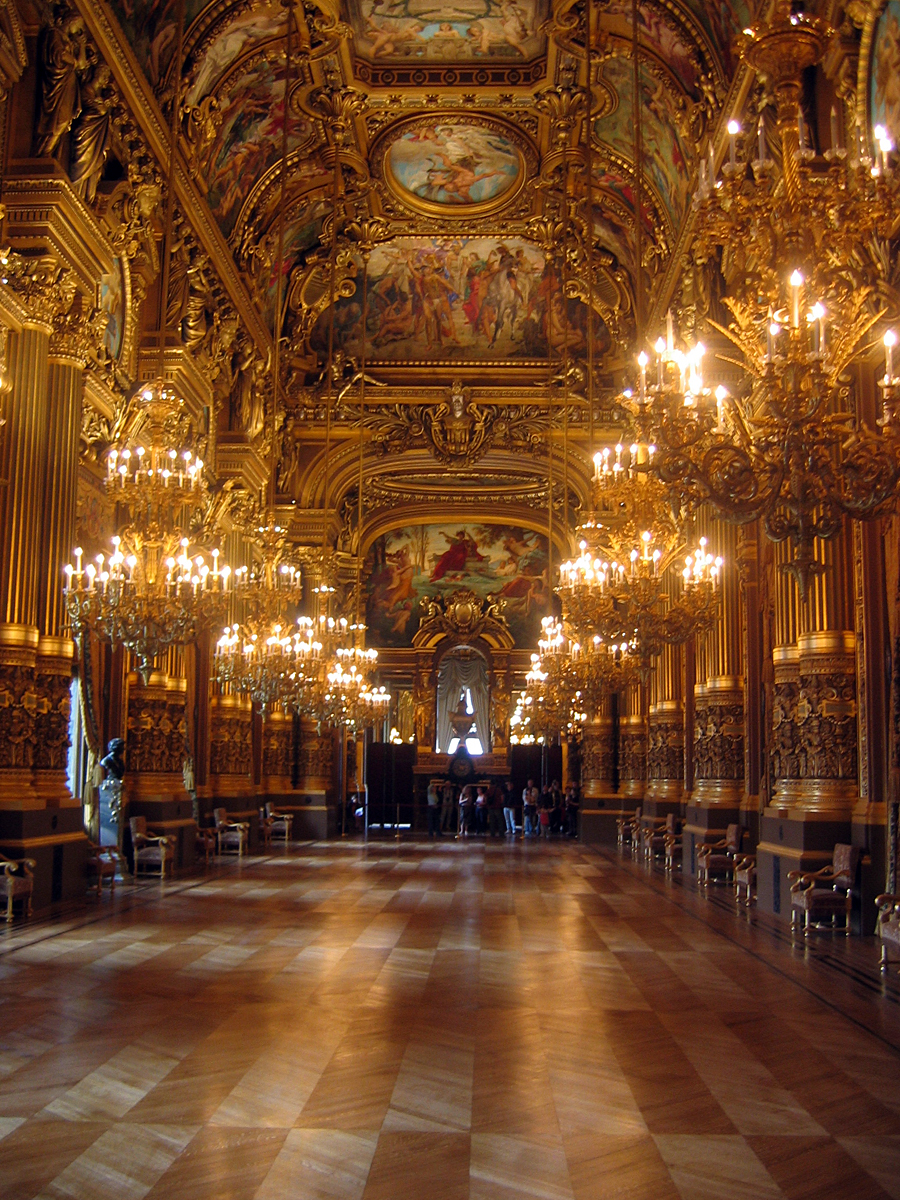
While unparalleled as the location for our conscious representations, glimmerings in the cultural imagination suggest that, as a psychogeography, the Internet is too real, or not real enough to fully articulate the more subconscious aspects of human experience, and other settings may have to be found. Last year I watched the TV show Battlestar Galactica, which (beyond its interesting treatment of the role of belief in the contemporary world) made use of a particular psychic location as a symbolic layer over the real world, directly experienced in visions by a number of the characters: the location of the Opera House. While in the show's plot this location ultimately served as only a cheap visual metaphor, its implications for the cultural imagination are far more suggestive. As an academic colleague pointed out, the Opera House replaces the sci-fi trope of virtual reality with a deeper psychic or subconscious reality, the theater as the place where the contents of our imaginations are made real for all of us. I have dreamt of the Opera House many times (though I was once an actor); it is, as Kerouac says in his own Book of Dreams, the Theater... that old spooky opera house and high school auditorium and classmeet hall of all my days, with hints from all the stages of Time's earth and actors too." While the symbol of the Opera House is still uncharted territory on the Internets, one only has to consider the mythological and ritual bombast of Wagner's operas, or just go see a movie. The drawing of the curtains, or now the darkening of the lights, acts as a veil torn between worlds, so that we sensually enter into the realities of our imaginations; the 3D wonderland of Pandora, the barely repressed longings to rescue Gotham, the Theater as the latest incarnation of the temple sanctum, where the gods become real in us. As Shakespeare said, all the world's a stage. We dream of the day (as Vinge does in Rainbows End) when our technologies allow us to visually project the settings of our imaginations onto the physical landscapes around us, so that we really will inhabit the lands of our dreams.

But where is this place (if not in us), and how are we to get there? The ancient Roman orators had a technique for memorizing long speeches and poems called the Method of Loci: one is asked to create a Memory Palace, taking a highly familiar location and placing in it associated images for the information to be recalled, so that all one has to do is stroll through the loci in the correct order. Personally I am interested in reverse-engineering this process, not further associating psychic terrains but unpacking all the cultural references that have been associated over time to various settings (a hermeneutics of the Opera House, of the Badlands, even of my dreams, whose consistent world this house is a cipher). The cities we inhabit may have a psychological effect on us, but we built the cities in our own image, and buried in them strata of meaning and longing. Perhaps we may uncover the ancient fear of Wilderness that has led so gradually to the current environmental destruction, or just learn to feel at home again, wherever we find ourselves.

12.20.2009

Learning to See

Learning to See, new collage by Tait McKenzie

"Have I said it before? I am learning to see. Yes, I am beginning. It's still going badly. But I intend to make the most of my time." - Rilke, from The Notebooks of Malte Laurids Brigge

12.11.2009

In the Desert of the Soul: Early Symbols in Jung's Red Book

I finally started reading the text of Jung's Red Book last night, and it is as revelatory, revolutionary, and vitally important as I suspected it would be, not just in terms of Jung's psychological theories but in taking a stance for a broader spiritual approach to reality that is even more lacking now than when Jung was writing. Reading this is like reading Blake, I want to quote every passage (as they are almost all brilliant), but if my cat will get off the tome I'll constrain myself to just one before looking at some of the important symbols and themes that Jung was attempting to articulate.

"The spirit of the depths took my understanding and all my knowledge and placed them at the service of the inexplicable and the paradoxical. He robbed me of speech and writing for everything that was not in his service, namely the melting together of sense and nonsense, which produces the supreme meaning.

But the supreme meaning is the path, the way and the bridge to what is to come. That is the God yet to come. It is not the coming God himself, but his image which appears in the supreme meaning. God is an image, and those who worship him must worship him in the images of the supreme meaning.

The supreme meaning is not a meaning and not an absurdity, it is image and force in one, magnificence and force together.

The supreme meaning is the beginning and the end. It is the bridge of going across and fulfillment
[a reference to the way of becoming the superman from Nietzsche's Zarathustra].

The other gods died of their temporality, yet the supreme meaning never dies, it turns into meaning and then into absurdity, and out of the fire and the blood of their collision the supreme meaning rises up rejuvenated anew.

The image of God has a shadow. The supreme meaning is real and casts a shadow. For what can be actual and corporeal and have no shadow?

The shadow is nonsense. It lacks force and has no continued existence through itself. But nonsense is the inseparable and undying brother of the supreme meaning...

The image of God throws a shadow that is as great as itself.

The supreme meaning is great and small, it is as wide as the starry Heaven and as narrow as the cell of the living body.


The spirit of this time in me wanted to recognize the greatness and extent of the supreme meaning, but not its littleness. The spirit of the depths, however, conquered this arrogance, and I had to swallow the small as a means of healing the immortal in me. It completely burnt up my innards since it was inglorious and unheroic. It was even ridiculous and revolting."


Potent symbols and themes in the first seven sections:

The spirit of the times vs. the spirit of the depths - Jung makes a distinction between the spirit or stance of the time in which he lives vs. the spirit of a greater, ancient, and universal reality that is entirely overlooked by the present, and is striving to come forth through Jung. This is historical consciousness vs. the mythic subconsciousness, and Jung frames the Red Book as a way of getting past all the small-minded, violent, materialistic impulses of his age (including a harsh criticism of Christianity), while recognizing that this present world may entirely ignore his warning and call for an understanding of the subconscious.

The supreme meaning - Jung claims that God and gods are only images of an eternal supreme meaning oscillating between meaning and absurdity, and it is this supreme meaning that men must come to recognize as a solution to the spirit of the times. This is entirely consistent with my concept of ultimate significance, in that the supreme meaning is more truly real than the images we conceive of it through.

Dreams and epiphanic visions - Jung recounts a number of visions prophesying the world wars as well as his own future work. He claims an uncontrollable compulsion to record these dreams, though he never did before. Similarly, a number of the passages Jung claims are actually the spirit of the depths or his soul speaking through him as a medium.

The soul - Much of the early part of this book is Jung's attempt to reconnect with his soul. This is the formation of his archetype of the anima/animus, but it is not made explicit in his academic writings that the archetype is not just an image but one's actual, living soul, which encourages us to live and do everything we dream of living and doing. The soul is one's God and opposite, which perfects us in the supreme meaning. The soul is not part of us, we are only the expression and symbol of our soul in the world.

The desert - Though Jung's academic writings discuss the archetypes they do not discuss (as far as I've read) the importance of subconscious locations. In particular Jung discusses here the image of the desert, which is the conception of oneself and soul that one must journey into and rejuvenate in order to overcome the spirit of the times. Jung believes he saw a desert because his soul had been withered (and perhaps those in touch with their souls experience a garden). From my own explorations of the subconscious I also found this "desert of the soul" as the location for the deeper, mythic realities I had to contend with outside of the city (the symbol for the everyday world and times). As my own process continued, this desert was first flooded and became a garden before the entire inner world was set to flames so that a new internal reality could form. I am curious how these locations change through Jung's process in the remainder of the Red Book, as I find such psychogeographies an essential compliment to the character archetypes.

The descent into hell - Jung has a vision in which he realizes that he must descend to hell in order to individuate himself and find the supreme meaning. Such descensus avernum are common in mythic and revelatory literature and serve as another example of the importance of place as symbol for Jung's theories. Jung equates this descent with the possibility of going mad, and sees himself as a sacrificed hero who must overcome that potential madness for a more divine madness lacking in the spirit of the times. This section (and the titles of the other sections) suggest that Jung is on a hero's journey comparable to that described by Joseph Campbell. This hell is all the absurd meaninglessness of our times that we must go through in order to construct our own meaning of events, which is the supreme meaning.

Alright, I'll close with another short passage: "You thought you knew the abyss? Oh you clever people! It is another thing to experience it. Everything will happen to you."

12.08.2009

Updates from the World


A Lost European Culture, Pulled From Obscurity


New Model of the Universe Says Past Crystallises out of the Future

Trees Communicate with Aspirin-like Chemical

Rudiments of Language Discovered in Monkeys

David Foster Wallace's Toy Cement Mixer


"Nothing is more free than the imagination of man; and though it cannot exceed that original stock of ideas furnished by the internal and external senses, it has unlimited power of mixing, compounding, separating, and dividing these ideas, in all the varieties of fiction and vision. It can feign a train of events, with all the appearance of reality, ascribe to them a particular time and place, conceive them as existent, and paint them out to itself with every circumstance, that belongs to any historical fact, which it believes with the greatest certainty. Wherein, therefor, consists the difference between such a fiction and belief?"
-David Hume, from An Enquiry Concerning Human Understanding

12.06.2009

A Yarn: The Burden of Proof (Unlimited Story #1)

[This is the first story generated by the now finished Unlimited Story Deck (beta version). The underlined words refer to the cards played.]


I was at the bar writing when I was approached by a girl who didn’t look old enough to get in, but she was dressed like a hipster, so maybe that’s the style of the week. We got into a debate about oppression, from parental to existential lacks of personal control, and I told her that a girl once told me that sometimes you have to wait, or ask, for help from outside the situation, like from a god in the machine of our world.

Who are you, the hip chick quarried, some outcast from the middle ages? No one believes in God anymore. Or maybe you’re just one of those androids who believes whatever they’ve been told enough times. I just smiled, and she for some reason followed, and later as we were walking toward the carnival through the milling crowds, a turn of fate showed her why.

The turn was that some eco-hackers had forced a viral attack on the nearby zoo’s computer system, hoping to liberate the animals; but they had accidentally released the creatures in a disastrous stampede! In order to escape the war-zone of terrified pedestrians we ducked into the closest café, but even there could not escape the TV’s blaring noise, advertising the doom and dying of the latest war. But just when all seemed hopeless, and she didn’t believe any help could come, out from a hidden lair beneath the kitchen hearth flew a whole mythic pantheon, turning all the rules of logic on their head as they saved the day!

Celebrating this miracle afterward with drinks and dancing back at the bar, the girl apologized for calling me names, and said that I must actually be some angelic messenger to have been so certain the gods would come. But what would really be convincing, she said, would be to next time catch it all on camera.


After just this one play, I am really pleased with how the deck works. The story, though randomly constrained, manages to convey the same kind of aesthetic, tone, pacing, etc. that I would usually put into a story of this length, but managed to be written in about a quarter of the time. Even more intriguing is that where I usually plot out the turn and ending hook of my flash stories, I was not able to here (since who knew what cards would later come up), and yet they happened to work with a fair amount of continuity. Part of this I suspect is foreshadowing: the otherwise arbitrary debate about oppression resolved through a deus ex machina became, as I constructed the tale, something of a goal or end state, the conflict to be resolved, which I continually kept in mind as I drew and played cards. Of course, with just one narrator, I knew what kinds of cards could possibly be played from my hand, and could group certain ones for later scenes or resolutions. At the same time though there were definitely several points when the story could have spiraled out of control; with so many ways of using any of the cards there is an over-determination of imaginative possibility. But I think that is only part of this deck's beauty: anything truly can happen!

Now to play it with more than one person...

12.05.2009

Truth and the Transcendent Function

Still preparing to dive into "The Red Book," I reread Jung's essay, "The Transcendent Function," in which he describes the technique that he used for his process of self-experimentation, a method for consciously delving into the subconscious and uniting them, which was also the practice he recommended to patients in order to continue working on their subconscious materials after or outside of therapy.

The method is one of active imagining, and involves taking whatever emotional state one is in and allowing that mood to become more conscious, at the same time writing down associations of that state (in a controlled manner, in order to not go off into other areas of the subconscious), until the unconscious emotion is enriched and clarified. Or, if there is no particular emotion to focus on, one should remove critical attention and let inner images, voices, or movements emerge, taking similar associative or symbolic notes. Once this material has been collected, Jung suggests (here from his own experience, viz. the Red Book), to either subject it to creative formulation or analytical understanding, that is, to give the unconscious an aesthetic form or concrete meaning, depending on one's tendencies towards either art or logic. The important thing though, is not to get caught up in either the form or meaning alone, but to be able to go back and forth between the two, essentially creating an internal dialogue by which the antipathy between the unconscious and conscious minds is transcended.

I have personally had much success with such methods of active imagination, particularly through dreaming (which Jung claims was too difficult to generally recommend as a method) and elaboration as internal fiction, which over the years has put me into direct contact with many of the subconscious forces and symbols that hold play over my psychology. My intention in reading "The Red Book" slowly and through Jung's techniques is in order to return to another stage in my own psychic self-experimentations.

One of the more interesting things I've discovered through becoming more in tune with my subconscious is a decreasing need for such conscious graspings as truth, non-contradiction, and blunt logic (while at the same time being able, ideally, to apply these to a wider scope). As Jung so deftly puts it in this essay:
"One of the greatest obstacles to psychological understanding is the inquisitive desire to know whether the psychological factor is "true" or "correct." If the description of it is not erroneous or false, then the factor is valid in itself and proves its validity by its very existence. One might just as well ask if the duck-billed platypus is a "true" or "correct" invention of the Creator's will. Equally childish is the prejudice against the role which mythological assumptions play in the life of the psyche. Since they are not "true," it is argued, they have no place in a scientific explanation. But mythologems exist, even though their statements do not coincide with our incommensurable idea of "truth."
Of course, one runs into such grasping for truth and consistency almost everywhere you turn, spying every day yet another atheistic rebuttal of belief, such as this article from Alternet on demanding evidence from religious believers (which asks: “Why do you think God or the supernatural exists? What makes you think this is true? What evidence do you have for this belief?”), when the important thing about belief is that one believes without proof, to demand evidence or a truth behind beliefs is to entirely miss the point of believing (at least for me; I will never apologize or condone dogmatism of any flavor). And furthermore, as Jung seems to agree, the important thing is not whether the contents of our belief are true or false, but what those beliefs allow us to feel or do in the real world. The belief exists, and extends beyond truthiness.

I encountered this kind of grasping in my Wisdom class the other day, discussing Berger's concept of the social construction of reality, which my teacher wanted to refute logically, at all costs. Granted, this teacher has applied logical arguments and the principle of truth = non-contradiction to everything we've read this semester, from Aristotle to Lao-tzu, and seems to find all of them lacking as logically consistent systems of wisdom, while I sit there baffled, wondering how logic will ever get you to wisdom, which for me seems at least equal parts belief. Now if this wasn't frustrating enough, the teacher's specific beef with Berger's theory (which I haven't read, so won't comment on myself), was that: to construct reality implies that reality has been made up or fabricated, and as a fiction it is thus false and a pack of lies of no value, etc. And that's the rub, the assumption that fiction necessarily equals falsehood, that things imagined can not convey truth or really effect the world, regardless of if the contents represent any historical, existent reality. Even the too-smart-for-his-britches philosophy major I usually disagree with was aghast, and despite our best arguments the teacher refused to listen to that his "truth" might be wrong.

It seems to me that this perspective is like someone only using the conscious part of their mind, ignoring or fending off the "demons of the irrational" subconscious instead of accepting them as equally a part of who we are, which they are, and if that boundary is transcended then we can begin to enjoy ourselves more fully in the world and more fully accept this world in all its irrational and boundless glory.

12.02.2009

Belief confirms Belief

Taking a break from working on a philosophy paper about free will to comment on this research presented in New Scientist showing that people ascribe their own beliefs to God:

God may have created man in his image, but it seems we return the favour. Believers subconsciously endow God with their own beliefs on controversial issues.

"Intuiting God's beliefs on important issues may not produce an independent guide, but may instead serve as an echo chamber to validate and justify one's own beliefs," writes a team led by Nicholas Epley of the University of Chicago in Proceedings of the National Academy of Sciences.

The researchers started by asking volunteers who said they believe in God to give their own views on controversial topics, such as abortion and the death penalty. They also asked what the volunteers thought were the views of God, average Americans and public figures such as Bill Gates. Volunteers' own beliefs corresponded most strongly with those they attributed to God.

Next, the team asked another group of volunteers to undertake tasks designed to soften their existing views, such as preparing speeches on the death penalty in which they had to take the opposite view to their own. They found that this led to shifts in the beliefs attributed to God, but not in those attributed to other people.

"People may use religious agents as a moral compass, forming impressions and making decisions based on what they presume God as the ultimate moral authority would believe or want," the team write. "The central feature of a compass, however, is that it points north no matter what direction a person is facing. This research suggests that, unlike an actual compass, inferences about God's beliefs may instead point people further in whatever direction they are already facing."


I think this is very useful research, as the way our beliefs, and the stories we tell to authenticate those beliefs, influences our actions is, for me, one of the prime functions of mythology, and highly overlooked in our polarized age. I think it is very important right now to look at the way the stories we tell influence us, as culturally we are aflood with stories telling us all kinds of wondrous and troubling things. Violence in video games is just the tip of the iceberg. It's not surprising though to find that God is less a moral compass than a sounding board; people have been using the concept of an ultimate reference for this purpose since we've been able to conceive of such an "objective" stance. The difference I think though is that originally (as conceived in both ancient Greece and theology), God was a sounding board for our conception of the largest possible scope of reference and goodness, that is, one which was bigger than our individual perspectives and could thus serve as a map or guide to them. Nowadays though the popular conception of God has become much smaller, inimical to a total perspective of belief, and very specific beliefs have been attached to the attendant texts and rituals that support belief in God (ie: all the dogma and hatred and ignorance of religious fundamentalists that are in us and not in It). Unfortunately it seems that we have grown to believe more in the one-sided interpretations that have codified over history than in the total set of possibilities inherent in an ultimate god belief, and as such project those back on that image in order to reinforce these negative views.

As always, it is important to remember that whether or not you believe that we are created by God, we create gods ourselves through our belief in them, which allows us to believe in ourselves. As I like to put it, gods are solely everything that has been said or believed about them or has been done in their names.

11.30.2009

The Unlimited Story Deck – Artist’s Statement

“I think we should put some mountains here. Otherwise, what are all the characters going to fall off of?” -Laurie Anderson
As a storyteller and theorist on the role that narratives play in our lives, I am concerned with how we produce stories, particularly in our contemporary, hyper-mediated age. We are exposed to narratives everywhere we turn, from the news and movies, to the expression of our memories and daily experiences. Despite this overwhelming abundance of narrative forms, it seems that people often take in stories passively, and do not think about how each of us are continually narrating the world around us. The uncertainty over the future of print media and the Internet’s allowance of the production of rapid and potentially low-quality narratives point to a pressing need to encourage people to continue to learn and enjoy the art of good storytelling. To this end I have created a game and technology, called the Unlimited Story Deck, which can be used to highlight the ways in which we construct narratives, both individually and as communities, and encourage people to tell and enjoy telling new and quality narratives.

There is a myth that that the authorial process is a challenging, mystical, and solitary craft. On the contrary though, everyone is telling stories all the time; the ability to form narrative connections between diverse concepts in our lives may be one of our most rudimentary abilities. Scott McCloud, in his Understanding Comics, suggests that we make such intuitive narrative connections when making sense between the panels of comics . We recognize patterns and desire causal or associational relationships between the contents of our experience, regardless of what those contents are or the contexts and mediums in which they are encountered, just as in comics we don’t need to be told how to interpret the variously arranged and disjointed panels. The Unlimited Story Deck works by presenting its users with a variety of such juxtaposed concepts, from which we can recognize and express our narrative connections.

But what are these contents or concepts we recognize and construct narratives from? The Pre-Socratic philosopher Anaximander believed that all reality was constructed from one underlying substance that he called the Unlimited, essentially a storehouse or database of all potential qualities that could be intermixed and expressed in the world . While this was subsequently disproved as a valid physical theory of the Universe, it may serve as a metaphor for the field of storytelling, in that all narrative realities are constructed from the intermixing and expressing of the unlimited storehouse of conceptualized language. Specifically, we find in stories concepts for characters, settings, events, objects, and dynamics, which are intermixed and expressed in a variety of ways. Each card of the Unlimited Story Deck presents one of these types of storytelling concepts, which can be played in a variety of ways to construct narratives.

While one of my aims is to see how we tell stories outside of expected forms or mediums, (otherwise how might they be novel), it seems we can tell stories from concepts because they are familiar or recognizable from our experience; we know the associations and trappings and how they might be used. There are through the wealth of human narratives certain types of stories that are told again and again, and which anyone who has ever read a book or watched a movie might immediately recognize. Like Anaximander’s Unlimited, one imagines a database of all available narrative types, a technology that Heidegger would call a “standing-reserve” of concepts , which reveal these concepts for us to use in story creation. For the Unlimited Story Deck I have collected such recognizable types of content, which should allow its users to more readily and enjoyably create narratives. Though the form of a deck is limited, physically by the need to shuffle the cards, the permutations of narrative connections between any of these concepts is as unlimited as the human imagination.

While I believe our ability to form narrative connections is intuitive, telling stories still takes work. As media theorist Espen Aarseth suggests, texts are machines for the production of narrative meaning that require the input of a human user to make them operate . Even traditional narrative forms like the novel require some amount of feedback and interpretation from the reader to make sense of a story. On the other hand, this ergodic feedback can be fun, when viewed as games that encourage us to enjoy the act of problem solving or narrative resolution . While it does not present the kinds of goals typical of games, the Unlimited Story Deck is intended to induce the same kind of fun when played by randomly generating concepts that we have to express as narratives, and as such stands in a tradition of storytelling and card games that require interaction to form narrative connections.

Aarseth notes that one of the oldest books, the Chinese I Ching, makes use of discrete nonlinear/random methods for being read, producing 4096 possible distinct readings from the permutations of its symbols . A similar and more direct antecedent is the divinatory system of the Tarot, which presents its users with randomly drawn cards that each contain a concept or archetype from which a reading is constructed. Some important aspects of the Tarot to note are that 1). The archetypes are drawn from familiar or basic situations in human life, 2). Provide open guidelines for the spatio-temporal arrangement and reading of the cards, and 3). Ask the reader to consider the cards and their constructed narrative as a representation of the reader and their personal associations to the cards’ contents.

This last point becomes important when considering another antecedent: that of role-playing games such as Dungeons and Dragons. Though many actions in RPGs are decided through the chance of dice rolls, this kind of game’s fun comes primarily through the story that the players and game master construct and express from the randomness of events and charts of possible outcomes. The players are encouraged towards this act of narrative construction because they identify themselves with the characters in the story. While the Unlimited Story Deck could be used in a similar, self-representational way, it seems that this identification between reader and character may be an integral part of how we interpret stories: by imagining ourselves into the situations and relationships presented these become real for us. Many of the cards in this deck have thus been addressed to the user to encourage their involvement in the stories that can be constructed.

A last few antecedent forms to consider include collectible card games, such as Magic: The Gathering, where players place cards on the table that each represent different characters or forces operating on each other. While this may look the most like the Ultimate Story Deck, collectible card games don’t generally encourage narrative creation and have very particular constraints of game play and goal-situations. Another card game worth mentioning though is Fluxx, where the cards played change the rules and end-situations of the game. This is closer to the player relationship to the cards played in the Ultimate Story Deck, but once again without the use of narratives. Lastly is the card game 1000 Blank White Cards (which I have yet to play, and so can’t speak freely about how it operates), essentially blank cards drawn on by the players to make up the game as it goes along. The Ultimate Story Deck seems very similar to this, but with a preset range of cards and a focus on narration somewhat more similar to the Surrealist storytelling game Exquisite Corpse, where a narrative is made up by people passing around sentences to be finished or continued.


This project is still unfinished, the cards are being designed and should hopefully be done next week in time to start play-testing how the Deck works. More details forthcoming.


1. Scott McCloud. Understanding Comics: The Invisible Art (New York: HarperPerrenial, 1994) 62-4
2. Philip Wheelwright [Ed.] The Presocratics (New York: Macmillan, 1985) 53
3. Martin Heidegger. The Question Concerning Technology. Basic Writings. David Farrell Krell [Ed.] 322
4. Espen Aarseth. Cybertext: Perspectives on Ergodic Literature (Baltimore: John Hopkins University) 20-1
5. Raph Koster. A Theory of Fun for Game Design (http://www.gamasutra.com/features/20041203/koster_01.shtml, 11.30.09)
6. Aarseth 9

11.24.2009

On Ultimate Realism

I haven't written much yet publicly on the new perspective or belief system I have been attempting to formulate over this past year, a perspective that I call Ultimate Realism, which is perhaps best summed up by the quote from Patchen's Memoirs of a Shy Pornogrpaher: "Everything which man can imagine, dream, or conceivably want to exist... does exist."

This view first occurred to me one day last year during a week of spiritual-existential difficulty. I had gone to a local bar and ran into an acquaintance, who said, having not seen me in ages due to my focus on school and writing, "welcome back to the real world," to which I could only reply, but isn't everywhere also just as real? and then wandered down the street struck by the total implications of everything around me being that real. There is some sense in which we tend to believe that only those habits and experiences that we usually have are really real, or at least of the most real importance to us, forgetting that other experiences we don't have are just as real. And beyond existing situations, every content of our imaginations and the stories we tell is real, in that these have real effects in the real world. And ultimately, any perspective that will allow us to articulate our lives in the whole of such a multifaceted reality, and perhaps allow us to formulate a perspective of global significance and understanding, will have to put us in relation to that whole, not just as it is scientifically and historically understood, but in relation to all that humans have said, imagined, believed, and dreamed.

This view has come out of years of questioning spiritual beliefs and the nature of the stories we tell. How do we, as human beings in a world with other human beings, deal with the fact that people have divergent and often contradictory views on what the world is and our place in it? Historically, belief systems have clashed, and continue to clash because each side takes their perspective as most true and right, whereas if one view was somehow objectively true and right there should be no cause for conflict; and yet there is. In my own life I have struggled with such limited perspectives, not knowing in what to believe, as the beliefs always seemed too small, and yet needing to believe in something, to tell some kind of story, and finally recognizing that any belief I would want to hold would have to be large enough to contain all possibilities of believing.

Similarly I fear global destruction due to the clash of these limited perspectives, and that we as a species do not have the stories to set us in relation to where we are now that might allow us to continue into the future in a meaningful, healthy, and positive way. The stories we are prone to tell today are often too small, quotidian, dealing with failure, comeuppance, and the meaningless joy ride of post-modernity, whereas we need a perspective that can address the Universe as a whole, for future generations of humanity in this Universe. These stories must be ultimate in order to place us and our actions in the widest set of meaning or significance necessary for survival.

My old professor, Dr. Fred Clothey (a student of famed mythographer Mircea Eliade), suggested that the stories we tell can tell us about ourselves, in effect modeling our understanding of reality in order to authenticate current actions and allow future actions. Our stories/ myths/ beliefs/ perspectives, etc. can do this precisely when they are cast in an "aura of ultimate significance," that is, by referring us to the widest possible scope of experience and understanding, to our cosmic and social beginnings, to our longed for and feared endings, to our ideals taking on human form. We find our place and being in between the limits of the real as we know it.

One such ultimate signifier, that has had a direct effect on real occurrences, is the concept of God(s). While belief in supernatural beings has allowed articulation of our relation to society and mortality, is has, perhaps most clearly and distressingly, served as a justification for centuries worth of horror and cruelty: crusades, inquisitions, terrorism, or just plain ignorance. But we are prone to forget in our polarized times that this personification of ultimate ideals was also a necessary and integral perspective for the development of scientific reasoning, framing an objective and total perspective that we humans could then hope to achieve ourselves, a belief that has existed coterminous to science up through the 20th century. Contemporary atheists might be glad that God is no longer a reference for rational understanding, but "His" death has negative impacts as well: God has traditionally not only been a signifier for ultimate perspective and knowing, but also for perfection and goodness, in short, ethical understanding of behavior, without which we do things like build the atomic bomb. Technology runs rampant when not placed in the widest relation to how it might rightly be used, or the lack of an ethical signifier allows the cultural insecurities that haunt us to become manifest, and such horrors not only be imagined but made real. One imagines a similar lack of ultimate significance in the perspectives that have allowed western culture's unparalleled material consumption, environmental destruction, and continued ideological warfare on the rest of humanity.

I am not arguing here for a return to a belief in the traditional monotheistic God or earlier gods. These stories, as we have seen, are just too small and conflict-provoking compared to those perspectives that now need to be adopted. I am arguing though for a greater belief in the reality and efficacy of the contents of our stories and imaginations, and an awareness of how these otherwise subconscious narratives influence the real world.

One of the problems to this approach is the primacy we give to literal truth, vs. the obvious falsity of our "true" representations of reality. I am a huge fan of stories of the fantastic, of the magical, supernatural, weird, heroic, or sci-fi, which, looking at the predominance of these themes in the current cultural media and imagination, I believe I am not alone in. But why do we love supermen, zombies, and the end of the world? There has been a trend in storytelling, dating from the late 18th century, of attempting to represent reality as it "really is," social or quotidian realism, and not as an allegorical reference for otherwise real things. Fiction, when it first was read as not literally true, was cast as "petite histories," in order to accept stories they had to mimic reality while being divorced from talking about reality. My immediate response to all this is, there's already too much of the world we experience on a daily basis, why create more of it, when stories beyond the everyday may raise possibilities of experience and understanding more than that which we are already familiar with. That familiarity constrains us, by being real, to the obviously inadequate belief systems we now live under. We hold up what we believe is a mirror and say, this is real, and because we say it, that marks the bounds up what we will allow to be really real.

My second issue with realism is that it is not reality despite how it primps and masquerades itself as such. It may represent aspects of reality, but does so by relying on and reaffirming our assumptions about how the world is and should be, which constrains us to accepting those views and realities as more true or valid, to the exclusion of wider views. And today it seems our view of the real is that it frankly sucks and nothing matters anymore. And any attempt to actually discuss real human issues in an emotionally valid way is negated by the irony and scorn with which we articulate the real world. The fantastic however, by being non-real and symbolic of the real (mythopoetic in Tolkien's terms), precisely allows us to highlight those human themes and conditions we want to examine in truthful ways. But in order to even accept the contents of fantastic stories we must (as Coleridge first suggested) suspend our disbelief of those things that couldn't be literally true in our everyday experience. We no longer have a problem leaping into wizard fights or across star systems, we can suspend disbelief but we are never asked to truly believe, and thus are not as prone to take such fantasies as being symbolic or ultimately significant for how we really are or could be in the world. We are content to let them be mere entertainments and diversions rather than suggestions of possibility.

Yet, are ghosts and gods really real, or is this even the right way of framing the question? There is a sense that certain things are existentially real, they commit us to accepting their physical reality, being right in front of us. The invisible and imaginative do not so commit us; one can not empirically and scientifically prove a god's actual existence. To argue one way or the other for this is to miss the entire point about gods. But one can clearly see the effects that belief in such unprovables has on our world, both on our perspectives and psychologies and in actual historical occurrences. Ignoring and belittling the immaterial causes of such beliefs and effects does little to add to our understanding of ourselves in the world, allows the results of inappropriate or too-small beliefs to continue unchecked, and limits the human imagination to articulate new possibilities of being and understanding being, which are necessary for our current and continued survival, let alone enjoyment and well being. On the other hand, if we do not remember that the stories we tell are only stories, that have been made up despite their real effects, we run the risk of mistaking the stories as literally true, thus causing us to act in dangerous and inappropriate ways, when imagining better stories to live by and through is always an option (and it is this lack of awareness of the power of our symbols that I mean by the absent narrative).

I do not know where we will go from here, but I am wary and sick of the post-modern skepticism that rejects any ultimate significance in favor of what we can directly lay our hands on (and in so doing, strangle it to death). I would prefer to see interconnections of the layers of reality rather than the whole's deconstruction and rebuttal. Acting as if we know everything and nothing really matters is perhaps the smallest and most dangerous perspective one could hold. Ultimately, we exist in a Universe which we barely understand, and in which we are a bare speck, and perhaps in that widest view humanity is indeed meaningless and fated to extinction for lack of any better options. And yet it is also possible to believe, and live by the belief, that life and our consciousness of life may be more than a random fluke or evolutionary mistake; not that we serve some clear teleological purpose or extant will of God, but that for all these unknowns we are still real, and still here, and confronted with the implications of that for all reality.

Though reality may be inherently meaningless we have the choice to take on meanings and act on those meanings, to continue to be and gather greater understanding and significance, both on this planet and in the Universe as a whole, should we choose to accept this mission. Anything less than such an Ultimately Realist perspective sells ourselves short, and will only propel us down the road of meaninglessness and destruction. But if we can perhaps articulate a perspective wide enough, not just for all humans, but all life in general and beyond life, then perhaps we can continue on until that perspective, and all else we can imagine, becomes real.

9.17.2009

The Power of the Imagination

"Imagination is the new canary in the cultural coal mine; imagination death precedes loss of the soul." -from an interview with Antero Alli

4.08.2009

Believing in the Fantastic of Gaiman's Neverwhere

Believing in the Fantastic of Gaiman's Neverwhere

After many adventures in a magical realm beneath the city of London, Richard Mayhew, the protagonist of Neil Gaiman’s novel Neverwhere, is faced with the harrowing ordeal of the key: the possibility that he has actually spent the last week as a crazy homeless person rather than a fantasy hero, and that by realizing this he is now, “starting to edge a little closer to sanity” (243). If he believes in the everyday reality suggested by the phantoms of his real-life friends, then Richard will edge not only closer to “sanity,” but to the suicidal edge of a subway platform. He also has the seemingly impossible choice of believing in the primacy or immediacy of the magical world, and in doing so go on to win the key, complete his quest, and become the greatest warrior in London Below.

At the crux of Richard’s ordeal is the necessity of belief in the magical or otherwise non-real reality in which he’s found himself. This question of belief is also at the heart of the reader’s quest through the book. If we approach the ordeal cold, that is, without already having read and believed in the magical world of Neverwhere, then we are likely to agree that Richard is mad, and instead side with his friend Gary, who claims of London Above that, “this is reality. Get used to it. It’s all there is” (368). Only the most unimaginatively adult readers seem likely to chose this interpretation of the text, but what allows the rest of us to so willingly believe in this world of angels, warriors, and rat-speakers? By applying certain Romantic and Fantasy theories of belief to the story – Coleridge’s concept of the suspension of disbelief, Tolkien’s thoughts on the consistency of Secondary Worlds, Blake’s Contrary Method, and Todorov’s notion of hesitation in the face of fantastic events – we can see how Gaiman has not only managed to create a compelling magical world in London Below, as well as inclined the reader to identify with his protagonist’s quest of believing in Neverwhere, but also questioned our belief in the primacy of our everyday reality.

The Willing Suspension of Disbelief
Like most people since the rational Age of Enlightenment, it is unlikely that you live in a world convincingly inhabited by faeries, witches or other creatures of fancy. The new sciences of the Eighteenth Century led to a general disbelief by the educated classes in real supernatural agents, which led to a decline of their use in the poetry and fiction of the period. The Romantic poet and philosopher Samuel Taylor Coleridge, whose focus on the powers of the imagination made him one of the forefathers of the genre of fantasy, struggled with this question of how to include non-realistic elements in his and his contemporaries’ writings. How could he convince readers to overlook the implausibility of such fantastic narratives, as with the undead sailors in his The Rime of the Ancient Mariner?

In chapter XIV of his Biographia Literaria, published in 1817, Coleridge suggests that supernatural stories can be framed, “so as to transfer from our inward nature a human interest and a semblance of truth sufficient to procure for these shadows of imagination that willing suspension of disbelief… which constitutes poetic faith.” This ‘suspension of disbelief,’ as the term has found purchase in contemporary culture, also requires for Coleridge: “the dramatic truth of such emotions as would naturally accompany such situations, supposing them real,” and is the power of imagination that “reveals itself in the balance or reconciliation of opposite or discordant qualities” (a phrase that echoes the Contrary Method of William Blake, another Romantic poet-philosopher whose ideas we will consider as an undercurrent to the more theoretical mechanics of believability).

While it may be difficult to untangle Coleridge’s centuries-old language it is still possible to apply his ideas to contemporary supernatural fictions such as Gaiman’s Neverwhere. At heart of our ability to suspend disbelief is the representation of the supernatural, not only as something really happening, but also as containing some relevance to everyday human affairs. At the beginning of the novel, Richard Mayhew is presented as an “everyman,” inhabiting a reality that, like for most of us, consists solely of: “work. Home. The pub. Meeting girls. Living in the city. Life;” a description tempered by the very real question, “is that all there is” (364)? Like many people in the contemporary world, Richard has problems at the office, problems in his relationship, an inability to hold his liquor, and a penchant for material goods (such as mass-produced trolls), “in a vain attempt at injecting a little personality into his working world” (12). By his sheer normalcy it would be impossible not to believe that Richard contains a “semblance of truth;” he represents each of us, more than we might comfortably like to admit.

It is not just Richard Mayhew’s ordinariness that we identify with (if so we could do away with the supernatural altogether and confine ourselves to the social realism of a Charles Dickens novel), but also his uncertainty about the world in which he lives. After being told his fortune in the opening scene, Richard is, true to a realistic emotional response to the situation, “a little unsure how to treat information of this nature” (3). This uncertainty deepens when he moves to the city of London, which Richard at first finds to be “fundamentally incomprehensible, with only the Tube map… giving it any semblance of order” (8). Who has not been lost in a new city, or even in a familiar city stumbled upon, as Richard does in a taxi ride home, “an unlikely route involving streets… never before seen” (19)? Richard is uncertain about the world, but that world itself is also uncertain. London’s chaotic history and growth, as narrated by Gaiman, allow an unexpected place for more than just everyday experiences to occur.

But what kind of extraordinary circumstance might a typical man encounter in a presumably real city? If, as Coleridge suggests, the imagination works through the balance of opposites, or, as Blake asserts in The Marriage of Heaven and Hell: “Without Contraries [there] is no progression,” then the only believable encounter is with a supernaturally powered woman from an assuredly fantastic otherworld. Just as Richard is at his wits end in dealing with the real world, a blank wall opens, and Door appears from London Below. By reacting with true human kindness to the hurt girl at his feet (as opposed to the caricatured blindness of his fiancé Jessica), Richard saves himself from the mundanity of dinner with the boss, and allows the reader to suspend their own disbelief, following our hero into the infinitely more exciting realms of the imagination.

The Inner Consistency of the Secondary World
In the century following Coleridge’s concept of the willing suspension of disbelief, supernatural elements once again became more common in literature. Many of these magical worlds however only seemed half-realized, or worse, were merely allegories for real-world events and religious doctrines (for example consider the realm of the seven dimensions in George MacDonald’s Lilith, which is only fully explicable in light of Biblical narratives). In 1938, J.R.R. Tolkien, whose The Lord of the Rings stands as the first major work in the fantasy genre, delivered a lecture entitled On Fairy-stories, which attempts to make clearer the mechanics of successful make-believe. Tolkien disagreed that the reader suspends their disbelief in a supernatural world, if so they are merely going along with it for sentiment’s sake. The burden of belief instead resides with the author, who can make “a Secondary World which your mind can enter. Inside it, what he relates is ‘true’: it accords with the laws of that world” (37). While difficult to achieve, such fantasies require “the inner consistency of reality” (48), that is, there are rules to the way a successful Secondary World operates.

Discovering the rules of a new magical reality is one of the great joys of reading good fantasy, and Neverwhere is no exception. As an added bonus, Richard Mayhew’s quest is often comprised of this need to discover how the Secondary World works. In his first foray into London Below, Richard “realized that he did not know very much about what went on beneath London” (47), but he will soon discover that his very survival depends on finding out! This paradoxically leads to the first rule of Neverwhere: the more you learn about London Below the less likely you are of being able to return to the real world of London Above. After he rescues Door she tells Richard it wouldn’t do him any good to know what happened to her, and the Marquis de Carabas forbids Richard not only from asking questions but also tells him not to “even think about what’s happening to you right now” (47). Though these characters are trying to save Richard from getting trapped in their world, Richard (and the reader along with him) can’t help but wonder about the little bits of magic we see, and consequently are drawn deeper into London Below.

The true magic of the novel, and what makes finding out the rules of London Below both an enjoyable and believable experience, is that this Secondary World works through puns and juxtapositions, so that we see familiar elements of our world in an entirely new light. This use of Blake’s Contrary Method is first hinted at in the Prologue to Neverwhere, when, after looking at a map of the London Underground, “Richard found himself pondering… whether there really was a circus at Oxford Circus” (4). Whenever a Tube station is mentioned it becomes increasingly more obvious that the station’s title will be taken literally: there is a bridge at Knightsbridge, an earl at Earl’s Court, shepherds at Shepherd’s Bush, black friars at Blackfriars. Though not every Tube station is visited in the course of the novel, the inclusion of the map in the front of the book leads the reader to continue filling out the world of London Below in their imagination through application of this rule of the metaphor made literal. Eventually Richard, and the reader, stops questioning the rule: “the longer he was here, the more he took at face value” (161).

It is not just the landscape of London Below that plays off the familiar; the characters and events follow these rules as well. Though the villains Croup and Vandemar “did not look like anything Richard had seen before” (33), their and Door’s clothing calls to Richard’s mind “the History of Fashion section of the Victoria and Albert Museum” (29). Old Bailey’s rooftop lair reminds Richard of a theatrical performance of Robinson Crusoe. The feast served to our heroes by the Earl at Earl’s Court is “Cadbury’s Fruit and Nut chocolate,” and an antique goblet “filled with Coca-Cola” (160). We are led to believe that the Secondary World of London Below is internally consistent because, through these juxtapositions with and references to the familiar, we see where the supernatural fits inside of or coexists with our everyday reality. The lack of contradictions to our world makes London Below seem like it could really exist! This is a testament to Gaiman’s powers of sub-creation; like Richard perhaps we too can go “beyond the world of metaphor and simile into the place of things that are” (307).

Hesitation in the Face of the Fantastic
Though London Below is presented as a consistent Secondary World where Richard “was at least learning to play the game” (102), in order to believe in Neverwhere ourselves we must more fully explore the significance of the supernatural events of London Below existing along side the familiar, mundane world. As Coleridge suggests, in order to suspend our disbelief the character must react as if these events were actually happening in the real world. The Structuralist critic Tzvetan Todorov, in his 1970 book Inroduction á la littérature fantastique (The Fantastic), presents what seems to be one of the truest literary responses to a confrontation with the extraordinary: uncertainty or hesitation. “In a world which is indeed our world… there occurs an event which cannot be explained by the laws of this same familiar world… the fantastic is that hesitation experienced by a person who knows only the laws of nature, confronting an apparently supernatural event” (25). Because “the fantastic implies an integration of the reader into the world of the characters; that world is defined by the reader’s own ambiguous perception of the events narrated,” and so “the character wonders (and the reader with him) whether what is happening to him is real” (31 and 24). The fantastic works through presenting a supernatural event along side a series of potentially rational explanations – drugs, madness, dreams, tricks, illusions, and coincidences (45) – that never quite account for what happened, thus urging the character and reader towards belief in the supernatural.

Throughout Neverwhere, Richrad Mayhew is essentially characterized by this response of hesitation; he is constantly positing unlikely explanations for the fantastic events he encounters. When Door asks him to apologize to what seems to be a talking rat, Richard considers that “maybe he was the one who was going mad” (42). Our hero has a similar need to rationally account for his sudden invisibility to the real world when he returns from his first encounter with London Below: “whatever madness was happening that day was really happening. It was no joke, no trick or prank” (61). Because nothing he is experiencing makes rational sense, Richard also finds recourse in the possibility that he “walked into a nightmare” (126). The Ordeal itself essentially catalogues Todorov’s explanations, as being potentially a dream, a figment of Richard’s imagination, or a break in his sanity (242). In order to pass the test however, and not consider one of these explanations as real, Richard must already have established a belief in the primacy of the supernatural world of London Below.

At certain key points in the story, Richard and the reader realize that we cannot explain away the marvelous events that seem to be happening. Upon meeting the angel Islington, Richard realizes that “it was much easier not to believe in something when it was not actually looking directly at you and saying your name” (197). No rational explanation can account for this direct encounter with the supernatural. On the other hand, after “experiencing the exhaustion of someone who had managed, somehow, to believe several dozen impossible things” (133), the party reaches British Museum Station, which Richard finds to be “one oddity too many” (164). This turns the hesitant reaction to supernatural events on its head, because it turns out this Tube station really did exist; it seems fantastic merely because Richard does not know everything that exists in the real world of London Above. “He wondered how normal London – his London – would look to an alien” (112). Eventually Richard, and the reader, learn to accept that “the simplest and most likely explanations for what he had seen and experienced recently were the ones that had been offered him – no matter how unlikely they might seem” (201), but without total knowledge of the real world or an objective frame of reference, who is to say what seemingly marvelous events aren’t equally as real?

Belief Beyond the Cavern of the Real
This question of whether or not supernatural events could actually occur seems to be a central concern of Neil Gaiman’s novel. That we feel the need to posit rational explanations for seemingly unreal circumstances merely belies a human preference for the primacy of the everyday world with which we are most familiar. As Blake however suggests in The Marriage of Heaven and Hell: “If the doors of perception were cleansed every thing would appear to man as it is, infinite. For man has closed himself up, till he sees all things thro’ narrow chinks of his cavern.” When Richard rescues Door at the beginning of Neverwhere, “a normal, sensible Richard Mayhew… was telling him how ridiculous he was being” (25), or, when returning to what he considers to be the primary reality, Richard believes that “the events of the previous two days became less and less real, increasingly less likely” (56). These expectations about what is real form the narrow chinks of Richard’s cavern, which are progressively widened to encompass a much broader worldview. How could something like the fantastic Night’s Bridge exist “beneath the city of London, without everyone knowing” (100)? The answer occurs later when the guests at the museum, exemplary of this realistic mindset, are confronted with the supernatural opening of the Angelus: “ having dealt with something entirely outside their experience, agreed, somehow, without a word, that it had simply never happened” (196). Our belief in the primacy of the everyday reality is merely a social or cultural convention based on a familiarity with what we expect is possible, and is a much more recent modern invention compared to the age-old belief in invisible spirits.

Blake might argue through his Contrary Method that, like good and evil, reality and fantasy necessitate each other. How can we know what is real unless the unreal also exists? In Neverwhere, we can only really see Richard Mayhew as a real and identifiable character in his interactions with the internally consistent magical reality of London Below. And given a choice between these two realities on his return to London Above, Richard claims that “if [the real world] is all there is, then I don’t want to be sane” (369). At the end of the story, Richard creates a door and chooses to return to the magical world of London Below, clearly favoring his belief in the primacy of the supernatural. Ultimately, it doesn’t seem clear whether or not this last supernatural event occurs (though in our imaginations we can continue the story and “find out”), so it is left up to the reader and our own preferences between reality and the supernatural to choose whether we too believe in Neverwhere.

Works Cited

Blake, William. “The Marriage of Heaven and Hell.” Blake Digital Text Project. 2003.
University of Georgia. 12 Apr. 2009.

Colerdige, Samuel Taylor. “Biographia Literaria.” Michael Gamer: Home Page.
University of Pennsylvania. 12 Apr. 2009


Gaiman, Neil. “Neverwhere.” Avon Books. New York: 1998

Todorov, Tzvetan. “The Fantastic: A Structural Approach to a Literary Genre.” Trans.
Richard Howard. Cornell University Press. Ithaca: 1995

Tolkien, J.R.R. “On Fairy-stories.” The Tolkien Reader. Ballantine Books. New York:
1971

8.07.2008

mapping soul

"Some were looking for spiritual happiness or for some form of unknown power, but I had a practical object. I wished for a system of thought that would leave my imagination free to create as it chose and yet make all that it created, or could create, part of the one history and that the soul’s."

-Yeats, on why he got involved with the occult

7.24.2007

borderlines of the imagination

I spent most of last night getting into Thomas Pynchon's "Mason and Dixon," figuring if I wanted to enjoy a tome right now I'd pick one with less current cultural prickliness than the latest Harry Potter. Once again I found myself overwhelmed, unable to stop turning pages, cast into a full world in the same way as when reading Pynchon's latest, "Against the Day." What strikes me the most about his writing is that Pynchon is an intelligent man. He has done extraordinary amounts of research in regards to the subject matter he's presenting, and in regards to just about everything else, and he knows how to weave it all into a compelling story which doesn't read like someone's narrated science manual. Furthermore he's also enough of a writer to not only understand his subjects, but to ignore all the truth of his knoweldge and make up his own sidereal histories to established persons and times, as if there were infinite number of histories, worlds to be historicized, waiting directly below this one, a Borgesian nest of worlds within worlds, each with its own sure dialects and idiosynchronicities, that can't quite be distinguished from but are certainly other than the world we live in. And there's a plot.

I had to put down Fernando Pessoa's "Book of Disquietude" because, despite how fascination his idea of assuming mulitple heteronyms to write under is, this is essentially a plotless notebook of moments of feeling rather glum and out of sorts with humanity, claiming to have fascinating dreams but not even telling us what they are, perhaps better titled a book of bemoaning. He is not even a Rilke with a prescience of vision and beauty beneath his Everyday which leaves one wondering just what the journalist really sees. Despite what I feel is a necessity to divulge the depths of the human mind and experience, one wants to at least wonder if something will change, some slightest event actually happen to break the author from their ennui into a sense of real life. Sartre looked at a tree and felt a profound nausea in that he was one with it, a spiritual enough experience in what is presented as an otherwise humdrum life, and because of that decides to look up an ex-lover. Not a terribly profound plot, but moving, because at the very least it goes somewhere. Even Pavic's recent "Dictionary of the Khazars," told in sprawling asymptotic encyclopedic entries that span space and time and religion and myth without ever quite being straightforward, has the ability to suggest that something happens to the characters, even if that happening is in the reader's own process of trying to assemble the disparate trains of thought. At least, entertaining, as it pushes the imagination, and the very act of reading.

Having felt creatively dry for days now, Pynchon's tome was like a refreshing drink, I was suddenly filled between his pages with ideas, scenes, a sense of something happening in the dark of my own internal narratives. He has created a world, which like all good worlds begs that it is quite possible to create others. The genius behind Tolkien's Middlearth is that it is self-contained, fleshed out, populated and mythologized to the utmost. Every line Tolkien wrote added to the fullness of his simulacraic reality, all the short stories and rejected fragments, so that we might have his grand trilogy, which is in itself not specifically a story but another chapter in the history of its world. The beauty, and curse, of dreams is that they are always set in their own realities, everyone's quite different, and more complicating it is a world with no set boundaries, that changes night by night so that a certain bridge you walked under five years ago no longer exists, and a strange tower now stands in its place which in itself never seems to quite stand still enough to tell how many floors it has, or who lives there, or if it is really there at all. Vague suggestions of denizens, deities, deep mythologies of the psyche, ever alluded to but never clearly explicated, forests and swamps and deserts that may indeed be nothing other than the dreamer's own body and somnolent processes.

Harry Potter may have his wizards' schools and loves and nemeses, but these elements can only belong, when all is written, to the world, to an externality of events driven more by economic fetishizing and the populaces that support it, than they can belong to himself. In the end Harry Potter's world can no longer sustain itself as a world, as it is not spun out of his own imagination with him as only a minor miracle worker in it, and he succumbs to the dustbins of all worn out marketing gimmicks. Arguably so does any element of history or the imagination, once the Author is done with them and moves on. Mason and Dixon, Bilbo Baggins, Bernando Soares, Harry Potter, the race of the Khazars, Borges himself, all these have passed on, returned to some post-formative, subterranean cavern underneath the ice shelves of cultural consciousness to be recycled back into the collective dreaming, to return next time with different faces, altered agendas, stripped of any original historicity and design, the only articulable world the one in which they somehow exist together, devoid of memories and the stories which birthed and bound them, lost names in the fabric of being nothing but someone else's character and never their own to invent, as we sometimes, barely, have the glimmering of possibility towards.

6.08.2007

heroes of the imagination

In response to the criticism of my last entry, it was not meant to be a well thought out essay as much as a rant or ramble just to get out some thoughts that had been building up in my head. With my eminent return to school in the fall I've found myself reading more and thinking more and needing to express my ideas, even if they are not yet coherent (certianly that last entry would not be a very good school paper!) nonetheless, feedback of any sort is always welcome. I've found that I can best articulate myself by "thinking outloud" and having others say, no, that's not it at all.

That said, on the subject of how children play, Sophie and I have been talking a lot about this recently, recalling from our own childhoods how we would take whatever movies or games we were exposed to and recreate them in our own play, rewriting plots of "labyrinth" or "star wars" in order to place ourselves into the action, which listening to descriptions of modern kids playing World of Warcraft seems like is a continuing tradition. How many times have you read a book and said, I really wish I could have been there? Despite the content, or perceived lack of content, in modern play, what remains essentially the same is the use of cultural plotlines in order to offer a jumping off point for the imagination. Whether reading old mythology or playing video games referencing that old material, a child might imagine themselves in that world, in any world that is more interesting than the one they daily live in, and if this kind of play is carried out through their lives could foster a deeper internal reality later accessible for artistic excavation. Indeed that is what I've found to be the case for myself. I watched Star Wars close on a hundred times growing up, and even though the specifics of the "arthurian space cowboy" aesthetic have lessened over the years, the deeper mythological themas have continued to hold importance in my psyche, even as a framing device for other stories. I imagine that Jung and Campbell were not trying to write out specific plot lines for others to follow exactly, but to find common themes that humanity has dealt with in its attempts to create coherent narratives over the centuries, which is what made Star Wars so successful in the first place (as well as the lasting resonance of punch and judy, or tom and jerry, or whichever two antagonistic figures are swinging sticks at each other on tv these days). At heart what is present is a conflict between forces, ideas, family, the need to find a place in the Universe or a sense of meaning to one's actions. It's not so much that today's media spectacles are meaningless in a world where things were once meaningful before, but that there has never been any meaning outside of what we have given to our experiences. The fin de secle writers in France decried a similar lack of meaning at the turn of the last century, which they addressed through various surreal, existential, or symbolic means, but each one an attempt to give personal meaning to modern life.

It is not surprising that superheroes and law-detectives have become the modern culture heroes, they are the figures that people can relate to, they are the legends that strive to rise above the Everyday and take real action in the world. Even if they don't exist, their possibility is enough for some even one kid in some small town to say, I could do that one day, I could do better than that. Or we see books coming out, on the other end of the spectrum from "the Da Vinci Code," where the heroes are intentionally irreal, mythical beings and monsters, who even more than the culture heroes address real human issues of the 21st century. Anne Carson's "Autobiography of Red" retells the myth of Herakles and Garyion, as if they were a homosexual couple going on vacation together, with all the monster's issues with being red, winged and unable to address the world except from behind the lens of a camera. Or Cary Doctorow's "Someone Comes to Town Someone Leaves Town" (which I heard about last night), whose main character is the son of a mountain and a washing machine and has a set of nesting dolls as brothers, and is trying to install free wireless in Toronto (Doctorow is a large proponent of Copy Left). Despite the element of the postmodern and absurd, such characters serve to focus the attention instead on a deeper psychology or perspective of what it is to feel different in an increasingly homogenized world. That in an increasingly wired existence where everyone has a voice, and every voice sounds about the same (like a large buzz from the vanishing bees), we are all still unique, and dealing with the same sense of existentiallity that earmarks such ancient mythic texts. Indeed, the classical gods ran around drunk and fucking each other more openly than the modern culture heroes do, and were worshiped for it.

6.02.2005

but what does healing look like?

Of course, having the time and space and energy to wander around and worry about the finiteness of existence takes a certain amount of privilege that I happen to have right now. If I was bogged down in school or a full time job there would be a lot more pressing things in my life to worry about than how soon the flowers might wilt. But then again, I have spent the last several years making my life one in which this type of perspective is possible. I could say that I am care-free, except that in the absence of more mundane cares these other more psychological issues raise their heads. So be it. At least a part of that "free time" is spent trying to figure out how others might be better able to address this stuff in their own lives.

As part of the community health collective Grace and I have started working on how to write up Wellness Recovery Action Plans, which essentially detail lists of personal early warning signs before breakdowns, symptoms of both good and bad health, and a "toolbox" of actions that can be taken when one is feeling down or in a crisis that could potentially be used to feel better (such as sleeping, eating well, talking to people, yoga, etc...). Ideally these WRAP's could be given to our closest friends so that when they see us getting close to a breaking point they can say "hey, why don't you do this instead of freaking out?" Because often in those situations of extreme duress it is so hard to keep in mind those simple things that actually help. Now to learn some new techniques that will. I'm excited that several hours of the next meeting will be spent learning some basic massage. I am craving being able to heal people with my hands.

Something else that has interestingly come up in this recent intensification of experience is an increased amount of visual synethsesia. I am immediately reminded of the tunnel dreams I had several years ago that I could never really wake up from and hung at the edges of my vision throughout those days, except that this is much less directly image-oriented. In moments of extreme presence, physical contact brings up the perception of colors and textures in my field of vision, especially when it is combined with appropriate music. Abrupt touches are a jagged red while brief brushings seem as a light blue field with white birds flapping across it. And sound itself has it's own looks. I got my viola back from the shop with new strings and the bow rehaired for the first time since elementary school, and the depth of the new tones at practice felt more like painting a picture than playing an instrument. I don't know how much of this is just a suggestion of my imagination but the multi-modality offers a pleasent change from more linear ways of interpreting the world. Perhaps it has always been this way, and I was just numb to it before, but it is certainly familiar, as if it were a part of the structure of human perception below the discrete partitions of the "five" senses.

3.27.2005

In the Realms of the Real


Last night I saw In the Realms of the Unreal, and it was incredibly inspiring. The story of outsider artist, Henry Darger, who lived as a recluse for most of his life and after his death his landlords found he had produced a 15,000 page novel fully illustrated about the world that he lived in in his head, filled with whimsical creatures and an eternal world war over child slavery, constructed from newspaper images collected through his lifetime. What a fascinating look at how the sometimes small experiences in a person's life can build up into an epic internal story. And at how the need to express that becomes all-consuming.

Fucking intense. Makes me feel like the work I've been doing is nothing. Of course I don't live in complete isolation from the rest of humanity, but still, it makes me want to throw out all the ideas I have for my next five novels and just start from scratch, clean and honest and fully intimate about the life I live where no one else sees. Already I hint at it, but that is nothing compared to what it could be. And even that is just hints. 15,000 pages, damn. As inspiring as this is, I am still more concerned with uniting my waking life with the world of my dreams than opting out of living all together to pursue some all-consuming internal vision. I still maintain that my life is my art, even if I am still coming into a full realization of just what that means. It takes a lifetime of practice, and I'm still young, but I fully belive that anything is possible.

Perhaps my favorite quote from the movie was when one of his neighbors was saying that they called poor artists like this crazy, and rich ones eccentric, and since Henry was poor they called him crazy. At least I have some close friends to support me in my own aesthetic madness.