
The heart never suffers
when it goes in search of its dream,
because every moment of the search
is a step towards encountering
God and Eternity.
(Paulo Coelho, from "The Alchemist")
8.28.2008


8.26.2008
Zenarchy
[via technoccult]
“Zen anarchy? What could that be ? Some new variations on the koans, those classic proto-Dadaist Zen “riddles”? What is the Sound of One Hand making a Clenched Fist? If you see a Black Flag waving on the Flagpole, what moves? Does the flag move? Does the wind move? Does the revolutionary movement move? What is your original nature—before May ‘68, before the Spanish Revolution, before the Paris Commune?
Somehow this doesn’t seem quite right. And in fact, it’s unnecessary. From the beginning, Zen was more anarchic than anarchism. We can take it on its own terms. Just so you don’t think I’m making it all up, I’ll cite some of the greatest and most highly-respected (and respectfully ridiculed) figures in the history of Zen, including Hui-Neng (638-713), the Sixth Patriarch, Lin-Chi (d. 867), the founder of the Rinzai school, Mumon (1183-1260), the Rinzai master who assembled one of the most famous collections of koans, Dogen (1200-1253), the founder of Soto, the second major school, and Hakuin (1685-1768), the great Zen master, poet and artist who revitalized Zen practice.
I. Smashing States of Consciousness
This is what all the great teachers show: Zen is the practice of anarchy (an-archy) in the strictest and most super-orthodox sense. It rejects all “archys” or principles—supposedly transcendent sources of truth and reality, which are really no more than fixed ideas, mental habits and prejudices that help create the illusion of dominating reality. These “principles” are not mere innocuous ideas. They are Imperialistic Principalities that intrude their sovereign power into our very minds and spirits. As anti-statist as we may try to be, our efforts will come to little if our state of mind is a mind of state. Zen helps us dispose of the clutter of authoritarian ideological garbage that automatically collects in our normal, well-adjusted mind, so that we become free to experience and appreciate the world, nature, and the “Ten Thousand Things,” the myriad beings around us, rather than just using them as fuel for our ill-fated egoistic cravings.”
Part 2 and Part 3
“Zen anarchy? What could that be ? Some new variations on the koans, those classic proto-Dadaist Zen “riddles”? What is the Sound of One Hand making a Clenched Fist? If you see a Black Flag waving on the Flagpole, what moves? Does the flag move? Does the wind move? Does the revolutionary movement move? What is your original nature—before May ‘68, before the Spanish Revolution, before the Paris Commune?
Somehow this doesn’t seem quite right. And in fact, it’s unnecessary. From the beginning, Zen was more anarchic than anarchism. We can take it on its own terms. Just so you don’t think I’m making it all up, I’ll cite some of the greatest and most highly-respected (and respectfully ridiculed) figures in the history of Zen, including Hui-Neng (638-713), the Sixth Patriarch, Lin-Chi (d. 867), the founder of the Rinzai school, Mumon (1183-1260), the Rinzai master who assembled one of the most famous collections of koans, Dogen (1200-1253), the founder of Soto, the second major school, and Hakuin (1685-1768), the great Zen master, poet and artist who revitalized Zen practice.
I. Smashing States of Consciousness
This is what all the great teachers show: Zen is the practice of anarchy (an-archy) in the strictest and most super-orthodox sense. It rejects all “archys” or principles—supposedly transcendent sources of truth and reality, which are really no more than fixed ideas, mental habits and prejudices that help create the illusion of dominating reality. These “principles” are not mere innocuous ideas. They are Imperialistic Principalities that intrude their sovereign power into our very minds and spirits. As anti-statist as we may try to be, our efforts will come to little if our state of mind is a mind of state. Zen helps us dispose of the clutter of authoritarian ideological garbage that automatically collects in our normal, well-adjusted mind, so that we become free to experience and appreciate the world, nature, and the “Ten Thousand Things,” the myriad beings around us, rather than just using them as fuel for our ill-fated egoistic cravings.”
Part 2 and Part 3
8.25.2008
On koans and rotting dogs
Erik Davis of Techgnosis on Jodorowsky's Spiritual Memoir:
"A friend recently asked me if I though Alejandro Jodorowsky’s Holy Mountain was a “good” movie, and I had to answer that, in the case of this surreal mythopoetic masterwork, the usual good/bad categorization does not apply. The film is truly beyond category; or rather, it is “terribly good.” While the first half of the movie—which was definitively released on DVD within the last year—is perhaps the greatest sustained expression of visionary psychedelic filmmaking ever, I can understand why people also find the exploding frogs repulsive and the mystagoguery redolent with all the erratic indulgence and hierophantic pretension that mark the more wayward domains of Seventies spiritual counterculture. But even that’s as much a plus as a minus, especially if, like me, you believe that the peculiar genius of this era provided mystical and hedonic conundrums that are still worthy of study and exploration.

"So it was with great excitement that I read the recent translation of Jodorowsky’s spiritual autobiography, entitled—hold onto your hats—The Spiritual Journey of Alejandro Jodorowsky. Like his films, it is a puzzling, wonderous, grotesque, and sometimes tedious book, but it does confirm the sense I get from his films that he is not fucking around with the mysteries. In the Sixties and Seventies, Jodorowsky was a serious practitioner of Zen, studying and meditating with a Japanese priest in Mexico City named Ejo Takata. Their koan combat is the most steady thread of this book, a male-buddy-cognitive conversation that forms a counterpoint with the other figures in the book, all of whom are women who offer Jodo various modes of initiation—artistic, sexual, magical, energetic. These women include the surrealist painter Leonora Carrington, who sounds as wacky brilliant as Dali, and a goat-killing silicone-implanted Mexican actress known as La Tigress."
"A friend recently asked me if I though Alejandro Jodorowsky’s Holy Mountain was a “good” movie, and I had to answer that, in the case of this surreal mythopoetic masterwork, the usual good/bad categorization does not apply. The film is truly beyond category; or rather, it is “terribly good.” While the first half of the movie—which was definitively released on DVD within the last year—is perhaps the greatest sustained expression of visionary psychedelic filmmaking ever, I can understand why people also find the exploding frogs repulsive and the mystagoguery redolent with all the erratic indulgence and hierophantic pretension that mark the more wayward domains of Seventies spiritual counterculture. But even that’s as much a plus as a minus, especially if, like me, you believe that the peculiar genius of this era provided mystical and hedonic conundrums that are still worthy of study and exploration.
"So it was with great excitement that I read the recent translation of Jodorowsky’s spiritual autobiography, entitled—hold onto your hats—The Spiritual Journey of Alejandro Jodorowsky. Like his films, it is a puzzling, wonderous, grotesque, and sometimes tedious book, but it does confirm the sense I get from his films that he is not fucking around with the mysteries. In the Sixties and Seventies, Jodorowsky was a serious practitioner of Zen, studying and meditating with a Japanese priest in Mexico City named Ejo Takata. Their koan combat is the most steady thread of this book, a male-buddy-cognitive conversation that forms a counterpoint with the other figures in the book, all of whom are women who offer Jodo various modes of initiation—artistic, sexual, magical, energetic. These women include the surrealist painter Leonora Carrington, who sounds as wacky brilliant as Dali, and a goat-killing silicone-implanted Mexican actress known as La Tigress."
8.24.2008
On Being a Young Poet
Every few years I find myself set adrift, for one reason or another placed in an emotional or moral position somewhat off center and in need of guidance. It is in times like these when invariably someone reminds me about Rainer Maria Rilke's "Letters to a Young Poet."
I first came across this text, and Rilke at all, in my first year of my first attempt at college, ten years ago. It was a required text for incoming freshmen! Of course, I was too young, too headstrong at the time, probably like any other kid fresh out in the world, to admit that there were deep issues, dark questions, that one might need advice, not in answering, but in living. As Rilke puts it, "be patient to all that is unsolved in your heart and try to love the questions themselves like locked rooms and like books written in a very foreign tongue. Do not now seek the answers, which cannot be given you because you would not be able to live them. And the point it, to live everything. Live the questions now. Perhaps you will then gradually, without noticing it, live along some distant day into the answer."
This quote has been a favorite for many years, though I still don't fully understand it. Another thing that it's taken me a long time to wrap my head around is the necessity of solitude, something that Rilke stresses on almost every page of his letters. Solitude in order to go into yourself, to find your reason to write and to seek out the dreams, memories, impressions that make one's internal world. Solitude in order to find the patience to allow everything to gestate, the acceptance of doing what is difficult and therefor necessary, the clarity of the senses beneath the surface and multiplicity of the world where one can actually create. Solitude in order to grow into one that can love and be loved, a "love that consists in this, that two solitudes protect and border and salute each other."
 These days I exist mostly in a happy solitude, with my stories and new kitten Ruby and lots of music, a happiness that is mainly broken only when other people are involved. It is strange to think that for years I sought out the company of others, not because I actually wanted to be around them, but because I was under the impression that I should, because it was easier to become involved in order to hide from myself and my possibilities behind the social masks of sex, drugs, rock and roll. One of the few kinds of occasions I would actually enjoy myself in public in was being on stage, playing a show. Talk about the performance of everyday life. Which isn't to say that I don't enjoy being around other people, but that I have learned that I require a much more immense amount of time to myself, which when I have it allows me to interact with others in a much more reciprocal and centered way, as well as get a lot of writing done.
"Love your solitude and bear with sweet-sounding lamentation the suffering it causes you. For those who are near you are far, you say, and that shows it is beginning to grow wide about you. And when what is near you is far, then your distance is already among the stars."
It is also interesting, and immensely inspiring, to think that Rilke was twenty-eight, my age, when he wrote these letters, and yet so wise (or so precocious with the weight of the world, though one feels that he really felt and bore that weight in its fullest understanding). I can only bow my head.
[quotes from M.D. Herter Norton's translation of Rainer Maria Rilke's "Letters to a Young Poet," though the Stephen Mitchell translation I linked to above is far superior, as Mitchell gets the emotional necessity of Rilke's writing.]
I first came across this text, and Rilke at all, in my first year of my first attempt at college, ten years ago. It was a required text for incoming freshmen! Of course, I was too young, too headstrong at the time, probably like any other kid fresh out in the world, to admit that there were deep issues, dark questions, that one might need advice, not in answering, but in living. As Rilke puts it, "be patient to all that is unsolved in your heart and try to love the questions themselves like locked rooms and like books written in a very foreign tongue. Do not now seek the answers, which cannot be given you because you would not be able to live them. And the point it, to live everything. Live the questions now. Perhaps you will then gradually, without noticing it, live along some distant day into the answer."
This quote has been a favorite for many years, though I still don't fully understand it. Another thing that it's taken me a long time to wrap my head around is the necessity of solitude, something that Rilke stresses on almost every page of his letters. Solitude in order to go into yourself, to find your reason to write and to seek out the dreams, memories, impressions that make one's internal world. Solitude in order to find the patience to allow everything to gestate, the acceptance of doing what is difficult and therefor necessary, the clarity of the senses beneath the surface and multiplicity of the world where one can actually create. Solitude in order to grow into one that can love and be loved, a "love that consists in this, that two solitudes protect and border and salute each other."
These days I exist mostly in a happy solitude, with my stories and new kitten Ruby and lots of music, a happiness that is mainly broken only when other people are involved. It is strange to think that for years I sought out the company of others, not because I actually wanted to be around them, but because I was under the impression that I should, because it was easier to become involved in order to hide from myself and my possibilities behind the social masks of sex, drugs, rock and roll. One of the few kinds of occasions I would actually enjoy myself in public in was being on stage, playing a show. Talk about the performance of everyday life. Which isn't to say that I don't enjoy being around other people, but that I have learned that I require a much more immense amount of time to myself, which when I have it allows me to interact with others in a much more reciprocal and centered way, as well as get a lot of writing done."Love your solitude and bear with sweet-sounding lamentation the suffering it causes you. For those who are near you are far, you say, and that shows it is beginning to grow wide about you. And when what is near you is far, then your distance is already among the stars."
It is also interesting, and immensely inspiring, to think that Rilke was twenty-eight, my age, when he wrote these letters, and yet so wise (or so precocious with the weight of the world, though one feels that he really felt and bore that weight in its fullest understanding). I can only bow my head.
[quotes from M.D. Herter Norton's translation of Rainer Maria Rilke's "Letters to a Young Poet," though the Stephen Mitchell translation I linked to above is far superior, as Mitchell gets the emotional necessity of Rilke's writing.]
8.20.2008
Review: "Youth Without Youth" by Mircea Eliade
When I saw the Coppola adaptation of this book I somewhat understood why the movie had received so many negative reviews: it was not the action-packed, World War II movie that it's setting might have lent itself towards. Instead, and in true fashion to Eliade's work, the movie dealt primarily with the metaphysical, spiritual, and even paranormal possibilities lurking behind every age, when the aging Romanian professor Dominic Matei is struck by lightning and suddenly rejuvenated, not just physically but with an hypermnesia that allows him to know anything he desires. However, I was somewhat displeased, as much of this came off as slightly removed from the action of the story itself, as if the plot was but an ill-fitting coat hanger for the ideas presented.
 As far as Eliade's novella, there is perhaps even less action and drama, and more focus on the possibility of ideas, including a random side adventure into Ireland to witness the Committee to Celebrate the Centennial of the Commemoration of the Death of Irish Poet, Magus, and Irredentist Sean Bran, a scene that seems entirely unrelated to the rest of the book, was dropped from the movie, and yet is one of the more enjoyable sections. "Youth Without Youth" reads more like a synopsis than a fleshed out work of fiction; one could easily imagine it expanded into a tome much like his masterful "Forbidden Forest." However, it also seems possible (the notorious "death of the author" aside) that as this was written at the end of Eliade's life he may have been slightly more concerned with getting the ideas down rather than developing them. If anything it could be a dying scholar and storyteller's wish to have one more chance at life to complete his work, while at the same time realizing the futility of that desire, here cast in terms of Chaungtzu's butterfly parable. Dominic Matei, perhaps Eliade himself, is an old man dreaming that he is a young man dreaming that he is every man, eventually falling into Eliade's spiritual catch-22 of the Eternal Return, bringing the still youthful Matei full circle to die where he had originally desired to commit suicide, having still not completed his life's work but learned to love life in the process.
As far as Eliade's novella, there is perhaps even less action and drama, and more focus on the possibility of ideas, including a random side adventure into Ireland to witness the Committee to Celebrate the Centennial of the Commemoration of the Death of Irish Poet, Magus, and Irredentist Sean Bran, a scene that seems entirely unrelated to the rest of the book, was dropped from the movie, and yet is one of the more enjoyable sections. "Youth Without Youth" reads more like a synopsis than a fleshed out work of fiction; one could easily imagine it expanded into a tome much like his masterful "Forbidden Forest." However, it also seems possible (the notorious "death of the author" aside) that as this was written at the end of Eliade's life he may have been slightly more concerned with getting the ideas down rather than developing them. If anything it could be a dying scholar and storyteller's wish to have one more chance at life to complete his work, while at the same time realizing the futility of that desire, here cast in terms of Chaungtzu's butterfly parable. Dominic Matei, perhaps Eliade himself, is an old man dreaming that he is a young man dreaming that he is every man, eventually falling into Eliade's spiritual catch-22 of the Eternal Return, bringing the still youthful Matei full circle to die where he had originally desired to commit suicide, having still not completed his life's work but learned to love life in the process.
Principles Against The Spirit Of The Age
A manifesto to live for (in its entirety):
Walk places, don't just drive.
Listen to albums, not just songs.
Read books, not just articles.
Watch films, not just clips.
Have sex, not just orgasms.
Take time, don't just kill it.
Walk places, don't just drive.
Listen to albums, not just songs.
Read books, not just articles.
Watch films, not just clips.
Have sex, not just orgasms.
Take time, don't just kill it.
8.19.2008
Writing Models
I was pointed at this writing model yesterday called telescopic text, where the simple sentence "I made tea" can be expanded through hyperlinks into a much lengthier and involved narrative. What I find interesting about it is that it illustrates the a difference in depth of detail useful to writers in evoking a scene- whether in just clearly stating a single action or going to great lengths to describe every detail of that action, each being necessary depending on where the focus of attention is supposed to be aimed in a narrative.
This also reminds me of a writing model called the snowflake method, which I heard about years ago and often find useful for fleshing out uncertain ideas for stories. The concept is to start with a on sentence description of the plot, then expand it into a paragraph to cover the major narrative events, then into a page, etc, each iteration allowing for more room of detail until one could find themselves with a whole novel on their hands based off and contained in the one sentence.
This also reminds me of a writing model called the snowflake method, which I heard about years ago and often find useful for fleshing out uncertain ideas for stories. The concept is to start with a on sentence description of the plot, then expand it into a paragraph to cover the major narrative events, then into a page, etc, each iteration allowing for more room of detail until one could find themselves with a whole novel on their hands based off and contained in the one sentence.
8.17.2008
Metaphysical Gangsters
David Lynch will be working on a film with Alejandro Jodorowsky. Best known for his series of surreal, mind-bending Fando y Lis, El Topo and The Holy Mountain, Jodorowsky hasn’t made a film since 1990. Jodorowsky certainly shares a lot more common ground with Lynch, but hearing of any new project by the Chilean 79-year-old is a bit incredible.
Jodorowsky’s film will be the metaphysical gangster movie King Shot. Already guaranteed to be NC-17 (no surprise given his earlier works), the film features Marilyn Manson as a 300-year old pope and will star Nick Nolte.
From an interview between Jodorowsky and Manson (in which Manson says "wow!" a lot at all the profound things Jodorowsky has to say):
 J: You, Manson, you are a symbol. You always wear make-up, no-one knows who you are… Christ is a man who became a symbol, you are the opposite. You are a symbol who is in the process of becoming human. When you say ‘Eat Me, Drink Me’, you prove your love for the world. You offer yourself… you are food for the vampire cannibals. That’s what I feel. Talking about you personally: you are a mythology, but back to front. Each new era needs new mythologies…
M: I completely agree. You understood that so much better than anyone… yes.
J: To express ourselves as artists in the world, we can no longer destroy it. It is ourselves that we have to destroy... And that's what you have to do. There isn't time to behave like normal people. You have to have the attitude of the old wise man who says "Make construction from destruction". Animals have ways of defending themselves. You can choose to change things, you can choose to save yourself, you can choose to attack. But there is a way of winning against the world, and it's to go into yourself very deeply.
[via technoccult]
Jodorowsky’s film will be the metaphysical gangster movie King Shot. Already guaranteed to be NC-17 (no surprise given his earlier works), the film features Marilyn Manson as a 300-year old pope and will star Nick Nolte.
From an interview between Jodorowsky and Manson (in which Manson says "wow!" a lot at all the profound things Jodorowsky has to say):
J: You, Manson, you are a symbol. You always wear make-up, no-one knows who you are… Christ is a man who became a symbol, you are the opposite. You are a symbol who is in the process of becoming human. When you say ‘Eat Me, Drink Me’, you prove your love for the world. You offer yourself… you are food for the vampire cannibals. That’s what I feel. Talking about you personally: you are a mythology, but back to front. Each new era needs new mythologies…M: I completely agree. You understood that so much better than anyone… yes.
J: To express ourselves as artists in the world, we can no longer destroy it. It is ourselves that we have to destroy... And that's what you have to do. There isn't time to behave like normal people. You have to have the attitude of the old wise man who says "Make construction from destruction". Animals have ways of defending themselves. You can choose to change things, you can choose to save yourself, you can choose to attack. But there is a way of winning against the world, and it's to go into yourself very deeply.
[via technoccult]
8.11.2008
Miniature Worlds
Found through the newly redesigned tor.com website, the delightful miniature worlds of Red Nose Studio.

From the bio:
Chris Sickels, the creative force behind award-winning Red Nose Studio, creates an eccentric world we’d all like to visit. Endearing characters and intricate sets draw you in with wit, intelligence and charm. His three-dimensional illustrations are built from a variety of materials. Sets and puppets are a combination of wire, fabric, cardboard, wood, miniatures, found objects and anything else within arm’s reach.

From the bio:
Chris Sickels, the creative force behind award-winning Red Nose Studio, creates an eccentric world we’d all like to visit. Endearing characters and intricate sets draw you in with wit, intelligence and charm. His three-dimensional illustrations are built from a variety of materials. Sets and puppets are a combination of wire, fabric, cardboard, wood, miniatures, found objects and anything else within arm’s reach.
Kafka's Porn
"A stash of explicit pornography to which Franz Kafka subscribed has emerged for the first time after being studiously ignored by scholars anxious to preserve the iconic writer's saintly image.
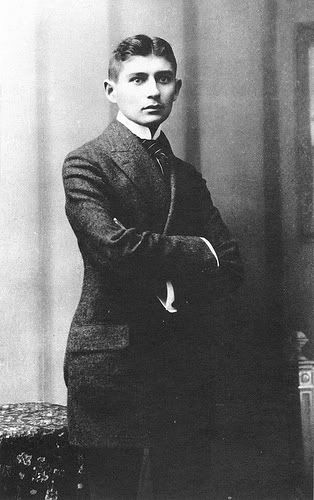 Having stumbled by chance across copies in the British Library in London and the Bodleian in Oxford while doing unrelated research, James Hawes, the academic and Kafka expert, reveals some of this erotic material in Excavating Kafka, to be published this month. His book seeks to explode important myths surrounding the literary icon, a "quasi-saintly" image which hardly fits with the dark and shocking pictures contained in these banned journals.
Even today, the pornography would be "on the top shelf", Dr Hawes said, noting that his American publisher did not want him to publish it at first. "These are not naughty postcards from the beach. They are undoubtedly porn, pure and simple. Some of it is quite dark, with animals committing fellatio and girl-on-girl action... It's quite unpleasant."
"Academics have pretended it did not exist," Dr Hawes said. “The Kafka industry doesn’t want to know such things about its idol."
He added: "Perhaps Kafka's biographers simply don't like the idea that their literary idol was helped out in this... way in the vital early stages of his career... Of the world's authors, only Shakespeare generates more PhDs, more biographies, more coffee-table books... Everything Kafka wrote, every postcard he ever sent, every page of his diary... is regarded as a potential Ark of the Covenant... Yet no-one has ever shown his readers Kafka's porn."
Having stumbled by chance across copies in the British Library in London and the Bodleian in Oxford while doing unrelated research, James Hawes, the academic and Kafka expert, reveals some of this erotic material in Excavating Kafka, to be published this month. His book seeks to explode important myths surrounding the literary icon, a "quasi-saintly" image which hardly fits with the dark and shocking pictures contained in these banned journals.Even today, the pornography would be "on the top shelf", Dr Hawes said, noting that his American publisher did not want him to publish it at first. "These are not naughty postcards from the beach. They are undoubtedly porn, pure and simple. Some of it is quite dark, with animals committing fellatio and girl-on-girl action... It's quite unpleasant."
"Academics have pretended it did not exist," Dr Hawes said. “The Kafka industry doesn’t want to know such things about its idol."
He added: "Perhaps Kafka's biographers simply don't like the idea that their literary idol was helped out in this... way in the vital early stages of his career... Of the world's authors, only Shakespeare generates more PhDs, more biographies, more coffee-table books... Everything Kafka wrote, every postcard he ever sent, every page of his diary... is regarded as a potential Ark of the Covenant... Yet no-one has ever shown his readers Kafka's porn."
8.07.2008
mapping soul
"Some were looking for spiritual happiness or for some form of unknown power, but I had a practical object. I wished for a system of thought that would leave my imagination free to create as it chose and yet make all that it created, or could create, part of the one history and that the soul’s."
-Yeats, on why he got involved with the occult
-Yeats, on why he got involved with the occult
Subscribe to:
Comments (Atom)

