5.31.2008

Pittsburgh Cultural Thrust

I realize that I post very little here about my personal life/ activities, mainly because I've been spending the last couple months laying low, reading, writing, working and little else, which most of the time is really all I need to be doing. This weekend however proved to be different, we went out of the house not just once but several times to enjoy some of the cultural highlights of Pittsburgh.

On Thursday night, after going to a friend's birthday party in a swank storefront apartment in the up and coming Lawrenceville, we jetted up to the Shadow Lounge to see Nikki Allen read some poetry for the release of her new chapbook, "Quite Like Yes." While the poets kept their sets somewhat short, plagued by migraines and excessive drunkenness, the evening was stolen by Landmonster!, who ranted obsessively absurd phrases over pre-sampled Casio beats while wearing space pajamas and a Mardi Gras mask.

The next day we went down to the museum to check out the 55th Carnegie International exhibit, which for the first time was given a title, "Life on Mars," prompting the artists to look at what at means to be human from an outsider perspective. There has apparently been a lot of critique over this move, as well as the inclusion of certain artists whose work may not measure up to the "standards" of the Carnegie Museum. I thought some of the work was fantastic and, like any museum exhibit, there were certain artists who just didn't do it for me. Most impressive were Thomas Hirschorn's Cavemanman, a packing tape and media image labyrinth; Cao Fei's Whose Utopia, a film of a fairy-tale ballet in a Chinese light-bulb factory, and Friedrich Kunath's whimsically bittersweet paintings.


Afterwards we walked over to the Carnegie Library of Pittsburgh, which unfortunately I rarely visit (since I prefer collecting books), but was pleased to find they have an extensive music and film section, including drawers full of classical symphonies, which, despite mainly being in the public domain, are almost impossible to find on the internet.

Tonight happens to be our second anniversary (of the day Sophie and I met at the Quiet Storm), and so to celebrate we're planning to continue our hunt of good Thai restaurants in Pittsburgh with Sweet Basil and La Filipiniana (last week it was the stellar Smiling Banana Leaf). And then we will eat a decadent cake while playing Super Scrabble, which for a couple of real homebody bookworms like us (unlike people who only pretend to read [via]) is really the perfect evening.

And just to throw in a couple things about the rest of the world, one of the last un-contacted tribes was discovered in the Amazon, who brandished notched arrows at the plane taking pictures at them which (according to the article) they must have thought was "a spirit or a large bird." Of course, it may also have been one of these new luxury aircraft hotels in the shape of a large white whale [via].

5.28.2008

Sexing the Surreal (...NSFW)

I recently read George Bataille's "Story of the Eye" (available for download w/in link), which was hailed by Susan Sontag and Roland Barthes as a masterpiece of pornographic literature. While I don't generally find descriptions of teenagers pissing on each other and inserting eggs and eyeballs into their various orifices all that erotic, the symbolic and almost dreamlike imagery of the book was rather fascinating to read, like watching a train wreck. It is almost easy in this hyper-sexualized age to forget that even a hundred years ago, when this book was written, such intense and idiosyncratic fetishizing was actually taboo and unheard of, and I suppose it attests to the power of Bataille's twisted imagination that his imagery still has the power to shock. For every somewhat vanilla person like myself who thinks that the over-pornigrafication of sex is getting boring, there are certainly countless kids waiting to be turned on by this kind of thing.

When I had put the book down however I couldn't stop thinking about my own admittedly little-explored sexual proclivities, and realized that they have remained somewhat shadowed because when I was young and forming such appetites my desires mainly focused on mermaids, superheroines, and other unattainable fantasy figures, who held out a promise of sexual relations in impossible and therefore more erotic ways. Who did not read Douglas Adams' "So Long and Thanks for all the Fish" and fantasize about making love while flying thousands of feet in the air? During this reverie I recalled one art book that held particular interest to my young, romantic imagination- the odd and almost morbid paintings of Leonor Fini, who it turns out was one of the surrealists, and whose nudes, with their feline features, impossibly long legs, and mineral and vegetable bodies grabbed me when I was too young to "know better."


The erotically surreal often comes up in the work of some of my favorite writers, Bruno Schulz's "The Street of Crocodiles" (particularly in the Brothers Quay adaptation of it, parts one and two where it really gets good), or Felisberto Hernandez's "The Daisy Dolls," in the guise of mannequins, dolls, or otherwise sexualized but non-living torsos. Even modern photographers like Joel-Peter Witkin understand this fascination and desire for the outre and irreal.


5.27.2008

More Artistically Rendered Realities


1 x semana seems to be a loose affiliation of Latin American artists and graphic designers who each illustrate in their own fashion a character, concept, or idea proposed by the group each week, from sea monsters to urban ninjas, 1920s robots to a re-imagined Wizard of Oz.


[via Technoccult]

A Picture is Worth A Thousand Words

And now imagine a story told with thousands of pictures.


Photographer Jamie Livingston took a polaroid photo every day until the day he died. [via Mentalfloss] This journey documents the ups and downs of life, changing fashions and important events through the decades, and finally the photographer's battle against cancer.

5.25.2008

Booking the Future

As an aspiring writer I often get concerned over the tenuous future of literature in our increasingly digital and instantaneous world. A week or so ago I tried to blog about an article discussing the potential end of Borders Books [via], which seems to ominously predict the end of reading, along with a friend's comment that he just didn't have the time or attention for novels. While thes kinds of commentaries seem all too easy to find these days, it is a relief to read this article by the Observer's literary editor on the explosively expanding market and opportunities for authors in this day and age. As he puts it: "To be a writer in the English language today is to be one of the luckiest people alive." (!)

5.22.2008

Swing that Censer Again

I recall that when I was young my mother forced me to attend midnight mass for Easter at our church, always an exasperating and nightmarish situation due to the late and long hour, the lack of food, the ghoulish candlelight and chanting, and such copious amounts of frankincense that I felt nauseous and distorted, like under the effects of some heavy narcotic, and had to go sit out in the hall to recover. To this day I can't smell incense without being taken back to that dark, ritualistic place (which is not really such a bad thing, as long as I have a full stomach first).


New research suggests that what I felt was not just the effect of sensory-overload generally accompanying the elaborate ritual paraphernalia of Catholicism, though there was plenty of that too, but the effect of Bosweilla, the psychoactive chemical in incense, which, like other religious uses of entheogens, really does make religion the opiate of the masses.

[via Technoccult]

5.20.2008

When the Cosmic Clock Strikes

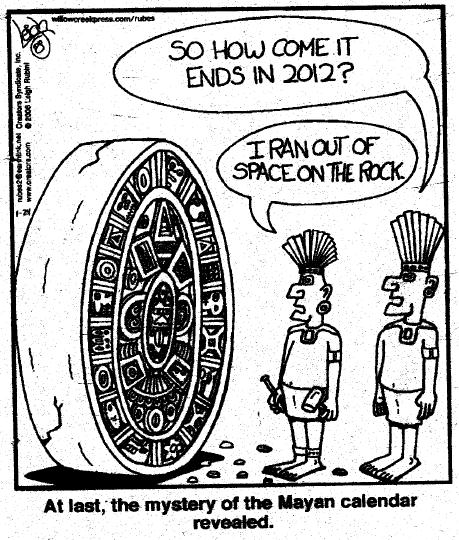
Having friends who have been fascinated by the modern resurgence of Mayan cosmology for the past decade, it has been rather interesting watching the hype growing around the year 2012 as a potential doomsday,, a cosmic awakening, or just another catastrophic letdown. While people are quick to jump to apocalypses whenever any ending is in sight, such as the end of centuries (and we all know how the world ended with Y2K), it seems important to keep in mind that what is essentially at stake is the end of a calendar cycle, much like midnight or new years, but on the scale of planetary revolutions. While it seems that the Mayans may not have predicted anything specific happening on December 21st of that swiftly approaching year, it is important to remember that people have a tendency to fulfill their own prophecies in any way possible. Though the ending of the solar year does not currently signal the end of the world, for centuries it did- cultures such as that of ancient Mesopotamia reenacted the destruction and recreation of reality on the new years, in elaborate, orgiastic festivals in which law was held at bay and chaos ruled, at least until tomorrow. Likewise it is possible that though no apocalyptic or revelatory event was predicted by the ancient Mayans, there is nothing to stop modern man from acting like it was, and putting on the kind of elaborate, psychotic dramas we're known for. Of course, the event of 2012 I'm most looking forward to is James Joyce's work going into the public domain.

5.15.2008

A Stop Motion Day

I've been having an incredibly déjà vued day, starting with dreams about certain books I should read, wandering down to the Strip to do some shopping and seeing two aging hippies smiling with wonder and glee at the origami in the dashboard of Sophie's car, and then after a nice walk along the river and some writing, this insane stop-motion animation done as paintings entirely on public spaces. Not only do I feel like I've seen this before but I feel that everyone else really has to watch it as well, immensely incredible stuff!


MUTO a wall-painted animation by BLU from blu on Vimeo.

[via Boingboing]

Memory Distortion and the Creation of Reality

This article on Memory Distortion "reflects on a narrative by Binjamin Wilkomirski, a Holocaust survivor who vividly detailed the horrors of his childhood experiences in a Nazi concentration camp. In his memoir entitled Fragments, he recounts his earliest memories of childhood included witnessing his father being crushed to death against the wall of a house and his separation from his mother and siblings. After his liberation from the death camps, he was moved to Switzerland where he lived with a foster family. The book earned widespread critical admiration; upon reading it Jonathon Kozol raved “this stunning and austerely written work is so profoundly moving…so free from literary artifice of any kind that I wondered if I even had the right to offer it praise.” It turns out, however, that Wilkomirski was neither a Jew nor a survivor. The bases for his traumatic “memories” of Nazi horrors, whatever those may be, do not come from his own childhood experiences in a concentration camp. According to Stefan Maechler, the Swiss journalist who pursued the scandal, Bruno Dossekker— Wilkomirski birth name—never spent a day of his childhood in the hands of Nazis. Rather, young Bruno enjoyed life in peacetime Switzerland as a Swiss-born, wealthy Christian child. Even upon his exposé, Wilkomirski steadfastly professed that his account of his childhood was authentic and claimed that he had been secretly switched as a young boy with Bruno Dossekker upon his arrival in Switzerland. Liar or not, what is of interest to us in this discussion is the following: Wilkomirski's alleged experiences in German-occupied Poland closely corresponded with real events of his factual childhood in Switzerland. This is the hallmark of the “sin” of misattribution. Memory misattribution often mistakes fantasy for reality or assigns a memory to the wrong source. Wilkomirski’s case is certainly extreme, but should not invalidate the frequency of memory misattribution in our daily lives."

This "sin of misattribution" seems to be to be a rather common theme in narratives of childhood, made most famous by Marcel Proust and honed by both Bruno Schulz and Felisberto Hernández. While these authors did not go so far as to claim that their fictional childhoods were real, a challenge faced by many self-claimed "memoirists" these days, they did understand the importance of using ones personal memories to construct a different reality, a new childhood that could take over in the distorted interstices of their "real" childhood. The question is raised for me: which reality is more real, the one lived in history or the one made famous through story? When it comes down to it what makes our pasts feel true is the artifacts that are left behind, and a written account is just as much an artifact as a photograph or school records. The important thing, it seems, is what one makes of ones past in order to create a future.

5.14.2008

The Dumbing of the Wor(l)d

A few of the 8 reasons why this is the dumbest generation:

2. They don't read books -- and don't want to, either.

"It's a new attitude, this brazen disregard of books and reading. Earlier generations resented homework assignments, of course, and only a small segment of each dove into the intellectual currents of the time, but no generation trumpeted aliteracy ... as a valid behavior of their peers.''

4. They get ridiculed for original thought, good writing.

"On MySpace, if you write clearly and compose coherent paragraphs with informed observations on history and current events, 'buddies' will make fun of you,'' Bauerlein says. Wikipedia writing is clean and factual, but colorless and judgment-free. Often the most clever students, with flashes of disorganized brilliance on MySpace, switch to dull Wiki-writing formats for school papers, he says. "If we could combine the style and imagination of MySpace with the content of Wikipedia, we might get good stuff."

Style Is What You Can't Help Doing

"We are creators. When we begin, separately or together, there’s a blank piece of paper. When we are done, we are giving people dreams and magic and journeys into minds and lives that they have never lived. And we must not forget that."


This is a great quote from Neil Gaiman, author of the award-winning and highly inspirational Sandman comics, who on his blog is discussing the way in which new writers have to copy other authors' in order develop their own:

"I don't think there's anything wrong with copying other people's styles -- it's a skill you'll need, after all. Many actors begin as mimics. You don't worry about it, and keep writing, and after a while you'll have written enough that you can't help sounding like yourself, whether you want to or not. Style is what you get wrong, that makes what you do sound like you. Style is what you can't help doing. Style is what you're left with."

While I'm not so certain I agree that "style is what you can't help doing," personally I think there is a lot more about aesthetic and intentional choices at play, I do agree that it's important to go through that process of emulation, finding out what works for other authors. As I've mentioned before it's like raiding their bag of tricks in order to build your own. Style could be which tools and tricks you like pulling out first.

And I would be the first to admit that reading Gaiman's Sandman comics was one of the biggest inspirations to myself as a writer, as he opened up the possibility of playing with myth and dreams, with vast worlds as equally as with the human heart.

5.13.2008

Oh Holy Space

This just in, The Vatican says it's okay to believe in aliens.

"Ruling out the existence of aliens would be like "putting limits" on God's creative freedom."

This is interesting to me, as it raises some interesting questions about certain inhuman religious creatures. Angels for instance, not your friendly winged people variety but some like the Ophanim which were depicted as eye-covered nested wheels.


Certainly one could nowadays imagine beings like this coming from outer space, unless of course all the prophets were on heavy drugs. Then again, I suppose people might say the same thing about those who claim to talk to both aliens and God.

5.09.2008

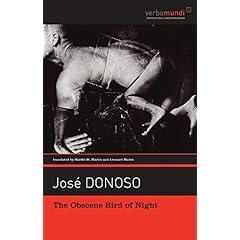
José Donoso's Multiplication of "The Obscene Bird of Night"

I just finished reading what I consider one of the strangest and most fascinating novels I've ever read, José Donoso's "The Obscene Bird of Night." It's hard to describe exactly what the book is about, the back cover blurb says it's the story of the last member of an aristocratic family who is born a monster and locked up in a labyrinth of other monsters so that he never learns what he really is, but at the same time this is only a small part of what are many other interwoven plots in the book. However, what was almost more fascinating than the oftentimes decadent and disturbing content, is the way that Donoso manages of weaving the entire story together, so that each plot seems to reflect or multiply the other plots, making the novel itself the labyrinth that entraps monstrosities.


One of the first techniques I noticed was the use of an unreliable and supernumerary first person narrator. Not only is the narrator potentially lying, insane, or obsessed about what is going on in the plot, making it difficult to believe whether the perspective on the events we are told is true or real, but he also becomes several different people, letting the first person narrative drift into the perspectives of the rest of the novel's characters. The story of the aristocratic monster is framed by the cloistered life of a nunnery, and the plot jumps forward and backwards in time in order to confuse and commingle these events. Donoso also relies heavily on repetition, of words, phrases, events, both the narrator and other characters becoming obsessed with and circling around certain themes from all angles in order to suggest their mirrored nature and importance to the plot. Lastly, and most fascinating, is a technique described on the back of the book as Donoso's ability to "multiply by myth." Early in the story, characters tell a legend about the family that all the rest of the events in the story somehow reflect or reference, whether by repeating the whole, or by stealing small parts from it to suggest the connection of the entire plot back to a mythic archetype.

On the whole this is an impressive literary work, both from the perspective of a reader and a writer. Highly worth checking out for those looking for something different to read this summer.

5.08.2008

The New Steam Age

It's sometimes strange living in the world of the internet where cultural trends like Steampunk are almost ubiquitous, but then in talking to friends who've never heard of it here in the often small-town Pittsburgh realize that Steampunk is still somewhat of an underground phenomena. Of course, thanks to this article on Steampunk in The New York Times, and a new Steampunk Anthology [both via Boing Boing], the whimsical neo-Victorian aesthetic of this sub-sub-genre may be coming to more public spotlight.


I first became aware of the term Steampunk in relation to Neil Stephenson's Baroque Cycle, a somewhat sci-fi styled series of novels set in 17-18th Century Europe. As opposed to the term Cyberpunk, which designated a genre of similarly-themed but slightly futuristic works, Steampunk began being used for works set in historical periods that nonetheless focused on the advent of technology, adventure, etc. Apparently such authors as Jules Verne with "Around the World in Eighty Days" and H.G. Wells with "The Time Machine" could be considered the grandfather's of Steampunk fiction. Personally I was always considered the "Little Nemo in Slumberland" comics of Winsor McCay, with their airships and Victorian sensibilities, to be another foreshadowing of this aesthetic (though perhaps the aesthetic yet to come of "Dreampunk"). From a slim genre of writing, Steampunk quickly became a fashion statement full of vests and petticoats and a DIY tinkering model full of brass plating and clockwork, and is slowly taking over other mediums such as music, video games, and film (at least according to the New York Times article and depending on how one wants to slice your sub-cultural definition). One of the biggest challenges apparently is that still being a rapidly growing sub-culture there is no exact definition of what makes something Steampunk. Similarly there are many artists who are currently drawing from this Victorian aesthetic, from Burlesque shows to fashion designers, without being aware that they might fall under a sub-cultural umbrella. Either way, what appeals to me in all this is Steampunk's sense of whimsy and elegance, the appeal to DIY ethics and a sense of adventure somewhat lost in the post-post modern world.

5.06.2008

On the Improper Propagation of Ideas

While I generally am interested in mythology, shamanism, personal and cultural enlightenment, etc. I am also, and perhaps more, interested in rational and well-written discourse. I am often flabbergasted by the mummery that passes for philosophy (the postmodern deconstructionism of Derrida and ilk) and religion (the new-agey second-rate Castaneda-ism) these days. The problem being that one can't really turn to science to talk about all the intangible, emotio-cultural, and even otherworldly concepts that also need to be grappled with. The problem also being that language is a frail, frail invention, and that in a world entirely consumed by the reproduction of the word it is almost entirely possible to say something that isn't slanted immediately into a thousand quite subjective perspectives. In other words, there is no objective dialogue. To paraphrase José Donoso, the author of a fabulous novel I'm currently reading, the limitation of would-be writers is that they believe there in the existence of a reality to portray. This is why I love stories. Unlike modern attempts at journalism, which fail because they can never be objective enough, literature by its very nature takes on the perspective of a narrator, and any information or ideas couched in the story are almost more palatable for being couched in what we already read as a biased perspective. Narrators lie, they can be obsessive or misinformed, and we love them all the more for it, qualities that would make us cringe in a journalist.

The Myth of the Green Fairy

"An analysis of century-old bottles of absinthe — the kind once quaffed by the likes of van Gogh and Picasso to enhance their creativity — may end the controversy over what ingredient caused the green liqueur's supposed mind-altering effects.


The culprit seems plain and simple: The century-old absinthe contained about 70 percent alcohol, giving it a 140-proof kick. In comparison, most gins, vodkas and whiskeys are just 80- to 100-proof." [via Disinfo]


For some reason this doesn't strike me as being that surprising at all, considering that plain old alcohol has been one of the most common and harshest muses to artists of all times. Wormwood on the other hand has been used medicinally since the time of the Greeks, and it seems that the desire to believe in the mind altering effects of the plant may have been due to the temperance movement, which, in a move similar to the modern American War on Drugs' demonization of marijuana, attempted to paint what was an otherwise cheap and ubiquitous drink as a dangerous and maddening substance. Which all signs point to alcohol being anyway, regardless of if it's green or not. I wonder on the other hand what absinthe's connection might be to the mention of wormwood in the Book of Revelations as a poisonous falling star.

[Edit: Since getting clean I've become quite fascinated by the mystique of drugs, not necessarily their psycho-physical effects but the bizarre subcultures and paraphernalia that accrue to perpetuate the use of certain chemicals. For instance on one of my sojourns on the West Coast I stumbled across a small enclave of "absinthe fiends," who were not emulating Baudelaire et al., but were emulating the media copies of Baudelaire- that is, they all dressed like the Disney version of the Mad Hatter, wore skull rings, smoked clove cigarettes, and drank lots of absinthe. It was really quite humorous, in a sad confused kind of way.]

Living in the City

“Men can see nothing around them that is not their own image; everything speaks to them of themselves. Their very landscape is alive.”-Karl Marx

Italo Calvino's Invisible Cities says that what makes up a city is not so much its physical structure but the impression it imparts upon its visitors, the way its inhabitants move within it.


Descending from psychogeographical techniques that started with the Situationist dérive, one now even finds artists measuring the Chi of their cities with giant acupuncture needles. Such attempts at urban holism however go back to ancient China, where feng shui was used not just to make sure one's room is copacetic, but to determine that the proper building place for every house, shrine, and tomb in the city was aligned to the entirety of the cosmos. Thanks to modern technologies we can now also map the psychology of locations.