I have been intrigued by this concept of psychogeography for years now. Not being a driver, I have the fortune of going on long meandering walks through the city in the dérive style of the early Situationists. However, over and above Debord's aim of psychogeography as the study of the effects of the environment on the emotions and behaviors of individuals, that is, the psychological effect of physical environments, I have grown curious about the representations of locations within the psyche itself, the way people dream, imagine, or narrate settings in which the images of their psychological processes take place, in short, a cartography of the soul.
 Granted, there is a correlation between the physical environments we move through and the way we use familiar places to represent psychic states. The view from my dream window does not look out on anywhere that I've not actually walked countless times, but simultaneously, my inner world contains vast deserts, towers spiring into the cosmos, the labyrinthine depths of Hell. The real physical environments are sometimes not big or wild enough to articulate certain feelings and experiences. I was struck with this while readings Jung's Red Book (before I got caught up in moving out of the literal pit of my old neighborhood), particularly that he described his soul as a desert in need of regrowth. I admittedly have not read enough Jung to verify this, but in the popular or casual understanding of Jung's work, while character archetypes play a central role, there is much less thought given to the settings in which those archetypes exist and act. None of us exist in a void (or for that matter in the strange hinterlands our psyches generate, just as very few have actually met living versions of their animas or shadows outside their dreams and projections onto other people). At the most there is discussions of mandalas as the Center, in terms of sacred centers and axis mundis as Eliade discusses in The Sacred and the Profane, but this seems but crude generalization of the array of unique settings in the cultural imagination.
So where do these psychogeographies come from? I am not convinced, as Jung seems to have been, that our archetypal symbols are biologically rooted, or easily divisible into collective vs. individual, conscious vs. subconscious. Instead I currently believe our symbols are mimetic, passed down in the cultural imagination through stories and other media and our personal experiences of and relationship to these cultural expressions. I only started dreaming of the desert after briefly visiting New Mexico, but its psychic power is proportional to the sway that the image of the Wild West still holds on the American imagination, even projected out into space as Tatooine, the desert planet of the Star Wars movie of my childhood. Similarly, the towers and hells could have been evoked by various fantasy stories and video games, and became over my life subconscious settings for the feelings of the epic and apocalyptic that reside in us (these are our oldest modes of storytelling), but seem to have no physical place in the modern world.
 On the other hand, people in various times and cultures have imagined precisely such a location where all contents of the human psyche reside. Most popularly articulated in the Theosophist's Akashic Records, this "storehouse of all knowledge" finds earlier analogue in the Islamic Al-Lawh Al-Mahfudh or Hebraic Book of Life. I can vouch for this location from my own psychic experiments, or point to the documented use of it for healing by the medium Edgar Cayce, while also suggesting that it, or there, is a potent metaphor for the possibility of a place for all knowledge, like one of Borges's infinite libraries or Alephs. This is similar to the metaphor of God as the possibility of all knowing, but where we seem today to no longer believe that one consciousness can know all, we are actively working to manifest that place that contains all knowledge. As the Internet expands, the metaphor of the Akashic Records becomes either real or unnecessary (though there are certainly still unknowns, dragons and edges of the world in the tubes of our epistemological maps). The Internet itself has become the imaginal place par excellence, existing nowhere and everywhere and as large as we can populate it, this terrain of our virtual representations which is literally the Sanskrit akasa: the all-pervasive space. Interestingly, it was through various science fiction authors imagining what a virtual reality would feel like - Stephenson's Metaverse, Vinge's Other World, Gibson's matrix - that the Internet as we know it, along with its spatial metaphors, came into being.
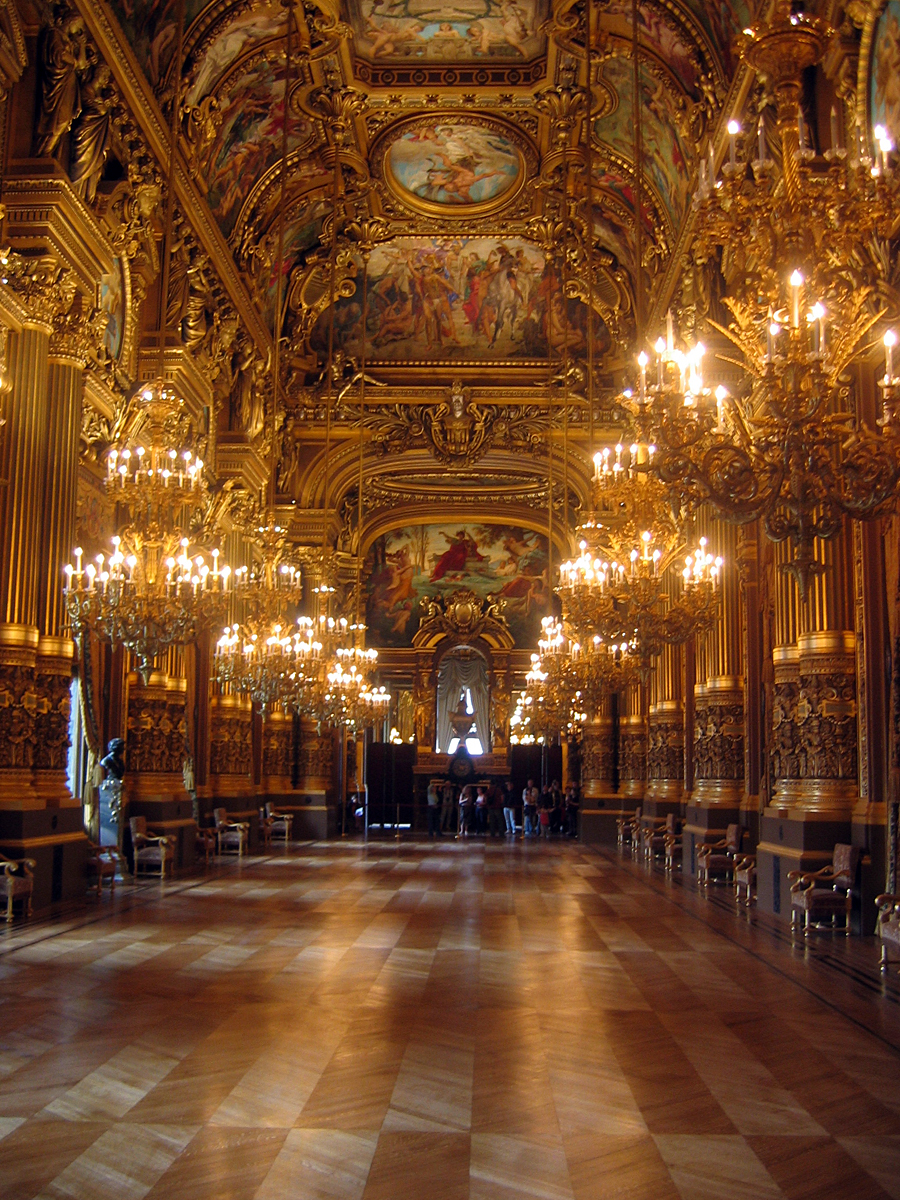 While unparalleled as the location for our conscious representations, glimmerings in the cultural imagination suggest that, as a psychogeography, the Internet is too real, or not real enough to fully articulate the more subconscious aspects of human experience, and other settings may have to be found. Last year I watched the TV show Battlestar Galactica, which (beyond its interesting treatment of the role of belief in the contemporary world) made use of a particular psychic location as a symbolic layer over the real world, directly experienced in visions by a number of the characters: the location of the Opera House. While in the show's plot this location ultimately served as only a cheap visual metaphor, its implications for the cultural imagination are far more suggestive. As an academic colleague pointed out, the Opera House replaces the sci-fi trope of virtual reality with a deeper psychic or subconscious reality, the theater as the place where the contents of our imaginations are made real for all of us. I have dreamt of the Opera House many times (though I was once an actor); it is, as Kerouac says in his own Book of Dreams, the Theater... that old spooky opera house and high school auditorium and classmeet hall of all my days, with hints from all the stages of Time's earth and actors too." While the symbol of the Opera House is still uncharted territory on the Internets, one only has to consider the mythological and ritual bombast of Wagner's operas, or just go see a movie. The drawing of the curtains, or now the darkening of the lights, acts as a veil torn between worlds, so that we sensually enter into the realities of our imaginations; the 3D wonderland of Pandora, the barely repressed longings to rescue Gotham, the Theater as the latest incarnation of the temple sanctum, where the gods become real in us. As Shakespeare said, all the world's a stage. We dream of the day (as Vinge does in Rainbows End) when our technologies allow us to visually project the settings of our imaginations onto the physical landscapes around us, so that we really will inhabit the lands of our dreams.
But where is this place (if not in us), and how are we to get there? The ancient Roman orators had a technique for memorizing long speeches and poems called the Method of Loci: one is asked to create a Memory Palace, taking a highly familiar location and placing in it associated images for the information to be recalled, so that all one has to do is stroll through the loci in the correct order. Personally I am interested in reverse-engineering this process, not further associating psychic terrains but unpacking all the cultural references that have been associated over time to various settings (a hermeneutics of the Opera House, of the Badlands, even of my dreams, whose consistent world this house is a cipher). The cities we inhabit may have a psychological effect on us, but we built the cities in our own image, and buried in them strata of meaning and longing. Perhaps we may uncover the ancient fear of Wilderness that has led so gradually to the current environmental destruction, or just learn to feel at home again, wherever we find ourselves.