12.25.2008

Murakami's "The Wind-up Bird Chronicle"


In this beautifully strange book Murakami tries to present a reality that is eventually broken open into an increasing irreality, and the narrator's struggle to get back to the "real" life he once led. Along the way we are presented with a colorful cast of characters, intense and vivid sensory/ consciousness details, a stunning use of dream sequences and imagery, a series of intriguing stories within the main story, and synchronistic interconnections between all the events, details, and characters that left me quite curious to keep turning each page to see just where it was all leading.

While being rather brilliantly written in these terms, enough that I highly enjoyed it, I was left slightly unsatisfied at the end for several technical reasons. The reality which the narrator originally inhabits is never clearly fleshed out so it is difficult to tell how far from it he moves (most likely due to cultural assumptions). The intense use of details and consciousness sometimes seem overwritten and don't add to the flow of the story's already tenuous plot. And for a story that relies on the interconnectedness of events and small details, many of the characters and events seem to randomly vanish as if they were threads that the author either never figured out what to do with or just forgot about when another more exciting detail suggested itself. This last point really irked me because it seemed as if the story could never quite figure out whether randomness or interconnectedness was more important to the total effect, and consequently the total effect seemed much more haphazard then I imagine it was meant to be. Add on top of that passages that accidentally change tense and case, which I would like to blame on the translation rather than the writing style. On the whole I felt that I was only getting half of what was supposed to be on the page.

Nonetheless this was a really wonderful read and points to all sorts of interesting directions for the use of fractured narratives, alternative histories, and perceptual irrealities that harken to the best of magical realist and post-modern literatures. I highly recommend this book and look forward to reading more of Murakami's work in the future.

12.23.2008

Quotes from Bolaño on Literature and the Abyss

"All literature, in a certain sense, is political. I mean, first, it’s a reflection on politics, and second, it’s also a political program. The former alludes to reality—to the nightmare or benevolent dream that we call reality—which ends, in both cases, with death and the obliteration not only of literature, but of time. The latter refers to the small bits and pieces that survive, that persist; and to reason. Although we know, of course, that in the human scale of things, persistence is an illusion and reason is only a fragile railing that keeps us from plunging into the abyss. But don’t pay any attention to what I just said."

"For me, the word writing is the exact opposite of the word waiting. Instead of waiting, there is writing. Well, I’m probably wrong—it’s possible that writing is another form of waiting, of delaying things. I’d like to think otherwise."

"Yes, plots are a strange matter. I believe, even though there may be many exceptions, that at a certain moment a story chooses you and won’t leave you in peace. Fortunately, that’s not so important—the form, the structure, always belong to you, and without form or structure there’s no book, or at least in most cases that’s what happens. Let’s say the story and the plot arise by chance, that they belong to the realm of chance, that is, chaos, disorder, or to a realm that’s in constant turmoil (some call it apocalyptic). Form, on the other hand, is a choice made through intelligence, cunning and silence, all the weapons used by Ulysses in his battle against death. Form seeks an artifice; the story seeks a precipice. Or to use a metaphor from the Chilean countryside (a bad one, as you’ll see): It’s not that I don’t like precipices, but I prefer to see them from a bridge."

[from an interview with RB]

The adventure tradition and the apocalyptic are "the only two traditions that remain alive on our continent, perhaps because they're the only two to get close to the abyss that surrounds us."

[from New York Review of Books]

God vs. the Scientific Method

A person's unconscious attitudes toward science and God may be fundamentally opposed, researchers report, depending on how religion and science are used to answer "ultimate" questions such as how the universe began or the origin of life.

"It seemed to me that both science and religion as systems were very good at explaining a lot, accounting for a lot of the information that we have in our environment. But if they are both ultimate explanations, at some point they have to conflict with each another because they can't possibly both explain everything."


As such, more Americans believe in the Devil, Hell and Angels than in Darwin’s Theory of Evolution, church attendance is projected to fall by 90% by the year 2050, and researchers are still trying to find a neurophysiological model of spiritual experience.

This fall I took a physics course in which we discussed quantum mechanics, relativity, cosmology, and other weird aspects of modern science. Far from finding these ideas in conflict with my perspectives on spirituality I found that science paints a picture of reality that is mysterious, open-ended, and ultimately not very different than many early spiritual beliefs. If the fact that the universe is made almost entirely of dark matter and energy that we know nothing about doesn't move one to contemplate the meaning of life then I am completely confused as to what makes for a spiritual or religious experience. According to Rudolf Otto in The Idea of the Holy anything that brings up this feeling of utter mystery and incomprehensibility in the face of reality is spiritual, and the closer science looks at the Universe there is only more and more that we don't understand.

On the other hand, science and religion could find another sort of common ground as the Vatican embraces iTunes prayer books.

12.14.2008

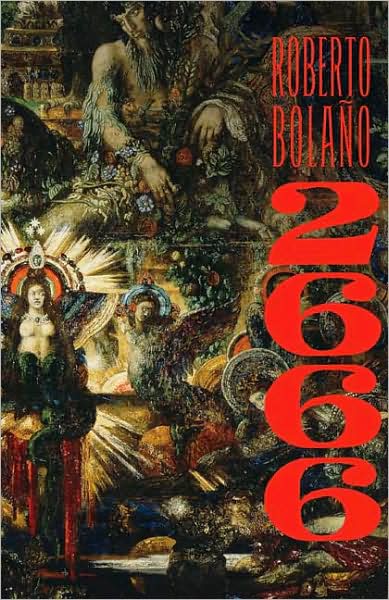
2666: Bolaño's Oasis of Horror


In the beginning of Roberto Bolaño's posthuomous masterpiece is a quote from Baudelaire, "An oasis of horror in a desert of boredom." That about sums up the aesthetic approach of the tome, the first section of which begins with the seemingly irrelevant story of an international group of academics chasing as elusive German author to the small Mexican border town of Santa Teresa. Sure, the academics give conferences, fall in love, and learn just briefly of a series of crimes in which hundreds of women have been killed in Santa Teresa over the past decade, but ultimately nothing happens, the academics do not find their author, and the story continues without them.

But this desert of boredom is the genius of the work, for in each section we get closer and closer to what is happening in Santa Teresa, reaching through the boredom to an unmistakable and spine-chilling horror that seems to lurk just below the surface of the page. Even the section about the crimes, essentially 200 pages worth of crime reports on every single raped and murdered woman in Santa Teresa (the crimes based off the still unsolved murders of women in the real Ciudad Juárez) told with the "false neutrality of a police report." These page are brutal, graphic, and yet, still part of the desert of boredom surrounding the horror that has not yet been revealed. As such it is interesting to note that Bolaño has turned Baudelaire's quote into a kind of architectonic structure for the plot of his novel. Instead of moving forward in time, or with building events, we have a microscope that starts off on the boring international level and gradually circles closer and closer to the terrifying circumstances of one small town.

12.12.2008

The Imaging of Dreams

Many years back I had a dream in which there had been invented the technology for people to record their dreams while asleep so that others could later view/ dream them for themselves. I called it the Subjunctive Dream Network, and many years worth of hilarity ensued in which I would be having a particularly terrible dream only to wake up (in another dream), take off the sleep mask and wires, and be thankful it was only someone else's dream I had been viewing.

It now seems that a group of Japanese scientists are in the process of developing software that can actually process and display the images of thoughts and dreams on a computer screen, which is a step closer to making the Subjunctive Dream Network and actual reality (though one imagines there's still lots of kinks, if this is actually true). Of course, it also means that instead of writing out all my dreams to use as material, I could just be making a movie while sleeping!