Showing posts with label modernity. Show all posts

12.11.2009

In the Desert of the Soul: Early Symbols in Jung's Red Book

I finally started reading the text of Jung's Red Book last night, and it is as revelatory, revolutionary, and vitally important as I suspected it would be, not just in terms of Jung's psychological theories but in taking a stance for a broader spiritual approach to reality that is even more lacking now than when Jung was writing. Reading this is like reading Blake, I want to quote every passage (as they are almost all brilliant), but if my cat will get off the tome I'll constrain myself to just one before looking at some of the important symbols and themes that Jung was attempting to articulate.

"The spirit of the depths took my understanding and all my knowledge and placed them at the service of the inexplicable and the paradoxical. He robbed me of speech and writing for everything that was not in his service, namely the melting together of sense and nonsense, which produces the supreme meaning.

But the supreme meaning is the path, the way and the bridge to what is to come. That is the God yet to come. It is not the coming God himself, but his image which appears in the supreme meaning. God is an image, and those who worship him must worship him in the images of the supreme meaning.

The supreme meaning is not a meaning and not an absurdity, it is image and force in one, magnificence and force together.

The supreme meaning is the beginning and the end. It is the bridge of going across and fulfillment
[a reference to the way of becoming the superman from Nietzsche's Zarathustra].

The other gods died of their temporality, yet the supreme meaning never dies, it turns into meaning and then into absurdity, and out of the fire and the blood of their collision the supreme meaning rises up rejuvenated anew.

The image of God has a shadow. The supreme meaning is real and casts a shadow. For what can be actual and corporeal and have no shadow?

The shadow is nonsense. It lacks force and has no continued existence through itself. But nonsense is the inseparable and undying brother of the supreme meaning...

The image of God throws a shadow that is as great as itself.

The supreme meaning is great and small, it is as wide as the starry Heaven and as narrow as the cell of the living body.


The spirit of this time in me wanted to recognize the greatness and extent of the supreme meaning, but not its littleness. The spirit of the depths, however, conquered this arrogance, and I had to swallow the small as a means of healing the immortal in me. It completely burnt up my innards since it was inglorious and unheroic. It was even ridiculous and revolting."


Potent symbols and themes in the first seven sections:

The spirit of the times vs. the spirit of the depths - Jung makes a distinction between the spirit or stance of the time in which he lives vs. the spirit of a greater, ancient, and universal reality that is entirely overlooked by the present, and is striving to come forth through Jung. This is historical consciousness vs. the mythic subconsciousness, and Jung frames the Red Book as a way of getting past all the small-minded, violent, materialistic impulses of his age (including a harsh criticism of Christianity), while recognizing that this present world may entirely ignore his warning and call for an understanding of the subconscious.

The supreme meaning - Jung claims that God and gods are only images of an eternal supreme meaning oscillating between meaning and absurdity, and it is this supreme meaning that men must come to recognize as a solution to the spirit of the times. This is entirely consistent with my concept of ultimate significance, in that the supreme meaning is more truly real than the images we conceive of it through.

Dreams and epiphanic visions - Jung recounts a number of visions prophesying the world wars as well as his own future work. He claims an uncontrollable compulsion to record these dreams, though he never did before. Similarly, a number of the passages Jung claims are actually the spirit of the depths or his soul speaking through him as a medium.

The soul - Much of the early part of this book is Jung's attempt to reconnect with his soul. This is the formation of his archetype of the anima/animus, but it is not made explicit in his academic writings that the archetype is not just an image but one's actual, living soul, which encourages us to live and do everything we dream of living and doing. The soul is one's God and opposite, which perfects us in the supreme meaning. The soul is not part of us, we are only the expression and symbol of our soul in the world.

The desert - Though Jung's academic writings discuss the archetypes they do not discuss (as far as I've read) the importance of subconscious locations. In particular Jung discusses here the image of the desert, which is the conception of oneself and soul that one must journey into and rejuvenate in order to overcome the spirit of the times. Jung believes he saw a desert because his soul had been withered (and perhaps those in touch with their souls experience a garden). From my own explorations of the subconscious I also found this "desert of the soul" as the location for the deeper, mythic realities I had to contend with outside of the city (the symbol for the everyday world and times). As my own process continued, this desert was first flooded and became a garden before the entire inner world was set to flames so that a new internal reality could form. I am curious how these locations change through Jung's process in the remainder of the Red Book, as I find such psychogeographies an essential compliment to the character archetypes.

The descent into hell - Jung has a vision in which he realizes that he must descend to hell in order to individuate himself and find the supreme meaning. Such descensus avernum are common in mythic and revelatory literature and serve as another example of the importance of place as symbol for Jung's theories. Jung equates this descent with the possibility of going mad, and sees himself as a sacrificed hero who must overcome that potential madness for a more divine madness lacking in the spirit of the times. This section (and the titles of the other sections) suggest that Jung is on a hero's journey comparable to that described by Joseph Campbell. This hell is all the absurd meaninglessness of our times that we must go through in order to construct our own meaning of events, which is the supreme meaning.

Alright, I'll close with another short passage: "You thought you knew the abyss? Oh you clever people! It is another thing to experience it. Everything will happen to you."

11.24.2009

On Ultimate Realism

I haven't written much yet publicly on the new perspective or belief system I have been attempting to formulate over this past year, a perspective that I call Ultimate Realism, which is perhaps best summed up by the quote from Patchen's Memoirs of a Shy Pornogrpaher: "Everything which man can imagine, dream, or conceivably want to exist... does exist."

This view first occurred to me one day last year during a week of spiritual-existential difficulty. I had gone to a local bar and ran into an acquaintance, who said, having not seen me in ages due to my focus on school and writing, "welcome back to the real world," to which I could only reply, but isn't everywhere also just as real? and then wandered down the street struck by the total implications of everything around me being that real. There is some sense in which we tend to believe that only those habits and experiences that we usually have are really real, or at least of the most real importance to us, forgetting that other experiences we don't have are just as real. And beyond existing situations, every content of our imaginations and the stories we tell is real, in that these have real effects in the real world. And ultimately, any perspective that will allow us to articulate our lives in the whole of such a multifaceted reality, and perhaps allow us to formulate a perspective of global significance and understanding, will have to put us in relation to that whole, not just as it is scientifically and historically understood, but in relation to all that humans have said, imagined, believed, and dreamed.

This view has come out of years of questioning spiritual beliefs and the nature of the stories we tell. How do we, as human beings in a world with other human beings, deal with the fact that people have divergent and often contradictory views on what the world is and our place in it? Historically, belief systems have clashed, and continue to clash because each side takes their perspective as most true and right, whereas if one view was somehow objectively true and right there should be no cause for conflict; and yet there is. In my own life I have struggled with such limited perspectives, not knowing in what to believe, as the beliefs always seemed too small, and yet needing to believe in something, to tell some kind of story, and finally recognizing that any belief I would want to hold would have to be large enough to contain all possibilities of believing.

Similarly I fear global destruction due to the clash of these limited perspectives, and that we as a species do not have the stories to set us in relation to where we are now that might allow us to continue into the future in a meaningful, healthy, and positive way. The stories we are prone to tell today are often too small, quotidian, dealing with failure, comeuppance, and the meaningless joy ride of post-modernity, whereas we need a perspective that can address the Universe as a whole, for future generations of humanity in this Universe. These stories must be ultimate in order to place us and our actions in the widest set of meaning or significance necessary for survival.

My old professor, Dr. Fred Clothey (a student of famed mythographer Mircea Eliade), suggested that the stories we tell can tell us about ourselves, in effect modeling our understanding of reality in order to authenticate current actions and allow future actions. Our stories/ myths/ beliefs/ perspectives, etc. can do this precisely when they are cast in an "aura of ultimate significance," that is, by referring us to the widest possible scope of experience and understanding, to our cosmic and social beginnings, to our longed for and feared endings, to our ideals taking on human form. We find our place and being in between the limits of the real as we know it.

One such ultimate signifier, that has had a direct effect on real occurrences, is the concept of God(s). While belief in supernatural beings has allowed articulation of our relation to society and mortality, is has, perhaps most clearly and distressingly, served as a justification for centuries worth of horror and cruelty: crusades, inquisitions, terrorism, or just plain ignorance. But we are prone to forget in our polarized times that this personification of ultimate ideals was also a necessary and integral perspective for the development of scientific reasoning, framing an objective and total perspective that we humans could then hope to achieve ourselves, a belief that has existed coterminous to science up through the 20th century. Contemporary atheists might be glad that God is no longer a reference for rational understanding, but "His" death has negative impacts as well: God has traditionally not only been a signifier for ultimate perspective and knowing, but also for perfection and goodness, in short, ethical understanding of behavior, without which we do things like build the atomic bomb. Technology runs rampant when not placed in the widest relation to how it might rightly be used, or the lack of an ethical signifier allows the cultural insecurities that haunt us to become manifest, and such horrors not only be imagined but made real. One imagines a similar lack of ultimate significance in the perspectives that have allowed western culture's unparalleled material consumption, environmental destruction, and continued ideological warfare on the rest of humanity.

I am not arguing here for a return to a belief in the traditional monotheistic God or earlier gods. These stories, as we have seen, are just too small and conflict-provoking compared to those perspectives that now need to be adopted. I am arguing though for a greater belief in the reality and efficacy of the contents of our stories and imaginations, and an awareness of how these otherwise subconscious narratives influence the real world.

One of the problems to this approach is the primacy we give to literal truth, vs. the obvious falsity of our "true" representations of reality. I am a huge fan of stories of the fantastic, of the magical, supernatural, weird, heroic, or sci-fi, which, looking at the predominance of these themes in the current cultural media and imagination, I believe I am not alone in. But why do we love supermen, zombies, and the end of the world? There has been a trend in storytelling, dating from the late 18th century, of attempting to represent reality as it "really is," social or quotidian realism, and not as an allegorical reference for otherwise real things. Fiction, when it first was read as not literally true, was cast as "petite histories," in order to accept stories they had to mimic reality while being divorced from talking about reality. My immediate response to all this is, there's already too much of the world we experience on a daily basis, why create more of it, when stories beyond the everyday may raise possibilities of experience and understanding more than that which we are already familiar with. That familiarity constrains us, by being real, to the obviously inadequate belief systems we now live under. We hold up what we believe is a mirror and say, this is real, and because we say it, that marks the bounds up what we will allow to be really real.

My second issue with realism is that it is not reality despite how it primps and masquerades itself as such. It may represent aspects of reality, but does so by relying on and reaffirming our assumptions about how the world is and should be, which constrains us to accepting those views and realities as more true or valid, to the exclusion of wider views. And today it seems our view of the real is that it frankly sucks and nothing matters anymore. And any attempt to actually discuss real human issues in an emotionally valid way is negated by the irony and scorn with which we articulate the real world. The fantastic however, by being non-real and symbolic of the real (mythopoetic in Tolkien's terms), precisely allows us to highlight those human themes and conditions we want to examine in truthful ways. But in order to even accept the contents of fantastic stories we must (as Coleridge first suggested) suspend our disbelief of those things that couldn't be literally true in our everyday experience. We no longer have a problem leaping into wizard fights or across star systems, we can suspend disbelief but we are never asked to truly believe, and thus are not as prone to take such fantasies as being symbolic or ultimately significant for how we really are or could be in the world. We are content to let them be mere entertainments and diversions rather than suggestions of possibility.

Yet, are ghosts and gods really real, or is this even the right way of framing the question? There is a sense that certain things are existentially real, they commit us to accepting their physical reality, being right in front of us. The invisible and imaginative do not so commit us; one can not empirically and scientifically prove a god's actual existence. To argue one way or the other for this is to miss the entire point about gods. But one can clearly see the effects that belief in such unprovables has on our world, both on our perspectives and psychologies and in actual historical occurrences. Ignoring and belittling the immaterial causes of such beliefs and effects does little to add to our understanding of ourselves in the world, allows the results of inappropriate or too-small beliefs to continue unchecked, and limits the human imagination to articulate new possibilities of being and understanding being, which are necessary for our current and continued survival, let alone enjoyment and well being. On the other hand, if we do not remember that the stories we tell are only stories, that have been made up despite their real effects, we run the risk of mistaking the stories as literally true, thus causing us to act in dangerous and inappropriate ways, when imagining better stories to live by and through is always an option (and it is this lack of awareness of the power of our symbols that I mean by the absent narrative).

I do not know where we will go from here, but I am wary and sick of the post-modern skepticism that rejects any ultimate significance in favor of what we can directly lay our hands on (and in so doing, strangle it to death). I would prefer to see interconnections of the layers of reality rather than the whole's deconstruction and rebuttal. Acting as if we know everything and nothing really matters is perhaps the smallest and most dangerous perspective one could hold. Ultimately, we exist in a Universe which we barely understand, and in which we are a bare speck, and perhaps in that widest view humanity is indeed meaningless and fated to extinction for lack of any better options. And yet it is also possible to believe, and live by the belief, that life and our consciousness of life may be more than a random fluke or evolutionary mistake; not that we serve some clear teleological purpose or extant will of God, but that for all these unknowns we are still real, and still here, and confronted with the implications of that for all reality.

Though reality may be inherently meaningless we have the choice to take on meanings and act on those meanings, to continue to be and gather greater understanding and significance, both on this planet and in the Universe as a whole, should we choose to accept this mission. Anything less than such an Ultimately Realist perspective sells ourselves short, and will only propel us down the road of meaninglessness and destruction. But if we can perhaps articulate a perspective wide enough, not just for all humans, but all life in general and beyond life, then perhaps we can continue on until that perspective, and all else we can imagine, becomes real.

11.10.2009

Disasters are Waiting for All of Us

Despite the fact that the Mayans have strongly emphasized that the western world has entirely misinterpreted and appropriated the year of 2012, that their myths say nothing about the end of the world, our telling of that story has become so hyped up by the media that the "2012 Prophecy" is actually sparking real fear and suicides. As the new movie convinces people that we are all going to die, others try to combat the myth by hopefully providing more accurate information. Or if that fails, suggestions on plans to ensure the continuity of our species. While asteroid defense, planet hacking, terrestrial seed vaults, lunar doomsday arcs, and off-world colonization all seem like noble, albeit sci-fi options (along with more actual attempts at space elevators and solar sails), it seems that culturally there is still the tendency to either believe that we are all going to die in 2012 (and perhaps that's a good thing) or that none of this is true (not even environmental degradation) and we should continue to live the technologically destructive lives we've been living throughout the last century.

Personally I hold the middle ground, that the whole 2012 phenomena is a myth, a story we have taken to heart because it is very suggestive to us of the possibilities of what might happen and what we ought to do about it. This means that 1). it is unlikely that anything untoward will actually happen on this date (besides perhaps some spectacular astronomical movements), and 2). despite this myth not being literally true, it is still figuratively significant in telling us that we really do fear the end of the world in some form, and that we are either responsible for bringing it about or for stopping it if at all possible. I feel that if we really are concerned with the continuity of our species, along with that of the planet that makes life possible for our species, instead of coming up with far fetched worse case scenarios or ignoring the mess altogether, we instead have to begin telling truthful stories about what is actually going on in the world, what might actually happen, and those immediate steps that will have to be taken to deal with it. No more fear-mongering or denial, but futurestance. We need stories that tell us how we are in the world, and why, and what we need to do.

Part of the problem here is a lack of any current mythology to address the rampant technological changes of the last century, which combined with the continually growing disbelief in the value of belief seems to spell disaster at every turn. One of the earliest functions of myth, as maps for human action, was casting reality in terms of ultimate significance. We are here and act as we do because the gods do it/ our ancestors do it, etc. The most we can say now is that we do because our celebrities and politicians do it, but we are as avid in taking them down to our level and know they are just as fallible, just as human. Not to advocate a return to belief in gods as really real, but our lack of contemporary myths of such large significance pushes us out to the meaningless edges of the cosmos where we no longer have any reason to believe or act with even the present in mind, let alone the future. I feel that what is lacking and most needed are new myths that replace us as central characters of our own story, not Earth as the physical center of the Universe, but us as the storytellers as the key for the meaning of our experiences, that is, myths that stress the responsibility we have as stewards of ourselves and the world which we've decided we control, stories that suggest that cooperation, multiple points of view, responsibility, awareness of actions, etc. are all heroic qualities that may have the most real effects in staving off whatever apocalypses we come up with to amuse and frighten ourselves.

10.25.2009

News Updates

The End of Philosophy. From Adbusters, interesting but the writer went to Pitt, and had one of the same philosophy classes I'm taking there this semester, and I agree its mostly irrelevant, except I'd have to say: don't expect other people to apply ideas for you, you have to think for yourself.

the Age of Universal Authorship. The one thing the author hasn't considered is that only will we have universal authorship when everyone has access to the technologies of communication and authorship.

Luther Blisset is now Wu Ming. Luther is one of the shared or multiple-use names phenomenon, which I first heard about in connection with Monty Cantsin and Neoism. Good to know these names are still out there.

Giant Orb Weaver Spider Discovered[image via riot rite right clit clip click]

Essential Plot Twists for Writers. Now in handy cartoon format.

Why Our Brains Will Never Live in a Matrix. Because they already live in bodies. Though the Internet is Altering our Brains.

The New End of the World Date is now 2068. Get Your calendars ready for the meteor crash.

In the mean time, don't forget to Live Life to the Full. A free guide to cognitive behavior therapy. Or, maybe depressed people are suffering from a lack of fun.

And finally, though science wants to stop aging, we still don't know exactly what is time?"

8.04.2009

On Aliens as Symbol and Experience

My family has many strange stories, of the kind that Gabriel Garcia Marquez might have written if he was into sci-fi, such as that when they were children both my brother and cousin claimed they were abducted by aliens. While visiting my family this past week we spent some time with this cousin, who I've only met a handful of times before and haven't seen in maybe five years, and Sophie wanted to ask her about being an abductee. I persuaded her not to, because as curious as we both are these stories in my family are all somewhat secret or taboo, often covering for situations that were traumatic or uncomfortable. Even the mere mention of Montana where my cousin grew up was enough to give her the howling fantods, mainly as that's where her family lived in a bunker as part of the Church Universal and Triumphant doomsday cult before the world didn't end and they became normal people again.

Asking my folks about it later gave us a little more information, though they too seemed anxious to change the subject: my cousin woke up one night in the woods far from the bunker (perhaps an alien abduction being more sane than their cult). My brother on the other hand had a much more normal upbringing, but this included a lot of educational struggles and being outcasted at school, which left him with some strange compulsive behaviors that he could only, and adamantly explained as having been abducted. While these situations could be explained as dissociation or social anxieties mixed with hyperactive imaginations, that doesn't account for the small triangular scar that they both have from whatever experience did happen to them. The strange thing was my mother's comments vis-à me.

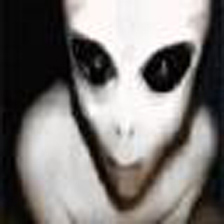
Personally I can recall (and have written of here before) being a kid and being paralyzed with fear of taking out the garbage at night, because I knew that a mothership would descend from the orange sky to get me, perhaps if they hadn't already. Or in the '90s when that pointy-chinned bug-eyed alien face was becoming a pop cultural icon I found it horrifying even to think about (though admittedly I felt that way about spiders and the California Raisins). Before that though when I was really young my mother helped edit the Time-Life Mysteries of the Unknown series on paranormal experiences, having to check sources for the articles. Apparently, though I have no memory of it, we were one day in a bookstore where she picked up Whitley Strieber's book of UFO research, on the cover of which was that iconic grayfaced alien. When I saw it I flipped out, telling her that I had seen those creatures before - that they had come for me in my dreams - which could have all sorts of interpretations but was clearly so terrifying that I completely repressed it, and have only recently begun to allow myself to see and sort through the symbol of the alien in my dreamwork practices. Though thinking back I always wondered or suspected if I'd been abducted, or was myself an alien, because my whole life I have clearly felt different or separated from my fellow human beings.

While I don't know, and refuse to make any claims without further direct experiences, if alien abductions really happen (and suspect these could be the imagination's way of covering up or describing otherwise even more inexplicable experiences), it seems clear that people have many reasons to feel and believe that they have or might be abducted, whether in fear or even desire for such extra-terrestrial intrusion, that has led to aliens becoming a potent symbol in our post-modern age. While often addressed through stereotypes of new-age fanaticism or pop-skepticism, alien beings may still say something vital about what it means or feels like to be human. Mac Tonnies of Posthuman Blues seems to suggest that the image of the gray aliens may be either a projection of our desire to transcend being merely human in this post/trans-human age, or a metaphoric anxiety nightmare left over from the horrors of war and technology from the middle of last century.

I am not quite convinced however that aliens don't also cover an impulse or feeling that is an ancient one for which these are only the most recent and applicable symbol: that of feeling alienated or disconnected from the other. Consider for example Greek legends of people being kidnapped by fauns or waylaid by sirens, Victorian romances in which men become monsters and vampires, or even the Biblical angels, who contain that same longing to transcend our everyday experiences through external salvation (angels being technically depicted as eye-studded revolving spheres that sound more like UFOs than anything else). Looking at my relatives' experiences, they clearly were in extreme situations of alienation, which they only found words for in terms of alien abduction: I don't belong, therefor I must have been removed/transformed. I suffered from the same kind of alienation as a child, feeling that either I didn't belong or that no one else did, a feeling particularly strong as a tenager dealing with understanding one's place in the social spheres, much less the celestial spheres. After trying and failing to fit in I tried not to fit in, and didn't fit in there either, and only found some relief from this anxiety in music and art, listening to Bowie's Ziggy Stardust, his myth of the good alien come to save all the alienated youth certainly allowing me (and I imagine many others) to feel that they did belong, somewhere, even if that was in the distant stars, much like a modern day Ezekial, whose visions of angels the Jews turned to during the alienating reign of Nebuchadnezzar. "Look out your window I can see his light/ If we can sparkle he may land tonight/ Don't tell your poppa or he'll get us locked up in fright."

While children are certainly more inclined to describe or occlude their experiences in imaginistic terms or characters, I suspect this feeling of being alienated may belong to everyone. As rational creatures whose perceptions work through distinction rather than homogenization of experiences, it is no wonder that some of the hardest struggles of history have risen from our perceived human differences. Race, sex, class, customs, gender, age, intelligence, ability, etc, whether arbitrary or not, when taken as the primary signifier and worth of individuals, reduces up to a type or group often at odds with or misunderstood by others outside that group, leading to such bromides as "men are from Mars/ women from Venus," or more real conflicts like the recent racial profiling and arrest of the black professor Gates in his own home (not to mention centuries of national or racial warfare). Orson Scott Card, in his brilliant Ender's Quartet novels sets up the Hierarchy of Exclusion, which seems to operate on a function between familiarity and communicability:

"The Nordic language recognizes four orders of foreignness. The first is the otherlander, or utlanning, the stranger that we recognize as being a human of our world, but of another city or country. The second is the framling... This is the stranger that we recognize as human, but of another world. The third is the raman, the stranger that we recognize as human, but of another species. The fourth is the true alien, the varelse, which includes all the animals, for with them no conversation is possible. They live, but we cannot guess what purposes or causes make them act. They might be intelligent, they might be self-aware, but we cannot know it." -from Speaker for the Dead

Of course, when the other is so foreign to us that we can't communicate, it often ends in direct conflict, or goes further, beyond anything remotely conceivable and thus truly alien. While this final level of total alienness could be interpreted as encounters with the numinous or ineffable - I am partial to the idea that God is the ultimate alien - it also points to our boundaries of knowledge and description, and more directly to the human experience of being bound in an individual consciousness. To some degree we are all alien to each other, and even sometimes to ourselves: this is a limit to our ability to express who we are and what our experiences of the world mean, and the alien may be the mask, the image we refer others to in order to describe what might otherwise be inexplicable, what feels out of this world, much like Freud's idea of the uncanny or un-homelike, except with Earth as Home, we react with fear and wonder to that which is extraordinarily unfamiliar. In an age when we can finally begin to say that we know most of what is on Earth, there is still more, roughly 98% more, in the Heavens than we can fit into our scientific philosophies, dark matter and gravity if not little gray beings (though the truth may still be out there... so might God for all we can prove or disprove).

I occasionally tell people that I'm in support of space exploration, which often (and more often than I'd have hoped in the 21st Century) draws blank or incredulous stares, as if I really am from outer space. As the author of the exceptional Red Mars,Kim Stanley Robinson recently pointed out, in conjunction with the 40th anniversary of the first moon landing, there is still a reason for going to space. Forget interstellar exploration, forget contact with other potentially intelligent life in the universe, forget finding a habitable new home for when this one inevitably wears out, the current resurgence of space programs could be local; by living on other planets in our solar system we might better figure out how to live on and take care of this planet, which is in sore need of better stewardship. Though this may first mean resolving those lingering problems of otherness that still plague and alienate mankind.

Which isn't to say that we can't refamiliarlize ourselves with those who are other from us, a process of dealienazation, which can only begin at home. This was one of the lessons I learned from seeing my family this week, that our secrets are symptomatic of larger miscommunications that lead to conflicts and division the way they do in the larger world, that even though we are all involved in fields of communication (as more and more people are these days), we are still shockingly out of touch from each other, as if E.T. had never extended his finger for contact. But all it sometimes takes is a phone call or a letter, or even just a smile, to make our families familiar to us again, which can equally apply to strangers, enemies, the world. Though we are all aliens lost in space, we are all human on Earth together, one vast estranged family still learning to accept each other and explain what this all might mean. Perhaps one day we'll be able to look up at the stars together, and when we see the occasional peculiar lights zipping around like nothing but unidentifiable objects, we can finally discuss them openly, or just say hello.

6.12.2009

Religious news: OS Religion and the Dali Lama's woes

"Open-source religion is an amalgamation of two ways of thinking about the world. The first is religion, a common set of practices, rituals, and beliefs. It’s as old as the hills, one of the most enduring traits of humankind. The “open source” component is new, an unforeseen consequence of the Internet revolution of the 1990s. It’s a reference to open-source computer code, code that anyone is allowed to rewrite, add to, or delete. Adherents of open-source religion note that tradition can calcify into dogma, and if there’s one common trait to people who practice open-source religion, it’s distaste for dogma. Some open-source believers want to found entirely new religions, and some merely want to reinvigorate a mainstream faith. All want to change people’s perceptions of religion from something that’s handed down to them, something they receive, and make religion something people do. All religions evolve, of course, but the tinkering inherent to open-source religions can benefit founders and followers alike, Webster says. “When you share what you learn, you learn better,” he notes, “and the content evolves that much more efficiently.”

...

This is contrasted to the Dali Lama, whose Buddhist Foes claim he is violating the basic tenets of Buddhism. And if that wasn't bad enough, the boy chosen as the next Dali Lama turns his back on the order, now sporting "baggy trousers and long hair, and more likely to quote Jimi Hendrix than Buddha." Which I suppose shows some of the challenges when one's ancient practices fail to keep up with the times.

5.18.2009

The Convergence of the Dynamo and the Virgin

I'm currently rereading, well, trying to finally finish Gravity's Rainbow, before Pynchon's newest novel comes out (a 60s noir novel Inherent Vice) and wanted to share these angles on Pynchon's trajectory and early influence:


"The larger principle of the V, the allegory of increasing death and dehumanization as the Modern world begins the downward slope of the parabola of “gravity’s rainbow,” the parable of self-destruction inscribed in the history of the nineteenth and twentieth centuries. Distinctions, political and otherwise, disappear, revealing a broader concept, the V, the idea of convergence of possibility into certainty, of diversity into uniformity.

"We discover in “Entropy” the origin of Pynchon’s symbol of the V... "Henry Adams, three generations before [Callisto’s] own, had stared aghast at Power; Callisto found himself now in much the same state over Thermodynamics, the inner life of that power, realizing like his predecessor that the Virgin and the dynamo stands as much for love as for power “ (280). Pynchon may have found the title for V--and the concept of the V as allegory--in Henry Adams’s Education. In the novel V, the V is embodied in a female principle of death, the Lady V. In Gravity’s Rainbow, it is the V-2 rocket.

"Pynchon also shows in “Entropy” that he has copied Henry Adams’s historical method and that his novels are “historical” in the sense that, like Adams, he rewrites history to deal with events and signs that conventional history tends to ignore.

[from allegoria paranoia on Pynchon's early short story Entropy]


"But to [Henry] Adams the dynamo became a symbol of infinity. As he grew accustomed to the great gallery of machines, he began to feel the forty-foot dynamos as a moral force, much as the early Christians felt the Cross. The planet itself seemed less impressive, in its old-fashioned, deliberate, annual or daily revolution, than this huge wheel... Before the end, one began to pray to it; inherited instinct taught the natural expression of man before silent and infinite force. Among the thousand symbols of ultimate energy the dynamo was not so human as some, but it was the most expressive.

"[The virgin and the dynamo] were as different as a magnet is from gravitation, supposing one knew what a magnet was, or gravitation, or love. The force of the Virgin was still felt at Lourdes, and seemed to be as potent as X-rays; but in America neither Venus nor Virgin ever had value as force -- at most as sentiment. No American had ever been truly afraid of either.

"The symbol was force, as a compass-needle or a triangle was force, as the mechanist might prove by losing it, and nothing could be gained by ignoring their value. Symbol or energy, the Virgin had acted as the greatest force the Western world ever felt, and had drawn man's activities to herself more strongly than any other power, natural or supernatural, had ever done; the historian's business was to follow the track of the energy."

(This one also supports what I would call Pynchon's apocryphal use of history and culture) "Historians undertake to arrange sequences, -- called stories, or histories -- assuming in silence a relation of cause and effect These assumptions, hidden in the depths of dusty libraries, have been astounding, but commonly unconscious and childlike; so much so, that if any captious critic were to drag them to light, historians would probably reply, with one voice, that they had never supposed themselves required to know what they were talking about."

[from The Education of Henry Adams]

The whole idea of a converging point of history seems similar to Bolano's use of the year 2666, a date set far enough in the future that the meaning of current events is like a shadow leading toward it. A similar concept is the singularity; technological, astronomical, apocalyptic, or otherwise. Pynchon's beauty is setting the horror and sublimity of any inevitable future against the possibility of that future also containing love, Adam's virgin. From Gravity's Rainbow: "The whole point is that lovers always get together, isolation is overcome, and like it or not that is the one great centripetal movement of the World. Throuh the machineries of greed, pettiness, and the abuse of power, love occurs."


[from the internet]

4.29.2009

Punctuation and Post-literal Communications, or the curious life of !

Recently I have become more involved with sending text messages as a useful and quick form of communication. Usually I prefer face to face communications, or if that is not possible, then long monologuous letters (in an attempt to keep alive that dying art form). I absolutely loathe the telephone, mainly because it gives the illusion of having a real conversations, except that all you get is someone's disembodied and ghostly voice in your ear, but not all the gestures, non-verbal cues, pheromones, that make real live communication so intricate and exciting. The issue of course is the level of mediation between the conversants, which, as our technology and ability to quickly communicate through little boxes increases, destroys the necessity of those heightened modes of articulation inextricable from the meat.

Also destroyed however is any pretense at actual emotion, particularly when you are limited to a miniscule number of character spaces and want to communicate something of such vast importance, or even with an element of friendliness, etc. I find that when I write a text message (and this I'm sure applies to Twitter, though I have no desire to get caught up in that ephemeral epiphenomenon), that if I don't include punctuation and read it back to myself before hitting send, it often reads to me as somewhat dour, or at least, mechanical. How could these few typographical symbols convey anything of the complexity of what I am actually feeling? The easiest solution I have found is simply to tag an exclamation mark at the end of the message, which, though it conveys perhaps even less of what I mean, also conveys (for me, and this is important) a sense of immediacy and positivity that allows me to know that my message will not be read in a negative light.

An article on the history and contemporary use of the exclamation mark suggests that: "The origin of the exclamation mark is uncertain. The first one appeared in print around 1400. The exclamation mark, it has been argued, derives from the Latin Io (which means joy). One day (we hypothesise) somebody wrote a joyful upbeat sentence and to clinch that sense, they concluded it by putting the second letter of Io under the first."

However, "Shipley and Schwalbe are right when they say a sentence without exclamation marks is less friendly than one with at least two. When, though, did friendliness become the arbiter of orthographic etiquette? There is surely a point after which exclamation marks no longer express friendliness. In this post-literal time, exclamation marks become signs of sarcasm as witty correspondents rebel against their overuse. Hence: "I loved your last email! OMG did I LOVE it!!!!!!" The point is they didn't. They were being IRONIC."

Sure too much of anything makes it meaningless, but personally, I don't find anything ironic about the exclamation mark, for me it is still a symbol expressing io: excitement, epiphany, agreement. But then again, I don't care much for the emotional irony that hallmarks our postmodern age. When I text for example "I love you!" I don't mean that ironically. I mean it more emphatically then just "I love you", where the lack of punctuation is like a cliff you can fall off of into all the ambiguity and sadness of the contemporary world. Granted, there is much good poetry, fiction, etc. that intentionally dis-uses punctuation in order to convey that uncertainty of effect, but once punctuation marks no longer signal what they are supposed to (imagine a period meaning &, or to skip a sentence), then the doors are open for every typographic symbol to become unattached from its accepted meaning or phoneme, with the possibility that any letter in this sentence could actually refer to something else. Granted, this might not be such a bad thing, as that is the basis for cryptographic transmutations, but the whole point of language, particularly written language, is that it is a commonly understood means of communication, without which none of this would make any sense at all!

4.23.2009

The American Hologram

[Highlights rom a speech by Joe Bageant]

"No matter how smart we may think we are, the larger world cannot and does not exist for most of us in this room, except through media and maybe through the shallow experience of tourism, or in the minority instance, we may know of it through higher education. The world however, is not a cultural history course, a National Geographic special or recreational destination. It is a real place with many fast developing disasters, economic and ecological collapse being just two. The more aware among us grasp that there is much at stake. Yet, even the most informed and educated Americans have cultural conditioning working against them round the clock.

"This financialization of our consciousness under American style capitalism has become all we know. That's why we fear its loss. Hence the bailouts of the thousands of "zombie banks," dead but still walking, thanks to the people's taxpayer offerings to the money god so that banks will not die. We believe that we dare not let corporations die. Corporations feed us. They entertain us. Corporations occupy one full half of our waking hours of our lives, through employment, either directly or indirectly. They heal us when we are sick. So it's easy to see why the corporations feel like a friendly benevolent entity in the larger American consciousness. Corporations are, of course, deathless and faceless machines, and have no soul or human emotions. That we look to them for so much makes us a corporate cult, and makes corporations a fetish of our culture. Yet to us, they are like the weather just there.

"Fortunately though, we can meaningfully differentiate our lives (at least in the Western sense) in the way we choose to employ our consciousness. Which is to say, to own our consciousness. If we exercise enough personal courage, we can possess the freedom to discover real meaning and value in our all-too-brief lives. We either wake up to life, or we do not. We are either in charge of our own awareness or we let someone else manage it by default. That we have a choice is damned good news.

"So how is it that we Americans came to live in such a parallel universe? How is it that we prefer such things as Facebook (don't get me wrong, I'm on Facebook too), and riding around the suburbs with an iPod plugged into our brain looking for fried chicken in a Styrofoam box? Why prefer these expensive earth destroying things over love and laughter with real people, and making real human music together with other human beings -- lifting our voices together, dancing and enjoying the world that was given to us? Absolutely for free.

"And the answer is this: We suffer under a mass national hallucination. Americans, regardless of income or social position, now live in a culture entirely perceived inside a self-referential media hologram of a nation and world that does not exist. Our national reality is staged and held together by media, chiefly movie and television images. We live in a "theater state."

"Now for a national mythology to work, it has to be accessible to everyone all the time, it has to be all in one bundle. For example, in North Korea, it is wrapped up in a single man, Kim. In America, as we have said, it is the media and Hollywood in particular. Hollywood accommodates Imperial myths, melting pot myths, and hegemonic military masculinity myths, and glamour myths. It articulates our culture's social imaginary: "the prevailing images a society needs to project about itself in order to maintain certain features of its organization." And the features of our media mythology are terrifying when you think about them."

3.12.2009

The Small Storm

How disappointing, she thought as she strode down the hall of the National Museum, where Lincoln’s gold pocket watch had just been opened up to reveal a message engraved inside by an erstwhile jeweler on the first day of the Civil War. The miniscule words were not nearly as exciting as the apocryphal version, but then again, she tweeted, kicking her long legs into the shoebox-sized taxi, most of what people say nowadays is drivel too. It was like some anachronistic twitter, a linguistic Kilroy that had taken 150 years to upload. And besides, what gadget was still large enough to engrave something on its surface?

Everything was getting smaller. She blinked in the article on her thumbnail-sized cell phone while checking her bags. Cars, microchips, certain species of mammals, even the lines at the airport were microsized, she smiled, whisking through security, now that the economy’s shrinking. Of course, so are the airplanes. She scrunched up her legs, trying to get comfortable in the clownishly small seat, graciously accepting a complementary peanut and thimbleful of ginger ale. It’s a good thing I’m on a diet, though these bones won’t start shrinking for another few decades yet!

But then, just before they reached Boston, where the technological conference was to be held and she hoped to find something smarmy to tweet about, a tremendous thwomping noise resounded through the cabin. Why, she thought, just before everything went black, maybe it’s one of those mysterious sonic booms that have been occurring up and down the Eastern Seaboard all week I was just reading about on my RSS feed.

Miraculously, she found when she woke up, everyone had survived the crash landing. They were in a deserted grassy field with no civilization in sight, perhaps one of the last places in the country, she speculated, without at least power lines. At least she could stretch her legs now, but just as she stood up and threw back her hair another loud boom sounded, and then another, knocking her over, flattening small patches of grass about the field. It’s like the Tunguska Event, she wanted to report, that whole Russian forest flattened in one fell whoomp, except much smaller, as if the electrons in the air were suddenly all speeding up, popping into and out of existence. It was almost magical, except that she had no wi-fi to share it with the rest of the world.

But then, what should appear, but a team of the new emergency response microcopters, little dust mote sized hotspots battling against the small storm of booming electromagnetic chaos to establish for one moment a local network of internet connectivity. She danced up and down, she could tweet at last, but then she stopped, uncertain and trembling, for how was she going to describe this to anyone, this patently absurd series of events, in 140 words or less?

3.08.2009

The Automata

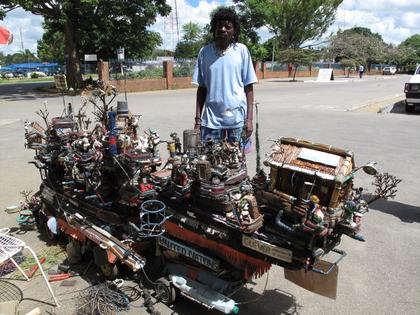
Dexter Nyamainashe was having trouble starting his automata. For years he had been collecting scrap metal from the wasteland deserts and the ruined streets, which he welded together into little worlds of people, animals, buildings. When he stepped behind the contraption and turned the crank, these tiny, mechanical beings would spring to life: eating, loving, killing (for verisimilitude); a whole microcosmic reproduction of the world he saw around him. He called them the Global Villages of Peace. And yet, despite the infinite and infinitesimal care with which he crafted and operated his machines, Dexter’s Zimbabwean countrymen wanted nothing to do with them. The government called them charlatanry; the poor called them witchcraft, and fled with dark backwards glances as soon as he touched the crank. Those who might have understood, who could afford an education, could also unfortunately afford televisions, and preferred to spend their time watching reproductions of such a distant, sensational life that Dexter’s Global Villages seemed little more than the scraps they were made out of.

Eventually one of his friends, who owned a junk shop in town, suggested that Dexter set up his automata in the store window, where he could crank to his heart’s content without fear of persecution or misunderstanding, even if the purpose of his art had been reduced to selling the occasional shoddy good. When his arm got tired he would stop cranking and turn bitterly to the television that also blared behind the storefront’s glass, tuned often to the peculiar cartoons of the Fox Network. Stupid box that needed no human turning to bring it to life, that was witchcraft, he thought, an automaton of the finest and yet pernicious make. For who turned the crank? He couldn’t figure it out.

One day however, when he was taking such a break, Dexter was startled by an interruption of the moving, speaking drawings in the box. There for once was a real man, named Rupert Murdoch, the head fox himself, the Zimbabwean thought. After several minutes of hemming and hawing, Rupert sighed, and then admitted that he had been slyly using the content of his shows to brainwash the North American people (and, by extension of the technology, the rest of the world): his cartoons would cleverly contradict the immediacy of global warming, or spout the political rhetoric with which the last North American President had been trying to take over the world. Ah, Dexter smiled sadly when the old fox had finished, so they were just automata, but what a shame that they were used to such evil ends, especially as anyone and everyone can see them. Witchcraft indeed. With that, he turned off the television, and began cranking his Global Village of Peace to life, even though no one was on the street to watch.

3.04.2009

The Greatest Discovery

If only he'd found them first: the twin black holes, spinning around each other like crushing dynamos, abysmal toy tops of the Universe. But no, that honor belonged to the astronomical team at _____ University, undoubtedly now basking in the fame of every major scientific journal, along with the guaranteed grants to continue their research. He had not even discovered the massive black hole twirling at the core of our own galaxy, and that had been his pet project for years, bound by the no longer seemingly foolish conviction that there was some connection between such imposing gravity and the energy fields of star systems. It had not been his name on the article. No, instead he'd gone out and gotten drunk with the molecular biologists, one of their experiential experiments on cell decay, and on his way home he had been jumped by a pair of hoodlums, they could have been twins in their identical skull masks, their cloth teeth chattering at his absolute inability to defend himself. It had taken the better part of the week to cancel and renew his credit card, replace his license and security badge. In fact, all that he had really lost, beyond the time in which he should have been the one to discover the black holes, was his wallet, a worn leather thing it'd been about time to replace anyway.

And so there he was, at Wal-Mart, or Target, with a new wallet in one hand and his new MasterCard in the other. After the cashier rang him out he opened the wallet to put the card inside, and found there, in one of the black pockets, ten teeth, ten human teeth. One of them had a filling. He was horrified, and despite the profuse apologies of the clerk, he hurried out, not taking the wallet or even the teeth he had paid for, and without giving his name to the reporter who had suddenly materialized, as if through matter transference, and tried to assure him that finding these teeth might prove to be the greatest discovery since Galileo found the moons of Jupiter.

3.03.2009

Steps to Futurity

After reading Fuller's "Operating Manual for Sapceship Earth," I began thinking of what we need to do now as a species in order to survive in the long run, starting from the premise that we are fucked now but that we can survive, if we allow that the narratives and perspectives we have on what is possible actually do determine reality.

In the long run, the sun, which is our primary fuel source, will die out, so by that point we will have needed to develop the technology to find and inhabit other Earth-like, life-sustaining planets. Previously the challenge to this has been inventing faster than light travel, but, as the rate of expansion of the Universe is increasing due to the heretofore unknown dark energy, we should instead focus on FTD (faster than dark) technology, or methods of alternate universe travel.

In order to create technologies on this level, and even to develop the scientific perspectives on which this technology might be based, we must first resolve local problems of time, resources, and education. The sun is our main energy source. We must develop technologies to harness this continually radiant and free energy source in order to stop using our non-renewable resources at all costs. This in turn requires a new model of wealth, not as debt, scarcity, or "not enough to go around" which rules the current economic markets, but as Fuller suggests as a measure of futurity: the number of forward-projected days per person that we as a species can live. Secondly we need to curb global consumption, in particularly North American culture's rampant production and consumption of readily-disposable, non-biodegradable, resource-wasting doohickeys. Perhaps new plastic-like materials can be invented from renewable resources.

But for either wealth or consumption to change we need a global, cultural paradigm shift towards sustainability, equality, conservation, etc, in short a shift towards looking at humanity as something with a future. This requires mass education and conscientious media engagement to raise awareness of the issues at hand, offer alternatives, and stop promoting the reckless, passive lifestyles and worldviews that currently infest our world. After this, resources need to be redistributed evenly to all peoples, as well as free access to health care, education, and technologies, in order that the largest number of people are freed of time and mind to be able to address the large social and technological problems of energy transformations, space travel, universal acceptance, etc.

The primary challenge to all of this utopian idealism is the mythologies of nationality and spiritual scarcity that promote global warfare. Wars may be fought over ideologies, money, resources, land, etc, but they result from the misguided notion of us vs. them, that there are only limited resources and that superficial differences between people determine who should acquire what goods and who should be obliterated. The new paradigm must be that we are all in this together. The more subtle and dangerous myth currently creating global hostilities, especially in the Middle East, is the religious myths of the Armageddon - that is, over who will control the end of their world by wiping out their cultural enemies and thus insuring the victors a place in Heaven, because clearly there is an age old belief that there is also not enough heaven or salvation to go around. This is the greatest fallacy being fought over between East and West. Any attempt to win, with any one side over the others, will inevitably result in the greatest expenditure of non-renewable resources and wealth as futurity, the loss of multicultural perspectives, and eventually or immediately the destruction of the human race. This was the threat of the Cold War and is has not gone away. Any total war will mean total destruction.

The only way to win will be by getting along and getting out of this mess, which is in creating Heaven on Earth, prior to exploring out into the very real heavens which are all around us. To this end education/ media narratives must encourage global, multicultural perspectives converging on the essential humanity of all of us in the face of the totality of Universal experience we as a species have so far attained or imagined, as well as a focus on grassroots community organizing via the internets, and the encouragement and sharing of ideas, instructions, perspectives, etc for people to once again take control of their own lives and futures.

3.02.2009

The Operating Manual

Worried over the global economic crises and wondering where he was going to get the budget to balance the lot, Obama was invited on a personal space tour (which was also looking for funding). Pondering if the ship had an operating manual as they alit up the gravity well, or at least an abort button, he turned to the window and soon money lost its weight. There was Earth, a little cloudier and muddied than he imagined. But, Obama smiled, that’s what made it real. The planet was breathtaking, all sun soaked amidst the embering stars, if not a little on the small side.


I apologize for the lack of posting in the last several months. I have been inordinately busy with school and going through what is most likely my Saturn Returns, attempting to find new perspectives on reality and how I can best approach it in the coming decades without giving up, getting jaded, or going crazy. On the other hand I have become obsessed with the concise narratives of flash or short short fiction, and so hopefully I will post more like the above here in the future as I work out some aesthetic and global theories. I have been particularly distraught over the news that the increased rate of expansion of the Universe will one day mean the vanishing of all the stars from the sky. Of most use in formulating more hopeful positions on life today has been R. Buckminster Fuller's Operating Manual for Spaceship Earth (full text online).

In the mean time, I posted a new story called In the Moment on my Goodreads account, a sort of absurdist tour diary of my rock and roll days in which a stolen book of censored songs precipitates the end of the world as we know it. Enjoy!

12.23.2008

God vs. the Scientific Method

A person's unconscious attitudes toward science and God may be fundamentally opposed, researchers report, depending on how religion and science are used to answer "ultimate" questions such as how the universe began or the origin of life.

"It seemed to me that both science and religion as systems were very good at explaining a lot, accounting for a lot of the information that we have in our environment. But if they are both ultimate explanations, at some point they have to conflict with each another because they can't possibly both explain everything."


As such, more Americans believe in the Devil, Hell and Angels than in Darwin’s Theory of Evolution, church attendance is projected to fall by 90% by the year 2050, and researchers are still trying to find a neurophysiological model of spiritual experience.

This fall I took a physics course in which we discussed quantum mechanics, relativity, cosmology, and other weird aspects of modern science. Far from finding these ideas in conflict with my perspectives on spirituality I found that science paints a picture of reality that is mysterious, open-ended, and ultimately not very different than many early spiritual beliefs. If the fact that the universe is made almost entirely of dark matter and energy that we know nothing about doesn't move one to contemplate the meaning of life then I am completely confused as to what makes for a spiritual or religious experience. According to Rudolf Otto in The Idea of the Holy anything that brings up this feeling of utter mystery and incomprehensibility in the face of reality is spiritual, and the closer science looks at the Universe there is only more and more that we don't understand.

On the other hand, science and religion could find another sort of common ground as the Vatican embraces iTunes prayer books.

12.12.2008

The Imaging of Dreams

Many years back I had a dream in which there had been invented the technology for people to record their dreams while asleep so that others could later view/ dream them for themselves. I called it the Subjunctive Dream Network, and many years worth of hilarity ensued in which I would be having a particularly terrible dream only to wake up (in another dream), take off the sleep mask and wires, and be thankful it was only someone else's dream I had been viewing.

It now seems that a group of Japanese scientists are in the process of developing software that can actually process and display the images of thoughts and dreams on a computer screen, which is a step closer to making the Subjunctive Dream Network and actual reality (though one imagines there's still lots of kinks, if this is actually true). Of course, it also means that instead of writing out all my dreams to use as material, I could just be making a movie while sleeping!

11.24.2008

Dali Lama Unleashes Revolutionary New Reincarnation Techniques


[via]

"Deciding that they should be the ones to appoint all future Lamas, in an attempt to gain the upper hand in the mindspace of the people of Tibet in their struggle against them for independence, the Chinese government recently enacted a law giving themselves full authority over all reincarnations.

Well played China. Well played.

But the Dalai Lama knows how to play the game as well.

In response, at the end of 2007, the Dalai Lama proposed to hold a referendum among his millions of followers on whether he should be reincarnated at all, and, if the vote was in favor, to determine his reincarnation while he was still alive. He cited the example of one of his teachers as a precedent for a lama being reincarnated while still alive. But he also indicated that he would not be reborn in China or any other country which is “not free.”

In turn, the Dalai Lama has raised the possibility to forgo his rebirth, or to be reborn while still alive so that he, not China, can choose his successor.

The Dalai Lama has even suggested reincarnating as a woman.

I find it incredibly interesting that the Dalai Lama, a being who’s existence spans at least fourteen lifetimes, is now reincarnating only in free countries in order to stay free of the grasp of the ancient empire which seeks to trap and control him within it’s borders. That is, of course, unless he chooses not to reincarnate at all and instead transcends to a higher dimension.

I certainly hope they aren’t using Dielbolds to count the votes in that referendum, it would be an easy way for the Chinese to finally remove the Dalai Lama from this level of reality (at least for a while).

What’s especially interesting about this strange game of espionage and rebirth is how important it actually is to the future of Tibet, China, and the rest of the world, as well as to the lives of the individuals involved."

11.14.2008

Stealing Your Library

OCLC, owners of WorldCat, are getting greedy. It's now demanding that every library that uses WorldCat give control over all its catalog records to OCLC. It literally is asking libraries to put an OCLC policy notice on every book record in their catalog. It wants to own every library. It's not just Open Library that's at risk here -- LibraryThing, Zotero, even some new Wikipedia features being developed are threatened. Basically anything that uses information about books is going to be a victim of this unprecedented power[ ]grab. It's a scary thought.

Open Library provides a free alternative to WorldCat, provided it doesn't get sued into oblivion.

[via metafilter]

9.28.2008

Poetry Bailout Will Restore Confidence of Readers

[from Harper's]

As you know, the glut of illiquid, insolvent, and troubled poems is clogging the literary arteries of the West. These debt-ridden poems threaten to infect other areas of the literary sector and ultimately to topple our culture industry.

Cultural leaders have come together to announce a massive poetry buyout: leveraged and unsecured poems, poetry derivatives, delinquent poems, and subprime poems will be removed from circulation in the biggest poetry bailout since the Victorian era. We believe the plan is a comprehensive approach to relieving the stresses on our literary institutions and markets.

Let there be no mistake: the fundamentals of our poetry are sound. The problem is not poetry but poems. The crisis has been precipitated by the escalation of poetry debt—poems that circulate in the market at an economic loss due to their difficulty, incompetence, or irrelevance.

Illiquid poetry assets are choking off the flow of imagination that is so vital to our literature. When the literary system works as it should, poetry and poetry assets flow to and from readers and writers to create a productive part of the cultural field. As toxic poetry assets block the system, the poisoning of literary markets has the potential to damage our cultural institutions irreparably.

As we know, lax composition practices since the advent of modernism led to irresponsible poets and irresponsible readers. Simply put, too many poets composed works they could not justify. We are seeing the impact on poetry, with a massive loss of confidence on the part of readers. What began as a subprime poetry problem on essentially unregulated poetry websites has spread to other, more stable, literary magazines and presses and contributed to excess poetry inventories that have pushed down the value of responsible poems.