
Christmas
One God is born. Others die. Truth
Did not come or go. Error changed.
Eternity is different now.
What happened was better always.
Blind Science plows the useless sod.
Fool Faith lives the dream of its observance.
A new God is but a word.
Search not, nor believe. All is hidden.
Showing posts with label science. Show all posts
Showing posts with label science. Show all posts
12.16.2009


12.09.2009
A Magnet for Possibilities (news)
APA Philosophy Referee Hand Sginals (above)
Rumors that first Dark Matter Particle has been discovered
US finally to settle Native American Trust Lawsuit
What Philosophers Believe
How the iPhone could Reboot Education (which I've already seen with my own eyes at Pitt)
Tom Waits may be up for a role in the Hobbit
David Bowie and the Occult
The Fortsas Bibliohoax
The Milky Way at different Wavelengths
Don't Believe in God? Can't Hold Office in NC
MIT's Mind Machine Project takes AI research to 2.0
Dave Eggers publishes a newspaper
Casual Sex found to not be psychologically dangerous for young people
Henry Miller's Watercolors
Should Earth Scientists take a Hippocratic Oath? (I say yes)
The Mystery of the Magically Braided Horse Manes
Music for Water Bears
100 Best last lines of novels, the first of which and my favorite is from Beckett's The Unnameable:
".... ...you must go on, I can’t go on, I’ll go on."
12.08.2009
Updates from the World

A Lost European Culture, Pulled From Obscurity
New Model of the Universe Says Past Crystallises out of the Future
Trees Communicate with Aspirin-like Chemical
Rudiments of Language Discovered in Monkeys
David Foster Wallace's Toy Cement Mixer
"Nothing is more free than the imagination of man; and though it cannot exceed that original stock of ideas furnished by the internal and external senses, it has unlimited power of mixing, compounding, separating, and dividing these ideas, in all the varieties of fiction and vision. It can feign a train of events, with all the appearance of reality, ascribe to them a particular time and place, conceive them as existent, and paint them out to itself with every circumstance, that belongs to any historical fact, which it believes with the greatest certainty. Wherein, therefor, consists the difference between such a fiction and belief?"
-David Hume, from An Enquiry Concerning Human Understanding
12.02.2009
Belief confirms Belief
Taking a break from working on a philosophy paper about free will to comment on this research presented in New Scientist showing that people ascribe their own beliefs to God:
I think this is very useful research, as the way our beliefs, and the stories we tell to authenticate those beliefs, influences our actions is, for me, one of the prime functions of mythology, and highly overlooked in our polarized age. I think it is very important right now to look at the way the stories we tell influence us, as culturally we are aflood with stories telling us all kinds of wondrous and troubling things. Violence in video games is just the tip of the iceberg. It's not surprising though to find that God is less a moral compass than a sounding board; people have been using the concept of an ultimate reference for this purpose since we've been able to conceive of such an "objective" stance. The difference I think though is that originally (as conceived in both ancient Greece and theology), God was a sounding board for our conception of the largest possible scope of reference and goodness, that is, one which was bigger than our individual perspectives and could thus serve as a map or guide to them. Nowadays though the popular conception of God has become much smaller, inimical to a total perspective of belief, and very specific beliefs have been attached to the attendant texts and rituals that support belief in God (ie: all the dogma and hatred and ignorance of religious fundamentalists that are in us and not in It). Unfortunately it seems that we have grown to believe more in the one-sided interpretations that have codified over history than in the total set of possibilities inherent in an ultimate god belief, and as such project those back on that image in order to reinforce these negative views.
As always, it is important to remember that whether or not you believe that we are created by God, we create gods ourselves through our belief in them, which allows us to believe in ourselves. As I like to put it, gods are solely everything that has been said or believed about them or has been done in their names.
God may have created man in his image, but it seems we return the favour. Believers subconsciously endow God with their own beliefs on controversial issues.
"Intuiting God's beliefs on important issues may not produce an independent guide, but may instead serve as an echo chamber to validate and justify one's own beliefs," writes a team led by Nicholas Epley of the University of Chicago in Proceedings of the National Academy of Sciences.
The researchers started by asking volunteers who said they believe in God to give their own views on controversial topics, such as abortion and the death penalty. They also asked what the volunteers thought were the views of God, average Americans and public figures such as Bill Gates. Volunteers' own beliefs corresponded most strongly with those they attributed to God.
Next, the team asked another group of volunteers to undertake tasks designed to soften their existing views, such as preparing speeches on the death penalty in which they had to take the opposite view to their own. They found that this led to shifts in the beliefs attributed to God, but not in those attributed to other people.
"People may use religious agents as a moral compass, forming impressions and making decisions based on what they presume God as the ultimate moral authority would believe or want," the team write. "The central feature of a compass, however, is that it points north no matter what direction a person is facing. This research suggests that, unlike an actual compass, inferences about God's beliefs may instead point people further in whatever direction they are already facing."
I think this is very useful research, as the way our beliefs, and the stories we tell to authenticate those beliefs, influences our actions is, for me, one of the prime functions of mythology, and highly overlooked in our polarized age. I think it is very important right now to look at the way the stories we tell influence us, as culturally we are aflood with stories telling us all kinds of wondrous and troubling things. Violence in video games is just the tip of the iceberg. It's not surprising though to find that God is less a moral compass than a sounding board; people have been using the concept of an ultimate reference for this purpose since we've been able to conceive of such an "objective" stance. The difference I think though is that originally (as conceived in both ancient Greece and theology), God was a sounding board for our conception of the largest possible scope of reference and goodness, that is, one which was bigger than our individual perspectives and could thus serve as a map or guide to them. Nowadays though the popular conception of God has become much smaller, inimical to a total perspective of belief, and very specific beliefs have been attached to the attendant texts and rituals that support belief in God (ie: all the dogma and hatred and ignorance of religious fundamentalists that are in us and not in It). Unfortunately it seems that we have grown to believe more in the one-sided interpretations that have codified over history than in the total set of possibilities inherent in an ultimate god belief, and as such project those back on that image in order to reinforce these negative views.
As always, it is important to remember that whether or not you believe that we are created by God, we create gods ourselves through our belief in them, which allows us to believe in ourselves. As I like to put it, gods are solely everything that has been said or believed about them or has been done in their names.
11.30.2009
The Way of What is to Come
Monday, listening to M.Pyres, dancing up and down over my copy of Jung's "Red Book" [on his theories of interpretation] finally arriving, though won't have time to dive into it for a couple weeks due to the increasing school work load. But soon.
For the time being here's some links that have been building up in my reader:

Images
From Kris Kuksi's Beast Anthology (above).
Dust Echoes: animated stories from the Australian dreamtime.
The dawn of a new post postmodern era in art.
Words
Viking love (and war) poetry.
Alan Moore's new zine, Dodgem Logic.
A Reader's Manifesto, or why contemporary literature sucks.
Bad sex in fiction award 2009 (NSFW).
The Books that founded D&D.
Faith and Politics
Obama omits reference to God in Thanksgiving speech.
The inherent fail of New Atheism.
Ritual sacrifices in Nepal see 320,000 animals sacrificed.
Switzerland Votes to Ban Minarets
CIA's lost magic manual resurfaces.
The global protest movement, ten years later.
Science
Doctors Recommend Medical Marjiuana for Minors with ADHD.
Humans hear through their skin.
Plants have a social life.
Science is shackled by intellectual property.
Large Hadron Collider sets world record for particle acceleration.
Virgin Galactic's Space-Grazing Aircraft Is Ready for Liftoff.
For the time being here's some links that have been building up in my reader:
Images
From Kris Kuksi's Beast Anthology (above).
Dust Echoes: animated stories from the Australian dreamtime.
The dawn of a new post postmodern era in art.
Words
Viking love (and war) poetry.
Alan Moore's new zine, Dodgem Logic.
A Reader's Manifesto, or why contemporary literature sucks.
Bad sex in fiction award 2009 (NSFW).
The Books that founded D&D.
Faith and Politics
Obama omits reference to God in Thanksgiving speech.
The inherent fail of New Atheism.
Ritual sacrifices in Nepal see 320,000 animals sacrificed.
Switzerland Votes to Ban Minarets
CIA's lost magic manual resurfaces.
The global protest movement, ten years later.
Science
Doctors Recommend Medical Marjiuana for Minors with ADHD.
Humans hear through their skin.
Plants have a social life.
Science is shackled by intellectual property.
Large Hadron Collider sets world record for particle acceleration.
Virgin Galactic's Space-Grazing Aircraft Is Ready for Liftoff.
11.09.2009
Adaptive Fictions
This is an interesting look from evolutionist Erin Johnson at the adaptive role fictions play in helping humans survive (from an article on Atheism as a Stealth Religion), not just in religions' use of gods, but in any thought or belief, that is expression as mythology:
This leads to a crucial distinction between what I call factual and practical realism. Consider Hans and Igor, who are mortal enemies. Hans understands that Igor is much like himself, even to the point of competing for the same square of ground. Igor regards Hans as an inhuman monster, completely unlike himself. If Igor's belief makes him fight with greater determination, then it counts as practically realistic, even if it is factually incorrect. Now imagine similar contests among beliefs--and the brains that create beliefs--taking place over thousands of generations of genetic and cultural evolution. Voila! We arrive at a conception of human mentality that is far more nuanced and interesting than the black-and-white cartoon of atheism vs. religion.
Factual and practical realism are not always at odds. To pick an obvious example, a hunter needs to know the exact location of his quarry. The point is that the relationship between the two is complex and that our minds are prepared to massively depart from factual realism, when necessary, in ways that motivate effective action. This is not a sign of mental weakness but a time-tested survival strategy. Moreover, adaptive fictions are not restricted to religions. Patriotic histories of nations have the same distorted and purpose-driven quality as religions, a fact that becomes obvious as soon as we consider the histories of nations other than our own. Intellectual movements such as feminism and postmodernism are often shamelessly open about yoking acceptable truths to perceived consequences. That's what it means to be politically correct. Scientific theories are not immune. Many scientific theories of the past become weirdly implausible with the passage of time, just like religions. When this happens, they are often revealed as not just wrong but as purpose-driven. Scientific theories cannot be expected to approximate factual reality when they are proposed, but only after they have been winnowed by empirical evidence.
These and other belief systems are not classified as religions because they don't invoke supernatural agents, but they are just like religions when they sacrifice factual realism on the altar of practical realism. The presence or absence of supernatural agents--a particular departure from factual realism--is just a detail. It is humbling to contemplate that the concerns typically voiced about religion need to be extended to virtually all forms of human thought. If anything, non-religious belief systems are a greater cause for concern because they do a better job of masquerading as factual reality. Call them stealth religions.
11.06.2009
Ancient Verse
I've been doing a lot of research recently for an essay to submit to the upcoming Immanence of Myth anthology, and have particularly grown fascinated by the scope of history, and particularly the birth of writing in the Mesopotamia river valley. Most well known is the Epic of Gilgamesh,a hero-myth written down in the 23rd century BCE Akkadian Empire, and for all intents the first action story as well as model for how kings and men ought to behave.

Around the same time though we also apparently find Enheduanna (above), daughter of Sargon the Great of Akkad, high En (priestess) of Nanna, and the first poet known by name, if not the first recorded author. The link contains links to some of her poems, which seem for the most part to be temple hymns to Innana and other Sumerian goddesses. It is interesting to note that after the development of writing, it seems most myths and stories were told in poetic verse, and most narratives were mythic, which lasts until the second emergence of Greek culture and the prose myths of Hesiod's Theogony (800 BCE).
Non-mythic literature doesn't arise until the Japanese serialized "novel", The Tale of the Genji (finished 1021 CE), and European Medieval allegories of the 1300s. We don't start taking stories as literally fictive until Robinson Crusoe in 1719, and even then it had to be published as a "petite historie," a private, little, or dubious history, perhaps because it was still hard to believe that something you hear is true in itself though not true in reality, a bit of doublethink those of us who've grown up in the present are accustomed to.
And just because this is now becoming an absurd saga, Baguette Dropped From Bird's Beak Shuts Down the Large Hadron Collider (Really), from Popular Science.
Around the same time though we also apparently find Enheduanna (above), daughter of Sargon the Great of Akkad, high En (priestess) of Nanna, and the first poet known by name, if not the first recorded author. The link contains links to some of her poems, which seem for the most part to be temple hymns to Innana and other Sumerian goddesses. It is interesting to note that after the development of writing, it seems most myths and stories were told in poetic verse, and most narratives were mythic, which lasts until the second emergence of Greek culture and the prose myths of Hesiod's Theogony (800 BCE).
Non-mythic literature doesn't arise until the Japanese serialized "novel", The Tale of the Genji (finished 1021 CE), and European Medieval allegories of the 1300s. We don't start taking stories as literally fictive until Robinson Crusoe in 1719, and even then it had to be published as a "petite historie," a private, little, or dubious history, perhaps because it was still hard to believe that something you hear is true in itself though not true in reality, a bit of doublethink those of us who've grown up in the present are accustomed to.
And just because this is now becoming an absurd saga, Baguette Dropped From Bird's Beak Shuts Down the Large Hadron Collider (Really), from Popular Science.
10.25.2009
News Updates
The End of Philosophy. From Adbusters, interesting but the writer went to Pitt, and had one of the same philosophy classes I'm taking there this semester, and I agree its mostly irrelevant, except I'd have to say: don't expect other people to apply ideas for you, you have to think for yourself.
the Age of Universal Authorship. The one thing the author hasn't considered is that only will we have universal authorship when everyone has access to the technologies of communication and authorship.
Luther Blisset is now Wu Ming. Luther is one of the shared or multiple-use names phenomenon, which I first heard about in connection with Monty Cantsin and Neoism. Good to know these names are still out there.
Giant Orb Weaver Spider Discovered [image via riot rite right clit clip click]
Essential Plot Twists for Writers. Now in handy cartoon format.
Why Our Brains Will Never Live in a Matrix. Because they already live in bodies. Though the Internet is Altering our Brains.
The New End of the World Date is now 2068. Get Your calendars ready for the meteor crash.
In the mean time, don't forget to Live Life to the Full. A free guide to cognitive behavior therapy. Or, maybe depressed people are suffering from a lack of fun.
And finally, though science wants to stop aging, we still don't know exactly what is time?"
the Age of Universal Authorship. The one thing the author hasn't considered is that only will we have universal authorship when everyone has access to the technologies of communication and authorship.
Luther Blisset is now Wu Ming. Luther is one of the shared or multiple-use names phenomenon, which I first heard about in connection with Monty Cantsin and Neoism. Good to know these names are still out there.
Giant Orb Weaver Spider Discovered
[image via riot rite right clit clip click]Essential Plot Twists for Writers. Now in handy cartoon format.
Why Our Brains Will Never Live in a Matrix. Because they already live in bodies. Though the Internet is Altering our Brains.
The New End of the World Date is now 2068. Get Your calendars ready for the meteor crash.
In the mean time, don't forget to Live Life to the Full. A free guide to cognitive behavior therapy. Or, maybe depressed people are suffering from a lack of fun.
And finally, though science wants to stop aging, we still don't know exactly what is time?"
10.22.2009
Atheism 3.0 vs the Functions of Faith and God
More news from the front lines of the war between faith and rationalism [via disinfo]:
I'm glad to see that rationalists are beginning to rationally recognize that there are tangible evolutionary benefits to at least the tangible ephemera of the intangible. Certainly community, a sense of well-being, health, cultural growth, etc. are all valuable things for humanity, but (without reading his book yet) I still think Sheiman is missing the whole point about faith, which is that he may never get his coherent rational argument for the existence of God: Faith does not rely on rational proof but on acceptance of things as being true whether or not you can see or prove them, and there are distinct evolutionary advantages in that.
I will try to illustrate: I have faith that there are forces larger than myself at work in the Universe. I (personally) can not prove they are real, nor can I directly observe them, but my ability to prove or observe does not make these forces any less real, or any less active on my life. These statements could just as easily apply to black holes, electromagnetism or other not readily observable scientific phenomena just as much as they could apply to God. Yes I know I can see light from a light bulb, and someone could explain how light comes from a light bulb, but I dare anyone to show me an electromagnetic field directly, without pointing only to its effects. Science for many centuries refused to admit the existence of fields precisely for this reason, that it seemed you had to believe in them. Just because we do not see God, except for in its tangible effects (under which some might group religion, culture, even consciousness and life), does not mean that it is not just an active and real force. Faith just accepts that you may never see it, and gets right along to making use of its effects without all the rejection and consternation of reason.
But there are even clearer and more direct benefits of believing in God. Granted, I have much doubt myself, not that there are intangible forces, but whether these forces are God, rather than malevolent demons intent upon deceiving me and making life miserable. The thing is, at least demons would be an excuse; without them there is absolutely no explanation for why I often feel deceived or miserable, other than saying it is human nature, or my pscyhology or upbringing. Without reference to some larger, intelligent, or teleological force in the Universe, we are hard pressed to find any true meaning or reason for life existing at all, except to eventually die. As Buddhists say, life is suffering, and all an illusion. The thing that God grants (referring mainly to the traditional Western conception of God as all powerful, knowing, and, most particularly, good), is something that a friend of mine in AA pointed out recently: that we can give up to God our feelings of helplessness in the face of cosmic pointlessness, we can give up to God our need for responsibility for all the things in our lives which for the most part aren't in our control to begin with. Not that God or equivalent powers absolve us of responsibility or grant us ultimate meaning, but by standing as metaphors for the possible existence of an ultimate meaning, goodness, or responsibility, especially because unseen, we get to choose to believe that these things are possible, and are thus given a bit of leeway to seek out these things in our own lives where we can, without killing ourselves or each other first. Evolutionarily, belief in God gives us hope and grace, which allow just enough room to trust in and build relationships and civilizations and keep this whole mess going, until we find out if there really is some larger point to any of it.
Bruce Sheiman doesn’t believe in God, but he does believe in religion.
Setting aside the question of whether God exists, it’s clear that the benefits of faith far outweigh its costs, he argues in his new book, An Atheist Defends Religion: Why Humanity is Better Off With Religion than Without It.
“I don’t know if anybody is going to be able to convince me that God exists,” Sheiman said in an interview, “but they can convince me that religion has intrinsic value.”
The old atheists said there was no God. The so-called “New Atheists” said there was no God, and they were vocally vicious about it. Now, the new “New Atheists” — call it Atheism 3.0 — say there’s still no God, but maybe religion isn’t all that bad.
Faith provides meaning and purpose for millions of believers, inspires people to tend to each other and build communities, gives them a sense of union with a transcendent force, and provides numerous health benefits, Sheiman says. Moreover, the galvanizing force behind many achievements in Western civilization has been faith, Sheiman argues, while conceding that he limits his analysis, for the most part, to modern Western religion.
“More than any other institution, religion deserves our appreciation and respect because it has persistently encouraged people to care deeply — for the self, for neighbors, for humanity, and for the natural world — and to strive for the highest ideals humans are able to envision,” Sheiman writes…
I'm glad to see that rationalists are beginning to rationally recognize that there are tangible evolutionary benefits to at least the tangible ephemera of the intangible. Certainly community, a sense of well-being, health, cultural growth, etc. are all valuable things for humanity, but (without reading his book yet) I still think Sheiman is missing the whole point about faith, which is that he may never get his coherent rational argument for the existence of God: Faith does not rely on rational proof but on acceptance of things as being true whether or not you can see or prove them, and there are distinct evolutionary advantages in that.
I will try to illustrate: I have faith that there are forces larger than myself at work in the Universe. I (personally) can not prove they are real, nor can I directly observe them, but my ability to prove or observe does not make these forces any less real, or any less active on my life. These statements could just as easily apply to black holes, electromagnetism or other not readily observable scientific phenomena just as much as they could apply to God. Yes I know I can see light from a light bulb, and someone could explain how light comes from a light bulb, but I dare anyone to show me an electromagnetic field directly, without pointing only to its effects. Science for many centuries refused to admit the existence of fields precisely for this reason, that it seemed you had to believe in them. Just because we do not see God, except for in its tangible effects (under which some might group religion, culture, even consciousness and life), does not mean that it is not just an active and real force. Faith just accepts that you may never see it, and gets right along to making use of its effects without all the rejection and consternation of reason.
But there are even clearer and more direct benefits of believing in God. Granted, I have much doubt myself, not that there are intangible forces, but whether these forces are God, rather than malevolent demons intent upon deceiving me and making life miserable. The thing is, at least demons would be an excuse; without them there is absolutely no explanation for why I often feel deceived or miserable, other than saying it is human nature, or my pscyhology or upbringing. Without reference to some larger, intelligent, or teleological force in the Universe, we are hard pressed to find any true meaning or reason for life existing at all, except to eventually die. As Buddhists say, life is suffering, and all an illusion. The thing that God grants (referring mainly to the traditional Western conception of God as all powerful, knowing, and, most particularly, good), is something that a friend of mine in AA pointed out recently: that we can give up to God our feelings of helplessness in the face of cosmic pointlessness, we can give up to God our need for responsibility for all the things in our lives which for the most part aren't in our control to begin with. Not that God or equivalent powers absolve us of responsibility or grant us ultimate meaning, but by standing as metaphors for the possible existence of an ultimate meaning, goodness, or responsibility, especially because unseen, we get to choose to believe that these things are possible, and are thus given a bit of leeway to seek out these things in our own lives where we can, without killing ourselves or each other first. Evolutionarily, belief in God gives us hope and grace, which allow just enough room to trust in and build relationships and civilizations and keep this whole mess going, until we find out if there really is some larger point to any of it.
10.19.2009
Space is the Place
Astronomical discoveries are all the rage right now, what with scientists finding a mysterious ribbon of atoms bounding the solar system's edge, along with a bounty of 32 new extrasolar planets.
What a shame that for the most part we are just stuck here looking up in marvel and wonder instead of out there exploring.
What a shame that for the most part we are just stuck here looking up in marvel and wonder instead of out there exploring.
10.14.2009
Is the Large Hadron Collider being Sabotaged from the Future? (and other strange news)

This NY Times article was too good not to post, it reminds me of some of the flash science-fictions I was working on in the spring [via metafilter]:
A pair of otherwise distinguished physicists have suggested that the hypothesized Higgs boson, which physicists hope to produce with the collider, might be so abhorrent to nature that its creation would ripple backward through time and stop the collider before it could make one, like a time traveler who goes back in time to kill his grandfather.
It sounds like the funny thing is that this theory is getting valid coverage and consideration as a real reason why no Higgs-producing collider has yet worked. Though Chinese scientists have created a miniature black hole without the world exploding.
On the other side of the spectrum we have the case of this man [via disinfo]:
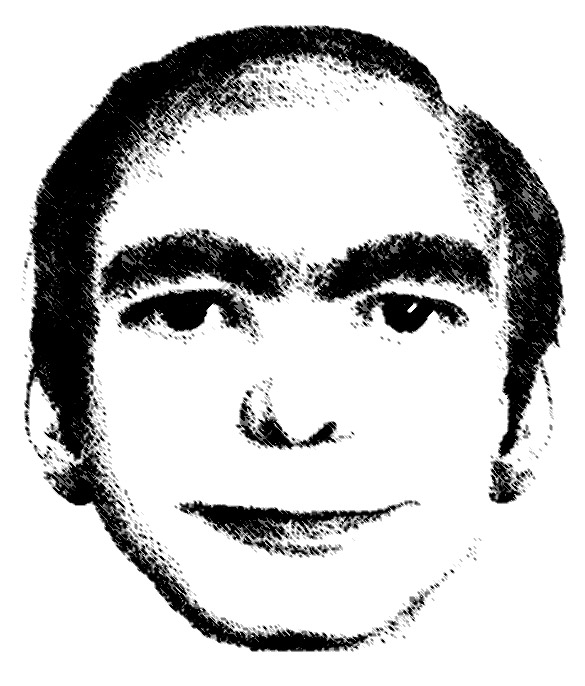
"From January 2006 until today, at least 2000 people have claimed they have seen this man in their dreams, in many cities all over the world: Los Angeles, Berlin, Sao Paulo, Tehran, Beijing, Rome, Barcelona, Stockholm, Paris, New Dehli, Moskow etc.
"At the moment there is no ascertained relation or common trait among the people that have dreamed of seeing this man. Moreover, no living man has ever been recognized as resembling the man of the portrait by the people who have seen this man in their dreams."
[Edit: or is this man just a marketing ploy?]
And lastly, the vegetarian spider, which prefers hunting plants to insects, of all the strange permutations nature could come up with.
10.13.2009
Where Science Ends and Magic Begins
From biochemist Rupert Sheldrake's response to the skeptical critics, of his book, A New Science of Life [via Daily Grail]:
As Arthur C. Clarke so brilliantly put it, "any sufficiently advanced technology is indistinguishable from magic." I would say that science is just magic repeated often enough that you know how it is works.
"Magic is an attempt to control and forecast natural events. Sir James Frazer distinguished two categories. First, sympathetic magic by similarity: like produces like. For example, manipulating a model of something is believed to give power over that which is modelled. Second, magic by contact or contagion: objects that were once joined together retain a mysterious connection when separated, so that a change in one can affect the other.
"Science is also about controlling and forecasting natural events. Much of its power comes from making models of natural processes. Mathematical modelling gives scientists ever more power to predict and control. And many modern technologies depend on a sympathetic resonance between similar patterns of vibration at a distance. A hundred years ago, television would have been magic, and so would mobile telephones.
"Second, in quantum theory, objects that were once joined together retain a connection at a distance when separated, as in magic by contact or contagion. Einstein dismissed quantum non-locality as "spooky action at a distance". But quantum entanglement is real, and is applied technologically in quantum computing.
"Isaac Newton ran into the science/magic problem with gravity. The idea that the moon influenced the tides through empty space sounded like magic, and Newton was embarrassed by his failure to explain what he called the "occult" or hidden force of gravitation. His critics, mainly French, accused him of magical thinking."
As Arthur C. Clarke so brilliantly put it, "any sufficiently advanced technology is indistinguishable from magic." I would say that science is just magic repeated often enough that you know how it is works.
The Future of Sex
from H+ magazine [via disinformation]:
“It is important to remember that sexual intercouse is a highly ancient, simplistic-at-its-core activity that we may choose to discard at some point in the future…”
In “Sex and the Singularity,” futurist magazine H+ asks radical techs (including Ray Kurzweil) to describe futuristic “sex after the Singularity.” They envision “more complex activities that generate even more pleasure and connection between people,” and suggest “The primary purpose of the Singularity will be seen, after the fact, to be Awesome Sex.
“There will be exponentially more sex, with exponentially more interfaces, and with exponentially more measures of pleasure.” With “millions of super computer-generated sex fantasies,” one technologist concludes “I love the future. Bring it on.”
“Whether we choose to call it ’sex’ will be entirely arbitrary, but it may bear little resemblance to the sex of today…”
10.07.2009
Possession and Schizophrenia
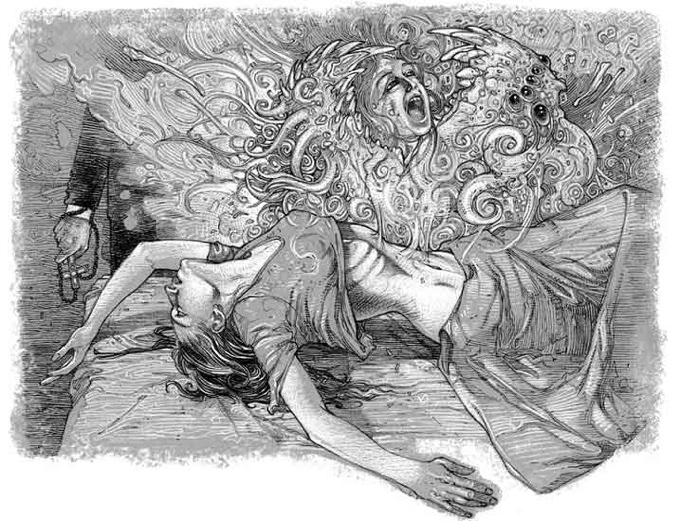
There is an interesting article from boingboing on exorcism and schizophrenia, which explains how patients in cultures with a strong belief in spirit possession, who have been possessed, have often been more successfully treated through schizophrenic medications than through exorcism. While this suggests that possession may be some cultures' ways of articulating the kinds of bizarre behaviors exhibited by schizophrenics, the article also cites a case where one of these medically treated possessees was actually seen to be possessed by other people.
So this might be an otherwise unremarkable psychiatric case if it were not for the fact that the prison chaplain, and several of the patient's cellmates, saw the spirit possess the patient as a ghostly mist. The chaplain was convinced this was a genuine case of possession, as had priests from several other faiths who had previously carried out exorcisms on the patient.
This begs the question, if the patient was treated for his belief in spirit possession and his apparent hallucinations as to the reality of the ghost, why were the chaplain and the others not considered to be ill ?
One could argue for mass hallucination, or conversely for some kind of cultural imagination at work, but perhaps it could mean that actual ghosts/spirits may be affected by chemical procedures? Not knowing off hand how medicines like trifluoperazine and clopenthixol work, I'd hazard a guess that whatever neural site/receptor these chemicals effect is also the neural site/receptor ghosts take possession of.
10.04.2009
Mass Link Updates
It's been a while since I've posted a number of links to interesting articles that have caught my eye in my daily journeys through the internets. I often just don't have the time to say something insightful about everything that catches my eye, so the world will just have to speak for itself.
Muthos:
-Interactive Fiction Competition 09
-Submissions wanted for an anthology on The Immanence of Myth
-Fair Use copyright:1 the Estate of James Joyce:0
-Best Fiction of the Millennium so far (and critics vs. readers)
-Most challenged books of 2008 for banned book week
-Exquisite Corpse Adventure
-School of Witchcraft opens in Taiwan
-Nabokov Edits Kafka's Metamorphosis
-Horacio Castellanos Moya's Disgust with the Bolaño Myth
-Dan Brown gets D.C. all Wrong
-More youths write today than ever before
-Post-medium publishing
-Tolkien trained as British Spy
Logos:
-The Psychology of anxiety
-Religious experience linked to the social regions of the brain
-The connection between Schizophrenia and smoking
-Quantum Entanglement now visible to the naked eye
-The Decline of Polymathy and General Knowledge
-Indians find Water on the Moon
-Brain Scans closer to Revealing what we have seen
-the Sun gets its Spots back
-Cities Organized like Human Brains, and as battlesuits for surviving the future
-Earth's oldest living organism cloned
Muthos:
-Interactive Fiction Competition 09
-Submissions wanted for an anthology on The Immanence of Myth
-Fair Use copyright:1 the Estate of James Joyce:0
-Best Fiction of the Millennium so far (and critics vs. readers)
-Most challenged books of 2008 for banned book week
-Exquisite Corpse Adventure
-School of Witchcraft opens in Taiwan
-Nabokov Edits Kafka's Metamorphosis
-Horacio Castellanos Moya's Disgust with the Bolaño Myth
-Dan Brown gets D.C. all Wrong
-More youths write today than ever before
-Post-medium publishing
-Tolkien trained as British Spy
Logos:
-The Psychology of anxiety
-Religious experience linked to the social regions of the brain
-The connection between Schizophrenia and smoking
-Quantum Entanglement now visible to the naked eye
-The Decline of Polymathy and General Knowledge
-Indians find Water on the Moon
-Brain Scans closer to Revealing what we have seen
-the Sun gets its Spots back
-Cities Organized like Human Brains, and as battlesuits for surviving the future
-Earth's oldest living organism cloned
9.26.2009
Mythos vs. Logos
Here is an interesting article titled Man vs. God, pitting religious thinker Karen Armstrong against noted atheist Richard Dawkins on the evolutionary role of God. Armstrong points out something rather important, that literal belief in God only dates back to the 17th century, and stresses the distinction between rational logos and narrative mythos as serving very different purposes in human development and culture:
Our challenge is that the mythic way of viewing the world has been almost entirely forgotten in the contemporary Western world. As I've been trying to articulate recently, science can not tell you what love feels like, hearing of Orpheus's descent into the underworld after Eurydice does. Or, science taught J. Oppenheimer how to build the atomic bomb, but only the Bhagavad Gita gave him the words to express how unleashing that much power feels. At this point in our collective evolution, it is I believe necessary to learn to re-express the world through both of these perspectives, though as of yet we are far from seeing how that worldview might look, or feel like.
Most cultures believed that there were two recognized ways of arriving at truth. The Greeks called them mythos and logos. Both were essential and neither was superior to the other; they were not in conflict but complementary, each with its own sphere of competence. Logos ("reason") was the pragmatic mode of thought that enabled us to function effectively in the world and had, therefore, to correspond accurately to external reality. But it could not assuage human grief or find ultimate meaning in life's struggle. For that people turned to mythos, stories that made no pretensions to historical accuracy but should rather be seen as an early form of psychology; if translated into ritual or ethical action, a good myth showed you how to cope with mortality, discover an inner source of strength, and endure pain and sorrow with serenity.
Our challenge is that the mythic way of viewing the world has been almost entirely forgotten in the contemporary Western world. As I've been trying to articulate recently, science can not tell you what love feels like, hearing of Orpheus's descent into the underworld after Eurydice does. Or, science taught J. Oppenheimer how to build the atomic bomb, but only the Bhagavad Gita gave him the words to express how unleashing that much power feels. At this point in our collective evolution, it is I believe necessary to learn to re-express the world through both of these perspectives, though as of yet we are far from seeing how that worldview might look, or feel like.
9.21.2009
On Retrograde Motions
I discovered yesterday that Mercury's been in retrograde since the 7th until the 29th, which can help explain some of my current frustrations with not being able to write or otherwise express myself clearly. Riding my bike around after finding this out, I was somewhat relieved to know it was "only the planets" moving backwards again, but considered that actually, retrograde motion isn't real, it is only a centuries old misperception that we still express because of how it looks to us, which was itself a kind of crisis to the scientific methods, in that in our anthropocentric cosmologies the planets had to be moving backwards, and no simple and elegant system could fully articulate that, when really it was only a disparity of orbits and velocity, where the planets on wider orbits would get behind our perception of where they should be in the sky, thus appearing to move backwards.
On the other hand, I believe that as big gravitationally active objects, the planets must have some physical effect on us, the way the moon influences tides and periods. At the beginning of the war on Iraq, Mars was the closest its been to Earth in thousands of years, and I don't think that's a coincidence, so that even though the planets don't move backwards they do seem to fall behind, thus causing a seeming opposition in our actual lives, particularly Mercury, which is fairly close to us, going retrograde three times a year, often with disastrous effects to communication and travel, those fields the Egyptians relegated to Hermes' influence.
Of course it seems it would be impossible to scientifically prove if the effects of retrograde motion are real or imagined (not that that might make much difference to those who claim to feel the effects), as any experiment would require a control solar system similar enough to ours but without retrograde motion, which clearly we don't just have a spare solar system lying around, or otherwise for a survey historical records of all communication happening during periods of Mercury retrograde, which data computers might be able to crunch one day, except that "not working" or "going wrong" seem to be more in our perceptions of the intended effects of our communications then int the communications themselves, once again a matter of misperception. And so like God, retrograde motion may currently have to be relegated to the realm of the unprovable, and thus a matter of individual taste and faith to believe in. If anything though, real or not, knowing Mercury's in retrograde right now at least took some of the burden off of blaming myself solely for things not working right, which makes it possible to frame the attitudes necessary to do them different, because retrogrades reminds me to remember that we often, like Earth, get ahead of the reality of our perceptions.
On the other hand, I believe that as big gravitationally active objects, the planets must have some physical effect on us, the way the moon influences tides and periods. At the beginning of the war on Iraq, Mars was the closest its been to Earth in thousands of years, and I don't think that's a coincidence, so that even though the planets don't move backwards they do seem to fall behind, thus causing a seeming opposition in our actual lives, particularly Mercury, which is fairly close to us, going retrograde three times a year, often with disastrous effects to communication and travel, those fields the Egyptians relegated to Hermes' influence.
Of course it seems it would be impossible to scientifically prove if the effects of retrograde motion are real or imagined (not that that might make much difference to those who claim to feel the effects), as any experiment would require a control solar system similar enough to ours but without retrograde motion, which clearly we don't just have a spare solar system lying around, or otherwise for a survey historical records of all communication happening during periods of Mercury retrograde, which data computers might be able to crunch one day, except that "not working" or "going wrong" seem to be more in our perceptions of the intended effects of our communications then int the communications themselves, once again a matter of misperception. And so like God, retrograde motion may currently have to be relegated to the realm of the unprovable, and thus a matter of individual taste and faith to believe in. If anything though, real or not, knowing Mercury's in retrograde right now at least took some of the burden off of blaming myself solely for things not working right, which makes it possible to frame the attitudes necessary to do them different, because retrogrades reminds me to remember that we often, like Earth, get ahead of the reality of our perceptions.
9.16.2009
Faith and the Pattern
Over the past year I have been going through an extreme crisis of faith. Due to a number of physical, emotional, and psychic challenges I found myself last winter in a state of disillusionment, that everything I had previously held to be good, desirable, possible, and expected in the world may not have been the case at all, a state close to feeling jaded, except that the crisis is precisely in trying to find some reason to carry on, to still believe: in love, the power of the human spirit, self-growth, god, some point to life as we know it, or at least a deeper understanding. But the closer I looked at any of these things the further they seemed to recede, from view, from understanding, so I was left wondering if they really existed. In centuries of the human quest for the truth and goodness we are still no closer to truth it seems, and people can be as ignorant, violent, and uncaring as they always have been, if not more so, which is rather disheartening to someone who feels they have spent their life searching for and hoping to bring these positive qualities into being. More recently I have summed up my quandary in asking, what is the point of self-growth, of struggling to improve how one is in the world, when the work is hard and there seems to be no real “reward” no incentive from society to do so (though that I take this as a valid question shows at least some will towards growing). How can I spend roughly the same amount of time writing on my novel as watching a TV show, and find the same amount of satisfaction in both? And sometimes more in the casual, indulgent activities, because they are easier? This is baffling to me. I believe that everything is real, even those things we can only imagine, but nevertheless there seems to be a primacy to the everyday, to those things, which when we pick ourselves off the floor or put down our books we still have to deal with, of which we can sigh and say, well maybe this is it. But is it? Ultimately everything is real, but some things are more real than others. Worrying about money or physical pain unfortunately feel to be some of the most real there is.
The problem, I know, is one of perspective. To say, this is it, is to presuppose that we know everything there is to know about life, enough to cast some judgment on it, when really we can know nothing with any such certainty. I am aware that the mystery of the Universe is far deeper than we can fathom. Not even the scientific method can say what is really true, either point at a position or velocity of a particle but not both, or how and why they are entangled and add up to all this. Any other human effort to value one mode of the world over another is based on subjective claims, of perception, of intuition, of faith. On some level even an atheist claims, I believe God doesn’t exist, because it is a statement that can’t be proven one way or another. For centuries scientists laughed at the notion of atoms, of forces and fields, because they couldn’t be seen, only to find that maybe they really are there, and though still unseen may be more real than this, but just as inexplicable and mystic as when the ancient Greeks first made up the story. How can I know this is just it, when my intuitions, the evidence my senses have gathered over a lifetime of searching, have suggested otherwise, if but to say, maybe it’s too hard to keep looking, no one else is really looking, not everywhere at once, and the whole edifice of Western knowledge is constructed on the basis of looking only at the visible and provable, and when confronted with a reality greater than that which can be known, it crumbles, is shown to be a charade based on the misapplication of ancient dialectical devices and assumptions: that dialectics can really tell us anything about anything, for when you point at or name something it always creates the thing it is not, and the thing neither of those are, ad nauseum, the way a proton pulled from an atomic nucleus mysteriously creates another proton in its place. This is beautiful and mysterious, but then you still have to go to work, or patch up an argument with your beloved. And there is no place to escape from that reality to, no one to turn to in our need outside this predicament. No matter what your perspective is on the world/Universe, or what you believe is our place and purpose in it, we are still within that system, like an existential Goedel’s Theorem, constrained by our physical senses and abilities and ways of knowing, and still have to find some reason to get out of bed in the morning, some small joy, and maybe the courage to choose to act as decent human beings, for ourselves and others, if we have any strength and calmness left over.
But how, and why? Because most days I feel full of rage, time slipping through the eye of it and feeling there is something more I could be doing that is the thing I really am meant to be doing, except I only have a vague, limited notion of what that is and no one has stepped down from on high to let me in on the secret plan for the Universe and my role in it. I feel a lot like the character John Locke from the show Lost, who, unlike the more reason-based characters trying to escape from the Island,, has an intuitive faith that he can and is meant to solve the labyrinthine puzzle and mystery that surrounds the place, following his gut, connecting scraps of information, seeking ever deeper in the mystery, and yet still plagued by doubts, hoping someone will tell him where to look next, constrained like the original philosopher Locke to the empiricism of believing what he can see, yet unable to explain that he has seen things beyond what most people would ever believe could be real. I relate to this and wonder how many others can. I think of my neighbor, watching sports on his big-screened TV, driving his motorcycle noisily up and down our street. He seems totally fulfilled in this, as far as I can see. There is not a question or even a need for a question of is this it.
The Presocratics (who I am studying in a class on the historical roots of science in mythology), were the first to systematically ask the questions, what is really real, can and do things change, can and what do we know? These ontological and epistemological questions are the foundation of any philosophy or metaphysics, and without before realizing that, they have also been my pivotal questions (along with that bugaboo, are we free/active agents). In answer to what is really real, they posit everything from water, to air, to numbers as the foundational substance of reality, or there is Anaximander, who believed it was the Apeiron, the unlimited storehouse of potential qualities of all things as the one underlying substance. My teacher, a younger grad student, laughed, this all seems absurd or primitive in light of our current scientific conceptions of reality, and the class all nodded. Except for me it doesn’t. For me the idea of some fount, of imagination or possibility, seems more intuitively true than the random motion of subatomic particles. In fact, it is an idea recorded in a number of different spiritual traditions: the Theosophic Akashic Records, the Sufi Scriptorum, the Hebraic Book of Life, even the Platonic Forms as an underlying reality. Is this really so absurd then, or are they all wrong? And more confounding, it is something that I have experienced, with my own senses (admittedly under a mystical trance state), but without knowing of it beforehand or expecting anything of the sort. But how could I explain this in class, in the face of the entire academic apparatus that is not about my experiences but recorded “facts?” These are two entirely different views of reality, like the conflict between Evolution and Creationism, both of which are mistaken for Truth, when they can never be anything more than descriptions, stories, metaphors for processes we can never really know anything about. Pirsig’s “Zen and the Art of Motorcycle Maintenance,” (reading in my class on Narrative and Technlogy), does a good job of framing this problem, n the context of a metaphysical detective story: we can either romantically-intuitively appreciate the surface aesthetic of things, or logically seek out the structures beneath them. But not both, though that is exactly what it seems we must do. That ability and desire however were lost centuries ago, when Aristotle argued down the Sophists in the forum, paving the way for Dialectical Materialism. And the world has been a cold calculating place since, lit by moments of decadence and revelry, but with no real new understanding or wisdom, meaning or faith to guide us out of this spiritual morass.
To what can we turn then, if not to our own experiences and the way we choose to pick them up in our daily lives (this division between events and our intentions or them being my definitions of fate and destiny). Are we just trapped on this island in space or do we choose to explore what being here could mean? When the stars that guided the ancients (both in sea travel and in mythic timekeeping) now begin to fade, there are still the stars in our hearts, which is the meaning of that word desire. As Crowley said, each and every one of us is a star. For most of my life I have been a proponent of a magical worldview, most clearly as spelled out in Bill Whitcomb’s Axioms, the first three of which are that reality is created from our worldviews that can be changed, that we reaffirm or change our worldviews through attention, and that seemingly disconnected events can strike us as being intricately connected, what Jung called synchronicity, or meaningful coincidence, but I call constellations of meaning, because meaning does not exist in events but in our interpretation of the relationships between them in relation to the patterns of our worldviews. Though I have actively sought out such constellations of meaning, in the last several years they have grown few and far between, a feeling I keep expressing as that always before the pattern of meanings suggested where to look next, except recently they haven’t, and everywhere has felt like a dead end, not at all that personal Eureka moment I recall first feeling reading James Joyce’s description of that Eureka moment in “Portrait of the Artist as a Young Man” and I’ve chased after ever since. Perhaps I have stopped looking in as active or connected a manner. Or perhaps, as I fear, that though I’ve looked and connected, the net of my looking wasn’t wide enough, and the pattern or destiny I found meaningful for myself in following certain dreams and ideas is too small, is not interrelated to Reality as a whole, as was the case with the Apeiron in class. Am I crazy for having experienced something no one else has, or are they for not even considering that such things could be? So that I lost faith with any of it being meaningful. And lastly, I have been afraid, for to connect our own meanings to any larger collective meaning takes work, and forces us to confront ourselves in wholly new ways, and precisely where our old maps no longer fit the territory of actual existence.
I have come to recognize recently that my novel, and indeed my task as a creative being, is an attempt to create such interconnected maps of our experience of Reality, a daunting and seemingly impossible task (though less impossible due to our current information technologies), yet one I am driven to through whatever genetic or spiritual reasons. To this end I have to start experiencing again the world, the larger world, as synchronistically connected, however those mechanisms work, but from scratch. Because if my patterns before are what I expected to find, but clearly didn’t, then I have to forgo faith in my expectations and recreate a new pattern from nothing, from everything, but not with the certainty in thinking that Descates had in his doubting of all. And in this letting go was confronted yesterday with a number of synchronicities if not answering than at least pointing to ways out of my current crisis. I wrote a letter to my beloved discussing love in terms of encouraging another’s and our own self-growth, an idea from Peck’s “The Road Less Traveled,” and immediately after in my Wisdom class in which we are reading that book, I had to write a letter as if to a distant friend on that very subject, allowing me to better clarify my questions. Then, finishing “Zen and the Art of…” came upon a summation passage equating Pirsig’s concept of Quality (as that missing from the Western dialectical tradition) to the Presocratic Ariste, excellence or heroic virtue, virtue already being a term personally loaded with positive meaning of acting right in the world, here defined not as virtue for others but of the self, improvement and growth into what one can most be, a joy in the process that I had forgotten, also connected to the Buddhist Dharma (further constellated in relation to the mystery in Lost as well as the self-mythologizing of Kerouac). All of which left me with a big Yes! And further constellated into this essay, which before I started writing I found a blog on synchronicities, cementing the point.
But the question remains, as much as I live this and find it necessary to my life, it seems mainly like a metaphysical thought experiment, and still does not connect back to the mundane, having to work sleep, relate to other people, go the bathroom, let alone all the wars and environmental degradation and illness at large in the world. Years ago I had a chance to sit in on a Zen retreat and told the Monk that it felt like I was in a dream from which I couldn’t wake up. He said, all our ideas, knowledge, stories, expectations, these are the dream, when Reality is just this. But now I realize that what I really meant was that that just this is what feels dreamlike, or actually worse, nightmarish, when the stories and ideas would be much more wonderful if they were that primarily real. I may find joy in contemplating quantum entanglement or synchronicity, but I see my friends struggling daily to find jobs or housing, getting robbed, sick, or mentally ill, and I wonder, why is that more real? Why am I not satisfied with it, except for perhaps being raised with some religious notion of an afterlife that has crushed me on idealism and hope for more? I understand that I am in a way very privileged to be able to even ask these questions. I have a steady job, a home, friends and family and fairly good health, I was raised with an education of intelligence, creativity, and faith, and questioning. Many do not have this, or if they did they got bogged down in the tribulations of the everyday, or just don’t care. I doubt for instance that my neighbor, if he were to take time away from his TV and motortoys, would he feel inclined to ask any of this? The meaning of his everyday life and material possessions seems to be enough for him (if they really are). Does he not want to spiritually grow, or is that process different for each person? Who can answer any of this? I on the other hand do not feel like I have a choice; even at my poorest and most downtrodden I have always felt the urge and made the time to ask these questions. I suspect that, being raised to have a capacity and willingness towards belief, but always questioning the presumed things one might believe in, it is like this large, too large hole that no material thing and few non-material things have ever come close to filling, or even fitting into, that leaves me with this internal tension, a spiritual angst like a spring about to burst, that might only find ease with ordering the whole reality in myself, and then what of everything out of reality? And then what of still having to live, and share this with others? It is as if, what are these questions for if they cannot be interconnected and applied in our daily lives, for everyone’s lives? What god is a map or pattern if other people can’t follow it somewhere they want to go? That I do not know, and only raises further questions. As Rilke put it, the pattern grows more intricate and subtle & being swept along is no longer enough.
The problem, I know, is one of perspective. To say, this is it, is to presuppose that we know everything there is to know about life, enough to cast some judgment on it, when really we can know nothing with any such certainty. I am aware that the mystery of the Universe is far deeper than we can fathom. Not even the scientific method can say what is really true, either point at a position or velocity of a particle but not both, or how and why they are entangled and add up to all this. Any other human effort to value one mode of the world over another is based on subjective claims, of perception, of intuition, of faith. On some level even an atheist claims, I believe God doesn’t exist, because it is a statement that can’t be proven one way or another. For centuries scientists laughed at the notion of atoms, of forces and fields, because they couldn’t be seen, only to find that maybe they really are there, and though still unseen may be more real than this, but just as inexplicable and mystic as when the ancient Greeks first made up the story. How can I know this is just it, when my intuitions, the evidence my senses have gathered over a lifetime of searching, have suggested otherwise, if but to say, maybe it’s too hard to keep looking, no one else is really looking, not everywhere at once, and the whole edifice of Western knowledge is constructed on the basis of looking only at the visible and provable, and when confronted with a reality greater than that which can be known, it crumbles, is shown to be a charade based on the misapplication of ancient dialectical devices and assumptions: that dialectics can really tell us anything about anything, for when you point at or name something it always creates the thing it is not, and the thing neither of those are, ad nauseum, the way a proton pulled from an atomic nucleus mysteriously creates another proton in its place. This is beautiful and mysterious, but then you still have to go to work, or patch up an argument with your beloved. And there is no place to escape from that reality to, no one to turn to in our need outside this predicament. No matter what your perspective is on the world/Universe, or what you believe is our place and purpose in it, we are still within that system, like an existential Goedel’s Theorem, constrained by our physical senses and abilities and ways of knowing, and still have to find some reason to get out of bed in the morning, some small joy, and maybe the courage to choose to act as decent human beings, for ourselves and others, if we have any strength and calmness left over.
But how, and why? Because most days I feel full of rage, time slipping through the eye of it and feeling there is something more I could be doing that is the thing I really am meant to be doing, except I only have a vague, limited notion of what that is and no one has stepped down from on high to let me in on the secret plan for the Universe and my role in it. I feel a lot like the character John Locke from the show Lost, who, unlike the more reason-based characters trying to escape from the Island,, has an intuitive faith that he can and is meant to solve the labyrinthine puzzle and mystery that surrounds the place, following his gut, connecting scraps of information, seeking ever deeper in the mystery, and yet still plagued by doubts, hoping someone will tell him where to look next, constrained like the original philosopher Locke to the empiricism of believing what he can see, yet unable to explain that he has seen things beyond what most people would ever believe could be real. I relate to this and wonder how many others can. I think of my neighbor, watching sports on his big-screened TV, driving his motorcycle noisily up and down our street. He seems totally fulfilled in this, as far as I can see. There is not a question or even a need for a question of is this it.
The Presocratics (who I am studying in a class on the historical roots of science in mythology), were the first to systematically ask the questions, what is really real, can and do things change, can and what do we know? These ontological and epistemological questions are the foundation of any philosophy or metaphysics, and without before realizing that, they have also been my pivotal questions (along with that bugaboo, are we free/active agents). In answer to what is really real, they posit everything from water, to air, to numbers as the foundational substance of reality, or there is Anaximander, who believed it was the Apeiron, the unlimited storehouse of potential qualities of all things as the one underlying substance. My teacher, a younger grad student, laughed, this all seems absurd or primitive in light of our current scientific conceptions of reality, and the class all nodded. Except for me it doesn’t. For me the idea of some fount, of imagination or possibility, seems more intuitively true than the random motion of subatomic particles. In fact, it is an idea recorded in a number of different spiritual traditions: the Theosophic Akashic Records, the Sufi Scriptorum, the Hebraic Book of Life, even the Platonic Forms as an underlying reality. Is this really so absurd then, or are they all wrong? And more confounding, it is something that I have experienced, with my own senses (admittedly under a mystical trance state), but without knowing of it beforehand or expecting anything of the sort. But how could I explain this in class, in the face of the entire academic apparatus that is not about my experiences but recorded “facts?” These are two entirely different views of reality, like the conflict between Evolution and Creationism, both of which are mistaken for Truth, when they can never be anything more than descriptions, stories, metaphors for processes we can never really know anything about. Pirsig’s “Zen and the Art of Motorcycle Maintenance,” (reading in my class on Narrative and Technlogy), does a good job of framing this problem, n the context of a metaphysical detective story: we can either romantically-intuitively appreciate the surface aesthetic of things, or logically seek out the structures beneath them. But not both, though that is exactly what it seems we must do. That ability and desire however were lost centuries ago, when Aristotle argued down the Sophists in the forum, paving the way for Dialectical Materialism. And the world has been a cold calculating place since, lit by moments of decadence and revelry, but with no real new understanding or wisdom, meaning or faith to guide us out of this spiritual morass.
To what can we turn then, if not to our own experiences and the way we choose to pick them up in our daily lives (this division between events and our intentions or them being my definitions of fate and destiny). Are we just trapped on this island in space or do we choose to explore what being here could mean? When the stars that guided the ancients (both in sea travel and in mythic timekeeping) now begin to fade, there are still the stars in our hearts, which is the meaning of that word desire. As Crowley said, each and every one of us is a star. For most of my life I have been a proponent of a magical worldview, most clearly as spelled out in Bill Whitcomb’s Axioms, the first three of which are that reality is created from our worldviews that can be changed, that we reaffirm or change our worldviews through attention, and that seemingly disconnected events can strike us as being intricately connected, what Jung called synchronicity, or meaningful coincidence, but I call constellations of meaning, because meaning does not exist in events but in our interpretation of the relationships between them in relation to the patterns of our worldviews. Though I have actively sought out such constellations of meaning, in the last several years they have grown few and far between, a feeling I keep expressing as that always before the pattern of meanings suggested where to look next, except recently they haven’t, and everywhere has felt like a dead end, not at all that personal Eureka moment I recall first feeling reading James Joyce’s description of that Eureka moment in “Portrait of the Artist as a Young Man” and I’ve chased after ever since. Perhaps I have stopped looking in as active or connected a manner. Or perhaps, as I fear, that though I’ve looked and connected, the net of my looking wasn’t wide enough, and the pattern or destiny I found meaningful for myself in following certain dreams and ideas is too small, is not interrelated to Reality as a whole, as was the case with the Apeiron in class. Am I crazy for having experienced something no one else has, or are they for not even considering that such things could be? So that I lost faith with any of it being meaningful. And lastly, I have been afraid, for to connect our own meanings to any larger collective meaning takes work, and forces us to confront ourselves in wholly new ways, and precisely where our old maps no longer fit the territory of actual existence.
I have come to recognize recently that my novel, and indeed my task as a creative being, is an attempt to create such interconnected maps of our experience of Reality, a daunting and seemingly impossible task (though less impossible due to our current information technologies), yet one I am driven to through whatever genetic or spiritual reasons. To this end I have to start experiencing again the world, the larger world, as synchronistically connected, however those mechanisms work, but from scratch. Because if my patterns before are what I expected to find, but clearly didn’t, then I have to forgo faith in my expectations and recreate a new pattern from nothing, from everything, but not with the certainty in thinking that Descates had in his doubting of all. And in this letting go was confronted yesterday with a number of synchronicities if not answering than at least pointing to ways out of my current crisis. I wrote a letter to my beloved discussing love in terms of encouraging another’s and our own self-growth, an idea from Peck’s “The Road Less Traveled,” and immediately after in my Wisdom class in which we are reading that book, I had to write a letter as if to a distant friend on that very subject, allowing me to better clarify my questions. Then, finishing “Zen and the Art of…” came upon a summation passage equating Pirsig’s concept of Quality (as that missing from the Western dialectical tradition) to the Presocratic Ariste, excellence or heroic virtue, virtue already being a term personally loaded with positive meaning of acting right in the world, here defined not as virtue for others but of the self, improvement and growth into what one can most be, a joy in the process that I had forgotten, also connected to the Buddhist Dharma (further constellated in relation to the mystery in Lost as well as the self-mythologizing of Kerouac). All of which left me with a big Yes! And further constellated into this essay, which before I started writing I found a blog on synchronicities, cementing the point.
But the question remains, as much as I live this and find it necessary to my life, it seems mainly like a metaphysical thought experiment, and still does not connect back to the mundane, having to work sleep, relate to other people, go the bathroom, let alone all the wars and environmental degradation and illness at large in the world. Years ago I had a chance to sit in on a Zen retreat and told the Monk that it felt like I was in a dream from which I couldn’t wake up. He said, all our ideas, knowledge, stories, expectations, these are the dream, when Reality is just this. But now I realize that what I really meant was that that just this is what feels dreamlike, or actually worse, nightmarish, when the stories and ideas would be much more wonderful if they were that primarily real. I may find joy in contemplating quantum entanglement or synchronicity, but I see my friends struggling daily to find jobs or housing, getting robbed, sick, or mentally ill, and I wonder, why is that more real? Why am I not satisfied with it, except for perhaps being raised with some religious notion of an afterlife that has crushed me on idealism and hope for more? I understand that I am in a way very privileged to be able to even ask these questions. I have a steady job, a home, friends and family and fairly good health, I was raised with an education of intelligence, creativity, and faith, and questioning. Many do not have this, or if they did they got bogged down in the tribulations of the everyday, or just don’t care. I doubt for instance that my neighbor, if he were to take time away from his TV and motortoys, would he feel inclined to ask any of this? The meaning of his everyday life and material possessions seems to be enough for him (if they really are). Does he not want to spiritually grow, or is that process different for each person? Who can answer any of this? I on the other hand do not feel like I have a choice; even at my poorest and most downtrodden I have always felt the urge and made the time to ask these questions. I suspect that, being raised to have a capacity and willingness towards belief, but always questioning the presumed things one might believe in, it is like this large, too large hole that no material thing and few non-material things have ever come close to filling, or even fitting into, that leaves me with this internal tension, a spiritual angst like a spring about to burst, that might only find ease with ordering the whole reality in myself, and then what of everything out of reality? And then what of still having to live, and share this with others? It is as if, what are these questions for if they cannot be interconnected and applied in our daily lives, for everyone’s lives? What god is a map or pattern if other people can’t follow it somewhere they want to go? That I do not know, and only raises further questions. As Rilke put it, the pattern grows more intricate and subtle & being swept along is no longer enough.
8.07.2009
The Rational Fallacy (or, in the future noone can hear you dream)
Several rather unsettling potential futures have been trickling across the aether the past several days: the Semantic Apocalypse (or the evolutionary dead end of human consciousness), the death of free will (as the last grasp of the unenlightened), and what really makes me sad and/or laugh, the need(?) to get out of the narrative fallacy, that our evolutionary ability to make meaning out of sense-events by stringing them into recognizable narratives is perhaps no longer necessary, and from the sound of the article all rational beings ought to immediately stop telling themselves stories. The irony being that these are all stories that speak of both a need for control and meaning, and more so indicate to me some peculiar postmodern desire to no longer be human, to escape from the weird impulses of our bodies and all our non-linear reasons for doing what we do. As if in a fully rational world we can all finally be sterile passionless robots or programs, rows of ones and zeroes doing nothing unexpected, nothing out of bounds, a dystopia predicted long before 1984 in Zamyatin's "We." As if just because the Universe is a mysterious ungraspable place, on the largest and smallest scales, the only way we rational beings can bear its unfathomableness is by killing off our own mysterious uncertain selves. This is a future in which art, magic, even love would no longer be possible, because the rational fallacy seeks to do away with the fact that just as much as we are analytical beings we are also batshit crazy, I mean, that we crave meaning and find value in our lives from novelty and personal experience and not from predictable routines or the scientific rigor mortis of western materialism. What is the point of learning how the Universe works if not to better understand how we exist in it, or could better exist. What is the point of knowing if our knowings don't add up to a larger picture, and who would be looking at the picture? As PK Dick asked, do androids dream of electric sheep? We are still, and hopefully will remain, more than just our neurochemical programs, our biological probabilities.
Besides allowing us to learn how to evade saber tooth tigers, or even get up in the morning, stories always have and continue to serve a vital human function, that of allowing us to express how we are or should be in the world. What this means to us, individually or collectively, and where we are going next. Even prior to ethics or mythological taboos, without a sense of narrative there is literally no future, no reason to believe in the consequences of our current actions. Logic divorced from muthos will not allow us to better exist on earth tomorrow, let alone two minutes from now. Science for science's sake, without a grander story to guide its research and invention, produced the atomic bomb and conditions for global warming (though to be very clear, it was the rather fucked up stories of those in power that allowed such atrocities to happen), and without finding a balance, the solely rational mindset could produce further horrors. If our dreams can't become reality there will cease to be one. This is rather similar to how I see the contemporary atheist movement, cultishly trying to kill the religious impulse when it is impossible to prove or disprove whether or not gods exist, without even trying to understand what purpose they, their worship, and belief in general might still serve in helping people determine how to be in the world and with each other. The greatest irony is that any argument for atheism ultimately relies solely on faith, that there is stubbornly not more on heaven and earth than can ever be dreamed of in our philosophies. Personally I believe that everything is real or has the potential to be real, tangible or intangible, anything ever conceived of, no matter how surreal or unfathomable, exists. As Pablo Picasso put it, "everything we can imagine is real." To believe otherwise is to close your mind, or dare I say soul, to all that is beautiful, marvelous, or deep in what it is to be human, in what it still could mean to be human. This is my fear of arguments for such rational post/trans-humanism: that if we don't learn to accept, or even revel in, all the psychotic, creative, baffling irrationales with which humankind has always struggled, than any transcended intelligent being may find these repressed instincts come back to haunt them more so... assuming we have stories, consciousness, and the will to get us that far first.
Besides allowing us to learn how to evade saber tooth tigers, or even get up in the morning, stories always have and continue to serve a vital human function, that of allowing us to express how we are or should be in the world. What this means to us, individually or collectively, and where we are going next. Even prior to ethics or mythological taboos, without a sense of narrative there is literally no future, no reason to believe in the consequences of our current actions. Logic divorced from muthos will not allow us to better exist on earth tomorrow, let alone two minutes from now. Science for science's sake, without a grander story to guide its research and invention, produced the atomic bomb and conditions for global warming (though to be very clear, it was the rather fucked up stories of those in power that allowed such atrocities to happen), and without finding a balance, the solely rational mindset could produce further horrors. If our dreams can't become reality there will cease to be one. This is rather similar to how I see the contemporary atheist movement, cultishly trying to kill the religious impulse when it is impossible to prove or disprove whether or not gods exist, without even trying to understand what purpose they, their worship, and belief in general might still serve in helping people determine how to be in the world and with each other. The greatest irony is that any argument for atheism ultimately relies solely on faith, that there is stubbornly not more on heaven and earth than can ever be dreamed of in our philosophies. Personally I believe that everything is real or has the potential to be real, tangible or intangible, anything ever conceived of, no matter how surreal or unfathomable, exists. As Pablo Picasso put it, "everything we can imagine is real." To believe otherwise is to close your mind, or dare I say soul, to all that is beautiful, marvelous, or deep in what it is to be human, in what it still could mean to be human. This is my fear of arguments for such rational post/trans-humanism: that if we don't learn to accept, or even revel in, all the psychotic, creative, baffling irrationales with which humankind has always struggled, than any transcended intelligent being may find these repressed instincts come back to haunt them more so... assuming we have stories, consciousness, and the will to get us that far first.
7.14.2009
Interim Novae
Yes I still exist, but have been too focused most of this summer so far working on my novel to post much here, though I still have been paying attention to all sorts of interesting news items that would make for great science flash fictions, some of which can be found in the massive dump of links below:
Culture:
*As a male with a unique name, I find it fascinating that the more uncommon or feminine a boy's first name is, the greater the likelihood that he will end up in prison.
*An interesting article from Adbusters about realizing that mystery is still an integral part of human existence, despite 21st century rational empiricism.
*In celebration of the 40th anniversary of the moon landing, the original landing tapes have finally been found.
*While Americans have been torn up about the death of Michael Jackson, Japan may decide to abolish money.
Religion:
*Ireland has just passed a blasphemy law, which besides seeming several centuries out of date has pissed off all the atheists who don't believe in blasphemy anyway.
*Meahwhile, The Pope's encyclical, Caritas in Veritate calls for a new global economic system based off of love.
*A Saudi genie is being sued for harassment after it stole one family's mobile phones (perhaps jealous of the telecommunications genie?).
*An interesting chart detailing the views of the dominant religions on sex.
Literature:
*In London, this coming weekend is World Literature Weekend.
*Ernest Hemingway may have actually been a failed KGB spy.
*From an article on porn and literature a list of 18 challenges in contemorary literature.
*An interesting look at Lithuanian Book Smugglers, like the outlaws in Bradbury's Fahrenheit 451.
*How does language shape or thinking?
*William Gibson on how culture shapes our language.
*The importance of the ineffable in literature, as opposed to the enormous novel of technical, scientific, or historical knowledge that has become the highest credential for contemporary male writers (though I don't see why mystery and fact have to be opposed...)
*And speaking of enormous novels of that type, I've been reading David Foster Wallace's Infinite Jest for Infinite Summer, which is really a long winded, uneventful yet gripping read. More on this soon.
*Whereas I am much more intrigued by the idea of writing down our dreams as a form of literary self-criticism.
Science:
*Speaking of dreams, here's an article on the evolutionary enigma of dream contents.
*Both bird's eyes and the photosynthesis of plants may work by quantum entanglement.
*Light that has either attractive or repulsive forces of "push" has been discovered.
*Frogs and toads around the world synchronise their mating behaviour to the full moon.
*Scientists are still searching for a three foot long spitting earthworm in Idaho.
*As if she was the fountain of youth, an infant-sized teenager may provide clues to reversing the aging process.
*A synthetic tree has been built able to capture carbon from the air 1,000 times faster than real trees.
*Scientists have also created artificial sperm from stem cells, making men progressively more obsolete.
*The new interplanatery internet just got its first node on the ISS.
*Stephen Hawkings in the meantime has decided that humans have entered a new stage of evolution, one based off our ability to exchange information.
*But only if NASA doesn't build self-replicating robots on Mars first.
*Whereas planets themselves might be living super-organisms.
*Perhaps we really do have twenty-one senses, which humanity is still learning to develop.
*Ants however have suddenly become a global super-colony.
*And lastly, a new theorem shows that if humans have free will, then so must elementary particles.
That seems about it for now. Hopefully now that my writing process is stabalized I will have more time to post here. Enjoy the summer!
Culture:
*As a male with a unique name, I find it fascinating that the more uncommon or feminine a boy's first name is, the greater the likelihood that he will end up in prison.
*An interesting article from Adbusters about realizing that mystery is still an integral part of human existence, despite 21st century rational empiricism.
*In celebration of the 40th anniversary of the moon landing, the original landing tapes have finally been found.
*While Americans have been torn up about the death of Michael Jackson, Japan may decide to abolish money.
Religion:
*Ireland has just passed a blasphemy law, which besides seeming several centuries out of date has pissed off all the atheists who don't believe in blasphemy anyway.
*Meahwhile, The Pope's encyclical, Caritas in Veritate calls for a new global economic system based off of love.
*A Saudi genie is being sued for harassment after it stole one family's mobile phones (perhaps jealous of the telecommunications genie?).
*An interesting chart detailing the views of the dominant religions on sex.
Literature:
*In London, this coming weekend is World Literature Weekend.
*Ernest Hemingway may have actually been a failed KGB spy.
*From an article on porn and literature a list of 18 challenges in contemorary literature.
*An interesting look at Lithuanian Book Smugglers, like the outlaws in Bradbury's Fahrenheit 451.
*How does language shape or thinking?
*William Gibson on how culture shapes our language.
*The importance of the ineffable in literature, as opposed to the enormous novel of technical, scientific, or historical knowledge that has become the highest credential for contemporary male writers (though I don't see why mystery and fact have to be opposed...)
*And speaking of enormous novels of that type, I've been reading David Foster Wallace's Infinite Jest for Infinite Summer, which is really a long winded, uneventful yet gripping read. More on this soon.
*Whereas I am much more intrigued by the idea of writing down our dreams as a form of literary self-criticism.
Science:
*Speaking of dreams, here's an article on the evolutionary enigma of dream contents.
*Both bird's eyes and the photosynthesis of plants may work by quantum entanglement.
*Light that has either attractive or repulsive forces of "push" has been discovered.
*Frogs and toads around the world synchronise their mating behaviour to the full moon.
*Scientists are still searching for a three foot long spitting earthworm in Idaho.
*As if she was the fountain of youth, an infant-sized teenager may provide clues to reversing the aging process.
*A synthetic tree has been built able to capture carbon from the air 1,000 times faster than real trees.
*Scientists have also created artificial sperm from stem cells, making men progressively more obsolete.
*The new interplanatery internet just got its first node on the ISS.
*Stephen Hawkings in the meantime has decided that humans have entered a new stage of evolution, one based off our ability to exchange information.
*But only if NASA doesn't build self-replicating robots on Mars first.
*Whereas planets themselves might be living super-organisms.
*Perhaps we really do have twenty-one senses, which humanity is still learning to develop.
*Ants however have suddenly become a global super-colony.
*And lastly, a new theorem shows that if humans have free will, then so must elementary particles.
That seems about it for now. Hopefully now that my writing process is stabalized I will have more time to post here. Enjoy the summer!
Subscribe to:
Comments (Atom)

