
-H. P. Lovecraft, from "The Dream-Quest of Unknown Kadath"
When I was a kid I always found myself drawn to exploring the many drawers and cabinets that seemed to multiply through the floors of our home, in particular I was always attracted to one low drawer filled with paperback novels , many of them pulp romances and mysteries but including a boxed set of the tales of H. P. Lovecraft, the master of the so-called "cosmic horror" genre. While considered by many to be racist, pulp trash, so that some libraries are only now including him in their collections, Lovecraft also spawned legions of cultural references from his invented Cthulhu mythos, from metal songs to tentacle porn to even lolthulhus.
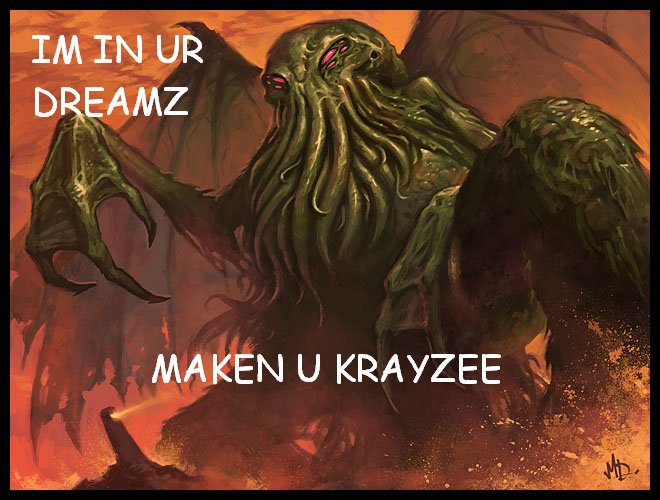
While Lovecraft's horror often featured incomprehensible monstrosities from outside time and space, which though he claimed to have invented may bear a rather striking semblance to the demons of Assyrian mythology, I was always most struck by Lovecraft's brand of psychological horror. What made his writing frightening was not the visions of cosmic horrors but the impending madness these suggestions of extra-planar reality created in his characters. Most exemplary of this is his tale "At the Mountains of Madness," which is currently in production for a movie version by Guillermo del Toro. Reading Lovecraft's work as a child was one of the few times in my life where I could clearly see the boundaries of what I was capable of reading (or comprehending without going mad), and it was almost like a badge of honor when I finally tackled my favorite Lovecraft tale, (and his only novel) "The Dream-Quest of the Unknown Kadath," in which his most stable hero Randolph Carter journeys through the most fantastic renditions of the sleeping mind accompanied by an army of cats and zombies.


No comments:
Post a Comment