6.13.2008

170 Million Atheists Might Be Wrong

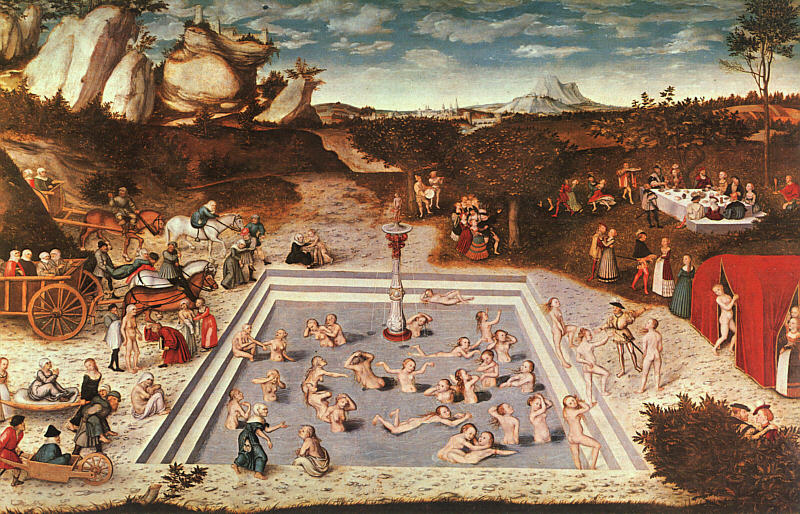
New research suggests that intelligent people are "less likely to believe in God," a fact which seems to raise some interesting questions when juxtaposed with this handy map of the world's religions:


But none of that effects the fact that a unicorn was born in Italy.


The universe still works in mysterious ways...

6.10.2008

On Religions

There's been a lot of articles on religion out there recently:

This map of heaven as an amusement park that never closes.

This website that allows you to send post-Rapture emails to all those left behind.

Or there's the Rapture for Nerds, an article on why the Singularity is as equally preposterous as the Flying Spaghetti Monster.

And finally Stuart Koffman's proposal that god is a "transnational mythic structure".

6.08.2008

Returning the Land

Oglala Sioux Could Regain Badlands National Parkland.

"BADLANDS NATIONAL PARK, S.D. - The southern half of this swath of grasslands and chiseled pink spires looks untouched from a distance. Closer up, the scars of history are easy to see.


Unexploded bombs lie in ravines, a reminder of when the military confiscated the land from the Oglala Sioux tribe during World War II and turned it into an artillery range. Poachers who have stolen thousands of fossils over the years have left gouges in the landscape. On a plateau, a solitary makeshift hut sits ringed by empty Coke cans and shaving cream canisters. It is the only remnant of a three-year occupation by militant tribal activists who had demanded that the land be returned.

Now the National Park Service is contemplating doing just that: giving the 133,000-acre southern half of Badlands National Park back to the tribe. The northern half, which has a paved road and a visitor center, would remain with the park system.
The park service has dissolved 23 parks and historic sites since 1930, but none has been returned to tribes. “It’s really exciting for us to think about walking down this road,” said Sandra J. Washington, head of planning for the service’s Omaha office, which oversees Badlands. “The intention is to be as honorable as possible."

6.07.2008

Collections of the Night

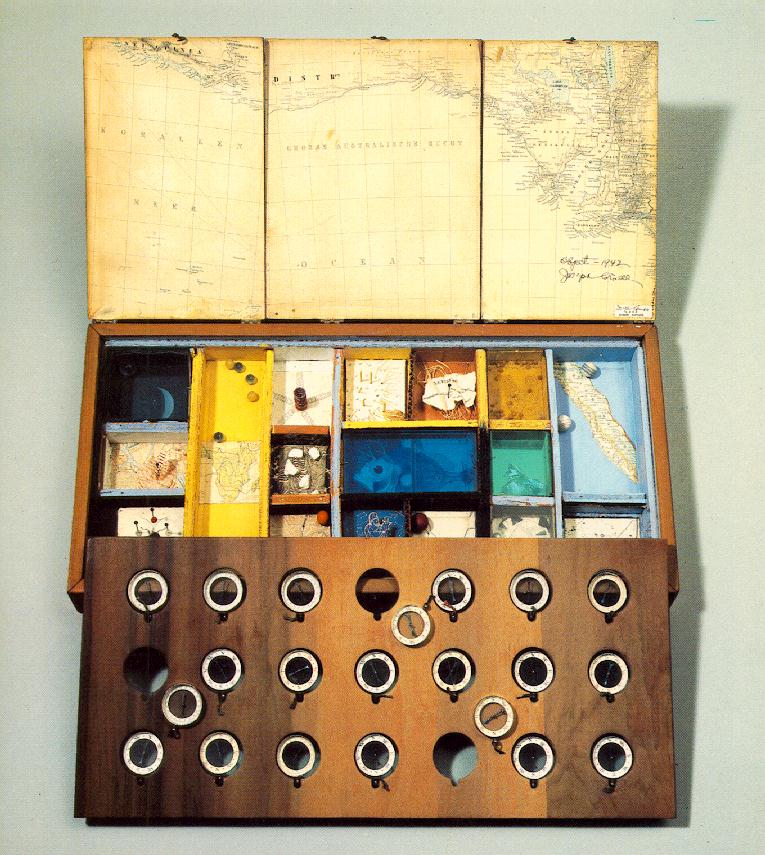
What do you get if you cross the detailed art cases of Joseph Cornell with the cosmic horror of H.P. Lovecraft?

You get the "cryptozoological pseudo-scientific assemblage art" of Alex CF [via].


For comparison here is one of Cornell's beautifully rendered assemblages

6.06.2008

That is Not Dead which can Eternal Lie

"But Carter preferred to look at them than at his captors, which were indeed shocking and uncouth black beings with smooth, oily, whale-like surfaces, unpleasant horns that curved inward toward each other, bat-wings whose beating made no sound, ugly prehensile paws, and barbed tails that lashed needlessly and disquietingly. And worst of all, they never spoke or laughed, and never smiled because they had no faces at all to smile with, but only a suggestive blankness where a face ought to be. All they ever did was clutch and fly and tickle; that was the way of night-gaunts."
-H. P. Lovecraft, from "The Dream-Quest of Unknown Kadath"

When I was a kid I always found myself drawn to exploring the many drawers and cabinets that seemed to multiply through the floors of our home, in particular I was always attracted to one low drawer filled with paperback novels , many of them pulp romances and mysteries but including a boxed set of the tales of H. P. Lovecraft, the master of the so-called "cosmic horror" genre. While considered by many to be racist, pulp trash, so that some libraries are only now including him in their collections, Lovecraft also spawned legions of cultural references from his invented Cthulhu mythos, from metal songs to tentacle porn to even lolthulhus.
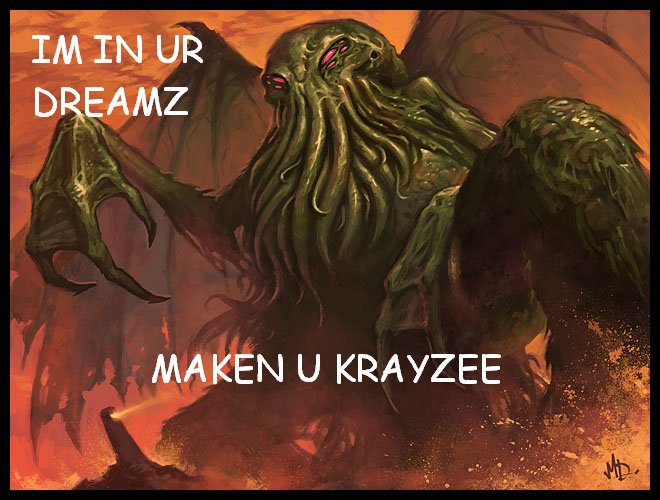


While Lovecraft's horror often featured incomprehensible monstrosities from outside time and space, which though he claimed to have invented may bear a rather striking semblance to the demons of Assyrian mythology, I was always most struck by Lovecraft's brand of psychological horror. What made his writing frightening was not the visions of cosmic horrors but the impending madness these suggestions of extra-planar reality created in his characters. Most exemplary of this is his tale "At the Mountains of Madness," which is currently in production for a movie version by Guillermo del Toro. Reading Lovecraft's work as a child was one of the few times in my life where I could clearly see the boundaries of what I was capable of reading (or comprehending without going mad), and it was almost like a badge of honor when I finally tackled my favorite Lovecraft tale, (and his only novel) "The Dream-Quest of the Unknown Kadath," in which his most stable hero Randolph Carter journeys through the most fantastic renditions of the sleeping mind accompanied by an army of cats and zombies.


The Myth of Eternal Youth

I've discussed before the mythology of the incompetent male which seems to plague modern cultural media, and it is interesting to see this series of links [via Metafilter] on the current trend in Hollywood movies to display the male rejection of adulthood.

"The center of attention is usually a guy, his buddies and his toys. He will, most of the time, be nudged toward responsibility, forgiven for his quirks and nurtured in his needs and neuroses by a woman who represents an ideal amalgam of supermodel and mom."

What is interesting to me is that this is not an entirely new trend in cultural longing, and that the desire to be eternally young and the glorification of incompetence seem to go hand in hand, attested to by the thankfully concluding reign of the village idiot. However, as any good myth-theorist could tell you, in order to understand what these kind of myth trends mean one has to look at who benefits by them, which in this case clearly seems to be all the corporations selling expensive gadgets, ie: toys, to American consumers. By telling people to be young and stupid, they are more likely to sell their products.

6.04.2008

Words from the Brainpan

For a while now I've been looking for a good way of cataloging my library, which is well on its way over four hundred books these days. While there's something to be said for lists and alphabetical order there's times when I want to reshelve my books by genre, or by nationality, themes, or rating/review, which is why discovering Goodreads has been such an ingenious find, as it allows me to do all these things, combined with the functionality of a social networking site. And on top of that one can even submit one's own work and push yourself as an author. And since my small amount of published writing is self-published zines I decided to upload them in entirety for anyone to read, starting with my two poetry chapbooks: Invisible Neighborhoods and All Tonight's Adventures, as well as an interesting series of prose, Excerpts from the Back of the Skull.

Of course, both these books were written several years ago, and the process of uploading them was an interesting journey down memory lane, back to a time when I was much more of a naïve romantic, with tremendous amounts of hope for the world and for the power of language. Not that I am jaded now, but trying to take a much more mature position on my work and what is possible for me to achieve. But what was interesting was not going back to the memories of events surrounding my life at that point, but to the memory of actually writing the poems, with all the peculiar linguistic challenges that presented. As I am not a trained poet and have very little knowledge of verse, meter, etc, I was really approaching these books from somewhat of an outsider standpoint and essentially making up the rules for my poetry as I went along.

Hopefully I will be posting more of my recent work in the future, so stay tuned.

Nomadology

Here's a couple of interesting psychogeographical research papers/ essays:

Paul Graham's Cities and Ambition. "...each city sends its inhabitants a distinct message about how they should live their lives. New York City sends the message that you should be richer. Cambridge sends the message that you should be smarter. Berkeley sends the message that you should live better. Consequently, the city you live in has a profound effect on what you strive for, what you value, and how you channel your ambitions." [via]

Erik Ottoson of Uppsala University's Seeking One's Own: On Encounters Between Individuals and Objects. "...The people in the study are not just looking for certain things – they are also seeking to come to terms with what they are actually looking for. Ideals of what is beautiful, useful and reasonable materialise in conjunction with the experience of what is available and what is absent or out of reach. It is suggested that this mode of looking for goods is not only about purchase deliberations, but more importantly is a specific way of interacting with the world and making places meaningful. It can be viewed as a way of creating and moderating anticipation, and thereby cultivating affect. Searching for things thus becomes an experiential horizon." [via]


As for the title of this post, "Nomadology is a science of the moment for the moment," a moment in which I highly encourage you to loose yourself.